Instructional Designer Cover Letter Examples & Tips for 2026
Three instructional designer cover letter examples for 2026, plus a keyword-smart breakdown of what gets you past the ATS and into the interview.
Build your cover letter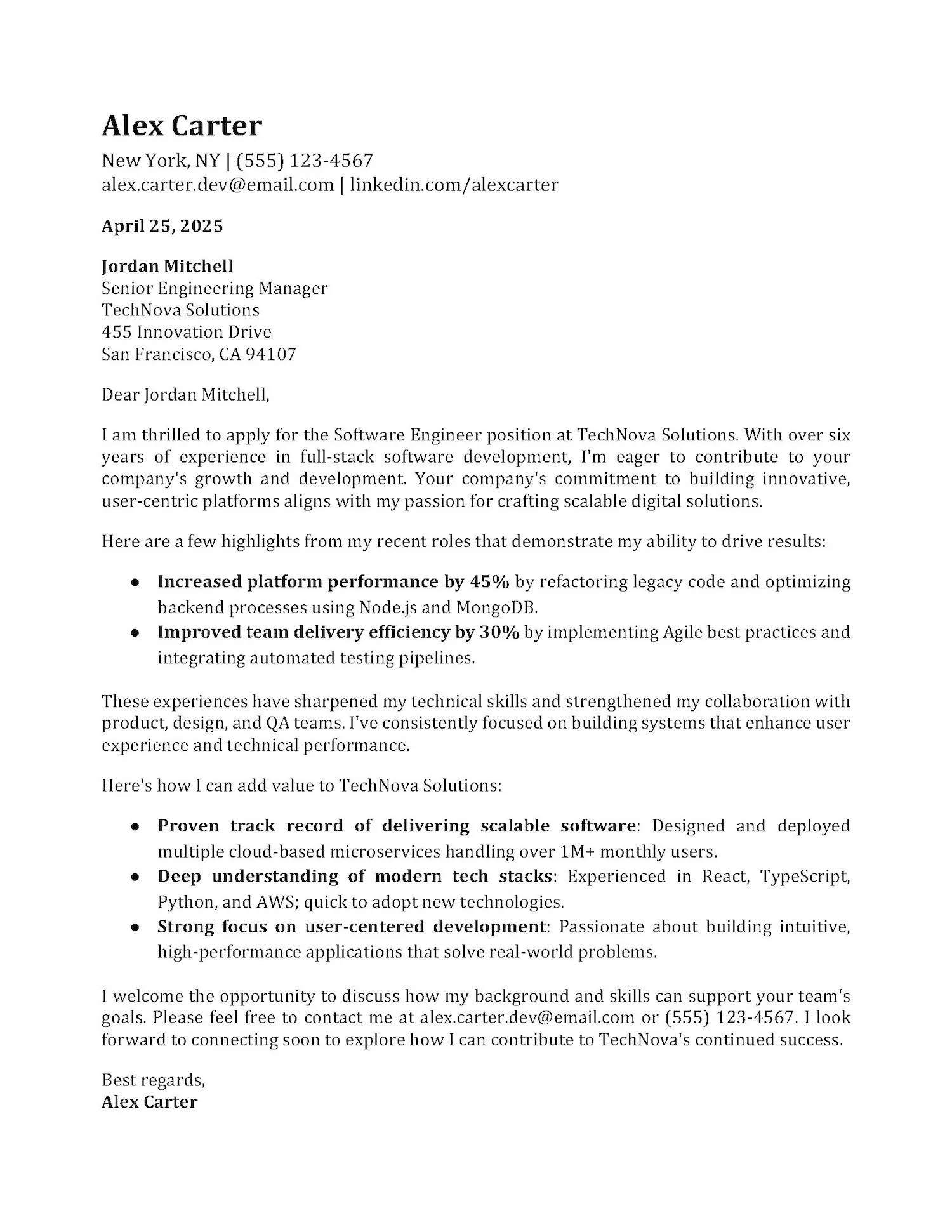



Your resume lists the courses you built and the tools you know. It cannot show how you turned a vague training request into a measurable lift in completion rates or time-to-competency. That story lives in the cover letter. A strong one connects a specific learning problem to the design choices you made and the numbers that followed. The three examples below do exactly that, each for a different person at a different stage, so you can see how the same logic flexes across experience levels.
3 strong Instructional Designer cover letter examples
Instructional Designer Cover Letter Example
Fits someone with 3 to 5 years who has owned full projects but not yet led a team. Notice how the compliance problem is named up front, then solved with specific tools and numbers.
Carlos Dmitriev
Columbus, OH | (614) 555-0182 | carlos.dmitriev@email.com
March 9, 2026
Paloma Khan
Director of Learning and Development
Meridian Health Systems, 410 Brookside Ave, Columbus, OH 43215
Dear Paloma Khan,
Compliance training has become a quiet liability for most health systems: completion rates stall out, and audit prep swallows whole weeks every quarter. Meridian is overhauling its clinical compliance training for exactly those reasons, and it is a knot I spent the last two years untangling at Halevy Diagnostics. There, a 14-module compliance library was technically complete but only 61 percent of staff finished it on time.
I rebuilt the worst-performing modules in Articulate Storyline 360, swapping passive slide decks for branching scenarios drawn from real incident reports the SMEs walked me through. After mapping the curriculum against WCAG 2.1 and Section 508 so screen-reader users were no longer dropping out, on-time completion climbed from 61 to 88 percent over two cycles. I also moved our SCORM packages into Cornerstone and set up xAPI tracking, which cut the data pull for quarterly audits from three days to about four hours.
Most of that work ran on the SAM model because the SMEs were busy clinicians and we needed quick prototypes they could react to in 30-minute reviews. I am comfortable owning the full timeline, from needs analysis through Kirkpatrick Level 2 evaluation, and I keep stakeholders looped in with short storyboard walkthroughs rather than long status emails.
I would welcome the chance to talk through where Meridian’s completion numbers are stuck and what I would prototype first.
Sincerely,
Carlos Dmitriev
- Opens on the company’s challenge: Names Meridian’s stalled compliance completion and slow audit prep before mentioning a single qualification.
- Results stated in figures: 61 to 88 percent completion and a three-day audit pull cut to four hours are concrete and varied, not rounded slogans.
- The stack appears in real tasks: Storyline 360, SCORM, xAPI, Cornerstone, WCAG 2.1, and SAM all appear inside actual accomplishments rather than a skills dump.
Entry-Level Instructional Designer Cover Letter Example
For a career-starter coming from teaching or a related field. Notice how classroom and certification work get reframed as instructional design evidence with real numbers.
Farah Rahman
Austin, TX | (512) 555-0147 | farah.rahman@email.com
April 2, 2026
Hiring Manager
Lumafield Learning, 2200 Guadalupe St, Austin, TX 78705
Dear Hiring Manager,
The job description says Lumafield needs an instructional designer who can take subject matter from busy product experts and turn it into self-paced courses that people actually finish. That handoff problem is one I worked on constantly as a high school science teacher, where I had to make dense material land for 130 students a semester with wildly different starting points.
Over the past year I retrained deliberately for this field. I built three sample courses in Articulate Rise and one branching scenario in Storyline, including a food-safety module that I tested with 22 volunteers from a local restaurant. Using the ADDIE framework, I ran a short needs analysis, storyboarded, then revised after the pilot when post-assessment scores showed a weak spot in the temperature-control section. The fix lifted average quiz scores from 72 to 89 percent. I also earned my SCORM and Moodle administration basics by setting up the LMS for a volunteer nonprofit’s onboarding.
Teaching gave me the parts of this work that are hard to fake: reading when an audience is lost, rewriting on the fly, and building assessments that measure understanding instead of recall. I am still early in authoring tools, but I learn them quickly and I document my design decisions clearly so reviewers know why each screen exists.
I would love to show you the food-safety module and hear what Lumafield’s SMEs struggle with most.
Warm regards,
Farah Rahman
- Reframes prior work: Positions teaching as direct evidence of needs analysis and audience adaptation rather than apologizing for a career switch.
- Shows real artifacts: A piloted Rise and Storyline module with a 72 to 89 percent score lift proves capability without years on the job.
- Honest about gaps: Admits being early in authoring tools while showing momentum through SCORM and Moodle self-study.
Senior Instructional Designer Cover Letter Example
For a lead or principal designer who manages others and owns strategy. Notice the shift from building courses to building systems and growing a team.
Ananya Pierce
Seattle, WA | (206) 555-0173 | ananya.pierce@email.com
February 18, 2026
Samuel Rahman
VP of People Operations
Northvane Software, 88 Dexter Yard, Seattle, WA 98109
Dear Samuel Rahman,
Northvane’s posting describes a learning function that grew fast and now runs on inconsistent courses with no shared standard, which is slowing onboarding as headcount climbs. I led the cleanup of that same situation at Castlewood Analytics, where five people were building training in four different tools with no template and no evaluation plan.
I owned the end-to-end redesign of a nine-module new-hire curriculum spanning sales, support, and engineering, cutting time-to-productivity from 11 weeks to 7 and lifting 90-day retention by 12 points. Underneath that, I standardized our authoring on Storyline 360 and Rise, wrote a reusable storyboard and accessibility checklist tied to WCAG 2.1, and migrated 40-plus legacy courses into Docebo with clean xAPI tagging so we could finally report Kirkpatrick Level 3 behavior change to leadership. I managed three designers through that transition and ran their portfolio reviews.
Where I add the most value is connecting a business metric to a design decision. I run quarterly needs analyses with department heads, prioritize ruthlessly when timelines collide, and kill courses that no longer earn their keep. I am as comfortable defending a budget line to a VP as I am sitting with a SME to storyboard a tricky workflow.
I would be glad to walk through how I would assess Northvane’s current library in the first 30 days and where I would standardize first.
Respectfully,
Ananya Pierce
- Systems over courses: Focuses on standardizing tools, templates, and reporting across a team rather than listing individual modules.
- Business-tied metrics: Time-to-productivity from 11 to 7 weeks and a 12-point retention gain frame learning as an operational lever.
- Leadership signal: Managing three designers, defending budget, and running needs analyses with department heads marks genuine senior scope.
How to write an Instructional Designer cover letter
A strong instructional designer cover letter proves you can move a metric, not just operate a tool. It should mirror the job description’s language, name your authoring and LMS stack inside real outcomes, and show the design cycle from analysis to evaluation. Here is how to build one that survives both the ATS and a skeptical L and D manager.
Lead with their learning problem
Open on the specific gap the posting hints at: low completion, slow onboarding, failed audits, scattered courses. State it plainly, then position yourself as someone who has solved that exact problem before. This beats any generic opener and signals you actually read the job description.
Attach a number to every claim
Hiring managers discount adjectives and trust data. Pair each accomplishment with a measured result: completion from 68 to 91 percent, time-to-competency cut by four weeks, assessment pass rates up 15 points. Vary the metrics so it reads like real work, not a template you filled in.
Show the full design cycle
Name where you used ADDIE or SAM, and tie tools to phases. Storyline and Rise for build, a needs analysis up front, Kirkpatrick or xAPI on the back end. This proves you think in systems and evaluation, not just slides, which is what separates designers from course assemblers.
Instructional Designer cover letter tips
Small choices separate a forgettable letter from one that earns a call.
- Mirror their stack: If the posting names Cornerstone or Captivate, use those exact terms where they fit so both the ATS and the reader see alignment.
- Quantify the learning lift: Lead with completion rates, pass scores, or time-to-competency, because those are the metrics L and D leaders report upward.
- Name your model: Say ADDIE or SAM and why you chose it, since that signals you design deliberately rather than by feel.
- Prove accessibility chops: Mention WCAG 2.1 or Section 508 inside a real project to show compliance is built into your work, not an afterthought.
- Reference your SMEs: Describe how you pull content from busy experts, because stakeholder collaboration is half the job and rarely shown.
Write your instructional designer cover letter faster with Jobscan
If you are staring at a blank page, Jobscan’s Cover Letter Generator turns your resume and the job description into a tailored first draft in seconds, so you spend your time sharpening the letter instead of starting it.
Instructional Designer cover letter FAQs

Keep the body between 180 and 280 words across three or four short paragraphs. That is enough to open on the employer’s learning problem, share two or three quantified wins with named tools, and close with a clear next step. Anything longer dilutes your numbers, and L and D managers skim like everyone else.
Open on the specific training gap the role is meant to fix, then prove you have closed a similar gap before. Include your authoring tools (Storyline, Rise, Captivate), your LMS experience, the design model you used, and at least two measurable outcomes like completion rate or time-to-competency. Close by referencing how you would approach their situation.
Reframe adjacent work. Teaching, training, technical writing, and onboarding roles all build the core skills: needs analysis, audience adaptation, and assessment design. Then show real artifacts you built while transitioning, such as a Rise course or a Storyline scenario you piloted, with any numbers you can attach. Be honest about which tools you are still learning and show momentum.
No. Each posting hints at a different problem, whether it is stalled compliance training, slow onboarding, or an inconsistent course library. Rewrite your opener to name that specific problem and swap in the tools and LMS the job description mentions. A generic letter reads as generic, and it weakens your ATS keyword match against the role.
Look for proxy data you can credibly reconstruct: pre and post quiz averages, completion timestamps in the LMS, reduced support tickets after a course launched, or time saved in onboarding. Even a pilot with 20 learners gives you a before-and-after number. If you genuinely have none, describe the evaluation plan you would build, since that still shows you think in outcomes.
Pair your instructional designer cover letter with a resume
A cover letter opens the door, and your resume has to back it up. See our instructional designer resume examples so both halves of your application tell the same story.