Best Instructional Designer Resume Examples for 2026
An instructional designer resume has to prove learning outcomes, not just list tools. See 2026 instructional designer resume examples and the ATS keywords that win interviews.



Instructional designers turn raw subject matter into learning that actually sticks. The work blends instructional theory with hands-on production: you analyze a performance gap, design the course, build it in tools like Articulate Storyline or Rise, and measure whether learners changed what they do. Whether you sit in corporate L&D, higher education, or an EdTech team, your resume has to show you can move the needle on learning, not just assemble slides.
Hiring managers skim an instructional design resume for evidence and process. They want to see the models you work in (ADDIE, SAM, Bloom’s Taxonomy), the authoring tools you know, and the results your courses drove, like faster onboarding, higher assessment scores, or fewer support escalations. Before a person reads it, though, an applicant tracking system scans for those exact signals: tool names, design methods, and role keywords pulled from the job description. A portfolio link helps, but the resume that clears the ATS and frames your impact clearly is what earns the interview.
The examples below show how instructional designers present their experience at every level and across related roles, from a first portfolio piece to senior learning strategy to training and curriculum specialties. Use them as a starting point, then run your own resume through Jobscan to match it against the job description and surface the keywords you are missing before you apply.
Ready to build yours? Try our ATS-friendly resume builder or scan your draft against the job description.
Instructional Designer resume example
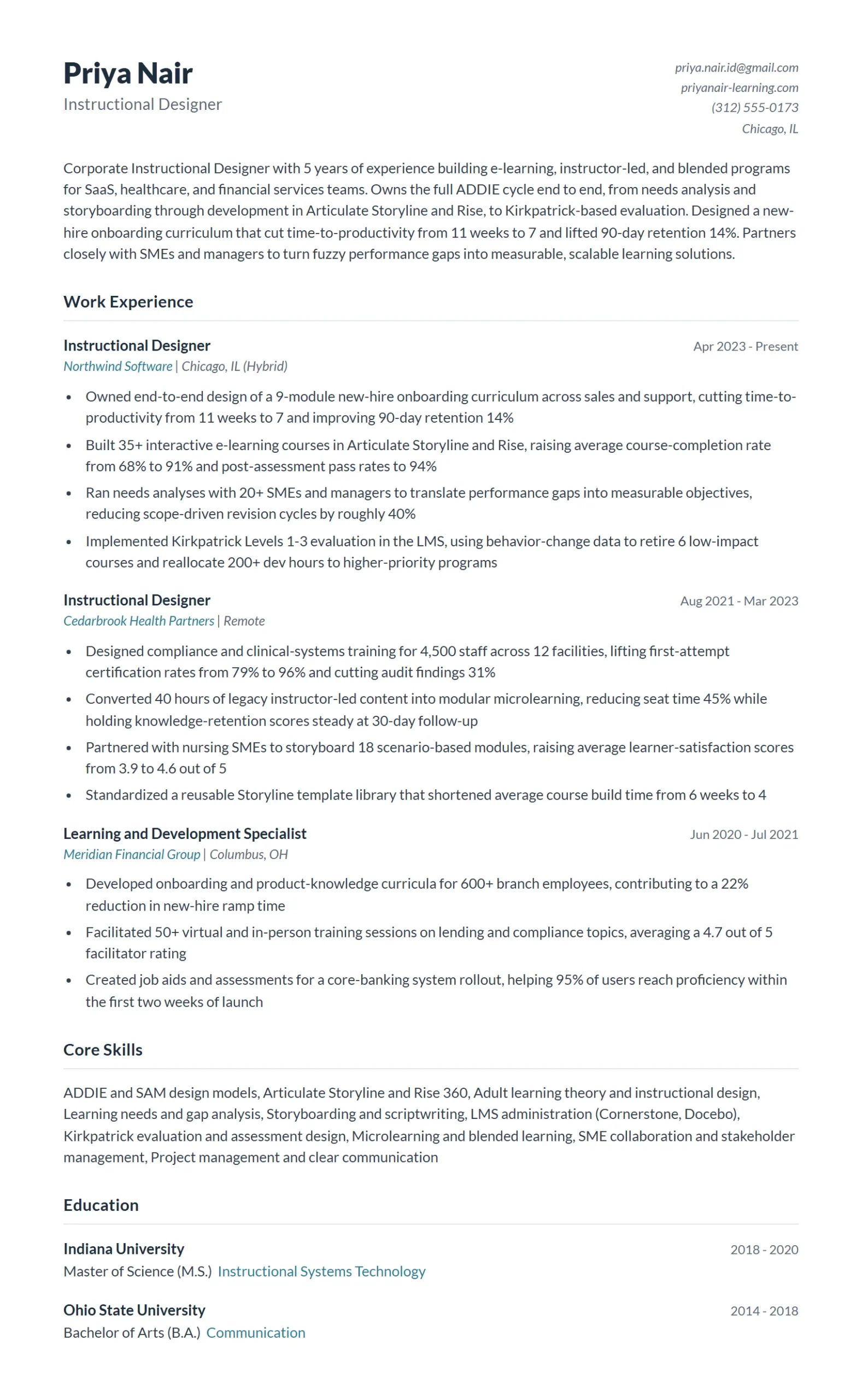
Not sure how to fit instructional theory, authoring tools, and real results onto one page? This instructional designer resume example shows how to balance design process with measurable learning outcomes.
This resume works because it pairs each course with a result a manager cares about, like cutting onboarding time or lifting assessment pass rates, instead of just naming responsibilities. It leads with a focused skills section that surfaces ATS keywords such as ADDIE, Articulate Storyline, and needs analysis, then backs them up with experience that walks through the full design cycle. The clean, single-column format keeps it easy for both recruiters and the ATS to scan.
Senior Instructional Designer resume example
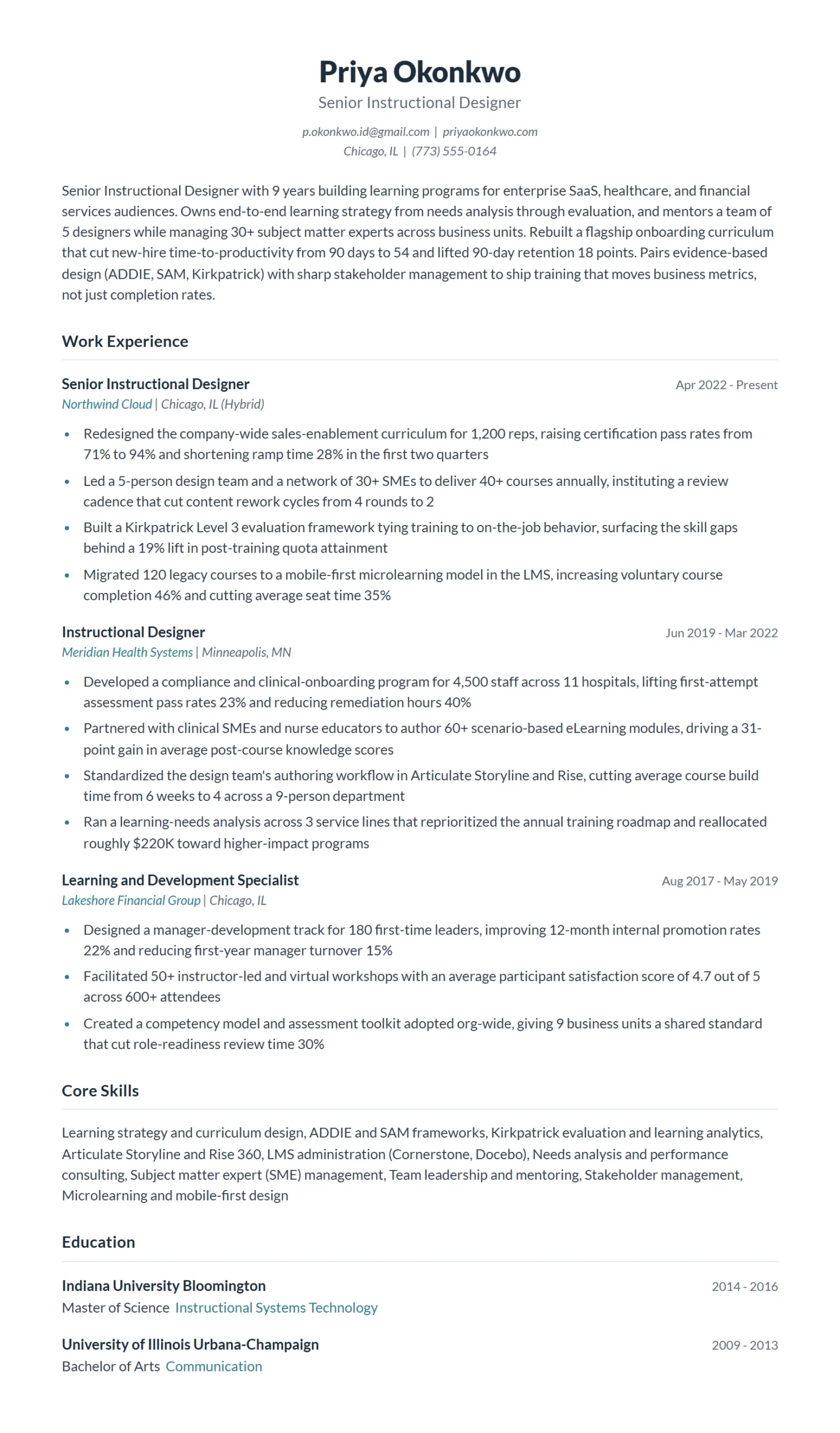
Moving up to a senior role means proving you can set learning strategy, not just build courses. This senior instructional designer resume example shows how to frame program ownership, mentorship, and stakeholder influence.
This resume works because it shifts the emphasis from producing single courses to leading at scale: owning a learning strategy for a business unit, managing subject matter experts, and aligning stakeholders around data-backed design decisions. Quantified outcomes (training programs launched, performance gains, designers mentored) signal seniority a title alone cannot. It still carries the core model and tool keywords an ATS expects, so depth never costs visibility.
Entry-Level Instructional Designer resume example
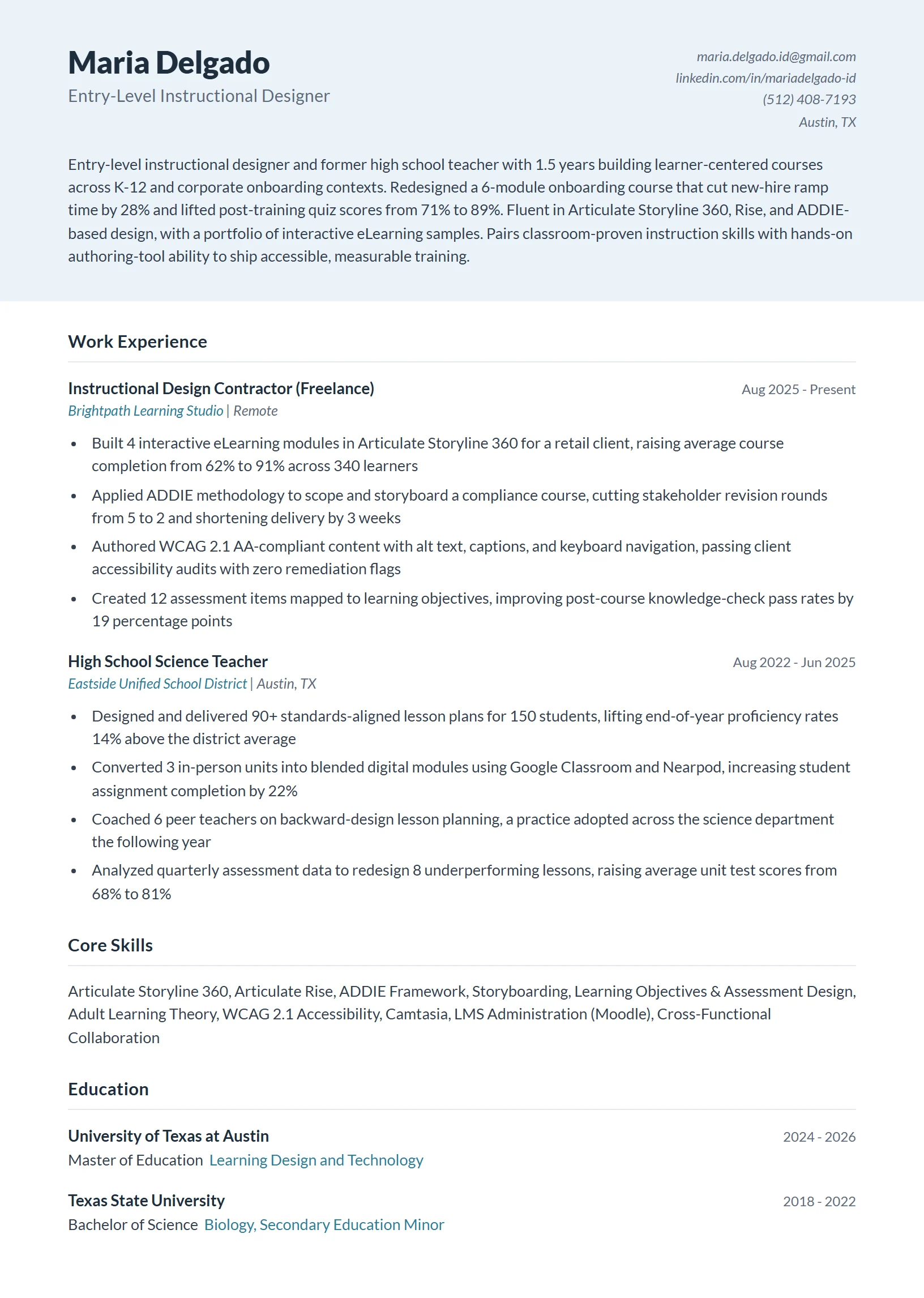
Breaking into instructional design, often from a teaching background, feels daunting when formal experience is thin. This entry-level instructional designer resume example shows how to make transferable skills and projects carry the weight.
This resume works because it leans on a course-design portfolio, certificate coursework, and transferable teaching experience to prove capability before a hiring manager sees a job title. It puts a skills and tools section near the top to clear ATS keyword checks for authoring software and design models, and it describes each project by the learning problem solved and the method used. A prominent portfolio link gives reviewers the proof they need to take a chance on a newer designer.
Corporate Trainer resume example
When the role centers on delivering training, not just designing it, your resume has to lead with facilitation and engagement. This corporate trainer resume example shows how to highlight delivery skills alongside design know-how.

This resume works because it foregrounds facilitation: sessions delivered, learners trained, and satisfaction or completion rates that prove the training landed. It connects each program to a business result, like faster ramp time or improved compliance, so delivery reads as impact rather than activity. Listing both facilitation skills and design tools widens the keyword coverage an ATS rewards for roles that blur training and instructional design.
Curriculum Developer resume example
Curriculum roles are won on structure and learning rigor. This curriculum developer resume example shows how to foreground your ability to build coherent, standards-aligned learning sequences.

This resume works because it centers curriculum architecture: scoping and sequencing content, aligning to learning objectives and standards, and building assessments that actually measure mastery. It quantifies scope in terms the role is judged on, like courses or modules built, programs supported, and learner volume reached. Method and standards keywords (backward design, Bloom’s Taxonomy, learning objectives) make it read as a curriculum specialist to both the ATS and the hiring team.
Learning Experience Designer resume example
When a role frames learning through a UX lens, your resume has to speak both design and learner experience. This learning experience designer resume example shows how to highlight learner-centered, digital-first design.

This resume works because it presents a modern, learner-centered toolkit: microlearning, learner journey mapping, and usability-minded design sit alongside authoring tools like Rise and Adobe Captivate. Projects show the move from learner research to a finished digital experience, proving you design for engagement and not just completion. Pairing UX-style methods with eLearning tools widens the keyword coverage an ATS rewards for these emerging LXD roles.
How to write an Instructional Designer resume that gets interviews
Hiring managers for instructional design roles want proof you can turn a learning need into a measurable outcome, not a list of courses you touched. Show the full ADDIE or SAM cycle, name your authoring tools and LMS platforms, and quantify how your training moved completion rates, time-to-competency, or assessment scores. Mirror the job description’s language so both the recruiter and the ATS see an instant match.
- Name your authoring tools and LMS by name: List the specific tools you actually use (Articulate Storyline 360, Rise, Adobe Captivate, Camtasia, Vyond) and the LMS platforms you have built or administered in (Cornerstone, Docebo, Workday Learning, Moodle, SAP SuccessFactors). Recruiters and ATS filters screen for exact tool names, so spelling them out beats a vague phrase like ‘e-learning software.’
- Anchor every project in a model and a measurable outcome: Reference the methodology you applied (ADDIE, SAM, Bloom’s Taxonomy, Kirkpatrick’s four levels, Gagne’s Nine Events) and then tie it to a result: a lift in course completion, a drop in onboarding time, or a measurable gain in knowledge-check scores. The model shows process maturity; the number shows impact.
- Quantify learner volume and business impact: State how many learners, courses, or hours of content you produced and what changed because of it. ‘Designed 40+ e-learning modules reaching 8,000 employees and cutting onboarding time by 30%’ is far stronger than ‘created training content for staff.’
- Show collaboration with SMEs and stakeholders: Instructional design is a partnership role. Demonstrate that you ran SME interviews, facilitated design reviews, and managed stakeholder expectations on timelines. This signals you can scope, gather content, and ship without constant supervision.
- Include accessibility and standards fluency: Call out experience with WCAG 2.1, Section 508, SCORM, xAPI (Tiny Can), and 508-compliant captioning. These are non-negotiable in corporate, government, and higher-ed settings, and listing them tells employers you can ship compliant content the first time.
- Tailor the resume to each job description: A corporate L&D role, a higher-ed course designer role, and a vendor instructional designer role reward different keywords. Scan the posting, match its phrasing for tools, audience, and deliverables, then run your draft through an ATS check before you submit.

Instructional Designer resume summary examples
Your summary is the first thing a recruiter reads. Lead with your specialty, years of experience, and a quantified win.
Good instructional Designer resume summary examples
- Instructional Designer with 7+ years building corporate e-learning, skilled in Articulate Storyline 360 and the ADDIE model. Designed 50+ modules for a 10,000-employee organization, raising course completion from 62% to 91% and cutting new-hire ramp time by 4 weeks.
- Results-driven Instructional Designer specializing in compliance and onboarding training across Cornerstone and Docebo LMS platforms. Produced 35 SCORM-compliant courses that lifted assessment pass rates by 28% and reduced repeat training requests by 40%.
- Learning experience designer with a background in K-12 curriculum and a Master’s in Instructional Design. Built 60+ interactive lessons in Rise and Captivate, improving average learner satisfaction scores from 3.6 to 4.7 out of 5 across 2,500 users.
What to avoid
- Hardworking instructional designer who is passionate about learning and loves creating training that helps people grow. (All adjectives, zero evidence. No tools, no model, no numbers, and nothing that separates this candidate from any other applicant.)
- Experienced professional seeking an instructional design role where I can use my skills to make a difference. (Objective-style and self-focused. It states what the candidate wants instead of the value they deliver, and it names no specialty, platform, or measurable result.)
Instructional Designer resume skills
Pull the exact tools and models from the job description, then list only the skills you can speak to in an interview. For a deeper breakdown, see our dedicated instructional designer skills guide.
Hard skills for a instructional Designer resume
- Articulate Storyline 360 and Rise
- Adobe Captivate
- ADDIE and SAM models
- LMS administration (Cornerstone, Docebo, Moodle)
- SCORM and xAPI (Tin Can)
- WCAG 2.1 and Section 508 accessibility
- Curriculum and storyboard design
- Assessment and learning evaluation (Kirkpatrick)
- Camtasia and Vyond video authoring
Soft skills for a instructional Designer resume
- SME and stakeholder collaboration
- Project and timeline management
- Clear written and visual communication
- Needs analysis and problem-solving
- Adaptability across audiences
Instructional Designer resume work experience bullet point examples
Lead each bullet with a strong verb and a measurable result.
Good bullet point examples
- Designed and launched 24 e-learning modules in Articulate Storyline 360, increasing course completion rates from 58% to 89% across 6,000 active learners.
- Led the full ADDIE cycle for a sales-enablement program, cutting average time-to-productivity for new reps from 12 weeks to 8 weeks.
- Built 15 SCORM-compliant, WCAG 2.1 AA accessible courses in Rise, reducing post-training support tickets by 35% and passing all 508 audits on first submission.
- Partnered with 12 subject matter experts to scope and storyboard a compliance curriculum, delivering all 18 modules two weeks ahead of the launch deadline.
Bad bullet point examples
- Responsible for creating training materials and updating courses in the LMS. (Lists duties, not results. ‘Responsible for’ is passive and there is no tool named, no scale, and no outcome a hiring manager can measure.)
- Helped improve employee training and made it more engaging for everyone. (Vague and unquantified. ‘More engaging’ is unproven, and ‘everyone’ tells the reader nothing about audience size or business impact.)
- Worked on various e-learning projects using different software tools. (Generic filler. It hides the specific tools (Storyline, Captivate, Rise) and projects that an ATS and a recruiter are actually scanning for.)
Instructional Designer resume tips
A strong Instructional Designer resume proves you close the gap between learning need and measurable performance, and these six tips help yours do exactly that.
- Mirror ATS Keywords: Pull exact terms from each job posting, such as SCORM, xAPI, ADDIE, or Cornerstone, and place them in your skills section and bullet points so the ATS scores your resume as a strong match before a human ever reads it.
- Quantify Learning Outcomes: Attach numbers to every project you can, citing metrics like a 30 percent reduction in time-to-competency, a 15-point rise in post-assessment scores, or a 90 percent course completion rate, because these figures prove business impact rather than just activity.
- Name Your Authoring Tools: List specific platforms such as Articulate Storyline 360, Rise, and Adobe Captivate rather than the generic phrase authoring tools, since recruiters and ATS systems search for product names, not category labels.
- Cite Accessibility Standards: If you have applied WCAG 2.1 or Section 508 compliance to your courseware, say so explicitly on your resume, because many enterprise and government employers screen for this requirement and few candidates surface it.
- Add Relevant Credentials: Include certifications like ATD CPTD, the Articulate Storyline certificate, or a Kirkpatrick Certified Professional designation directly after your name or in a dedicated credentials line so they are visible above the fold.
- Show the SME Bridge: Mention your role in facilitating SME interviews, leading needs analysis workshops, or translating complex subject matter into storyboards, because the ability to manage subject matter experts and stakeholders is a top hiring differentiator that pure tool lists miss.
Pair your instructional Designer resume with a cover letter
A strong resume goes further with a tailored cover letter. Browse our instructional designer cover letter examples to round out your application.
Instructional Designer resume frequently asked questions
Balance tools, models, and the soft skills that make projects ship. For hard skills, name your authoring stack (Articulate Storyline, Rise 360, Adobe Captivate), LMS platforms (Cornerstone, Docebo, Canvas), and the frameworks you actually apply like ADDIE, SAM, Bloom’s Taxonomy, and adult learning theory. For soft skills, highlight stakeholder management, subject matter expert collaboration, and the ability to turn dense content into clear learning objectives. Mirror the exact tools and methodologies named in the job posting, since those are often the precise terms an ATS scans for.
Tie your courses to outcomes, not just deliverables. Instead of “created onboarding training,” write what changed: a course that cut ramp time by 30 percent, raised quiz pass rates from 70 to 92 percent, or reduced support tickets after launch. Pull numbers from completion rates, assessment scores, learner satisfaction surveys, and time-to-competency. When hard metrics are not available, quantify scope instead, like the number of modules built, learners reached, or SMEs managed.
Lead with the work, not the job titles. Feature 2 or 3 strong projects from a bootcamp, certification, a volunteer course you built, or a redesign of existing training, and describe each with the problem, your design choices, and the result. Teaching, corporate training, or curriculum work all transfer well, so frame that experience around learning design. A storyboard, a published Rise course, or an e-learning sample in your portfolio often proves more than a list of adjectives.
Yes, if the posting calls for them or you genuinely used them, because hiring managers and ATS filters both look for these models by name. List the methodologies you have actually applied and back them with a bullet that shows the model in action, such as running a rapid prototyping cycle in SAM or building an assessment in the ADDIE evaluation phase. Naming a framework you cannot speak to in an interview does more harm than leaving it off.
An instructional designer resume should emphasize learning strategy: needs analysis, learning objectives, content structure, and assessment design. An e-learning developer resume leans more technical, foregrounding authoring tools, multimedia production, HTML or JavaScript, and SCORM or xAPI packaging. Many roles blend the two, so read the posting closely and weight your skills section toward whichever side it emphasizes. If you do both, lead with the strategy work and list the build skills right after.
Recruiters and ATS software screen the resume first, so do not rely on the portfolio to carry you. Put a clean portfolio URL in your header next to your email and LinkedIn, then reference specific samples in your bullets, like a branching scenario or a microlearning series. Host work where it opens without a login, since gated links often go unclicked. Use the resume to summarize impact and the portfolio to prove the craft behind it.