Best Principal Resume Examples for 2026
Principal resume examples for 2026 show leadership and student outcomes. See samples for assistant, elementary, and high school roles built for district ATS.



School principals are pivotal in shaping educational environments, leading staff, and driving student achievement. This blog offers expert-written principal resume examples and actionable tips to help you stand out to hiring committees.
Employers seek leaders with proven instructional expertise, operational management skills, and the ability to foster positive school cultures—qualities that a well-written resume should effectively highlight.
Ready to create a principal resume that captures your leadership strengths and educational impact? Read on for insights, valuable tips and examples designed to help you make a lasting impression.
Principal resume example
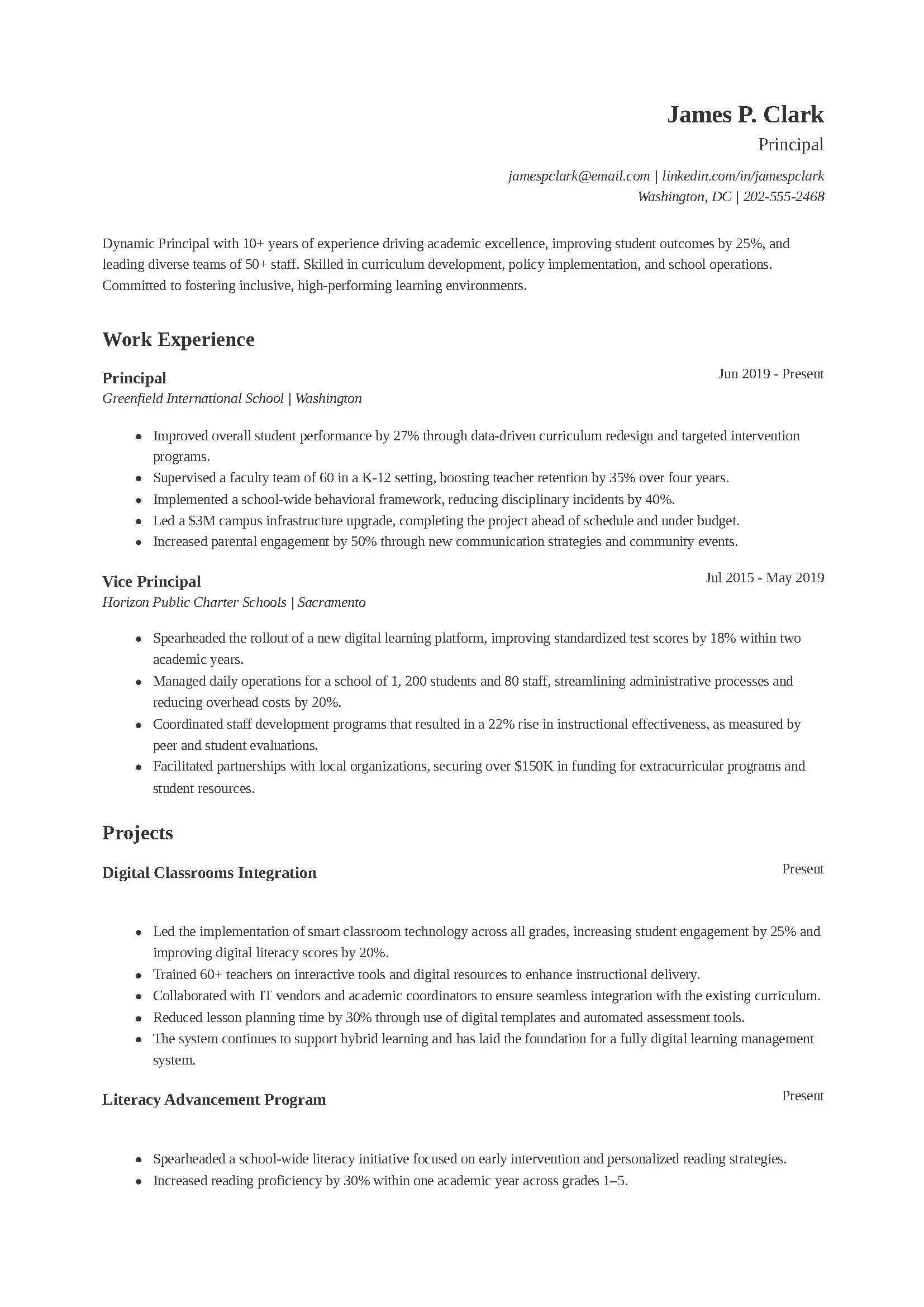
Looking to take the next big step in your education career? Wondering how to show off your leadership skills, drive for student success, and ability to lead entire school operations on a resume? Check out this strong principal resume example that highlights the kind of impact and leadership schools are looking for.
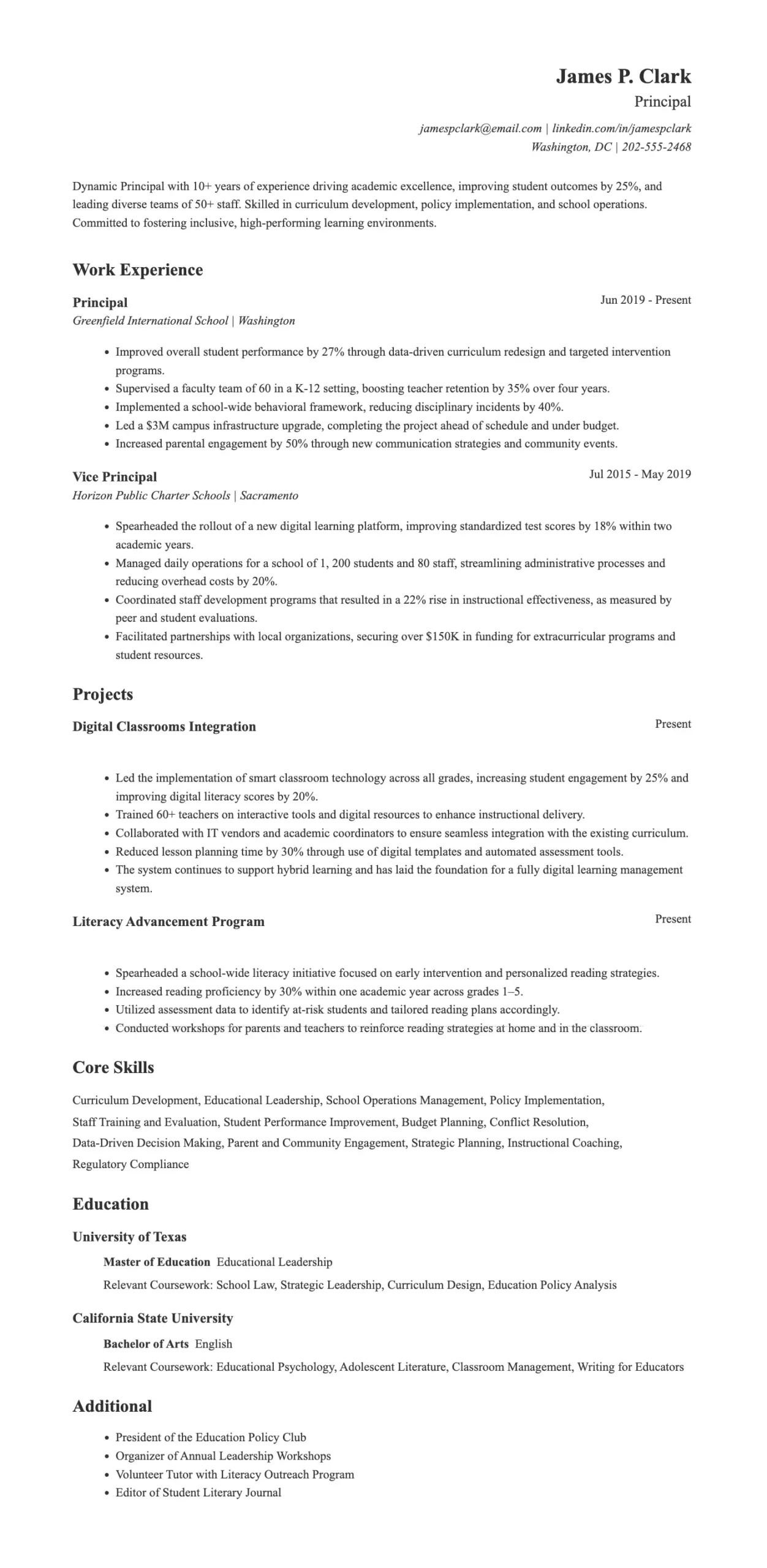
Principal roles call for more than just administrative oversight—they require strategic thinking, people management, and a deep understanding of what drives student achievement. Candidates are expected to lead teams, manage budgets, improve performance metrics, and create inclusive learning environments that support both staff and students.
This resume works because it clearly shows impact—percentages, improvements, and results are front and center. It highlights leadership, not just in title but through real examples of managing teams, budgets, and projects. The skills are targeted, the layout is clean, and each section adds value. Employers love seeing outcomes, and this resume delivers just that without fluff or filler.
Assistant principal resume example
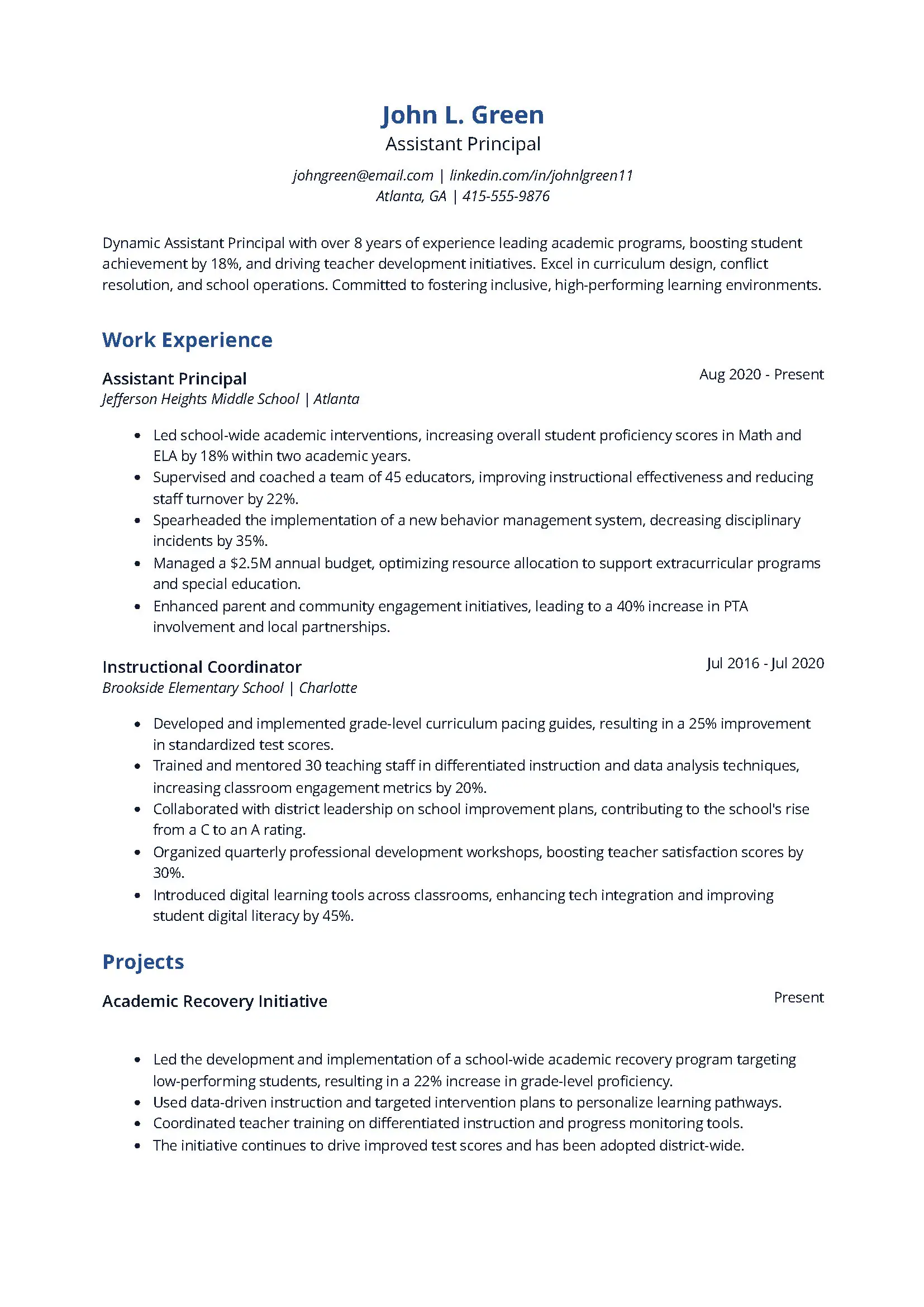
Want to step into a leadership role in education but not sure how to make your resume stand out? Curious how to highlight your impact on student growth, staff performance, and school culture? This assistant principal resume example is a strong blueprint for showcasing real results and leadership in action.
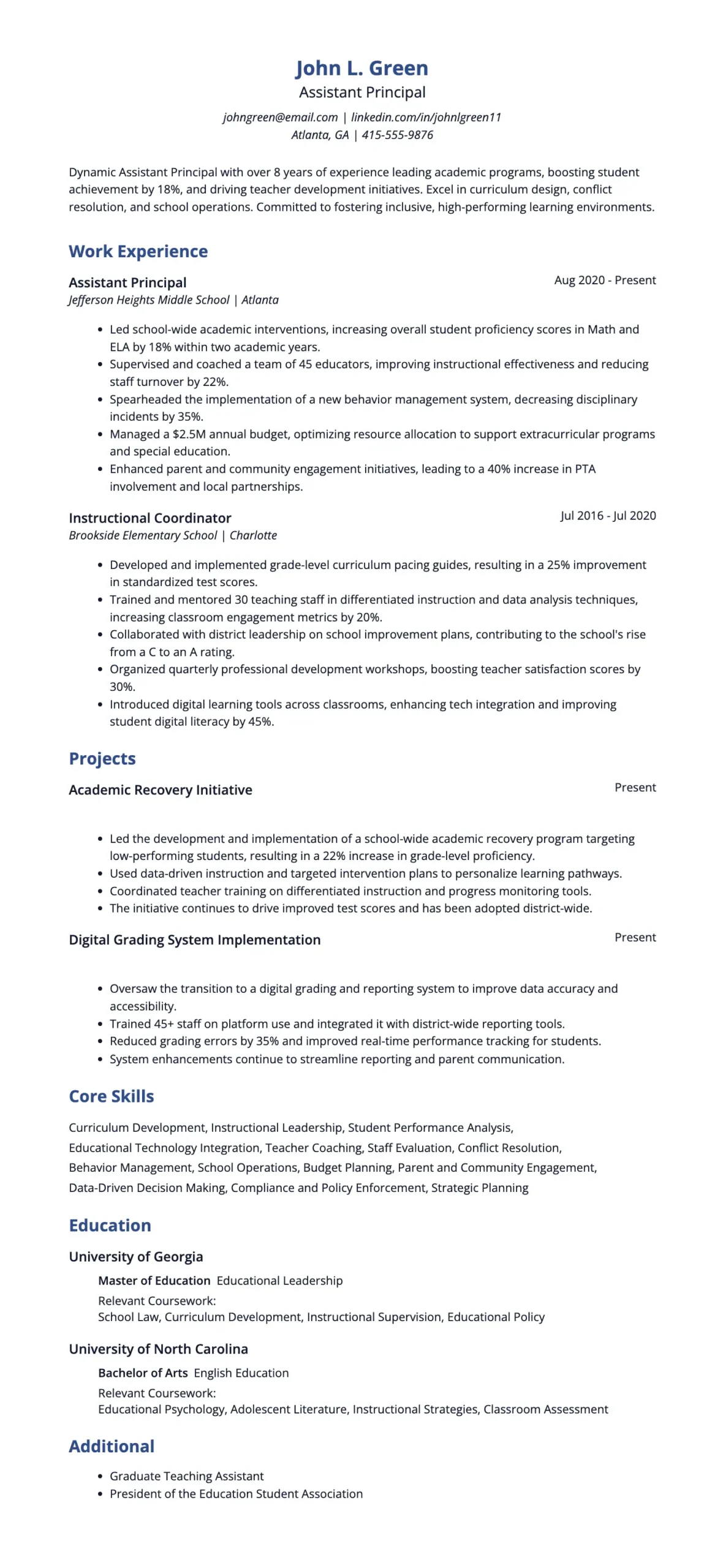
Assistant principal roles demand more than just classroom experience—they require the ability to lead teams, drive academic outcomes, and manage school-wide initiatives. Candidates need to show they can support teachers, connect with families, and create a positive, structured environment for students to thrive.
The work experience section uses strong action verbs and real metrics to show results—like boosting test scores and improving teacher retention. The layout is clean, easy to scan, and highlights key skills up front. Each section is clear and purposeful, which helps employers quickly see the value. It’s the kind of format hiring managers appreciate—clear, results-focused, and tailored to highlight leadership and impact in every section.
Vice principal resume example
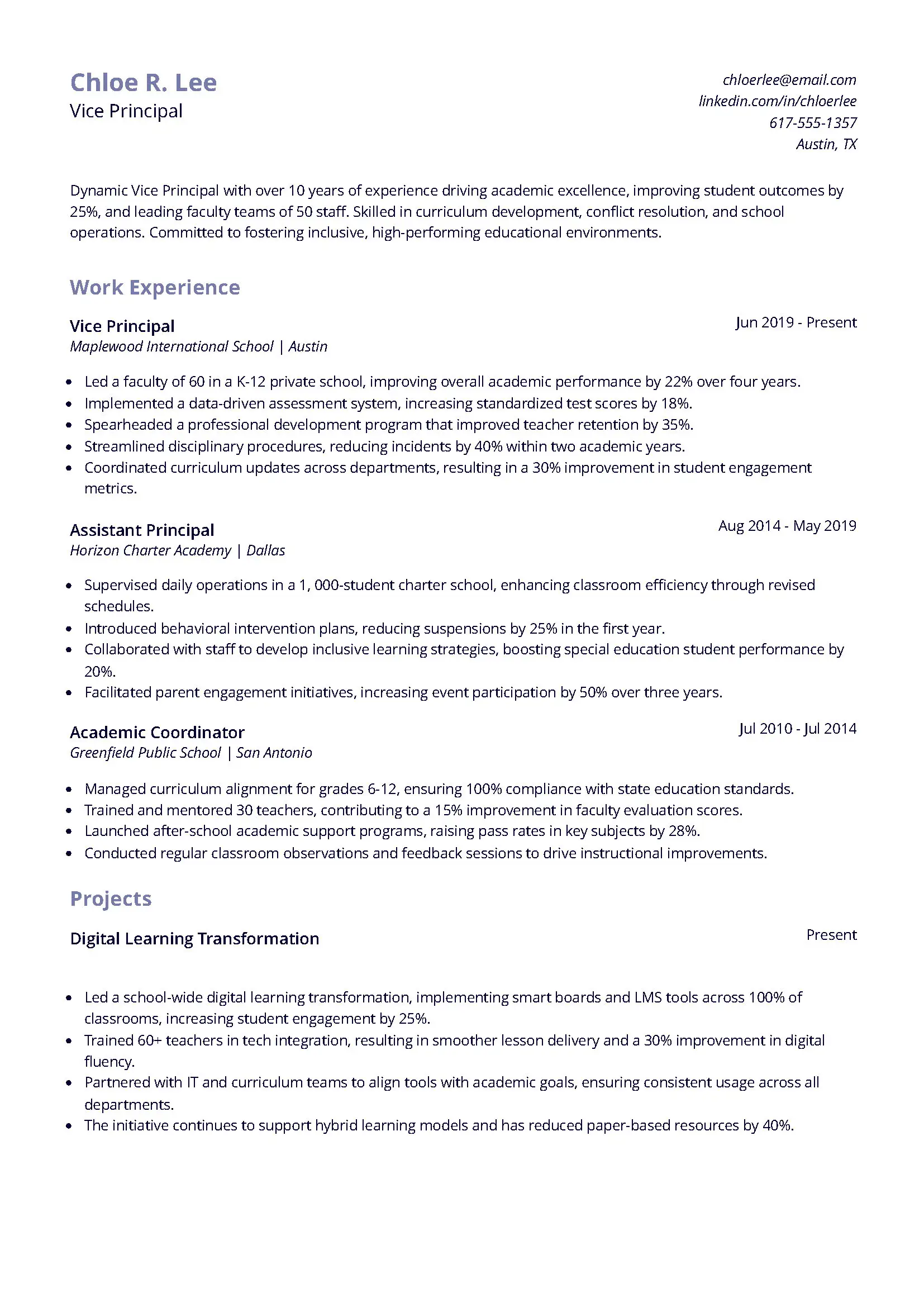
If you’re applying for school leadership roles, your resume needs to clearly show your impact on student achievement and team development. Demonstrating real results and strong leadership can help set you apart from the competition. This vice principal resume example highlights exactly what hiring managers want to see—measurable results, leadership experience, and a proven track record of improving academic performance.
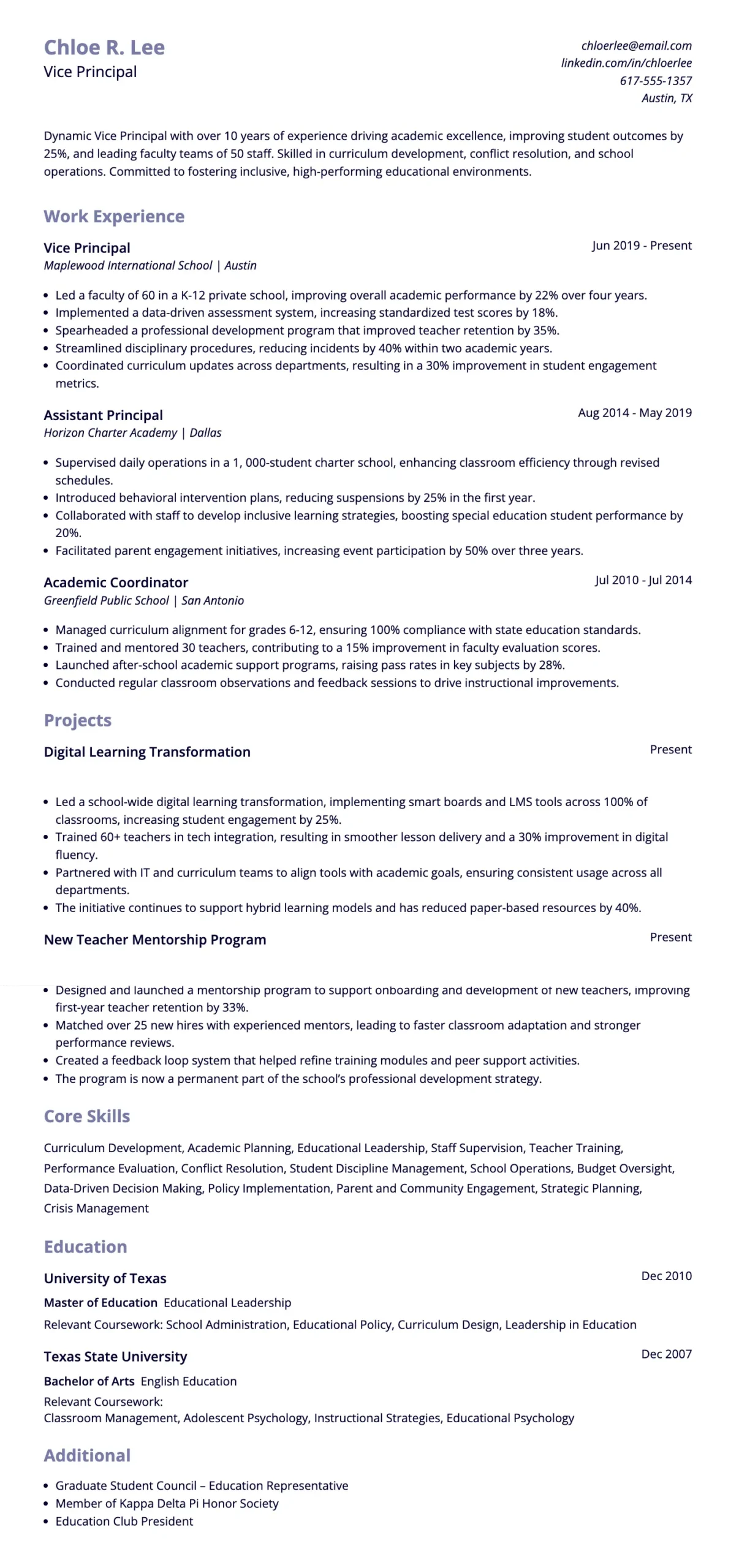
The role of a vice principal calls for someone who can manage daily school operations, guide teachers, and ensure a safe, supportive learning environment. Schools look for candidates who can lead with confidence, handle challenges calmly, and collaborate with staff and parents to drive student success.
By blending hard skills like curriculum planning with soft skills like conflict resolution, this resume shows both expertise and leadership—something schools value highly. The work experience shows steady career growth, highlighting leadership, impact, and results at each level. Everything is easy to scan, well-organized, and cleanly formatted. It appeals to employers because it tells a clear story of growth, capability, and readiness to lead—all in a professional layout that’s simple to read.
Elementary principal resume example
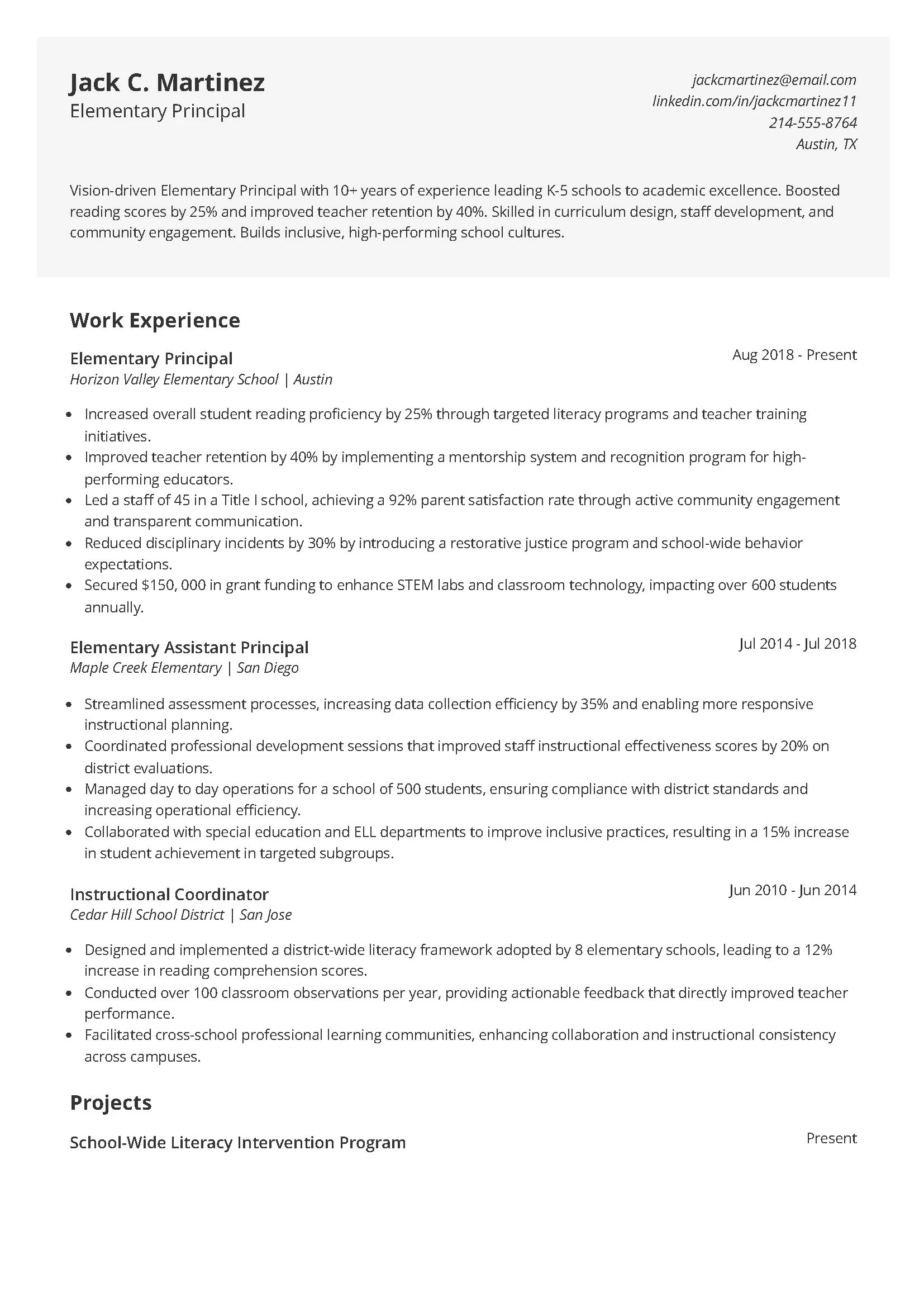
Thinking of your next role in school leadership? Wondering how to present your impact—from boosting student success to supporting staff—in a way that stands out? Check out this strong elementary school principal resume example to see how to highlight your achievements clearly and effectively.
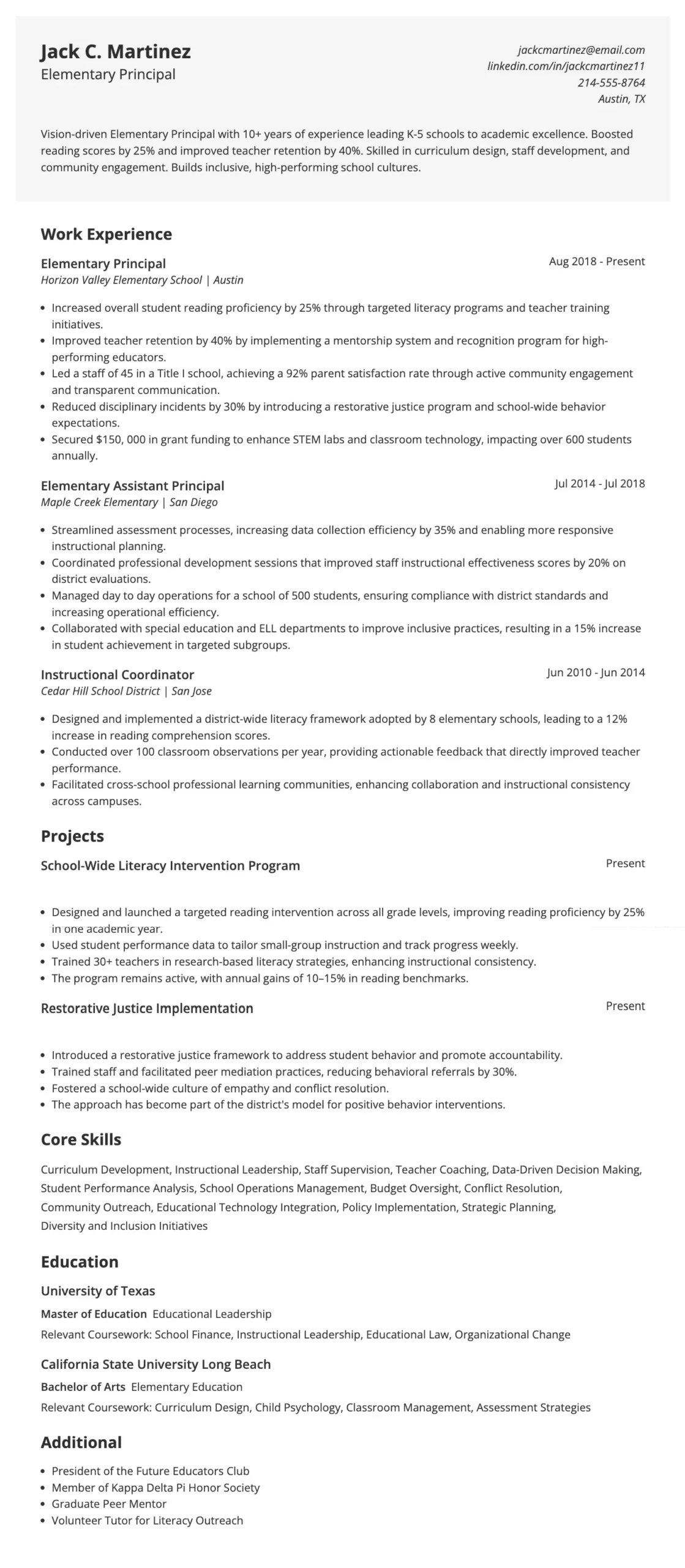
This role calls for more than just managing daily operations. It requires someone who can lead with vision, improve academic outcomes, support teacher growth, and build a strong school community. Employers look for candidates who can demonstrate results, communicate clearly, and create a positive learning environment.
This resume template is ATS-friendly with keyword-rich sections like “CORE SKILLS” and clearly labeled job titles. It highlights specific achievements—like boosting reading scores by 25% and reducing disciplinary issues by 30%—which shows measurable impact. The layout is clean, with bullet points that make key info easy to find. It speaks directly to what school districts want in a leader: results, leadership, and community focus.
High school principal resume example
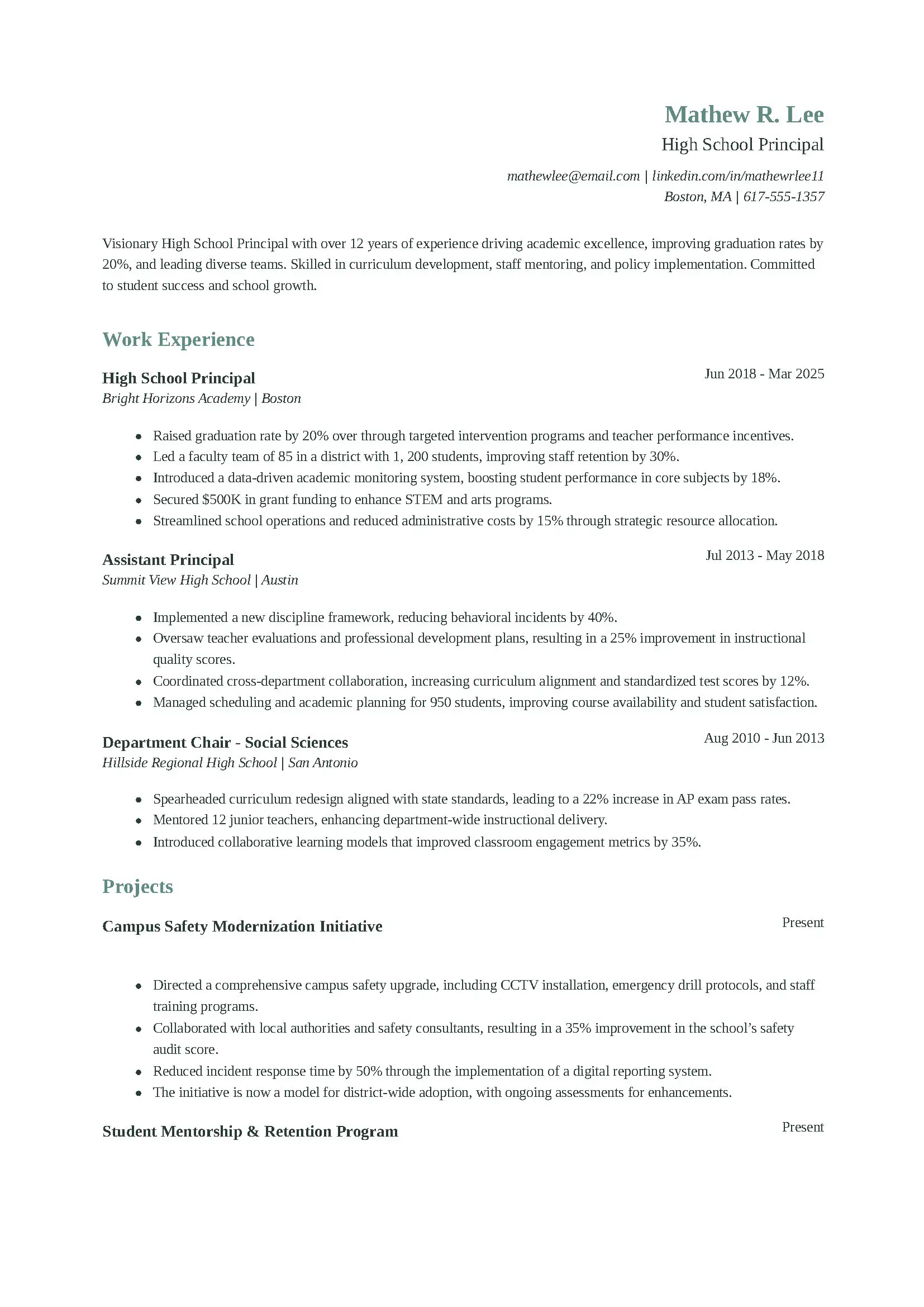
Thinking about your next step as a high school principal? Wondering how to show impact beyond just overseeing operations—like boosting graduation rates, improving staff retention, or driving student performance? This resume example below highlights exactly what school districts look for in top-level candidates.
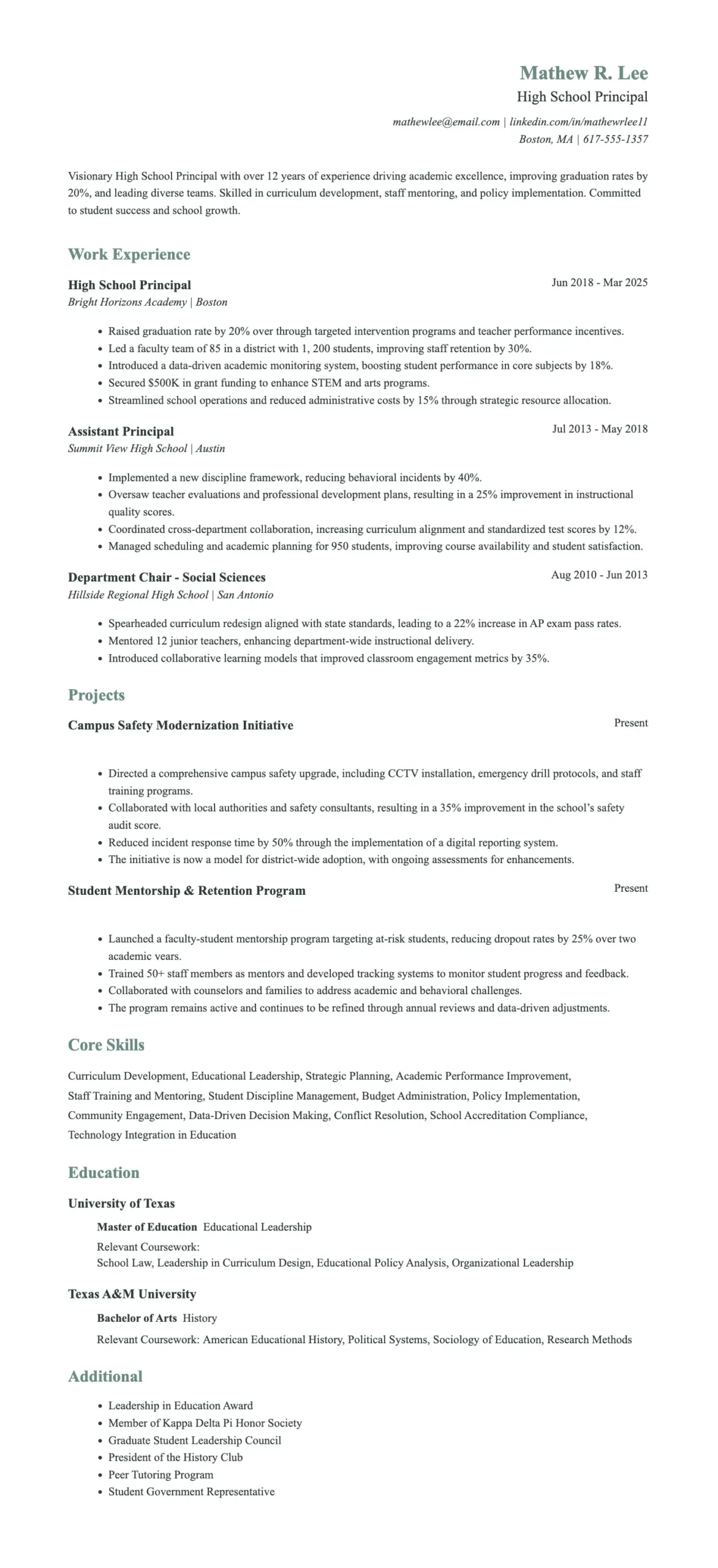
The role of a high school principal calls for strong leadership, strategic planning, and a clear focus on student achievement. Schools want someone who can guide teachers, improve academics, manage budgets, and create a safe, engaging environment. It’s about making a real difference—both in the classroom and across the school community.
The dedicated projects section helps show real-world impact beyond daily responsibilities. Projects like the Campus Safety Modernization Initiative and the Student Mentorship Program highlight leadership and results, such as a 35% safety audit boost and a 25% drop in student dropout rates. The clean format, bullet points, and clear outcomes make it easy to read and appealing to employers looking for proven school leadership.
High school assistant principal resume example
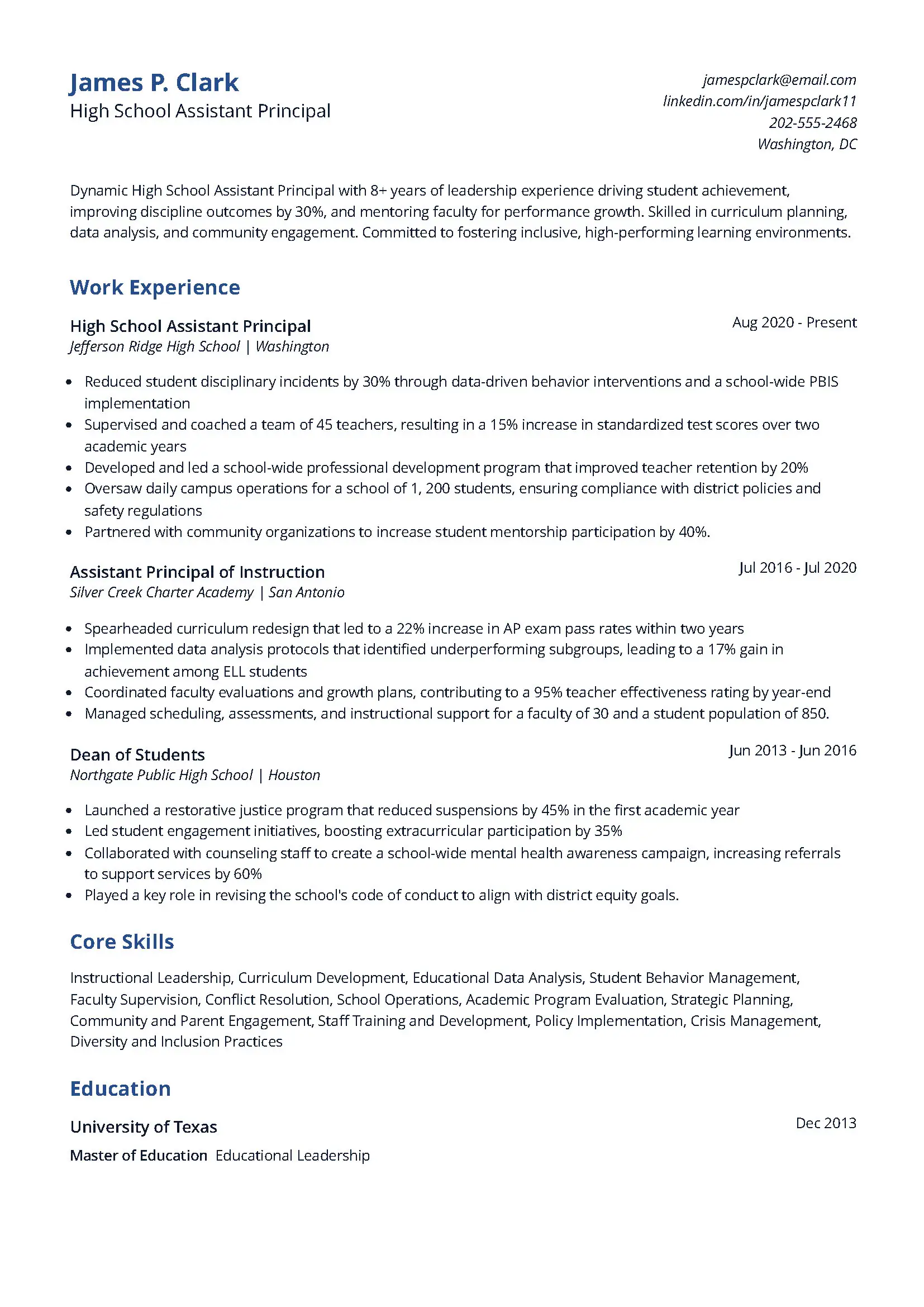
Stepping into a leadership role in education means taking on the responsibility to inspire students, support teachers, and shape a positive school culture. This high school assistant principal resume example shows how to effectively highlight leadership, impact on student outcomes, and the ability to manage both people and programs.

The role of an assistant principal goes beyond discipline and daily operations. It calls for strong instructional leadership, data-driven decision-making, and the ability to guide both students and staff toward success. Schools are looking for leaders who can improve academic performance, foster inclusivity, and keep things running smoothly.
It clearly shows impact with measurable results—like a 30% drop in disciplinary incidents and a 22% boost in AP exam pass rates. It also highlights leadership across key areas like faculty development and school operations. This kind of resume stands out to prospective employers because it combines data-driven results with hands-on school leadership experience, which is exactly what the role calls for.
Also Read: 10 Best Resume Skills to Put on a Resume
How to write a principal resume that will get you an interview
Writing a compelling principal resume goes beyond listing your experience—it’s about demonstrating your leadership impact, educational vision, and ability to drive school success.
Many school districts and educational institutions use Applicant Tracking Systems (ATS) to simplify the hiring process. Think of an ATS like a search engine—if your resume doesn’t include the right keywords, it could be overlooked, no matter how qualified you are.
For a principal position, hiring teams often search for keywords like “instructional leadership,” “curriculum development,” “teacher evaluation,” “school improvement planning,” “budget management,” and “parent engagement.” Including these terms naturally in your resume can greatly increase your chances of making it through the initial screening.
How ATS works:
- Job posting setup: Employers input the job title, required skills, and qualifications into the system.
- Resume scanning: The ATS reviews submitted resumes and extracts relevant information based on predefined criteria.
- Searchable database: Recruiters and hiring committees use specific keywords to identify top candidates from the database.
Even highly qualified educators can be passed over if their resume isn’t ATS-friendly. Using relevant leadership and education-specific keywords—along with a clean, organized format—helps ensure your resume reaches a human reader.
Need help building an ATS-optimized resume? Tools like Jobscan’s ATS resume maker can help you structure a great resume effectively, integrate the right keywords, and present your leadership experience in a way that gets noticed.

Key elements of a principal resume
Your resume should clearly reflect your qualifications, leadership style, and accomplishments. Make sure to include the following sections:
- Contact information – Full name, phone number, professional email, LinkedIn profile (optional), and location (city/state).
- Professional summary – A brief, high-impact introduction that summarizes your experience and strengths.
- Core skills – List key competencies such as instructional leadership, curriculum development, teacher evaluation, budget management, and parent/community relations.
- Professional experience – The work experience section must highlight leadership roles, initiatives you’ve led, and measurable achievements. List your positions in reverse chronological order.
- Education and certifications – Include degrees, licenses (e.g., school administrator certification), and relevant training.
- Projects – Showcase standout initiatives such as school improvement plans, tech integration efforts, or new disciplinary frameworks.
- Achievements and awards – Recognitions, honors, or performance outcomes that demonstrate academic excellence.
- Professional affiliations – Membership in educational leadership organizations like NAESP or ASCD.
Write a strong professional summary
Your summary sets the tone for your resume. Use it to showcase your years of experience, leadership achievements, and what sets you apart from other candidates. Keep it concise and focus on your value as a school leader.
Here are a few examples of both good and bad professional summaries:
Good examples of a resume summary
- “Dynamic K–12 principal with 12+ years of experience transforming underperforming schools into high-achieving learning environments through collaborative leadership and strategic planning.”
- “Visionary educational leader with a passion for student success, teacher empowerment, and inclusive school culture. Proven record of raising academic standards and boosting staff retention.”
Bad examples of a resume summary
- “I am a school principal looking for a new job where I can use my skills.”
- “Worked in education for a long time. I am good at handling teachers and organizing school events.”
Let Jobscan’s resume summary generator simplify the process of writing a powerful professional summary by creating an ATS-friendly statement tailored to your leadership experience in education. Just enter your details, and Jobscan will generate a polished, keyword-rich summary that highlights your strengths and captures the attention of hiring committees.
Demonstrate key principal skills
Your skills section and experience bullets should reflect your leadership capabilities and professional strengths. As a principal, showing a strong mix of hard and soft skills is crucial—these are what hiring committees scan for when shortlisting candidates.
Hard skills for a principal
- Curriculum Development
- Instructional Leadership
- Budget Management
- Data Analysis
- Compliance Monitoring
- Technology Integration
- Crisis Management
- Staff Recruitment
Soft skills for a principal
- Team Leadership
- Conflict Resolution
- Cultural Awareness
- Communication Skills
- Empathy
- Strategic Planning
- Adaptability
- Collaboration
Effectively incorporating these skills into your resume bullet points helps highlight both your impact and financial expertise. But simply listing day-to-day tasks isn’t enough. How you present your experience as a financial advisor can make all the difference in catching a recruiter’s attention. Let’s look at some examples of how to showcase your skills the right way—and what to avoid.
4. Write impactful resume bullet points for principal
Good examples of resume bullet points
- “Led a school-wide instructional shift that increased state test scores by 22% over two years.”
- “Implemented a middle school teacher mentorship program that improved retention by 35%.”
- “Managed a $3.2M annual budget, allocating funds to enhance student services and technology access.”
- “Facilitated regular parent engagement initiatives, resulting in a 40% increase in family participation.”
- “Introduced a restorative discipline model that reduced suspensions by 50% within one school year.”
Bad examples of resume bullet points
- “Responsible for school operations and teacher oversight.”
- “Attended staff meetings and supervised classrooms.”
- “Worked with parents and teachers on school-related matters and academic goals.”
- “Helped high school students with academic issues when needed.”
- “Used computers and email to communicate with staff.”
Use Jobscan’s resume bullet point generator to write impactful, results-oriented resume bullet points tailored to school leadership roles. Simply upload your resume and the job description to your Jobscan dashboard, and the tool will generate customized suggestions that highlight your leadership skills, school-wide initiatives, and measurable achievements.
Highlight your achievements as a school principal
Hiring committees aren’t just looking for a rundown of your daily duties—they want to see the real impact you’ve made in your school community. Whether it’s improving student performance, increasing staff retention, or leading strategic initiatives, measurable accomplishments help paint a clear picture of your leadership capabilities.
Here are a few examples of how to turn responsibilities into results-driven achievements:
- “Improved school-wide standardized test scores by 22% over two academic years through targeted instructional strategies.”
- “Reduced teacher turnover by 35% by implementing a mentorship and professional development program to improve the teaching experience.”
- “Secured $250K in grant funding to expand STEM curriculum and upgrade classroom technology.”
- “Led the adoption of a restorative justice model, resulting in a 50% decrease in suspensions.”
Tailor your resume to the job description
Using the same resume for every application may save time, but it often leads to missed opportunities. A customized resume significantly increases your chances of making it past ATS filters and grabbing a hiring manager’s attention—especially in competitive school leadership roles.
Here’s how to tailor your principal resume to the job description effectively:
- Analyze the job posting: Identify keywords and key competencies mentioned—such as “instructional leadership,” “data-driven decision-making,” or “staff development.”
- Use strategic keywords: Integrate those terms naturally throughout your professional summary, skills section, and experience bullets.
- Match your experience to their needs: Highlight initiatives and outcomes that align with the role’s priorities, like improving school climate or increasing academic performance.
- Customize your professional summary: Briefly explain how your experience and leadership style are a great fit for the school’s mission and challenges.
- Adjust bullet points: Prioritize examples that demonstrate your ability to lead change, manage budgets, or engage stakeholders.
- Optimize for ATS: Keep formatting simple—use standard fonts, clear headings, and avoid graphics or columns that can confuse Applicant Tracking Systems.
Also Read: The Top 5 ATS Resume Keywords of 2025
Include relevant education and certifications
Your education and certifications show that you have the foundational knowledge, leadership training, and professional qualifications required for a school principal role.
Here’s how to include them effectively:
- List your degree, major, and institution clearly (e.g., Master of Education in Educational Leadership, University of XYZ).
- Include your certification(s)—such as School Administrator License, Principal Certification, or Instructional Leadership Endorsement—along with the issuing state or body.
- If you’re an early-career principal, mention your graduation year and any specialized coursework in areas like Educational Leadership, Curriculum Design, or School Law.
- If you’re an experienced leader, keep this section concise, focusing on your highest level of education and most relevant certifications.
- If you transitioned into education from another field, highlight any leadership training, educational coursework, or administrator preparation programs.
- Demonstrate a commitment to ongoing learning by including relevant professional development—such as Restorative Practices Certification or Equity-Centered Leadership Training.
Top certifications for school principals
While certification requirements vary by state or district, these credentials can add value to your resume and reinforce your readiness for leadership:
- School Administrator Credential (state-issued)
- Principal Certification or License (state-specific)
- National Board Certification – Educational Leadership
- Instructional Leadership Certification
- AASA National Superintendent Certification (for aspiring district leaders)
- Restorative Practices Certification
- Diversity, Equity, and Inclusion in Education (various providers)
- Professional Learning Communities (PLC) Leadership Training
Principal resume tips
Writing a strong resume is more than listing your duties—it’s about clearly demonstrating your leadership impact and aligning your experience with what hiring committees are looking for. These tips will help you refine your principal resume for maximum impact:
- Keep it concise: If you have under 10 years of leadership experience, aim for a one-page resume. Focus on the most relevant roles and accomplishments.
- Emphasize impact over duties: Use metrics and results to show how your leadership made a difference—like improvements in test scores, staff retention, or student outcomes.
- Use role-specific keywords: Include terms like Instructional Leadership, Staff Development, Curriculum Oversight, or School Improvement Planning—especially those mentioned in the job description.
- Start with strong action verbs: Use words like Led, Implemented, Improved, Directed, or Facilitated to convey initiative and achievement.
- Highlight a range of leadership responsibilities: Balance instructional leadership, operations, community engagement, and team management.
- Tailor each resume: Customize your summary, skills, and experience bullets for each school’s mission and needs.
- Link to accomplishments: If applicable, include links to published school improvement plans, professional presentations, or awards.
- Show your leadership process: Briefly highlight how you plan, implement, and evaluate school initiatives.
- Proofread carefully: Avoid typos and inconsistent formatting. A clean, polished resume reflects professionalism and attention to detail.
Also Read: How to Organize Your Resume Sections to Stand Out?
Include a cover letter with your principal resume
A thoughtful, well-written cover letter can help you stand out from other candidates by highlighting your passion for education, leadership philosophy, and the specific ways you’ve made an impact in your current or previous schools. While your resume provides a summary of your experience, the cover letter gives you space to tell your story—and explain why you’re the right fit for the school’s culture and goals.
What to include in your principal cover letter:
- A strong opening: Mention the position you’re applying for and express genuine interest in the school, district, or community.
- Relevant leadership experience: Highlight your experience with instructional leadership, staff development, student achievement, or any initiatives that align with the school’s needs.
- Vision and values: Share your approach to school leadership, problem-solving, and student success. Reflect on your ability to foster a safe, inclusive, and high-performing school environment.
- A compelling closing: Reiterate your enthusiasm for the role, briefly summarize your qualifications, and express interest in an interview.
Use Jobscan’s cover letter generator to write a personalized, ATS-friendly cover letter that complements your resume and captures the attention of school hiring committees.
Write a winning principal resume with Jobscan
A clear, strategic resume can open doors to school leadership opportunities. By showcasing your administrative experience, aligning your resume with the job description, and emphasizing measurable achievements, you can stand out in a competitive education landscape. Pair your resume with a tailored cover letter to create a strong first impression.
Need help getting started? Jobscan’s ATS resume builder makes it easy to create a customized, ATS-friendly principal resume in just minutes. Just enter your experience, and the tool will structure your resume to highlight your leadership strengths and help you get noticed by decision-makers.

Principal common interview questions
Answer:
“I believe in supporting teachers through targeted professional development and clear, collaborative feedback. When I notice a teacher struggling, I start by scheduling a coaching conversation to understand any challenges they’re facing. I work with them to set specific, measurable goals and offer support through mentorship, observation cycles, and instructional resources. In one case, I helped a new teacher improve classroom management by pairing them with an experienced mentor and conducting bi-weekly check-ins. Within a semester, student engagement and performance improved significantly.”
Answer:
“A positive school culture starts with positive relationships and shared values. I prioritize open communication, recognize staff and student achievements regularly, and lead with transparency. For example, I introduced a ‘Shout-Out Friday’ tradition, where teachers and students could celebrate one another in our morning announcements. I also created monthly staff wellness events and student leadership forums. These small but consistent actions helped build a sense of community, trust, and shared ownership across the school.”
Answer:
“I use data as a tool to inform instruction, set goals, and evaluate programs. I lead regular data meetings with grade-level teams to identify trends and address learning gaps. For example, when our mid-year assessments showed a dip in reading comprehension scores in grades 3–5, we launched a targeted intervention program and adjusted small group instruction. By the end of the year, those grades showed a 15% improvement in reading proficiency. Data allows us to be proactive, not reactive.”
Answer:
“I approach conflict with empathy, transparency, and a focus on solutions. I listen to all perspectives without judgment, identify the root issue, and guide the conversation toward common goals. When two staff members had a disagreement about shared responsibilities, I facilitated a conversation where each person could express their concerns. We clarified expectations and documented an action plan that they both agreed to. The outcome not only resolved the conflict but also strengthened their working relationship.”
Principal resume frequently asked questions
The most important skills to include are those that demonstrate your leadership, instructional expertise, and ability to manage school operations. These can include instructional leadership, staff development, curriculum planning, school improvement, budget management, conflict resolution, data analysis, community members engagement, strategic planning, and team leadership. Be sure to incorporate these skills naturally into your work experience and accomplishments to show how you’ve applied them in real situations.
Your educational background should appear in a dedicated education section near the end of your resume. List your degree, such as a Master of Education in Educational Leadership or any other higher education, along with the university name and graduation year. If you’re newer to the role, you can mention relevant coursework or academic achievements. Be sure to include any required licensure or principal certifications. You can also highlight your teaching and leadership experiences within your work history, especially if you’ve held roles like assistant principal, department chair, or instructional coach.
If you don’t have extensive experience or if you’re applying for your first principal role, focus on leadership experience gained in other positions, such as assistant principal, instructional coordinator, or lead teacher. Emphasize key projects you’ve led, improvements you’ve driven in instruction or student performance, and your ability to mentor and manage teams. Use your professional summary to highlight your leadership strengths and readiness for the principal role. You might also consider adding a “Leadership Highlights” section to showcase major accomplishments that demonstrate your qualifications, even if you haven’t held the principal title yet.