Product Designer Cover Letter Examples & Tips for 2026
Three product designer cover letter examples for 2026, plus the keyword and ATS moves that get your portfolio clicked, not skipped.
Build your cover letter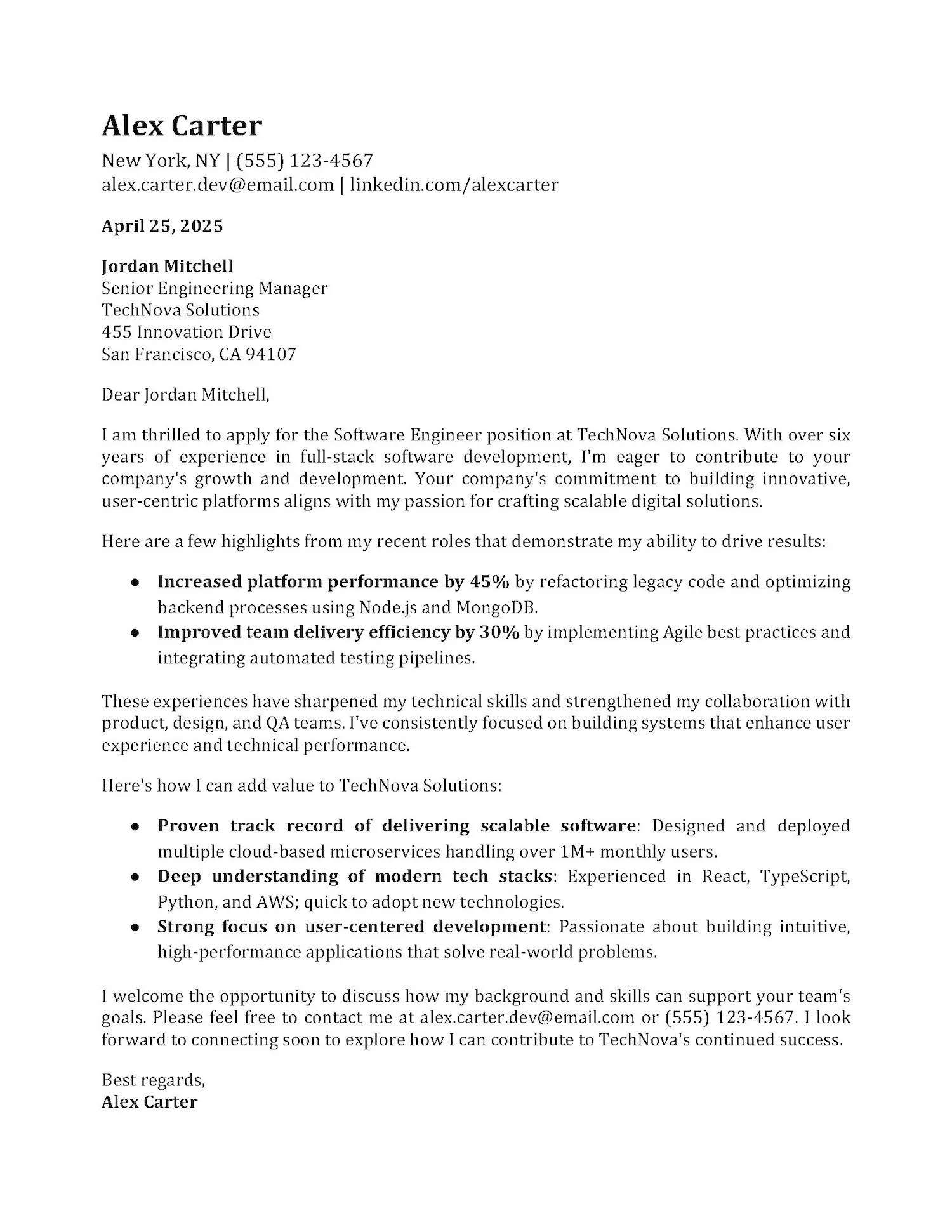


Your resume proves you can ship clean screens and lists the tools to back it up. A cover letter has to prove the harder thing: that you can take a fuzzy problem from discovery to a measured, shipped feature and influence what gets built in the first place. Hiring managers skim resumes for outcomes. They read cover letters for judgment. The three examples below show how to connect a specific number to a specific decision so a design lead trusts you before the first call.
3 strong Product Designer cover letter examples
Product Designer Cover Letter Example
Fits a designer with 3 to 5 years who owns features end to end. Notice how each claim ties a design decision to a metric, not just a screenshot.
Layla Cho
Austin, TX | (512) 555-0148 | layla.cho@email.com
March 4, 2026
Omar Aquino
Director of Product Design
Lumen Freight, 220 Congress Ave, Austin, TX 78701
Dear Omar,
Lumen Freight’s push to cut the time carriers spend booking loads inside a dashboard most of them call confusing is a problem I have lived with up close. For the last two years at Railyard Logistics, I worked on almost exactly that, where the load-booking flow had a 41 percent drop-off before drivers ever confirmed a shipment.
I owned that redesign from discovery through shipped UI. I ran nine user research sessions with dispatchers and owner-operators, then mapped the friction back to a booking form that asked for the same information twice. Working in Figma, I rebuilt the flow into a three-step confirmation, prototyped two versions, and ran an A/B test across roughly 4,000 weekly users. The winning variant cut drop-off to 19 percent and pulled average booking time down from 6 minutes to under 3. I also folded the new components into our design system so the mobile team shipped the same pattern without redrawing it.
What I care about beyond the numbers is figuring out which problem is actually worth solving. I worked closely with our PM and two backend engineers to kill a feature we had half-built once the data showed nobody used it, which freed up a sprint for the booking work that mattered. I would bring that same product sense and willingness to push back to your carrier team.
I would love to walk you through the prototypes and the test results. My portfolio is linked above.
Kind regards,
Layla Cho
- Starts with their problem: Names Lumen’s confusing dashboard and carrier booking time in the first line, then matches it to a near-identical problem she already solved.
- Numbers carry the story: 41 to 19 percent drop-off and 6 minutes to under 3 are tied to specific moves: research, a three-step rebuild, and an A/B test on 4,000 users.
- Shows judgment, not just craft: The killed half-built feature signals she influences what gets built, which is what design leads actually screen for.
Entry-Level Product Designer Cover Letter Example
For a career-starter coming out of a bootcamp or adjacent role. Notice how real shipped work and measured results replace years of tenure.
Daniel Hayes
Columbus, OH | (614) 555-0192 | daniel.hayes@email.com
February 18, 2026
Bloomwell Health, 88 Gay St, Columbus, OH 43215
Dear Hiring Manager,
Bloomwell’s job listing says the patient onboarding flow has too many people abandoning before they finish setting up an account. I ran into the same wall during my capstone at Tincup Design Lab, where the nonprofit we partnered with lost most volunteers before they ever completed a profile.
I joined that project as the lead designer for a five-person team and treated it like a real product, not a class exercise. I interviewed eleven volunteers, watched four of them stumble on the same medical-history step, and rebuilt the onboarding into shorter screens with progress saved between sessions. In Figma I prototyped the full flow, tested it with eight users, and handed engineers a documented component set. After launch, completed signups went from 23 to 58 of every 100 starts over six weeks, and the coordinator told us it cut her manual follow-up in half.
Before design I spent two years in customer support at a health software company, so I am comfortable sitting with the messy reasons people give up on a product. I learned interaction design and data-informed iteration by shipping, not just studying, and I read every drop-off chart I could get my hands on.
I would be glad to walk through my process and the research behind those numbers. The full case study is in my portfolio above.
Best regards,
Daniel Hayes
- Real problem, real solve: Leads with Bloomwell’s onboarding abandonment and ties it to a measured project, so lack of years does not read as lack of evidence.
- Concrete outcome: 23 to 58 of every 100 starts over six weeks gives a hiring manager a number to remember from an entry-level candidate.
- Adjacent experience reframed: Two years in health software support becomes proof he understands why users quit, not filler about being eager.
Senior Product Designer Cover Letter Example
For a senior or lead designer expected to shape strategy and grow a team. Notice the shift from one feature to systems and influence.
Ibrahim Lefevre
Seattle, WA | (206) 555-0173 | ibrahim.lefevre@email.com
January 27, 2026
Sergei Greco
VP of Product
Northpeak Software, 1201 Western Ave, Seattle, WA 98101
Dear Sergei,
Northpeak is hiring a lead product designer because, as your posting puts it, the product has grown faster than its design language and teams keep rebuilding the same patterns. I lived inside that exact problem at Cedarpoint Analytics, where four squads shipped three different date pickers in one quarter.
I built and ran the design system that fixed it. Starting from an audit of 140 inconsistent components, I worked with two engineers to ship a Figma library and coded tokens that every squad adopted within a quarter. That cut net-new design time on standard flows by roughly 30 percent and let us spend that recovered time on a 0-to-1 reporting feature I owned through discovery, prototyping, and an experimentation phase. It reached 9,000 accounts in its first quarter and lifted weekly active use of the analytics suite by 22 percent.
The part I am proudest of is not a screen. I mentored three mid-level designers, set up a weekly critique that actually changed shipped work, and partnered with product and engineering leads to decide our roadmap, including arguing successfully to delay a flashy feature until research backed it. I think about design as a lever on the business, and I am comfortable defending that view in a room full of stakeholders.
I would welcome a conversation about where Northpeak’s system needs to go next. My portfolio and a few system case studies are linked above.
Warm regards,
Ibrahim Lefevre
- Names the growth pain: Opens on Northpeak’s fragmented design language and matches it with the three date pickers in one quarter story, instantly credible to a VP.
- Systems plus shipping: 30 percent less design time and a 0-to-1 feature reaching 9,000 accounts show both scaled infrastructure and product impact.
- Leadership made concrete: Mentoring three designers and delaying a feature until research backed it proves influence over the roadmap, not just the pixels.
How to write a Product Designer cover letter
A strong product designer cover letter does what a portfolio link cannot: it shows your reasoning. It should prove you can frame a problem, choose a method, and tie the outcome to a number a hiring manager cares about. Keep it specific, keep it human, and make every tool you name earn its place inside a real story.
Open on the company’s actual product problem
Skip the introduction and name the situation they are trying to fix: a leaky onboarding funnel, an inconsistent design language, a feature that isn’t adopted. Pull it from the job post or the product itself. Then connect it to a problem you have already solved. This proves you read past the requirements list and think like a product person.
Show one feature from discovery to measured outcome
Pick a single project and walk it through: the research that framed it, the prototyping and testing you did in Figma, and the metric that moved. Use real numbers like task time, drop-off, adoption, or weekly active use. One fully told story beats five name-dropped skills, because it shows you can take something from fuzzy to shipped.
Prove you influenced what got built
Designers who only push pixels get filtered out. Mention a moment you changed the roadmap: killing a low-value feature, delaying a launch until research supported it, or convincing a PM with data from an A/B test. This is the product sense and cross-functional collaboration leads are quietly reading for.
Product Designer cover letter tips
Small choices separate a letter that gets your portfolio clicked from one that gets skimmed.
- Link the portfolio: Put a working portfolio URL in your header and reference a specific case study in the letter so the reader knows exactly where to click.
- Mirror their keywords: If the post says product discovery, interaction design, or design systems, use those exact terms inside real accomplishments so the ATS and the human both register them.
- Quantify the design: Translate craft into outcomes: conversion lift, task-time reduction, adoption counts, or accuracy of an experiment, not just how clean the UI looked.
- Name your method: Say how you knew something worked, whether that was an A/B test, usability sessions, or a drop-off analysis, so claims read as data-informed instead of decorative.
- Cut the windup: Delete any sentence that announces you are applying and start with the problem instead, which buys you back twenty words for proof.
Write your product designer cover letter faster with Jobscan
If you are staring at a blank page, Jobscan’s Cover Letter Generator turns your resume and the job description into a tailored first draft in seconds, so you spend your time sharpening the letter instead of starting it.
Product Designer cover letter FAQs

Keep the body between 180 and 280 words, which is three to four tight paragraphs on a single page. Hiring managers skim, so a focused letter that tells one real project story beats a long one that lists every tool you know. If a sentence isn’t adding a number, a method, or a decision, cut it.
Open on the company’s specific product problem, then tell one project from discovery through a measured outcome, naming the methods and tools you used (user research, Figma, prototyping, A/B testing) inside the story. Include at least one moment that shows you influenced what got built, and link your portfolio. End by inviting a conversation, not by repeating your resume.
Treat capstone work, freelance projects, or internships as real products. Lead with a problem you solved, describe your research and prototyping process, and include a metric like a completion-rate jump or a usability finding. Reframe any adjacent role, such as support or marketing, as proof you understand users. Concrete shipped work matters far more than years on the calendar.
No. The opening line has to name that specific company’s situation, and that alone forces customization. You can reuse a strong project story across applications, but you should swap in the employer’s actual problem and mirror the keywords from each post. A generic letter signals you didn’t look at the product, which is a fast way to get filtered.
Yes, always. Design hiring is partly about whether your work can be clicked and reviewed, so put a working URL in your header and point to one relevant case study in the body. Make sure the linked project matches the problem you described in the letter, so the reader lands on proof instead of hunting for it.
Pair your product designer cover letter with a resume
A cover letter opens the door, and your resume has to back it up. See our product designer resume examples so both halves of your application tell the same story.