Best Product Designer Resume Examples for 2026
A product designer resume has to prove outcomes, not just tools. See 2026 product designer resume examples and the skills and ATS keywords that win interviews.



Product designers own how a product works and feels, carrying an idea from user research and wireframes through high-fidelity prototypes and shipped interfaces. The role sits at the intersection of design, product, and engineering, so the best resumes prove you can solve real user problems and move business metrics, not just produce beautiful screens. Whether you lean toward interaction design, UI craft, or design systems, your resume has to show the full arc from problem to result.
Hiring managers skim a product design resume for evidence: a clickable portfolio, a clear design process, and outcomes tied to numbers like activation, conversion, retention, or task success. Before a person ever reads it, an applicant tracking system scans for the right signals first: tools like Figma, methods like usability testing and prototyping, and the exact role keywords pulled from the job description. A strong portfolio gets you the offer, but a resume that clears the ATS and frames your impact clearly is what earns the interview.
The examples below show how designers at different levels and specialties present their work, from a mid-level product designer to senior strategy and design leadership to closely related UX and UI roles. Use them as a starting point, then run your own resume through Jobscan to match it against the job description and surface the keywords you are missing before you apply.
Ready to build yours? Try our ATS-friendly resume builder or scan your draft against the job description.
Product Designer resume example
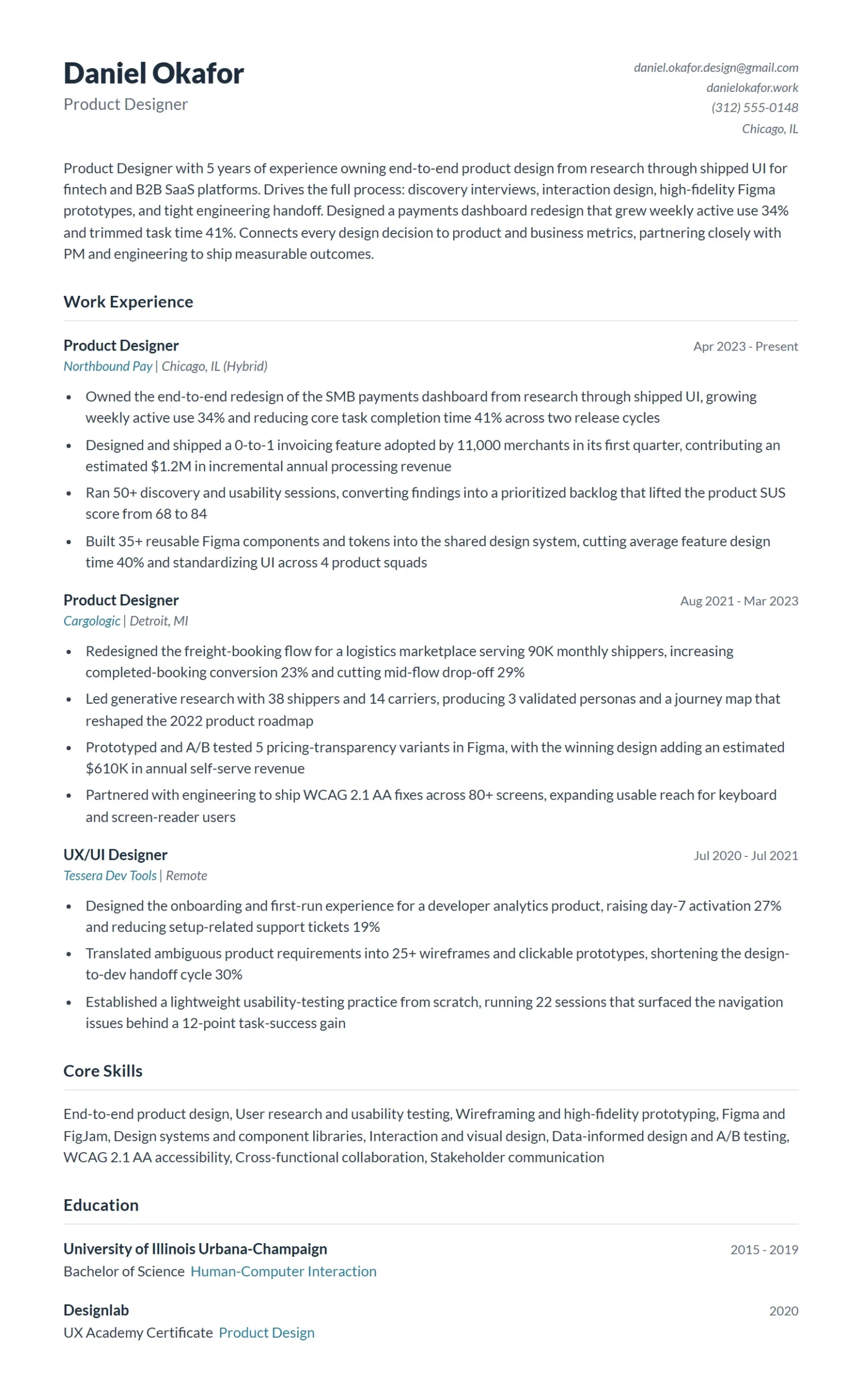
Not sure how to fit research, design, and shipped results onto one page without it reading like a tool list? This product designer resume example shows how to balance process and outcomes so hiring managers see the full picture.
This resume works because it pairs each project with a measurable product outcome, like higher activation or lower drop-off, instead of just naming responsibilities. It leads with a focused skills section that surfaces ATS keywords such as prototyping, design systems, and Figma, then backs them up with experience that shows the end-to-end design process. The clean single-column format keeps it easy for both recruiters and the ATS to scan.
Senior Product Designer resume example
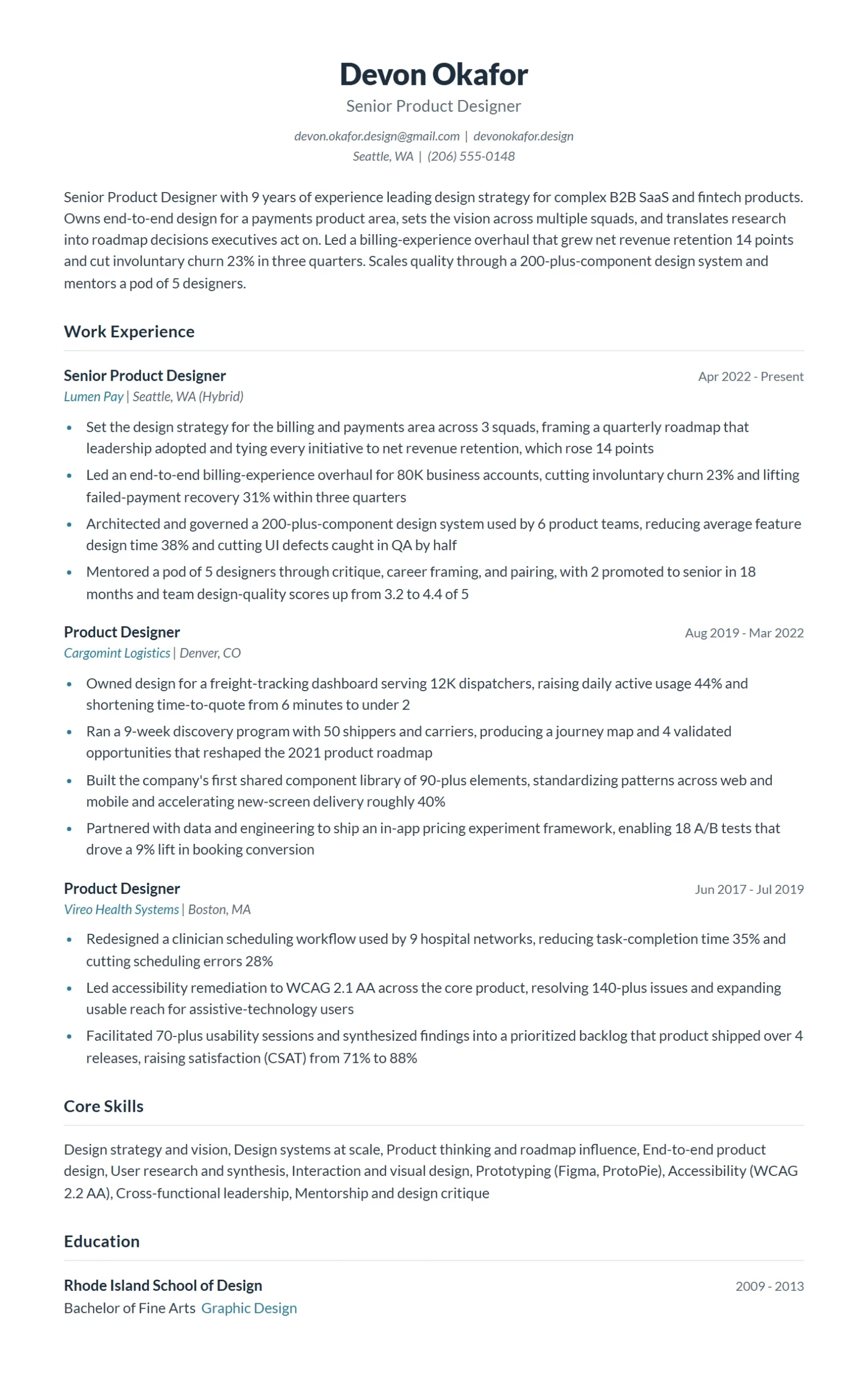
Stepping up to a senior role means proving you can set direction, not just execute. This senior product designer resume example shows how to frame strategy, scaled impact, and cross-functional influence.
This resume works because it shifts the emphasis from individual tasks to ownership and scale: driving the design vision for a product area, building design systems other teams adopt, and aligning stakeholders around research-backed decisions. Quantified outcomes like revenue influenced, retention gained, and time-to-decision reduced signal seniority that a title alone cannot. It still carries the core tool and method keywords an ATS expects, so depth never costs visibility.
UX/UI Designer resume example
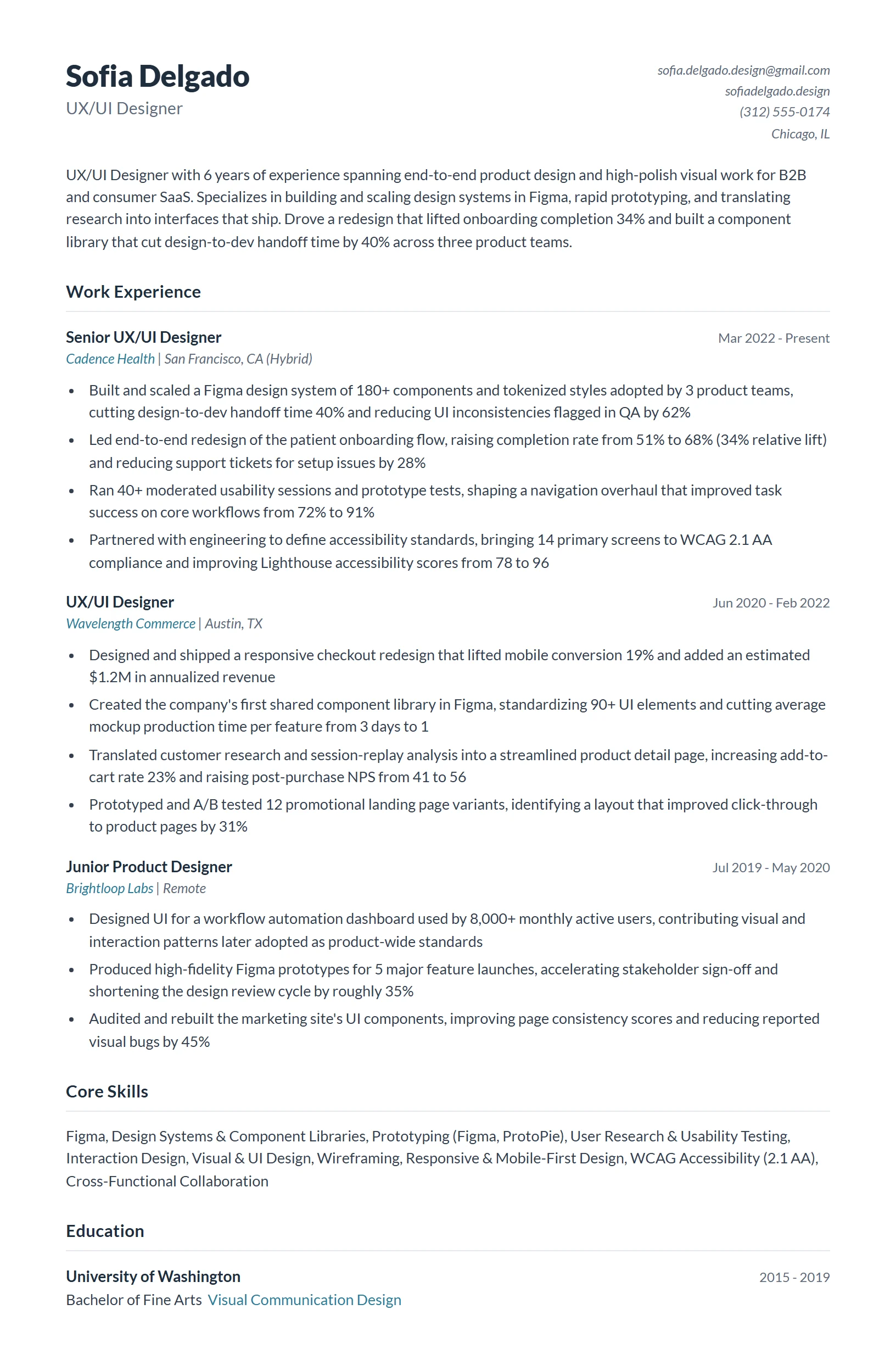
When a role blends experience design with visual polish, your resume has to speak both languages. This UX/UI designer resume example shows how to highlight research and interface craft in equal measure.
This resume works because it makes the hybrid skill set obvious: usability testing and user flows sit alongside visual design, design systems, and responsive layouts, matching the dual expectations in UX/UI job descriptions. Projects trace the handoff from research insight to finished interface, proving you can carry an idea from problem to pixel. Listing both UX methods and UI tools widens the keyword coverage an ATS rewards for these blended roles.
Product Design Lead resume example
Leading a design team means your resume has to show craft and leadership at once. This product design lead resume example shows how to frame team direction, process, and the business outcomes you are accountable for.

This resume works because it foregrounds leadership signals: setting design vision, building process and rituals, mentoring designers, and owning outcomes across a pod rather than a single feature. It quantifies impact at the team level, like delivery speed, adoption of a design system, and roadmap influence, while still naming the hands-on tools that prove you lead from credibility. That balance reads as a leader to the hiring team and keeps keyword coverage intact for the ATS.
UX Designer resume example
If you are targeting research-and-flow-heavy UX roles, your resume needs to lead with process and validated decisions. This UX designer resume example shows how to foreground the methods behind your designs.
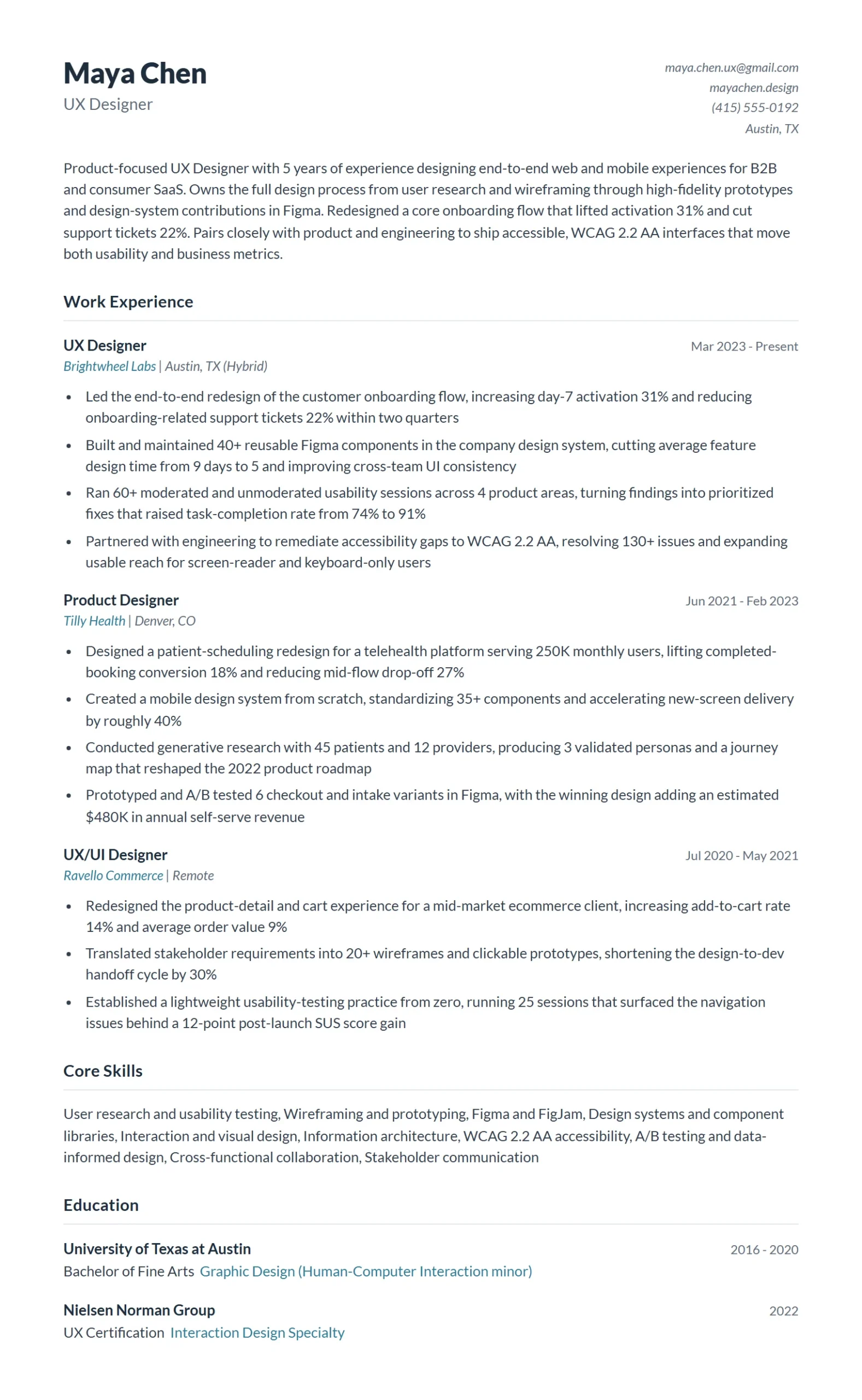
This resume works because it centers the design process (user research, journey mapping, wireframing, usability testing, and iteration) and connects each project to the user problem it solved. It quantifies impact with usability and product metrics like task-completion rate and support-ticket reduction, proving the work mattered. Method and tool keywords such as usability testing and Figma make it read as a true UX specialist to both the ATS and the hiring team.
How to write a Product Designer resume that gets interviews
Product design hiring is about business impact, not just clean screens. Design leads and product managers skim your resume for proof you can take a problem from discovery to a shipped, measured feature, and that you influence what gets built, not only how it looks. They also want a portfolio they can click. Most companies run your resume through an Applicant Tracking System (ATS) first, so the language has to match the job description before a human reads it. The tips below help you clear the ATS scan and convince the product team reading next.
- Lead with shipped products and business outcomes: Product designers are hired to move product metrics, so anchor your resume in what shipped and what it changed. Tie your work to activation, retention, conversion, adoption, or revenue: “drove a 19% lift in feature activation,” “cut trial-to-paid drop-off 14%,” “increased weekly active users 25% after a navigation redesign.” A resume full of mockups and zero shipped, measured outcomes reads as UX-adjacent, not product design.
- Put your portfolio link in the header and make it product-focused: A product design resume without a clickable portfolio is dead on arrival. Add the URL next to your email (with a password if work is under NDA), and make the portfolio lead with 2-3 case studies that show the full arc: the product problem, the constraints, the decisions you made, what shipped, and the metric it moved. Process and outcomes, not a gallery of polished UI. The resume earns the interview; the portfolio earns the offer.
- Show end-to-end ownership across discovery, ship, and iterate: Product design is broader than UX. Show that you own the problem from discovery (research, defining the opportunity, scoping with the roadmap) through high-fidelity design, build, launch, and post-launch iteration based on production data. Reference A/B tests, feature flags, and shipped versions you refined after measuring real usage. This signals you operate as a product owner who designs, not a designer who waits for a brief.
- Name the product trio and your influence on what got built: Hiring managers want designers who partner with a PM and engineers and shape the roadmap, not just execute it. Use bullets that name the partnership and the call you influenced: “Partnered with a PM and 5 engineers to reprioritize the Q3 roadmap around an onboarding redesign that lifted activation 21%.” Showing you can defend a decision with data and steer scope is what separates a product designer from a UI producer.
- Match tools, methods, and product language to the job description: ATS scans for specific terms. List the tools you actually use (Figma, FigJam, Maze, Amplitude, Mixpanel, UserTesting) and mirror the methods named in the posting (product discovery, prototyping, design systems, A/B testing, WCAG accessibility, 0-to-1, end-to-end ownership). If the role says “data-informed design” and you ran experiments, use that exact phrase. Skip outdated tools and never keyword-stuff. Recruiters notice.
- Tailor each application and keep the format ATS-clean: A 0-to-1 startup role, a design-systems role, and a growth-focused product role reward different case studies and keywords. Reorder your skills and swap your headline examples to mirror each posting. Then keep the format parseable: standard section headings, a single clean column, no text boxes or graphics that scramble the scan. Run it through Jobscan to check your match rate against the job description before you apply.

Product Designer resume summary examples
Your summary is the first thing a recruiter reads. Lead with your specialty, years of experience, and a quantified win.
Good product Designer resume summary examples
- Product designer with 6+ years shipping web and mobile products across SaaS and fintech. Owns the full arc from product discovery and prototyping to A/B-tested launches, with recent work lifting feature activation 21% and cutting trial-to-paid drop-off 14%. Fluent in Figma, design systems, and data-informed iteration on products serving 2M+ monthly users.
- End-to-end product designer specializing in 0-to-1 features and complex B2B workflows. Partners closely with PMs and engineers to shape the roadmap, not just execute it. Recent launches increased weekly active users 25% and earned a 92% task-success rate in moderated testing, validated against production analytics.
- Product designer with a systems mindset and a growth track record. Built and scaled a Figma design system adopted by 5 product teams, cutting design-to-dev handoff time 40%, and led experiments that raised onboarding completion from 58% to 81%. Known for tying every design decision to a measurable product outcome.
What to avoid
- Creative product designer looking for an exciting opportunity to grow my skills and work on innovative products with a great team. (It is about what the candidate wants, not what they deliver. No specialization, no tools, no portfolio signal, and zero evidence of shipped products or impact. A hiring manager learns nothing actionable.)
- Passionate designer who loves building beautiful, user-friendly products and is a fast learner with a great eye for detail. (Pure adjectives with no proof. “Beautiful” and “user-friendly” are claims anyone can make. It names no product outcome, no process, no tools, and no metric, so both the ATS and the recruiter skip past it as filler.)
Product Designer resume skills
Pull the exact tools and methods from each job description and mirror that language here. This is a quick resume snapshot, so keep it to your strongest, role-relevant skills rather than an exhaustive list.
Hard skills for a product Designer resume
- Product Discovery
- Prototyping
- Design Systems
- Figma
- A/B Testing & Experimentation
- Data-Informed Design
- User Research
- Interaction Design
- Information Architecture
- Accessibility (WCAG)
Soft skills for a product Designer resume
- Cross-Functional Collaboration
- Product Sense
- Communication
- Problem Solving
- Strategic Thinking
- Adaptability
Product Designer resume work experience bullet point examples
Lead each bullet with a strong verb and a measurable result.
Good bullet point examples
- Led end-to-end design for a new self-serve onboarding flow, from product discovery to shipped release, lifting feature activation 21% and cutting time-to-first-value from 9 minutes to under 4.
- Ran an A/B test on a redesigned pricing page that increased trial-to-paid conversion 14%, adding an estimated $1.2M in annual recurring revenue.
- Built and scaled a Figma design system adopted by 5 product teams, reducing design-to-development handoff time 40% and standardizing components across web and mobile.
- Partnered with a PM and 5 engineers to reprioritize the roadmap around a checkout redesign, shipping in 6 weeks and reducing cart abandonment 22%.
Bad bullet point examples
- Designed wireframes and high-fidelity mockups for various product features in Figma. (Lists tasks with no outcome. “Various features” is vague, and there is no shipped result, no product problem solved, and no metric. It shows you used a tool but not whether the work mattered to the product.)
- Responsible for the design of the company’s flagship product. (“Responsible for” describes a title, not an accomplishment. No specific action, no process, no measurable impact. Lead with a strong verb (Led, Shipped, Redesigned) and end with the product metric you moved.)
- Worked closely with the team to improve the product and make it more intuitive for users. (Subjective and unquantified. “More intuitive” is an opinion, “the team” names no partnership, and there is no result. Replace it with the trio you worked with and the activation, retention, or conversion number you changed.)
Product Designer resume tips
A strong Product Designer resume proves you ship real products that move real metrics, and these tips help yours get past the ATS and into the hands of the hiring team.
- Mirror Job Description Keywords: Pull exact phrases like ‘design systems,’ ‘user research,’ and ‘interaction design’ directly from each job posting and use them in your bullets, because ATS tools match on literal strings, not synonyms.
- Quantify Design Impact: Lead with metrics that product teams respect: conversion rate lifts, task completion improvements, time-on-task reductions, or revenue influenced by a shipped feature, not just the number of screens you designed.
- Name Your Tools Explicitly: List Figma, along with any prototyping, research, or experimentation tools you use (such as Maze, Optimal Workshop, or Amplitude), because many ATS filters screen for specific tool names before a recruiter sees your resume.
- Show Discovery to Delivery: Frame at least two or three bullets around the full arc from problem discovery and user research through prototyping, A/B testing, and a measured launch, because hiring managers are scanning for end-to-end ownership.
- Tailor for Seniority Level: For senior or staff roles, surface strategic contributions like influencing roadmap decisions, scaling a design system across multiple product areas, or mentoring other designers, not just execution-level craft.
- Link Your Portfolio Prominently: Place a clickable portfolio URL directly under your name and contact information, because product design hiring is one of the few roles where the resume is often treated as a gate to the portfolio rather than the primary artifact.
Pair your product Designer resume with a cover letter
A strong resume goes further with a tailored cover letter. Browse our product designer cover letter examples to round out your application.
Product Designer resume frequently asked questions
A product designer resume should show a wider arc than a UX resume: not just research and interaction design, but how your decisions moved product and business outcomes like activation, retention, or revenue. Frame each project around the problem, the design decision, and the metric it shifted, rather than stopping at deliverables. Mirror whichever title the job posting uses, since some companies use “product designer” and “UX designer” interchangeably while others mean very different scopes.
Write 2 or 3 sentences that name your level, your specialty, and one quantified outcome that proves business impact. For example: “Product designer with 5 years across B2B SaaS, leading end-to-end design from research to ship, including a checkout redesign that raised conversion 19 percent.” Mirror the exact title and a few core skills from the job posting so the recruiter and the ATS both register an immediate match. Skip generic lines like “passionate about great UX” and lead with evidence instead.
Attach a number to the outcome whenever you can: conversion, activation, retention, task completion, support ticket reduction, or time saved. When you do not have a clean metric, quantify the scope instead, such as users affected, flows shipped, or experiments run. Use a structure like “Redesigned onboarding for 40,000 monthly users, lifting day-7 retention from 22 to 31 percent,” so each bullet pairs the design decision with the result it drove.
Lead with the work, not the titles. Feature 2 or 3 strong end-to-end projects from a bootcamp, a design challenge, or a self-initiated product redesign, and describe each with the problem, your research and design choices, and a measurable or estimated result. List your tools (Figma, prototyping, user research) and add a short summary that frames you as an entry-level product designer. A realistic redesign of an app you actually use often reads stronger than an invented case study.
Balance tools, methods, and the product judgment that separates the role from pure UI work. Name your stack (Figma, prototyping, design systems), research and validation methods (user interviews, usability testing, A/B testing), and product skills (information architecture, interaction design, working from product metrics and roadmaps). Add the collaboration skills hiring managers screen for, like cross-functional work with PM and engineering and defending decisions with data. Match the specific tools and methods named in the job description, since those are often the exact terms the ATS scans for.
Often not well. Applicant tracking systems struggle with multi-column layouts, text inside images, icons, and graphics, so a visually elaborate resume can get scrambled during parsing. Use a clean single-column layout, standard headings (Experience, Skills, Education), real selectable text instead of images, and a .docx or text-based PDF. Save the visual craft for your portfolio, link the portfolio in your header, then scan the resume against the job description with a tool like Jobscan to confirm your keywords and formatting pass.