Best Photographer Resume Examples for 2026
A photographer resume has to prove your eye and your reliability. See 2026 photographer resume examples plus the skills and ATS keywords that book interviews.


Photographers turn a moment, a product, or a story into an image that does a job: sell, inform, or move someone. The craft is only half of it. The work also runs on client communication, tight turnarounds, post-production, and the business of booking and delivering. Whether you shoot weddings, products, news, or all of the above, your resume has to show that you produce great images and that clients and editors can count on you to deliver.
Hiring managers and studios skim a photographer resume for proof, not adjectives. They look for the genres you shoot, the gear and software you know (cameras, lighting, Lightroom, Photoshop, Premiere Pro), and results they can measure, like shoots completed, clients retained, or published work. Many employers and agencies also screen applications through an applicant tracking system first, so the keywords from the job posting, your editing tools, and your shoot specialties need to appear in plain text. A portfolio link earns the second look; a resume that clears the ATS earns the first.
The examples below show how photographers present their work across specialties and career stages, from an assistant building a first reel of credits to a freelancer running a full client roster. Use them as a starting point, then run your own resume through Jobscan to match it against the job description and catch the keywords you are missing before you apply.
Ready to build yours? Try our ATS-friendly resume builder or scan your draft against the job description.
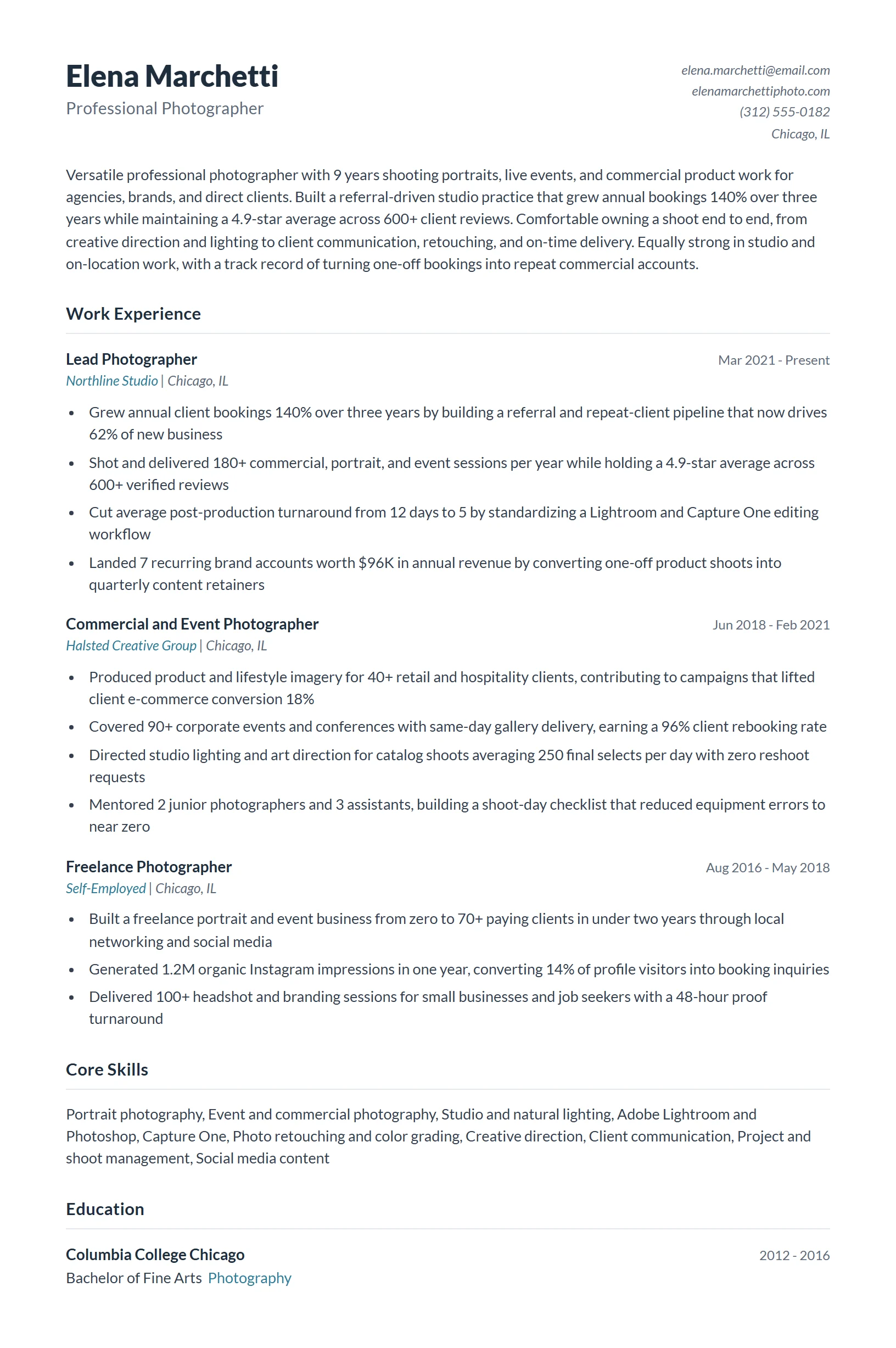
Photographer resume example
Worried your resume reads like a gear list instead of a body of work? This photographer resume example shows how to balance technical skill, range, and the results your images delivered.
This resume works because it pairs craft with outcomes, naming the genres shot and the gear and editing tools used, then tying them to results like client volume, repeat bookings, or published placements. It front-loads a skills section with ATS keywords such as Lightroom, Photoshop, studio lighting, and the specific shoot types in the job description. A clean, single-column layout keeps it readable for both a recruiter and the ATS, while a portfolio link carries the visual proof a resume cannot.
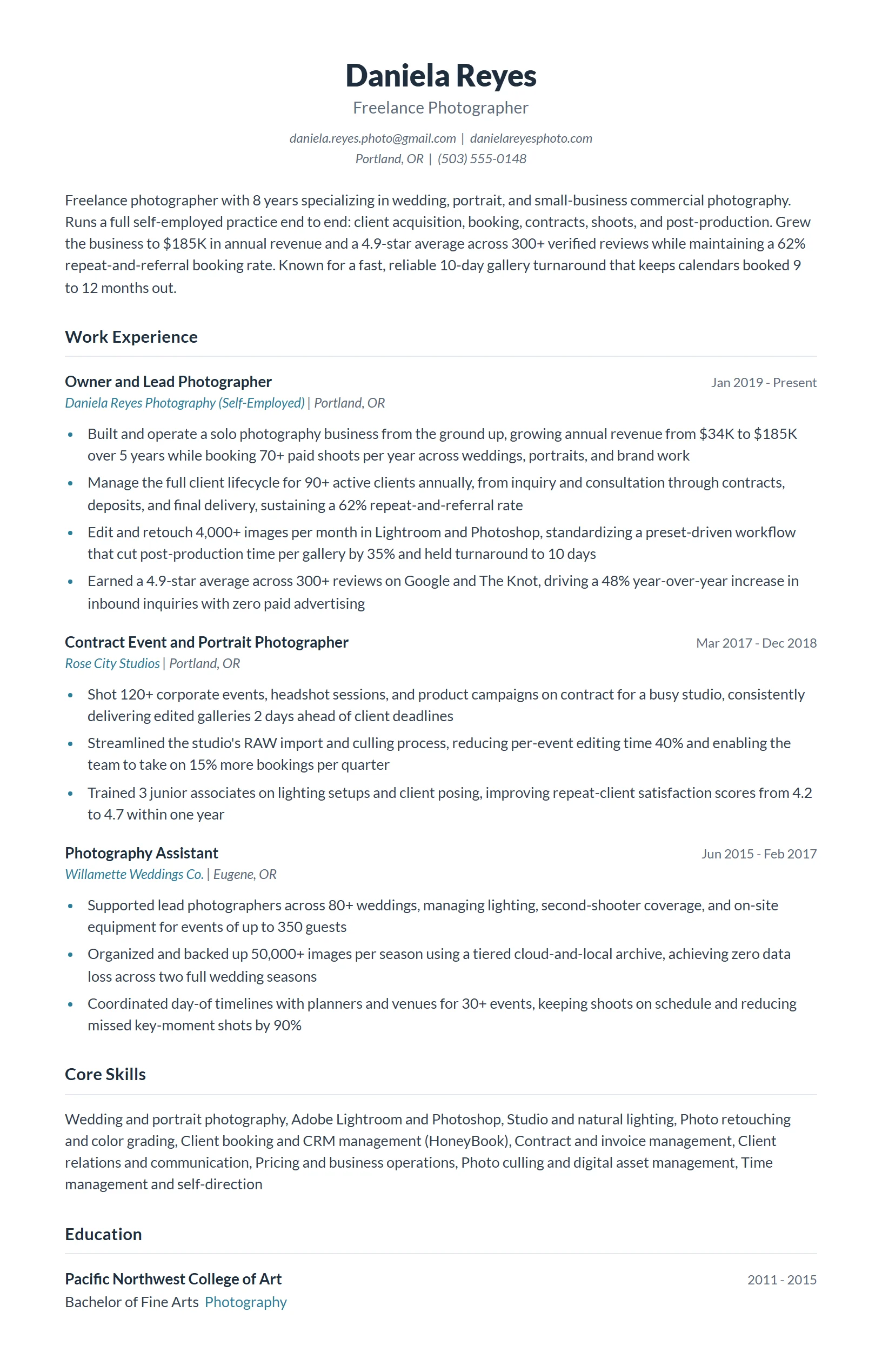
Freelance Photographer resume example
Running your own photography business means proving you can do the work and manage the client. This freelance photographer resume example shows how to frame self-employment as a strength, not a gap.
This resume works because it treats freelance work as real experience, listing it as a single role with named clients, project types, and outcomes instead of a string of disconnected gigs. It highlights the business side hiring managers and studios value (client acquisition, contracts, scheduling, and on-time delivery) alongside the shooting and editing skills. Quantified signals like clients served, shoots delivered, or revenue managed show reliability, and the tool and genre keywords keep it ATS-friendly.
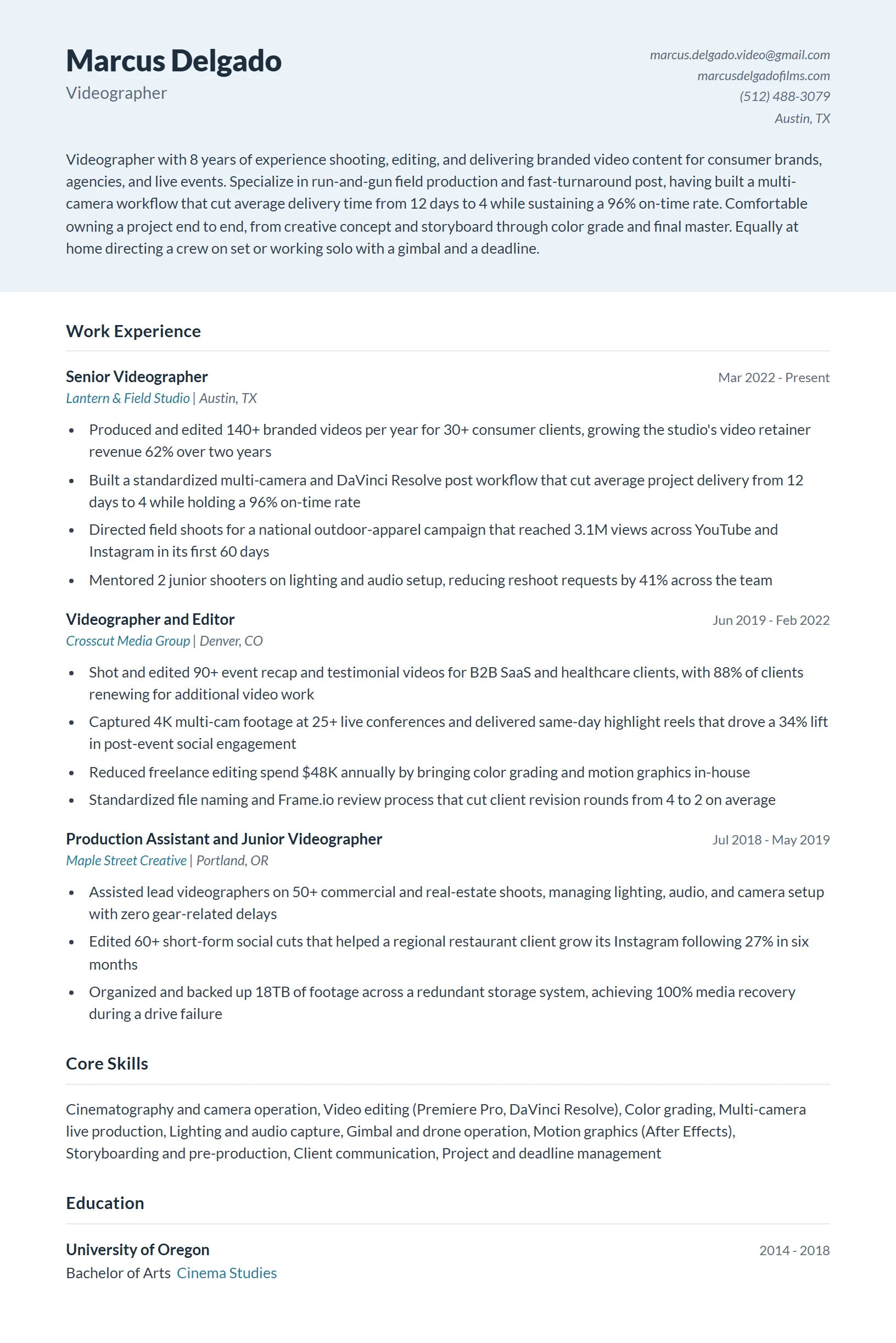
Videographer resume example
Moving from stills to motion, or applying for a role that wants both? This videographer resume example shows how to foreground production and editing without burying your shooting skills.
This resume works because it speaks the language of video production: pre-production, shooting, lighting, audio, and post in editors like Premiere Pro and DaVinci Resolve, each tied to deliverables and deadlines met. It quantifies work in terms a videographer is judged on, such as projects shipped, runtimes delivered, or view counts, rather than just listing equipment. Listing both camera and editing tools widens keyword coverage so the ATS reads it as a true production hire, not a stills photographer in the wrong stack.
Wedding Photographer resume example
Wedding work is won on trust as much as talent. This wedding photographer resume example shows how to prove you can handle the day, the clients, and the pressure of a moment you only get once.

This resume works because it leads with reliability under pressure: weddings shot, timelines managed, and clients guided from booking to final gallery. It pairs the shooting and editing skills with the soft skills couples and studios care about (communication, calm under stress, and vendor coordination) and quantifies them with volume and review or referral signals. Genre-specific keywords like candid, posed, and reception coverage, plus editing tools, keep it aligned with what wedding studios screen for.
Photographer Assistant resume example
Breaking into photography usually starts on set, supporting a lead shooter. This photographer assistant resume example shows how to make hands-on experience and reliability outweigh a thin job history.
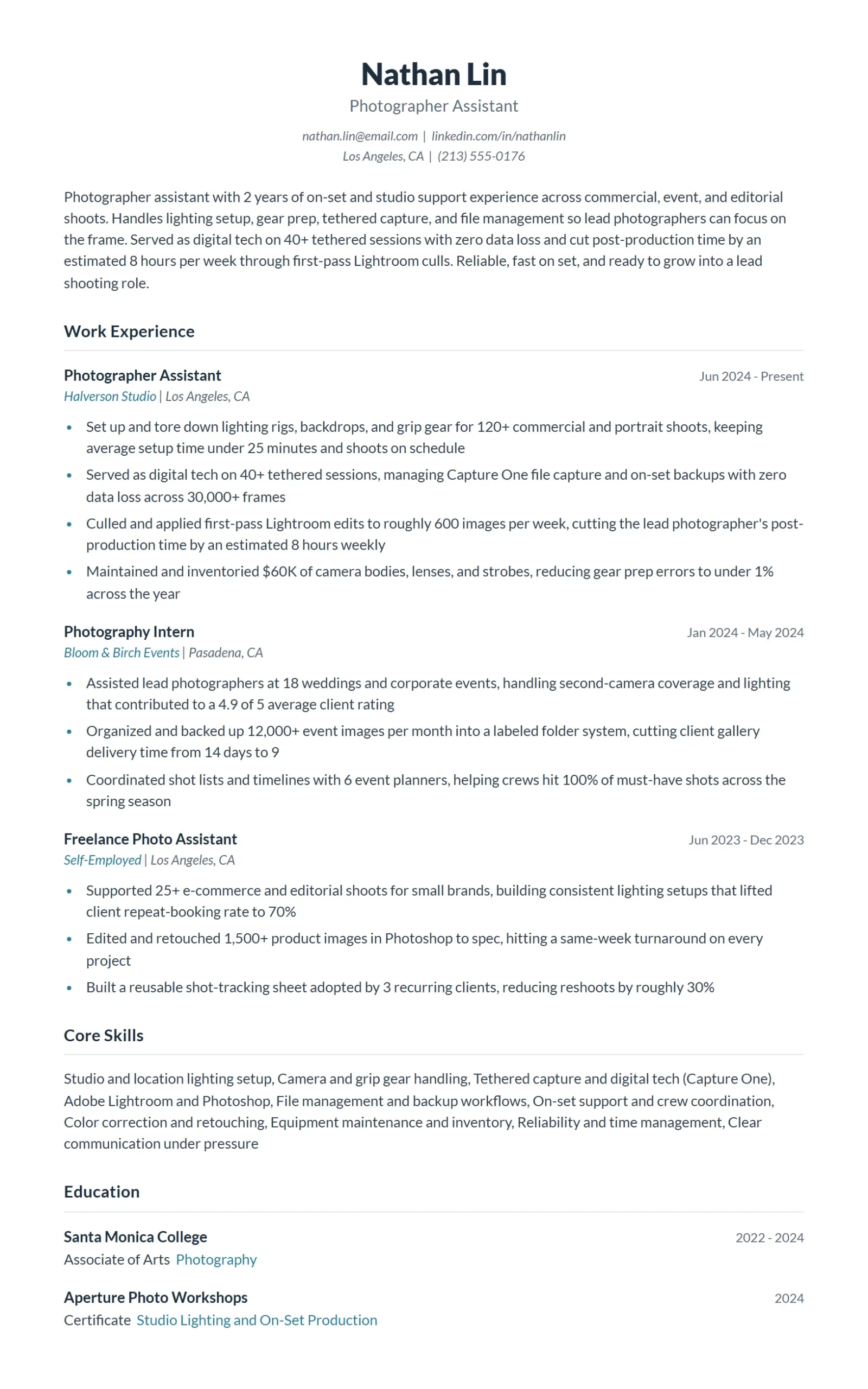
This resume works because it makes practical on-set value obvious: lighting setup and breakdown, gear handling, file management, and supporting the lead so shoots run on time. It puts a skills and tools section near the top to clear ATS keyword checks, then describes each role or internship by what you did and learned, showing you already understand a working set. Listing equipment, editing basics, and dependability signals readiness to grow into a shooting role, which is exactly what studios hiring assistants want to see.
Photojournalist resume example
News photography is judged on story and speed, not studio polish. This photojournalist resume example shows how to foreground your published work, your judgment, and your ability to deliver under a deadline.

This resume works because it centers editorial credibility: publication credits, assignments covered, and images that told the story, each tied to where and when they ran. It emphasizes the skills the beat demands, like fast turnaround, working in unpredictable conditions, captioning, and journalistic ethics, rather than commercial polish. Naming publications, beats, and tools (cameras, Photo Mechanic, Photoshop within editorial limits) gives both editors and the ATS the specific signals that separate a news shooter from a studio photographer.
How to write a Photographer resume that gets interviews
Photographers get hired on the strength of their portfolio, but the resume is what gets that portfolio opened. Studios, agencies, publications, and in-house creative teams skim it for proof you can deliver on deadline, work with clients, and shoot the specific genre they need. Many larger employers also run your resume through an Applicant Tracking System (ATS) before a human sees it, so the language has to match the job posting first. The tips below help you do both: clear the ATS scan and convince the editor or creative director reading next.
- Lead with your portfolio link, and tailor it to the role: A photographer resume without a portfolio URL gets passed over. Put a clickable link in your header next to your email and phone. Then make the work behind it match the job: a wedding studio wants galleries of real weddings, an e-commerce brand wants clean product and lifestyle sets, and an editorial outlet wants published photo essays. The resume gets you the look; the portfolio gets you the booking, so treat that link as the most important line on the page.
- Name your genre and specialization clearly: “Photographer” alone tells a hiring manager nothing. State whether you shoot portrait, wedding, product and e-commerce, editorial, real estate, food, sports, or commercial work, and lead with the one that matches the posting. A product photographer and a wedding photographer run completely different workflows, gear, and client relationships, so a vague title makes you look like a generalist when the role wants a specialist.
- Quantify volume, output, and business impact: Editors and studio owners care about throughput and results, not just artistry. Use numbers: “Shot and edited 45+ weddings per season with a 98% on-time gallery delivery rate,” “Produced 1,200+ retouched product images per month,” or “Drove a 32% increase in client bookings through a refreshed portfolio and referrals.” If you freelance, quantify clients retained, revenue, turnaround time, or social reach. Numbers turn a hobby into a track record.
- Show the full pipeline, not just the shutter: Hiring teams want photographers who own the work end to end. Reference the parts that matter for the role: pre-production and shot lists, lighting setups, directing subjects, capture, culling, and post-production in Lightroom and Photoshop. Naming your editing and color workflow signals you deliver finished, client-ready files on a schedule, which is often what separates a working pro from a talented amateur.
- Match gear, software, and keywords to the job description: ATS scans for specific terms. List the software you actually use (Adobe Lightroom, Photoshop, Capture One) and the systems and methods named in the posting (studio lighting, on-location shooting, retouching, color grading, photo editing). Name your primary camera systems if the role is gear-specific. Use the exact phrases from the listing where they are true for you, and skip keyword-stuffing. Editors can tell.
- Prove reliability and client experience: Beyond craft, employers screen for someone who shows up, hits deadlines, and keeps clients calm. Use bullets that name the client type and the result: “Managed 60+ on-location commercial shoots with zero missed deadlines” or “Maintained a 4.9-star rating across 200+ client reviews.” This signals you can run a shoot, handle people on set, and be trusted with paid work, not just produce nice images when conditions are perfect.

Photographer resume summary examples
Your summary is the first thing a recruiter reads. Lead with your specialty, years of experience, and a quantified win.
Good photographer resume summary examples
- Commercial and product photographer with 7+ years shooting for e-commerce and lifestyle brands. Produces 1,000+ retouched, on-brand images per month with a 99% on-time delivery rate, and built a studio workflow that cut average turnaround from 5 days to 48 hours. Expert in studio lighting, Capture One tethered capture, and high-volume retouching in Photoshop.
- Wedding and portrait photographer with 5 years and 200+ events shot across destination and studio settings. Maintains a 4.9-star rating across 180+ client reviews and a 98% on-time gallery delivery record. Owns the full client experience from booking and shot planning through editing and final delivery in Lightroom.
- Editorial and documentary photographer with 8 years of published work in regional and national outlets. Shot 40+ assigned features on tight news deadlines, managed pre-production and on-location logistics, and grew a personal photo platform to 75K followers that now drives inbound commercial bookings.
What to avoid
- Passionate photographer with a great eye for capturing beautiful moments and a love for telling stories through images. (Pure adjectives with no proof. It names no genre, no software, no volume, and no result. “Great eye” and “beautiful moments” are claims anyone can make, so the ATS and the hiring manager both skip it.)
- Creative photographer seeking an exciting opportunity to grow my skills and work on interesting projects with a talented team. (It is all about what the candidate wants, not what they deliver. There is no specialization, no tools, no client track record, and zero evidence of impact, so a creative director learns nothing they can act on.)
Photographer resume skills
Pull the exact gear, software, and shooting style from each job posting, then mirror that language here. This is a quick resume snapshot, so keep it to your strongest, role-relevant skills rather than an exhaustive gear list.
Hard skills for a photographer resume
- Studio & On-Location Lighting
- Adobe Lightroom
- Adobe Photoshop
- Capture One
- Photo Retouching & Color Grading
- Portrait & Product Photography
- Pre-Production & Shot Planning
- Tethered Capture
- Photo Editing & Culling
- DSLR & Mirrorless Camera Systems
Soft skills for a photographer resume
- Client Communication
- Directing Subjects on Set
- Time & Deadline Management
- Attention to Detail
- Adaptability
- Creative Problem Solving
Photographer resume work experience bullet point examples
Lead each bullet with a strong verb and a measurable result.
Good bullet point examples
- Shot and edited 45+ weddings per season with a 98% on-time gallery delivery rate, earning a 4.9-star average across 180+ client reviews.
- Produced 1,200+ retouched product images per month for an e-commerce catalog, cutting average shoot-to-delivery turnaround from 5 days to 48 hours.
- Directed full-day commercial shoots from shot list and lighting setup through final color grade in Capture One, delivering client-ready files for 60+ campaigns with zero missed deadlines.
- Grew studio bookings 32% year over year by rebuilding the portfolio, streamlining the client onboarding flow, and driving referrals from past clients.
Bad bullet point examples
- Took photos at events and edited them in Photoshop. (Lists a task with no outcome. “Events” is vague, there is no volume, no client type, and no result. It tells the reader you used a tool but not whether your work mattered or scaled.)
- Responsible for all photography needs of the company. (“Responsible for” describes a job title, not an accomplishment. It shows no specific action, no genre, and no measurable impact. Lead with a strong verb (Shot, Produced, Directed) and end with a result instead.)
- Captured stunning, high-quality images that clients really loved. (Subjective and unquantified. “Stunning” and “really loved” are opinions with no proof. Replace them with a metric that backs the claim, such as client rating, repeat-booking rate, or on-time delivery percentage.)
Photographer resume tips
A well-optimized resume turns your portfolio link into a click by proving you have the exact skills and experience the hiring team searched for.
- Mirror the Job Posting: Paste the job description into Jobscan and replace vague phrases on your resume with the exact terminology the employer used, swapping a generic ‘photo editing’ for ‘Adobe Lightroom’ or ‘Capture One’ when those tools are named.
- Quantify Your Output: Back up your experience with numbers that make sense for photography: volume of images delivered per shoot, turnaround time in hours, number of clients managed per month, or percentage reduction in post-production time after you streamlined a color grading workflow.
- Name Every Relevant Tool: ATS filters frequently screen for specific software, so list each platform you use by its full name, including Adobe Lightroom, Adobe Photoshop, Capture One, and any tethered capture setups, rather than grouping them as ‘Adobe Suite’ or ‘editing software’.
- Specify Your Genre: Studios and agencies search for photographers by specialty, so label your niche clearly on your resume, whether that is portrait photography, product photography, editorial, or event, and match that label to the exact genre language in each job posting you apply to.
- Include Pre-Production Skills: Many applicants skip the planning side of the job, so explicitly listing skills like shot planning, mood board development, and client briefing signals to creative directors that you reduce on-set problems before the camera is ever unpacked.
- Keep the Portfolio Link Prominent: Place your portfolio URL in the contact header rather than burying it in a bullet point, and make sure the link is live and goes directly to work relevant to the role you are applying for, not a generic homepage.
Pair your photographer resume with a cover letter
A strong resume goes further with a tailored cover letter. Browse our cover letter examples to round out your application.
Photographer resume frequently asked questions
Yes. Your portfolio proves your eye and technical range, but most studios, agencies, and companies screen a resume first, and many never open a portfolio link without one. Use the resume to summarize your specialties, clients, and results, then drive readers to your work. Put your portfolio URL in the header next to your email and phone so it is impossible to miss.
Lead with the work, not job titles. Feature 2 or 3 strong projects from school, internships, second-shooting, or self-directed shoots, and describe each one with the subject, your setup or approach, and the outcome (published, delivered to a client, featured in an exhibit). Add your gear and software proficiency, then write a short summary that frames you as an entry-level or emerging photographer in your niche. A real shoot for a local business or nonprofit often reads stronger than a generic studio assignment.
Treat your freelance work like a job. Use a title such as “Freelance Photographer” or your business name, add a date range, and list your strongest engagements as bullet points with the client type and the result. Quantify wherever you can: number of shoots per year, client retention, deliverables turned around, or revenue growth. This shows recruiters you ran a real operation rather than took photos on the side.
Balance technical skills, software, and the client-facing skills that win repeat work. For technical skills name your specialties (portrait, product, event, real estate, photojournalism), lighting (natural, studio, off-camera flash), and equipment you shoot on. For software list Adobe Lightroom, Photoshop, Capture One, and any culling or color tools. Then add client communication, art direction, and project management, and mirror the exact terms in the job posting since those are often what an ATS scans for.
Often not well. Applicant tracking systems struggle with text inside images, multi-column layouts, headshots, and decorative graphics, and may drop or scramble that content before a recruiter sees it. Keep the resume itself a clean, single-column document with standard headings and real text, and send your visual creativity to the portfolio instead. Run your resume against the target job description with a tool like Jobscan to confirm your skills and keywords are being read correctly.
Write 2 or 3 sentences that name your specialty, your experience level, and one concrete result that proves your value. For example: “Commercial product photographer with 6 years shooting for e-commerce brands, delivering 200-plus images per week that lifted listing conversion 18 percent.” Mirror the exact job title and a couple of keywords from the posting so both the recruiter and the ATS see an immediate match. Skip vague lines like “passionate about capturing moments” and lead with evidence instead.