Best Producer Resume Examples for 2026
Build a Producer resume for 2026 that proves you can run budgets, schedules, and crews. Real examples plus the skills and keywords ATS scans for.



A producer turns an idea into a finished deliverable on time and on budget. Whether you run video shoots, film projects, music sessions, or live productions, your resume has to show that you can own the schedule, the money, and the team without dropping a single ball.
Hiring managers want proof, not adjectives. They look for the projects you shipped, the budgets you managed, the crews you led, and the results those productions drove. Before a person ever reads it, an applicant tracking system (ATS) scans your resume for the exact skills and titles in the job description, so the right keywords decide whether you make the shortlist.
The examples below show how strong producer resumes are built across different production roles. Use them to frame your own experience, match the language each job posting uses, and get past the ATS with a resume that reads like the producer they already want to hire.
Ready to build yours? Try our ATS-friendly resume builder or scan your draft against the job description.
Producer resume example
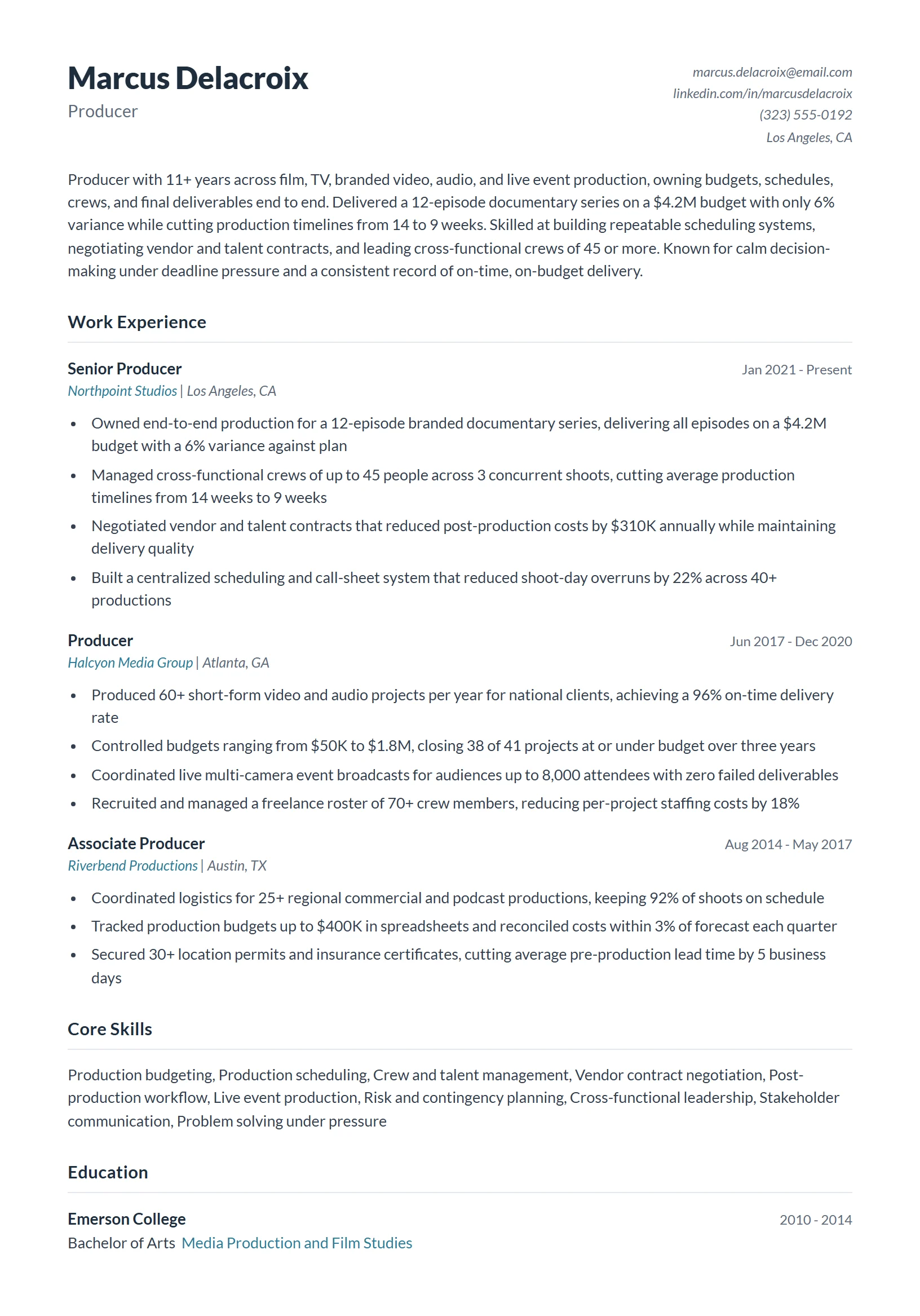
A general producer resume that works across film, video, audio, and live production. It leads with shipped projects, managed budgets, and the size of the teams you directed.
This resume works because it quantifies scope: budget size, project count, crew headcount, and on-time delivery. It mirrors the language of the job posting so the ATS matches you on core production keywords, and it puts outcomes (launched, delivered, under budget) ahead of duties.
Video Producer resume example
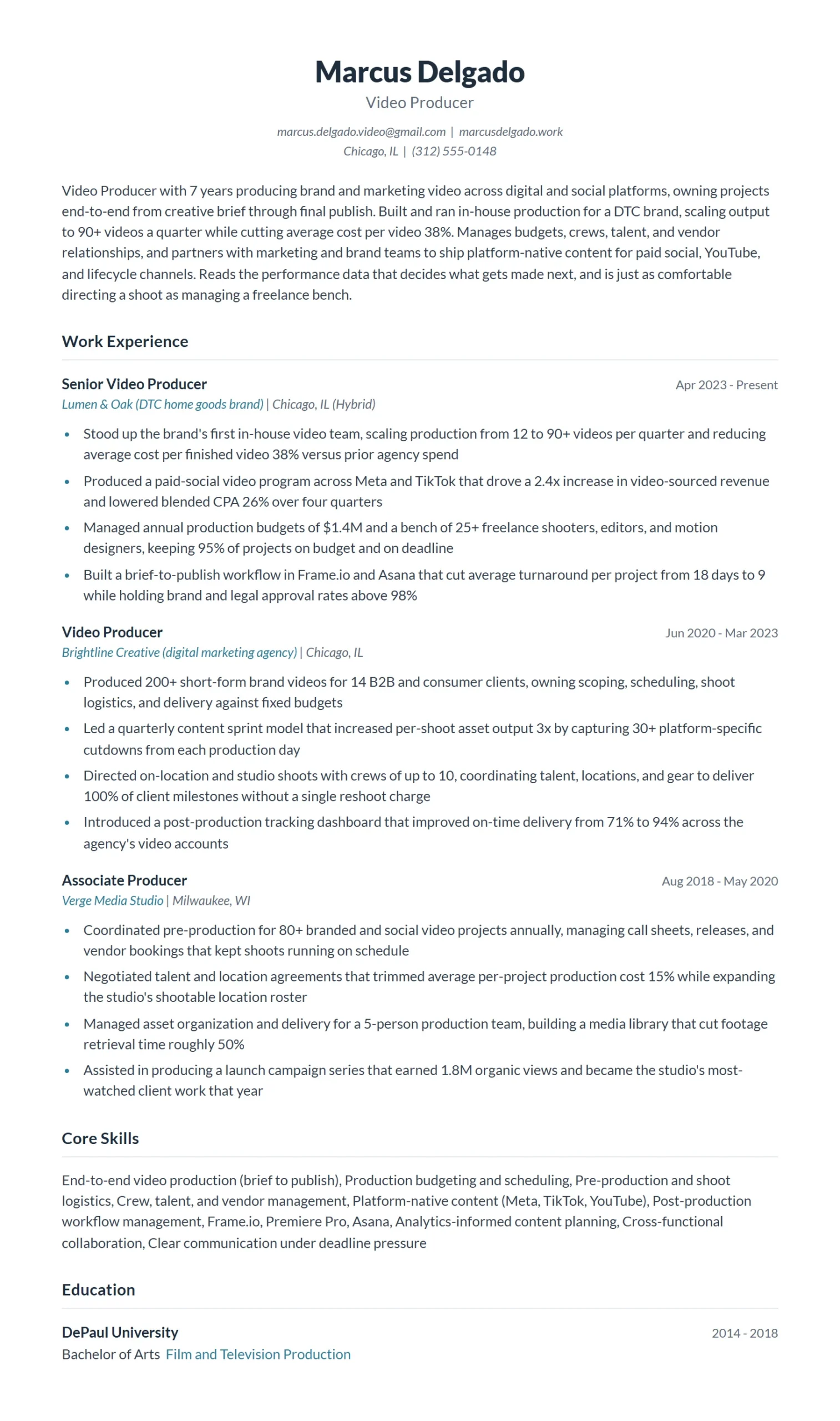
Built for brand, agency, and digital video roles. It shows the full pipeline from creative brief to final publish across the platforms a team actually ships to.
It stands out by tying production work to performance: views, engagement, and campaign results, not just clip counts. Listing tools and platforms (editing suites, motion graphics, distribution channels) hits the technical keywords recruiters and ATS filters expect for digital video.
Film Producer resume example
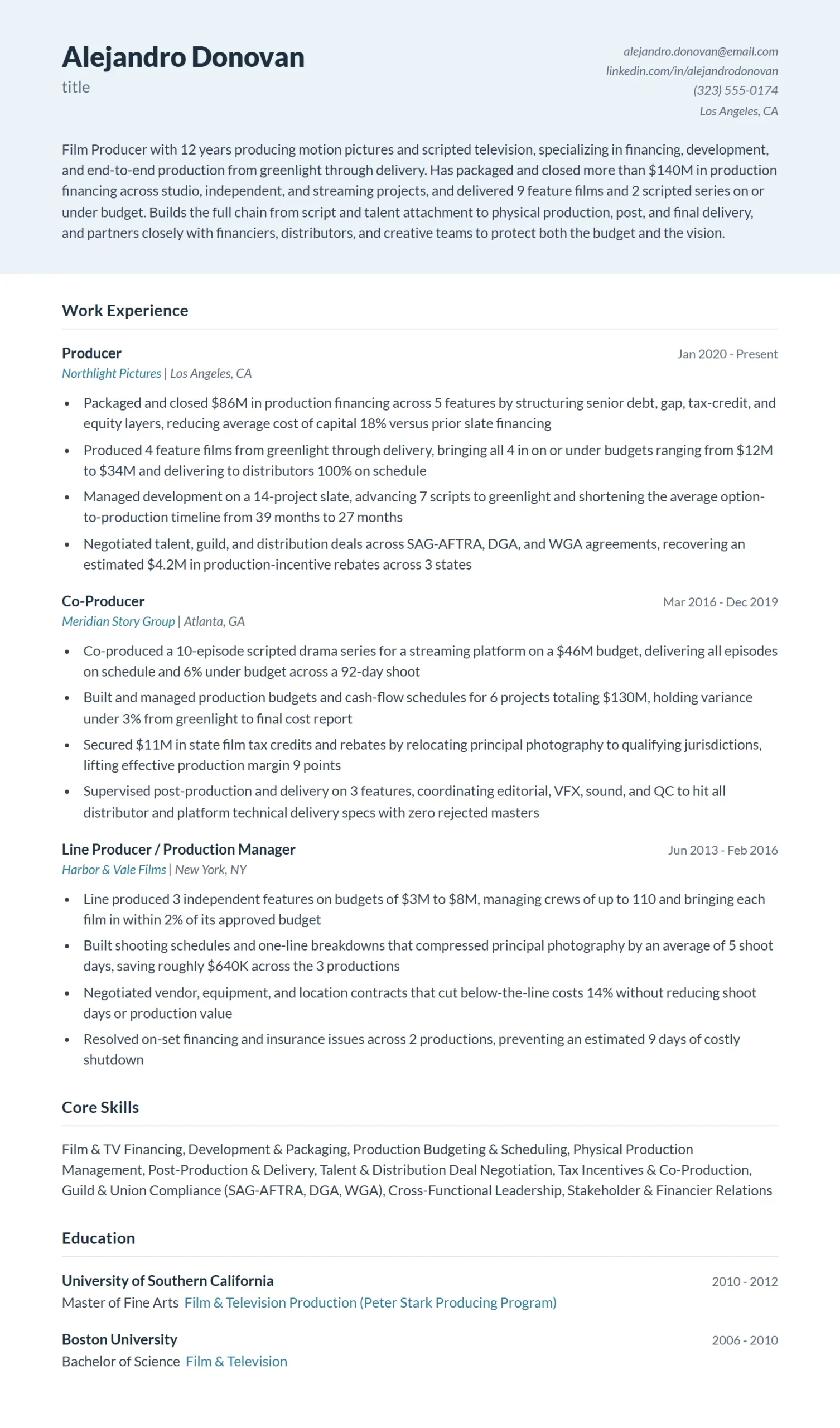
Aimed at motion picture and scripted TV. It emphasizes development, financing, and steering a production from greenlight through delivery.
This one lands because it speaks the industry’s vocabulary: development, financing, principal photography, post, and distribution. Naming credits, formats, and the scale of each production signals real experience and surfaces the title-specific keywords casting and studio teams search for.
Music Producer resume example
For audio and record production roles. It highlights arrangement, engineering, session direction, and the artists or projects you helped bring to release.
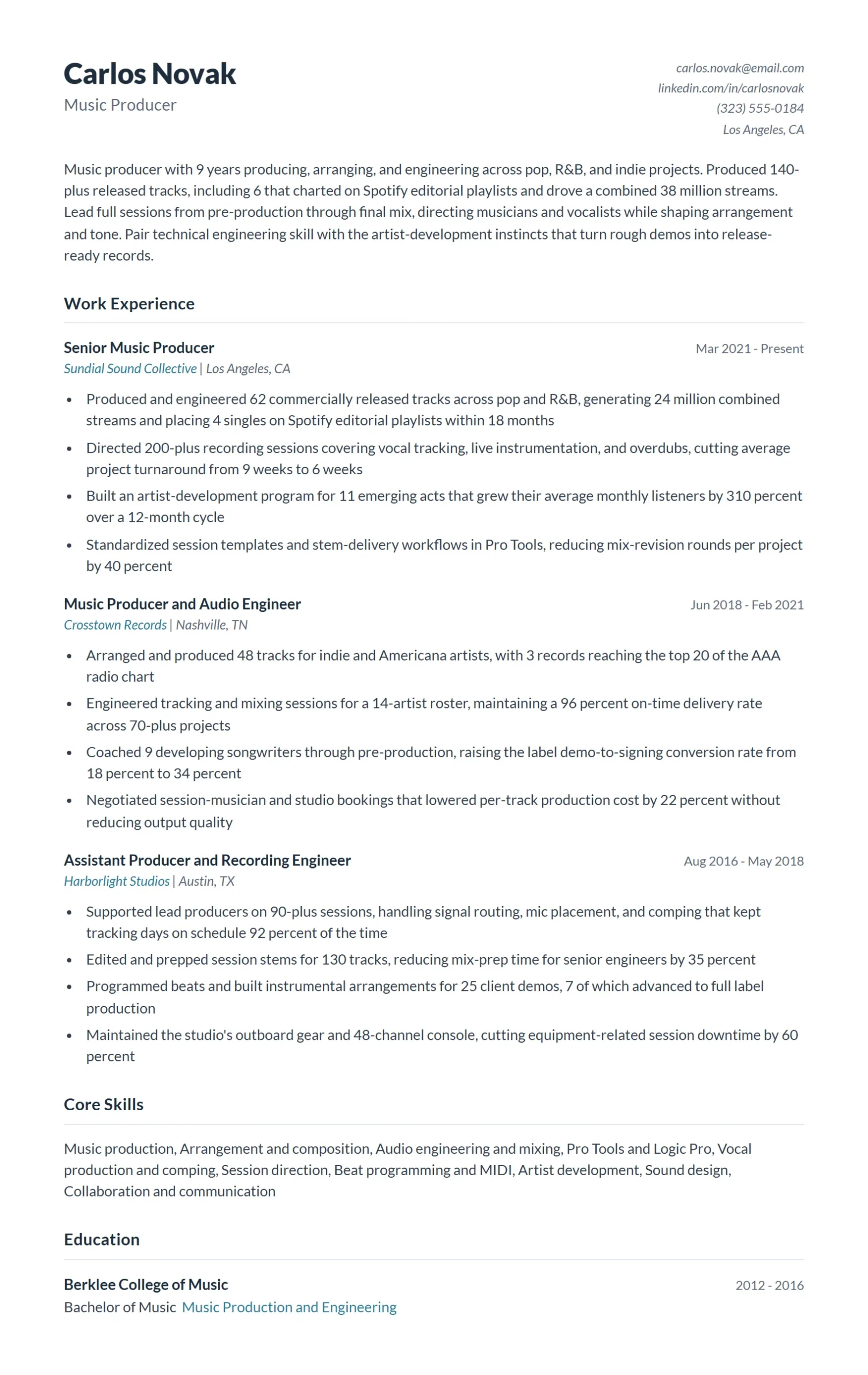
It works by pairing creative range with technical command: genres, DAWs, recording and mixing skills, plus released tracks and streaming or sales results. That mix of craft keywords and measurable output is what gets a music producer resume past the filter and onto the shortlist.
Associate Producer resume example
The right starting point for early-career producers. It frames coordination, research, scheduling, and on-set support as real production contributions.

This resume succeeds by making support work concrete: how many shoots you coordinated, what you scheduled, which deliverables you tracked. It uses the same production keywords as senior roles so the ATS sees a clear path, while honestly reflecting an associate-level scope.
Executive Producer resume example
For senior leaders who own greenlights, financing, and portfolio-level oversight rather than day-to-day shoot logistics.

It reads as senior because it leads with outcomes at scale: total budgets overseen, slates greenlit, revenue or audience results, and the teams of producers reporting in. Strategic keywords (financing, development, P&L, partnerships) signal executive scope to both recruiters and the ATS.
How to write a Producer resume that gets interviews
A Producer gets hired on one question: can you deliver the project on time, on budget, and at the quality the work demands? Hiring managers skim your resume for proof you have owned that responsibility, the size of the productions you have run, and the numbers that show you protected the schedule and the dollars. Most studios, agencies, and production companies also run resumes through an Applicant Tracking System (ATS) first, so your language has to mirror the job description before a human ever reads it. The tips below show you how to clear the ATS scan and convince the person who decides who gets the call.
- Lead with budgets, scale, and delivery: Producers are trusted with money and deadlines, so prove you can handle both. Quantify the budgets you have managed, the size of the crews and casts you have coordinated, and the volume of work you shipped. “Produced 40+ branded video spots on a $1.2M annual budget” or “Managed a $3M feature production across a 32-day shoot” tells a hiring manager exactly what you can be handed. Numbers establish your tier before they read a single bullet.
- Show the full production lifecycle you own: Name the phases you actually run: development, pre-production, principal photography or production, post, and delivery. A Producer who only lists “managed shoots” reads as a coordinator. Reference scheduling, budgeting, crew and vendor hiring, contracts and clearances, call sheets, and final delivery to the platform or client. Showing the arc from greenlight to wrap signals you can own a project end to end, not just one slice of it.
- Quantify on-time and on-budget delivery: The two metrics that matter most for a Producer are schedule and cost. Spell them out: “delivered 18 episodes on schedule across two seasons,” “brought the project in 8% under budget,” or “reduced post-production turnaround from 6 weeks to 4.” If you negotiated vendor or location rates, state the savings. Producers who can prove they protect the timeline and the budget get interviews over producers who only describe what they made.
- Match the medium and tools to the job description: Producer means something different in film, TV, live events, music, advertising, and digital content, and the ATS scans for the right terms. List the tools you use (Movie Magic Budgeting and Scheduling, StudioBinder, Airtable, Asana, Adobe Premiere, Frame.io) and the exact methods named in the posting (line producing, post-production supervision, vendor management, union and SAG-AFTRA compliance, location scouting). If the role says “branded content” and that is your background, use that phrase, not a generic “video production.”
- Prove you lead people and vendors, not just tasks: Producing is a leadership job. Hiring managers want someone who hires the right crew, manages directors and talent, keeps clients calm, and resolves the problems that surface on every production. Use bullets that name the people and the result: “Hired and directed a 25-person crew across three concurrent shoots with zero overtime overages.” This signals you can run a room and a budget under pressure, which is the core of the role.
- Tailor to the role and keep the format ATS-clean: A line producer role, a content producer role, and an executive producer role reward different keywords and credits. Reorder your skills and swap your headline projects to mirror each posting, and lead with the credits closest to the job. Then keep the format parseable: standard section headings, a single clean column, no text boxes or graphics that scramble an ATS, and your strongest credits up top. Run it through Jobscan to check your match rate against the job description before you apply.

Producer resume summary examples
Your summary is the first thing a recruiter reads. Lead with your specialty, years of experience, and a quantified win.
Good producer resume summary examples
- Results-driven Producer with 8+ years leading video and branded content from concept to delivery. Managed annual production budgets up to $2.5M and 30+ projects a year, consistently delivering on time and an average of 9% under budget. Skilled in scheduling, crew and vendor management, and post supervision across a 20-person team.
- Film and TV Producer specializing in unscripted series and documentary. Produced 24 episodes across three seasons on a $4M budget, all delivered on schedule, and negotiated location and vendor agreements that cut production costs 12%. Known for keeping complex shoots calm, staffed, and on track.
- Content Producer with a background in agency and in-house teams, producing 50+ social and digital videos per quarter for brands with 5M+ combined followers. Built a streamlined production pipeline that cut average turnaround from 3 weeks to 9 days while holding quality and client approval rates above 95%.
What to avoid
- Hardworking producer looking for an exciting opportunity to work on creative projects with a passionate team. (It is about what the candidate wants, not what they deliver. There is no medium, no budget or project scale, no tools, and zero evidence they have ever shipped anything on time. A hiring manager learns nothing they can act on.)
- Experienced producer with great communication skills and a passion for storytelling and making great content. (Pure adjectives with no proof. “Great content” and “passion for storytelling” are claims anyone can make. It names no budgets, no delivery record, no scale, and no tools, so the ATS and the recruiter both skip past it.)
Producer resume skills
Pull the exact tools and production terms from each job description and mirror that language here. This is a quick resume snapshot, so keep it to your strongest, role-relevant skills; the full skills breakdown lives on the dedicated skills page.
Hard skills for a producer resume
- Production Scheduling
- Budgeting & Cost Tracking
- Pre-Production Planning
- Post-Production Supervision
- Crew & Vendor Management
- Contracts & Clearances
- Movie Magic / StudioBinder
- Project Management Tools (Asana, Airtable)
Soft skills for a producer resume
- Leadership
- Problem Solving
- Communication
- Negotiation
- Time Management
Producer resume work experience bullet point examples
Lead each bullet with a strong verb and a measurable result.
Good bullet point examples
- Produced 45 branded video campaigns on a $1.8M annual budget, delivering 100% on schedule and an average of 11% under budget across two fiscal years.
- Managed a 28-person crew and $3M production across a 30-day feature shoot, coordinating cast, locations, and vendors with zero days lost to scheduling conflicts.
- Negotiated vendor, equipment, and location agreements that reduced per-project production costs 14%, saving an estimated $220K annually without cutting output.
- Supervised post-production for 18 episodes, cutting average turnaround from 6 weeks to 4 by restructuring the editorial and review workflow in Frame.io.
Bad bullet point examples
- Responsible for producing videos and managing the production process for various clients. (“Responsible for” describes a job title, not an accomplishment. “Various clients” is vague, and there is no budget, scale, or result. Lead with a strong verb (Produced, Managed, Negotiated) and end with a metric.)
- Helped coordinate shoots and worked with the crew to make sure everything ran smoothly. (“Helped” and “ran smoothly” are soft and unquantified. It shows no ownership and no measurable outcome. Name what you owned, how big it was, and the on-time or on-budget result that proves it.)
- Made high-quality content that the client was really happy with. (Subjective and unproven. “High-quality” and “really happy” are opinions, not evidence. Replace them with the number that backs the claim, such as volume delivered, approval rate, budget variance, or turnaround time.)
Producer resume tips
A strong Producer resume proves to both ATS and hiring managers that you have moved real projects from greenlight to delivery without blowing the budget or the deadline.
- Mirror the Job Description: Copy the exact phrasing from each posting, such as ‘production scheduling,’ ‘post-production supervision,’ or ‘crew management,’ because ATS scores your resume against those literal strings before a human sees it.
- Quantify Budget and Scale: Include the dollar value of every production you owned (for example, ‘Managed a $2.4M episodic budget’) so recruiters can instantly gauge whether your experience matches the size of their projects.
- Name Your Tools Explicitly: List Movie Magic Budgeting, StudioBinder, Asana, and Airtable by their full product names in your skills section, because ATS parsers search for exact tool names and abbreviations rarely match.
- Claim Delivery Metrics: State on-time and on-budget outcomes in concrete terms, such as ‘Delivered all 12 episodes on schedule and 4% under budget,’ because those two numbers are the core proof points for any Producer hire.
- Tailor for Medium: Adjust your lead credits and vocabulary to the specific medium in each application, film, television, advertising, or branded content, because a studio hiring for episodic TV weights different credits than a brand agency hiring for campaign work.
- Keep It to Two Pages: Limit your resume to two pages maximum and list only the last 10 to 15 years of credits, because production credits stack up fast and burying your most relevant work in a long list hurts both ATS ranking and recruiter attention.
Pair your producer resume with a cover letter
A strong resume goes further with a tailored cover letter. Browse our cover letter examples to round out your application.
Producer resume frequently asked questions
Anchor the resume to the specific kind of producer the job is hiring, whether that is a film, TV, video, music, podcast, live event, or digital content producer, because the skills and credits that matter shift with each. Mirror the exact title from the posting in your summary and headline, then feature the projects and deliverables that match it. If you have crossed between formats, lead with the experience closest to the target role and let the rest support it. A focused resume reads as a specialist, while a catch-all one reads as unsure.
Producers manage budgets, timelines, teams, and audiences, so almost every accomplishment has a number behind it. Show the budget you oversaw, the size of the crew or cast you coordinated, the number of episodes or projects you delivered, and the results such as views, ticket sales, downloads, or on-time and on-budget completion. For example: “Produced a 12-episode docuseries on a $400K budget, delivered all episodes on schedule, and grew the channel to 2.1M views.” Numbers prove you can run a production, not just work on one.
Treat credits like accomplishments, not a filmography dump. For each notable project, name the title, your exact producer credit (Producer, Line Producer, Associate Producer, Executive Producer), the format and runtime, and one outcome such as a festival selection, network, distributor, or audience figure. Keep the strongest and most relevant credits near the top, and link an online reel or IMDb profile in your header so reviewers can verify the work. List full credits on your portfolio and keep the resume to the titles that match the role.
A coordinator or production assistant supports the schedule, logistics, and paperwork, while a producer owns the budget, key creative and hiring decisions, and overall delivery. If you are moving up, frame your coordinator experience around the producing responsibilities you already carried, such as managing vendors, tracking budgets, or running the production schedule end to end. Use action verbs like led, owned, and greenlit where they are honest, and pair them with results. Then mirror the target title in your summary so recruiters and the ATS read you as a producer candidate.
Group your freelance work under one heading such as “Freelance Producer” with your specialty and total years, then list standout projects as bullets or short entries beneath it rather than as a long string of separate jobs. This shows continuity and a clear specialty instead of looking like a gap-filled patchwork. Lead each project with the client or production, your role, the budget or scope, and the outcome. Reserve full detail for your reel or portfolio and keep the resume focused on the work that matches the role you want next.
Yes, most studios, networks, agencies, and production companies route resumes through an ATS before a human sees them, so formatting and keywords matter even in a creative field. Use a clean single-column layout, standard headings (Experience, Skills, Education), and real selectable text instead of graphics or text inside images. Include the exact terms from the posting, such as the producer title, budgeting, scheduling, post-production, and the specific software or platforms named. Scan your resume against the job description with a tool like Jobscan to confirm your keywords and formatting pass before you submit.