Best Video Editor Resume Examples for 2026
Video editor resume examples for 2026 across film, freelance, and social media roles, with the editing software and storytelling keywords ATS scans for.



A video editor turns raw footage into finished stories. The job blends technical command of editing software with a sense for pacing, sound, and visual rhythm, whether you are cutting a feature, a brand campaign, or a 30-second clip built for a phone screen. The strongest resumes prove both sides: the tools you run and the results your edits drove.
Hiring managers scan for specific software (Premiere Pro, DaVinci Resolve, After Effects, Final Cut Pro) and for evidence that your work moved a number: views, watch time, retention, or turnaround speed. Before a human sees your resume, an applicant tracking system (ATS) checks it for those exact terms. Bury them in dense paragraphs or leave them off entirely, and you can get filtered out before anyone watches your reel.
The examples below show how to lead with a strong summary, quantify your edits, and place the right keywords where both the ATS and the hiring manager will find them. Pick the one closest to your role, then tailor it to the job description. A focused, keyword-matched resume gets your reel in front of the people who decide.
Ready to build yours? Try our ATS-friendly resume builder or scan your draft against the job description.
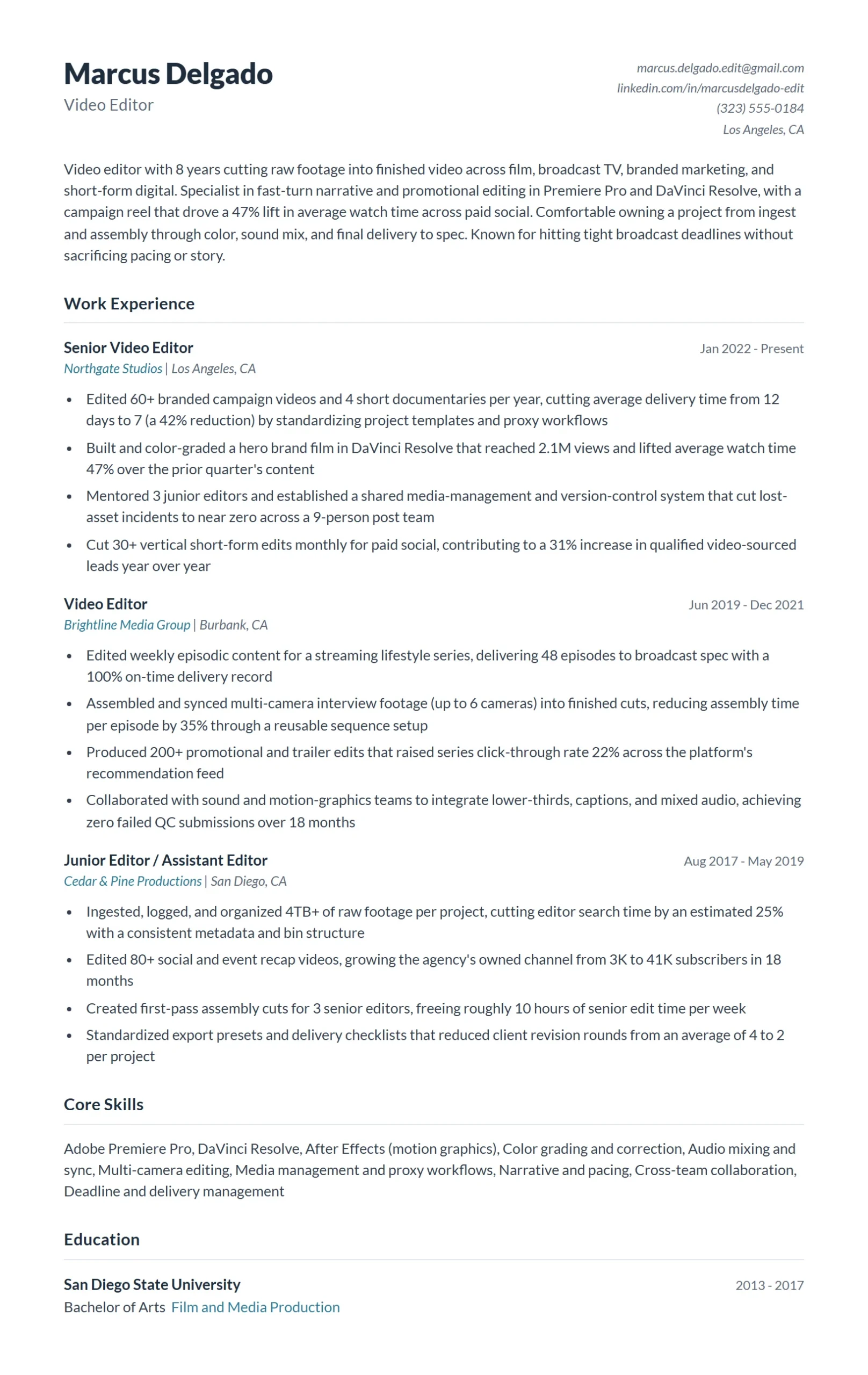
Video Editor resume example
A general-purpose example for editors working across formats, from corporate and marketing video to broadcast and digital.
It opens with a summary that names core tools and years of experience, then backs each role with quantified outcomes like views, completion rates, and turnaround time. Software lives in a dedicated skills section so the ATS catches every term, and a link to the reel sits up top where it counts.
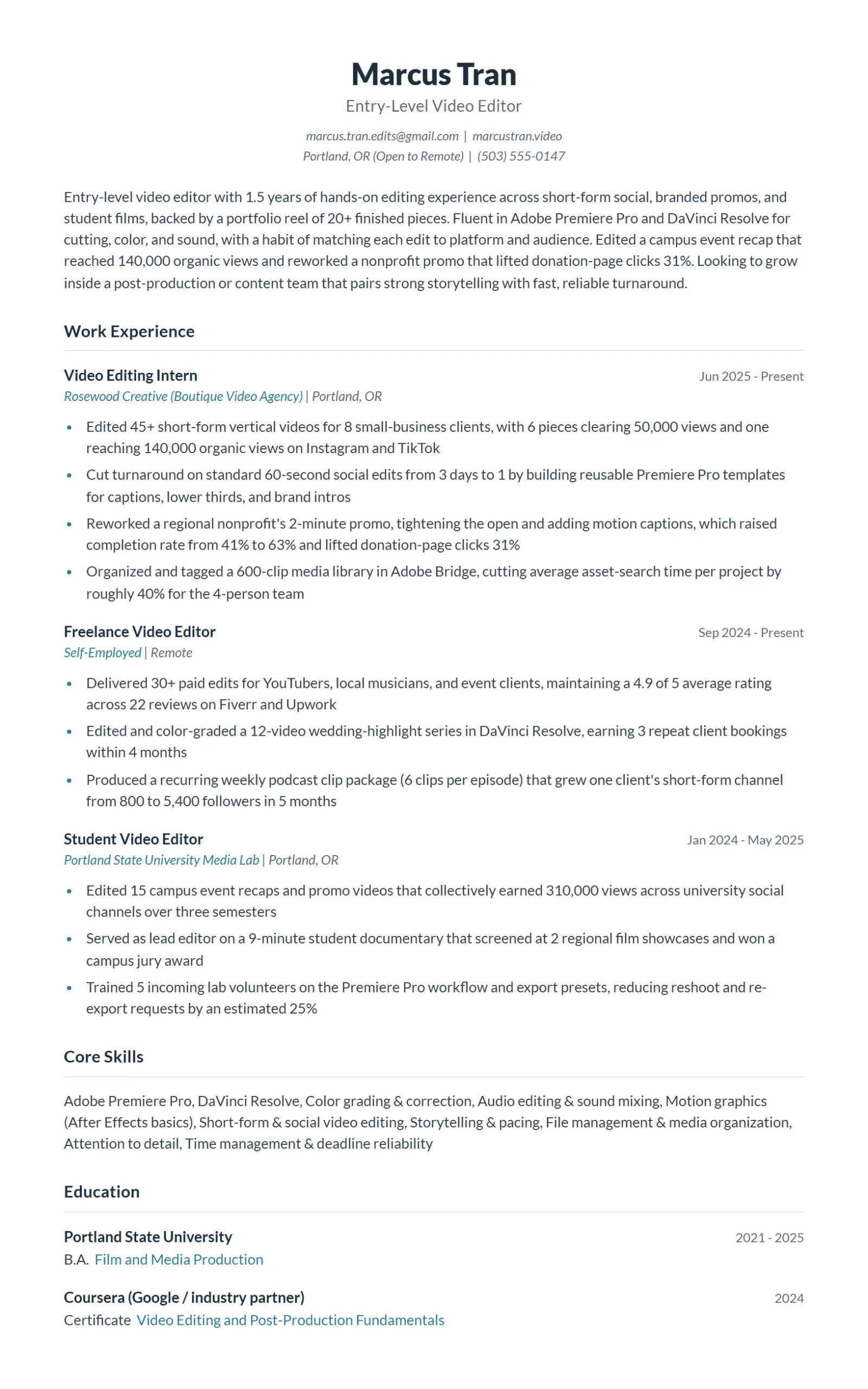
Entry-Level Video Editor resume example
Built for recent grads and career changers with internships, freelance gigs, or strong student projects instead of years of paid credits.
It puts a portfolio reel and relevant coursework or certifications front and center to offset a thin work history. Internship and project work is framed in achievement terms (deliverables shipped, formats edited) so limited experience still reads as capable and ATS-ready.
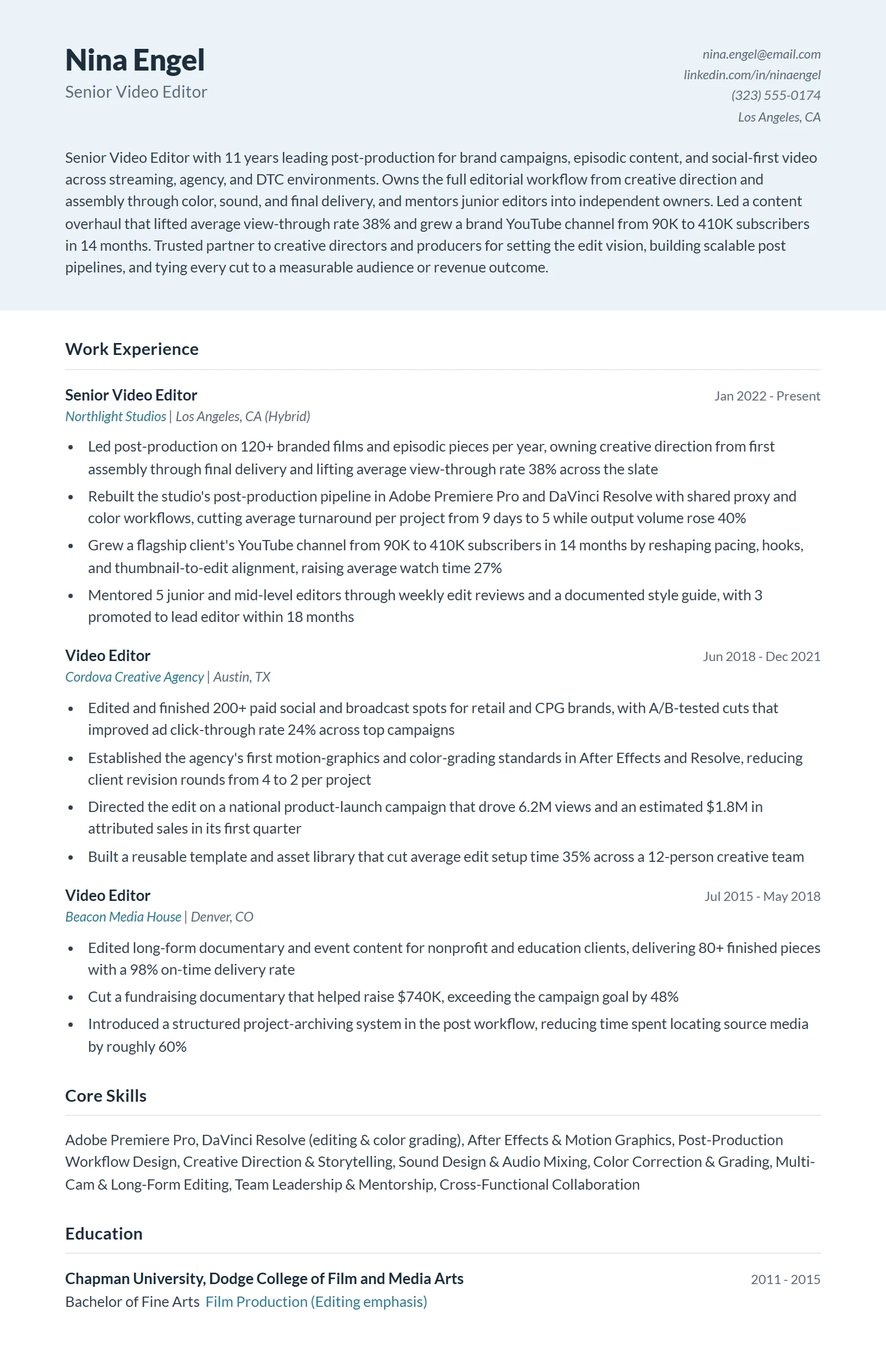
Senior Video Editor resume example
For editors who own post-production end to end and guide junior editors or contractors.
It shifts from task lists to leadership and impact: workflows built, teams mentored, and edits tied to revenue, reach, or efficiency gains. Advanced tools (color grading, motion graphics, multi-cam) appear alongside the high-level keywords hiring managers use for senior roles.
Freelance Video Editor resume example
For independent and contract editors juggling multiple clients and project types.
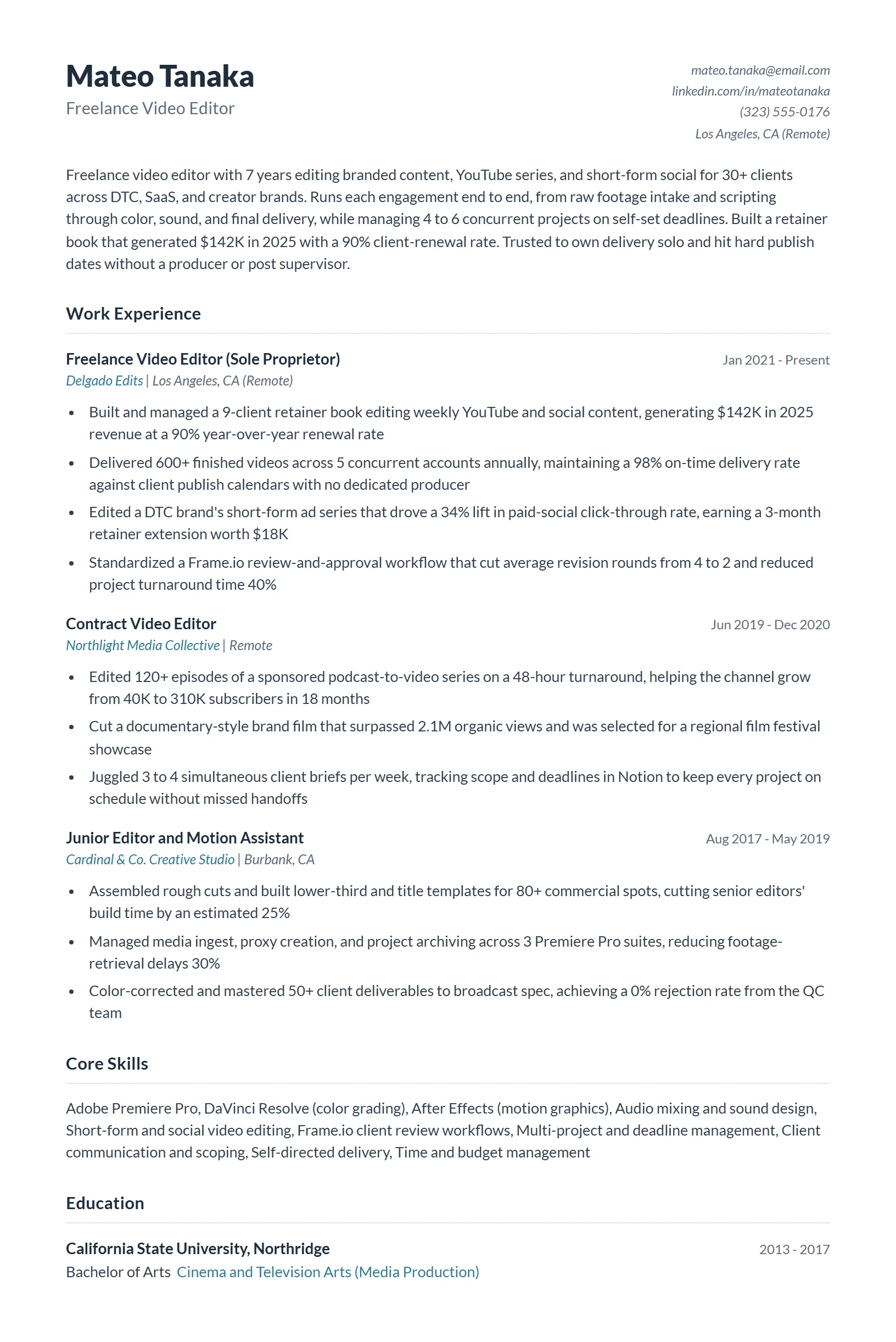
It treats freelancing as structured experience, grouping client work under a single banner with named brands, project volume, and delivery results. That framing answers the recruiter’s question about consistency while keeping the software and deliverable keywords an ATS needs to see.
Social Media Video Editor resume example
For editors focused on short-form vertical content for TikTok, Reels, and YouTube Shorts.

It foregrounds platform-native skills (vertical editing, hooks, captions, trend awareness) and proves them with engagement numbers like views, watch time, and follower growth. Keywords match how brands and agencies actually post these roles, so the resume clears the ATS and reads as platform-fluent.
Film & Video Editor resume example
For narrative, documentary, and broadcast editors who shape story and tone.

It highlights craft over volume: story structure, continuity, color, and close work with directors and sound teams. Credits are listed with the production, role, and format, and tools like DaVinci Resolve and Avid sit in the skills section so the resume reads as both creative and technically precise.
How to write a Video Editor resume that gets interviews
Hiring managers and post-production leads skim a video editor resume for proof you can cut footage that performs, not just that you know the software. They want a reel they can watch in seconds, a sense of the formats and platforms you handle, and results tied to numbers like watch time, view counts, or turnaround. Most companies also run your resume through an Applicant Tracking System (ATS) first, so your language has to match the job description before a person ever sees it. The tips below show you how to do both: clear the ATS scan and convince the editor or producer reading next.
- Put your demo reel link at the top, and make it count: A video editor resume without a reel link is dead on arrival. Add a clickable URL in your header next to your email (Vimeo, YouTube, or a personal site, with a password if the work is under NDA). Keep the reel itself short and front-loaded: 60 to 90 seconds of your strongest cuts, with your best work in the first 10 seconds. Match the reel to the job, so a YouTube creator role sees retention-style editing and a corporate role sees polished brand and event work. The resume earns the click; the reel earns the interview.
- Quantify outcomes, not just edits: Anyone can say they edited videos. Show what the work did: “grew a YouTube channel from 40K to 180K subscribers in 11 months,” “cut a 90-second ad that lifted click-through 34%,” or “edited 200+ short-form videos averaging 1.2M views each.” Tie your cuts to view counts, watch time, retention rate, engagement, subscriber growth, or revenue. If you cannot share business metrics, use volume and turnaround: videos delivered per week, average project length, or a tightened delivery timeline.
- Name your software stack and the formats you cut: ATS scans for specific tools, so list the ones you actually use: Premiere Pro, DaVinci Resolve, Final Cut Pro, After Effects, Avid Media Composer, Audition. Then name the work types the job calls for, like short-form social (Reels, TikTok, Shorts), long-form YouTube, commercials, corporate and event video, documentary, or motion graphics. If the posting says “color grading” and you grade in Resolve, use that exact phrase. Skip software you barely touch and never keyword-stuff.
- Show the full post-production workflow: Editing is more than splicing clips. Reference the arc that proves you can own a project: ingesting and organizing footage, assembly and rough cut, story and pacing, sound design and audio mixing, color correction and grading, motion graphics and titles, and export to spec for each platform. A bullet that shows you took raw footage to final delivery reads as a real editor, not just someone who trims clips someone else assembled.
- Prove speed, volume, and reliability: Most editing teams live and die by turnaround. Hiring managers want editors who hit deadlines without dropping quality. Quantify your throughput: “delivered 15 to 20 short-form videos per week across 3 brand accounts,” or “managed a 5-day edit-to-publish cycle for a weekly long-form series.” Mention how you handle revisions, manage feedback rounds, and keep projects organized so a producer trusts you with their content calendar.
- Tailor the resume to each role and keep it ATS-clean: A social-first creator role, a film and documentary role, and a corporate marketing role reward different reels and keywords. Reorder your skills and swap your headline projects to mirror each posting. Then keep the format ATS-friendly: standard section headings, no text boxes or multi-column layouts that scramble parsing, real selectable text, and a single clean column. Run it through Jobscan to check your match rate against the job description before you apply.

Video Editor resume summary examples
Your summary is the first thing a recruiter reads. Lead with your specialty, years of experience, and a quantified win.
Good video Editor resume summary examples
- Video editor with 6+ years cutting short-form and long-form content for social, brand, and YouTube. Edited 800+ videos in Premiere Pro and After Effects, including a Shorts series that drove a channel from 40K to 180K subscribers in under a year. Strong on pacing, sound design, and color grading, with a 48-hour average turnaround across high-volume content calendars.
- Senior video editor specializing in commercial and branded content, from raw footage to final delivery. Owns the full post workflow in DaVinci Resolve and After Effects: assembly, color grade, motion graphics, and export to spec. Recent campaign edits lifted ad click-through 34% and cut average delivery time from 7 days to 4.
- Multimedia video editor with a motion-graphics background and an eye for retention-driven storytelling. Cut 200+ social videos averaging 1.2M views each and built a reusable After Effects template system that sped up team delivery 40%. Known for hitting tight deadlines without sacrificing polish.
What to avoid
- Creative video editor looking for an exciting opportunity to grow my skills and work on cool projects with a talented team. (It is all about what the candidate wants, not what they deliver. There is no software, no content type, no reel signal, and zero evidence of impact. A hiring manager learns nothing they can act on.)
- Passionate editor who loves storytelling and making engaging videos with great attention to detail. (Pure adjectives with no proof. “Engaging” and “great attention to detail” are claims anyone can make. It names no tools, no formats, and no measurable result like views or watch time, so the ATS and the recruiter both skip past it.)
Video Editor resume skills
Pull the exact software and content types from each job description, then mirror that language here. This is a quick resume snapshot, so keep it to your strongest, role-relevant skills rather than an exhaustive list.
Hard skills for a video Editor resume
- Adobe Premiere Pro
- DaVinci Resolve
- Final Cut Pro
- After Effects (Motion Graphics)
- Color Correction & Grading
- Sound Design & Audio Mixing
- Video Editing & Pacing
- Short-Form & Long-Form Editing
- Adobe Audition
- Export & Encoding to Spec
Soft skills for a video Editor resume
- Storytelling
- Attention to Detail
- Time Management
- Collaboration
- Receiving Feedback
- Meeting Deadlines
Video Editor resume work experience bullet point examples
Lead each bullet with a strong verb and a measurable result.
Good bullet point examples
- Edited 800+ short-form videos in Premiere Pro for 3 brand accounts, averaging 1.1M views each and growing combined follower count 62% over 12 months.
- Cut and color graded a 90-second product launch ad in DaVinci Resolve that lifted landing-page click-through 34% and was repurposed into 6 platform-specific versions.
- Owned end-to-end post for a weekly YouTube series, from footage ingest to motion graphics and export, raising average viewer retention from 38% to 51%.
- Built a reusable After Effects title and lower-third template system, cutting per-video production time 40% across a 4-editor team.
Bad bullet point examples
- Edited videos for the company using Premiere Pro and After Effects. (Lists a task with no outcome. There is no content type, no volume, and no result like views or retention. It tells the reader you used the tools but not whether your work performed.)
- Responsible for managing all video content for the marketing department. (“Responsible for” describes a job title, not an accomplishment. It shows no specific action, no format, and no measurable impact. Lead with a strong verb (Edited, Cut, Produced) and end with a result instead.)
- Made high-quality, engaging videos that customers loved. (Subjective and unquantified. “High-quality” and “customers loved” are opinions with no proof. Replace them with the metric that backs the claim, such as view count, watch time, or engagement lift.)
Video Editor resume tips
A strong video editor resume proves you move projects from raw footage to polished final cut on time and on brand.
- Mirror the Job Post: Copy the exact software names from the posting (Adobe Premiere Pro, DaVinci Resolve, Final Cut Pro) into your skills section, because ATS systems match on precise strings, not synonyms.
- Quantify Your Impact: Anchor every key bullet to a metric that matters in post-production: view counts, watch time percentages, subscriber growth, turnaround time, or number of deliverables completed per week.
- List Your Reel Prominently: Place a shortened portfolio URL directly below your name and contact line so hiring managers can click through in seconds, since a visible reel is the fastest proof of skill in this field.
- Specify Formats and Platforms: Name the content types and distribution channels you have cut for (YouTube long-form, TikTok short-form, broadcast, corporate training) because editors are often hired for platform-specific experience.
- Include Motion and Audio Tools: Call out After Effects for motion graphics and any audio tools or sound design experience separately, since many job descriptions score these as bonus qualifications that push your application past the first filter.
- Keep It One Page: Unless you have more than ten years of post-production credits, fit everything on one page, because production leads reviewing dozens of applicants rarely scroll past the first sheet.
Pair your video Editor resume with a cover letter
A strong resume goes further with a tailored cover letter. Browse our video editor cover letter examples to round out your application.
Video Editor resume frequently asked questions
Yes. Your reel proves your craft, but recruiters and applicant tracking systems screen the resume first, and many hiring managers never open the reel without it. Use the resume to summarize the projects, clients, and measurable results behind your best work, then drive viewers to the reel. Put your reel or portfolio URL in the header next to your email and LinkedIn so it is the first thing a reviewer sees.
Name the specific tools you actually use, since those are often the exact terms an ATS scans for. List your editing suites (Adobe Premiere Pro, Final Cut Pro, DaVinci Resolve, Avid Media Composer), motion and finishing tools (After Effects, Audition, color grading), and core skills like color correction, audio mixing, multicam editing, and storytelling or pacing. Match the platforms and formats named in the job description, whether that is YouTube, social verticals, broadcast, or long-form documentary. Skip generic lines like “creative” and let the tool list and results carry your skills section.
Tie your edits to outcomes the business cares about, not just the number of videos cut. Use metrics like view counts, watch time or retention, engagement lift, turnaround time, and volume delivered (for example, “edited 120+ short-form videos that drove a 40 percent increase in average watch time”). If you cannot share view data, quantify scope instead: hours of footage, number of channels supported, or deadlines hit. Numbers turn a list of tasks into proof of impact.
Lead with the work, not the job titles. Feature 2 or 3 strong projects from freelance gigs, a personal channel, school, or volunteer edits for a local nonprofit or small business, and describe each with the problem, your editing decisions, and the result. List your software and a short summary that frames you as an entry-level or freelance video editor. A real edited project with view or engagement numbers often reads stronger than any generic objective statement.
Yes, and treat it like real experience, because it is. Group steady freelance work under a single heading such as “Freelance Video Editor” with a date range, then list notable clients or project types as bullet points underneath with their results. This keeps the resume clean instead of fragmenting your history into a dozen tiny one-off entries. If a client is recognizable or the project performed well, name it, since brand names and strong numbers both catch a recruiter’s eye.
One page is the standard unless you have roughly 10 or more years of experience or a long list of senior credits that genuinely add value. Keep it ATS-safe with a clean single-column layout, standard section headings (Experience, Skills, Education), and real selectable text rather than graphics or text inside images, since heavily designed resumes often get scrambled during parsing. Save the visual flair for your reel and keep the resume tight, scannable, and results-focused. Scan it against the job description with a tool like Jobscan to confirm your keywords and formatting pass before you apply.