Best Web Designer Resume Examples for 2026
A web designer resume has to show design range and results, not just tools. See 2026 web designer resume examples and the ATS keywords that win interviews.



Web designers turn brand, content, and goals into sites people actually want to use. The role blends visual craft with practical front-end know-how: you design layouts, build responsive pages, choose type and color with intent, and increasingly partner with developers and marketers to ship work that performs. Whether you focus on marketing sites, landing pages, or full design systems, your resume has to prove you can make a site look great and do its job.
Hiring managers skim a web design resume for evidence, not adjectives. They want proof your work moved something: higher conversion, faster load times, a cleaner redesign that lifted engagement, backed by the tools and process behind it. Before a person ever reads it, though, an applicant tracking system scans for the right signals: tools like Figma, Adobe XD, and Webflow, skills like responsive design, HTML, CSS, and UI design, and role keywords pulled straight from the job description. A portfolio link matters, but a resume that clears the ATS and frames your results clearly is what earns the interview.
The examples below show how designers at every level present their experience, from a first portfolio of client sites to senior design leadership to freelance and UI-focused roles. Use them as a starting point, then run your own resume through Jobscan to match it against the job description and surface the keywords you are missing before you apply.
Ready to build yours? Try our ATS-friendly resume builder or scan your draft against the job description.
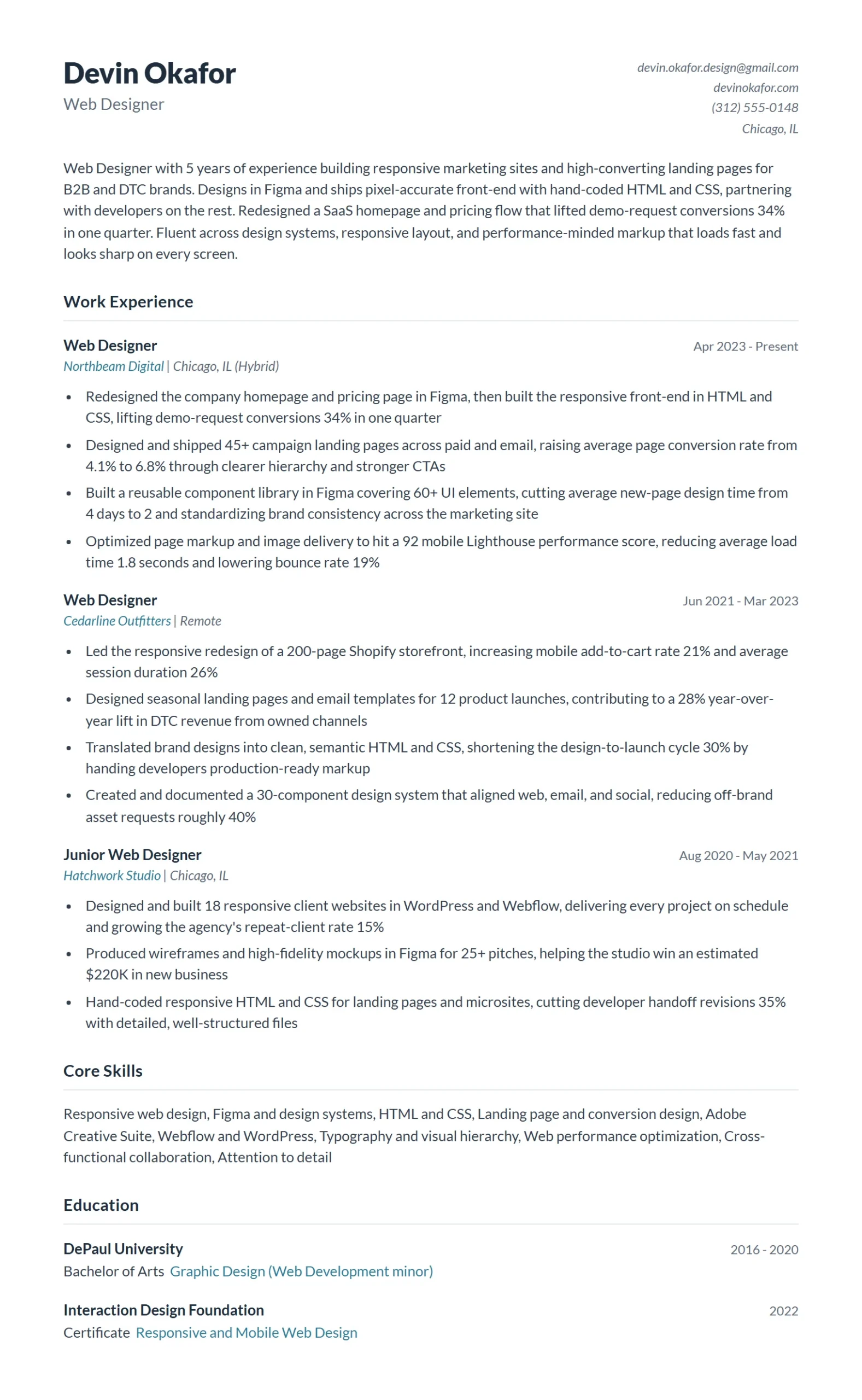
Web Designer resume example
Not sure how to show both visual skill and the results your sites drive without it reading like a software list? This web designer resume example balances craft and outcomes so hiring managers see the full picture.
This resume works because it pairs each project with a measurable result, like a redesign that lifted conversions or a faster page that cut bounce rate, instead of just naming responsibilities. It leads with a focused skills section that surfaces ATS keywords such as responsive design, Figma, HTML, and CSS, then backs them up with experience that shows the work from concept to launch. The clean, single-column layout keeps it easy for both recruiters and the ATS to scan.
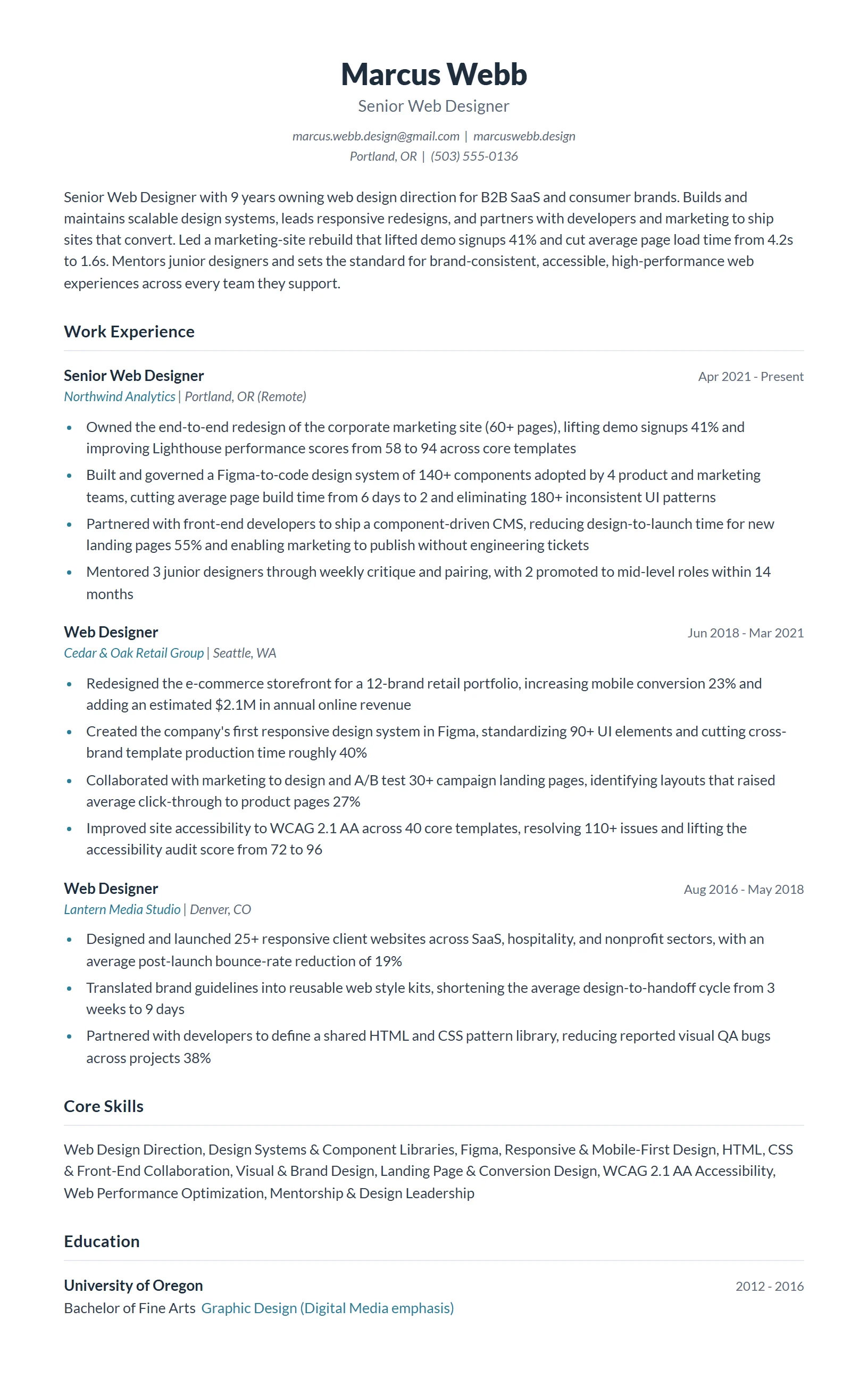
Senior Web Designer resume example
Stepping up to a senior role means proving you can set direction, not just execute pages. This senior web designer resume example shows how to frame design leadership, systems work, and cross-functional influence.
This resume works because it shifts the emphasis from individual builds to leadership and impact at scale: owning the design direction for a site or product area, building reusable design systems, and mentoring junior designers. Quantified outcomes (conversion gains, revenue influenced, redesigns shipped) signal seniority that a title alone cannot. It still carries the core tool and skill keywords an ATS expects, so depth never costs visibility.
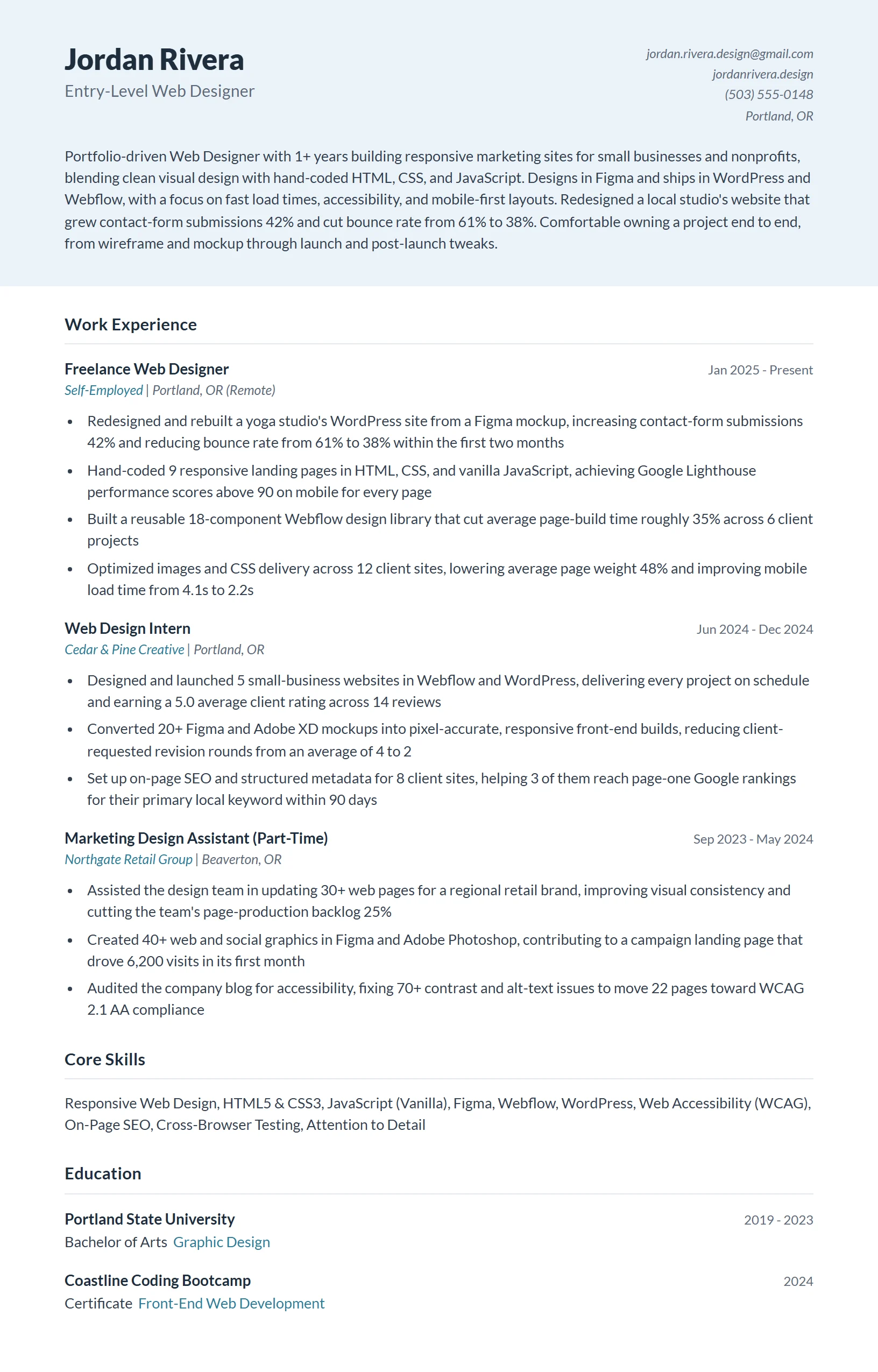
Entry-Level Web Designer resume example
Breaking into web design without years on the job feels daunting, but your projects and portfolio can carry the weight. This entry-level web designer resume example shows how to make limited experience look strong.
This resume works because it leans on coursework, internships, and self-directed client sites to prove capability when formal experience is thin. It puts a skills and tools section near the top to clear ATS keyword checks, and it describes each project by the problem solved and the result delivered, showing you already think beyond aesthetics. A prominent portfolio link gives hiring managers the proof they need to take a chance on a newer designer.
Freelance Web Designer resume example
Freelance work is varied by nature, and a resume has to make that range read as strength, not scatter. This freelance web designer resume example shows how to frame client projects, scope, and business results.

This resume works because it organizes diverse client work into a clear track record: sites launched, platforms used, and outcomes delivered, rather than a tangle of one-off gigs. It quantifies value the way a freelancer is judged (conversion lifts, projects shipped on deadline, repeat or referral clients) and groups tools and platforms like WordPress, Webflow, and Figma so an ATS still finds its keywords. Framing self-employment as managed projects signals reliability that contract roles reward.
UI Designer resume example
When a role centers on the interface itself, your resume has to lead with visual systems and precision. This UI designer resume example shows how to foreground components, hierarchy, and the tools behind polished screens.

This resume works because it centers interface craft: design systems, component libraries, visual hierarchy, and responsive layouts, then ties each to the product it shipped on. It surfaces the keywords UI job descriptions reward, like Figma, design systems, and UI design, and shows the handoff from design to development so engineers and recruiters both see fit. Pairing tool fluency with examples of consistent, scalable interfaces reads as a specialist to the ATS and the hiring team alike.
How to write a Web Designer resume that gets interviews
Hiring managers skim a web designer resume for two things at once: a portfolio of live sites they can click and proof that your designs actually performed (faster load times, higher conversions, more engaged visitors). Most companies also run your resume through an Applicant Tracking System (ATS) before a person ever reads it, so your language has to match the job description first. The tips below show you how to do both: clear the ATS scan and convince the design lead or marketing manager reading next.
- Lead with a portfolio link to live, shipped sites: A web designer resume without a portfolio is dead on arrival. Put a clickable URL in your header next to your email, and make sure it leads with real sites you can point to, not just static mockups. Recruiters want to visit the work, check that it loads fast, looks right on mobile, and reflects the visual range of the job. The resume earns the click; the portfolio earns the interview, so treat that link as the most important line on the page.
- Quantify design outcomes, not just deliverables: Anyone can say they redesigned a homepage. Show what it did: “lifted conversion rate 18%,” “cut bounce rate from 64% to 41%,” or “improved mobile page-load time from 4.2s to 1.6s.” Tie your work to conversions, engagement, bounce rate, load speed, or time on page. If you do not have business metrics, use design-system or efficiency wins, like cutting template build time or standardizing 30+ page layouts. They prove impact just as well.
- Show both the visual design and the build: Web designers sit between art direction and front-end code, so prove you can do both. Reference visual work (layout, typography, responsive design, brand systems) and the build side (HTML, CSS, JavaScript, and the CMS or builder you ship in, such as WordPress, Webflow, or Shopify). A resume that only lists Photoshop reads as graphic design; a resume that pairs Figma with hand-coded responsive layouts reads as a designer who can actually launch a site.
- Match tools and keywords to the job description: ATS scans for exact terms. List the tools you really use (Figma, Adobe XD, Photoshop, Illustrator, WordPress, Webflow, Sketch) and the methods named in the posting (responsive design, UI design, wireframing, design systems, HTML/CSS, WCAG accessibility, SEO basics). If the role says “Webflow” and you build in Webflow, use that exact word. Skip dead tools like Flash and never keyword-stuff, because design leads notice.
- Name the collaboration and the client work: Web design rarely happens solo. Hiring managers want designers who partner with developers, marketers, and content teams, and who can take a brief from a client or stakeholder and ship to deadline. Use bullets that name the partnership and the result: “Partnered with 3 developers and the marketing team to launch a 40-page site redesign on schedule, lifting demo signups 24%.” This signals you can run a real project, not just hand off comps.
- Keep the format ATS-clean and tailor each version: An agency role, an in-house brand role, and a front-end-leaning role reward different keywords and samples, so reorder your skills and swap your headline projects to mirror each posting. Then keep parsing simple: standard section headings, no text boxes or multi-column layouts that scramble an ATS, and one clean column. Run the resume through Jobscan to check your match rate against the job description before you apply.

Web Designer resume summary examples
Your summary is the first thing a recruiter reads. Lead with your specialty, years of experience, and a quantified win.
Good web Designer resume summary examples
- Web designer with 6+ years designing and building responsive marketing sites across SaaS and e-commerce. Redesigned a flagship site that lifted conversion 18% and cut mobile load time from 4.1s to 1.5s. Fluent in Figma, WordPress, and hand-coded HTML/CSS, with a portfolio of 30+ live sites serving 1M+ monthly visitors.
- Front-end-focused web designer who ships pixel-accurate, accessible layouts from Figma to production. Owns the full arc from wireframe to launch in Webflow and WordPress. Recent redesign dropped bounce rate from 62% to 39% and earned a 98 Lighthouse performance score on mobile.
- Brand-minded web designer specializing in conversion-driven landing pages and design systems. Built and documented a component library adopted by 4 product teams, cutting page build time 40%. Known for pairing closely with developers and marketers to ship work that loads fast and converts.
What to avoid
- Creative web designer looking for an exciting opportunity to grow my skills and build beautiful websites for a great company. (It is all about what the candidate wants, not what they deliver. There is no specialization, no tools, no portfolio signal, and zero evidence of impact. A hiring manager learns nothing they can act on.)
- Passionate designer with a great eye for detail who loves making clean, modern, user-friendly websites. (Pure adjectives with no proof. “Clean” and “modern” are claims anyone can make. It names no tools, no build skills, and no measurable result like conversion lift or faster load time, so the ATS and the recruiter both skip past it.)
Web Designer resume skills
Pull the exact tools and methods from each job description, then mirror that language here. This is a quick resume snapshot, so keep it to your strongest, role-relevant skills rather than an exhaustive list.
Hard skills for a web Designer resume
- Responsive Web Design
- UI Design
- Figma
- Adobe Creative Suite (Photoshop, Illustrator)
- HTML & CSS
- JavaScript
- WordPress
- Webflow
- Design Systems
- Web Accessibility (WCAG)
Soft skills for a web Designer resume
- Collaboration
- Communication
- Attention to Detail
- Client Management
- Time Management
- Problem Solving
Web Designer resume work experience bullet point examples
Lead each bullet with a strong verb and a measurable result.
Good bullet point examples
- Redesigned the company homepage and pricing page in Figma, then built them in WordPress, lifting conversion rate 18% and adding an estimated $320K in annual revenue.
- Rebuilt 40+ responsive page templates to a new design system, cutting mobile page-load time from 4.2s to 1.6s and improving the Lighthouse performance score from 58 to 94.
- Designed and hand-coded a conversion-focused landing page in HTML/CSS for a paid campaign, raising demo signups 27% over the previous version in an A/B test.
- Partnered with 3 developers and the marketing team to ship a 50-page site redesign on deadline, reducing bounce rate from 61% to 42% across the top traffic pages.
Bad bullet point examples
- Designed web pages and banners for various clients using Photoshop. (Lists a task with no outcome. “Various clients” is vague, and there is no result, no metric, and no sign the work shipped. It tells the reader you used a tool but not whether your design mattered.)
- Responsible for the look and feel of the company website. (“Responsible for” describes a job title, not an accomplishment. It shows no specific action, no build work, and no measurable impact. Lead with a strong verb (Redesigned, Built, Launched) and end with a result instead.)
- Made the website look more modern and easier to navigate. (Subjective and unquantified. “More modern” and “easier to navigate” are opinions with no proof. Replace them with the metric that backs the claim, such as a lower bounce rate, higher conversion, or faster load time.)
Web Designer resume tips
A strong web designer resume proves you can ship beautiful, functional work that moves the needle for real users.
- Mirror the Job Post: Copy exact tool names and skill phrases from each posting (for example, write ‘Webflow’ or ‘Figma’ exactly as the employer wrote them) so your resume passes ATS keyword matching before a human ever sees it.
- Quantify Design Impact: Attach a performance number to every major project: conversion rate lifts, bounce rate reductions, page load time improvements, or accessibility score gains give recruiters proof your designs did more than look good.
- Name Every Relevant Tool: List specific tools in a dedicated skills section, including Figma, Adobe Creative Suite (Photoshop and Illustrator), Webflow, WordPress, HTML, CSS, and JavaScript, because ATS systems often scan for exact software names.
- Link Your Portfolio Prominently: Place a clickable portfolio URL directly under your contact information, not buried in a summary, so hiring managers can open live work the moment they load your resume.
- Tailor for Role Type: Emphasize responsive web design and HTML or CSS for in-house developer-adjacent roles, but lead with UI design, client management, and collaboration skills when applying to agencies where soft skills and account work carry equal weight.
- Keep It One Page: Unless you have more than ten years of experience, fit everything on one page: web design roles attract large applicant pools, and a tight, scannable resume signals the same editing judgment you bring to a finished layout.
Pair your web Designer resume with a cover letter
A strong resume goes further with a tailored cover letter. Browse our web designer cover letter examples to round out your application.
Web Designer resume frequently asked questions
Lead with a portfolio of real or self-directed projects, like redesigns of existing sites, freelance work, or volunteer builds for local businesses and nonprofits. List the tools you actually use (Figma, Adobe XD, HTML, CSS) and frame coursework or bootcamp projects as deliverables with measurable outcomes. A strong portfolio link near the top of your resume often matters more to a hiring manager than years on the job.
Yes, always. Put your portfolio URL in the header next to your contact info so it is impossible to miss, and make sure the link works and points to current work. For most web design roles the portfolio is the deciding factor, so treat it as a required element, not an optional extra.
Common must-haves include design tools (Figma, Sketch, Adobe Creative Suite), front-end basics (HTML, CSS, and often JavaScript), responsive and mobile-first design, and familiarity with platforms like WordPress or Webflow. Many listings also want UX fundamentals such as wireframing, prototyping, and accessibility (WCAG). Match the exact tool names from the job description so an applicant tracking system can recognize them.
Use a clean, single-column layout with standard section headings (Experience, Skills, Education) and skip text inside images, since an ATS cannot read those. Mirror the exact keywords from the job posting, such as specific tools and skills like Figma, responsive design, or UI/UX, using the same wording the employer uses. Save and submit as a .docx or text-based PDF unless the listing asks for a different format.
Tie your design work to outcomes the business cares about, like conversion rate, bounce rate, page load time, or engagement. For example, write “Redesigned checkout flow, lifting mobile conversions 18%” rather than “Designed web pages.” Even small projects can show impact if you track a before-and-after number.
It depends on the role you are targeting. If the job emphasizes user research, wireframing, and prototyping, call out UX/UI skills clearly because employers increasingly expect web designers to handle both visual and experience design. Read the job description and lead with whichever side it weighs more heavily, while still showing you can do both.