Best 3D Artist Resume Examples for 2026
Build a 3D Artist resume that lands interviews in 2026 with real examples, the software and pipeline skills studios scan for, and ATS-ready formatting.



3D artists build the models, textures, environments, and animation that bring games, film, product design, and AR/VR to life. The role blends technical craft with visual storytelling, so your resume has to prove both: command of the tools and a portfolio of work that shipped.
Hiring managers at studios scan fast. They want specific software (Maya, Blender, ZBrush, Substance Painter, Unreal Engine), a clear sense of where you sit in the pipeline, and shipped titles or projects with measurable polish. Before a human ever sees it, an applicant tracking system checks your resume for the exact tools and keywords in the job post, so generic phrasing gets filtered out.
The examples below show how to surface your reel, your technical stack, and your production wins so your resume clears the ATS and earns a closer look. Pair them with Jobscan to match your resume to each job description before you apply.
Ready to build yours? Try our ATS-friendly resume builder or scan your draft against the job description.
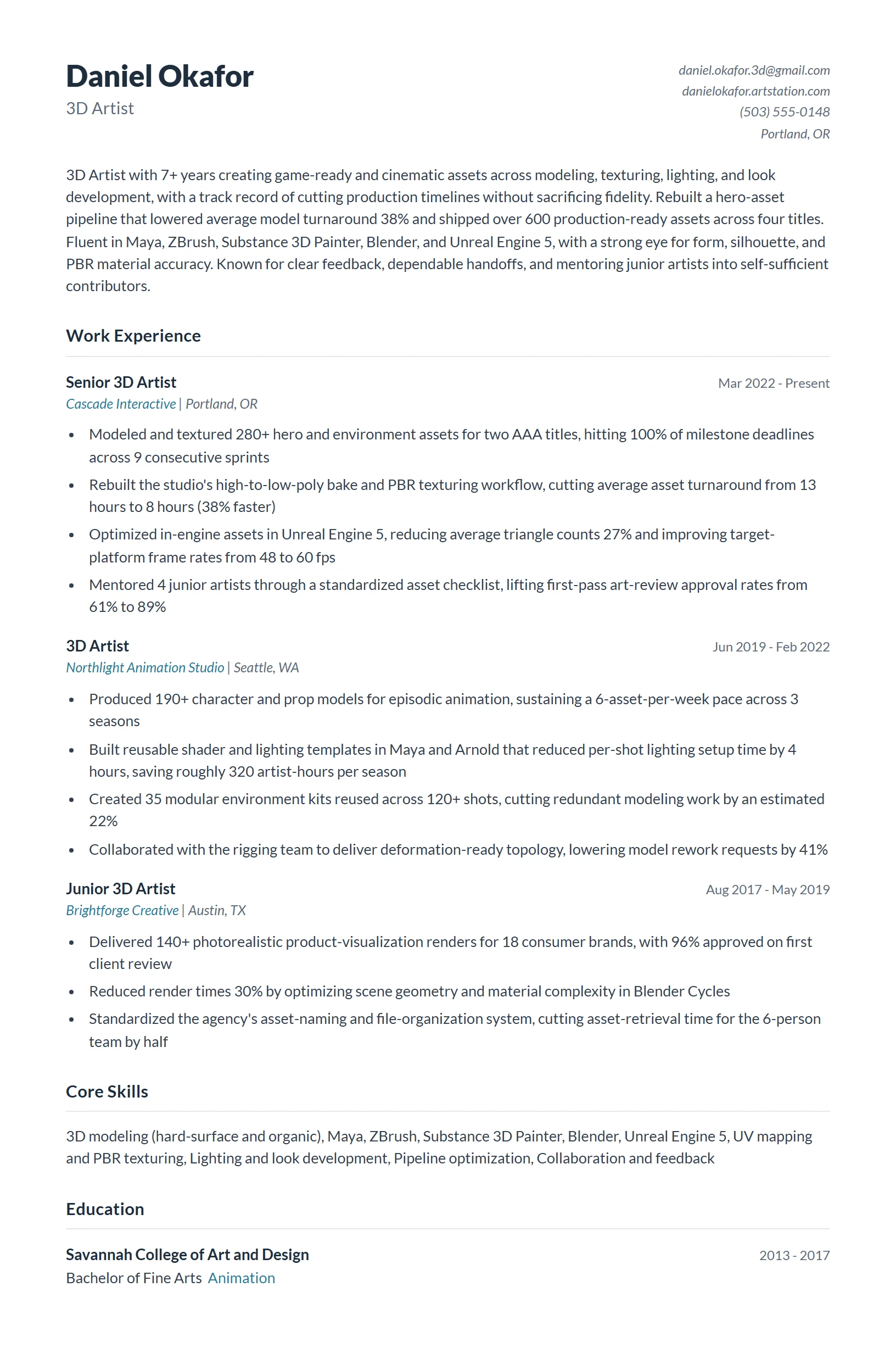
3D Artist resume example
A generalist 3D artist resume built to show range across modeling, texturing, and lighting while still proving depth in a core specialty.
It leads with a tools-and-pipeline summary so recruiters and ATS see Maya, Blender, and Substance Painter in the first scan. Project bullets tie each piece of work to a shipped title or client outcome, which turns a portfolio link into evidence. A dedicated skills block mirrors the exact software named in the job post.
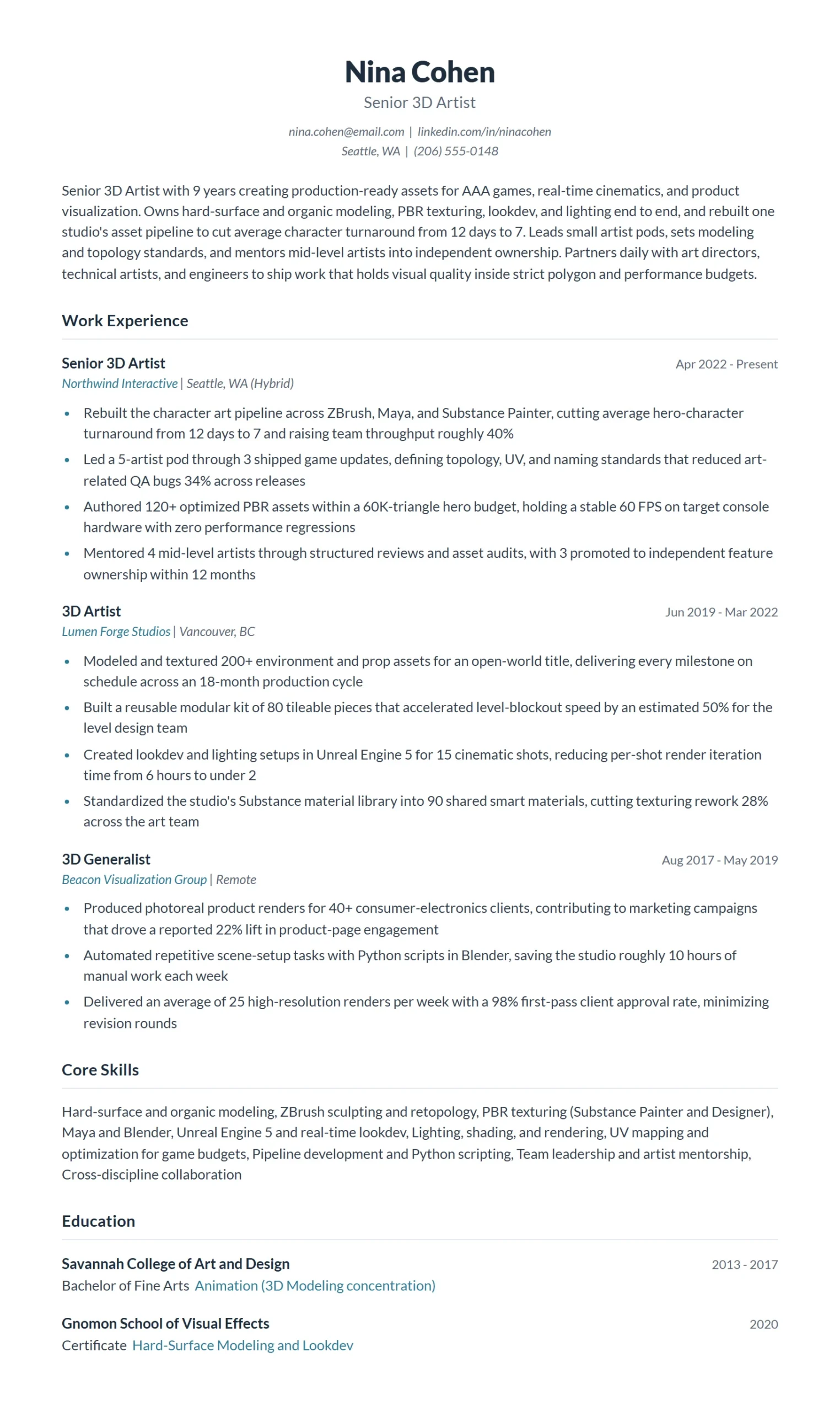
Senior 3D Artist resume example
A senior resume that frames the candidate as a craft leader who owns asset quality and mentors junior artists.
It foregrounds pipeline ownership, art direction input, and the number of artists or projects guided, signaling scope beyond hands-on work. Achievement bullets quantify efficiency gains, like reducing asset turnaround or standardizing shader workflows. Shipped AAA or flagship titles anchor seniority that hiring managers can verify.
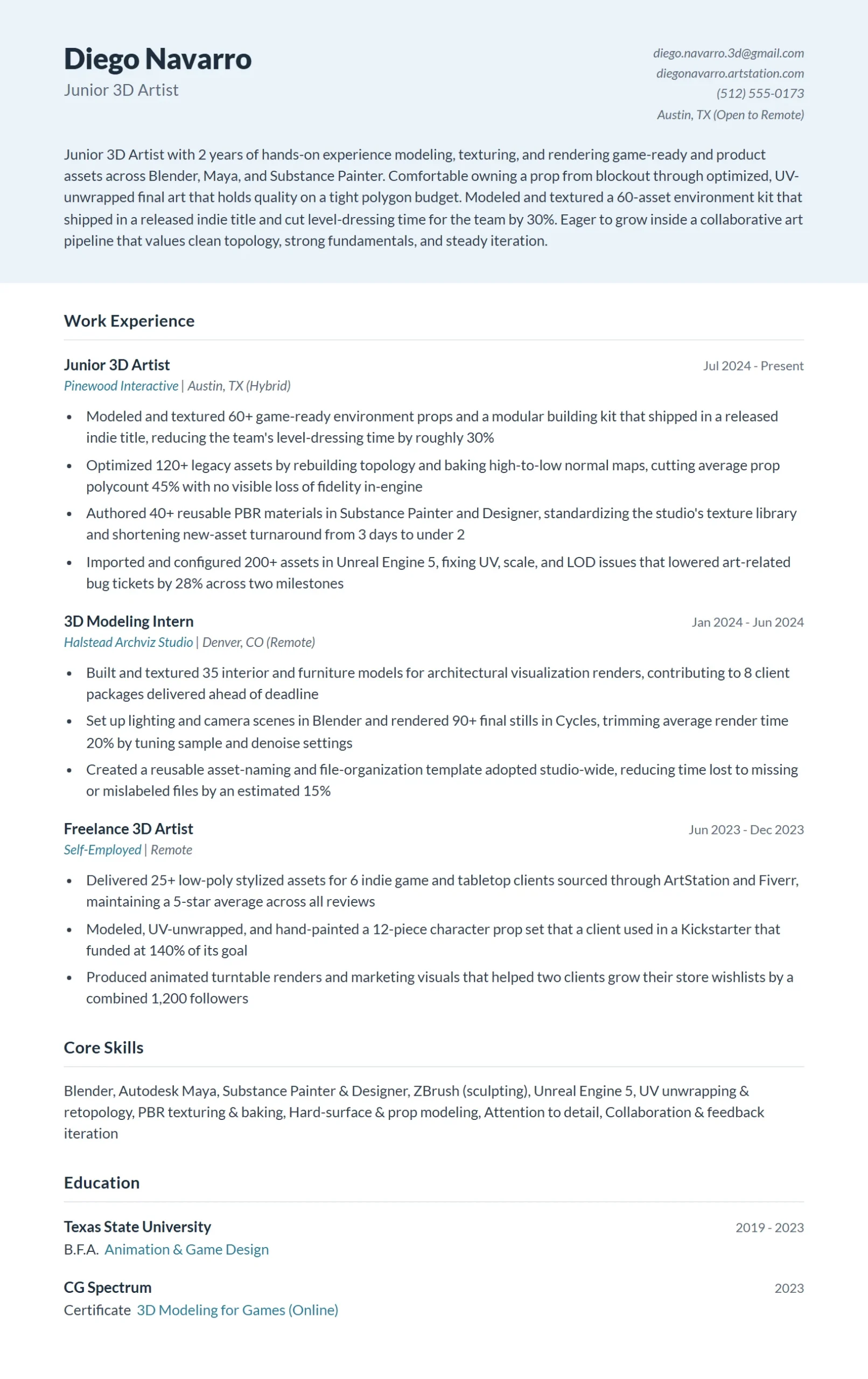
Junior 3D Artist resume example
An entry-level resume for grads, bootcamp finishers, and career-changers with a strong reel but limited studio experience.
It puts the portfolio link and a focused skills section up top so thin work history does not bury the talent. Student projects, game jams, and freelance gigs are written as real production work with tools and outcomes named. Relevant coursework and certifications fill the experience gap without padding.
3D Modeler resume example
A specialist resume centered on hard-surface and organic modeling for games, film, or product visualization.

It emphasizes topology, UV unwrapping, and clean, game-ready meshes, the details lead artists actually screen for. Bullets cite poly budgets met and assets delivered on deadline to prove production discipline. Naming ZBrush, Maya, and 3ds Max precisely matches the modeler-specific keywords in the ATS.
3D Animator resume example
A specialist resume for artists who bring characters and objects to motion across games and film.

It highlights animation principles, rigging familiarity, and reel sequences tied to specific shots or in-game actions. Bullets reference frame counts, character performances, or cinematics delivered, giving concrete proof of output. The skills block names Maya, MotionBuilder, and engine animation tools to match animator job posts exactly.
3D Environment Artist resume example
A specialist resume for artists who build worlds, sets, and level art for games and virtual production.

It centers world-building, modular asset creation, and lighting that holds up in real time inside Unreal or Unity. Bullets connect environments to shipped levels or scenes and note performance constraints hit. Listing Unreal Engine, Megascans, and Substance Designer surfaces the environment-specific keywords studios search for.
3D Character Artist resume example
A specialist resume for sculptors who design and build characters and creatures for games and film.

It leads with high-to-low-poly sculpting, anatomy, and look-development work tied to recognizable characters or projects. Bullets show creatures or heroes taken from concept to game-ready asset, proving end-to-end ownership. ZBrush, Substance Painter, and Marvelous Designer in the skills block match character-art job requirements.
How to write a 3D Artist resume that gets interviews
Art directors and recruiters skim a 3D artist resume for two things: proof you can hit the studio’s visual bar, and proof you can do it inside a real production pipeline. Your demo reel sells the craft, but the resume decides whether anyone clicks it. Before a human even sees it, most studios run your resume through an Applicant Tracking System (ATS) that scans for software, techniques, and role keywords pulled from the job description. The tips below show you how to clear that scan and convince the art lead reading next.
- Put your demo reel link at the top, and make every second earn its place: A 3D artist resume without a reel link is dead on arrival. Add a clickable URL in your header next to your email (ArtStation, a personal site, or a hosted reel). Then make sure the reel opens with your strongest 5 seconds and runs 60 to 90 seconds, with a shot breakdown listing exactly what you did on each piece (modeled, textured, lit, rendered) and the software used. The resume earns the click; the reel earns the interview, so treat that link as the most important line on the page.
- Name your software and pipeline by exact version and role: ATS scans for specific terms, and 3D hiring is software-specific. List what you actually use: Maya, Blender, 3ds Max, ZBrush, Substance Painter and Designer, Houdini, Marvelous Designer, and your render engine (Arnold, V-Ray, Redshift, Cycles) or real-time engine (Unreal Engine 5, Unity). If the posting says “hard-surface modeling in Maya” or “lookdev in Substance,” mirror that exact phrasing where it is true. Match your stack to the discipline too: a games role wants real-time and PBR workflows, a film or VFX role wants offline rendering and high-poly detail.
- Quantify the craft with production specs, not just adjectives: “Created high-quality 3D models” tells an art lead nothing. Show the constraints you hit: “Modeled and textured 40+ game-ready hero assets at a 15k-tri budget with 4K PBR texture sets,” “Optimized scene geometry to cut render times 35%,” or “Delivered 12 cinematic shots on a 6-week schedule with zero retakes.” Poly counts, texture resolution, draw-call budgets, render times, shot counts, and on-time delivery are the numbers that prove you can work to spec, not just make pretty renders in isolation.
- Show you fit a collaborative production pipeline: 3D work is rarely solo. Studios want artists who take direction, hit deadlines, and hand clean files to the next department. Reference the pipeline in your bullets: clean topology and UVs for the rigging team, naming conventions and version control (Perforce, Git, ShotGrid), feedback from art directors and leads, and handoff to animation, lighting, or engine integration. A bullet like “Delivered rig-ready models with optimized UVs that cut downstream rework 30%” signals you can operate inside a real team, not just on your own machine.
- Tailor the resume and reel to the discipline and industry: A character artist, an environment artist, and a hard-surface or prop artist reward different keywords and reel pieces, and games, film, VFX, archviz, and product visualization each judge work differently. Reorder your skills and swap your headline reel shots to mirror each posting. If a studio hires for environments in Unreal, lead with your real-time environment work and the engine, not a hero character bake. Generalist resumes that try to cover everything usually convince no one.
- Keep the format ATS-friendly so the parser does not scramble it: It is tempting to design your resume like a portfolio piece, but heavy graphics, multi-column layouts, icons, and text inside images break ATS parsing and can drop your content entirely. Use a clean single-column layout, standard section headings (Experience, Skills, Software, Education), real selectable text, and a .docx or text-based PDF. Save the visual showmanship for your reel and ArtStation, then run the resume through Jobscan to check your match rate against the job description before you apply.

3D Artist resume summary examples
Your summary is the first thing a recruiter reads. Lead with your specialty, years of experience, and a quantified win.
Good 3D Artist resume summary examples
- 3D environment artist with 6 years creating game-ready worlds for AA and AAA titles in Unreal Engine 5. Built 200+ modular assets and trim sheets on strict tri and draw-call budgets, and authored PBR materials in Substance Designer that shipped in two console releases. Known for clean modular kits that cut level-dressing time for the design team by 30%.
- Character artist specializing in high-to-low poly hero assets for cinematics and games. Owns the full pipeline from ZBrush sculpt through retopology, UVs, and Substance Painter texturing, delivering 40+ production characters at 4K PBR fidelity. Recent hero asset led the studio reel and was approved by the art director with zero major revisions.
- Hard-surface and prop 3D artist with 4 years across product visualization and games. Models photoreal assets in Maya and lights and renders in Arnold and Redshift, cutting average shot render time 35% through optimized geometry and shader reuse. Comfortable taking a brief from concept to final beauty render on a deadline.
What to avoid
- Creative and passionate 3D artist looking for an exciting opportunity to make amazing art and grow with a talented team. (It is all about what the candidate wants, not what they deliver. There is no discipline (character, environment, props), no software, no reel signal, and zero evidence of production work. An art lead learns nothing they can act on.)
- Talented 3D artist skilled in many software programs with a strong eye for detail and a love of creating beautiful, realistic models. (Pure adjectives with no proof. “Many software programs” hides the exact tools an ATS scans for, and “beautiful, realistic” is a claim anyone can make. It names no specialty, no pipeline, no poly or texture specs, and no shipped work, so it reads as filler.)
3D Artist resume skills
Pull the exact software and techniques from each job description, then mirror that language here, leading with the discipline (character, environment, hard-surface) the role hires for. Keep this a quick snapshot of your strongest, role-relevant skills rather than an exhaustive tool dump.
Hard skills for a 3D Artist resume
- 3D Modeling (hard-surface & organic)
- Texturing & PBR Materials
- Lighting & Rendering
- UV Mapping & Retopology
- Maya / Blender / 3ds Max
- ZBrush
- Substance Painter & Designer
- Unreal Engine 5 / Unity
- Arnold / V-Ray / Redshift
- Sculpting & Digital Painting
Soft skills for a 3D Artist resume
- Collaboration
- Communication
- Receiving Art Direction
- Time & Deadline Management
- Attention to Detail
- Adaptability
3D Artist resume work experience bullet point examples
Lead each bullet with a strong verb and a measurable result.
Good bullet point examples
- Modeled and textured 60+ game-ready environment assets in Maya and Substance Designer on a 12k-tri budget with 4K PBR materials, shipped in a UE5 title with 500k+ players.
- Sculpted and retopologized 25 hero characters from ZBrush to a clean game-ready mesh with optimized UVs, cutting downstream rigging rework 30% across the production.
- Lit and rendered 14 cinematic product shots in Arnold, optimizing scene geometry and shaders to reduce average render time from 9 hours to under 6 per frame.
- Built a modular environment kit and trim-sheet system in Unreal Engine 5 that cut level-dressing time for 4 designers by an estimated 35% per level.
Bad bullet point examples
- Created various 3D models and textures using Maya and other software. (Lists a task with no outcome. “Various models” is vague, and there is no poly budget, texture spec, discipline, or shipped result. It tells the reader you opened a program but not whether your work met production standards.)
- Responsible for the 3D art on several projects. (“Responsible for” describes a job title, not an accomplishment. It shows no specific asset, no software, no pipeline, and no measurable impact. Lead with a strong verb (Modeled, Sculpted, Lit, Rendered) and end with a spec or result instead.)
- Made high-quality, realistic models that looked great in the final render. (Subjective and unquantified. “High-quality” and “looked great” are opinions with no proof. Replace them with the constraints you hit (tri count, texture resolution, render time) or the production outcome, like shipping on schedule or passing art-director review without revisions.)
3D Artist resume tips
Beyond the basics, these six targeted tips help 3D Artists avoid common resume pitfalls and stand out in both ATS filters and recruiter reviews.
- Resume Length Rule: Keep your resume to one page if you have under eight years of experience, and cap it at two pages for senior or lead roles, because recruiters at studios scan fast and a bloated resume signals poor editing judgment.
- Avoid Broken Formatting: Submit your resume as a .docx or clean single-column PDF with no tables, text boxes, or columns, since many studio ATS platforms misread multi-column layouts and drop your software credits entirely.
- Keyword Placement Matters: Place software names and pipeline terms in a dedicated Skills section near the top of the document, because most ATS tools weight matches found in labeled sections more heavily than the same terms buried in bullet points.
- List Relevant Certifications: Include Autodesk Certified Professional credentials, Houdini apprentice completions, or Unreal Authorized Instructor status in a named Certifications section, because these signal verified proficiency that a software list alone cannot.
- Common Costly Mistake: The single most common mistake 3D Artists make is linking a demo reel that requires a password or a login, which causes recruiters to skip it entirely rather than request access.
- Show Cross-Team Communication: Name a specific instance where you translated a director note into a revised shading pass that was approved without further rounds, because that concrete outcome demonstrates production communication skills more credibly than listing the word collaborative.
Pair your 3D Artist resume with a cover letter
A strong resume goes further with a tailored cover letter. Browse our 3d artist cover letter examples to round out your application.
3D Artist resume frequently asked questions
Put your portfolio and reel link in the header so recruiters can click it in seconds, then use the resume to prove the skills behind the work. List your specialties (modeling, texturing, lighting, rigging, or look development), the software and render engines you use, and the projects or titles you contributed to. Think of the resume as the keyword-rich, ATS-readable index that gets you past the first screen so a human actually opens your reel.
Name the exact tools from the job posting rather than generic phrases, since ATS and recruiters search for specific terms. Common ones include Maya, Blender, 3ds Max, ZBrush, Substance Painter, Houdini, Unreal Engine, Unity, Marmoset, and render engines like Arnold, V-Ray, or Redshift. Add pipeline and workflow terms you genuinely know, such as PBR texturing, UV unwrapping, retopology, hard-surface or organic modeling, and game-ready asset optimization, then mirror the posting’s wording where it matches your real experience.
Translate visual work into outcomes by stating what you built, the constraints you hit, and the result. For example, “Modeled and textured 40+ game-ready environment assets under a 12k-tri budget, cutting scene load time by 18 percent.” Lead with strong verbs (modeled, sculpted, rigged, lit, optimized), include polygon or texture budgets and turnaround times when you can, and tie work to the shipped title, client, or release whenever possible.
Tailor it, because games and film and VFX value different things. Game studios care about real-time constraints, engine experience, LODs, and optimization, while film and VFX or animation studios weigh photorealism, simulation, and look development more heavily. Keep one master resume with all your experience, then trim and reorder it for each role so the most relevant specialty and software sit at the top.
Treat personal projects, game jams, freelance gigs, and coursework as real experience and describe them with the same outcome-focused bullets. List the project, your role, the tools used, and what you produced, such as “Created a fully textured character for a 48-hour game jam using Blender and Substance Painter.” Pair it with a strong, curated portfolio and reel, since hiring managers care far more about the quality of the work than where it came from.
Lead with the specialty the job is hiring for, then show useful range below it. Junior and generalist roles reward breadth across modeling, texturing, and lighting, while senior and studio roles usually want clear depth in one area like character modeling, environment art, or look development. Match your top-listed skills to the job title so a recruiter immediately sees you as the kind of artist they are looking for, and keep secondary skills brief.