Best Grad School Resume Examples for 2026
See proven grad school resume examples for 2026 plus expert tips to highlight research, coursework, and results that get applications noticed.



A grad school resume sells you to an admissions committee, not a hiring manager. It pulls together your academic record, research, relevant work, and skills into one focused page (or two, if your research warrants it) that shows you are ready for advanced study in your chosen field.
Committees and the application systems they use scan for specific signals: your degree and GPA, research or lab experience, publications or presentations, relevant coursework, and skills tied to the program. Clear section headings, standard formatting, and the exact terms from the program description help your application get read in full instead of skimmed past.
You have more to show than you think. The right structure turns your coursework, projects, and early experience into a credible case for admission. The examples below show you how to organize it and what to emphasize for the program you want.
Ready to build yours? Try our ATS-friendly resume builder or scan your draft against the job description.
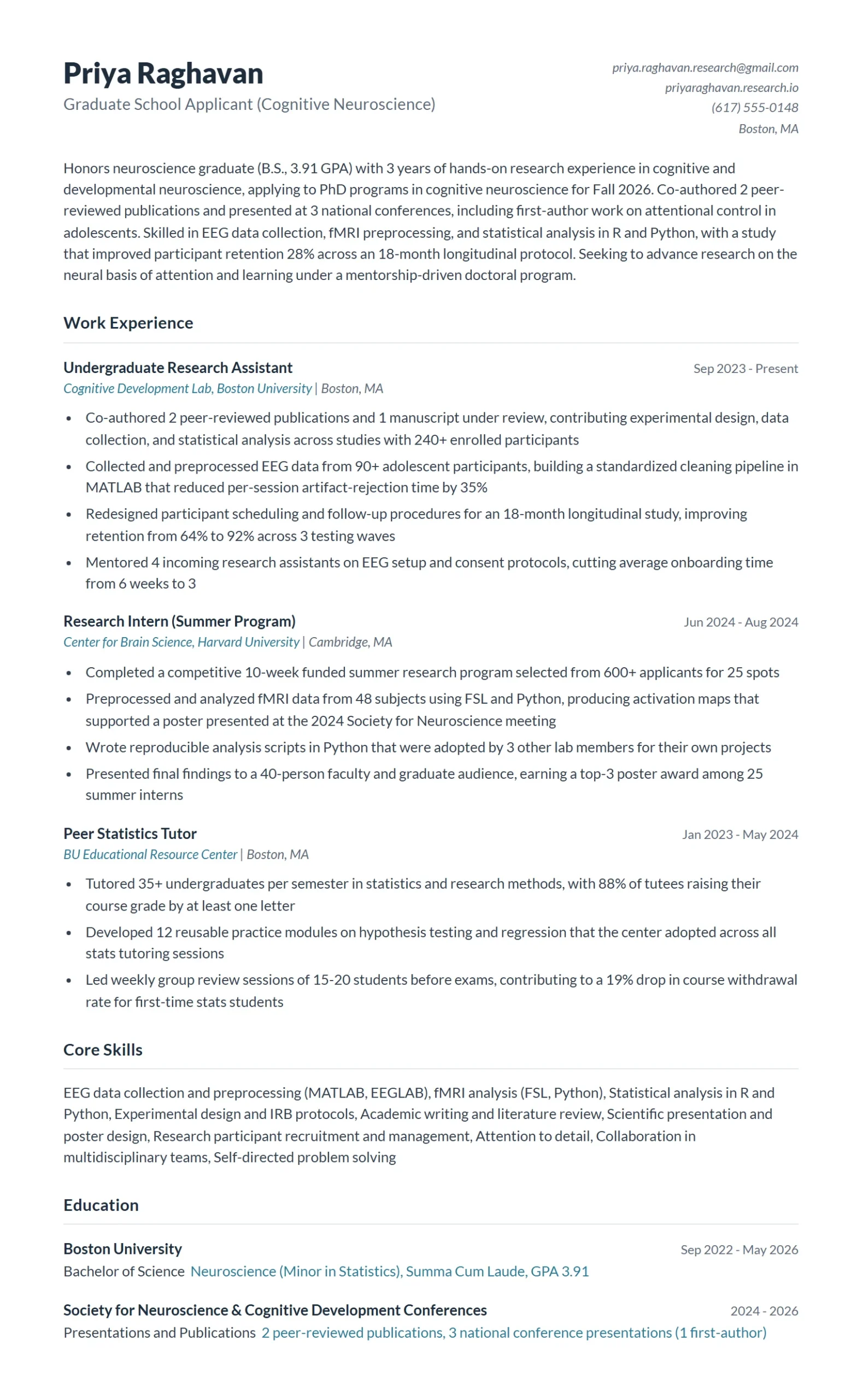
Grad School resume example
A clean, academically focused resume for any prospective graduate student applying to master’s or doctoral programs.
It leads with education and relevant research rather than burying them under a generic objective, which matches what committees look for first. Coursework, projects, and skills are framed around the target program, so every line reinforces fit. Clear, standard sections keep it readable for both reviewers and the application portals that parse it.
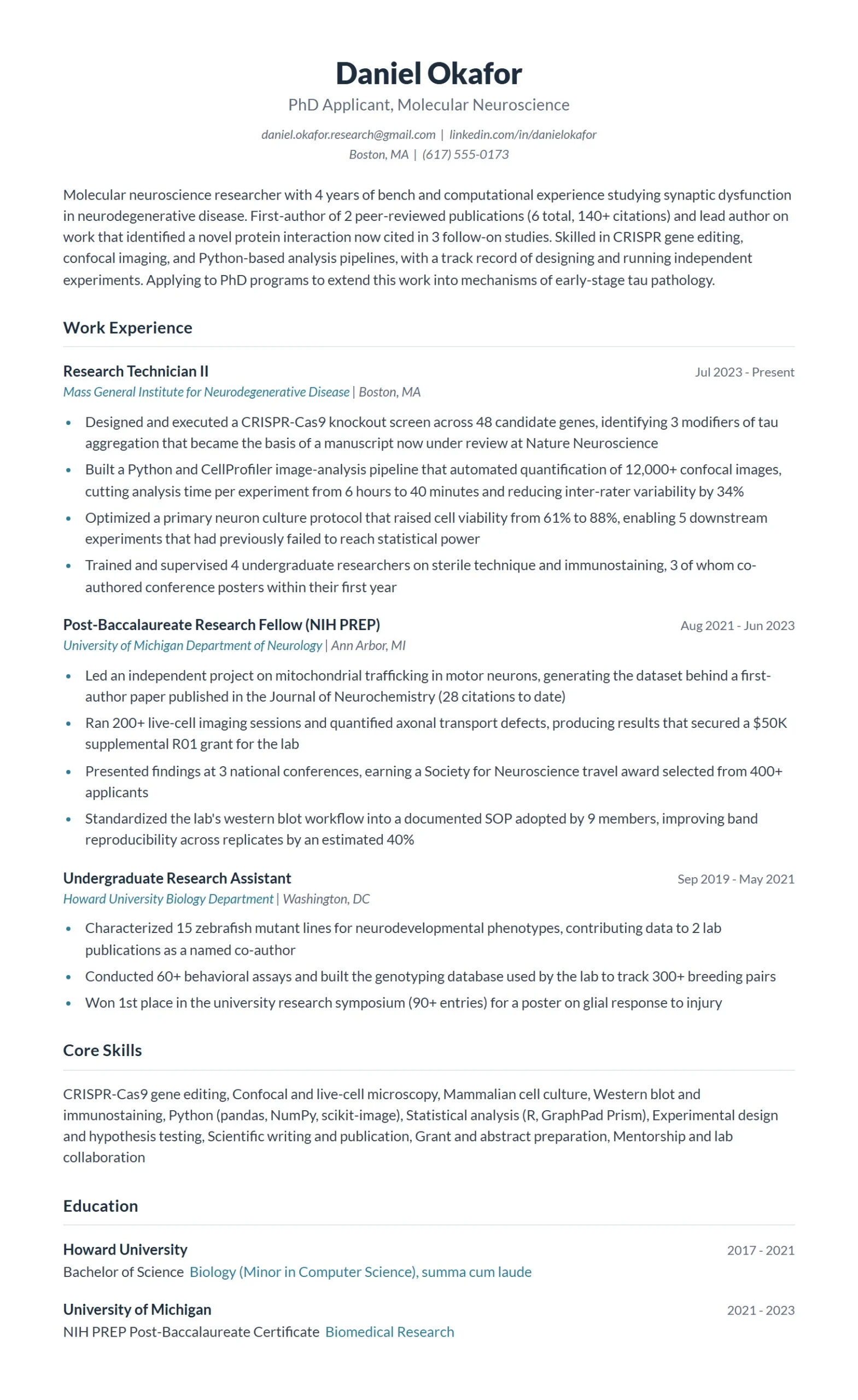
PhD Applicant resume example
A research-forward resume for doctoral applicants who need to prove depth and independent scholarship.
It puts research experience, publications, and presentations near the top, signaling readiness for original work. Each entry names methods, tools, and outcomes so reviewers can gauge technical capability quickly. The format reads like a streamlined academic CV while staying focused enough to scan.
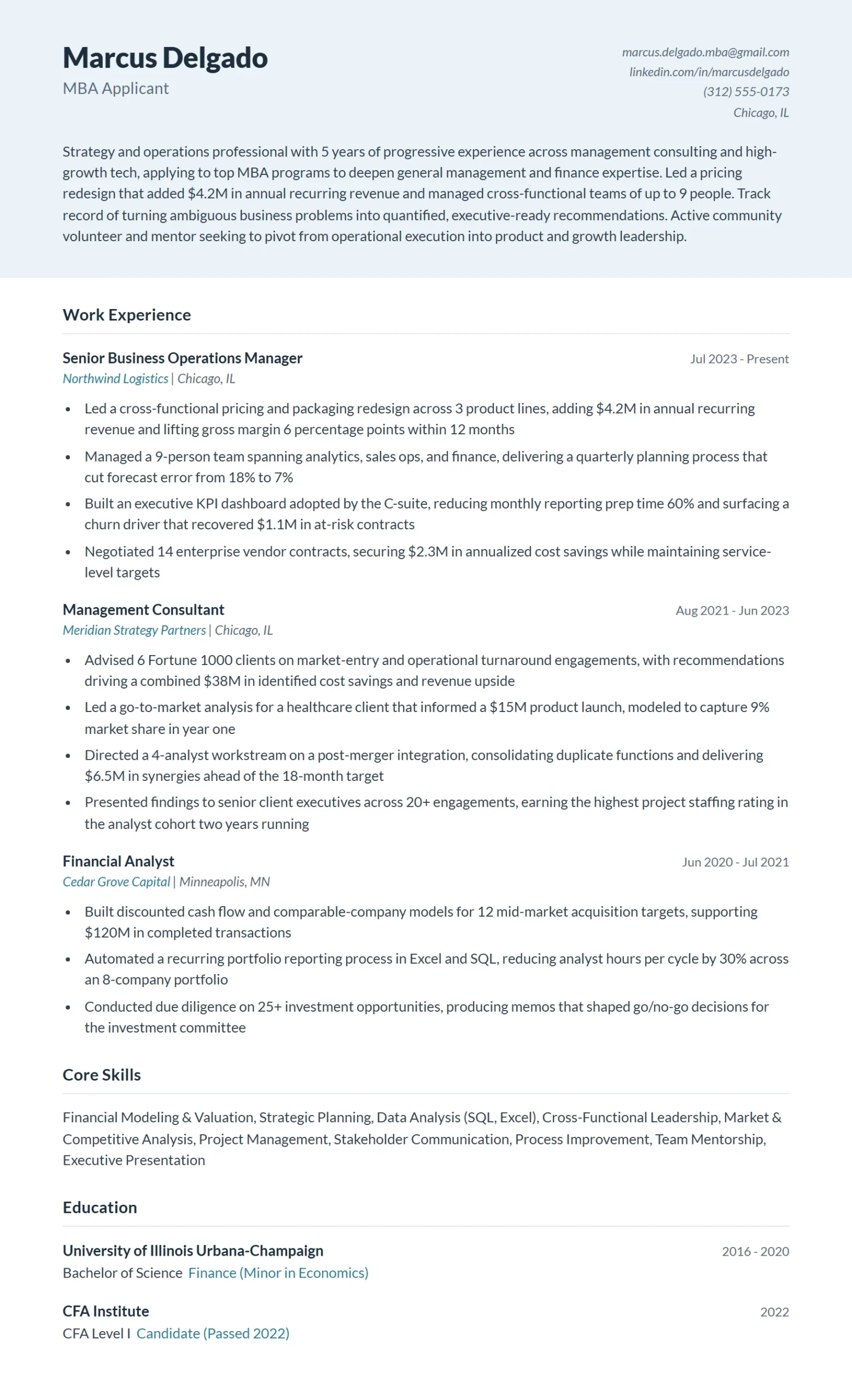
MBA Applicant resume example
A results-driven resume for business school applicants whose professional track record carries real weight in admissions.
It quantifies impact with numbers (revenue, team size, growth) because MBA committees evaluate leadership and outcomes, not just GPA. Career progression is easy to follow, showing increasing responsibility over time. Strong action verbs and concrete metrics make achievements credible rather than vague.
Master’s Program Applicant resume example
A balanced resume for MS, MA, MPH, and similar applicants bridging undergrad work and early experience.

It gives roughly equal space to education and relevant experience, which fits applicants who are not pure researchers or seasoned professionals. Coursework and skills are tailored to the specific program to show direct preparation. The layout stays to one page, keeping the focus tight and the reviewer moving.
Graduate School with Limited Experience resume example
A resume for recent grads or career changers applying with a thin work history.

It elevates coursework, academic projects, GPA, and honors so the page demonstrates ability even without years of experience. Class projects are written like real accomplishments, with the problem, approach, and result spelled out. Volunteer work and transferable skills round it out, showing initiative beyond the classroom.
Research Assistant resume example
A lab-focused resume that works for both grad applications and research assistant positions.

It centers hands-on methods, instrumentation, and data skills that programs and principal investigators screen for directly. Contributions to studies are described with specific techniques and measurable results rather than generic duties. The keyword-rich, technical framing helps it clear the application systems that filter on exact skill terms.
How to write a Grad School resume that gets interviews
A grad school resume is read by an admissions committee and the faculty you want to work with, not a corporate recruiter, so the bar is different. They are deciding whether you are ready for graduate-level work and whether your interests fit their program and labs. They look for research experience, academic achievement, and a clear through-line that points toward what you want to study next. Many programs also route applications through a portal that parses your resume, so clean formatting and the right terms still matter. The tips below show you how to position yourself as a strong candidate for the program, not just a good employee.
- Lead with education, not work experience: Unlike a job resume, a grad school resume puts Education first and gives it room to breathe. List your degree, institution, graduation date, GPA (if 3.5 or above, or if the program asks), major and minor, honors, and relevant coursework that maps to the program you are applying to. If you wrote a thesis or completed a capstone, name it and add a one-line description. The committee wants to see your academic foundation before anything else.
- Make research experience the centerpiece: Research is the single strongest signal for most graduate programs, especially anything thesis-based or PhD-track. Detail the labs you worked in, the principal investigator or faculty you reported to, your specific contributions, the methods you used, and any findings. Be concrete: “Ran 40+ behavioral trials,” “cleaned and analyzed a 12,000-row dataset in R,” “co-developed the experimental protocol.” If you have limited research, count independent projects, course research, and data-heavy internships.
- List publications, presentations, and posters in their own section: Anything you authored or presented belongs in a dedicated section, formatted in the citation style of your field (APA, MLA, IEEE, or Chicago). Include peer-reviewed papers, conference posters, talks, preprints, and works in progress (mark them “in preparation” or “under review”). Even one undergraduate poster at a regional conference signals you can do and communicate scholarly work. This is a section a job resume rarely has, and committees look for it directly.
- Connect your experience to the program and faculty you are targeting: Generic resumes get lost. Tailor yours so the research interests, coursework, and skills you highlight align with the specific program, lab, or advisor you are applying to. If a professor studies cognitive aging and you ran memory experiments, foreground that. Mirror the language the department uses on its site. This shows fit, which is often the deciding factor between two academically strong applicants.
- Quantify academic and project impact, not just job duties: Numbers work in admissions too. Show scale and outcome: “Tutored 25 students per term with a 90% pass rate,” “presented findings to a 60-person department colloquium,” “managed a $5,000 undergraduate research grant.” Quantify datasets, participants, hours, awards, and funding. Vague phrases like “assisted with research” tell the committee nothing about what you can actually do at the graduate level.
- Add the academic sections a job resume skips, and keep formatting clean: Include sections that signal scholarly readiness: relevant coursework, honors and awards, scholarships and grants, academic and professional memberships, languages, and technical or lab skills. Drop unrelated high-school jobs unless space allows and they show transferable skill. Keep it to one or two pages, use standard section headings, and avoid columns or text boxes that break portal parsing. Run it through Jobscan against the program description or call for applicants to confirm the key terms are present.

Grad School resume summary examples
Your summary is the first thing a recruiter reads. Lead with your specialty, years of experience, and a quantified win.
Good grad School resume summary examples
- Psychology graduate (B.S., 3.8 GPA) with two years of research experience in cognitive neuroscience, targeting a PhD in developmental psychology. Co-authored one poster presented at the Midwestern Psychological Association and ran 40+ EEG sessions in Dr. Lee’s lab. Proficient in R, SPSS, and experimental design, with a strong interest in memory development across the lifespan.
- First-generation B.A. in Economics (summa cum laude) seeking admission to a master’s in public policy. Completed a senior thesis on minimum-wage effects using panel data, presented at the university research symposium, and held a $4,000 undergraduate research fellowship. Skilled in Stata, econometric modeling, and policy analysis, with two summers in state-level legislative research.
- Biology major and undergraduate researcher with three semesters in a molecular genetics lab, applying to PhD programs in cell biology. Contributed to one manuscript under review and presented a poster at a regional ABRCMS conference. Experienced in PCR, CRISPR gene editing, and data analysis, aiming to study gene regulation in stem cells.
What to avoid
- Hardworking recent graduate looking to attend a great grad school program to advance my education and career. (It says nothing about field, research, or fit. There is no major, no GPA, no research signal, and no mention of what the candidate wants to study or why this program. A committee cannot evaluate readiness or interest from any of it.)
- Motivated student passionate about science and eager to learn from world-class faculty in your program. (Pure flattery and adjectives with zero evidence. “Passionate” and “motivated” are claims every applicant makes. It names no research experience, no methods, no coursework, and no specific interest, so it reads as filler the committee skips.)
Grad School resume skills
Pull the methods, software, and lab techniques named in the program description or your target advisor’s research, then mirror that language here. Keep this to a tight, field-relevant snapshot; the dedicated resume skills page covers building a full skills section in depth.
Hard skills for a grad School resume
- Research Methods
- Statistical Analysis (R, SPSS, Stata)
- Data Analysis
- Academic Writing
- Literature Review
- Laboratory Techniques
- Experimental Design
- Citation Management (APA, MLA, Chicago)
Soft skills for a grad School resume
- Critical Thinking
- Written Communication
- Time Management
- Intellectual Curiosity
- Collaboration
- Attention to Detail
Grad School resume work experience bullet point examples
Lead each bullet with a strong verb and a measurable result.
Good bullet point examples
- Conducted 40+ EEG sessions in a cognitive neuroscience lab, contributing to a study on working memory that was presented as a poster at a regional psychology conference.
- Analyzed a 12,000-row behavioral dataset in R, building the statistical models that supported two findings in a manuscript currently under peer review.
- Designed and ran an independent senior thesis on minimum-wage policy using panel data, earning departmental honors and a $4,000 undergraduate research fellowship.
- Tutored 25 organic chemistry students per term as a peer-led team leader, raising the section’s pass rate to 90% over two academic years.
Bad bullet point examples
- Helped out in a research lab and assisted professors with various tasks. (Vague and passive. “Helped out” and “various tasks” reveal no methods, no scale, and no contribution the committee can evaluate. Name the lab, the techniques, and what you specifically did and found.)
- Took many advanced courses and got good grades in my major. (Generic and unquantified. “Many” and “good grades” prove nothing. List the specific relevant courses and a GPA, and put coursework in its own section rather than burying it in a weak bullet.)
- Responsible for collecting data for an important project. (“Responsible for” describes a role, not an accomplishment, and “important project” is undefined. Lead with a strong verb (Collected, Analyzed, Designed), name the project, and end with a measurable result or finding.)
Grad School resume tips
A targeted grad school resume signals to admissions committees that your research background and academic focus are a precise match for their program.
- Mirror Program Keywords: Pull specific terms from the program description and faculty lab pages, such as ‘experimental design,’ ‘longitudinal analysis,’ or the exact statistical tools they use (R, Stata, SPSS), and work them naturally into your experience entries so portal parsers and reviewers both flag you as a fit.
- Quantify Research Output: Replace vague descriptions with concrete metrics that academics recognize: sample sizes, number of studies coded for a literature review, hours logged in a lab, datasets analyzed, or conference posters presented.
- Name Your Methods Explicitly: Admissions readers scan for methodological competence, so state the research methods and statistical techniques you used in each role rather than summarizing outcomes alone (for example, ‘conducted regression analysis in R on a 2,400-record dataset’ beats ‘analyzed survey data’).
- List Citation Tools: Note citation management software such as Zotero or EndNote and the style you work in (APA, MLA, Chicago) because it signals professional academic writing habits that faculty value in incoming students.
- Keep It Two Pages Max: A grad school resume can run two pages if you have substantial research or lab experience, but every line must earn its place: cut unrelated jobs and condense coursework to a single line listing only graduate-level or methods-focused courses.
- Tailor to the PI: If you are naming a specific faculty advisor in your application, adjust your resume to surface the techniques, topics, and lab skills that match their published work, because that faculty member often reviews your materials before the full committee does.
Pair your grad School resume with a cover letter
A strong resume goes further with a tailored cover letter. Browse our grad school cover letter examples to round out your application.
Grad School resume frequently asked questions
A grad school resume is built for an admissions committee, not a hiring manager, so it leads with your academic record, research, and relevant projects rather than career progression. Education usually moves to the top and gets more detail (degree, GPA, honors, relevant coursework, thesis), while work experience is framed around transferable and research-related skills. The goal is to show you are prepared to succeed in the program, so tailor every section to the field and the specific school you are applying to.
Lean on academic and extracurricular experience, which admissions readers expect from applicants. Feature research assistantships, lab work, a capstone or thesis, class projects, volunteer roles, leadership positions, and presentations or posters, and describe each with the problem, your contribution, and the result. Relevant coursework, academic awards, and skills like statistical software or lab techniques carry real weight when your job history is thin, so do not leave them off.
Yes, if it is strong (generally 3.5 or higher) or if the program asks for it, list your GPA near your degree in the education section. If your overall GPA is lower but your major GPA is high, you can list the major GPA and label it clearly. When your GPA is below the program’s stated range, leave it off the resume and let your transcript, statement of purpose, and recommendations make your case instead.
For research-focused or PhD programs, yes, research is often the single most important section, so detail your projects, methods, tools, and any findings or outcomes. List publications, conference posters, and presentations in a dedicated section using a consistent citation format, and include works in progress or under review if relevant. Even for course-based master’s programs, a research project or thesis signals you can handle independent academic work.
One page is standard for most master’s and professional program applicants, especially early in your career. You can extend to two pages if you have substantial research, publications, presentations, or relevant professional experience to document, which is common for PhD applicants and those submitting a full academic CV. Always check the program’s instructions first, since some specify a page limit or ask for a CV rather than a resume.
A resume is a concise, one to two page summary of your most relevant qualifications, while an academic CV is a longer, comprehensive record of your education, research, publications, presentations, teaching, and awards with no strict length limit. Many master’s programs accept a resume, but research-heavy and PhD programs often request a CV. Read the application requirements carefully and submit exactly what is asked, then run your document through Jobscan to confirm it reflects the keywords and qualifications the program emphasizes.