Best Backend Developer Resume Examples for 2026
Backend developer resume examples for 2026, entry-level to senior, showing how to feature APIs, databases, and the technical keywords ATS scans for.



A backend developer builds the logic, APIs, and data layer that keep applications running, work that rarely shows on screen but carries the system. Because that impact is hidden, your resume has to make it visible: the services you shipped, the load you handled, and the problems you solved.
Hiring managers scan for proof, not buzzwords. They want languages and frameworks tied to real outcomes (latency cut, throughput raised, downtime reduced), plus the systems thinking behind your choices. The ATS scans first, matching your resume against the job description for skills like REST, SQL, Python, and cloud platforms before a person ever reads it.
The examples below show how to do both at once: surface the right keywords for the software, and quantify the wins that convince the human. Match your stack to the posting, lead with measurable results, and you move from the screening pile to the interview.
Ready to build yours? Try our ATS-friendly resume builder or scan your draft against the job description.
Backend Developer resume example
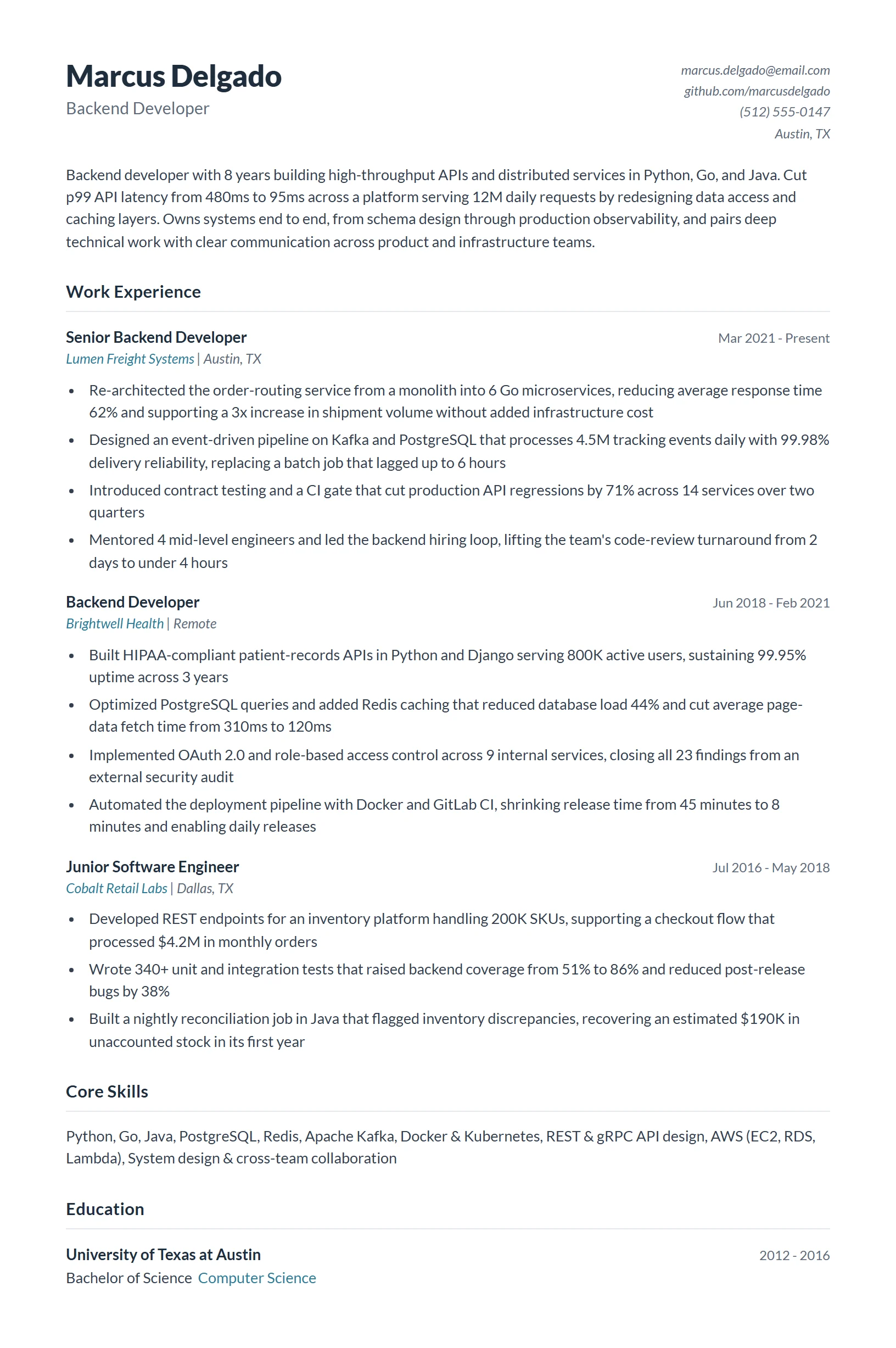
A general-purpose backend resume built around services, data, and reliability. It works for most server-side roles regardless of stack.
This resume works because it leads with outcomes (API response times, request volume, uptime) instead of listing technologies in a vacuum. It names languages, frameworks, and databases in the same bullets where they delivered results, so both the ATS and the hiring manager see skills tied to impact. The summary frames the candidate as a systems thinker, not just a coder.
Entry-Level Backend Developer resume example
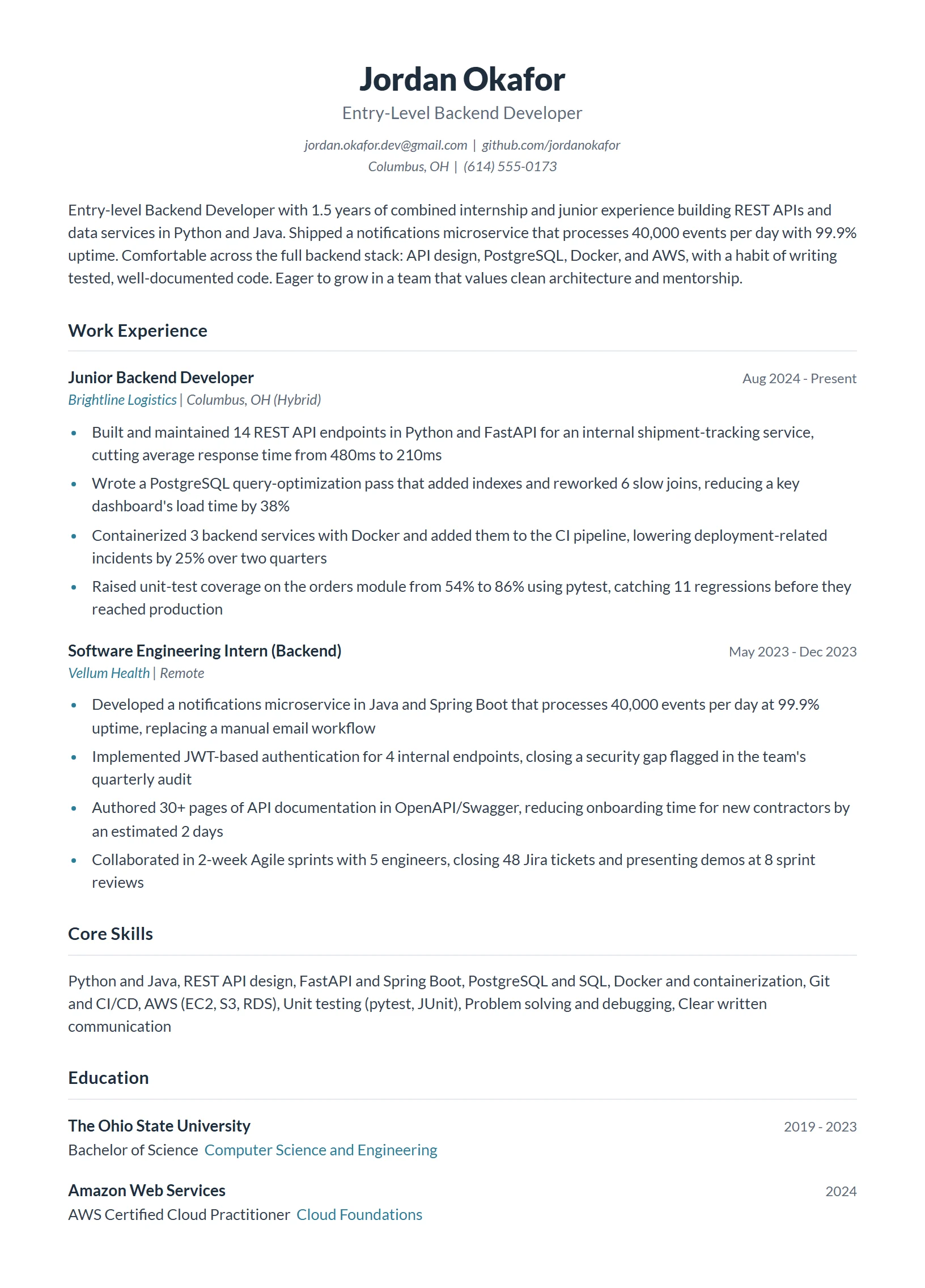
For new grads, bootcamp finishers, and career changers with limited professional experience. It leans on projects and fundamentals.
With no long work history to draw on, this resume earns attention by treating personal and academic projects like real jobs: what was built, which stack was used, and what it accomplished. It front-loads in-demand fundamentals (a primary language, SQL, Git, REST) so the ATS matches even a thin resume. A focused skills section signals readiness without overstating seniority.
Senior Backend Developer resume example
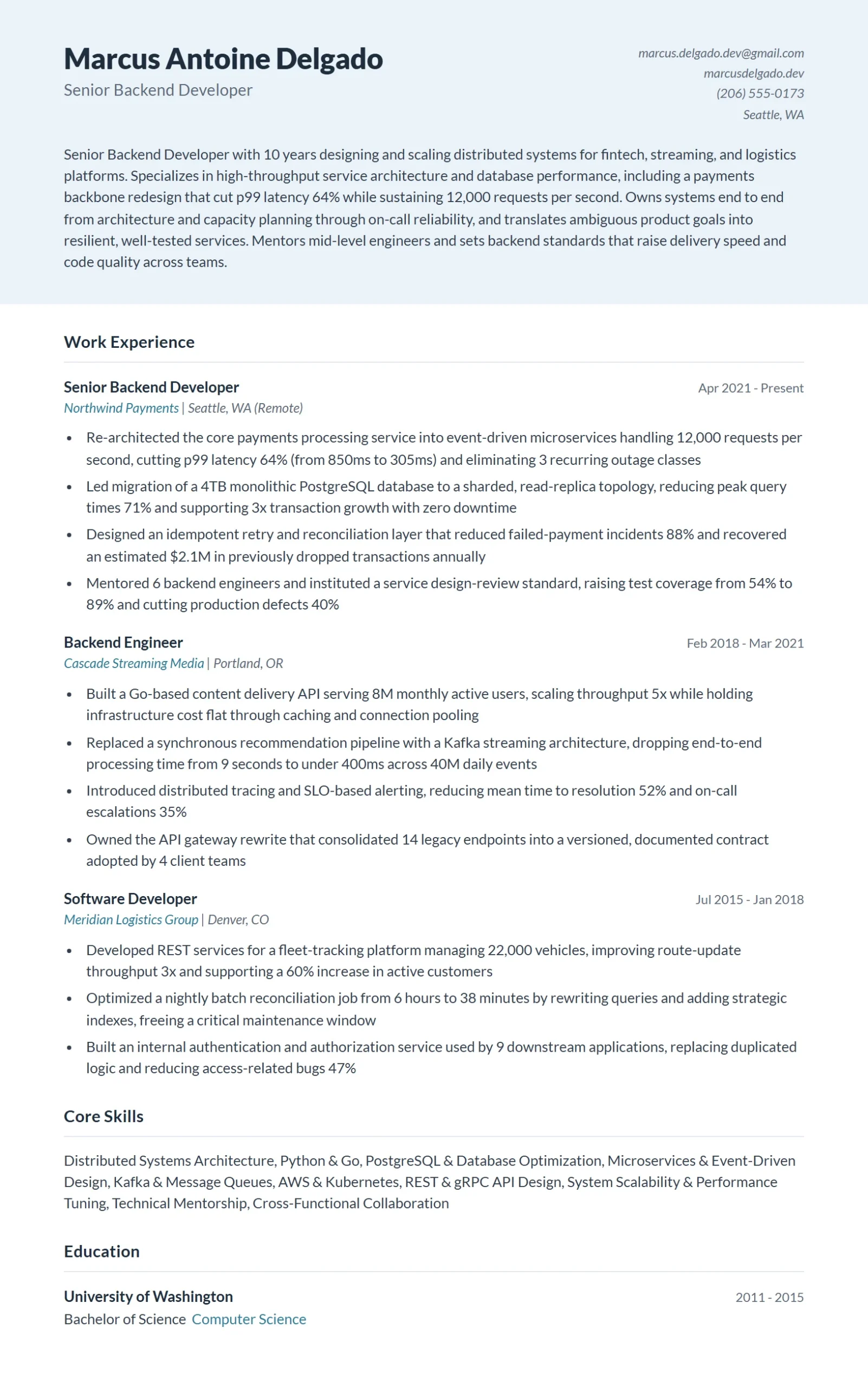
For experienced engineers moving into architecture, scale, and technical leadership. It emphasizes design decisions and team impact.
At the senior level, recruiters look past coding to system design and influence, so this resume foregrounds architecture choices, scaling work, and the trade-offs behind them. Bullets quantify scale (requests per second, data volume, cost saved) and show ownership of mentorship and cross-team decisions. The result reads as an engineer who shapes systems, not just ships features.
Java Backend Developer resume example
Tuned for enterprise Java roles built on Spring, microservices, and the JVM ecosystem. It speaks to large-scale, regulated environments.
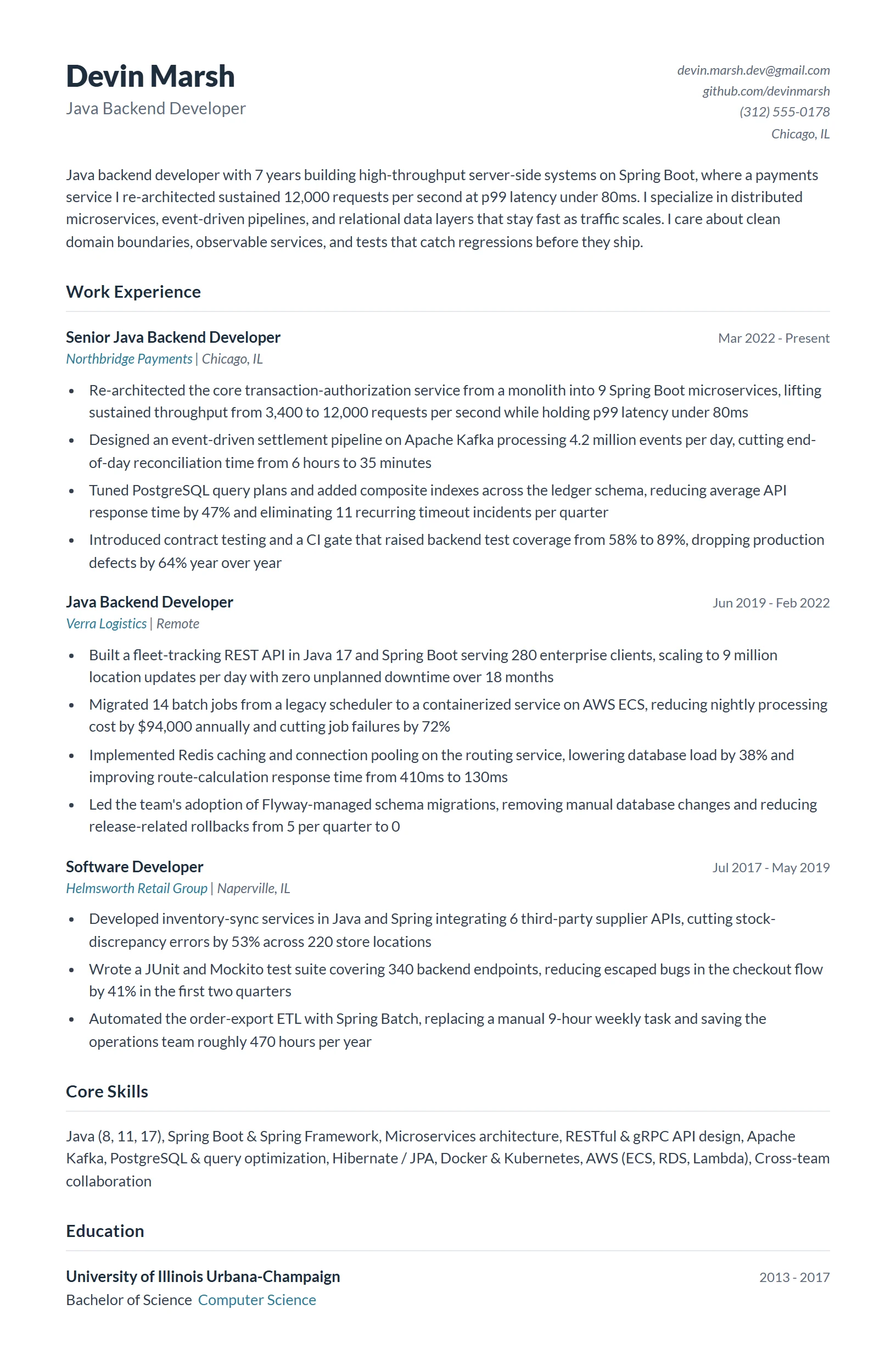
This resume matches the keywords enterprise postings demand (Spring Boot, Hibernate, microservices, Kafka, JUnit) and ties each to a concrete delivery. It shows comfort with the scale and process of large organizations, including testing, CI/CD, and service decomposition. Naming the exact Java ecosystem tools is what clears keyword-heavy ATS filters at big companies.
Python Backend Developer resume example
Built for Python-first backends using Django, FastAPI, or Flask, common in startups, data-heavy products, and ML-adjacent teams.
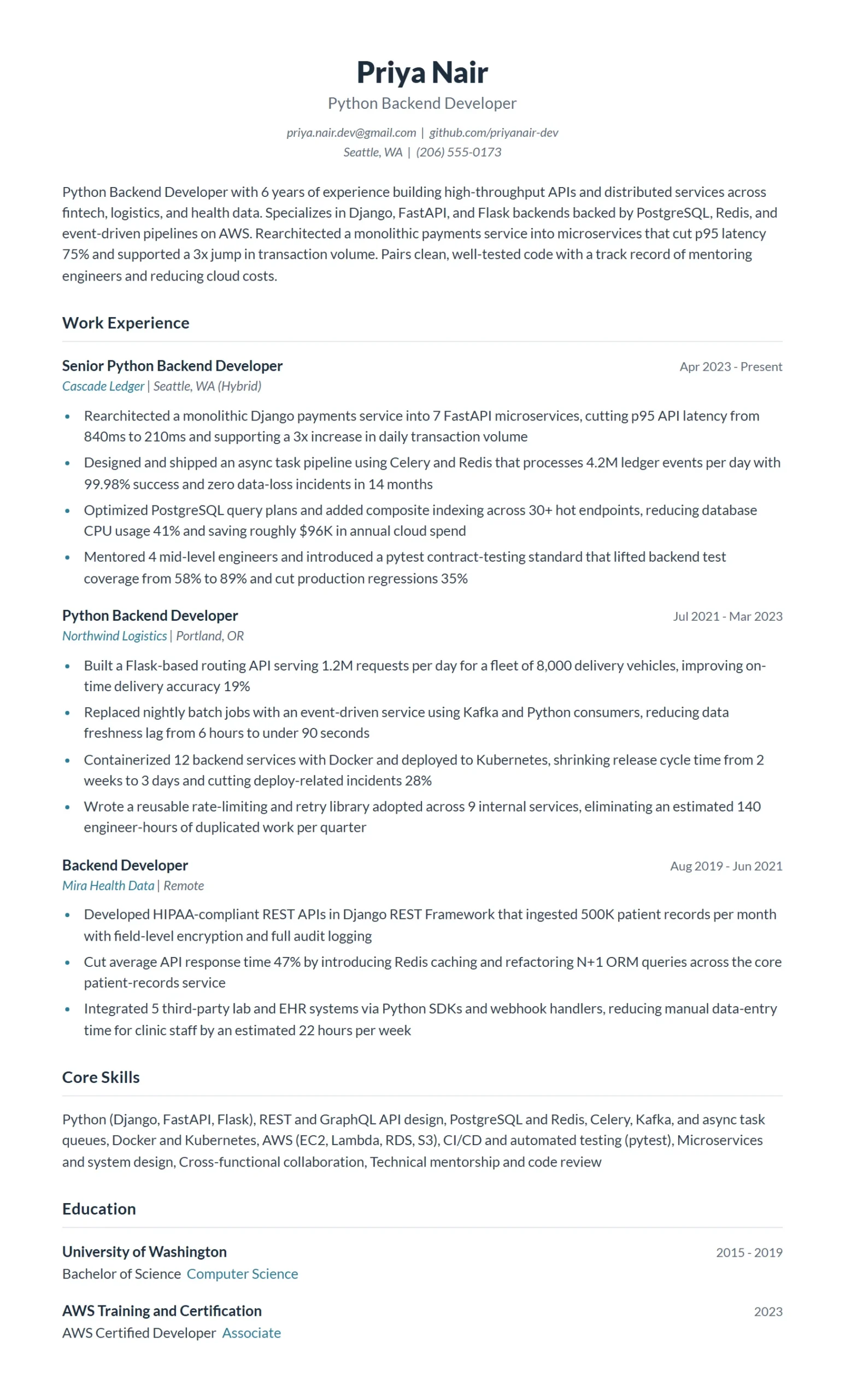
It centers the Python web stack (Django or FastAPI, ORMs, Celery, REST and GraphQL APIs) and pairs each tool with a shipped result. Because Python roles often touch data and ML pipelines, the resume signals that adjacency without drifting off the backend lane. Concrete metrics on API performance and data throughput keep it credible to both the ATS and the reviewer.
Node.js Backend Developer resume example
For JavaScript and TypeScript backends running on Node, often paired with Express, microservices, and real-time features.
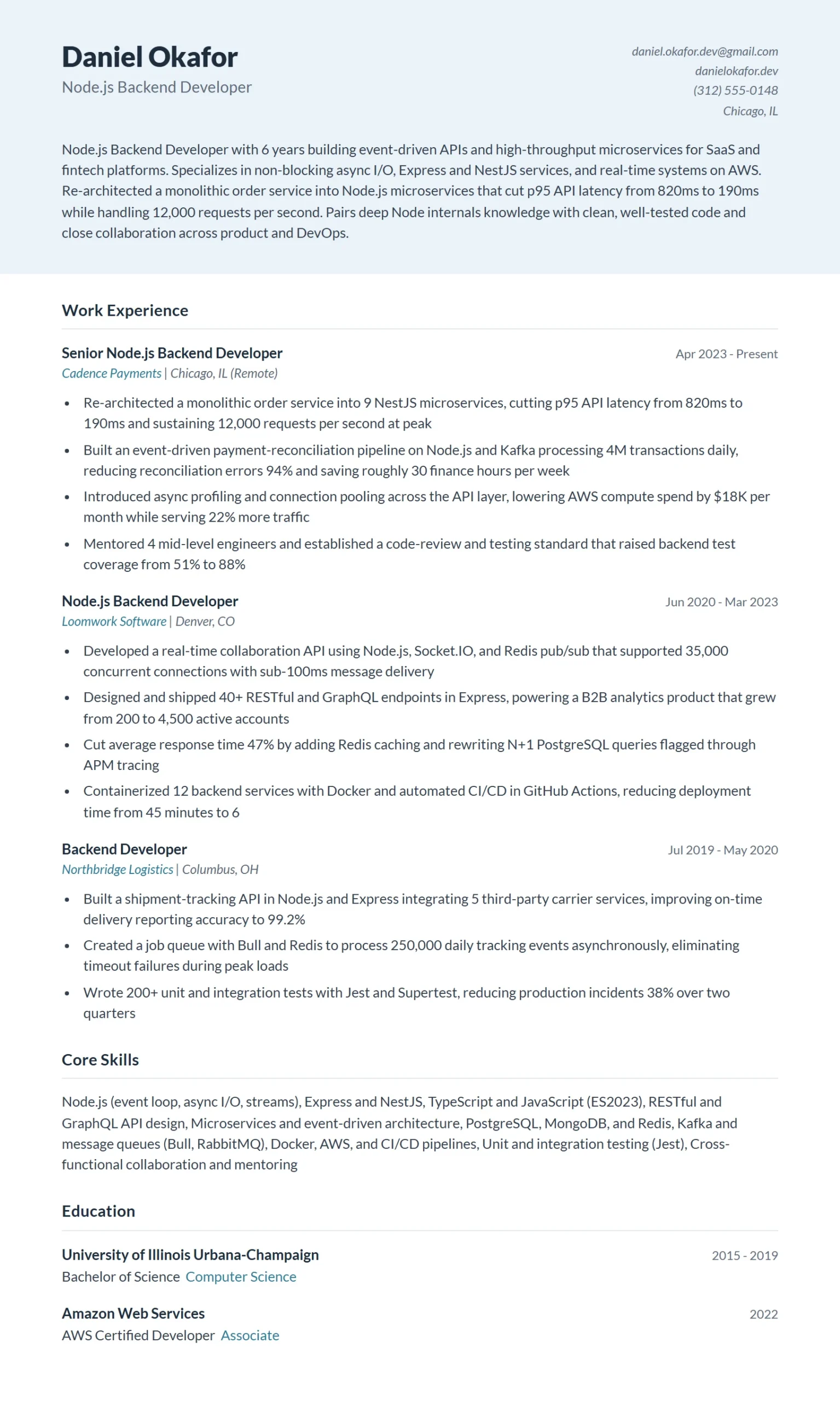
This resume speaks the Node ecosystem directly (Express or NestJS, TypeScript, REST and WebSocket APIs, async patterns) so it matches modern full-JS job descriptions. It demonstrates handling concurrency and real-time workloads, the problems Node teams actually hire to solve. Quantified results on latency and concurrent connections turn stack familiarity into proof of impact.
How to write a backend developer resume that gets interviews
Engineering managers skim a backend resume for proof you can build systems that stay up under load, not just write code that compiles. They want your stack, the scale you have worked at, and outcomes tied to numbers: latency cut, throughput raised, uptime held, cost reduced. Most companies also run your resume through an Applicant Tracking System (ATS) before a human sees it, so the language has to match the job description first. The tips below show you how to clear the ATS scan and convince the engineer reading next.
- Lead with your stack and the scale you have run it at: A backend resume lives and dies on specifics. Name your primary languages (Python, Go, Java, Node.js), your frameworks (Django, Spring Boot, Express), your databases (PostgreSQL, MySQL, MongoDB, Redis), and the infrastructure you ship on (AWS, GCP, Docker, Kubernetes). Then anchor it to scale: requests per second, rows in the table, users served, services owned. “Built REST APIs” tells a manager nothing. “Built and owned 12 REST microservices handling 40M requests/day” tells them exactly what you can handle.
- Quantify performance, reliability, and scale: Backend work is measurable, so measure it. Show what your code did to the system: “cut p95 API latency from 800ms to 120ms,” “raised throughput 3x by adding a Redis cache layer,” “held 99.99% uptime across a service serving 5M daily users,” or “reduced AWS spend 28% by right-sizing instances and adding autoscaling.” Latency, throughput, uptime, error rate, query time, and infrastructure cost are your equivalents of revenue. Pick the ones that matter for the role and put real numbers on them.
- Show how you design systems, not just write endpoints: Senior backend hiring is about architecture judgment. Reference the decisions, not just the deliverables: schema design, API contracts, caching strategy, message queues, database indexing, sharding, and the tradeoffs you weighed. A bullet like “Migrated a monolith to event-driven microservices with Kafka, cutting deploy risk and enabling independent scaling” signals you can reason about a system. Endpoints alone read as ticket-closing; design decisions read as engineering.
- Match languages, tools, and keywords to the job description: The ATS scans for exact terms. If the posting says “Go” and “gRPC,” do not write “Golang” and “RPC services” and hope it matches. List the tools you actually use and mirror the posting’s phrasing: REST, GraphQL, microservices, CI/CD, Kubernetes, Terraform, SQL, NoSQL, message queues. Skip languages you touched once and never keyword-stuff. An engineer reviewing after the scan can tell the difference between depth and a buzzword list in seconds.
- Prove production ownership and on-call maturity: Companies want backend engineers who own services in production, not just merge pull requests. Show the full lifecycle: monitoring and observability (Datadog, Prometheus, Grafana), incident response, debugging under pressure, and the postmortems that followed. “Owned on-call for 8 production services, drove a runbook overhaul that cut mean time to resolution 45%” tells a hiring manager you can be trusted with their uptime. This is often the line that separates a mid-level candidate from a senior one.
- Keep the format ATS-friendly and tailor it per role: A platform role, an API-product role, and a data-infrastructure role reward different keywords and projects. Reorder your skills and swap your headline bullets to mirror each posting. Then keep the format parseable: standard section headings, a single clean column, no text boxes or graphics that scramble the ATS, and a separate skills section for your stack. Run it through Jobscan to check your match rate against the job description before you apply.

Backend Developer resume summary examples
Your summary is the first thing a recruiter reads. Lead with your specialty, years of experience, and a quantified win.
Good backend Developer resume summary examples
- Backend developer with 6+ years building scalable APIs and distributed systems in Go and Python. Designed and owned microservices handling 40M requests/day at 99.99% uptime, and cut p95 latency from 800ms to 120ms through caching and query optimization. Deep with PostgreSQL, Redis, Kafka, and Kubernetes on AWS.
- Senior backend engineer specializing in high-throughput services and database performance. Led a monolith-to-microservices migration that cut deploy risk and enabled independent scaling, and reduced cloud spend 28% through autoscaling and instance right-sizing. Comfortable owning services end to end, from schema design to on-call.
- Backend developer with a strong systems-design foundation and a track record of shipping reliable APIs at scale. Built event-driven pipelines processing 2M events/hour, raised throughput 3x with a Redis cache layer, and drove an observability overhaul that cut mean time to resolution 45%. Fluent in Java, Spring Boot, SQL, and Docker.
What to avoid
- Hardworking backend developer looking for a challenging role at an innovative company where I can grow my skills and contribute to a great team. (It is entirely about what the candidate wants, not what they deliver. There is no stack, no scale, and zero evidence of impact. A hiring manager learns nothing they can screen on, and the ATS finds no keywords to match.)
- Passionate coder with a love for clean code and solving hard problems. Quick learner, team player, and proficient in many languages and frameworks. (Pure adjectives with no proof. “Many languages” names none, so the ATS matches nothing, and “clean code” and “team player” are claims anyone can make. It signals no specialty, no systems experience, and no measurable result.)
Backend Developer resume skills
List the languages, databases, and infrastructure you actually use, and mirror the exact terms in the job description so your resume matches both the ATS and the engineer reviewing it.
Hard skills for a backend Developer resume
- Python, Go, Java, or Node.js
- REST and GraphQL API design
- SQL databases (PostgreSQL, MySQL)
- NoSQL and caching (MongoDB, Redis)
- Microservices and system design
- Message queues (Kafka, RabbitMQ)
- Docker, Kubernetes, and CI/CD
- Cloud platforms (AWS, GCP, Azure)
- Database optimization and indexing
- Monitoring and observability (Datadog, Prometheus)
Soft skills for a backend Developer resume
- Systems and architecture thinking
- Debugging under pressure
- Cross-functional collaboration
- Clear technical communication
- Production ownership and accountability
Backend Developer resume work experience bullet point examples
Lead each bullet with a strong verb and a measurable result.
Good bullet point examples
- Designed and built 12 REST microservices in Go handling 40M requests/day, cutting p95 latency from 800ms to 120ms through query optimization and a Redis cache layer.
- Led migration of a Django monolith to event-driven microservices with Kafka, enabling independent scaling and reducing average deploy time from 45 minutes to 6.
- Owned on-call for 8 production services and drove a runbook and observability overhaul (Datadog, Prometheus) that cut mean time to resolution 45%.
- Optimized PostgreSQL schema and indexing for a 200M-row table, reducing the slowest report query from 14 seconds to under 400ms and cutting database CPU 30%.
Bad bullet point examples
- Responsible for writing backend code and fixing bugs. (Vague and passive. “Responsible for” describes a duty, not an achievement, and there is no language, no scale, and no result. Every backend developer writes code and fixes bugs, so this differentiates nothing.)
- Worked on APIs and databases to improve the product and help the team. (No specifics on any axis: no tech named for the ATS to match, no measure of the improvement, and “help the team” is filler. A hiring manager cannot tell whether you built the system or watched someone else build it.)
- Used many different technologies to build fast and reliable software. (Claims without evidence. “Many technologies” names none, and “fast and reliable” should be a number (latency, uptime), not an adjective. It reads as a list of buzzwords rather than a record of what you actually shipped.)
Backend Developer resume tips
A strong backend developer resume proves you can own production systems at scale, and these six tips help you get past the ATS and land in front of the engineer making the hire.
- Mirror JD Keywords: Copy the exact technology names from the job posting (PostgreSQL vs. Postgres, Kubernetes vs. K8s) because ATS scanners match strings literally, so inconsistent abbreviations can cost you a pass-through.
- Quantify System Impact: Backend reviewers want numbers tied to reliability and scale, so write in terms they care about: reduced API latency by 40 ms (p99), increased throughput to 50,000 requests per second, or held 99.95 percent uptime across 12 months.
- List Your Stack Precisely: Name every relevant language and tool (Go, Python, Redis, Kafka, AWS RDS) in a dedicated skills section so ATS can surface your profile for searches that filter by specific technology, not just broad category.
- Show Cloud Depth: If you hold an AWS, GCP, or Azure certification, list the full official title and year earned, because engineering managers treat cloud credentials as a fast signal of production-grade infrastructure knowledge.
- Highlight Ownership Scope: Backend roles reward production accountability, so note the size of what you owned: services handling X GB of daily data, databases with Y million rows, or pipelines supporting Z downstream teams.
- Keep It One Page (Usually): Unless you have more than ten years of directly relevant backend experience, trim to one page, because a dense two-page resume often signals an inability to prioritize, which is itself a backend engineering red flag.
Pair your backend Developer resume with a cover letter
A strong resume goes further with a tailored cover letter. Browse our cover letter examples to round out your application.
Backend Developer resume frequently asked questions
List the languages, frameworks, and infrastructure you actually use, such as Java, Python, Go, or Node.js, plus frameworks like Spring Boot, Django, or Express. Include databases (PostgreSQL, MySQL, MongoDB, Redis), API styles (REST, GraphQL, gRPC), and cloud and DevOps tools (AWS, Docker, Kubernetes, CI/CD). Match these to the exact terms in the job description so the ATS and the hiring manager both find them fast.
Quantify performance, scale, and reliability instead of just listing tasks. Use numbers like ‘cut API p95 latency from 800ms to 120ms,’ ‘scaled the service to handle 2M requests per day,’ or ‘reduced database query time 60% by adding indexes and caching.’ Metrics about throughput, uptime, cost savings, and error-rate reduction make invisible engineering work concrete to recruiters and managers.
Use a clean single-column layout, standard section headings, and a common font, and save it as a .docx or text-based PDF rather than an image or graphic-heavy template. Mirror the keywords from the job posting, including both the spelled-out term and the acronym (for example ‘Continuous Integration (CI/CD)’), since parsers do not always connect them. Run your resume against the target job description with a tool like Jobscan to confirm your match rate before you apply.
Include them only if they are relevant to the role, and keep them clearly secondary to your backend strengths. A line noting basic React or HTML and CSS familiarity can help for full-stack or smaller-team positions where you touch the whole stack. For a focused backend role, lead with system design, APIs, databases, and infrastructure, and do not let frontend tools crowd out your core expertise.
Frame each project around the problem, your architecture decisions, and the measurable result rather than a feature list. Mention design choices that signal seniority, such as microservices versus monolith, event-driven queues, database schema design, or caching strategy, and explain the tradeoff you made. For personal or open-source work, link the repo and note your specific contribution so reviewers can verify the depth.
For junior roles, emphasize languages, fundamentals, internships, and projects that prove you can ship working code. For mid-level, lead with ownership of services, performance and reliability wins, and cross-team collaboration. For senior or staff roles, foreground system architecture, scalability decisions, mentorship, and business outcomes, since hiring managers at that level care more about judgment and impact than a long tools list.