Best Chief Technology Officer Resume Examples for 2026
Build a Chief Technology Officer resume for 2026 that proves technology leadership at scale, with real CTO examples and the keywords ATS and boards scan for.



A Chief Technology Officer sets the technology vision, leads the engineering organization, and ties every technical decision back to revenue, risk, and growth. At this level your resume is not a list of systems you have touched. It is the case for why you can own technology at the executive table.
Hiring boards, CEOs, and executive recruiters skim CTO resumes for a few specific signals: business outcomes tied to dollars, the scale of the teams and budgets you have run, and the platform, security, and architecture decisions you owned. Most CTO roles are still filtered by an ATS first, so the language matters. Plain titles, recognizable keywords like cloud architecture, platform strategy, and engineering leadership, and quantified results all help your resume clear the screen and reach a human.
The examples below show how strong technology leaders frame scope, outcomes, and judgment, whether you are targeting an enterprise CTO seat, a startup founding role, or an adjacent VP of Engineering position. Use them as a model, then make the achievements unmistakably yours.
Ready to build yours? Try our ATS-friendly resume builder or scan your draft against the job description.
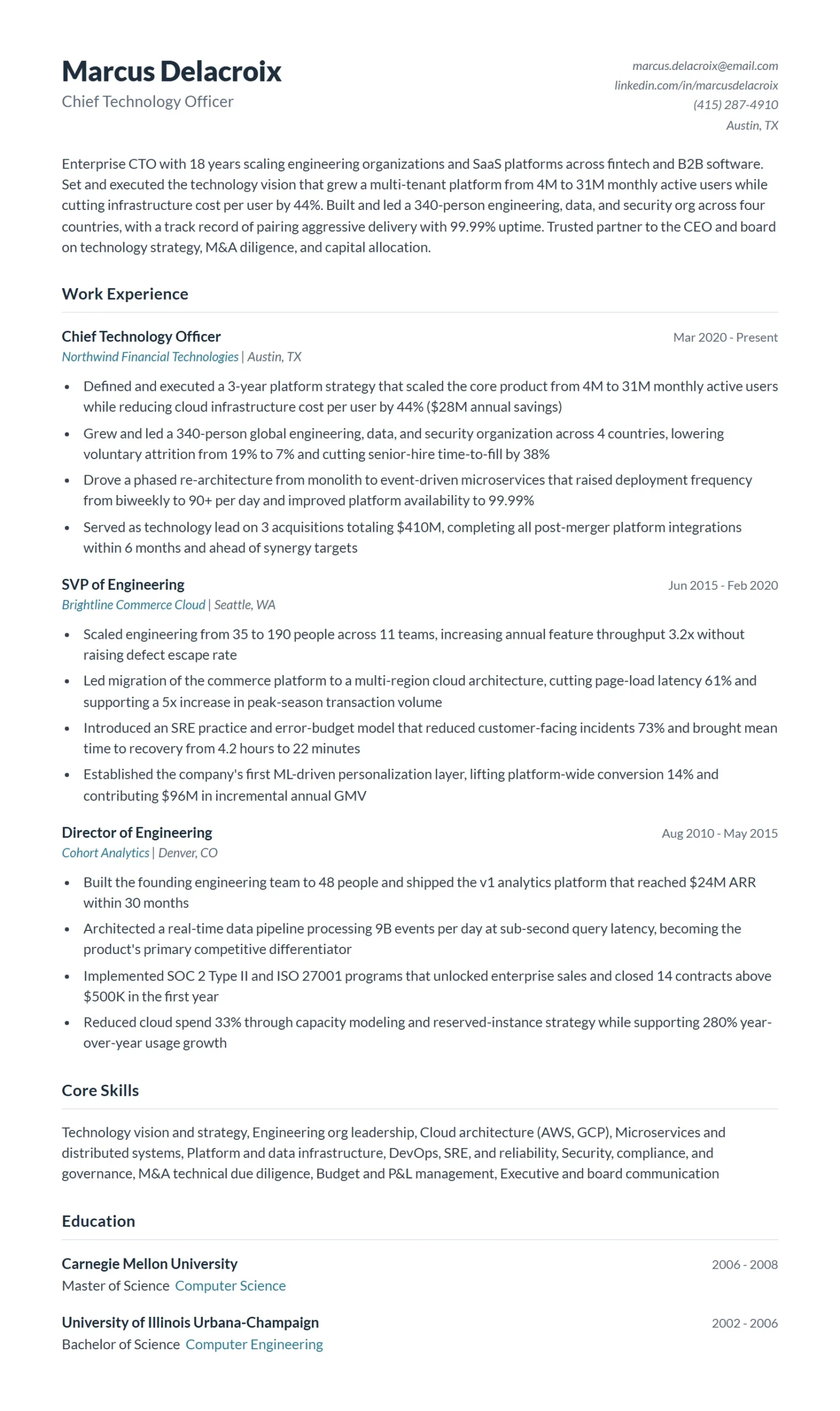
Chief Technology Officer resume example
An enterprise CTO resume that leads with business impact, organizational scale, and the technology bets that paid off.
It works because every bullet connects a technical decision to a business result: revenue enabled, cost removed, risk reduced, or time to market cut. The summary frames scope up front (team size, budget, and platforms owned) so a board sees executive weight in seconds. Keywords like platform strategy, cloud architecture, and engineering leadership are placed naturally, so it reads as a leader’s resume and still clears ATS screening.
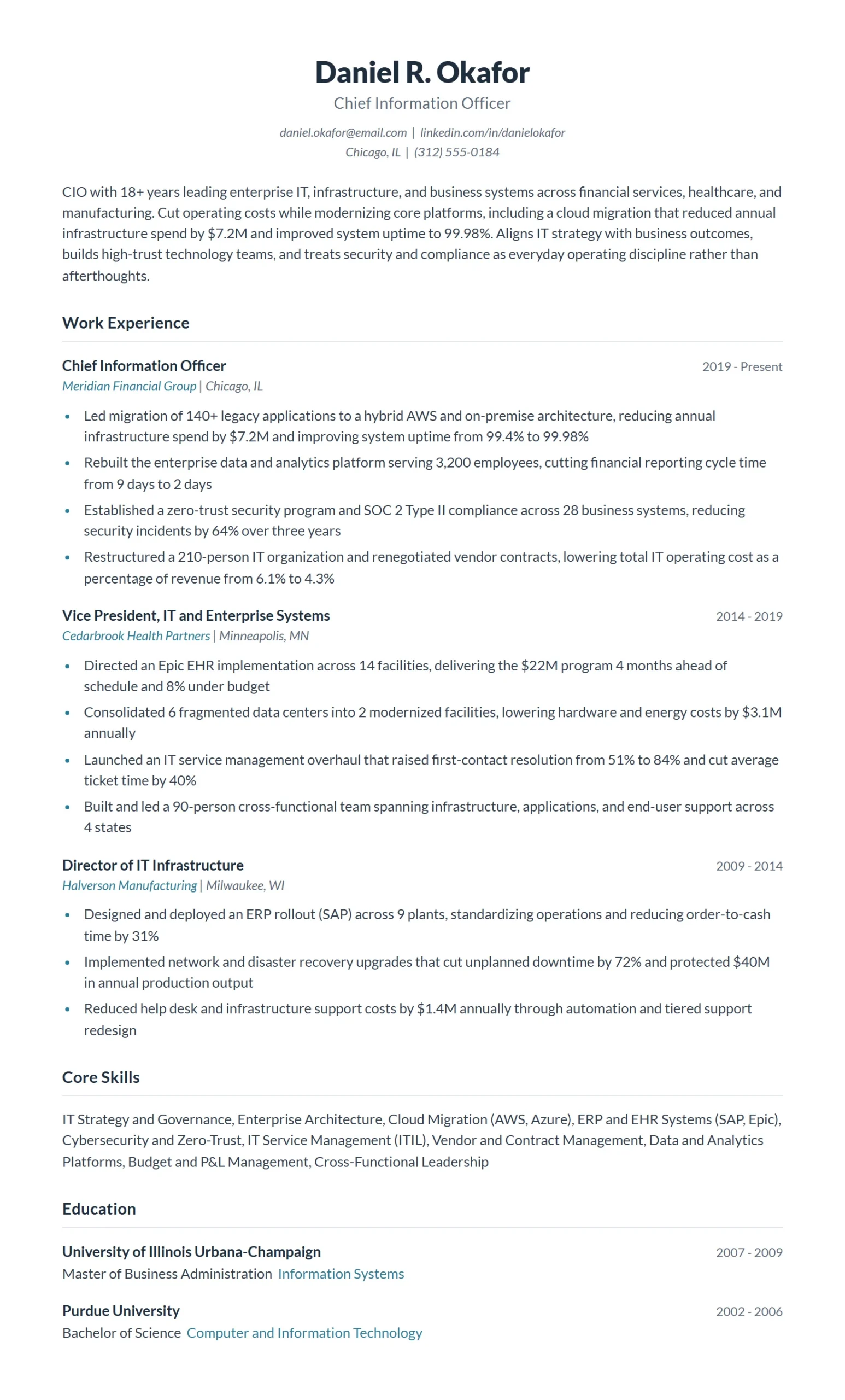
Chief Information Officer resume example
A CIO resume built around internal technology, security, and the business systems that keep the company running.
This example separates the CIO from the CTO clearly, centering on IT operations, enterprise systems, cybersecurity, and vendor strategy rather than product engineering. It quantifies uptime, risk reduction, and cost savings, the outcomes a board expects from the person who owns information and infrastructure. That precise framing helps recruiters slot you into the right C-suite seat instead of a generic tech leader role.
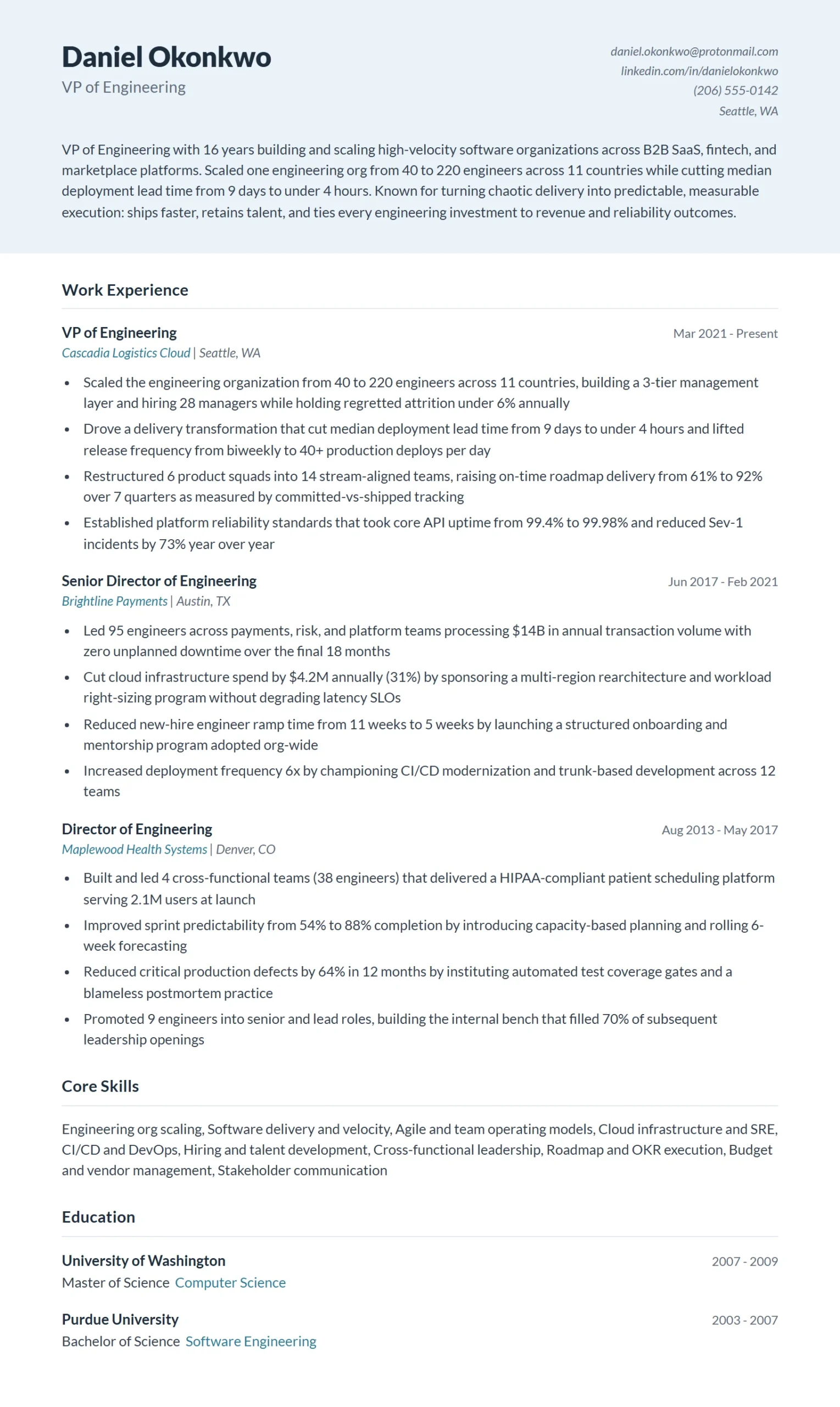
VP of Engineering resume example
A VP of Engineering resume focused on execution: shipping, scaling teams, and raising delivery velocity.
It earns attention by proving you can run the engine, not just set direction. The achievements highlight team growth, hiring, delivery speed, and reliability metrics rather than abstract vision. For candidates moving toward or from a CTO role, this example shows how to make execution leadership the headline while keeping the strategic language that signals you are ready for the next step.
VP of Technology resume example
A VP of Technology resume that bridges strategy and hands-on delivery, common at mid-size and scaling companies.
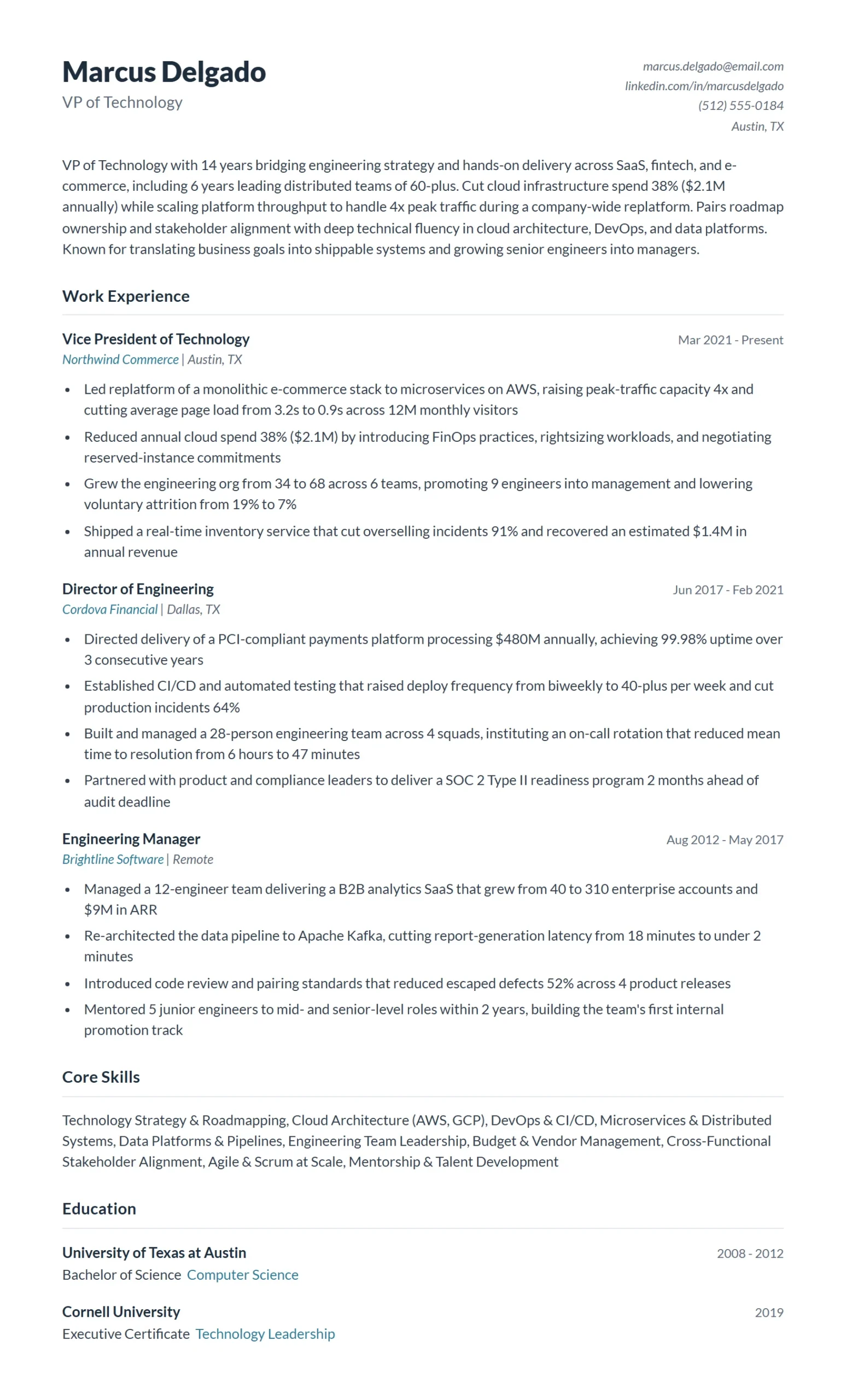
This one works because it shows range: setting technical direction while staying close enough to architecture and delivery to be credible with engineers. It balances strategic keywords with concrete project outcomes, so the resume reads as a leader who can both plan and build. That dual signal is exactly what mid-size companies want when the title sits just below the C-suite.
Startup CTO resume example
A startup CTO resume for the founding or early-stage technical leader who builds, hires, and ships from zero.

It stands apart by foregrounding hands-on building, speed, and ownership rather than enterprise scale. The bullets show shipping a product from scratch, making pragmatic architecture calls under constraints, and supporting fundraising or growth milestones. That framing signals to founders and investors that you can wear multiple hats and move fast, which is what early-stage CTO hires are evaluated on.
How to write a Chief Technology Officer resume that gets interviews
A CTO resume is judged on business impact, not technical depth. Boards, CEOs, and executive recruiters want proof that you turned technology into revenue, margin, and competitive advantage while building an engineering organization that scales. Lead with outcomes (revenue enabled, costs cut, teams grown, platforms shipped) and quantify the scope you owned: budget, headcount, uptime, and the size of the business your technology supported. Keep the stack details brief and push them toward the bottom; what wins interviews is evidence that you operate as a peer to the CEO and CFO, not as the most senior engineer in the room.
- Lead with scope and stakes, not tools: Open with a positioning line that states the size of the org and P&L you led: engineering headcount, technology budget, ARR or transactions your platform supported, and the company stage (seed, growth, public). A recruiter should know within five seconds whether you have run technology at their scale. “CTO scaling engineering from 15 to 120 across 3 product lines” beats “experienced technology leader.”
- Tie every technical decision to a business result: Boards do not fund re-platforming; they fund growth and margin. Reframe architecture and infrastructure work as business outcomes: a cloud migration becomes “cut infrastructure spend 38% ($2.4M/yr) while improving uptime to 99.99%.” A re-architecture becomes “reduced feature lead time from 6 weeks to 4 days, accelerating the roadmap.” If a bullet does not connect to revenue, cost, risk, or speed, rewrite it.
- Quantify the organization you built: At the CTO level, building and retaining the team is the job. Show org-building with numbers: headcount grown, attrition reduced, leaders hired and promoted, and how you structured the org (squads, platform teams, offshore/nearshore). “Hired 4 directors and grew engineering 6x to 120 while holding voluntary attrition under 8%” signals you can scale people, not just systems.
- Show board, P&L, and cross-functional fluency: CTOs answer to a board and partner with the CEO, CFO, and CRO. Include evidence of owning a technology budget, presenting to the board, running build-vs-buy and vendor decisions, and aligning roadmap to company strategy. Mention fundraising support (diligence, technical due diligence), M&A integration, or audit/compliance ownership (SOC 2, ISO 27001, HIPAA) where relevant to the target company.
- Make security, reliability, and scale concrete: Risk ownership is a core CTO mandate. State the reliability and security posture you delivered: uptime SLAs hit, incident rate reduced, mean time to recovery, traffic or data volume handled, and compliance certifications achieved. “Took the platform from 99.5% to 99.99% uptime while scaling to 4B daily events” is the kind of line that survives a board conversation.
- Mirror the company’s stage and challenge: A CTO resume is not one-size-fits-all. For an early-stage startup, emphasize 0-to-1 building, hands-on shipping, and capital efficiency. For a scale-up, emphasize org design, reliability, and platform investment. For an enterprise, emphasize transformation, governance, and modernization. Read the job description and the company’s stage, then reorder your bullets so the most relevant proof sits at the top. Run the result through Jobscan to match the wording the role actually uses.

Chief Technology Officer resume summary examples
Your summary is the first thing a recruiter reads. Lead with your specialty, years of experience, and a quantified win.
Good chief Technology Officer resume summary examples
- Chief Technology Officer and engineering executive who scaled a SaaS platform from $4M to $52M ARR while growing engineering from 12 to 95 across 4 countries. Cut cloud spend 41% ($3.1M/yr), lifted uptime to 99.99%, and led technical diligence for a $120M Series C. Operates as a board-level peer translating technology investment into revenue, margin, and defensible product advantage.
- Hands-on CTO who has taken three products from zero to one and one company from seed to acquisition. Built and led 60-person engineering, data, and security org; shipped an ML-driven platform that drove 28% of new ARR; achieved SOC 2 Type II and HIPAA compliance ahead of two enterprise deals worth $9M combined. Pairs deep architecture judgment with P&L ownership of an $18M technology budget.
- Transformation-focused Chief Technology Officer who modernized a 400-engineer organization at a public fintech, retiring 70% of legacy systems and cutting feature lead time from 8 weeks to 5 days. Reduced production incidents 62% year over year, established platform and SRE functions from scratch, and partnered with the CFO to deliver $14M in run-rate savings over 24 months.
What to avoid
- Visionary technology leader with a passion for innovation and a proven track record of leveraging cutting-edge technologies to drive results across the organization. (All adjectives, zero evidence. “Visionary,” “passion,” and “proven track record” are unverifiable filler. There is no scope (headcount, budget, ARR), no metric, and no business outcome. A board cannot act on this. It also uses banned buzzwords like “leveraging.”)
- Experienced CTO skilled in AWS, Kubernetes, Python, microservices, CI/CD, and agile methodologies looking for a new leadership opportunity. (This reads like a senior engineer, not an executive. At the CTO level a stack list is table stakes and belongs near the bottom; it signals you still think in tools rather than business outcomes, team scale, or P&L. “Looking for a new opportunity” wastes the most valuable line on the page.)
Chief Technology Officer resume skills
Keep skills tight on the resume and weave the proof into your experience bullets; see the dedicated CTO skills page for the full breakdown and how to match them to a job description.
Hard skills for a chief Technology Officer resume
- Technology strategy and roadmap ownership
- Engineering org design and scaling
- Cloud architecture (AWS, GCP, Azure)
- Technology budget and P&L management
- Security, compliance, and risk (SOC 2, ISO 27001, HIPAA)
- Platform and infrastructure reliability (SRE, uptime, MTTR)
- Data and AI/ML strategy
- Technical due diligence and M&A integration
Soft skills for a chief Technology Officer resume
- Executive and board communication
- Cross-functional leadership (CEO, CFO, CRO)
- Talent development and retention
- Strategic decision-making
- Stakeholder and vendor negotiation
Chief Technology Officer resume work experience bullet point examples
Lead each bullet with a strong verb and a measurable result.
Good bullet point examples
- Scaled engineering from 18 to 110 across 5 product squads in 30 months while holding voluntary attrition under 7%, hiring 5 directors and promoting 9 engineers into lead roles.
- Led a cloud re-architecture that cut infrastructure cost 41% ($3.1M annualized) and raised platform uptime from 99.4% to 99.99%, supporting growth to 4.2B daily events.
- Owned the $18M technology budget and presented quarterly to the board; drove build-vs-buy decisions that avoided $2.6M in vendor spend and shortened time-to-market by 9 weeks.
- Achieved SOC 2 Type II and HIPAA compliance in under 7 months, unlocking 3 enterprise contracts worth $9.4M ARR and clearing security review for a $120M Series C raise.
Bad bullet point examples
- Responsible for overseeing the engineering team and the company’s overall technology strategy and direction. (Describes the job title, not what you accomplished in it. “Responsible for” and “overseeing” carry no result, no scale, and no metric. Every CTO is responsible for technology strategy, so this differentiates nothing.)
- Implemented modern technologies and best practices to improve the development process and team efficiency. (Vague on every axis: which technologies, which practices, and improved efficiency by how much? “Modern technologies” and “best practices” are empty signals. Replace with a specific change and a measured outcome (lead time, deploy frequency, incident rate).)
- Worked closely with cross-functional teams to align on goals and deliver value to stakeholders. (Pure corporate filler that could appear on any resume in any function. “Deliver value to stakeholders” says nothing. Name the partners (CEO, CFO, CRO), the decision, and the quantified business result it produced.)
Chief Technology Officer resume tips
A strong CTO resume positions you as the executive who made technology a business weapon, and these six tips will help yours clear ATS filters and impress the board-level stakeholders who review it.
- Mirror the Job Description: Pull exact phrases from the posting, such as “technology roadmap,” “engineering org design,” or “cloud architecture,” and use them verbatim in your summary and experience sections so ATS parsers score you as a strong match.
- Quantify Budget and Scope: State the P&L or technology budget you owned, the headcount you led, and the annual revenue the business generated under your technology, because executive recruiters use those numbers to instantly calibrate seniority.
- Name the Right Frameworks: Include compliance and reliability shorthand that ATS systems scan for, specifically SOC 2, ISO 27001, HIPAA, SRE, and MTTR, placing each in the context of a real outcome rather than a skills list.
- Claim the Cloud Platforms: List AWS, GCP, or Azure as the platforms you governed strategy on (not just used), and add any relevant certifications such as AWS Certified Solutions Architect or Google Professional Cloud Architect to satisfy both ATS keyword filters and technical validators.
- Highlight Board Exposure: Include at least one bullet per role that names the audience you reported to (board, audit committee, CEO, CFO) and the decision your communication influenced, because this detail is unique to the CTO level and differentiates you from VP of Engineering candidates.
- Keep It to Two Pages: Cap your resume at two pages by limiting early career roles to a single line and cutting stack details that are older than ten years, since executive search firms expect concision and boards rarely read past page two.
Pair your chief Technology Officer resume with a cover letter
A strong resume goes further with a tailored cover letter. Browse our cover letter examples to round out your application.
Chief Technology Officer resume frequently asked questions
Two pages is the right target for most CTO candidates, and it is the one place the one-page rule does not apply. You are summarizing 15 or more years of leadership, so use the space to show scope (team size, budget owned, revenue influenced) rather than every project. Keep the first half-page focused on a sharp executive summary and your highest-impact outcomes, since recruiters and board members skim that section first. A third page is only justified for extensive board work, patents, or speaking and publications, and even then it belongs in an addendum.
Both, but business leadership leads. At the executive level, hiring committees and boards assume you can architect systems, so the differentiator is whether you can tie technology to revenue, margin, risk, and company strategy. Frame your technical decisions by their business result: a platform re-architecture that cut infrastructure cost 40 percent, or a security overhaul that unblocked an enterprise deal. Keep a tight technical-competencies section so the depth is still visible, then spend your bullets proving you can run technology as a business function.
Write a 3 or 4 sentence executive summary that names your scope, your industry, and the business outcomes you are known for. Lead with the size of what you have run (engineering org headcount, budget, users or revenue supported) and one or two quantified wins, such as scaling a platform to 50M users or reducing time-to-market by half. Mirror the exact title and a few priorities from the job description, whether that is AI strategy, scaling for an IPO, or modernizing legacy systems. Avoid generic phrases like visionary leader and replace them with evidence a board can act on.
Translate strategy into the numbers an executive is measured by: revenue enabled, cost reduced, time-to-market, system reliability, team growth, and retention. Instead of led digital transformation, write reduced cloud spend 35 percent (4.2M annually) while improving uptime to 99.99 percent across 12 product lines. When a result is hard to attribute directly, anchor it to scale and ownership, such as owning a 90M technology budget or growing engineering from 40 to 220. Board-facing metrics like these signal executive impact far more than naming the technologies you used.
Yes. Even executive roles are usually filtered through an applicant tracking system before a recruiter or board contact reviews them, especially when you apply through a company portal. Use a clean single-column layout with standard headings (Experience, Technical Competencies, Education), real selectable text rather than logos or charts, and mirror the leadership and technology keywords from the posting (P&L ownership, cloud architecture, AI strategy, SOC 2). Skip the heavily designed template and scan your resume against the job description with a tool like Jobscan to confirm your keyword match and formatting pass before you send it.
The altitude changes. A senior engineer resume proves hands-on delivery, and a VP of Engineering resume proves you can run execution and scale teams, but a CTO resume has to prove you set technology strategy at the company level and partner with the CEO and board. Shift the emphasis from systems you built to outcomes you owned: technology roadmap tied to company strategy, build-versus-buy and M&A technical diligence, and risk, security, and compliance posture. Feature board presentations, executive hires you made, and the business results your strategy produced rather than the code or architecture itself.