Best Cybersecurity Resume Examples for 2026
Build a cybersecurity resume for 2026 with real examples across analyst, SOC, and engineering roles, plus the tools and keywords ATS scans for.



Cybersecurity is one of the most in-demand fields in tech, and it covers a wide range of roles: analysts monitoring threats, engineers hardening infrastructure, SOC teams triaging incidents, and specialists running risk and compliance. A strong resume has to prove you can protect systems, not just list the tools you have touched.
Hiring managers scan for evidence, not buzzwords. They want measurable outcomes (threats detected, incidents resolved, audit findings closed) backed by named tools and certifications like CISSP, Security+, or CEH. Before a human ever reads your resume, an applicant tracking system checks it for the exact skills and keywords in the job description, so the language you use matters as much as the work you have done.
The examples below show how to do both. Use them to frame your experience around impact, surface the right technical keywords for your target role, and build a resume that clears ATS filters and earns the interview.
Ready to build yours? Try our ATS-friendly resume builder or scan your draft against the job description.
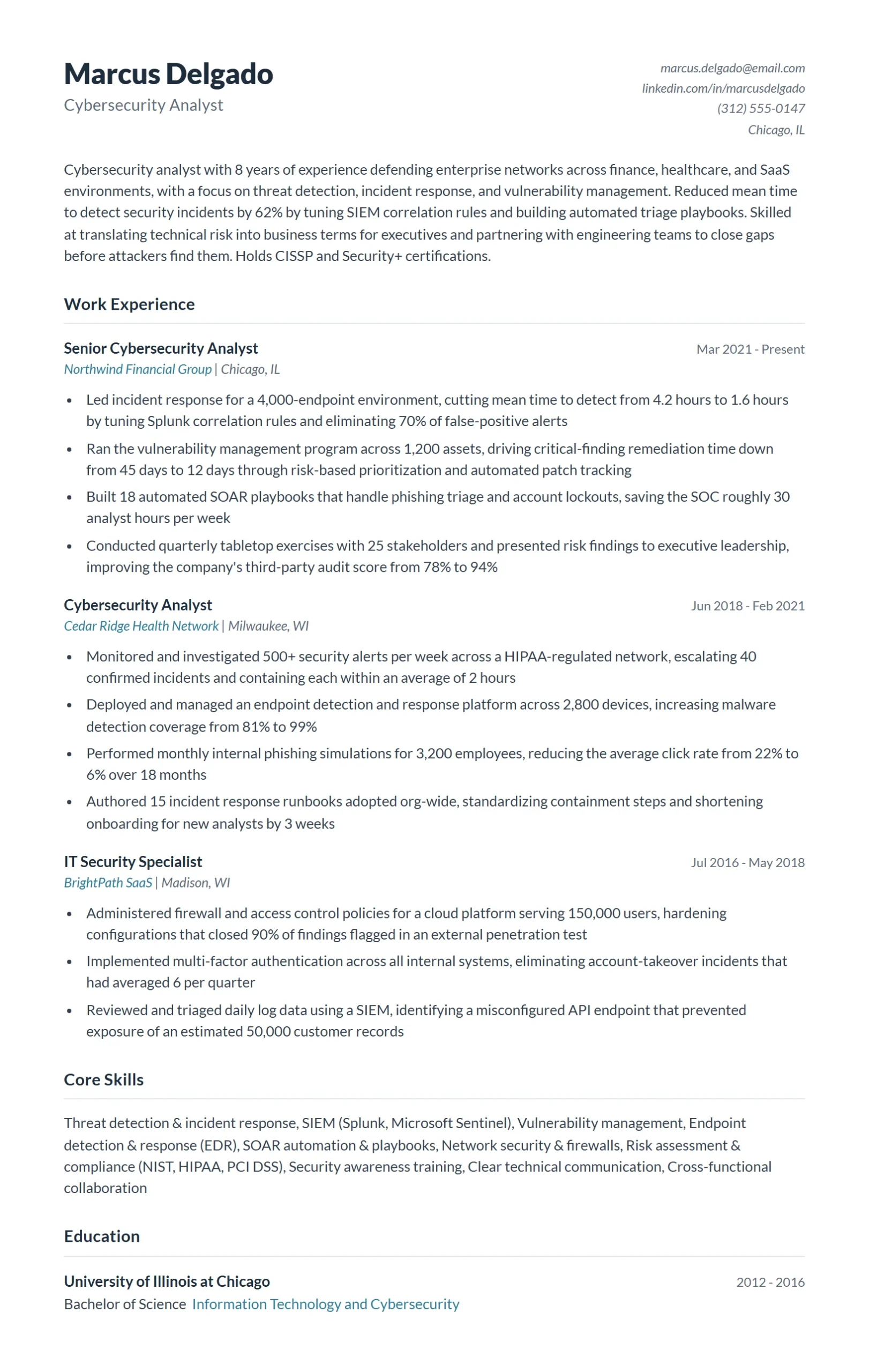
Cybersecurity resume example
A general-purpose cybersecurity resume that works across analyst, engineering, and security operations roles. It leads with measurable security outcomes and the core tools and frameworks employers expect.
This resume works because it pairs technical depth (SIEM, vulnerability management, NIST and ISO frameworks) with quantified results like reduced incident response time and closed audit findings. It surfaces certifications near the top where recruiters and ATS look first. The skills section mirrors common job-description language, so it matches a wide range of cybersecurity postings.
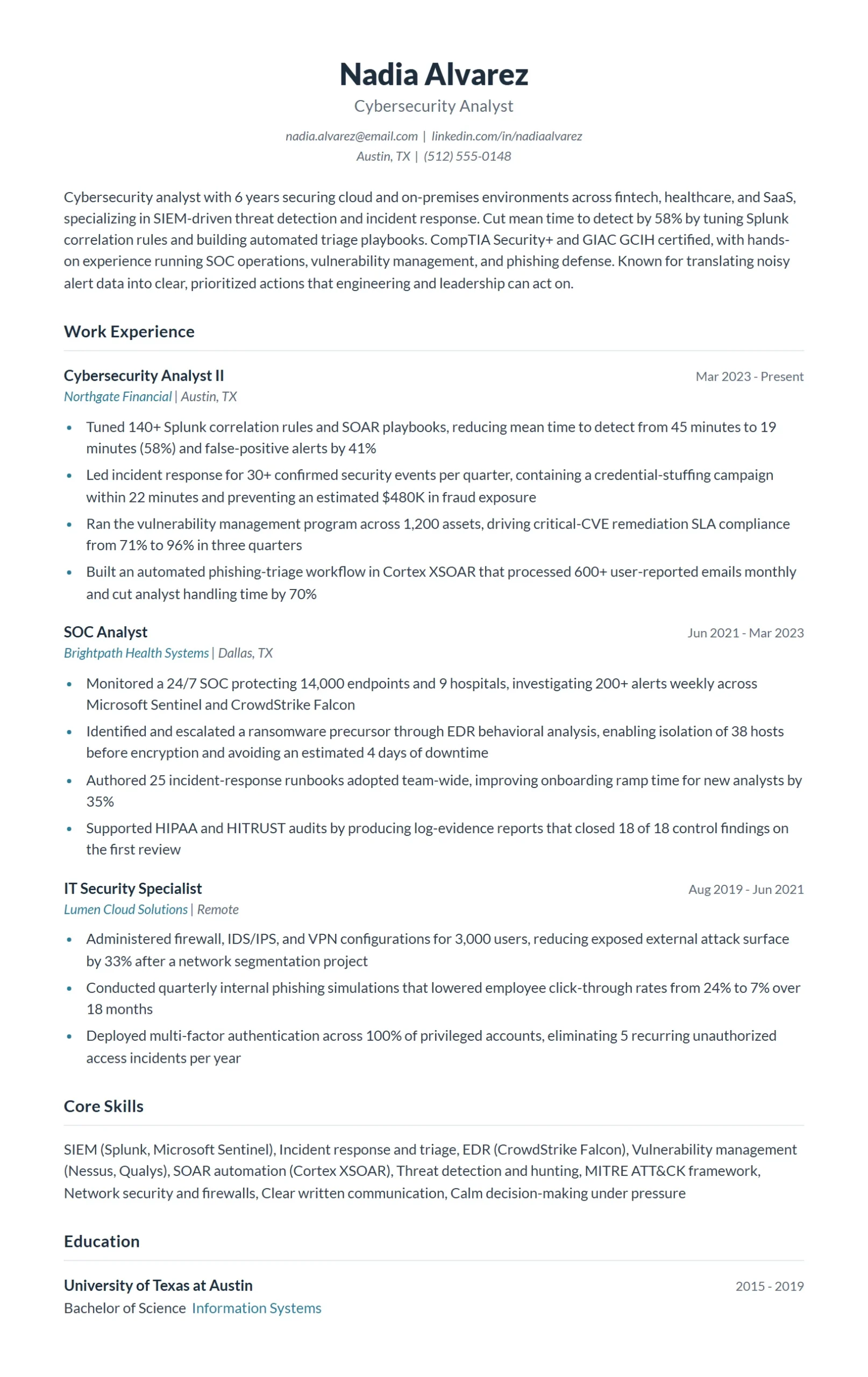
Cybersecurity Analyst resume example
Built for the most-searched role in the field, this example centers on threat detection, monitoring, and response. It shows how to turn daily analyst work into evidence of impact.
It wins because every bullet quantifies the work: alerts triaged, false positives reduced, threats escalated, mean time to detect improved. It names the analyst toolkit recruiters scan for (Splunk, QRadar, EDR, threat intelligence platforms) and aligns skills to the exact keywords in analyst job descriptions, which is what gets it past ATS filters.
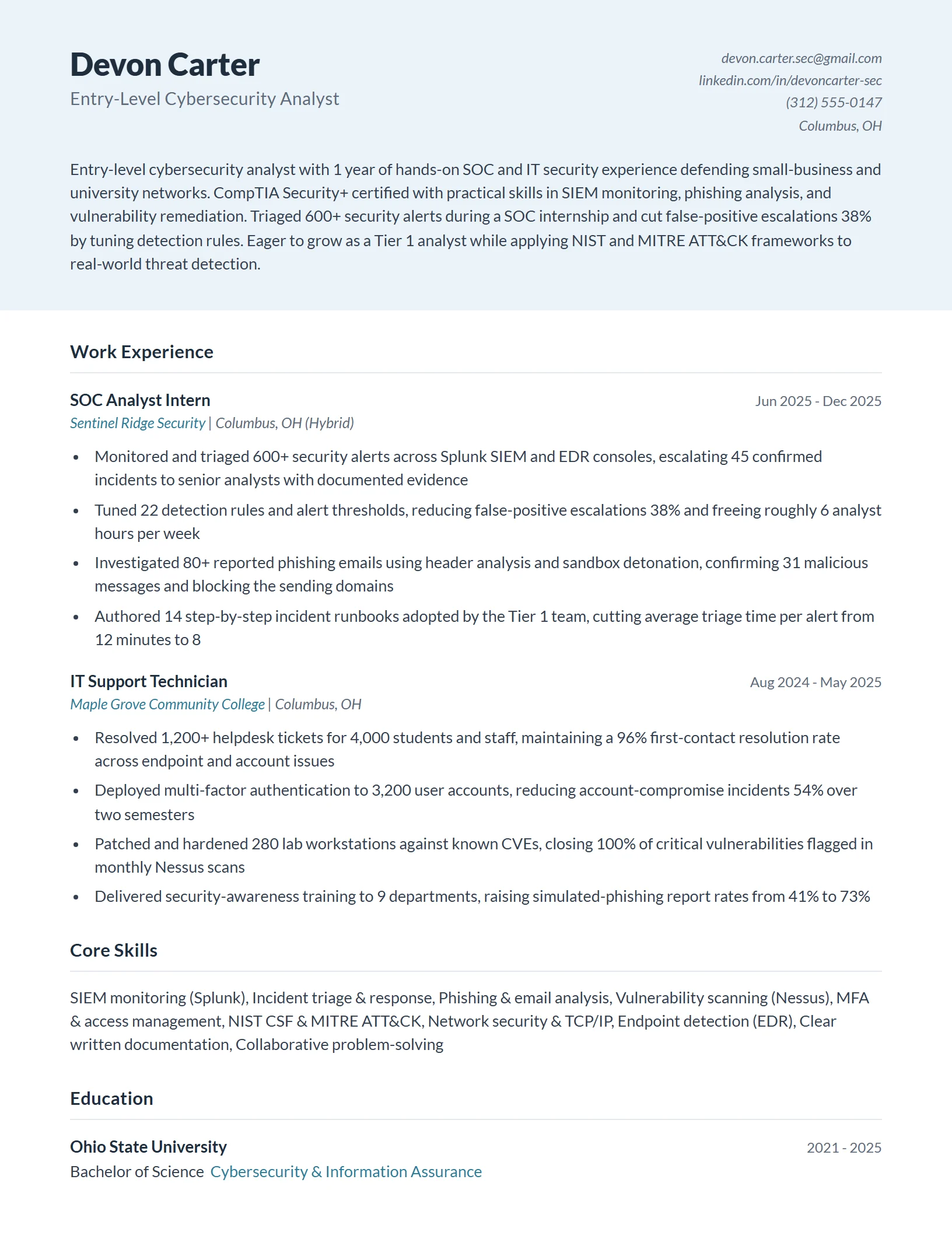
Entry-Level Cybersecurity resume example
For students, career changers, and anyone breaking in with little formal experience. It proves readiness through labs, projects, certifications, and transferable IT skills.
This resume works because it replaces a thin work history with hard proof: home lab projects, TryHackMe or capture-the-flag results, a Security+ certification, and any help desk or IT support experience reframed around security. It front-loads keywords from entry-level postings so an ATS still finds a match, even without years on the job.
SOC Analyst resume example
Tailored to security operations center roles focused on real-time monitoring, alert triage, and incident escalation. It speaks the language of a 24/7 SOC environment.

It stands out by showing volume and speed: alerts handled per shift, escalation accuracy, and adherence to incident runbooks and SLAs. It highlights SIEM tooling, playbook execution, and tier-1 to tier-2 progression, with the shift-based, ticket-driven keywords SOC job descriptions use and ATS systems scan for.
Security Engineer resume example
For the build-and-harden side of cybersecurity, where the work is securing infrastructure rather than monitoring it. It emphasizes architecture, automation, and prevention.

This resume works because it frames the engineer as someone who reduces risk by design: implementing IAM controls, hardening cloud environments, automating security checks in CI/CD, and closing vulnerabilities at scale. It names the engineering stack (AWS or Azure security, Terraform, firewalls, zero trust) that both senior reviewers and ATS expect to see.
Information Security Analyst resume example
Uses the formal job title that appears in many corporate and government postings, with a stronger emphasis on governance, risk, and compliance alongside technical work.
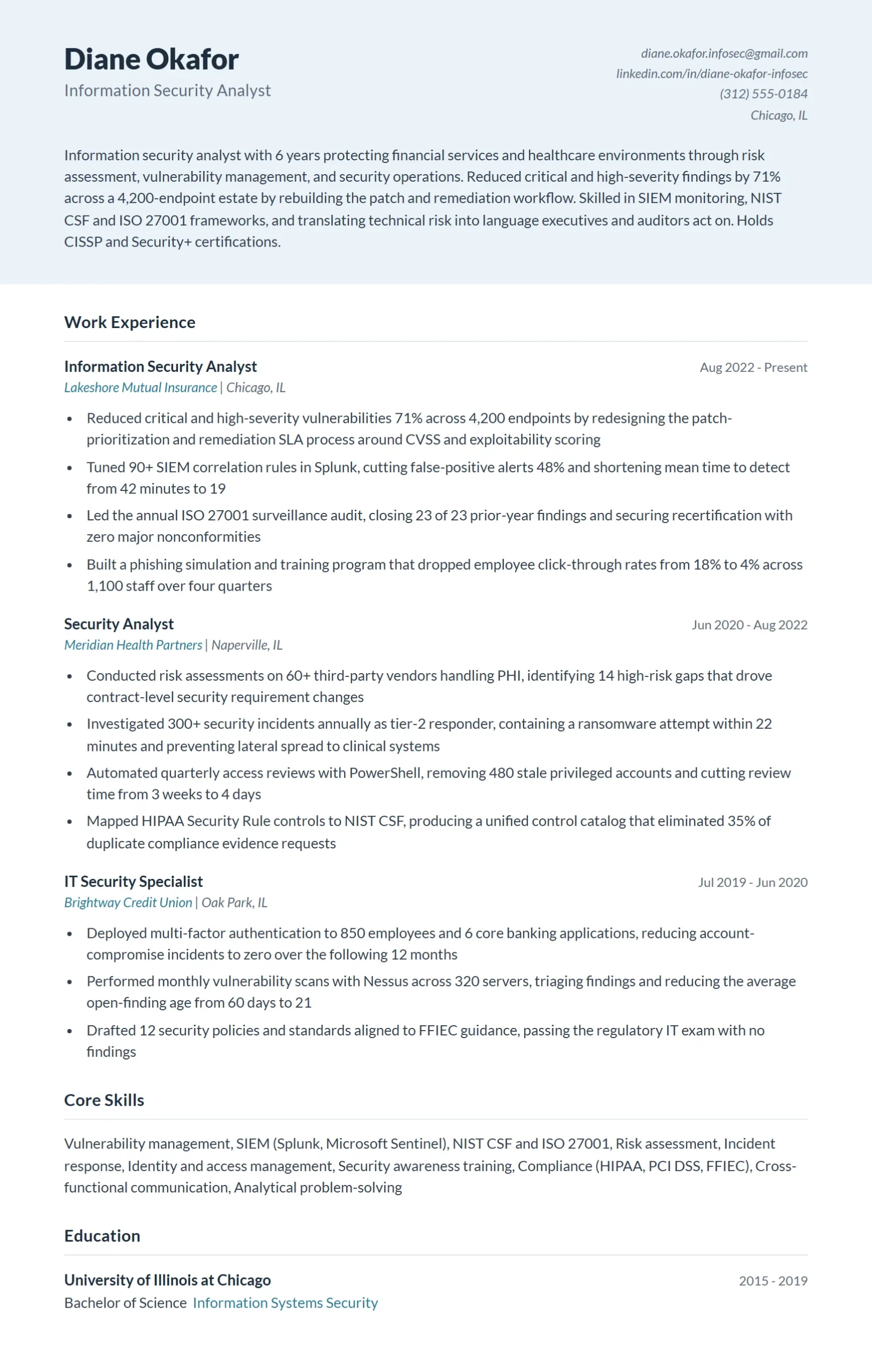
It performs well because it balances hands-on security skills with the policy and audit language these roles require: risk assessments, compliance with SOC 2, HIPAA, or PCI DSS, and security awareness initiatives. Matching the exact ‘information security’ phrasing from the job description helps the resume clear ATS screening that ‘cyber security’ alone might miss.
How to write a Cybersecurity resume that gets interviews
Cybersecurity hiring teams scan for two things fast: proof you can reduce real risk, and the exact tools, frameworks, and certifications the role requires. Most resumes fail because they list responsibilities (“monitored alerts,” “managed firewalls”) instead of outcomes (“cut mean time to detect from 45 to 12 minutes”). Your resume also has to clear the ATS first, which means mirroring the certifications and platform names in the job description before a human ever reads it. Use the tips below to make every line carry a metric, a tool, or a framework.
- Lead with risk reduced, not tasks performed: Security work is measured in incidents prevented and exposure shrunk, so quantify it. Swap “responsible for vulnerability management” for “remediated 1,200+ critical and high CVEs across 800 endpoints, cutting the external attack surface by 40% in two quarters.” Reach for metrics like MTTD, MTTR, dwell time, alert volume reduced, audit findings closed, false-positive rate, and phishing click-through rate.
- Name the exact tools and platforms, not just “SIEM” or “EDR”: Recruiters and ATS filters search for specific product names. Write Splunk, Microsoft Sentinel, CrowdStrike Falcon, SentinelOne, Wireshark, Nessus, Qualys, Burp Suite, Snort, or Palo Alto, depending on what you have actually used. Pull the platform names directly from the job posting and only claim the ones you can defend in an interview.
- Put certifications where they get seen: Certs are often the first hard filter in security hiring. List active ones (Security+, CySA+, CISSP, CISM, OSCP, GCIH, CEH, AWS Security Specialty) near the top, either in a dedicated Certifications section or beside your name. Spell out both the acronym and the full name once so the ATS matches either version, and include the year or “in progress” status.
- Map your bullets to recognized frameworks: Tying work to MITRE ATT&CK, NIST CSF, the NIST 800-53 controls, ISO 27001, CIS Controls, SOC 2, PCI DSS, or HIPAA signals that you operate at a professional standard. Example: “Mapped detection coverage to MITRE ATT&CK, closing gaps across 18 techniques and raising coverage from 54% to 89%.”
- Show the SOC tier or specialization you actually work at: “Cybersecurity” spans wildly different jobs. Make your lane obvious: SOC analyst (Tier 1 to 3), incident response, threat hunting, GRC and compliance, application or cloud security, penetration testing, or security engineering. Match your headline and summary to the posting so a SOC role does not read like a pen-testing resume, and vice versa.
- Run your resume against the job description before you apply: Security postings are dense with required keywords (specific tools, certs, clearances, frameworks). Compare your resume to the exact posting and fix gaps in skill phrasing before submitting. If the role requires an active clearance (Secret, Top Secret, TS/SCI) or US citizenship, state your status plainly. Recruiters filter hard on it and leaving it implied can cost you the screen.

Cybersecurity resume summary examples
Your summary is the first thing a recruiter reads. Lead with your specialty, years of experience, and a quantified win.
Good cybersecurity resume summary examples
- SOC analyst with 4 years monitoring enterprise environments of 10,000+ endpoints in Splunk and CrowdStrike Falcon. Reduced mean time to detect from 38 to 9 minutes and cut false-positive alerts 45% by tuning correlation rules. Security+ and CySA+ certified, with detection coverage mapped to MITRE ATT&CK.
- Incident response lead who has contained 60+ confirmed security incidents, including two ransomware events resolved with zero data loss and under four hours of downtime. GCIH and CISSP certified, fluent in NIST 800-61 IR lifecycle, EDR forensics, and threat hunting across hybrid AWS and on-prem environments.
- GRC analyst who guided two organizations through successful SOC 2 Type II and ISO 27001 certifications, closing 95 of 98 audit findings ahead of deadline. Maps controls to NIST CSF and CIS Controls, and built a vendor risk program that assessed 140+ third parties in the first year.
What to avoid
- Hardworking cybersecurity professional with a passion for protecting data and a strong desire to keep companies safe from hackers. (All sentiment, zero evidence. No tools, no certs, no metrics, no specialization. A recruiter cannot tell whether this person runs a SOC, writes policy, or just finished a bootcamp.)
- Detail-oriented team player seeking a challenging security role where I can grow my skills and contribute to a dynamic organization. (It is about what the candidate wants, not what they deliver. “Detail-oriented team player” and “challenging role” are filler that match no ATS keyword and prove nothing about security capability.)
Cybersecurity resume skills
Match these to the exact job posting and add any required certifications (Security+, CySA+, CISSP, OSCP); see the dedicated cybersecurity skills page for the full keyword list.
Hard skills for a cybersecurity resume
- SIEM (Splunk, Microsoft Sentinel)
- EDR/XDR (CrowdStrike Falcon, SentinelOne)
- Vulnerability management (Nessus, Qualys)
- Incident response and digital forensics
- MITRE ATT&CK and NIST CSF
- Network security (firewalls, IDS/IPS, packet analysis)
- Cloud security (AWS, Azure)
- SIEM rule tuning and log analysis
- Penetration testing (Burp Suite, Metasploit, Kali)
- Compliance frameworks (SOC 2, ISO 27001, PCI DSS, HIPAA)
Soft skills for a cybersecurity resume
- Clear incident communication under pressure
- Analytical and investigative thinking
- Attention to detail
- Cross-team collaboration with IT and engineering
- Calm decision-making during active incidents
Cybersecurity resume work experience bullet point examples
Lead each bullet with a strong verb and a measurable result.
Good bullet point examples
- Investigated and triaged 150+ security alerts per week in Microsoft Sentinel, escalating confirmed threats with a 96% accuracy rate and reducing analyst escalation backlog by 30%.
- Led containment and eradication for a business-email-compromise incident affecting 22 mailboxes, restoring full access in under 3 hours and implementing conditional access policies that blocked 100% of repeat attempts.
- Remediated 1,400+ critical and high vulnerabilities identified by Nessus across 650 servers, lowering the average CVSS exposure score from 7.8 to 4.1 within two quarters.
- Built and tuned 40+ Splunk correlation rules mapped to MITRE ATT&CK, expanding detection coverage from 58% to 91% of relevant techniques and cutting false positives by half.
Bad bullet point examples
- Responsible for monitoring security alerts and responding to incidents as needed. (Describes the job description, not performance. No volume, no tools, no outcome. “As needed” is filler that says nothing about scale or skill.)
- Helped improve the company’s overall security posture and reduce risk. (Vague and unmeasurable. “Helped” hides the candidate’s actual role, and “improve posture” has no number, tool, or framework a hiring manager can verify.)
- Used various security tools to protect the network from threats. (“Various tools” defeats the purpose. ATS filters and recruiters search for specific product names (Splunk, CrowdStrike, Nessus), so naming none means matching none.)
Cybersecurity resume tips
A strong cybersecurity resume proves you reduce risk with measurable results and speaks the exact language of every ATS and hiring manager scanning for Splunk, CrowdStrike, and MITRE ATT&CK.
- Mirror the JD Keywords: Copy tool and framework names exactly as written in the job posting, so if the JD says ‘Microsoft Sentinel’ and you write ‘Azure Sentinel,’ the ATS may not match them.
- Quantify Incident Impact: Attach a number to every incident response bullet using metrics that matter to security teams: mean time to detect (MTTD), mean time to respond (MTTR), number of endpoints protected, or percentage of false positives reduced.
- List Certifications Prominently: Place certifications like CISSP, CEH, CompTIA Security+, or cloud security credentials (AWS Security Specialty, Microsoft SC-200) in a dedicated section near the top so both ATS filters and recruiters find them in under five seconds.
- Name Every Tool: Spell out each platform you have used, including Splunk, CrowdStrike Falcon, SentinelOne, Nessus, Qualys, and Wireshark, because ATS systems match on exact product names, not category labels like ‘SIEM tool’ or ‘EDR solution’.
- Map Bullets to Frameworks: Reference MITRE ATT&CK tactics or NIST CSF functions (Identify, Protect, Detect, Respond, Recover) inside your bullet points to signal framework fluency and match the language security hiring managers use internally.
- Separate Cloud from Network Skills: Cybersecurity roles increasingly split between cloud-native and traditional network security, so list cloud security experience (AWS GuardDuty, Azure Defender, IAM policy hardening) in its own skills cluster rather than burying it under general network security.
Pair your cybersecurity resume with a cover letter
A strong resume goes further with a tailored cover letter. Browse our cybersecurity cover letter examples to round out your application.
Cybersecurity resume frequently asked questions
List the certs that match the job description, and put your highest-value ones near the top of your resume or in a dedicated Certifications section. For most roles that means Security+, CySA+, or CEH at the analyst level, and CISSP, CISM, or OSCP for senior and specialized positions. Spell out the full name and the acronym (for example, “Certified Information Systems Security Professional (CISSP)”) so the ATS catches both, and include “In progress” with an expected date for any you are currently studying for.
Reframe your existing experience around security tasks you already touch: patching, access management, incident escalation, endpoint hardening, or enforcing security policies. Lead your summary with your target title (“aspiring SOC analyst” or “security analyst”) rather than your current one, and feature a Security+ cert plus any hands-on lab work. A help desk background is an asset here, since troubleshooting, ticketing, and user support map directly to triage and incident response, so name those connections explicitly instead of hiding the IT history.
Quantify the outcome, not the classified specifics. Use figures like “reduced mean time to detect by 35%,” “triaged 40+ alerts per shift,” “cut phishing click-through from 18% to 4% after a training rollout,” or “remediated 200+ vulnerabilities flagged in quarterly scans.” You can describe the type of threat, the tool, and the result without naming the employer’s systems, breach details, or anything under NDA. Generalize the context and keep the metric, which is what hiring managers actually want to see.
Most private-sector roles do not require a clearance, but many government and defense contractor positions do, and listing an active one can move you to the top of the pile. If you hold a clearance, state the level and status near your contact info or summary (for example, “Active Secret clearance” or “TS/SCI eligible”). Never invent or overstate clearance status, since it is verified during hiring. If you do not have one, focus on the roles that don’t require it and note your eligibility only if it’s genuinely current.
Mix technical tools, frameworks, and the analytical skills that show how you think. Name your stack (SIEM platforms like Splunk or Microsoft Sentinel, Wireshark, Nessus, Burp Suite, EDR tools) alongside frameworks recruiters scan for (NIST CSF, MITRE ATT&CK, ISO 27001, the CIA triad). Add core methods like incident response, vulnerability management, threat hunting, log analysis, and network security. Pull the exact tools and frameworks named in the job posting, since those are frequently the precise keywords the ATS is matching against.
Treat your home lab, certifications, and projects as real experience and put them front and center. Build a lab (a SIEM, a vulnerable VM, a capture-the-flag practice environment), document what you detected and fixed, and write it up with the same problem-action-result structure you’d use for a job. Earn an entry-level cert like Security+ to clear keyword filters, and feature platforms like TryHackMe or Hack The Box if you’ve completed meaningful work there. A documented project that shows you investigated and resolved a real attack scenario often reads stronger than a generic IT job with no security tie-in.