Best Database Developer Resume Examples for 2026
Build a database developer resume for 2026 that proves it, with real examples, SQL and data-modeling skills, and the keywords ATS scans for.



Database developers design, build, and optimize the systems that store and serve an organization’s data. The role blends schema design, SQL and stored-procedure work, data modeling, and performance tuning, and it overlaps with SQL developers, ETL developers, and DBAs depending on the team.
Hiring managers want proof you can ship reliable, fast data systems, not just list technologies. They look for the platforms you know (SQL Server, PostgreSQL, Oracle, MySQL), the impact of your work (faster queries, cleaner models, fewer failures), and quantified results. Before a human sees any of it, an applicant tracking system scans for the exact skills and keywords in the job description, so the right terms have to be on the page.
The examples below show how to do both. Find the variant closest to your target role, then borrow the structure, the skill framing, and the keyword choices that get a database developer resume past ATS filters and in front of a hiring manager.
Ready to build yours? Try our ATS-friendly resume builder or scan your draft against the job description.
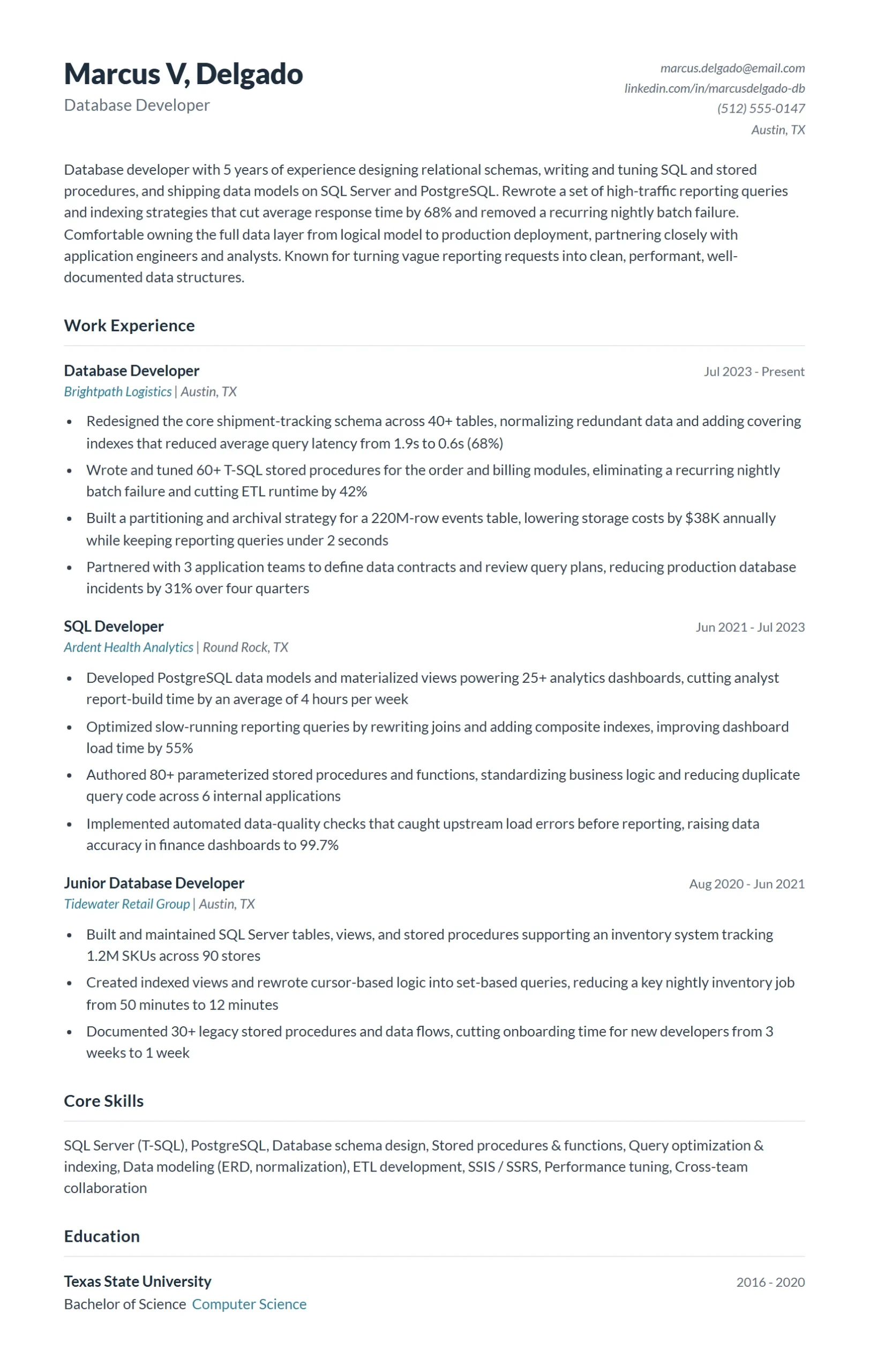
Database Developer resume example
A mid-level database developer with around five years building and tuning relational systems for a production application.
This resume leads with platform fluency (SQL Server, PostgreSQL) and pairs every responsibility with a measurable result, like cutting average query time or reducing failed jobs. It frames schema design and stored-procedure work as business outcomes rather than tasks, which is exactly what hiring managers and ATS keyword filters reward.
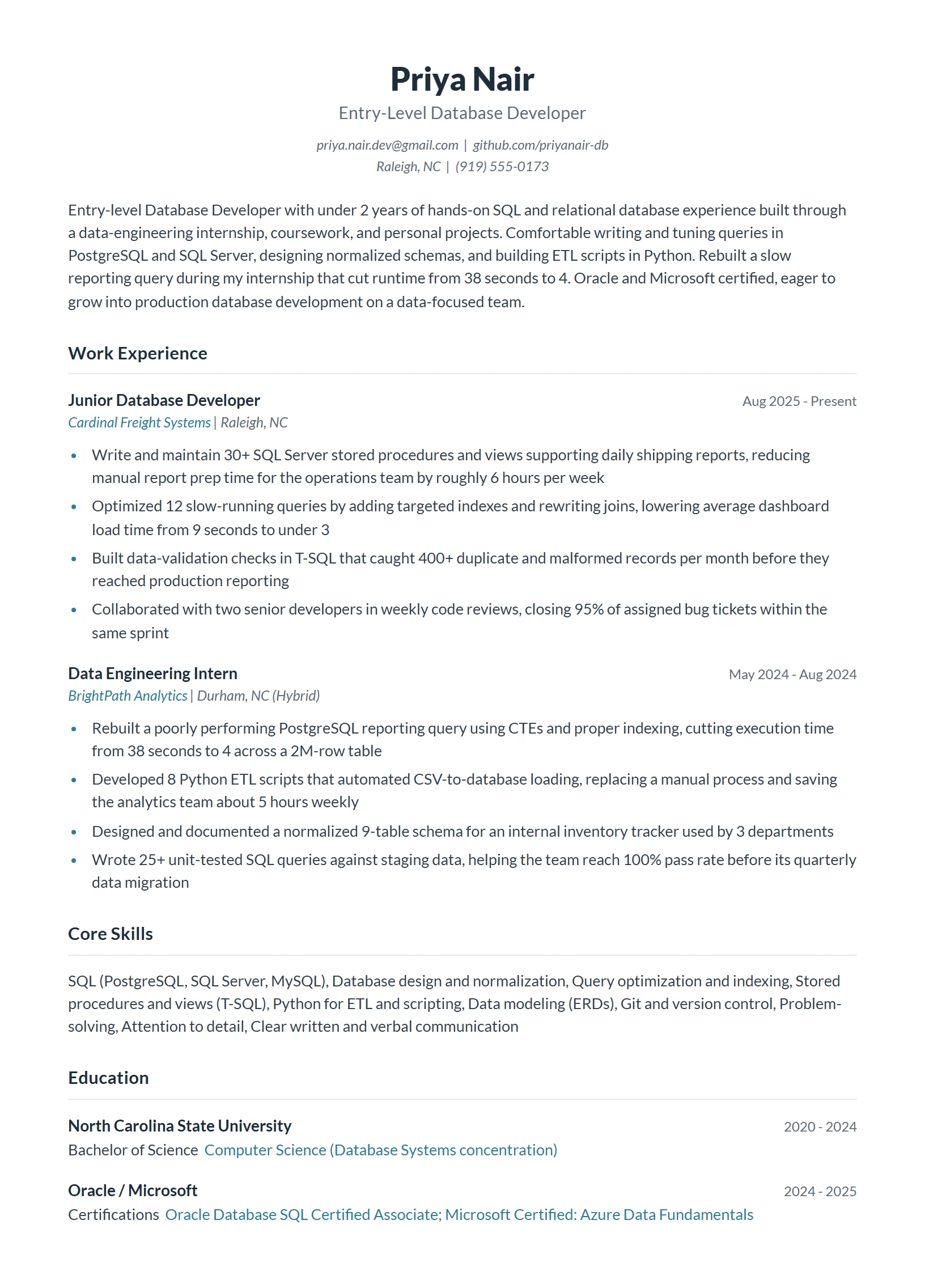
Entry-Level Database Developer resume example
An early-career candidate breaking in with a CS degree or bootcamp background and limited production experience.
With fewer roles to show, this resume leans on SQL coursework, personal and capstone projects, an internship, and certifications to prove hands-on ability. It surfaces concrete skills (writing joins, normalizing tables, basic query tuning) so an ATS still matches the core keywords even without years of experience.
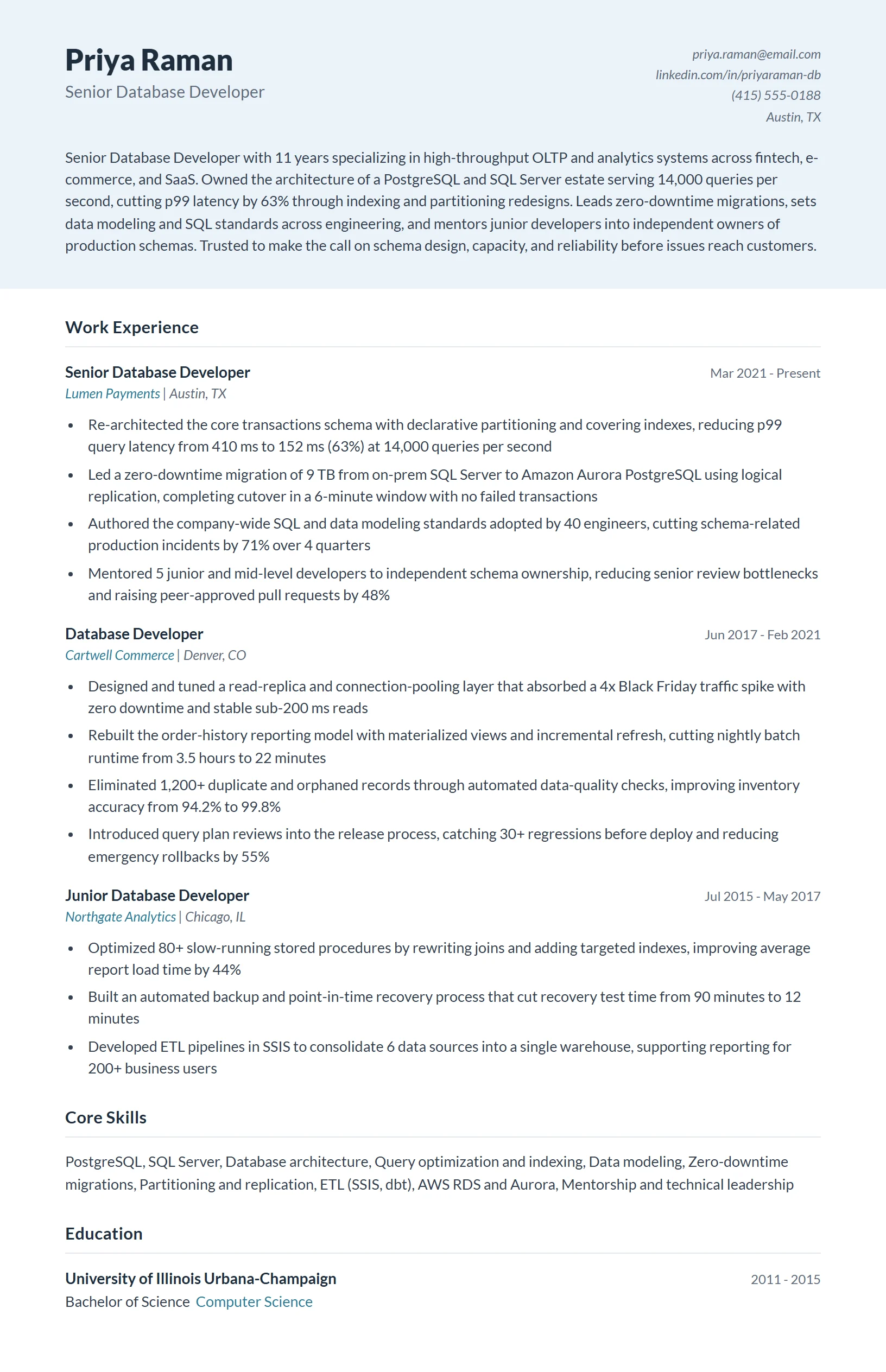
Senior Database Developer resume example
A senior developer who owns database architecture, leads migrations, and mentors a team.
This resume shifts from doing the work to setting the direction, with bullets on architecture decisions, large-scale migrations, and standards that improved reliability across teams. Quantified wins (query performance gains, downtime reduction, cost savings) and leadership signals separate it from mid-level resumes and match senior-level keywords.
SQL Developer resume example
A sibling role centered on writing, optimizing, and maintaining complex SQL rather than full database architecture.

This version foregrounds deep T-SQL or PL-SQL skill, query optimization, indexing strategy, and reporting or stored-procedure delivery. It proves you make existing databases faster and more reliable, the angle recruiters and ATS expect for SQL-specific job descriptions.
Database Administrator resume example
An adjacent operations role focused on keeping databases secure, available, and performant in production.

This resume highlights backups and recovery, replication, high availability, security, and patching, with uptime and reliability metrics front and center. The keyword set leans operational (HA, disaster recovery, monitoring), so a build-focused developer applying to DBA roles can see exactly which terms to add.
ETL Developer resume example
A specialization centered on moving and transforming data across systems and into warehouses.

This example features ETL/ELT pipeline design and tools like SSIS, Informatica, or dbt, with results tied to data quality, load times, and downstream reporting. It shows how to frame integration and data-warehousing work as measurable wins that match the keywords ATS screens for in pipeline roles.
How to write a Database Developer resume that gets interviews
Hiring managers and engineering leads skim a database developer resume for proof you can design schemas, write performant SQL, and keep production data fast and reliable under load. They want specific databases, specific query and pipeline work, and outcomes measured in latency, throughput, cost, and uptime. Most companies also run your resume through an Applicant Tracking System (ATS) first, so your stack and your accomplishments have to match the job description before a human ever reads them. The tips below show you how to clear the ATS scan and convince the engineer reading next.
- Name your exact stack, not just “databases”: Recruiters and the ATS scan for specific systems. Spell out the engines (PostgreSQL, MySQL, SQL Server, Oracle, MongoDB), the languages (SQL, T-SQL, PL/SQL, Python), and the tooling (SSIS, dbt, Airflow, Redis, Snowflake, AWS RDS). If the posting says “T-SQL and SSIS,” use those exact terms, not a generic “strong SQL skills.” A reader should know within five seconds whether you match their environment.
- Quantify performance, scale, and cost: This is the difference between a senior-looking resume and a junior one. Show what your work did: “cut average query time from 4.2s to 280ms,” “tuned indexes that reduced CPU load 40%,” “designed a schema supporting 12M daily transactions,” or “migrated 3TB to PostgreSQL with zero downtime.” Tie your bullets to latency, throughput, rows or transactions handled, storage saved, and infrastructure cost. Numbers prove you operated at real scale.
- Lead with optimization and tuning, not just maintenance: Anyone can say they “managed databases.” Hiring teams pay for people who make slow things fast and fragile things reliable. Foreground query optimization, indexing strategy, execution-plan analysis, partitioning, and stored-procedure refactoring. Show the before-and-after: the bottleneck you found, what you changed, and the measured result. Maintenance keeps the lights on; tuning gets you hired.
- Prove data integrity, security, and reliability: Production data is a trust job. Reference the practices that keep it safe: normalization and schema design, backup and recovery, replication and failover, ACID compliance, role-based access, and encryption. A bullet like “implemented automated backups and point-in-time recovery, cutting restore time from 6 hours to 20 minutes” tells a hiring manager you can be trusted with their most important asset.
- Show ETL, pipelines, and cross-team work: Modern database roles bleed into data engineering. Name the pipelines you built and who you built them for: “Designed an SSIS ETL pipeline feeding a reporting warehouse used by 40+ analysts” or “Partnered with backend engineers to refactor an ORM layer, cutting N+1 queries 70%.” This signals you can move data between systems and collaborate with developers, analysts, and DevOps rather than working in isolation.
- Keep the format ATS-friendly and tailor every application: A SQL-developer role, a data-engineering role, and a DBA-leaning role reward different keywords. Reorder your skills and swap your headline bullets to mirror each posting. Then keep the format clean: standard section headings, no text boxes or multi-column layouts that scramble parsing, and one clear column. Run it through Jobscan to check your match rate against the job description before you apply.

Database Developer resume summary examples
Your summary is the first thing a recruiter reads. Lead with your specialty, years of experience, and a quantified win.
Good database Developer resume summary examples
- Database developer with 7+ years designing and optimizing relational databases across fintech and SaaS. Tuned queries and indexes that cut average response time from 4.2s to under 300ms and reduced database CPU load 40%. Deep expertise in PostgreSQL, SQL Server, T-SQL, and SSIS, with a track record of supporting systems handling 12M+ daily transactions.
- SQL developer specializing in high-volume OLTP systems and ETL pipelines. Owns the full data lifecycle from schema design and stored-procedure development to performance tuning and reporting. Recent work migrated 3TB from Oracle to PostgreSQL with zero downtime and cut nightly batch runtimes 55%.
- Results-driven database developer skilled in query optimization, data modeling, and pipeline automation. Built dbt and Airflow workflows feeding a Snowflake warehouse used by 40+ analysts, and refactored stored procedures that lowered infrastructure spend $90K annually. Strong partner to backend engineering and analytics teams.
What to avoid
- Hardworking database developer looking for a challenging role where I can use my SQL skills and grow with a great company. (It is about what the candidate wants, not what they deliver. There is no stack, no scale, no tuning work, and zero measurable impact. A hiring manager learns nothing they can act on, and the ATS finds no specific keywords to match.)
- Detail-oriented developer with strong knowledge of databases and a passion for writing efficient code and solving problems. (Pure adjectives with no proof. “Strong knowledge of databases” names no engine, no language, and no result. It reads as filler the recruiter skips, because “efficient” means nothing without a before-and-after number to back it.)
Database Developer resume skills
Pull the exact engines, languages, and tools from each job description, then mirror that language here. This is a quick resume snapshot, so keep it to your strongest, role-relevant skills rather than an exhaustive list.
Hard skills for a database Developer resume
- SQL
- PostgreSQL
- Microsoft SQL Server (T-SQL)
- MySQL
- Oracle (PL/SQL)
- Database Design & Normalization
- Query Optimization & Indexing
- Stored Procedures
- ETL / SSIS
- Data Modeling
Soft skills for a database Developer resume
- Problem Solving
- Attention to Detail
- Collaboration
- Communication
- Analytical Thinking
Database Developer resume work experience bullet point examples
Lead each bullet with a strong verb and a measurable result.
Good bullet point examples
- Optimized indexing and query execution plans on a high-traffic PostgreSQL database, cutting average query time from 4.2s to 280ms and reducing CPU load 40%.
- Designed and normalized a schema supporting 12M daily transactions, eliminating redundant tables and improving join performance across the reporting layer 35%.
- Migrated 3TB of customer data from Oracle to PostgreSQL with zero downtime, using replication and a phased cutover validated by automated row-count and checksum tests.
- Built an SSIS ETL pipeline feeding a data warehouse used by 40+ analysts, cutting nightly batch runtime from 5 hours to 2.2 hours and adding automated failure alerts.
Bad bullet point examples
- Responsible for maintaining company databases and writing SQL queries. (“Responsible for” describes a job title, not an accomplishment. It names no database, no specific work, and no result. Lead with a strong verb (Optimized, Designed, Migrated) and end with a measurable outcome instead.)
- Wrote various stored procedures and fixed bugs to improve performance. (“Various” and “improve performance” are vague with no proof. How much faster, on what system, handling how much data? Without a before-and-after metric the reader cannot tell whether the work mattered.)
- Worked with the team to manage the database and keep it running smoothly. (Subjective and unquantified. “Running smoothly” is an opinion, not evidence. Replace it with the uptime, recovery time, or query-performance number that backs the claim, and name the database you actually managed.)
Database Developer resume tips
A strong database developer resume proves to both ATS filters and hiring engineers that you can design, optimize, and scale data systems that hold up under real production pressure.
- Mirror the Job Description: Copy the exact database names and tools from the posting (PostgreSQL, T-SQL, PL/SQL, MySQL) into your skills section and bullet points, because ATS systems match keywords literally and will score you lower for synonyms or abbreviations the employer did not use.
- Quantify Query Wins: Every optimization story needs a number: cut query execution time from 8 seconds to 400 milliseconds, reduced index bloat by 60 percent, or improved throughput from 2,000 to 11,000 transactions per second, because latency and throughput are the metrics database hiring managers trust most.
- Name Specific Schema Work: Call out the normalization form, the scale, and the domain (third normal form schema supporting 200 million rows in a healthcare billing system) rather than just listing database design, so engineers can immediately assess the complexity of your experience.
- List Certifications Precisely: Spell out credentials in full, such as Oracle Database SQL Certified Associate or Microsoft Certified: Azure Database Administrator Associate, and include the year earned so ATS parsers and recruiters can verify relevance without guessing.
- Separate Hard and Soft Skills: Put SQL, stored procedures, indexing strategies, and specific platforms in a dedicated technical skills section, then demonstrate soft skills like collaboration and communication inside bullet points with context (partnered with four backend engineers to redesign the reporting schema), never in a standalone list.
- One Page vs. Two Pages: Keep the resume to one page if you have fewer than eight years of database experience, and reserve a second page only for genuinely distinct roles where you owned different systems or solved materially different problems, because database hiring managers rarely read past page two and padding dilutes your strongest work.
Pair your database Developer resume with a cover letter
A strong resume goes further with a tailored cover letter. Browse our cover letter examples to round out your application.
Database Developer resume frequently asked questions
List the database platforms you actually work in (SQL Server, Oracle, PostgreSQL, MySQL, MongoDB), the languages that prove your depth (SQL, T-SQL, PL/SQL, Python), and the tasks you own end to end (schema design, stored procedures, query optimization, ETL pipelines, data modeling). Add tools like SSIS, SSRS, dbt, or Apache Airflow if the job calls for them, plus cloud platforms (AWS RDS, Azure SQL, Snowflake) since those keywords increasingly drive screening. Match the exact technologies named in the posting, because an ATS often scans for those precise terms before a recruiter ever sees your resume.
Tie every optimization to a measurable before-and-after number, since a faster query means nothing to a hiring manager without the figure attached. Write bullets like “Rewrote indexing strategy and refactored stored procedures, cutting average report query time from 14 seconds to under 2” or “Optimized ETL jobs to reduce nightly batch load from 6 hours to 90 minutes.” Name the technique (indexing, query tuning, partitioning, caching) so both the recruiter and the ATS see the skill, and quantify the business impact wherever you can.
A Database Developer resume centers on building: writing SQL, designing schemas, developing stored procedures, and creating ETL and reporting pipelines that move and transform data. A DBA resume centers on maintaining: backups, replication, security, high availability, and uptime of existing systems. The roles overlap, so read the job description carefully and lead with the keywords that match it, because applying with the wrong emphasis is one of the most common reasons qualified database candidates get filtered out.
Start each bullet with a strong verb (designed, built, optimized, automated, migrated), name the specific technology, then state the result with a number. For example: “Built a SQL Server data warehouse and SSIS pipeline consolidating 8 source systems, enabling self-service reporting for 200+ users.” Focus on what you delivered and the impact it had, not routine duties everyone in the role performs. Aim for 3 to 5 bullets per role and put your most impressive, most relevant work first.
Yes, especially when they match the stack in the job posting. Microsoft Azure Database certifications, Oracle Database SQL Certified Associate, AWS data certifications, and Snowflake credentials all signal verified skill and frequently appear as preferred qualifications, which means an ATS may be scanning for them. List them in a dedicated Certifications section with the full credential name and year. They matter most early in your career or when you are pivoting platforms; senior candidates can lean more on demonstrated project impact.
Use a clean single-column layout with standard headings (Experience, Skills, Certifications, Education) and real selectable text, not skills buried in tables, columns, or graphics that parsers scramble. Spell out the exact technologies from the posting using the same wording, for example writing both “T-SQL” and “SQL Server” if the job lists them, since an ATS matches literal terms. Save as a .docx or text-based PDF, then scan your resume against the job description with a tool like Jobscan to confirm your keyword match and formatting before you apply.