Best DevOps Resume Examples for 2026
Build a DevOps resume for 2026 that proves you ship reliable systems, with real examples and the CI/CD, cloud, and automation keywords ATS scans for.



DevOps engineers sit between development and operations, automating the path from code commit to production. The role spans CI/CD pipelines, infrastructure-as-code, cloud platforms, containers, monitoring, and the on-call reliability work that keeps systems running. Because the title covers so much ground, your resume has to show not just the tools you know but the outcomes you delivered with them.
Hiring managers want proof that you reduce friction and risk: faster deployments, less downtime, lower cloud spend, fewer manual steps. They scan for measurable wins, then look for the stack that matches their environment. The applicant tracking system gets there first, so it has to recognize terms like Kubernetes, Terraform, AWS, Docker, and CI/CD before a person ever reads your bullets. Skills buried in a paragraph or hidden in a graphic often never get parsed.
The examples below show how to frame your experience around results, surface the right keywords without stuffing, and format the page so it clears ATS filters cleanly. Find the version closest to your role, then borrow the structure and adapt the details to your own work.
Ready to build yours? Try our ATS-friendly resume builder or scan your draft against the job description.
DevOps Engineer resume example
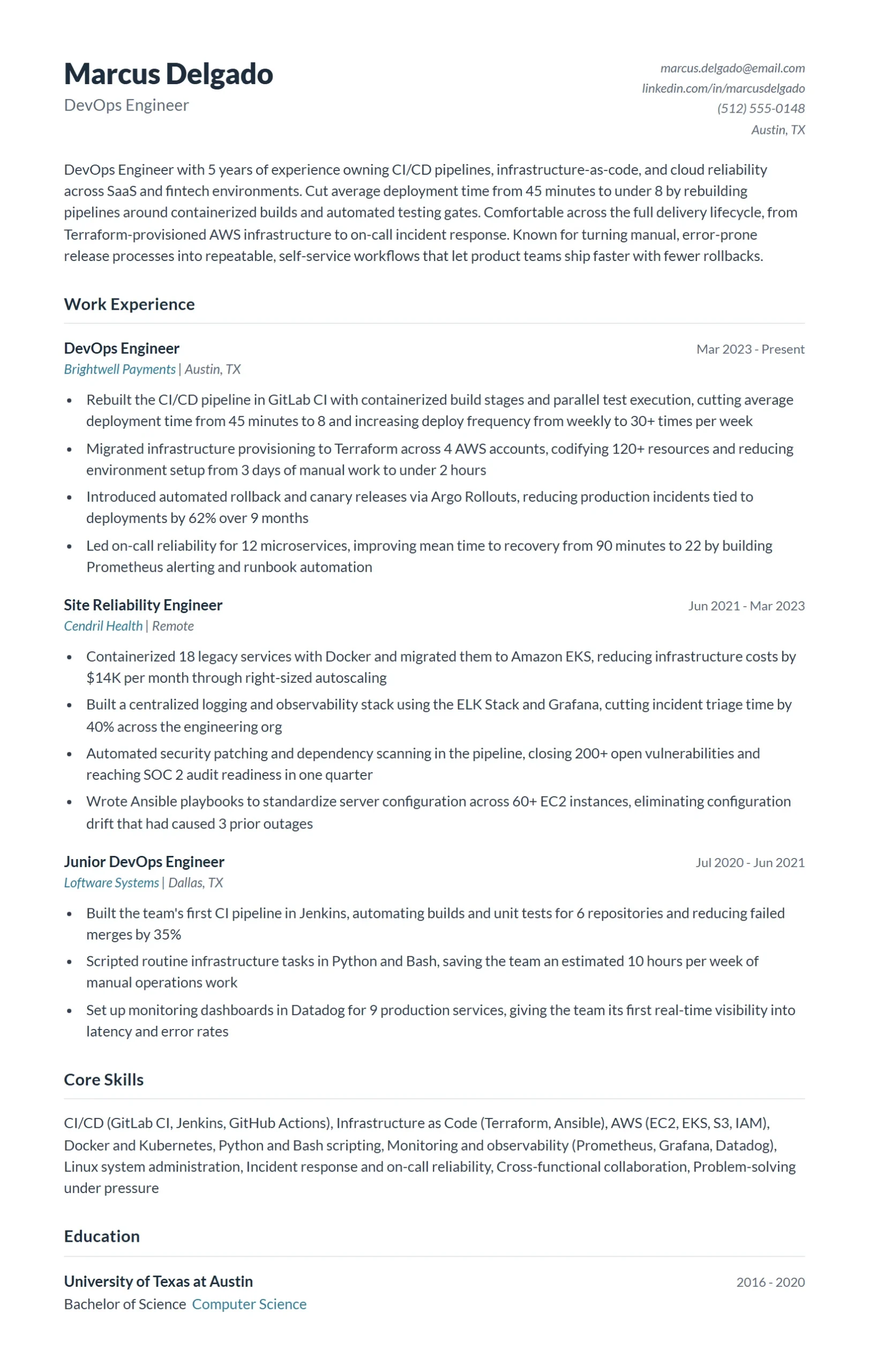
A mid-level DevOps generalist with around five years of experience owning CI/CD pipelines, infrastructure-as-code, and cloud reliability. This is the core example most DevOps job seekers should start from.
It leads every bullet with a measurable outcome (deploy frequency, mean time to recovery, cloud cost) instead of just listing tools. The summary names the full stack early so ATS parses Kubernetes, Terraform, and AWS in the first scan, and the experience section ties each technology to a business result. That balance of keywords and impact is what moves a resume past both the filter and the hiring manager.
Senior DevOps Engineer resume example
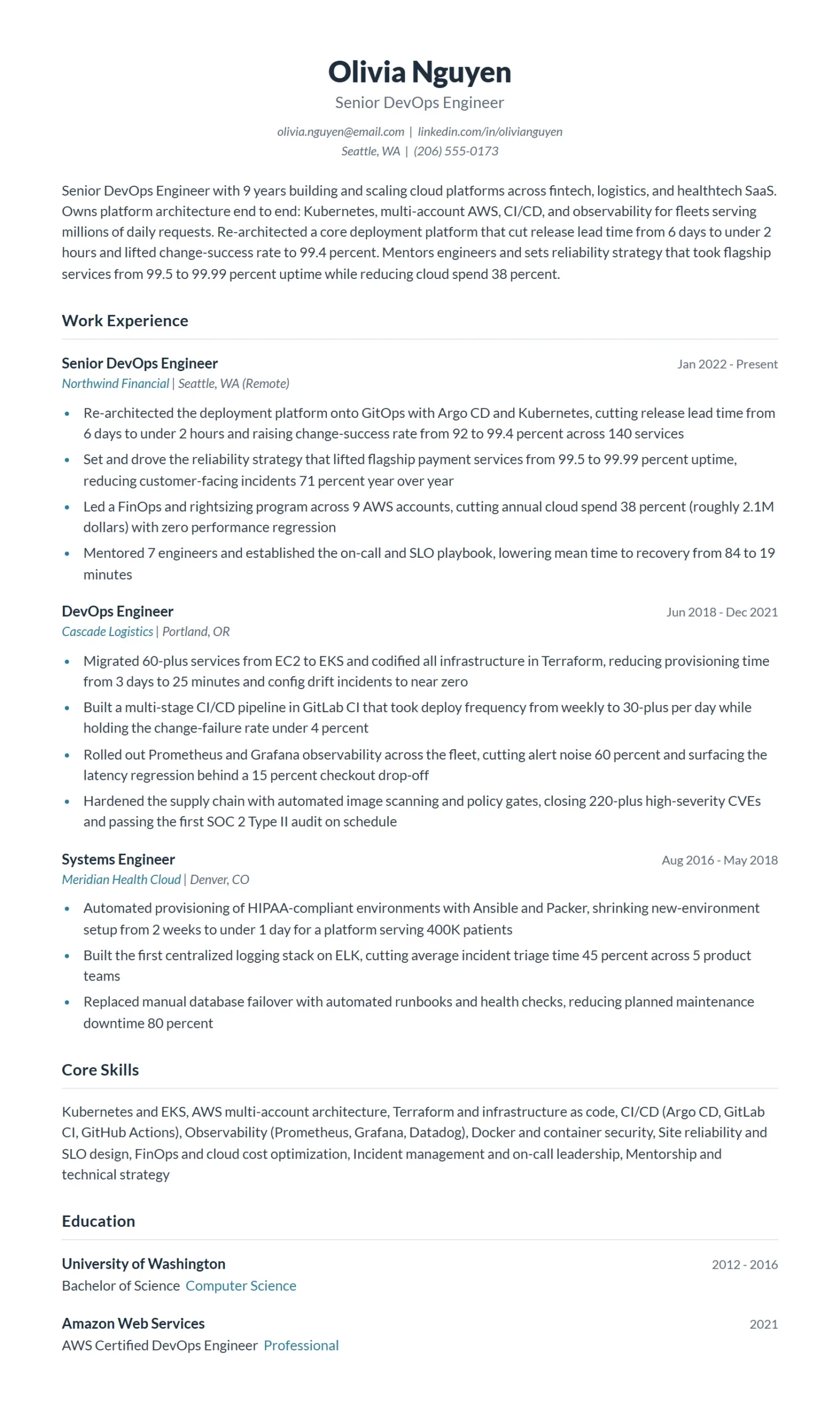
A senior or lead engineer with eight-plus years who owns platform architecture, sets reliability strategy, and mentors a team. The framing shifts from doing the work to driving outcomes across teams.
It emphasizes scope and influence: systems serving millions of requests, multi-region architecture decisions, and the dollar impact of cost and reliability work. Leadership signals (mentoring, setting standards, cross-team initiatives) appear alongside deep technical depth, so it reads as senior without dropping the hands-on credibility hiring managers still want at this level.
Junior DevOps Engineer resume example
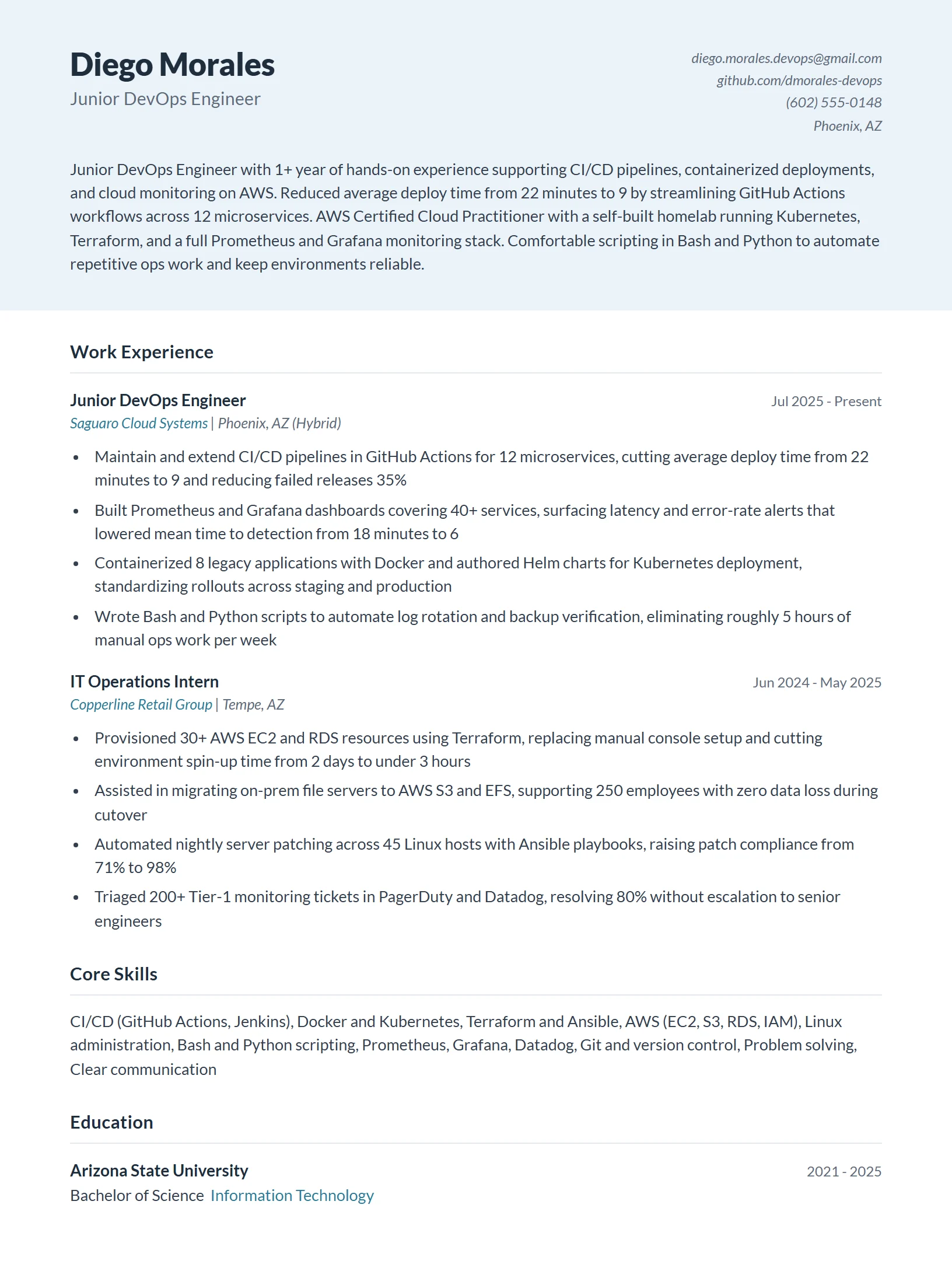
An early-career engineer or career-switcher with zero to two years, leaning on certifications, projects, and a homelab to prove readiness. Built to overcome the experience gap many junior candidates face.
It puts certifications (AWS, Kubernetes) and hands-on projects front and center to compensate for a short work history, and quantifies even small wins like automating a manual deploy or cutting build time. By showing real pipeline and container work from internships or self-directed projects, it gives ATS the keywords and the hiring manager the evidence that this candidate can contribute on day one.
Cloud Engineer resume example
A sibling role focused on provisioning and managing cloud infrastructure (AWS, Azure, or GCP) more than owning deployment pipelines. Strong fit for engineers whose work centers on the cloud platform itself.
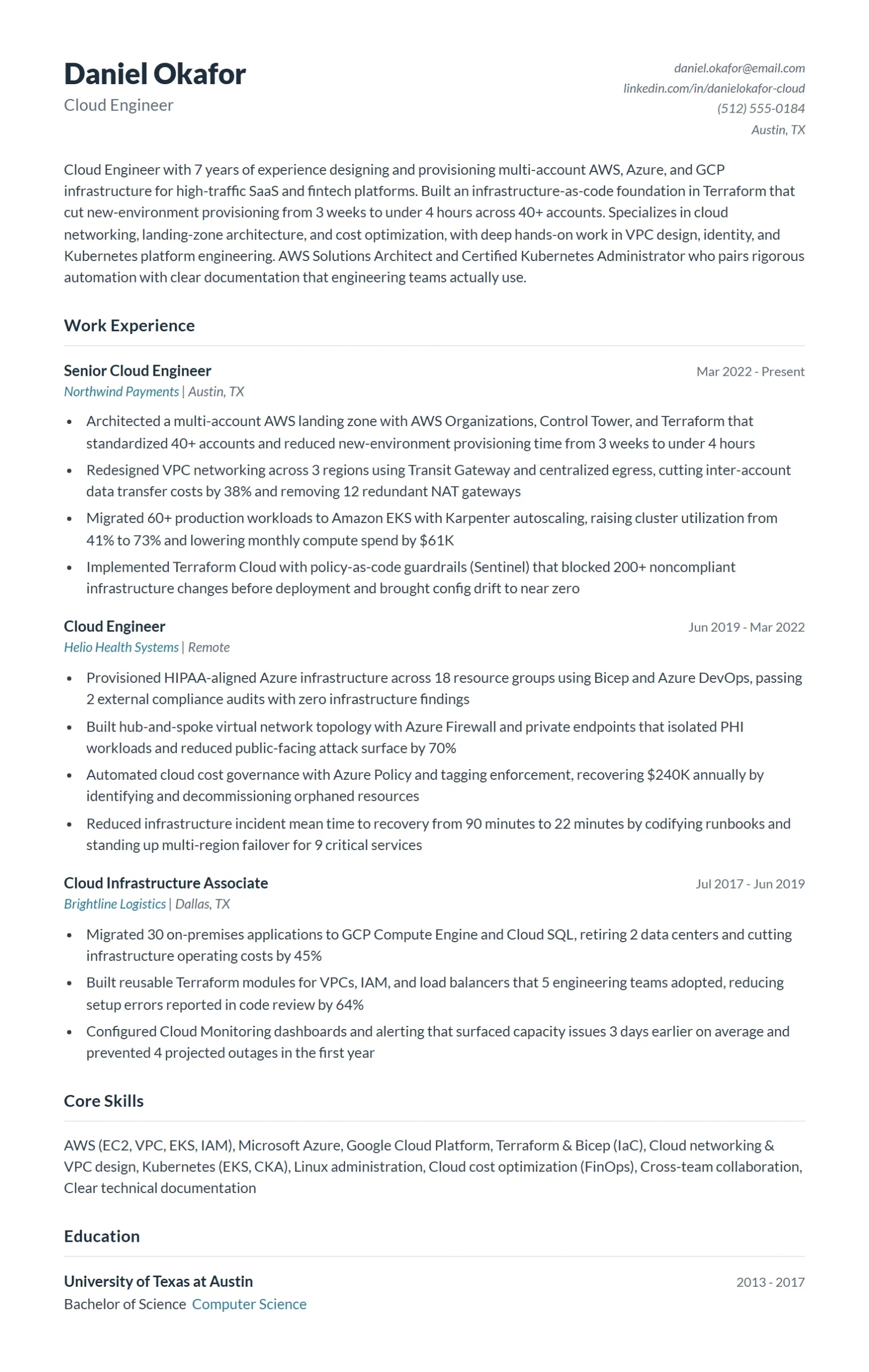
It foregrounds cloud-native depth: networking, IAM, cost optimization, and infrastructure-as-code at scale, rather than the full CI/CD lifecycle. Vendor certifications and specific services (EC2, EKS, CloudFormation) are surfaced clearly so the resume matches cloud-heavy job descriptions, where ATS weights provider and service names heavily.
Site Reliability Engineer resume example
An SRE-focused variant built around reliability, SLOs, observability, and incident response rather than pure build-and-ship work. For engineers measured on uptime and toil reduction.

It frames achievements in reliability terms hiring managers look for: error budgets, SLO attainment, reduced incident volume, and automated toil. Coding ability shows up as a first-class skill (Python, Go) because SRE roles expect software engineering alongside operations, and the observability stack (Prometheus, Grafana, OpenTelemetry) is named explicitly for the ATS match.
Platform Engineer resume example
A sibling role centered on building internal developer platforms and self-service tooling that other engineers use. For candidates whose customers are their own development teams.

It positions the engineer as a product builder, with outcomes like reduced developer onboarding time, higher self-service adoption, and faster delivery for the teams they support. Kubernetes platform work, golden paths, and internal tooling are described as products with users and metrics, which distinguishes it from a standard DevOps resume and matches the growing platform-engineering job market.
How to write a DevOps resume that gets interviews
Hiring managers and engineering leads scan a DevOps resume for proof you can ship reliably, automate the painful parts, and keep production healthy at scale. They want named tooling, real infrastructure ownership, and outcomes tied to numbers: deploy frequency, uptime, lead time, cost. Most companies route your resume through an Applicant Tracking System (ATS) first, so the language has to mirror the job description before a human reads a word. The tips below help you do both: clear the ATS scan and convince the engineer reading next.
- Lead with the tooling stack the job actually names: DevOps job descriptions are dense with specific tools, and the ATS scans for exact terms. Match them precisely. If the posting says Kubernetes, Terraform, and GitLab CI, do not write “container orchestration” and “infrastructure as code” and hope the parser connects the dots. Name the tools: AWS, Docker, Kubernetes, Terraform, Ansible, Jenkins, GitHub Actions, Prometheus, Grafana, Datadog. Group them in a clean skills section and repeat the most important ones inside your experience bullets so they show up in context, not just a keyword list.
- Quantify reliability and velocity, not just tasks: “Maintained CI/CD pipelines” tells a hiring manager nothing. The DORA metrics do: deployment frequency, lead time for changes, change failure rate, and mean time to recovery (MTTR). Show movement. “Cut deployment time from 45 minutes to 6,” “raised deploy frequency from weekly to 30+ per day,” “reduced MTTR from 4 hours to 25 minutes,” “held 99.98% uptime across 200+ microservices.” If you lack business metrics, reliability and pipeline numbers prove impact just as well.
- Show infrastructure as code, not click-ops: Senior DevOps roles want engineers who manage infrastructure declaratively and version it like application code. Make that visible. Reference Terraform or CloudFormation modules you wrote, environments you codified, and the drift or manual toil you eliminated. “Migrated 60+ manually provisioned AWS resources to Terraform, cutting environment setup from 2 days to 20 minutes” signals maturity that “configured AWS services” never will.
- Prove you own production, including the on-call reality: DevOps is judged on what happens at 3 a.m. Show observability and incident response, not just build pipelines. Name your monitoring and alerting stack (Prometheus, Grafana, Datadog, PagerDuty, the ELK stack), the SLOs you defended, and incidents you resolved or designed out. “Built alerting and runbooks that cut false-positive pages 70% and shrank P1 incident resolution to under 30 minutes” tells a lead you can be trusted with production.
- Quantify cloud cost and scale: Cloud spend and scale are language hiring managers act on. Put numbers on the systems you ran and the money you saved. “Right-sized EKS workloads and added spot instances, cutting monthly AWS cost 38% (about $22K/month)” or “scaled infrastructure to handle 50K requests per second during peak” shows you operate at a level the role needs and that you treat the cloud bill as your problem too.
- Tailor to the role flavor and keep the format ATS-clean: A platform engineering role, an SRE role, and a cloud infrastructure role reward different keywords and projects. Reorder your skills and swap your headline bullets to mirror each posting (SRE leans SLOs and error budgets; platform engineering leans developer experience and internal tooling). Then keep parsing simple: standard section headings, a single column, no text boxes or graphics that scramble the ATS. Run it through Jobscan to check your match rate against the job description before you apply.

DevOps resume summary examples
Your summary is the first thing a recruiter reads. Lead with your specialty, years of experience, and a quantified win.
Good devOps resume summary examples
- DevOps engineer with 7+ years automating CI/CD and managing cloud infrastructure at scale. Built GitOps pipelines on Kubernetes and Terraform that lifted deploy frequency from weekly to 40+ per day and cut lead time 80%. Held 99.99% uptime across 300+ microservices on AWS while reducing monthly cloud spend 35%.
- Platform engineer specializing in AWS, Kubernetes, and infrastructure as code. Codified 200+ resources in Terraform and built a self-service internal platform that cut new-environment provisioning from 2 days to 15 minutes. Reduced change failure rate to under 4% and MTTR to 22 minutes through automated rollbacks and observability.
- Site reliability engineer focused on resilient, observable systems. Owns SLOs and error budgets across a 50-service estate, drove MTTR down 65% with Prometheus, Grafana, and PagerDuty, and scaled infrastructure to handle 60K requests per second during peak with zero downtime deployments.
What to avoid
- Motivated DevOps engineer seeking a challenging role where I can use my skills with cloud technologies and grow with an innovative team. (It is all about what the candidate wants, not what they deliver. No named tools, no scale, no metrics, no ownership. An engineering lead learns nothing actionable and the ATS finds nothing to match against the job description.)
- Hardworking IT professional with experience in servers, automation, and the cloud, and a passion for new technology. (Vague and generic. “Servers, automation, and the cloud” could describe a dozen roles. It names no specific stack (AWS, Kubernetes, Terraform), no pipeline or reliability numbers, and no outcomes, so both the recruiter and the parser skip past it.)
DevOps resume skills
List the tools the job description names and back each with a quantified bullet. For a deeper breakdown, see the DevOps skills page.
Hard skills for a devOps resume
- AWS / Azure / GCP
- Kubernetes
- Docker
- Terraform
- Ansible
- CI/CD (Jenkins, GitHub Actions, GitLab CI)
- Linux administration
- Python / Bash / Go scripting
- Prometheus, Grafana, Datadog (observability)
- Helm and GitOps (Argo CD, Flux)
Soft skills for a devOps resume
- Incident response under pressure
- Cross-functional collaboration with dev teams
- Clear technical documentation
- Ownership and on-call accountability
DevOps resume work experience bullet point examples
Lead each bullet with a strong verb and a measurable result.
Good bullet point examples
- Rebuilt the CI/CD pipeline on GitHub Actions and Argo CD, cutting deployment time from 45 minutes to 6 and raising deploy frequency from weekly to 30+ per day.
- Migrated 180+ manually provisioned AWS resources to Terraform modules, reducing environment setup from 2 days to 20 minutes and eliminating configuration drift across staging and production.
- Designed Prometheus and Grafana observability with PagerDuty alerting and runbooks, cutting MTTR from 4 hours to 25 minutes and reducing false-positive pages 70%.
- Right-sized EKS workloads and introduced spot instances and autoscaling, lowering monthly AWS spend 38% (roughly $24K/month) while sustaining 99.98% uptime across 220 microservices.
Bad bullet point examples
- Responsible for maintaining CI/CD pipelines and deploying applications to production. (Lists a duty with no result. “Responsible for” describes the job, not the impact. There is no tooling named, no before/after metric (deploy time, frequency, failure rate), so it reads as a job description rather than evidence.)
- Worked with AWS and Kubernetes to support the infrastructure and help the team. (Generic and passive. “Worked with” and “help the team” show no ownership or outcome. It names tools but attaches no scale, no number, and no specific problem solved, so a hiring manager cannot tell what the candidate actually did.)
- Automated various manual processes to improve efficiency and save time. (Quantifies nothing. “Various processes” and “save time” are unmeasurable filler. What was automated, with what tool, and how much time or toil was removed? Without specifics it carries no weight against a quantified competitor.)
DevOps resume tips
A strong DevOps resume proves you own the pipeline end to end, and these six tips make sure both the ATS and the hiring engineer see that immediately.
- Mirror Job Description Keywords: Pull exact tool names and phrases from each posting (for example, swap in ‘GitHub Actions’ or ‘GitLab CI’ to match whichever the employer lists) because ATS systems score on literal string matches, not synonyms.
- Quantify DevOps Metrics: Lead every impact statement with the numbers that engineering leads care about most: deployment frequency, mean time to recovery (MTTR), uptime percentage, infrastructure cost reduction, or pipeline runtime cut by X minutes.
- List Certifications Prominently: Place active credentials such as AWS Solutions Architect, CKA (Certified Kubernetes Administrator), or HashiCorp Terraform Associate in a dedicated line near the top so ATS parsers index them and recruiters spot them instantly.
- Scope Your Cloud Clearly: State the specific cloud platform (AWS, Azure, or GCP) alongside the service names you actually managed (for example, ‘AWS EKS, RDS, and CloudWatch’) rather than listing the provider alone, because job postings filter on service-level keywords.
- Address On-Call Ownership: Include at least one bullet that names your incident response role directly (runbook authorship, on-call rotation, or SLO ownership) because engineering leads treat production accountability as a hard filter, not a soft preference.
- Keep Length to Two Pages: Cap your resume at two pages even with broad tooling experience: cut older Bash scripts or deprecated Jenkins setups that do not appear in your target job descriptions and use the recovered space for current Kubernetes or Terraform wins.
Pair your devOps resume with a cover letter
A strong resume goes further with a tailored cover letter. Browse our devops cover letter examples to round out your application.
DevOps resume frequently asked questions
List the tools you have actually used in production, grouped by category: CI/CD (Jenkins, GitLab CI, GitHub Actions), containers and orchestration (Docker, Kubernetes), infrastructure as code (Terraform, Ansible, CloudFormation), cloud platforms (AWS, Azure, GCP), and monitoring (Prometheus, Grafana, Datadog). Mirror the exact tool names from the job description, since an ATS matches keywords literally and will not credit ‘K8s’ when the posting says ‘Kubernetes.’ Skip anything you cannot speak to in an interview.
Tie your work to numbers the business cares about: deployment frequency, lead time, uptime, mean time to recovery, and cost. For example, ‘Cut deployment time from 45 minutes to under 5 by migrating builds to GitHub Actions’ or ‘Reduced AWS spend 30 percent by right-sizing instances and adding autoscaling.’ If you do not have exact figures, use defensible estimates and percentages rather than vague phrases like ‘improved efficiency.’
Yes, certifications such as AWS Certified DevOps Engineer, Certified Kubernetes Administrator (CKA), and Terraform Associate carry real weight because they are common ATS keywords and recruiter filters. Put them in a dedicated Certifications section and spell out the full name plus the common acronym so both versions get matched. Include the year if recent, and only list active credentials.
Many DevOps engineers come from sysadmin, software development, SRE, or cloud roles, so reframe that experience around DevOps responsibilities you already handled: automating deployments, managing infrastructure, building pipelines, or running monitoring. Lead bullets with the DevOps action and the tool, then show the result. Add a strong skills section and any home-lab or open-source projects to prove hands-on ability when your titles do not say ‘DevOps.’
DevOps resumes emphasize building and automating delivery pipelines, infrastructure as code, and collaboration between dev and ops teams. SRE resumes lean harder on reliability metrics, service level objectives (SLOs), error budgets, on-call incident response, and observability at scale. The toolsets overlap heavily, so tailor the framing and the metrics you highlight to whichever title the posting uses, and match its exact keywords.
Keep it to one page for under 10 years of experience and two pages beyond that. Use a single-column layout, standard section headings (Experience, Skills, Education, Certifications), and a common font, and avoid tables, text boxes, columns, and graphics that ATS parsers often garble. Save and submit as a .docx or text-based PDF, never an image or a scan.