Best Machine Learning Resume Examples for 2026
Build a machine learning resume that clears the ATS and proves real impact. Use these examples and expert tips to land more interviews in 2026.



Machine learning roles sit at the intersection of software engineering, statistics, and data science. Whether you build production models, run research experiments, or keep pipelines running in production, your resume has to show that you can take a problem from raw data to a deployed, measurable result.
Hiring managers scan for the stack you actually use (Python, PyTorch or TensorFlow, SQL, cloud platforms, MLOps tooling) and for outcomes, not just tasks. Applicant tracking systems screen for those exact skills and keywords before a human ever reads your resume, so the terms in the job description need to appear in yours, backed by metrics like model accuracy gains, latency cuts, or revenue impact.
The examples below show how to do both: match the keywords that get you past the ATS and quantify the work that gets you hired. Pick the one closest to your target role and use it as a starting point.
Ready to build yours? Try our ATS-friendly resume builder or scan your draft against the job description.
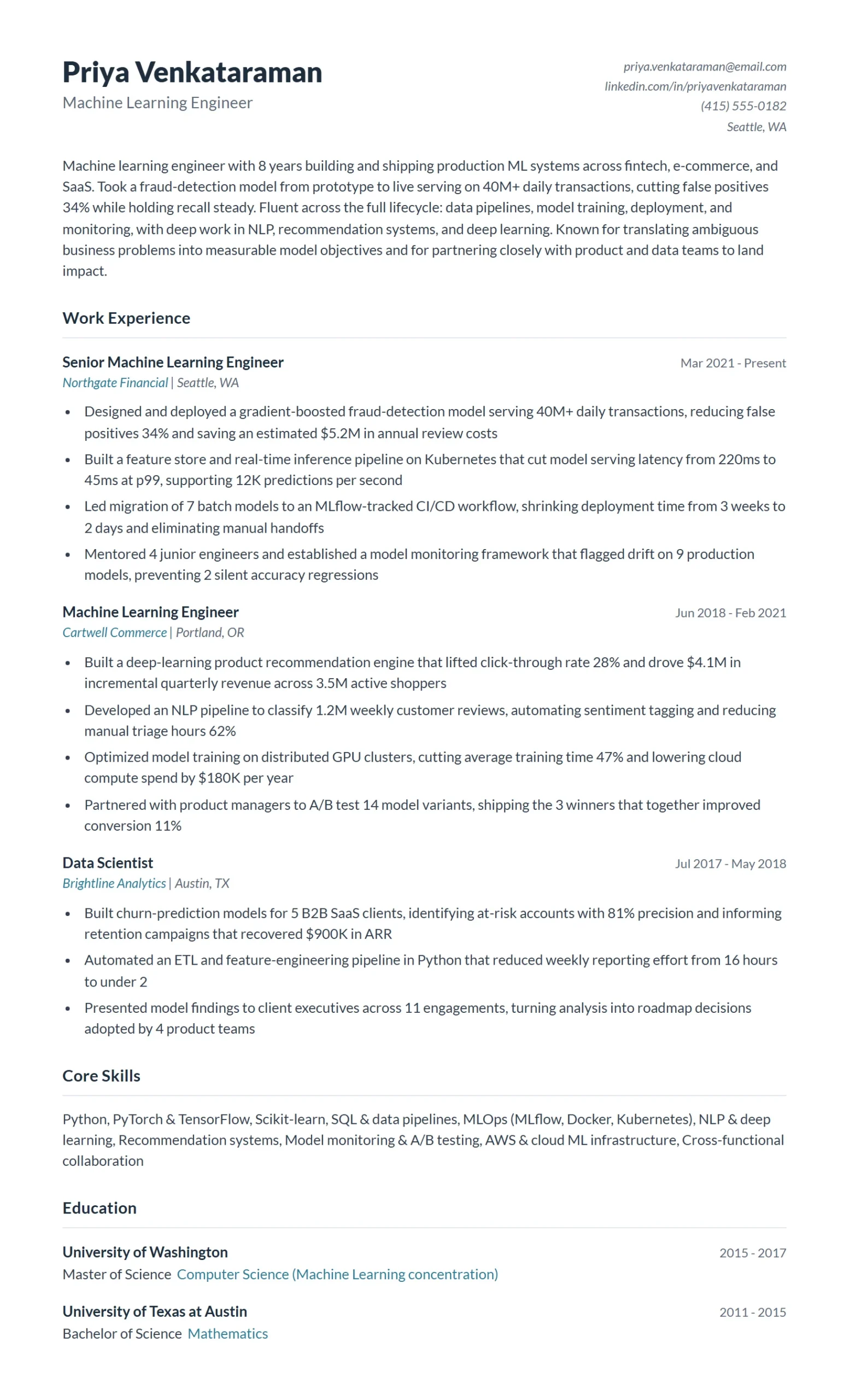
Machine Learning resume example
A versatile template for machine learning practitioners across applied, engineering, and research roles. It leads with technical breadth and a portfolio of shipped models.
This resume works because it pairs a clear skills section (languages, frameworks, ML techniques) with project bullets that name the business problem and the result. Each bullet ties a model to an outcome, such as improving prediction accuracy or reducing manual review time, so recruiters see impact, not just tools. It keeps the ATS happy by mirroring the exact terminology from the job posting.
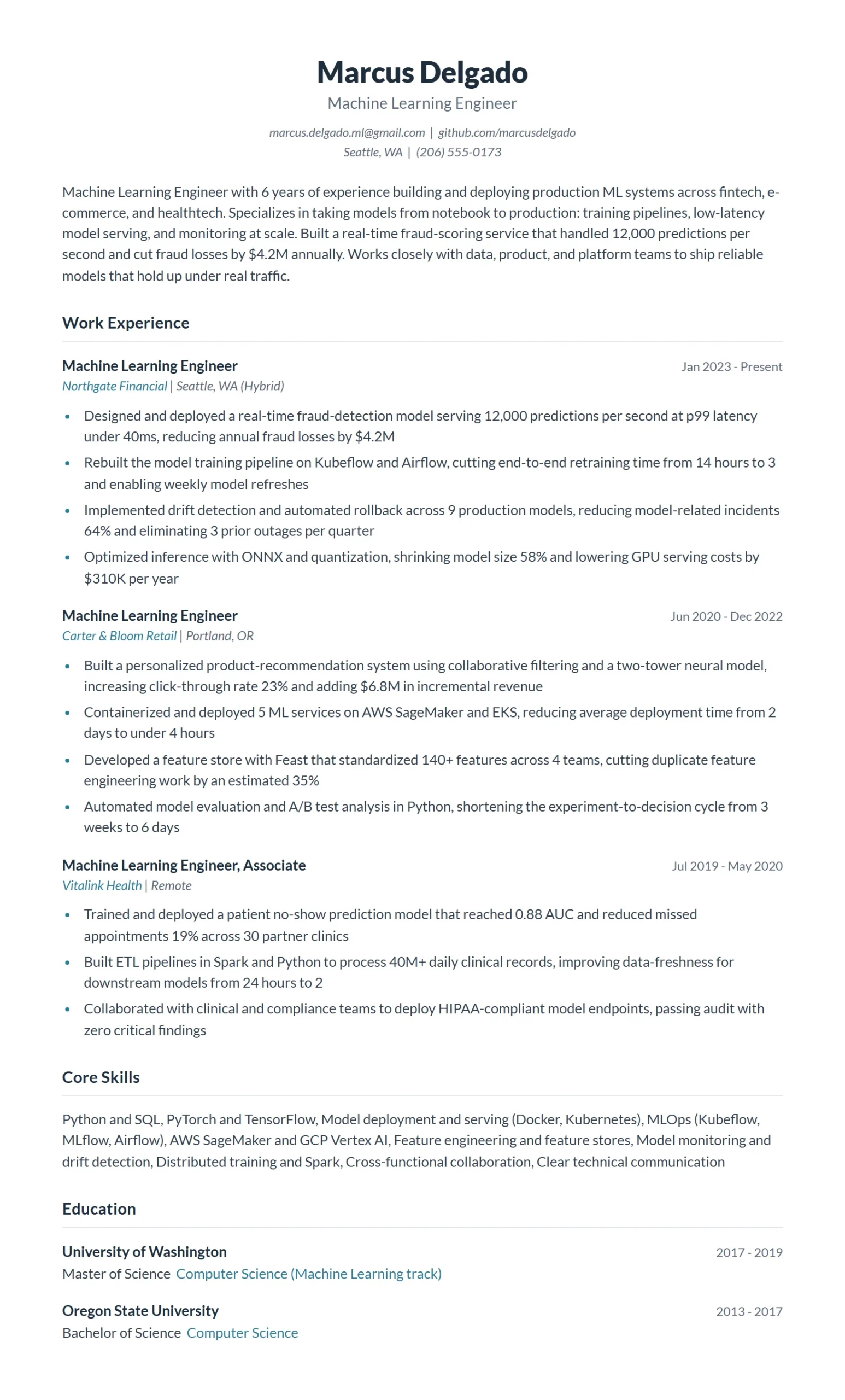
Machine Learning Engineer resume example
Built for the production-focused engineer who designs, trains, and deploys models at scale. It emphasizes end-to-end ownership from data pipeline to live inference.
It stands out by quantifying engineering impact: model latency reduced, inference cost cut, accuracy lifted, and uptime maintained. The skills section foregrounds the full stack (Python, PyTorch, SQL, Docker, Kubernetes, AWS or GCP) so it matches the dense keyword lists in ML engineering job descriptions. Strong action verbs like built, deployed, and optimized signal that the candidate ships, not just experiments.
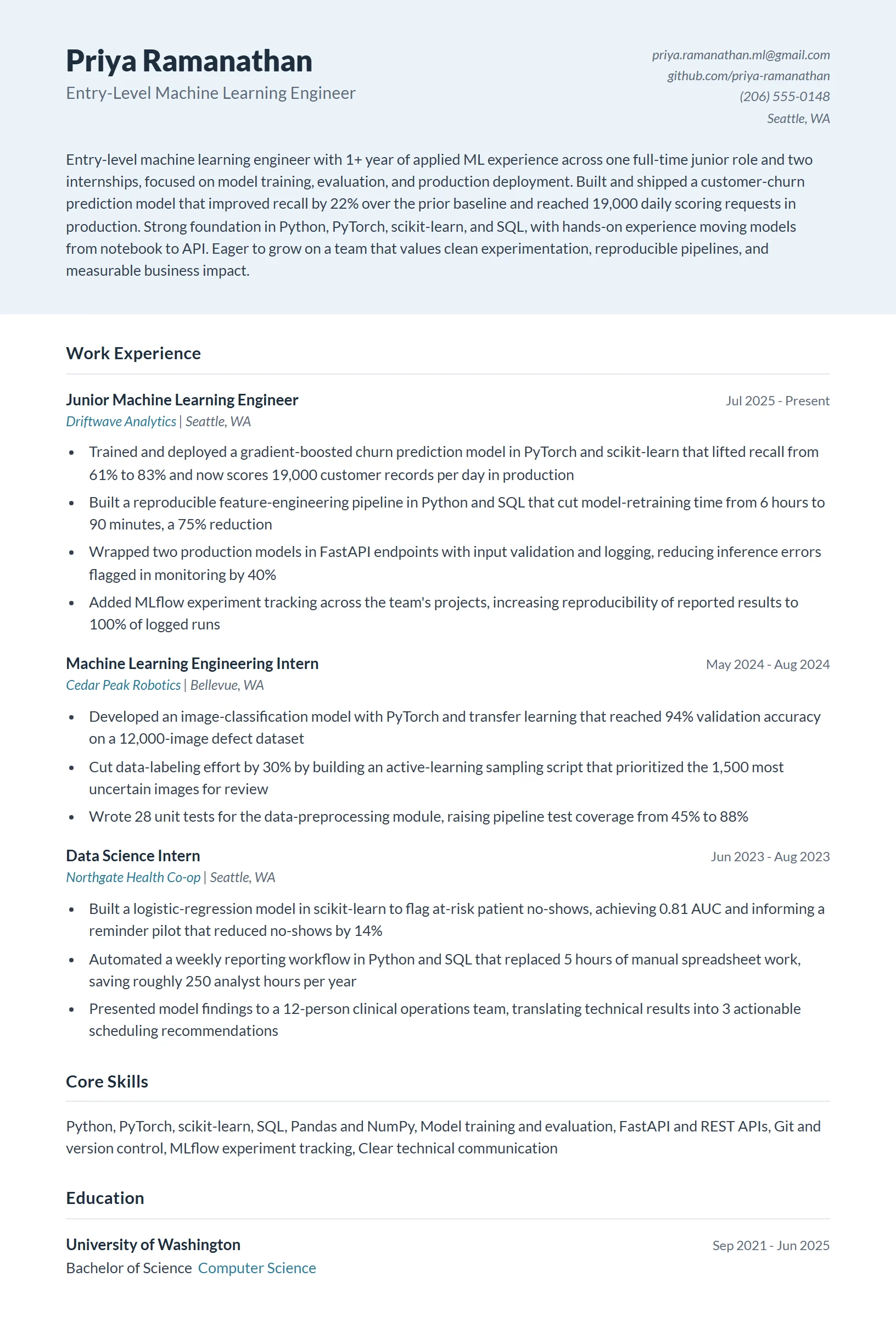
Entry-Level Machine Learning Engineer resume example
Designed for new grads and career switchers with limited professional experience. It leans on projects, internships, and coursework to prove readiness.
This resume works because it treats academic projects, Kaggle competitions, and personal models as real experience, complete with metrics and the tools used. A focused skills section and a short summary that names the target role help an entry-level candidate clear the ATS even without years on the job. It avoids generic objective statements and lets concrete work do the talking.
Senior Machine Learning Engineer resume example
For experienced engineers leading model development, architecture decisions, and teams. It shifts the focus from doing the work to driving outcomes across an organization.
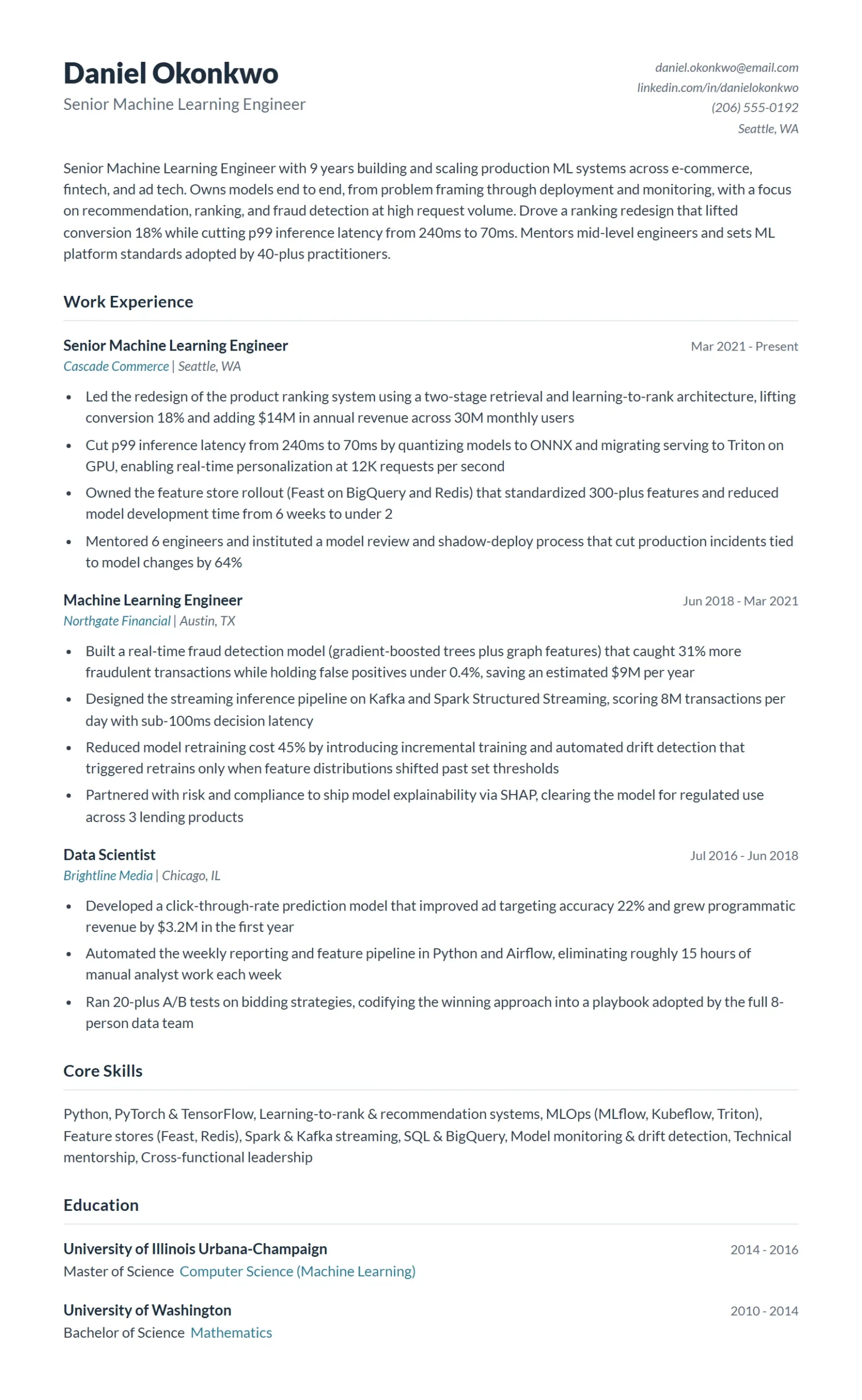
It succeeds by quantifying scope and leadership: models in production serving millions of requests, systems that cut costs by a measurable percentage, and engineers mentored. The bullets show strategic judgment, like choosing architectures and setting ML standards, which is what separates a senior hire. It still lists current tooling so it passes the same keyword screens as junior roles.
Machine Learning Research Scientist resume example
Tailored to the research track where novel methods, experimentation, and publications matter more than production deployment. It puts research output front and center.
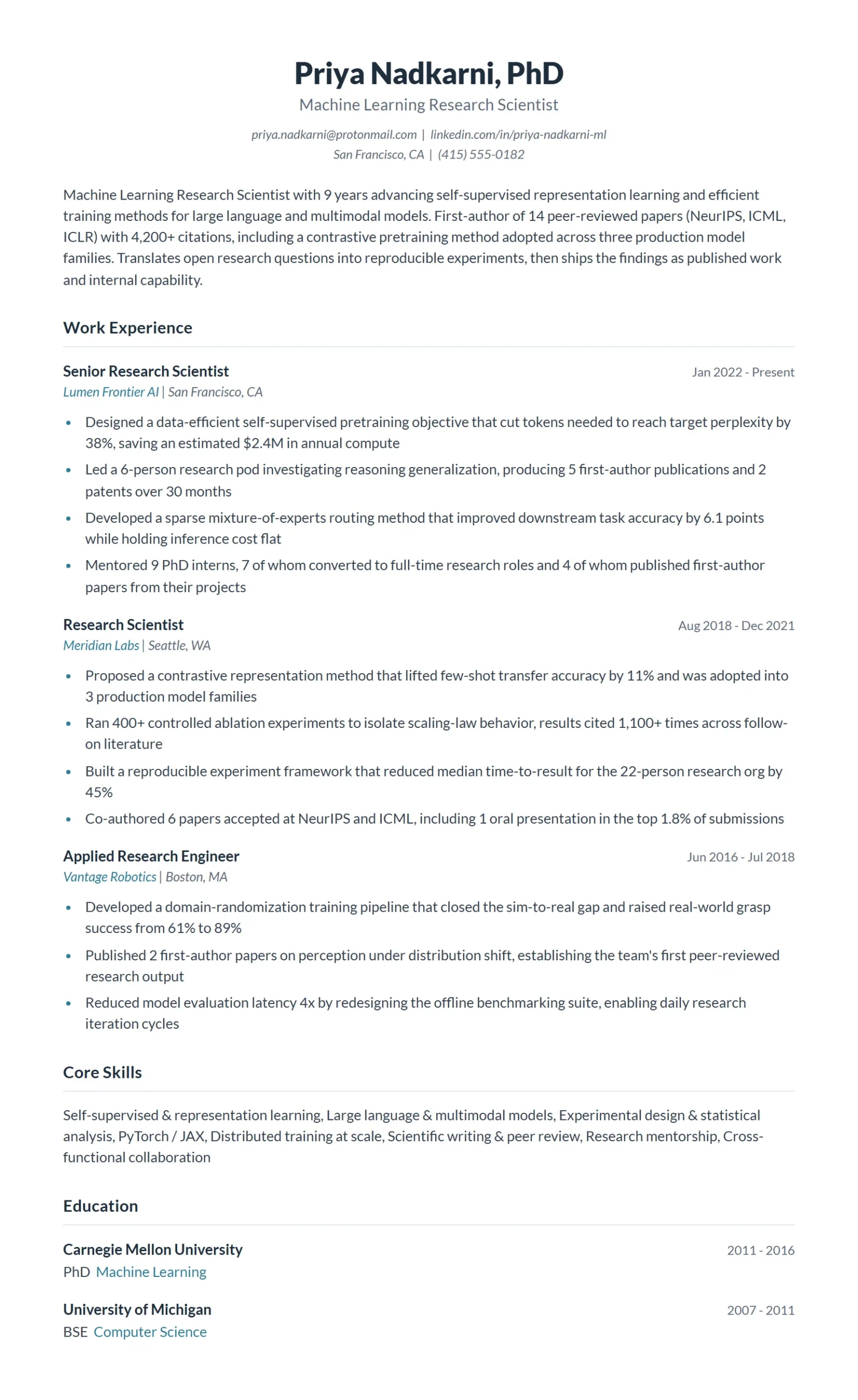
This resume works because it highlights publications, citations, conference acceptances, and patents alongside the research problems solved. It quantifies experimental results (benchmark improvements, state-of-the-art comparisons) the way an engineering resume quantifies business impact. Listing specialized areas like NLP, computer vision, or reinforcement learning helps it match the narrower keyword sets used in research job postings.
MLOps Engineer resume example
Built for the infrastructure-focused role that deploys, monitors, and scales models in production. It centers on reliability, automation, and the ML lifecycle.
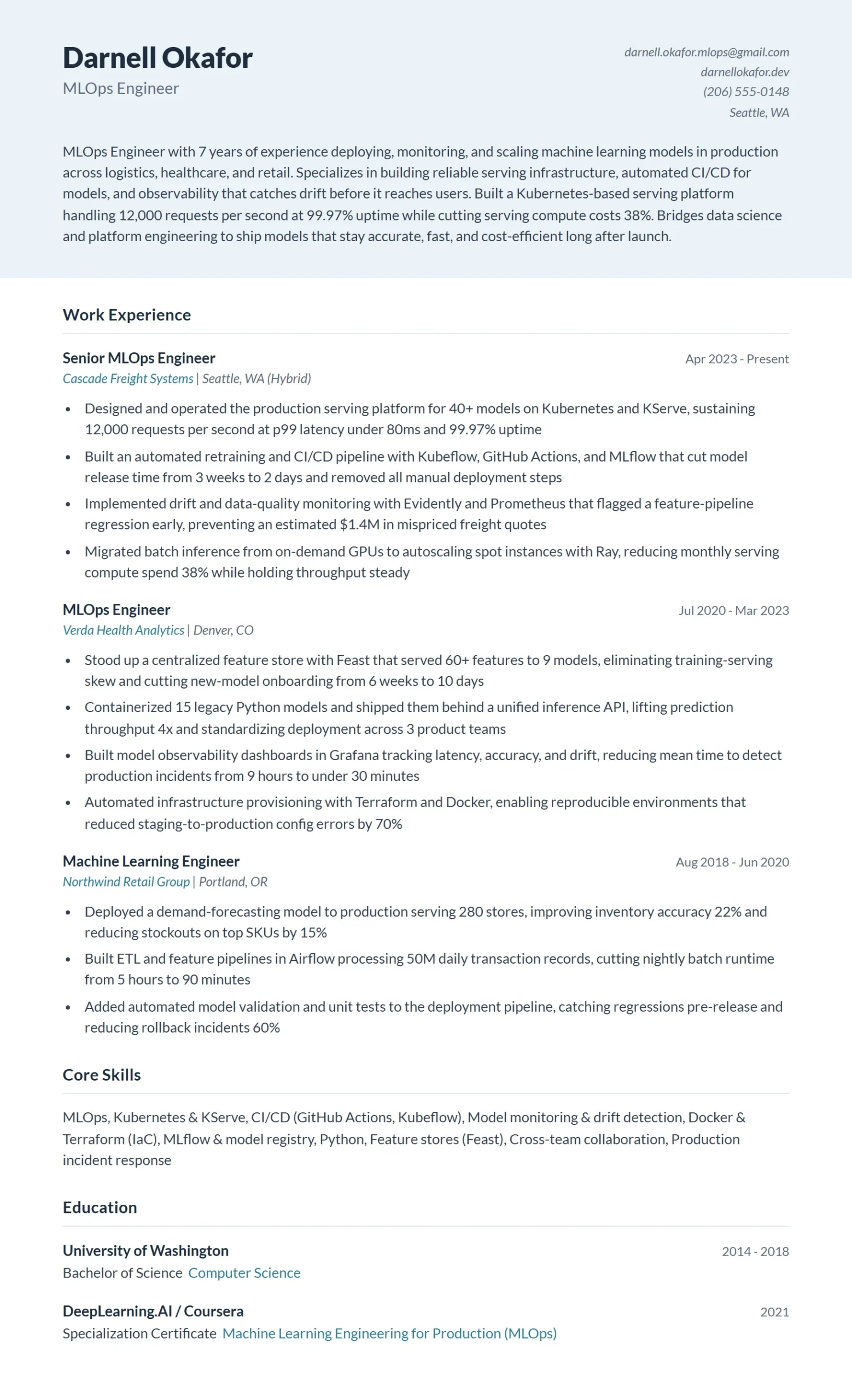
It stands out by emphasizing the operational stack (CI/CD, Kubernetes, Docker, MLflow, model monitoring, feature stores) and quantifying reliability gains like reduced deployment time or improved model uptime. The bullets show ownership of the pipeline rather than the model itself, which is the core distinction recruiters screen for. Naming both ML and DevOps tooling lets it match a hybrid keyword profile that pure engineering resumes miss.
How to write a Machine Learning resume that gets interviews
Hiring managers and ML leads skim a machine learning resume for proof you can ship models that work in production, not just train notebooks that score well offline. They want to see real business impact, the modeling and engineering stack you actually use, and evidence you understand the full lifecycle from data to deployment to monitoring. Most companies also run your resume through an Applicant Tracking System (ATS) first, so the language has to match the job description before a human ever sees it. The tips below show you how to do both: clear the ATS scan and convince the ML engineer or hiring manager reading next.
- Quantify model impact in business terms, not just metrics: An AUC of 0.91 means nothing to a hiring manager on its own. Tie it to outcomes: “raised fraud-detection precision to 94% and cut false positives 38%, saving an estimated $2.1M in manual review,” or “improved recommendation CTR 17% and added $4.3M in incremental revenue.” When you cite a model metric (precision, recall, F1, AUC, RMSE, MAP@k), pair it with the downstream result it drove. Offline metrics prove competence; the business lift proves you ship models that matter.
- Show the full lifecycle, including production and deployment: Plenty of candidates can train a model. Fewer can deploy and maintain one. Make it clear you own the arc: data pipelines and feature engineering, model selection and training, evaluation, deployment to a serving endpoint, and monitoring for drift. Reference real production signals like inference latency, model versioning, A/B testing, retraining cadence, and how you caught and fixed degradation. A resume that stops at “trained a model in a Jupyter notebook” reads as academic, not production-ready.
- Name your stack precisely and match it to the posting: ATS scans for specific terms. List the frameworks you actually use (PyTorch, TensorFlow, scikit-learn, XGBoost, Hugging Face), the languages (Python, SQL, sometimes Scala), the ML-ops and infra tools (MLflow, Kubeflow, Airflow, Docker, Kubernetes, SageMaker, Vertex AI), and the cloud (AWS, GCP, Azure). If the posting says “LLM fine-tuning” or “recommendation systems” and you have done it, use that exact phrasing. Skip tools you touched once and never keyword-stuff. An interviewer will probe anything you list.
- Specialize: do not present as a generic ML generalist: “Machine learning” spans NLP, computer vision, recommender systems, forecasting, and increasingly LLMs and generative AI. Hiring teams hire for a specialty. Lead your summary and your strongest bullets with the domain that matches the role, whether that is “built transformer-based NLP models for document classification” or “designed a real-time ranking system serving 40M daily requests.” A focused profile beats a flat list of every algorithm you have heard of.
- Make data and scale concrete: ML lives or dies on data, so quantify it. State the dataset size, the request volume, the number of features, and the scale you operated at: “trained on 120M labeled examples,” “served predictions at 8,000 requests per second,” “reduced training time 60% by moving to distributed training on 16 GPUs.” Scale and data fluency separate engineers who have shipped real systems from those who have only worked with toy datasets, and recruiters use these numbers to gauge seniority.
- Tailor to each role and keep the format ATS-friendly: A research-leaning ML role, an applied ML engineer role, and an ML-ops-heavy role reward different keywords and projects. Reorder your skills and swap your headline examples to mirror each posting. Then keep the format clean: standard section headings, no text boxes or multi-column layouts that scramble parsing, and a single clean column. Run it through Jobscan to check your match rate against the job description before you apply.

Machine Learning resume summary examples
Your summary is the first thing a recruiter reads. Lead with your specialty, years of experience, and a quantified win.
Good machine Learning resume summary examples
- Machine Learning Engineer with 6+ years building and deploying production models across NLP and recommendation systems. Shipped a transformer-based ranking model that lifted recommendation CTR 17% and added $4.3M in annual revenue. Fluent in PyTorch, Python, and MLflow, with experience serving low-latency predictions at 8,000+ requests per second on AWS SageMaker.
- Applied ML scientist specializing in computer vision and model optimization. Owns the full lifecycle from data pipeline to deployed endpoint, with recent work cutting inference latency 45% and improving defect-detection recall from 82% to 96% across 2M+ daily images. Strong in TensorFlow, Docker, and Kubernetes, and known for translating model gains into measurable production outcomes.
- ML engineer with a research background in NLP and large language models. Fine-tuned LLMs for document classification that reduced manual review 38% and saved an estimated $2.1M annually. Experienced across the stack: feature engineering, distributed training on GPU clusters, A/B testing, and drift monitoring with Airflow and Vertex AI.
What to avoid
- Passionate machine learning enthusiast eager to apply AI and data science skills to solve exciting real-world problems at an innovative company. (It is all adjectives and aspiration with no proof. “Enthusiast” signals hobbyist, not practitioner. There is no specialty, no stack, no scale, and zero evidence a model ever shipped. A hiring manager learns nothing they can act on.)
- Detail-oriented data professional skilled in Python, machine learning, and statistics, looking for an opportunity to grow and learn in the AI field. (Generic and self-focused. “Machine learning” and “statistics” are categories, not skills, with no framework, domain, or result behind them. “Looking to grow and learn” tells the reader what the candidate wants, not what they deliver, so both the ATS and the recruiter skip it.)
Machine Learning resume skills
Pull the exact frameworks, methods, and domain terms from each job description, then mirror that language here. This is a quick resume snapshot, so keep it to your strongest, role-relevant skills rather than an exhaustive list.
Hard skills for a machine Learning resume
- Python
- Machine Learning
- PyTorch
- TensorFlow
- scikit-learn
- SQL
- Deep Learning
- Model Deployment (MLOps)
- Feature Engineering
- Cloud ML (AWS / GCP / Azure)
Soft skills for a machine Learning resume
- Problem Solving
- Cross-Functional Collaboration
- Communication
- Analytical Thinking
- Adaptability
Machine Learning resume work experience bullet point examples
Lead each bullet with a strong verb and a measurable result.
Good bullet point examples
- Built and deployed a transformer-based recommendation model serving 40M daily requests, lifting click-through rate 17% and adding an estimated $4.3M in annual revenue.
- Designed a fraud-detection pipeline using XGBoost and real-time feature engineering, raising precision to 94% and cutting false positives 38%, saving roughly $2.1M in manual review costs.
- Reduced model inference latency 45% by quantizing a PyTorch vision model and moving serving to a containerized endpoint on Kubernetes, with no measurable drop in accuracy.
- Led end-to-end development of an LLM fine-tuning workflow on 120M labeled examples, automating retraining and drift monitoring with Airflow and MLflow to keep production F1 above 0.92.
Bad bullet point examples
- Built machine learning models using Python and various algorithms for different projects. (Lists a task with no outcome. “Various algorithms” and “different projects” are vague, there is no metric, no scale, and no business result. It tells the reader you wrote code but not whether the model ever shipped or mattered.)
- Responsible for data analysis and developing predictive models for the team. (“Responsible for” describes a job duty, not an accomplishment. It shows no specific action, no stack, and no measurable impact. Lead with a strong verb (Built, Deployed, Optimized) and end with a quantified result instead.)
- Achieved high accuracy on a dataset using a neural network in a Jupyter notebook. (“High accuracy” is unquantified, and a notebook result signals offline experimentation, not production. It names no data scale, no business outcome, and no deployment, so it reads as a class project rather than shipped ML work.)
Machine Learning resume tips
A strong machine learning resume proves you can move models from experiment to production and tie every project to measurable business value.
- Mirror JD Keywords: Copy exact terms from the job posting (PyTorch vs TensorFlow, MLOps vs model deployment) because ATS systems match on precise strings, not synonyms.
- Quantify Model Impact: Lead every project bullet with a production metric: latency reduction, revenue lift, churn rate drop, or inference cost saved, not just accuracy scores on a test set.
- List Your Full Stack: Include the end-to-end toolchain (scikit-learn for prototyping, PyTorch or TensorFlow for training, SQL for feature pipelines) so the ATS captures every layer of your technical range.
- Name Certifications Precisely: Spell out credentials in full (AWS Certified Machine Learning Specialty, Google Professional Machine Learning Engineer) because recruiters and ATS filters search on the complete credential name.
- Separate MLOps Skills: Add a dedicated line for deployment and monitoring tools (model serving, CI/CD for ML, drift detection) because hiring managers scan for production readiness separately from modeling ability.
- Show Cross-Team Wins: Call out one bullet per role where your analytical thinking or communication translated a model output into a decision a non-technical stakeholder acted on, since ML leads screen for this bridge skill.
Pair your machine Learning resume with a cover letter
A strong resume goes further with a tailored cover letter. Browse our cover letter examples to round out your application.
Machine Learning resume frequently asked questions
Write 2 or 3 sentences that name your focus area, your level of experience, and one quantified result that proves business impact. For example: “Machine learning engineer with 5 years building and deploying production models across NLP and recommendation systems, including a fraud model that cut false positives 32 percent.” Mirror the job title and a few core terms from the posting (PyTorch, MLOps, model deployment) so both the recruiter and the ATS register an immediate match. Lead with shipped outcomes, not a list of algorithms you have read about.
Balance languages, frameworks, ML methods, and the engineering skills that get models into production. Name your stack (Python, SQL, PyTorch, TensorFlow, scikit-learn), the techniques you actually use (regression, classification, deep learning, NLP, computer vision), and the deployment side (Docker, Kubernetes, AWS or GCP, MLflow, CI/CD for models). Match the exact tools and methods named in the job description, since an ATS often scans for those literal terms. Group them so a recruiter can find your most relevant skills in seconds.
Lead with projects framed like real work, not coursework titles. Feature 2 or 3 strong projects (a Kaggle competition, a capstone, or a model you built end to end) and describe each with the problem, the data and approach, and the measurable result, such as “trained a gradient-boosted model that reached 0.91 AUC on imbalanced churn data.” Link to a GitHub repo or a deployed demo so a reviewer can verify your work. A model you actually shipped or deployed reads far stronger than a long list of online certificates.
Yes. Quantify both the model and the impact, because numbers are what separate a strong ML resume from a generic one. Pair model metrics (accuracy, F1, AUC, RMSE, latency) with the downstream business result they drove, like “improved recommendation CTR 18 percent” or “reduced inference cost 40 percent.” When you cannot share exact figures for confidentiality reasons, use relative gains or ranges rather than dropping the metric entirely.
Yes, and name the specific versions or libraries the job posting calls for rather than writing vague phrases like “machine learning tools.” An ATS frequently matches on exact keywords, so “PyTorch,” “Hugging Face Transformers,” and “Spark” will register where “deep learning experience” alone may not. List each tool where you genuinely used it (in a project bullet or a dedicated skills section) so a recruiter sees both the keyword and the context. Avoid padding the list with tools you have only touched once, since that surfaces fast in technical interviews.
Reweight the same experience toward what each role values most. For research roles, foreground publications, novel modeling, and experimentation depth; for MLOps, foreground deployment, pipelines, monitoring, and scale; for data science, foreground analysis, experimentation, and business impact. Reorder your bullets and skills so the most relevant work sits at the top, and mirror the posting’s exact language for the title and core requirements. Run each tailored version against the job description with a tool like Jobscan to confirm you have matched the keywords that matter for that specific role.