Best PHP Developer Resume Examples for 2026
PHP developer resume examples for 2026 at every level, built to pass ATS scans and show the frameworks, databases, and shipped results hiring managers look for.



PHP developers build and maintain the server-side logic behind a huge share of the web, from custom web apps and APIs to Laravel platforms and WordPress sites. The role spans junior contributors fixing bugs and writing tests all the way to senior engineers who own architecture and scaling decisions.
Hiring managers want proof you can ship: real frameworks (Laravel, Symfony), databases (MySQL, PostgreSQL), and clean, tested, secure code that performs under load. Before a human sees your resume, an applicant tracking system scans it for the exact skills in the job description, so the tools and keywords from the posting need to appear in plain text, not buried in a graphic or skills wheel.
Use the examples below as a starting point. Match them to the level and specialization you are targeting, swap in your own shipped projects and measurable outcomes, then run your draft against the job description to confirm the right keywords are present and the formatting reads cleanly.
Ready to build yours? Try our ATS-friendly resume builder or scan your draft against the job description.
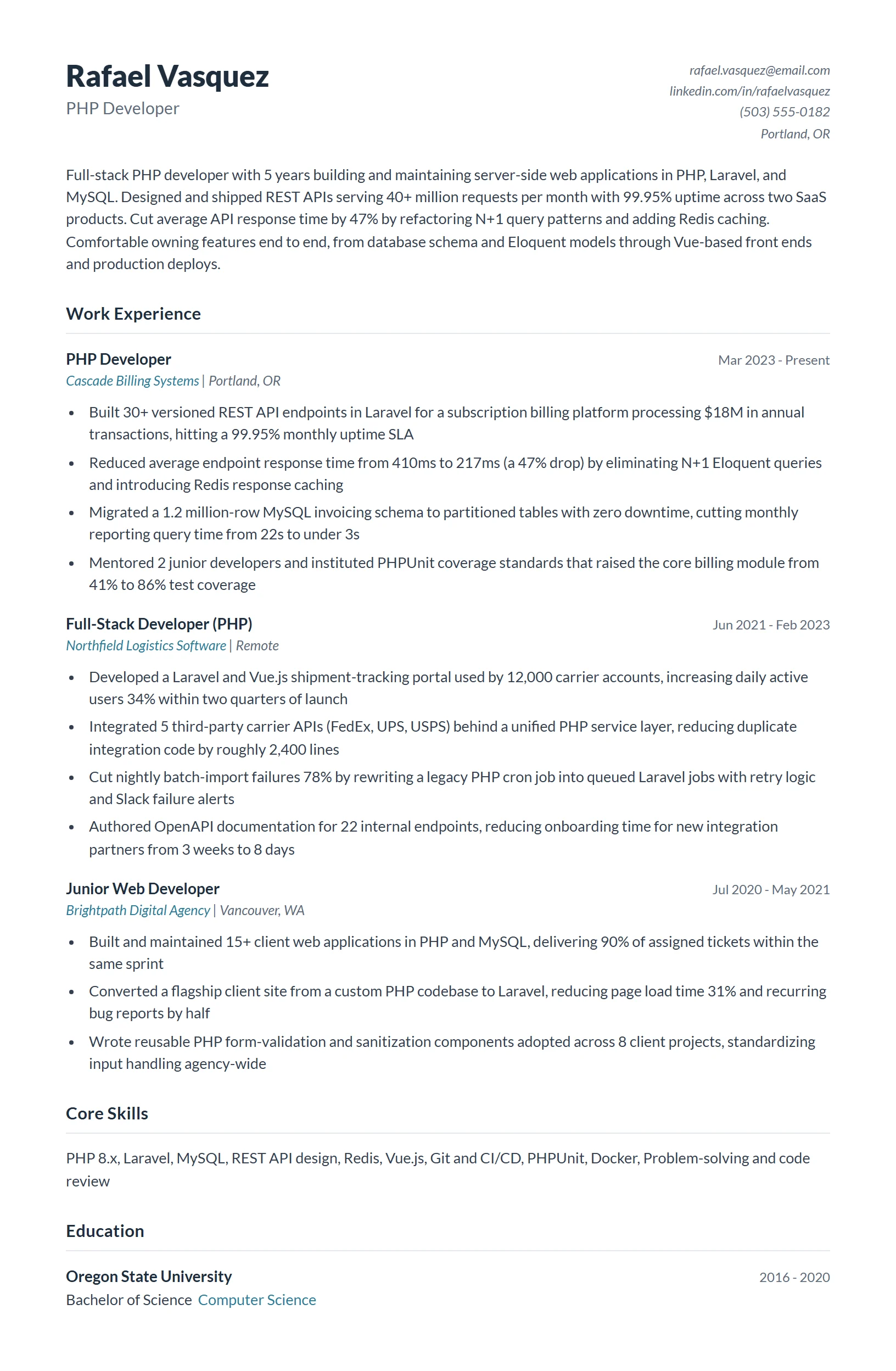
PHP Developer resume example
A mid-level, full-stack PHP developer with around four to five years building and maintaining production web applications. Strong on PHP, MySQL, REST APIs, and a modern framework.
This resume works because every bullet pairs a technical action with a business result, like cutting page load time or reducing API error rates. It names the specific stack (PHP 8, Laravel, MySQL, Redis) in plain text so ATS keyword matching succeeds, and it leads with a summary that mirrors the language of common PHP job descriptions.
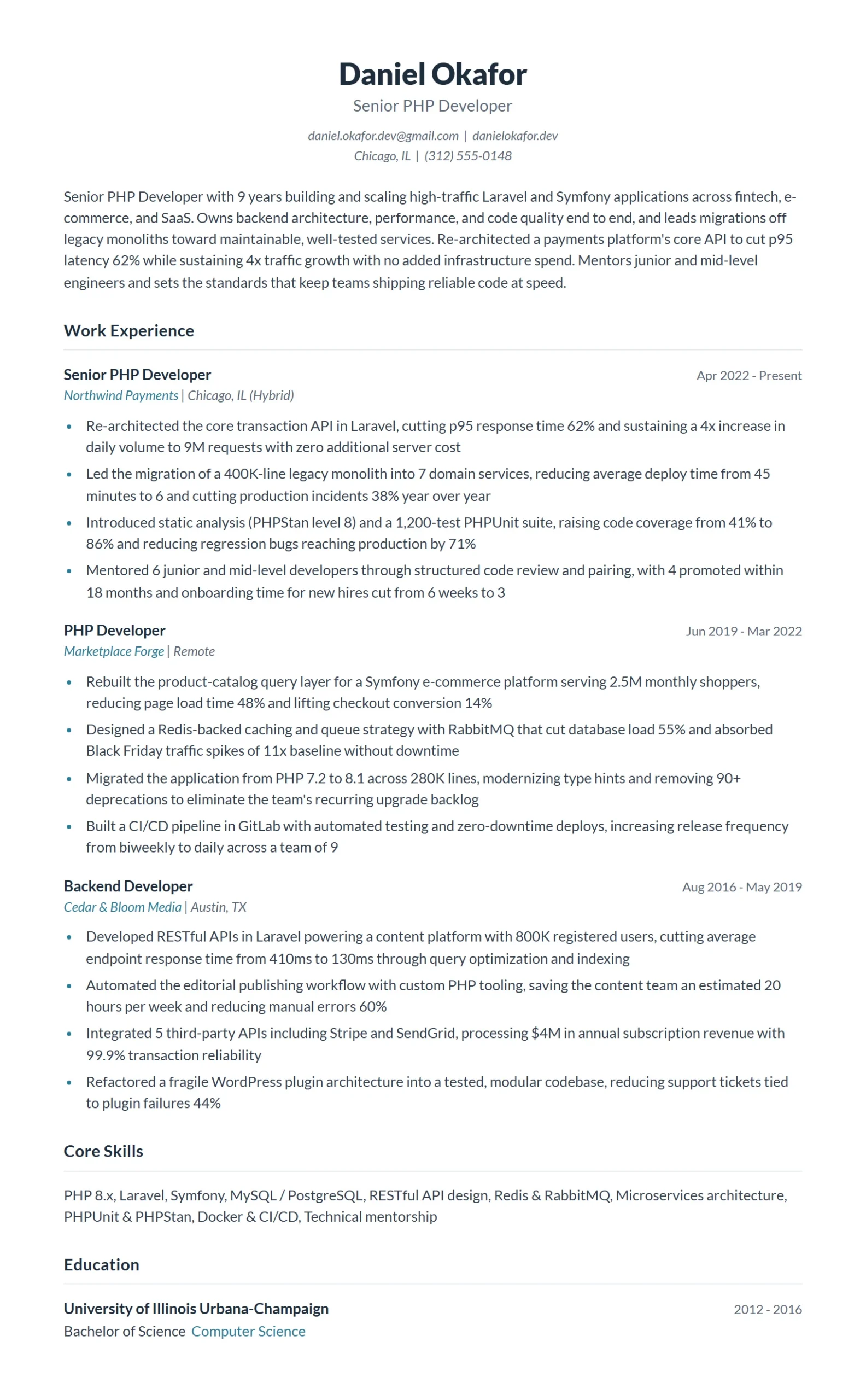
Senior PHP Developer resume example
A senior engineer with roughly eight or more years who owns architecture, performance, and code quality while mentoring a team. Geared toward lead and staff-track roles.
It works because it shifts from task execution to ownership and impact: leading a framework migration, cutting infrastructure cost, and setting code review standards. Quantified scope (team size, request volume, uptime) signals seniority, and architecture keywords like microservices, caching, and CI/CD line up with what senior PHP postings screen for.
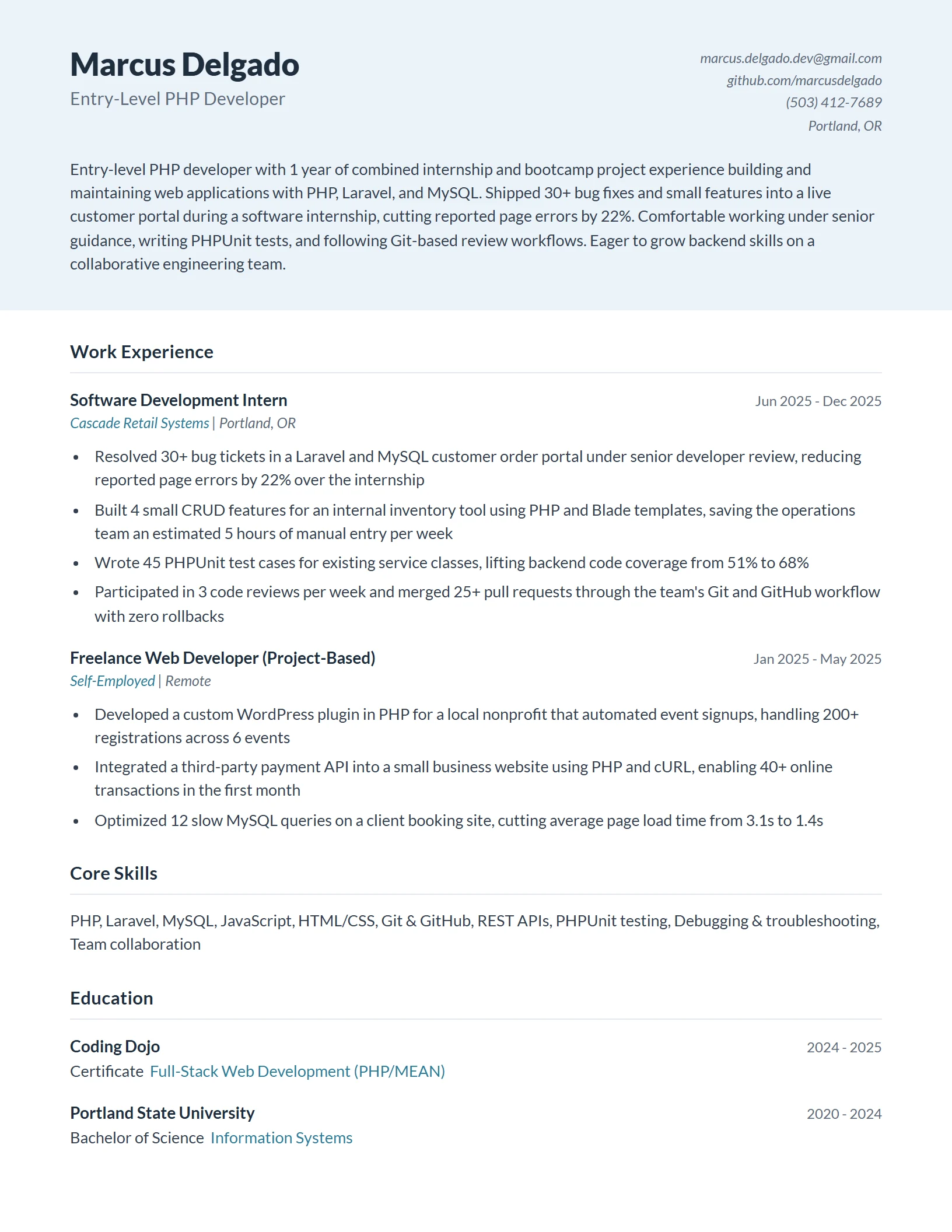
Entry-Level PHP Developer resume example
An early-career developer with zero to two years, often a bootcamp or CS new grad. Built around projects, internships, and supporting role work rather than years of experience.
This one works by leading with skills and projects so thin work history is not the headline. Each project shows a working build with a link and a clear tech stack, and bullets emphasize learning, testing, and contribution. That gives ATS the keywords it needs and gives a hiring manager evidence of real, hands-on PHP work.
Laravel Developer resume example
A PHP developer specialized in the Laravel framework, covering Eloquent, Blade, queues, and API development. Common as a distinct job title and search.

It works because it goes deep on the Laravel ecosystem rather than staying generic, citing Eloquent relationships, queued jobs, and Sanctum or Passport for auth. Framework-specific terms match niche Laravel postings exactly, and outcome-driven bullets show the candidate ships features, not just configures packages.
Full-Stack PHP Developer resume example
A developer who owns features end to end: PHP on the back end plus JavaScript and a front-end framework like Vue or React on the front. Built for roles that expect breadth across the stack.
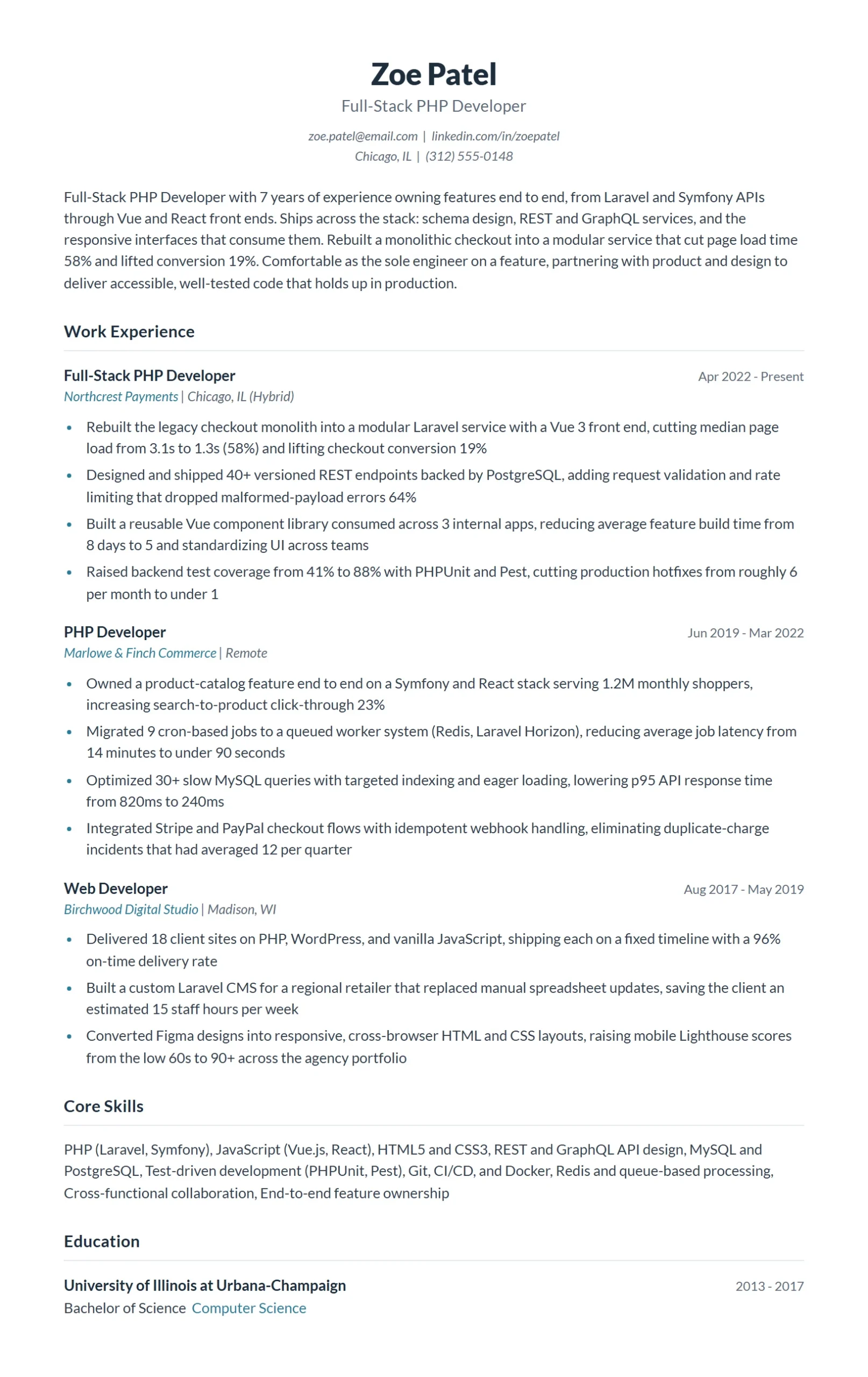
This resume works by clearly splitting back-end and front-end skills so an ATS can match either side of a job description. Bullets describe shipping complete features from database schema to UI, which proves the breadth the title implies and reassures hiring managers the candidate can work without handoffs.
WordPress Developer resume example
A PHP developer focused on custom WordPress work: themes, plugins, and the WooCommerce stack. A large, distinct slice of the PHP job market.
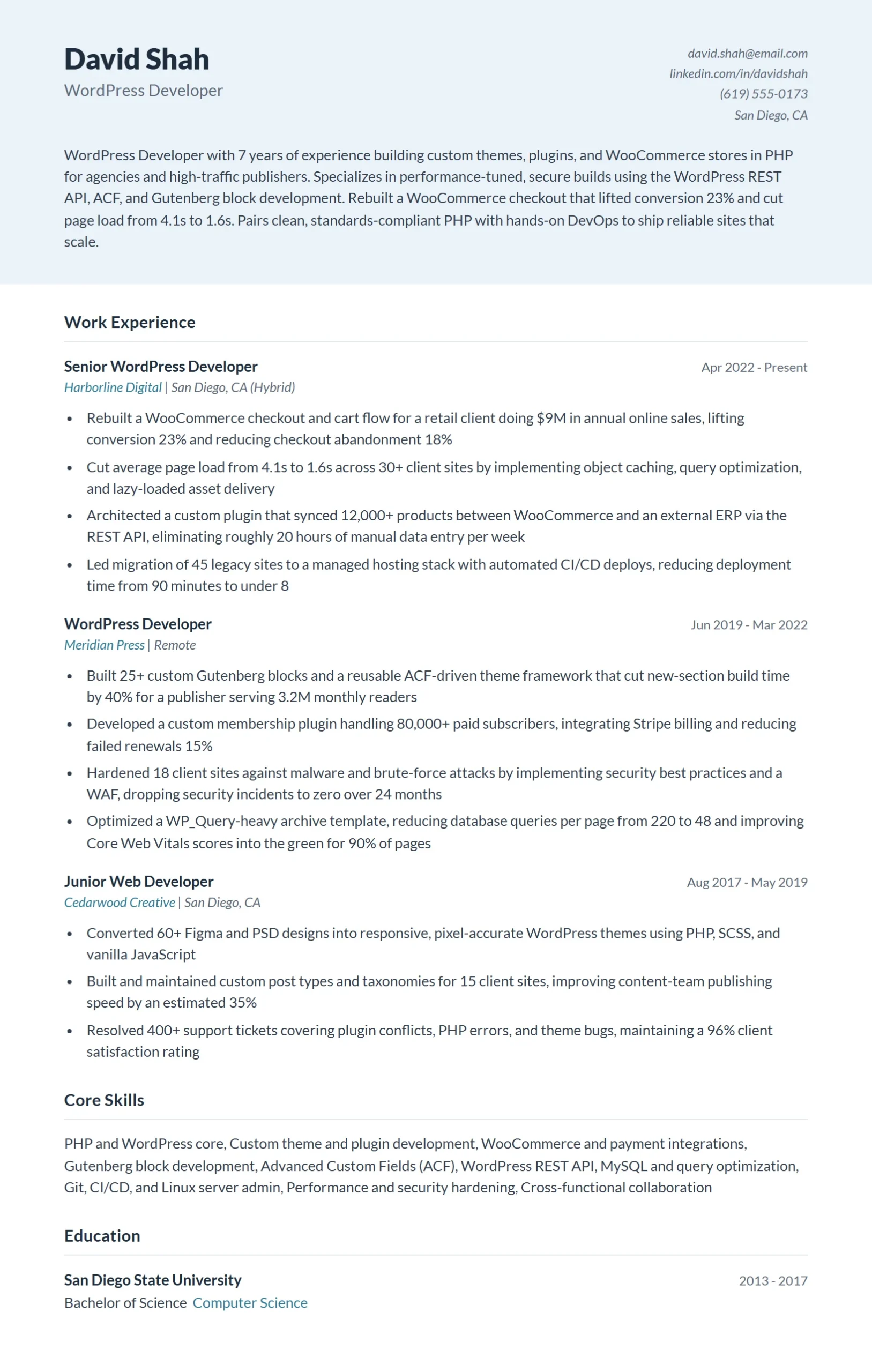
It works because it treats WordPress as serious engineering, citing custom plugins, hooks and filters, the WordPress REST API, and WooCommerce builds rather than just site setup. Naming PHP, MySQL, and WordPress-specific tools satisfies ATS scans for these postings, and performance and security wins separate it from page-builder resumes.
How to write a PHP developer resume that gets interviews
Most engineering teams run your resume through an Applicant Tracking System (ATS) before a human reads it, so the language has to match the job description first. Then a hiring manager or lead engineer skims for proof you can ship maintainable PHP at scale: real frameworks, a database you can optimize, APIs you have built, and outcomes tied to numbers. A wall of buzzwords reads as junior. The tips below show you how to clear the ATS scan and convince the engineer reading next.
- Name your stack, not just “PHP”: “PHP developer” alone tells a recruiter almost nothing. State the frameworks and tools you actually use: Laravel, Symfony, CodeIgniter, or WordPress, plus your database (MySQL, PostgreSQL), caching (Redis, Memcached), and front-end touchpoints (Vue, React, Blade, Twig). If the posting says “Laravel” and you have shipped Laravel, use that exact word. ATS scans for specific terms, and a lead engineer wants to know what you can be productive in on day one.
- Quantify performance and scale, not just features: Anyone can say they built a feature. Show what it did: “cut average API response time from 800ms to 180ms,” “optimized MySQL queries that reduced page load 40%,” or “refactored a legacy module serving 2M requests a day with zero downtime.” Tie your work to latency, throughput, uptime, query time, error rate, or cost. Backend impact is measurable, so measure it. Numbers are what separate a senior resume from a junior one.
- Show modern engineering practices, not just code: Hiring managers want PHP developers who write maintainable, testable code. Reference the practices that signal that: object-oriented PHP, PSR standards, dependency injection, unit and integration testing (PHPUnit, Pest), Git workflows, code review, and CI/CD. A resume that lists only “wrote PHP scripts” reads like 2010. Show that you build software, not just pages.
- Lead with APIs, integrations, and data: Most PHP roles live at the seams of a system. Call out the REST or GraphQL APIs you designed, the third-party integrations you wired up (Stripe, payment gateways, Twilio, internal microservices), and the data work behind them: schema design, migrations, indexing, and query optimization. “Built and documented a REST API consumed by 3 client apps” tells an engineer far more than “worked on backend.”
- Specify your PHP version and migration work: PHP 7 to 8 is a real dividing line, and legacy modernization is a huge part of the job. If you have upgraded a codebase, say so: “migrated a legacy PHP 5.6 app to PHP 8.2 and Laravel 10, eliminating 40+ deprecation warnings.” Naming your version (PHP 8.1+, typed properties, enums) signals you are current, and migration experience is a high-demand skill many candidates leave off entirely.
- Tailor to each role and keep the format ATS-safe: A WordPress role, a Laravel SaaS role, and a high-throughput API role reward different keywords. Reorder your skills and swap your headline projects to mirror each posting. Then keep parsing clean: standard section headings, a single column, no text boxes or graphics that scramble the scan. Run it through Jobscan to check your match rate against the job description before you apply.

PHP Developer resume summary examples
Your summary is the first thing a recruiter reads. Lead with your specialty, years of experience, and a quantified win.
Good pHP Developer resume summary examples
- Backend PHP developer with 6+ years building and scaling Laravel applications across fintech and e-commerce. Cut average API response time 60% through query optimization and Redis caching, and led a PHP 8.2 migration across a 200K-line codebase with zero production downtime. Strong in MySQL, REST API design, and PHPUnit-driven test coverage.
- Full-stack PHP developer specializing in Symfony and high-throughput REST APIs serving 5M+ daily requests. Owns work end to end, from database schema and indexing to CI/CD deployment, and recently reduced infrastructure costs 25% by refactoring N+1 queries and adding caching. Comfortable pairing with front-end teams on Vue and React.
- WordPress and PHP developer with deep custom plugin and theme experience for content sites at 1M+ monthly visitors. Built a custom REST API layer that cut page load time 35% and reduced support tickets 20% after a checkout rebuild. Fluent in PHP 8.1, MySQL optimization, and WP-CLI automation.
What to avoid
- Hardworking PHP developer looking for an exciting opportunity to grow my skills and work on challenging projects with a great team. (It is all about what the candidate wants, not what they deliver. There is no framework, no database, no scale, and zero evidence of impact. A lead engineer learns nothing they can act on and moves to the next resume.)
- Passionate coder with strong knowledge of PHP and a love for writing clean, efficient code and solving problems. (Pure adjectives with no proof. “Clean” and “efficient” are claims anyone can make. It names no stack (Laravel? Symfony? WordPress?), no metric, and no shipped work, so the ATS and the engineer both skip it as filler.)
PHP Developer resume skills
Pull the exact frameworks and tools from each job description, then mirror that language here. This is a quick resume snapshot, so keep it to your strongest, role-relevant skills rather than an exhaustive list.
Hard skills for a pHP Developer resume
- PHP 8
- Laravel
- Symfony
- MySQL
- REST API Design
- Object-Oriented PHP (OOP)
- PHPUnit
- Git
- Redis
- MVC Architecture
Soft skills for a pHP Developer resume
- Problem Solving
- Code Review
- Collaboration
- Communication
- Attention to Detail
- Debugging
PHP Developer resume work experience bullet point examples
Lead each bullet with a strong verb and a measurable result.
Good bullet point examples
- Optimized MySQL queries and added Redis caching across a Laravel API, cutting average response time from 800ms to 180ms and reducing database load 45%.
- Migrated a legacy PHP 5.6 monolith to PHP 8.2 and Laravel 10, eliminating 40+ deprecation warnings and shipping the upgrade with zero production downtime.
- Designed and documented a REST API consumed by 3 client applications, handling 2M+ requests per day at 99.9% uptime.
- Refactored an N+1 query pattern flagged in code review, lifting checkout throughput 30% and cutting AWS database costs roughly $1,800 a month.
Bad bullet point examples
- Wrote PHP code for various features on the company website. (Lists a task with no outcome. “Various features” is vague, names no framework, and gives no result or metric. It tells the reader you wrote code but not whether it mattered or what stack it ran on.)
- Responsible for backend development and maintaining the database. (“Responsible for” describes a job description, not an accomplishment. There is no action, no scale, and no measurable impact. Lead with a strong verb (Built, Optimized, Migrated) and end with a result instead.)
- Fixed bugs and improved the performance of the application. (Subjective and unquantified. “Improved performance” is a claim with no proof. Replace it with the number that backs it up, such as a lower response time, fewer errors, or a measured throughput gain.)
PHP Developer resume tips
A well-optimized PHP Developer resume can move you past ATS filters and straight onto a lead engineer’s shortlist.
- Mirror Job Description Keywords: Copy the exact spellings and versions the posting uses, such as PHP 8, Laravel 10, or PHPUnit, because ATS software matches strings literally and will miss synonyms or abbreviations you invent.
- Quantify Backend Impact: Attach numbers that engineers respect: query execution time reduced by 40%, API response time cut from 800ms to 120ms, or test coverage raised from 30% to 85% using PHPUnit.
- Name Your Database Work: Specify MySQL optimization techniques you applied, such as index tuning, query caching, or schema refactoring, rather than writing a vague phrase like improved database performance.
- List Framework Versions: Write Laravel 10 or Symfony 6 instead of just listing the framework name, because version numbers signal to hiring managers that your experience is current and not five years out of date.
- Tailor for Framework Focus: When a job targets one framework heavily, move that framework to the top of your skills section and weight at least half your bullet points toward projects built with it.
- Show Code Review Contributions: PHP roles on established teams value maintainability, so note collaboration habits explicitly, for example: reviewed 15 plus pull requests per sprint and enforced PSR-12 standards across a six-person backend team.
Pair your pHP Developer resume with a cover letter
A strong resume goes further with a tailored cover letter. Browse our php developer cover letter examples to round out your application.
PHP Developer resume frequently asked questions
Lead with core PHP and the framework you actually work in (Laravel, Symfony, or CodeIgniter), then back it with the full stack employers expect: MySQL or PostgreSQL, REST and GraphQL APIs, Composer, Git, and front-end basics like JavaScript and HTML/CSS. Add the things that separate senior candidates, such as unit testing with PHPUnit, Docker, CI/CD pipelines, and queue or caching tools like Redis. Match the exact terms in the job description, because an ATS scans for specific keywords like “Laravel” or “MVC” rather than a generic “backend development.”
You can describe the impact without exposing confidential code or client names. Frame each item around the problem, what you built in PHP, and the measurable result, for example “Rebuilt a legacy order-processing module in Laravel that cut checkout errors 40 percent and handled 12,000 daily transactions.” If you have open-source contributions or a personal GitHub, link it in your header so reviewers can verify your code quality directly.
Be specific. Listing “PHP 8.2” signals you work with modern features like typed properties, enums, and attributes, which reassures hiring managers that you are not stuck on legacy PHP 5 or 7 habits. Name the frameworks and ecosystem tools you use most (Laravel, Symfony, Eloquent, Blade), and reserve the generic “PHP” only for a brief skills-summary line. Specificity also helps you pass the keyword match, since recruiters often search for the framework, not the language.
Tie your work to performance, scale, or business outcomes that a backend role can credibly own. Use numbers like query or page-load time reduced (“optimized database queries to cut API response time from 800ms to 120ms”), traffic or transactions handled, bugs or downtime reduced, or features shipped on deadline. If you do not have exact figures, reasonable estimates of scale (“served roughly 50,000 monthly users”) still read far stronger than duty statements like “responsible for maintaining the website.”
A junior resume leans on foundational skills, projects, and any framework exposure, and it is fine to feature bootcamp work, internships, or strong personal builds near the top. A senior resume shifts the focus to architecture and ownership: designing scalable systems, mentoring, code review, leading migrations, and choosing tools, all backed by measurable impact. As you advance, trim the basic syntax and tooling lists and give that space to outcomes, technical decisions, and the scope of systems you owned.
Use a clean single-column layout with standard headings (Experience, Skills, Education), real selectable text instead of icons or graphics, and a .docx or text-based PDF so the parser reads everything correctly. Mirror the exact tools and keywords from the job posting, including the framework, database, and methodologies like Agile or TDD, since those are the terms the system filters on. Before you submit, scan your resume against the specific job description with a tool like Jobscan to confirm your keyword match and formatting both pass.