Best QA Analyst Resume Examples for 2026
QA Analyst resume examples for 2026 across every level, showing how to feature your test-case, automation, and defect-tracking skills plus the keywords ATS scans for.



A QA Analyst keeps bad software from reaching users. You design test cases, run manual and automated checks, log and track defects, and validate that every release matches its requirements. Hiring managers know the role is the last line of defense before launch, so your resume has to prove you catch what matters and communicate it clearly.
ATS filters and reviewers look for specific signals: the tools you test with (Jira, Selenium, Cypress, Postman, TestRail), the testing types you own (functional, regression, API, performance), and outcomes you drove (defects caught before release, regression cycles cut, coverage increased). Generic phrases like “detail-oriented team player” get skimmed past. Specific, measured wins get you the interview.
The examples below show how to do that at every stage, from your first QA role to a senior or automation-focused title. Use them to frame your own experience, mirror the keywords from the job description, and turn a list of duties into proof that you ship quality.
Ready to build yours? Try our ATS-friendly resume builder or scan your draft against the job description.
QA Analyst resume example
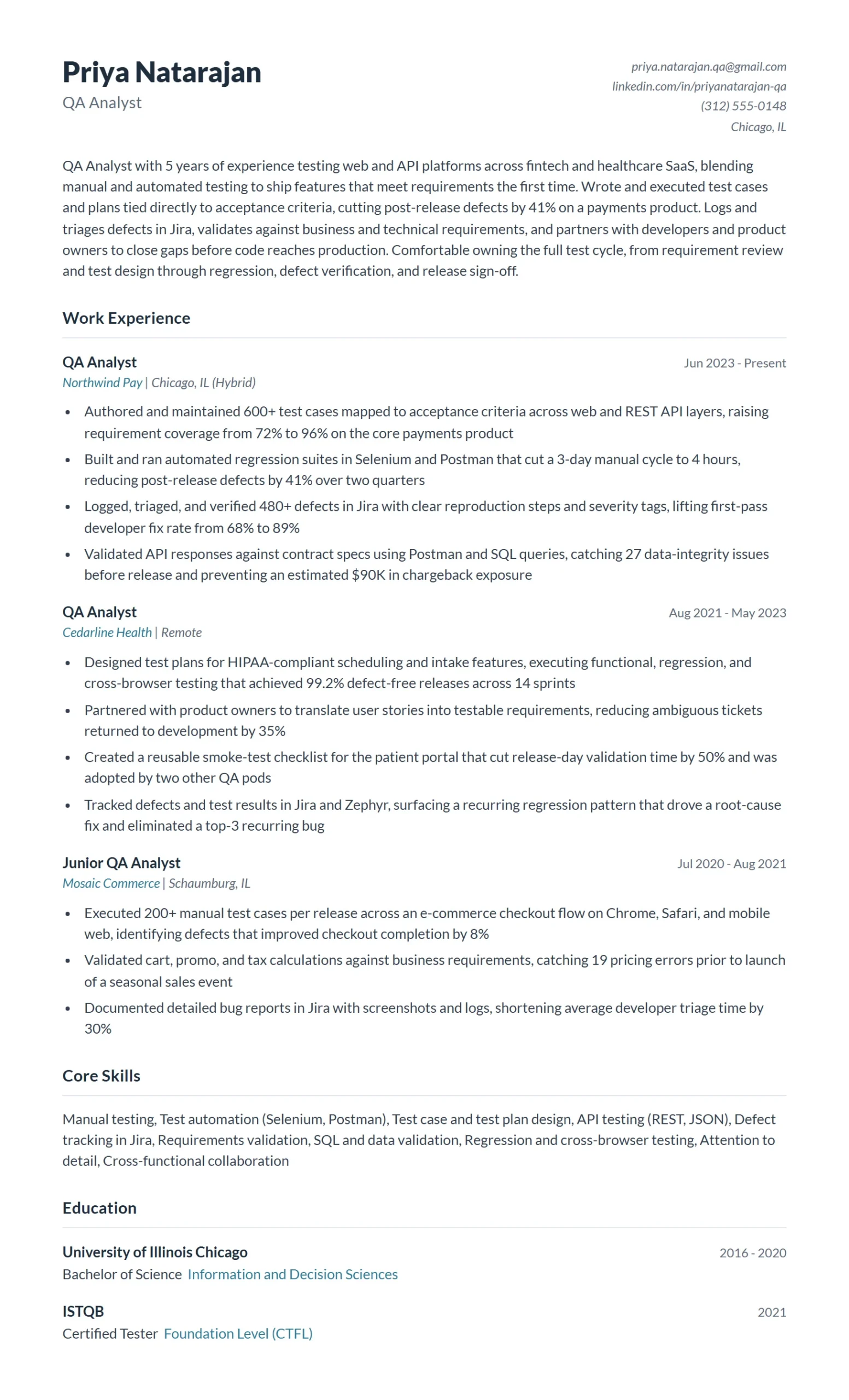
A mid-level QA Analyst with five years across web and API testing, blending manual and automated coverage. This is the core example most job seekers should model first.
It works because every bullet pairs a testing activity with a result: defects caught before release, regression time cut, requirements coverage raised. The skills section names the exact tools (Jira, TestRail, Postman, SQL) that ATS filters scan for, and the summary frames quality as a business outcome rather than a checklist of tasks.
Entry-Level QA Analyst resume example
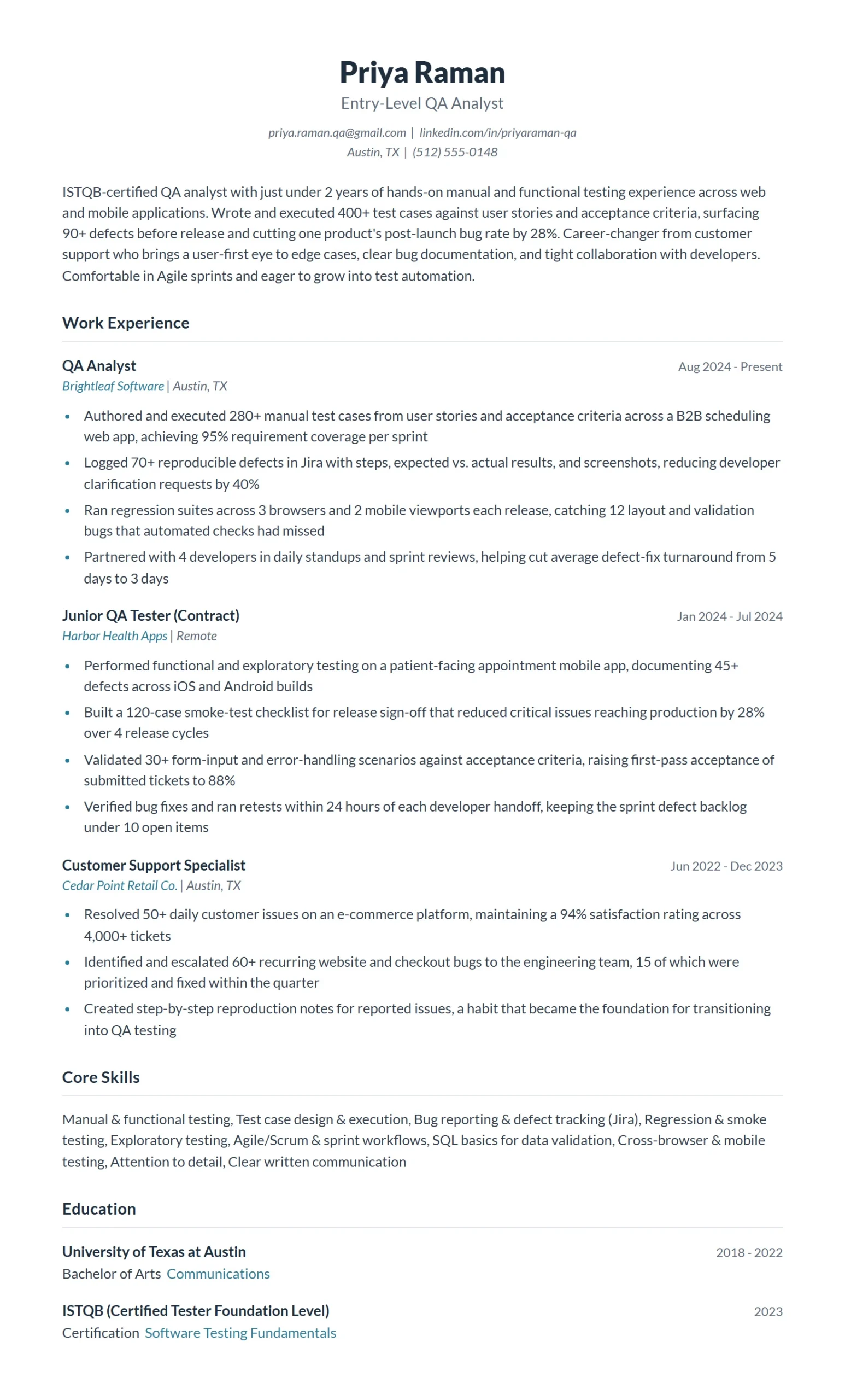
A first QA role for a recent grad or career-changer, leaning on manual and functional testing plus foundational certifications.
With limited work history, it leads with a focused skills section, an ISTQB Foundation credential, and a hands-on project or internship where real bugs were found and documented. It proves test-case design and clear defect reporting without overstating experience, which is exactly what hiring managers want to see from a junior tester.
Senior QA Analyst resume example
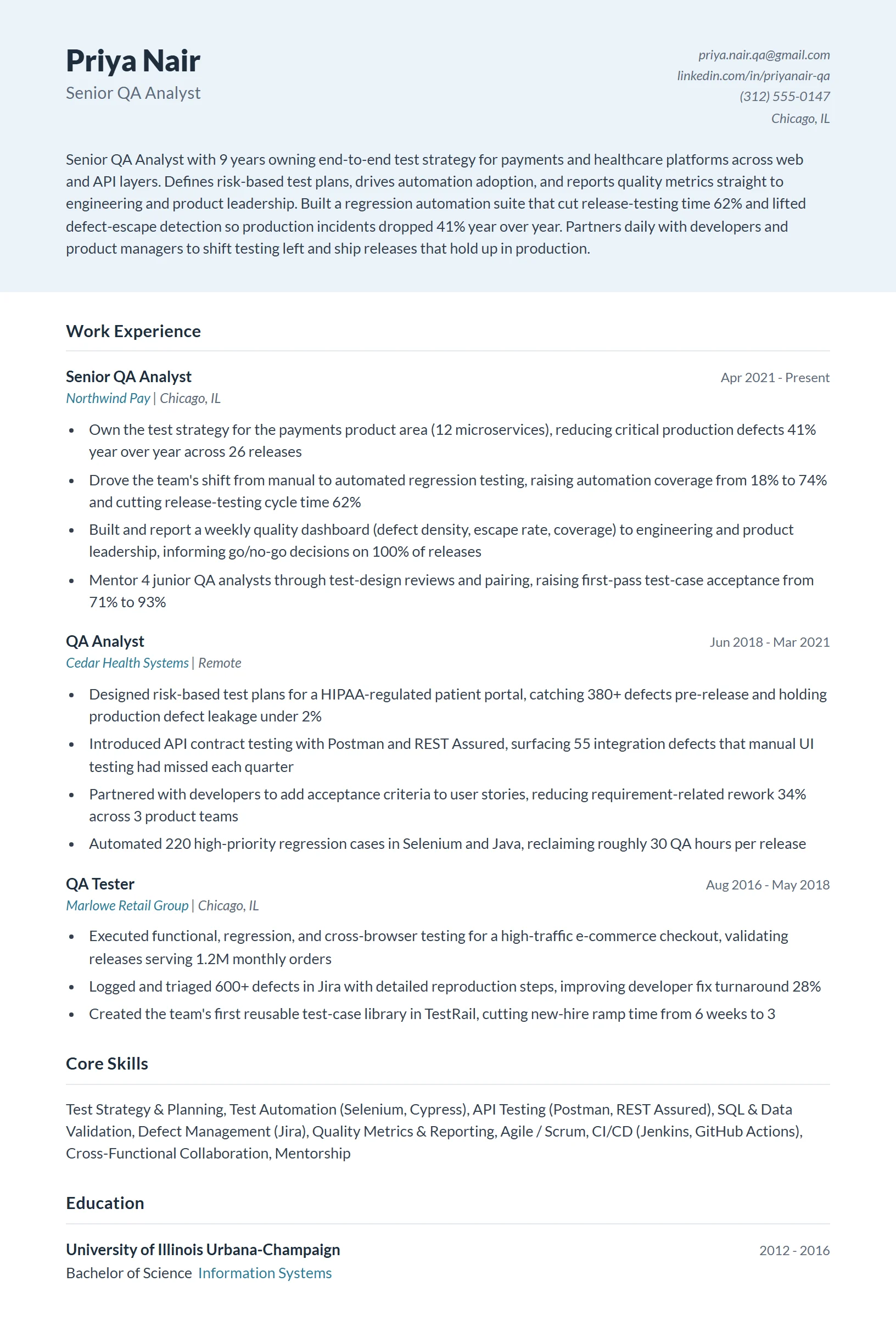
A senior individual contributor who owns test strategy for a product area, mentors junior testers, and drives automation adoption.
The summary and bullets shift from “executed tests” to “set strategy and raised the bar”: defined test plans for a full product line, reduced escaped defects, mentored a team, and reported quality metrics to leadership. It signals scope and ownership, the difference reviewers look for between a mid-level and a senior hire.
QA Engineer resume example
A more technical, code-leaning sibling role focused on building and maintaining test automation rather than running manual checks.
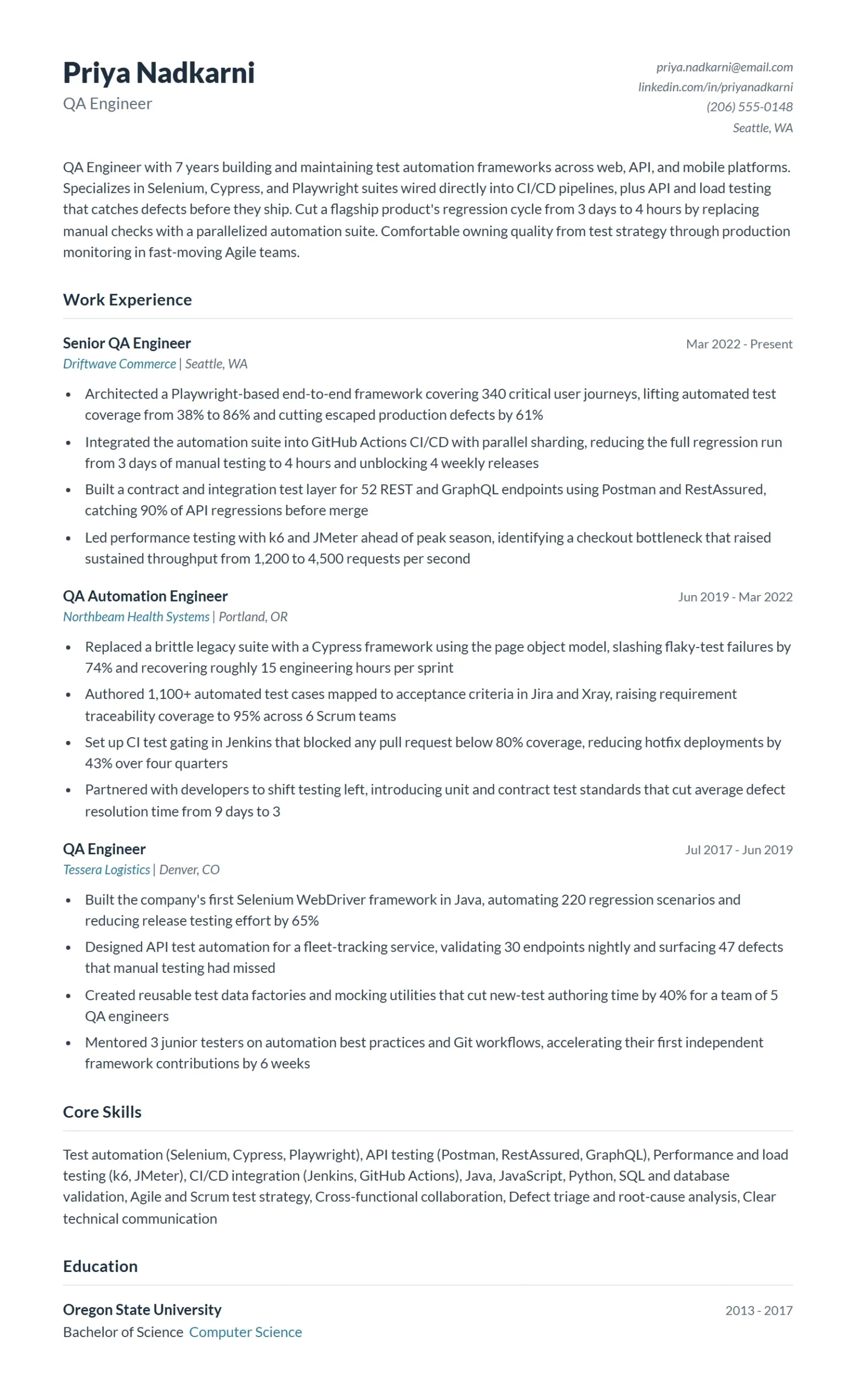
It foregrounds engineering depth: automation frameworks built in Selenium or Playwright, tests wired into CI/CD, and API and performance coverage. Quantified results like faster regression runs and higher automated coverage show the candidate writes maintainable code, not just test cases, which is what separates a QA Engineer from a QA Analyst on paper.
QA Tester resume example
A manual-testing-leaning role centered on executing test cases, exploratory testing, and cross-browser and device validation.

It emphasizes the craft of finding and reporting bugs: clear reproduction steps, well-organized regression suites, and exploratory testing that surfaces issues scripted cases miss. Naming the platforms, browsers, and tracking tools tested against gives ATS the keywords it needs while showing the candidate is thorough and easy for developers to work with.
Automation QA Engineer resume example
An automation-first specialization built around framework design, scripting, and shrinking manual regression cycles.

This resume leads with the languages and tools that define the role (Python or Java, Selenium, Cypress, CI/CD pipelines) and quantifies impact: manual regression hours eliminated, coverage expanded, releases shipped faster. It reads like an engineer’s resume with a quality focus, positioning the candidate for the higher-paying automation roles teams compete for.
How to write a QA Analyst resume that gets interviews
Hiring managers want proof that you catch defects before customers do and that your testing protects releases. A strong QA Analyst resume reads like evidence: the test types you own, the tools you work in, the bugs you find, and the quality outcomes you drive. Mirror the exact language in the job description (test case, regression, defect tracking, the specific tools they name) so both the recruiter and the ATS see an instant match.
- Lead with quality outcomes, not just activities: Anyone can say they “tested software.” Show what your testing prevented or improved: defect escape rate, production incidents avoided, test coverage gained, regression cycle time cut. A QA Analyst who reduced escaped defects by 40% stands out from one who simply “executed test cases.”
- Name your tools and test types explicitly: ATS filters scan for specifics. List the exact tools you use (Jira, TestRail, Zephyr, Postman, Selenium, qTest, Xray) and the testing you actually perform: functional, regression, integration, smoke, exploratory, UAT, API, and cross-browser. Match the job posting’s wording rather than using vague terms like “QA experience.”
- Quantify your defect work: Numbers make QA credible. Reference how many test cases you authored or maintained, defects you logged per release, the severity mix you triaged, and how your reporting cut reproduction time. “Authored 300+ test cases and logged 450 defects across 8 sprints” tells a far clearer story than “responsible for testing.”
- Show you connect testing to requirements: QA Analysts are valued for traceability and risk judgment, not just clicking through screens. Highlight requirements analysis, acceptance-criteria reviews, and test coverage mapped to user stories. Showing you maintained a requirements traceability matrix or caught gaps in acceptance criteria signals analyst-level thinking, not just execution.
- Tailor each resume to the role’s QA flavor: A manual-heavy functional QA role, an API-testing role, and a hybrid manual-plus-automation role want different things. Re-order your skills and rewrite your summary so the top third of the resume matches that specific posting. Lead with what they emphasize, whether that is regression discipline, automation exposure, or domain knowledge.
- Pair technical detail with collaboration: QA sits between product, development, and release. Show that you write clear, reproducible bug reports developers act on, that you join sprint ceremonies, and that you communicate risk to stakeholders. The best QA Analysts make engineers faster, so prove you reduce back-and-forth, not just find problems.

QA Analyst resume summary examples
Your summary is the first thing a recruiter reads. Lead with your specialty, years of experience, and a quantified win.
Good qA Analyst resume summary examples
- Detail-driven QA Analyst with 5 years testing web and mobile applications across functional, regression, and API testing. Authored 400+ test cases in TestRail and logged 600+ defects in Jira, cutting escaped production defects 38% over four release cycles. Known for clear, reproducible bug reports that reduced average defect reproduction time from 25 minutes to under 10.
- Results-focused QA Analyst with 6 years in Agile SaaS environments, specializing in regression testing, requirements traceability, and UAT coordination. Built a 250-case regression suite that cut release-testing time 30% while maintaining 99.5% defect-free deployments. Partners closely with developers and product to catch requirement gaps before they reach the sprint board.
- Quality Analyst with 3 years in functional and exploratory testing for fintech applications. Reduced critical defects reaching production 45% by introducing risk-based test prioritization, and improved test coverage from 68% to 92% across core payment flows. Comfortable spanning manual testing and basic Selenium and Postman automation.
What to avoid
- Hardworking QA professional with a passion for quality and attention to detail looking for a challenging new opportunity. (Generic, all adjectives and no evidence. No tools, no test types, no metrics, and it focuses on what the candidate wants instead of what they deliver.)
- QA Analyst responsible for testing software and finding bugs to make sure the product works correctly. (Describes the job title rather than the candidate’s results. Every QA Analyst tests software, so this adds nothing and includes zero quantified outcomes or named tools.)
QA Analyst resume skills
List the tools and test types named in the job posting first; this is a snapshot, so see our QA skills guide for the full breakdown.
Hard skills for a qA Analyst resume
- Functional, regression, and smoke testing
- Test case design and execution
- Defect tracking and triage (Jira, Bugzilla)
- Test management tools (TestRail, Zephyr, qTest)
- API testing (Postman, REST)
- SQL for data validation
- Requirements traceability and analysis
- Cross-browser and mobile testing
- Basic test automation (Selenium)
- Agile and Scrum testing practices
Soft skills for a qA Analyst resume
- Attention to detail
- Clear written communication
- Analytical and critical thinking
- Cross-functional collaboration
- Prioritization under release deadlines
QA Analyst resume work experience bullet point examples
Lead each bullet with a strong verb and a measurable result.
Good bullet point examples
- Authored and maintained 400+ functional and regression test cases in TestRail, raising automated and manual coverage of core checkout flows from 70% to 94% across three quarters
- Logged, triaged, and tracked 600+ defects in Jira with reproducible steps and severity scoring, cutting average developer reproduction time from 25 minutes to 9
- Built a risk-based regression suite that reduced full release-testing time from 5 days to 3.5 while lowering escaped production defects 38% over four release cycles
- Reviewed acceptance criteria for 120+ user stories per quarter and maintained a requirements traceability matrix that caught 30+ coverage gaps before development began
Bad bullet point examples
- Responsible for testing the application and reporting bugs to the development team. (No scope, no tools, no numbers. “Responsible for” describes a duty, not an achievement, and it could apply to any QA role at any company.)
- Worked closely with developers and attended daily standups and sprint meetings. (Lists participation, not impact. Attending ceremonies is expected, so it wastes a line that should show a quality outcome you drove.)
- Used various testing tools to ensure high quality across the product. (Vague on both ends. “Various tools” defeats the ATS keyword match, and “high quality” is an unmeasured claim with no defect, coverage, or cycle-time figure to back it up.)
QA Analyst resume tips
A well-targeted QA Analyst resume can move you past the ATS and straight onto a hiring manager’s shortlist by speaking the exact language of quality engineering.
- Mirror Tool Names: Paste the exact tool names from the job posting (TestRail, Zephyr, Postman, Bugzilla) into your skills section and bullet points, because ATS parsers match strings literally and will miss synonyms or abbreviations.
- Quantify Defect Impact: Replace vague claims with numbers that QA managers recognize: defect detection rate, number of test cases authored, bug escape rate reduced, or release cycle time shortened (for example, ‘authored 400 regression test cases covering 12 core modules’).
- List Certifications Explicitly: Place credentials such as ISTQB Foundation, CSTE, or tool-specific certifications in a dedicated line near the top so both recruiters and ATS systems surface them immediately rather than burying them inside bullet points.
- Separate Test Types: Call out functional, regression, smoke, API, and cross-browser testing as distinct line items in your skills section, because hiring managers scan for coverage breadth and ATS systems treat each test type as its own keyword.
- Show Traceability Work: Mention requirements traceability and RTM (Requirements Traceability Matrix) experience explicitly, because this signals to senior QA managers that you connect test coverage back to business requirements, a nuance many candidates omit.
- Keep It Two Pages Max: Limit your resume to two pages even with broad tool experience, prioritizing the skills and environments listed in the target job description and cutting older manual-only testing work that does not reflect current role requirements.
Pair your qA Analyst resume with a cover letter
A strong resume goes further with a tailored cover letter. Browse our qa analyst cover letter examples to round out your application.
QA Analyst resume frequently asked questions
List a mix of technical and process skills that match the job description: test case design, manual and automated testing, bug tracking (Jira, Bugzilla), SQL for backend validation, API testing (Postman), and test management tools (TestRail, Zephyr). Include methodologies like Agile, Scrum, and the STLC, plus any automation frameworks (Selenium, Cypress, Playwright) you have used. Mirror the exact tool names from the posting so your resume passes the ATS keyword match.
Translate your work into outcomes, not just activities. Quantify defects caught before release, reduction in production escapes, regression cycles automated, or test coverage increased (for example, “Identified 120+ critical defects pre-release, cutting production bug reports by 35%”). Numbers like test cases written, automation hours saved, and release sign-off rates turn invisible QA work into measurable value hiring managers can see.
Lead with whatever the job emphasizes, then show both. If the role is automation-heavy, put your frameworks, scripting languages, and CI/CD experience near the top; if it is manual or hybrid, foreground test case design, exploratory testing, and domain knowledge. Many QA Analyst roles want a blend, so demonstrating that you can write solid manual cases and automate the repetitive ones makes you more competitive.
ISTQB (Foundation Level) is the most widely recognized QA certification and worth listing if you have it. Certified Scrum Master (CSM) or Agile certifications signal you understand the delivery process, and tool-specific or automation credentials (Selenium, ISTQB Advanced) add weight for technical roles. Certifications are not required to land a QA job, so do not delay applying, but they help your resume clear ATS filters and stand out for senior positions.
Use a clean, single-column layout with standard section headings (Experience, Skills, Education) and save it as a .docx or text-based PDF, not an image. Pull the exact keywords from the job description, including tool names, methodologies, and the title “QA Analyst” itself, and weave them naturally into your summary, skills, and bullet points. Run your resume against the posting with a tool like Jobscan to confirm your match rate before you submit.
Highlight transferable skills and any hands-on practice: testing personal or open-source projects, bootcamp work, QA coursework, or freelance bug-bounty contributions. Create a projects section showing test plans you built, bugs you logged, or automation scripts you wrote, and quantify them where you can. Emphasize attention to detail, analytical thinking, and familiarity with tools like Jira and SQL, since employers hiring junior QA Analysts weigh aptitude and process understanding heavily.