Best Service Desk Analyst Resume Examples for 2026
Service Desk Analyst resume examples for 2026 that pass the ATS, prove your troubleshooting and ticketing skills, and land more IT support interviews.

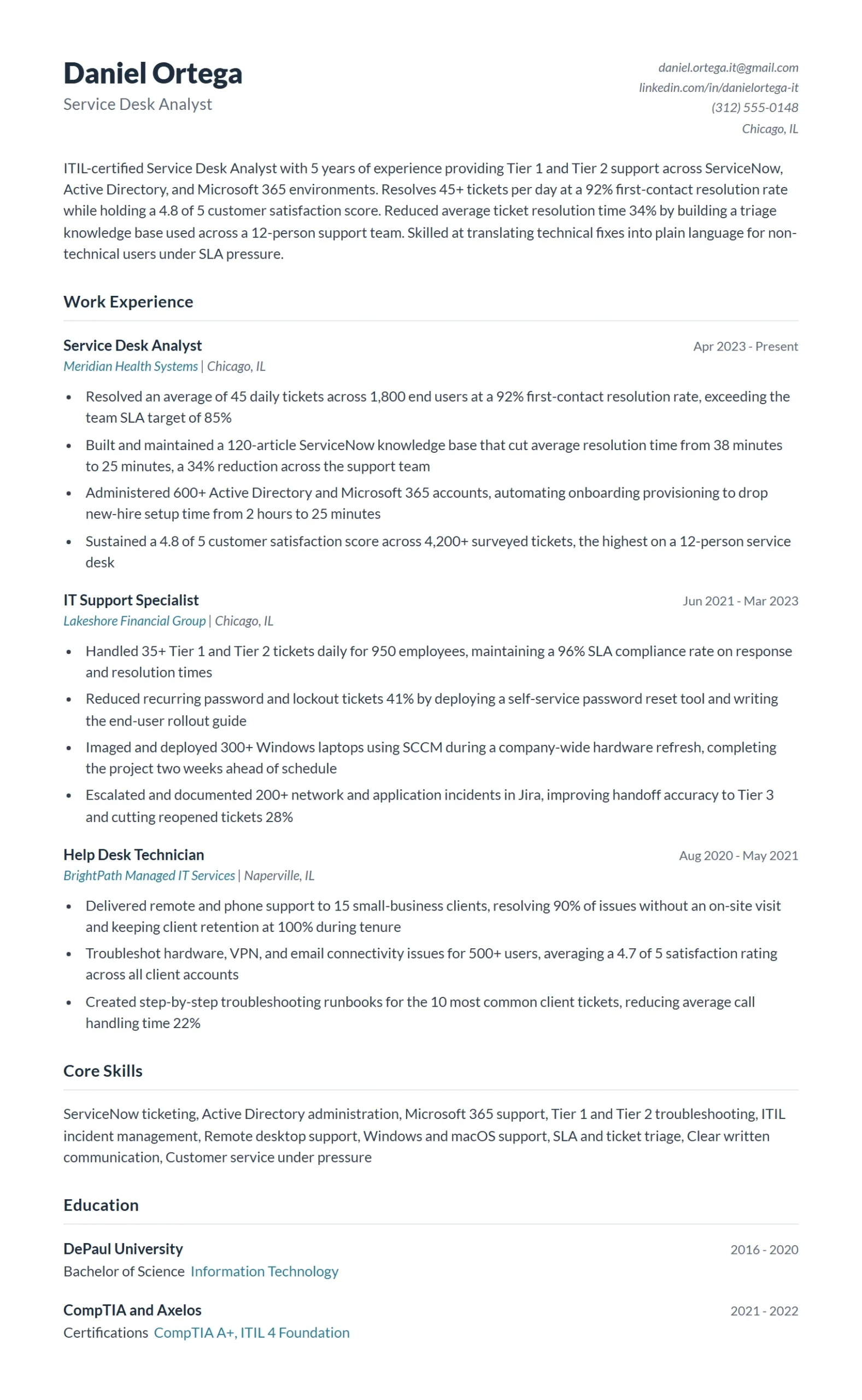
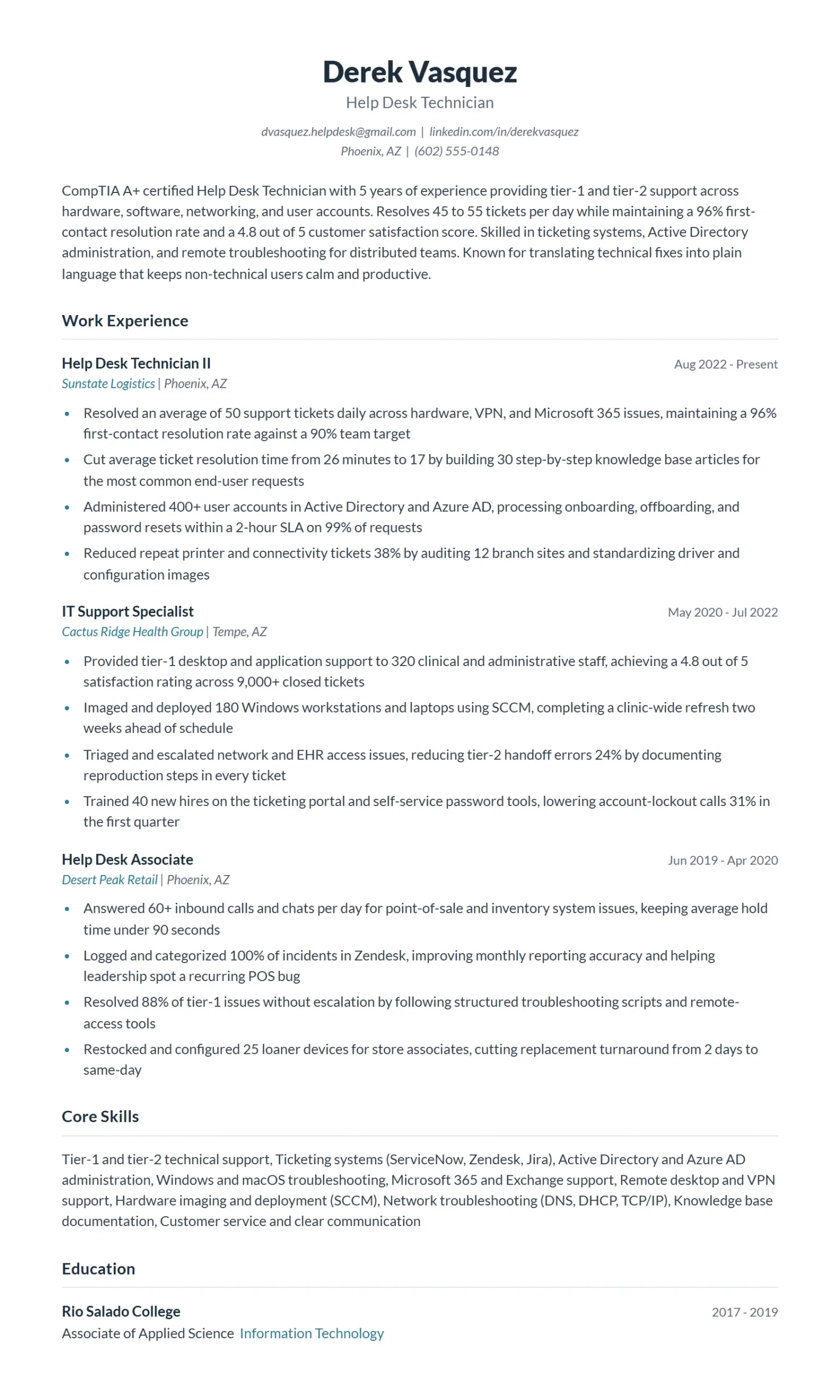
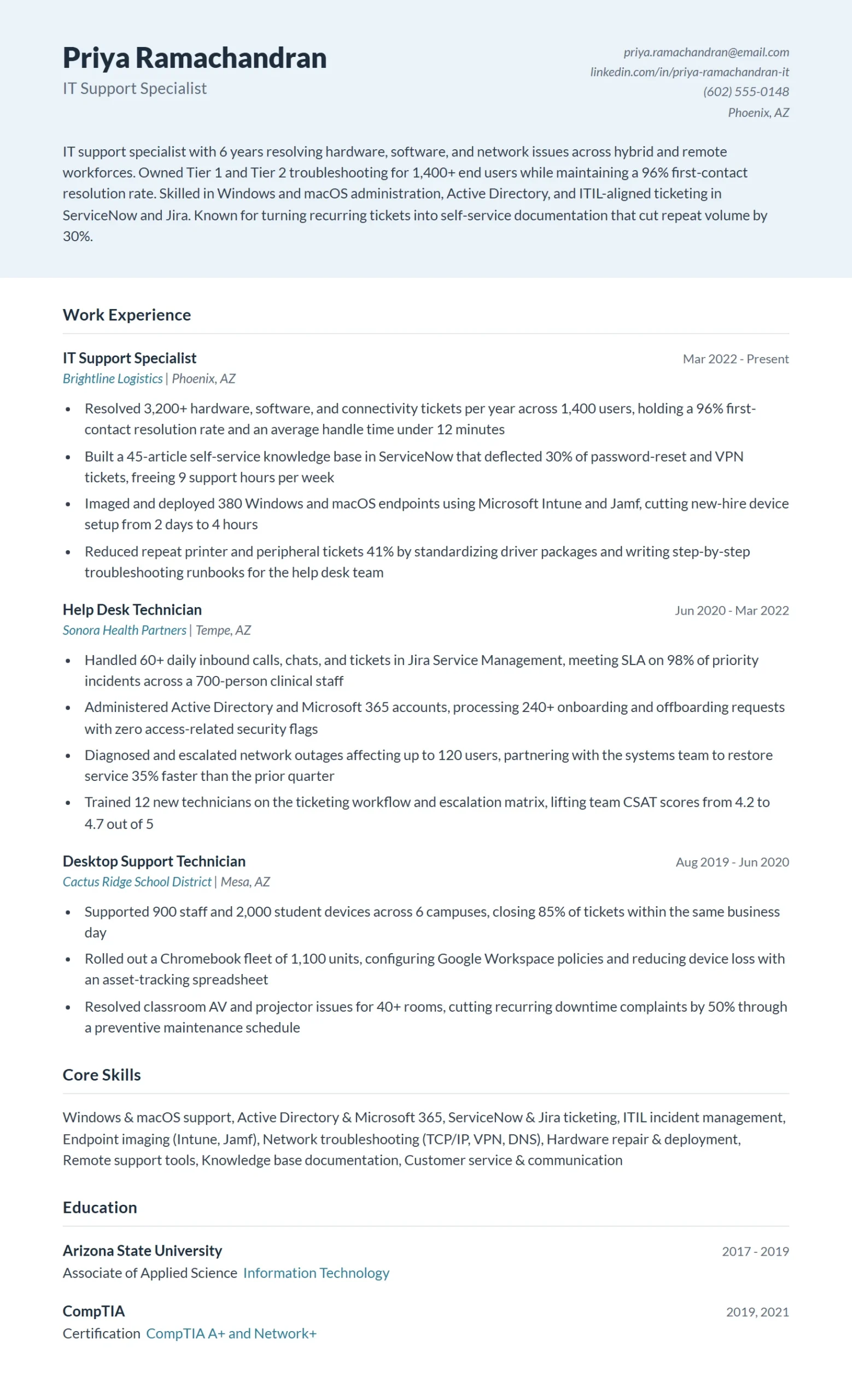


A service desk analyst is the first line of IT support, fielding tickets, troubleshooting hardware and software issues, resetting access, and escalating problems that need a specialist. It is a role hiring managers fill constantly, which means your resume competes against a large stack and often gets screened by an applicant tracking system before a person ever reads it.
Hiring managers want proof you can resolve issues fast and keep users productive. They scan for the tools you know (ticketing platforms like ServiceNow, Jira, or Zendesk, plus Active Directory and Office 365), the support tiers you have handled, and metrics like first-call resolution rate, ticket volume, and SLA adherence. The ATS, meanwhile, is matching your resume against keywords pulled straight from the job description, so the exact terms you use matter.
The examples below show how to do both at once: write for the human reader and the software. Pick the version closest to your target role, mirror its structure, and swap in your own tools, metrics, and wins.
Ready to build yours? Try our ATS-friendly resume builder or scan your draft against the job description.
Service Desk Analyst resume example
A mid-level template built around ticket resolution, tiered support, and the platforms most service desks run on.
This resume leads with first-contact resolution and ticket volume because those numbers tell a hiring manager you can handle a busy queue. It names specific tools (ServiceNow, Active Directory, Office 365) so the ATS finds an exact keyword match, and it frames each bullet as a problem solved rather than a task performed.
Help Desk resume example
A broad support template for the most-searched role in the IT support family, covering phone, email, and chat troubleshooting.
Because help desk job descriptions vary widely, this version stays adaptable: it foregrounds transferable support skills and customer communication, then leaves room to mirror the specific tools each posting lists. The summary states years of experience and supported user count up front, which is what screeners look for first.
IT Support resume example
A versatile template for general IT support roles that blend end-user help with light systems and hardware work.
This resume widens the technical surface area on purpose, listing networking basics, hardware repair, and OS imaging alongside ticketing. That breadth matches the catch-all nature of IT support postings and signals you can cover gaps a small team needs filled, while metrics keep it from reading as a vague skills dump.
IT Help Desk Analyst resume example
A ticketing-focused template that emphasizes tiered escalation, SLA performance, and knowledge base contributions.

Where a general help desk resume stays broad, this one drills into process: it quantifies SLA adherence, documents how issues move from Tier 1 to Tier 2, and shows you build reusable fixes. That operational detail reassures larger IT organizations that you understand structured support, not just one-off troubleshooting.
Desktop Support resume example
A hands-on template for endpoint-focused roles centered on hardware, imaging, and on-site or remote device support.

This version shifts the spotlight from the phone queue to the physical and managed endpoint: workstation deployments, hardware diagnostics, OS and software imaging, and remote tools. Listing device counts supported and deployment projects completed gives the concrete, scope-of-work proof desktop support managers screen for.
Entry-Level Help Desk resume example
A starter template for candidates breaking into IT with certifications, coursework, or transferable customer service experience.

With limited work history, this resume leads with certifications (CompTIA A+, ITIL) and hands-on projects instead of a thin job list, then reframes prior customer-facing roles as proof of communication and problem-solving. It deliberately echoes the exact technical keywords from entry-level postings so a light resume still clears the ATS filter.
How to write a Service Desk Analyst resume that gets interviews
IT managers screen a Service Desk Analyst resume for two things: can you fix the ticket, and can you do it without breaking the SLA. They want proof you resolve issues fast, document them cleanly, and keep frustrated users calm under pressure. Nearly every IT team also runs your resume through an Applicant Tracking System (ATS) first, so your tools, ticketing platform, and support tier have to match the job description before a human ever reads it. The tips below help you do both: clear the ATS scan and convince the hiring manager you can carry a queue from day one.
- Lead with resolution metrics, not duties: Anyone can write “answered support tickets.” Hiring managers want the numbers that define service desk performance: first-call resolution rate, average handle time, tickets resolved per day or week, SLA compliance, and CSAT. Trade “resolved user issues” for “resolved 40+ tickets daily at a 92% first-contact resolution rate while holding a 4.7/5 CSAT.” If you do not have exact figures, estimate conservatively from your queue volume. A specific number always beats a vague verb.
- Name your ticketing system and support tools by exact name: The ATS scans for specific platforms. List the tools you actually use: ServiceNow, Jira Service Management, Zendesk, Freshservice, or Remedy for ticketing; Active Directory, Office 365, and Azure AD for account and access management; SCCM, Intune, or Jamf for device management; and remote support tools like TeamViewer or Bomgar. If the posting names ServiceNow and you have used it, use that exact phrase, not “ticketing software.”
- Specify your support tier and scope: “Service Desk Analyst” covers a wide range. State whether you worked Tier 1, Tier 2, or escalation; whether support was phone, email, chat, walk-up, or remote; and the size of the user base you supported. “Provided Tier 1 and Tier 2 remote support to 1,200+ end users across three offices” tells a manager instantly whether you fit the role. It also signals you understand escalation paths instead of trying to solve everything alone.
- Show the ITIL and process side, not just the fixes: Strong analysts follow a framework. Reference incident management, problem management, change management, and ticket escalation, and name ITIL if you are certified or trained in it. Document that you log, categorize, and route tickets correctly and update the knowledge base. A resume that lists only hardware and software fixes reads as a technician. Showing process signals you can scale and work inside a structured IT operation.
- Quantify the user experience you protect: Service desk work is half technical, half customer service. Prove you keep users productive and satisfied: “reduced average ticket resolution time 30% by building 25 knowledge base articles,” “maintained 98% SLA compliance across a 50-ticket daily queue,” or “raised satisfaction scores from 3.9 to 4.6 over two quarters.” These outcomes show you are not just closing tickets but improving how the whole desk runs.
- List your certifications and tailor to each posting: Certifications carry real weight in service desk hiring. Surface CompTIA A+, Network+, ITIL Foundation, the Microsoft 365 Certified: Modern Desktop Administrator, or HDI Support Center Analyst near the top if you hold them. Then mirror each job: a Tier 1 phone role and an MSP role reward different keywords. Reorder your skills and tools to match the posting, keep the format single-column and ATS-friendly with standard headings, and run it through Jobscan to check your match rate before you apply.

Service Desk Analyst resume summary examples
Your summary is the first thing a recruiter reads. Lead with your specialty, years of experience, and a quantified win.
Good service Desk Analyst resume summary examples
- Service Desk Analyst with 5+ years providing Tier 1 and Tier 2 support to 1,500+ end users in ServiceNow. Maintained a 94% first-contact resolution rate and 97% SLA compliance across a 45-ticket daily queue. ITIL Foundation and CompTIA A+ certified, with a track record of cutting average resolution time through knowledge base contributions.
- Customer-focused IT Service Desk Analyst skilled in incident and request management across Windows and Office 365 environments. Resolved 50+ tickets daily at a 4.8/5 CSAT while managing Active Directory accounts and remote troubleshooting. Built 30 knowledge base articles that reduced repeat tickets 22%.
- Detail-driven service desk professional with HDI Support Center Analyst certification and hands-on experience in Jira Service Management and Intune. Supported a hybrid workforce of 900 users, held average handle time under 8 minutes, and escalated complex incidents with clean, complete documentation that sped Tier 3 resolution.
What to avoid
- Hardworking IT professional seeking a service desk role where I can use my skills and grow my career in a fast-paced environment. (It is all about what the candidate wants, not what they deliver. There is no ticketing platform, no support tier, no metrics, and no certifications. A hiring manager learns nothing they can screen on.)
- Reliable team player with great communication skills and a passion for helping people solve their computer problems. (Pure adjectives with no proof. It names no tools, no SLA or resolution numbers, and no ITIL process, so both the ATS and the recruiter skip past it as filler.)
Service Desk Analyst resume skills
A resume-context snapshot only. Mirror the exact tools and certifications in each job posting, and see our full Service Desk Analyst skills guide for the complete list and how to phrase each one.
Hard skills for a service Desk Analyst resume
- ServiceNow / Jira Service Management / Zendesk ticketing
- Active Directory and Office 365 / Azure AD administration
- Tier 1 and Tier 2 incident and request management
- ITIL framework (incident, problem, change management)
- Windows and macOS troubleshooting
- Remote desktop support (TeamViewer, Bomgar)
- Hardware, printer, and peripheral support
- Knowledge base documentation and SLA tracking
Soft skills for a service Desk Analyst resume
- Clear communication with non-technical users
- Patience and composure under pressure
- Active listening and problem diagnosis
- Time management across a busy queue
- Collaboration and clean escalation handoffs
Service Desk Analyst resume work experience bullet point examples
Lead each bullet with a strong verb and a measurable result.
Good bullet point examples
- Resolved 45+ daily tickets in ServiceNow at a 94% first-contact resolution rate, holding SLA compliance at 97% across phone, chat, and email channels.
- Authored 30 knowledge base articles for common Active Directory and Office 365 issues, cutting average resolution time 30% and reducing repeat tickets 22%.
- Provided Tier 1 and Tier 2 remote support to 1,500+ users across three offices, escalating complex incidents to Tier 3 with complete documentation that reduced rework.
- Improved customer satisfaction scores from 3.9 to 4.6 over two quarters by standardizing triage and follow-up procedures across a five-person service desk team.
Bad bullet point examples
- Responsible for answering tickets and helping users with their IT problems. (Describes a duty, not a result. There is no ticketing system, no volume, no resolution rate, and no SLA, so it gives the hiring manager nothing to measure.)
- Provided excellent customer service and resolved issues in a timely manner. (“Excellent” and “timely” are unquantified claims. Without a CSAT score, handle time, or resolution metric, it reads as filler that the ATS cannot match to the job description.)
- Worked with various software and hardware to support the company. (Vague on every front. It names no specific tools (ServiceNow, Active Directory, Intune), no support tier, and no outcome, so it neither passes keyword screening nor proves capability.)
Service Desk Analyst resume tips
A well-targeted Service Desk Analyst resume can move you past the ATS and straight into a hiring manager’s shortlist by showing both the tools you know and the speed at which you use them.
- Mirror the Job Post: Copy the exact ticketing platform name from the posting (ServiceNow, Jira Service Management, or Zendesk) into your skills section and bullet points, because ATS systems match keywords literally and will miss abbreviations or alternate names.
- Quantify Your Queue: Include metrics that IT managers actually track: average ticket resolution time, daily or weekly ticket volume handled, first-call resolution rate, and SLA compliance percentage, even rough figures from memory beat vague claims.
- Name Your Support Tier: Explicitly label your experience as Tier 1 or Tier 2 support, since many ATS filters screen by tier and hiring managers use it to gauge how complex the issues you owned were versus what you escalated.
- List ITIL and Certs: If you hold an ITIL Foundation certification, CompTIA A+, or Microsoft MD-102, place it in a dedicated certifications line near the top of your resume, because these are frequent ATS filters for service desk roles and signal structured process knowledge.
- Highlight Remote Tools: Specify the remote desktop tools you have used (TeamViewer, Bomgar, or similar) alongside the platforms you supported (Windows, macOS, Office 365, Azure AD), since hybrid workforces mean remote support proficiency is now a baseline requirement, not a bonus.
- Show the Soft Skill in Action: Rather than listing patience or communication as standalone skills, embed them in a result-driven bullet such as de-escalated frustrated users while maintaining a 95 percent satisfaction score, which proves the soft skill without wasting a keyword slot.
Pair your service Desk Analyst resume with a cover letter
A strong resume goes further with a tailored cover letter. Browse our cover letter examples to round out your application.
Service Desk Analyst resume frequently asked questions
Write 2 or 3 sentences that name your support tier and experience level, the ticketing and remote-support tools you know, and one quantified result. For example: “Service Desk Analyst with 4 years of Tier 1 and Tier 2 support, resolving 50+ tickets daily in ServiceNow with a 95 percent first-contact resolution rate.” Mirror the job title and a few key terms from the posting so the recruiter and the ATS both see an immediate match. Lead with metrics like resolution time, CSAT, or SLA compliance instead of generic phrases like “hardworking team player.”
Balance technical tools, support processes, and the people skills the role runs on. Name your ticketing and ITSM platforms (ServiceNow, Zendesk, Jira Service Management, Freshservice), remote-support and OS environments (Active Directory, Office 365, Windows, macOS, remote desktop tools), and frameworks like ITIL. For soft skills, highlight troubleshooting, customer service, clear written communication, and patience under pressure. Match the exact tools and certifications the job description names, since those are often the precise keywords an ATS scans for.
Lead with transferable evidence: any customer service, retail, or call-center role shows you can handle users calmly and resolve issues, which is most of the job. Feature relevant certifications like CompTIA A+ or ITIL Foundation, a home lab or help-desk simulation project, and any hands-on work with ticketing tools, password resets, or hardware setup. Describe each item with a problem, your action, and a result so it reads like real support work. A short summary that frames you as an entry-level service desk analyst, plus a tool-focused skills section, helps you clear the keyword screen.
Yes, and they are some of the strongest signals you can include. Hiring managers want proof you can hit service targets, so quantify ticket volume, first-contact resolution rate, average handle or resolution time, SLA compliance, and customer satisfaction (CSAT) scores. Even rough figures like “resolved 40 to 60 tickets per day” or “maintained 92 percent CSAT” beat vague claims like “provided excellent support.” Pull the numbers from your ticketing dashboards or past performance reviews so they are accurate and defensible.
CompTIA A+ is the most recognized entry point and signals core hardware, OS, and troubleshooting knowledge, while ITIL Foundation shows you understand service management processes the role follows. Microsoft 365 and CompTIA Network+ certifications also help, especially for environments heavy in Office 365 or networking issues. List active certifications near the top, just under your summary or in a dedicated section, with the credential name and year. If a posting names a specific certification, include the exact term so the ATS registers the match.
Use a clean single-column layout with standard headings (Summary, Experience, Skills, Certifications) and real selectable text, not graphics or text inside images. Mirror the language in the job posting, so if it says “ServiceNow” use “ServiceNow” rather than “ticketing system,” and spell out terms like “first-contact resolution” the way the description does. Match the exact job title, whether that is Service Desk Analyst, IT Support Analyst, or Help Desk Technician. Before you apply, scan your resume against the posting with a tool like Jobscan to confirm your keywords, skills, and formatting pass the screen.