Best Software Testing Resume Examples for 2026
Software testing resume examples for 2026 across QA, automation, and SDET roles, with the tools, methodologies, and ATS keywords that win interviews.

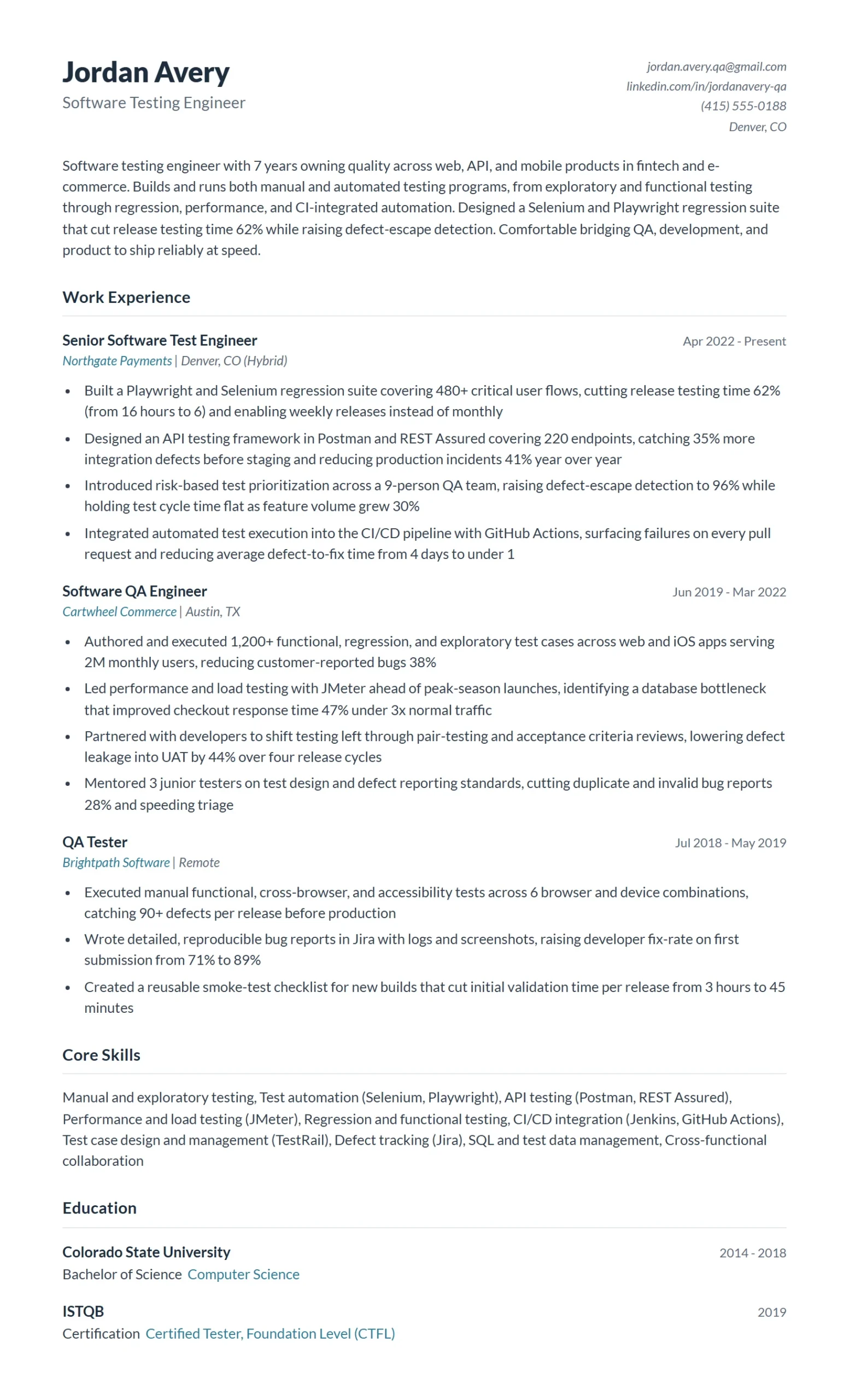
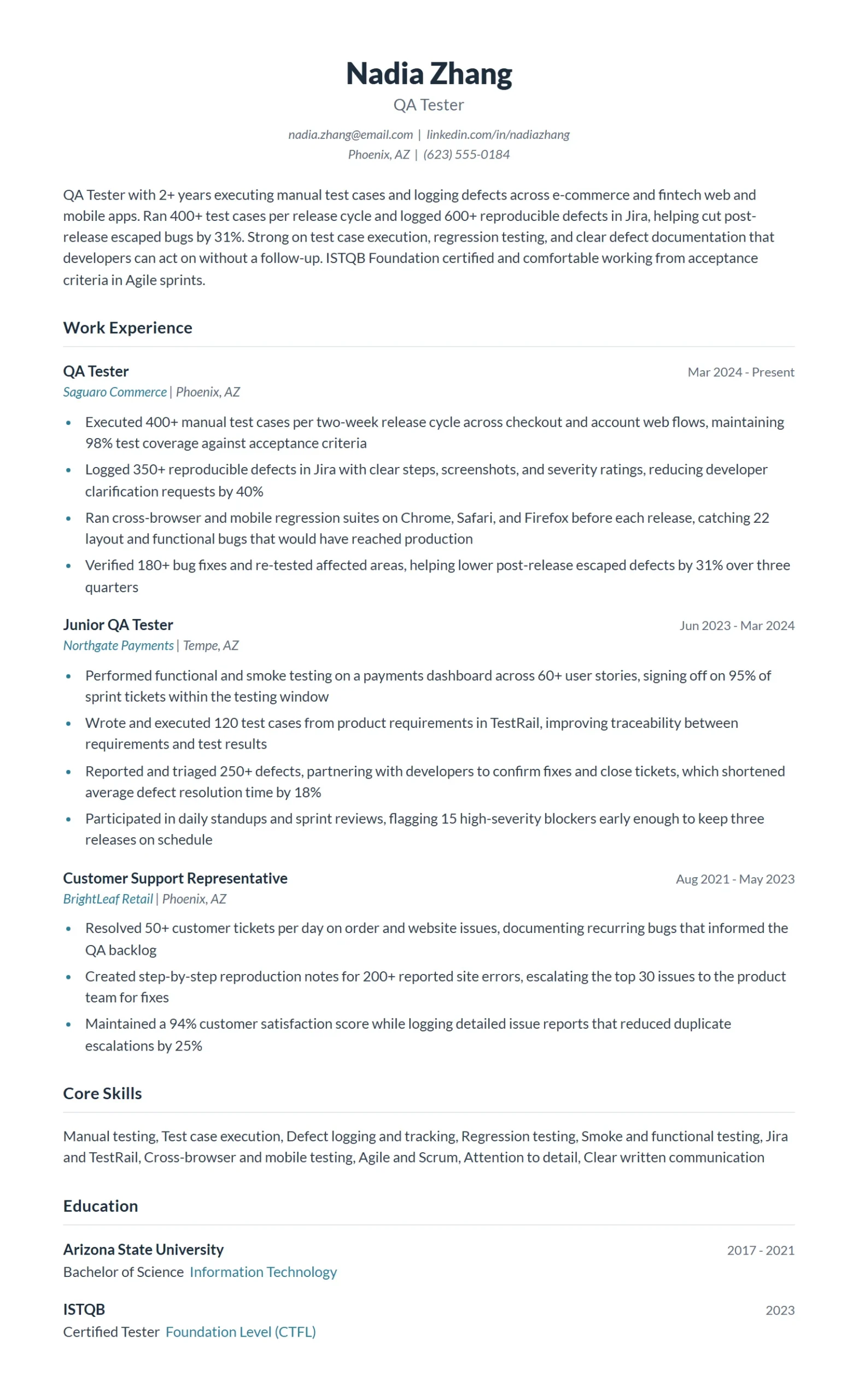
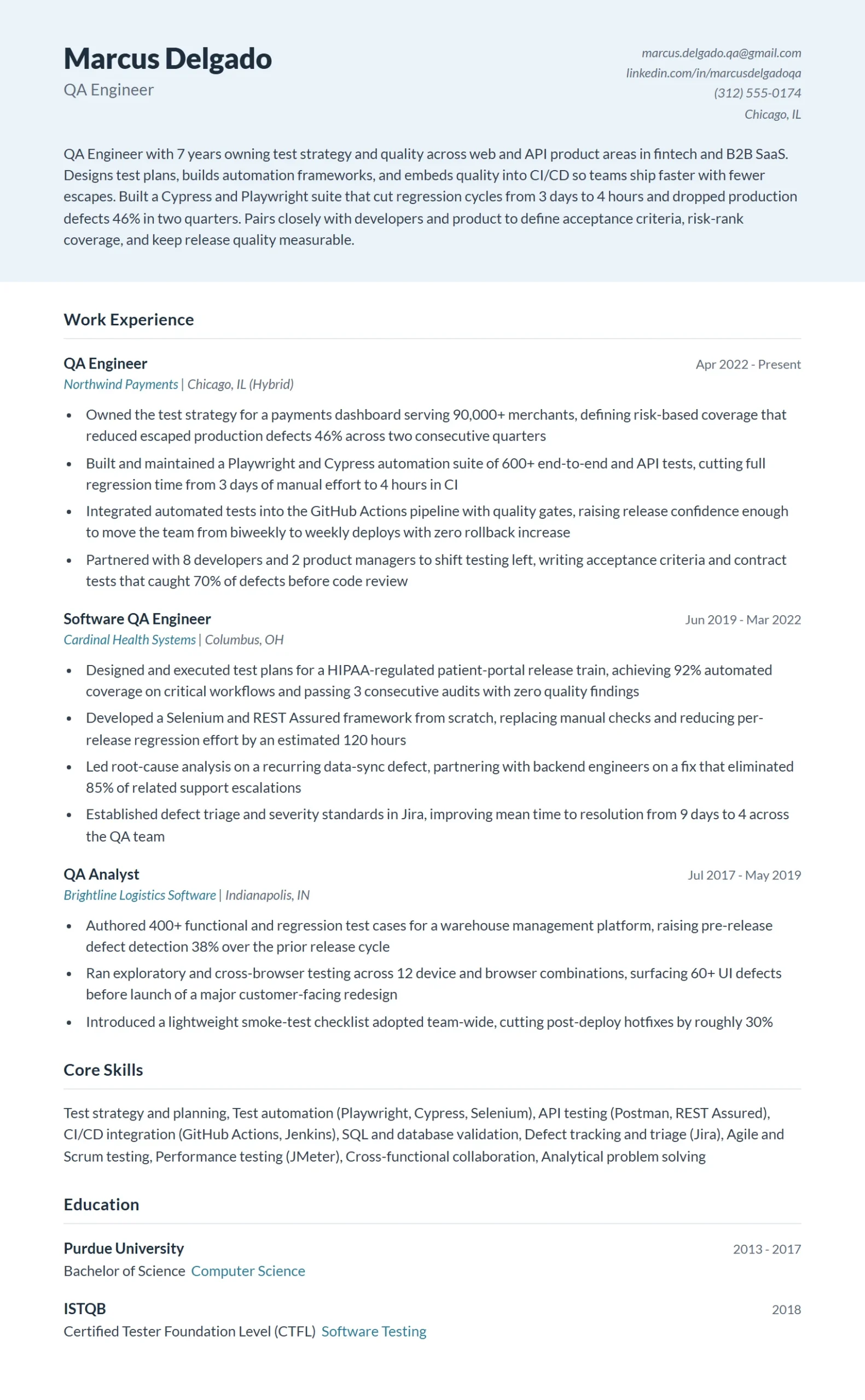


Software testing keeps products from breaking in front of users. Whether you write automated test suites, run exploratory sessions by hand, or own quality strategy across a whole product, your resume has to prove you catch problems early and ship with confidence. The role spans a wide range of titles, from QA tester to SDET, and each one expects a slightly different mix of skills.
Hiring managers want to see proof, not adjectives. Show the tools you actually use (Selenium, Cypress, Playwright, JIRA, Postman), the methodologies you work in (Agile, regression, integration, API testing), and the impact you delivered: defects caught before release, coverage you raised, cycle time you cut. Before a human reads any of it, an applicant tracking system scans for those exact terms, so the keywords from the job description need to appear naturally in your resume.
The examples below break down what works for each testing role, from entry-level QA up through automation and engineering-focused positions. Use them to frame your experience, surface the right skills, and build a resume that clears the ATS and lands the interview.
Ready to build yours? Try our ATS-friendly resume builder or scan your draft against the job description.
Software Testing resume example
A general software testing resume that works across QA, manual, and automation roles. Built to show you can plan, execute, and report on testing while clearing ATS filters.
This resume leads with a skills section that mixes testing types (functional, regression, integration, performance) with concrete tools, so it matches a broad range of job descriptions. Each role bullet pairs an action with a measurable result, like defects caught before release or test coverage raised. That combination of breadth and proof is what gets a generalist tester shortlisted.
QA Tester resume example
An entry-accessible QA tester resume focused on executing test cases, logging defects, and verifying fixes. Ideal for early-career candidates breaking into quality assurance.
This example proves competence without years of experience by showing test cases written and run, bugs documented in JIRA or a similar tracker, and clear communication with developers. It front-loads the foundational skills recruiters screen for (test case design, defect lifecycle, regression testing) so an entry-level candidate still reads as job-ready rather than green.
QA Engineer resume example
A QA engineer resume built around owning test strategy and quality for a product or feature area, not just running individual test cases.
This resume shifts the emphasis from execution to ownership: building test plans, defining coverage, and partnering with engineering on release readiness. Bullets quantify scope (releases supported, suites maintained, escape rate reduced) so the candidate reads as someone who drives quality decisions. That strategic framing is what separates a QA engineer from a tester in a hiring manager’s eyes.
SDET (Software Development Engineer in Test) resume example
An SDET resume that proves real engineering ability, not just testing. It centers on the code you write to build frameworks and automate quality at scale.
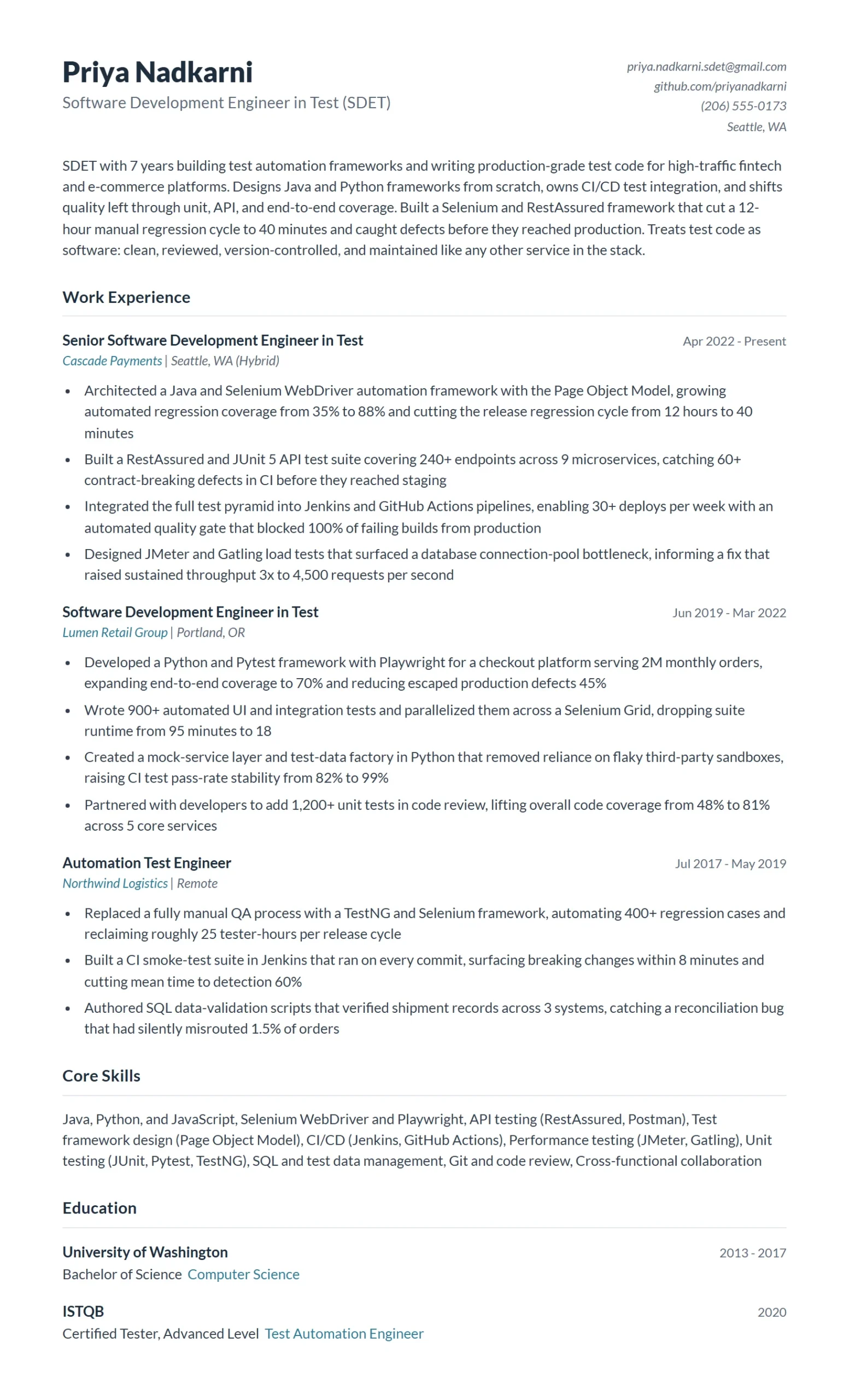
This example treats programming as a headline skill, listing languages (Java, Python, JavaScript) and showing frameworks built or extended, CI/CD pipelines integrated, and flaky tests stabilized. It reads more like a software engineer resume than a QA one, which is exactly what the title demands. Quantifying time saved by automation and coverage gained makes the engineering impact concrete.
Automation Tester resume example
An automation tester resume centered on building and maintaining automated test suites that run inside CI/CD pipelines.

This resume puts tooling front and center (Selenium, Cypress, Playwright, TestNG) and shows the candidate converting manual tests into reliable automated coverage. Bullets quantify the payoff: regression time cut, suites scaled, releases unblocked. Because automation roles are screened hard for specific frameworks, naming the exact tools from the job posting is what gets this resume past the ATS.
Manual Tester resume example
A manual tester resume that highlights exploratory, usability, and edge-case testing done without scripting, where human judgment catches what automation misses.
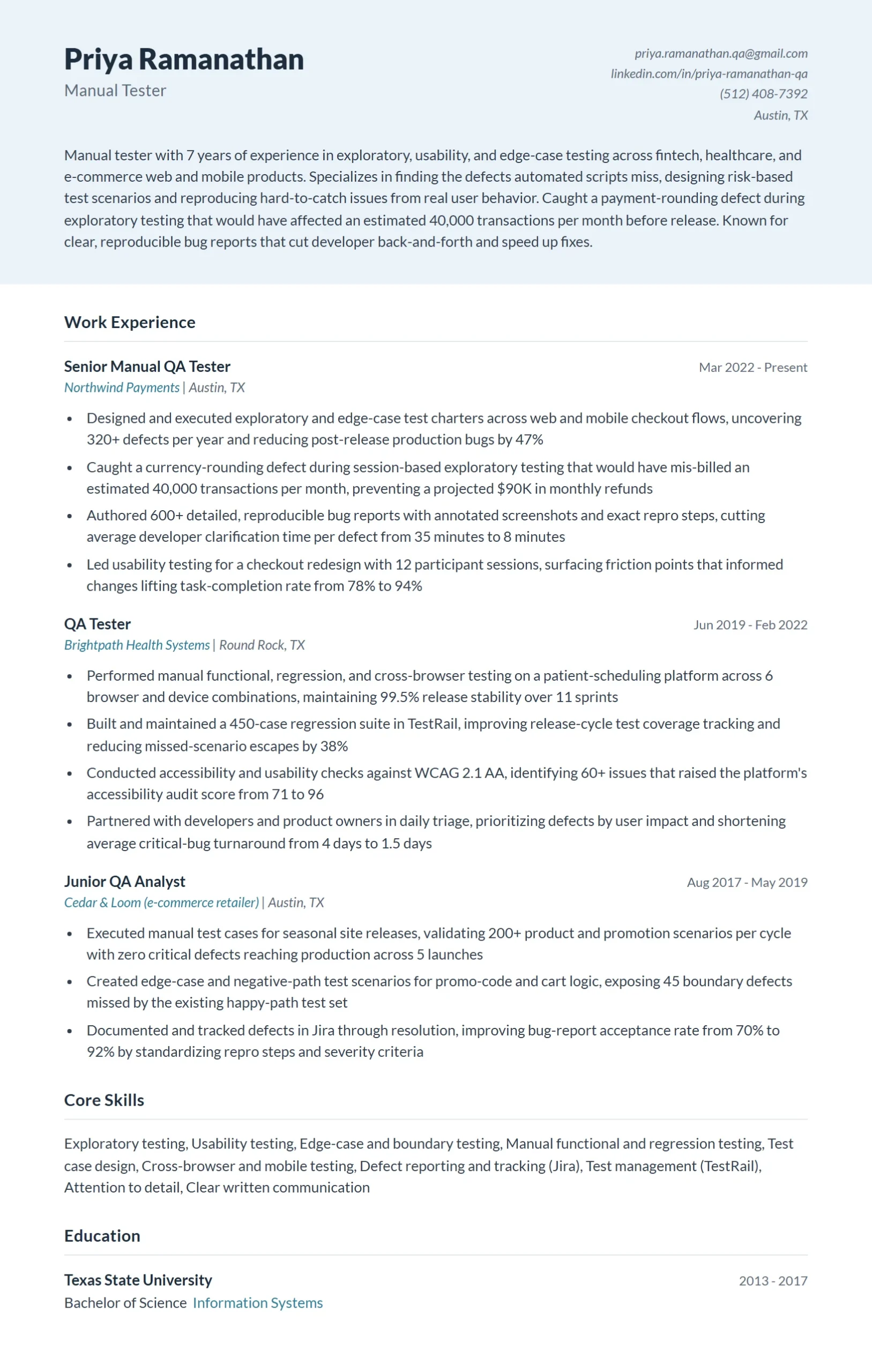
This example reframes manual testing as a strength, not a limitation, by showing exploratory sessions that surfaced high-severity bugs, detailed repro steps, and close collaboration with developers and product. It emphasizes test case design, attention to detail, and domain knowledge, the qualities teams still hire manual testers for. Pairing that with familiarity with tracking and test management tools keeps it ATS-relevant.
How to write a software testing resume that gets interviews
QA leads and hiring managers skim a software testing resume for proof you find the bugs that matter and ship quality without slowing the team down. They want to see what you test, how you test it, and the defects, coverage, and release outcomes you drove. Most companies run your resume through an Applicant Tracking System (ATS) first, so the language has to match the job description before a human reads it. The tips below show you how to clear the ATS scan and convince the QA lead reading next.
- Lead with defects caught and coverage, not tasks performed: “Wrote test cases” tells a hiring manager nothing. Show the result: “caught 40+ critical defects pre-release across 6 sprints,” “raised regression coverage from 55% to 90%,” or “cut post-release escaped defects 30% in two quarters.” Tie your work to defect counts, coverage percentage, escaped-defect rate, or release stability. Numbers are the fastest way to prove you protect quality.
- Name your testing types and methodologies precisely: Software testing is a wide field, so spell out exactly what you do: functional, regression, integration, smoke, sanity, exploratory, API, performance, load, and accessibility testing. Reference where you sit in the SDLC and STLC, and whether you work in Agile, Scrum, or Waterfall. A QA lead reading “performed black-box and exploratory testing within a two-week Scrum cadence” knows immediately how you operate.
- Show both manual depth and automation, and be honest about the split: Most testing roles now want some automation, even if the title says manual QA. State the framework and language you use (Selenium with Java or Python, Cypress, Playwright, TestNG, JUnit, Postman or REST Assured for API tests) and what you automated: “built a Selenium regression suite of 200+ cases that cut a manual cycle from 3 days to 4 hours.” If you are still manual-heavy, say so and show the exploratory and edge-case judgment that automation cannot replace.
- Connect your work to the bug-tracking and CI/CD toolchain: QA does not happen in isolation. Name the tools you actually use: Jira and Azure DevOps for defect tracking, TestRail or Zephyr for test case management, and Jenkins, GitHub Actions, or GitLab CI for running tests in the pipeline. A bullet like “integrated automated smoke tests into the Jenkins pipeline so every build was gated by a passing suite” signals you understand modern release engineering, not just clicking through screens.
- Match the tools and keywords to the job description: ATS scans for specific terms. If the posting says “API testing with Postman” and you have done it, use that exact phrase rather than “tested services.” Mirror the named frameworks, the test management tool, the methodology, and the domain (fintech, healthcare, ecommerce). Skip tools you have not touched and never keyword-stuff. A QA reviewer spots a padded skills list instantly.
- Tailor the resume to the role and keep the format ATS-clean: A manual QA role, an SDET-leaning role, and a performance-testing role reward different keywords and examples. Reorder your skills and swap your headline bullets to mirror each posting. Then keep the format parse-friendly: standard section headings, a single clean column, no text boxes or graphics that scramble the scan. Run it through Jobscan to check your match rate against the job description before you apply.

Software Testing resume summary examples
Your summary is the first thing a recruiter reads. Lead with your specialty, years of experience, and a quantified win.
Good software Testing resume summary examples
- Detail-driven Software Testing professional with 5+ years across manual and automated testing for web and mobile applications. Caught 50+ critical defects pre-release and raised regression coverage from 60% to 92% by building a Selenium and TestNG suite. Skilled in API testing with Postman, Jira defect tracking, and Agile delivery across two-week sprints.
- QA tester specializing in exploratory and regression testing for high-traffic ecommerce platforms serving 3M+ users. Reduced escaped defects 35% in three quarters by tightening test case coverage in TestRail and integrating smoke tests into the Jenkins pipeline. Strong in functional, integration, and cross-browser testing.
- Software testing engineer with a balance of manual judgment and automation. Built a Cypress regression suite of 250+ cases that cut a full manual cycle from 3 days to 5 hours, and shifted testing left by writing API tests in REST Assured. Known for clear, reproducible bug reports that speed developer fixes.
What to avoid
- Hard-working QA tester looking for a great opportunity to use my testing skills and grow with an exciting company. (It is all about what the candidate wants, not what they deliver. There is no testing type, no tools, no methodology, and zero evidence of defects caught or coverage improved. A QA lead learns nothing they can act on.)
- Passionate about quality and very detail-oriented, with experience testing software and finding bugs to make products better. (Pure adjectives with no proof. “Detail-oriented” and “finding bugs” are claims anyone can make. It names no test types, no frameworks, no tracking tools, and no measurable result, so the ATS and the reviewer both skip past it.)
Software Testing resume skills
Pull the exact frameworks, tools, and testing types from each job description and mirror that language here. This is a quick resume snapshot, so keep it to your strongest, role-relevant skills rather than an exhaustive list.
Hard skills for a software Testing resume
- Manual Testing
- Test Automation (Selenium, Cypress)
- Regression Testing
- API Testing (Postman, REST Assured)
- Test Case Design
- Defect Tracking (Jira)
- Test Management (TestRail)
- SQL
- CI/CD (Jenkins, GitHub Actions)
- Agile / Scrum
Soft skills for a software Testing resume
- Attention to Detail
- Analytical Thinking
- Clear Communication
- Collaboration
- Problem Solving
Software Testing resume work experience bullet point examples
Lead each bullet with a strong verb and a measurable result.
Good bullet point examples
- Built and maintained a Selenium and TestNG regression suite of 220+ cases, cutting a full manual test cycle from 3 days to 4 hours and freeing the team for exploratory testing.
- Designed and executed functional, integration, and API test cases in TestRail across 8 sprints, catching 45 critical defects before release and reducing escaped defects 32%.
- Integrated automated smoke tests into the Jenkins CI/CD pipeline so every build was gated by a passing suite, cutting broken deploys to production by 90%.
- Performed exploratory and cross-browser testing on a checkout flow used by 2M+ monthly users, surfacing 12 high-severity edge cases that QA scripts had missed.
Bad bullet point examples
- Wrote and executed test cases for various software applications. (Lists a task with no outcome. “Various applications” is vague, and there is no defect count, coverage number, or release impact. It tells the reader you did testing but not whether it caught anything that mattered.)
- Responsible for testing the product and reporting bugs to developers. (“Responsible for” describes a job duty, not an accomplishment. It shows no test type, no tools, and no measurable result. Lead with a strong verb (Designed, Automated, Caught) and end with a quantified outcome instead.)
- Used Selenium and Jira to help improve software quality. (Names tools but proves nothing. “Help improve quality” is unquantified and passive. Replace it with what you actually built or caught, such as a coverage increase or a count of defects found before release.)
Software Testing resume tips
A strong software testing resume proves you catch critical bugs early and keep releases on track, and these six tips help yours do exactly that.
- Mirror ATS Keywords: Pull exact tool names and testing types from each job posting (such as Selenium, Cypress, REST Assured, or TestRail) and use them verbatim in your skills section and bullet points so the ATS scores your resume as a close match.
- Quantify Defect Impact: Replace vague claims with numbers that QA leads care about: defect detection rate, bugs found before production, test coverage percentage, or reduction in post-release incidents (for example, ‘Caught 94% of critical defects before UAT across a 1,200-test regression suite’).
- Separate Manual and Automation: List manual testing skills (test case design, exploratory testing, Jira defect tracking) and automation skills (Selenium, Cypress, REST Assured, SQL) in distinct skills categories so a recruiter scanning for an automation engineer or a manual QA specialist can immediately confirm you qualify.
- Add Certifications Prominently: If you hold ISTQB Foundation, Certified Agile Tester, or a tool-specific credential, place it in a dedicated Certifications section near the top of the resume rather than burying it at the bottom, because many ATS platforms and recruiters filter on these credentials first.
- Show Pipeline Contribution: Include one bullet per role that ties your testing work to a release or sprint outcome (for example, cycle time reduced, release frequency increased, or a production rollback prevented) to demonstrate that your QA work accelerated delivery rather than slowed it.
- Keep It Two Pages Max: Software testing resumes beyond two pages signal poor prioritization to hiring managers, so cut older manual-only experience if you now have automation skills, and limit each role to three to five high-impact bullets focused on test scope, tools used, and measurable outcomes.
Pair your software Testing resume with a cover letter
A strong resume goes further with a tailored cover letter. Browse our cover letter examples to round out your application.
Software Testing resume frequently asked questions
List a mix of technical and methodology skills that match the job description. On the technical side, include test automation tools (Selenium, Cypress, Playwright), programming or scripting languages (Java, Python, JavaScript), API testing (Postman, REST Assured), and bug-tracking and test-management tools (Jira, TestRail, Zephyr). On the methodology side, name the testing types you actually perform, such as functional, regression, integration, smoke, exploratory, and performance testing, plus frameworks like Agile or Scrum. Pull the exact terms from the posting and scan your resume so the keywords match what the ATS is looking for.
Lead with hands-on proof instead of job titles. Build a small portfolio of test cases, bug reports, or automation scripts on GitHub, contribute to open-source projects, or document the testing you did during a bootcamp or personal project. In your summary and projects sections, use real QA language (writing test plans, logging defects, running regression suites) so the content reads like testing work, not generic tech work. A relevant certification like ISTQB Foundation Level also signals you know the vocabulary recruiters and the ATS screen for.
Yes, quantified results make testing work concrete and credible. Show scale and impact: number of test cases written or automated, percentage of regression effort reduced through automation, defects caught before release, or improvement in test coverage. For example, “Automated 200+ regression test cases in Selenium, cutting manual test time by 40%” lands harder than “Responsible for test automation.” Keep each bullet to one clear achievement so it stays readable for both recruiters and ATS parsing.
A manual testing resume emphasizes test design and execution: writing test plans and cases, exploratory and usability testing, defect logging, and close collaboration with developers and product teams. An automation testing resume leans technical, highlighting frameworks (Selenium, Cypress, Playwright), a programming language, CI/CD integration (Jenkins, GitHub Actions), and the test suites you built or maintained. Many QA roles want both, so tailor the balance to each posting. If the job is automation-heavy, move your tooling and code skills toward the top.
ISTQB Foundation Level is the most widely recognized starting point and is often named directly in QA job postings, which makes it useful for ATS keyword matching. As you advance, consider ISTQB Advanced certifications, Certified Agile Tester, or tool and cloud certifications tied to your stack, such as a Selenium or AWS credential. List only certifications relevant to the role, with the full name and the year earned so an ATS reads them cleanly.
Mirror the language of the job description. If the posting says “test automation,” “regression testing,” or “defect tracking,” use those exact phrases rather than synonyms the parser may not connect. Use a clean, single-column layout with standard section headings (Experience, Skills, Education) and skip tables, text boxes, and graphics that scanners struggle to read. Save as a .docx or text-based PDF, then run your resume against the job description to confirm your QA keywords and skills actually match before you apply.