Best Architecture Resume Examples for 2026
Best architecture resume examples for 2026 across the field, from intern to senior, with the design, licensure, and ATS keywords that win interviews.



Architecture roles blend creative design with technical rigor, code compliance, and project delivery. Whether you draft in Revit all day or run client meetings and lead a studio, your resume has to prove both the design eye and the discipline to ship buildings on time and on budget.
Hiring managers scan for licensure status (or AXP progress), software fluency like Revit, AutoCAD, SketchUp, and Rhino, and proof you have moved real projects through schematic design, documentation, and construction administration. Applicant tracking systems screen for those exact terms before a person ever sees your file, so the right keywords matter as much as the work itself.
Use these examples to frame your portfolio in words: quantify the square footage, budgets, and timelines you have handled, then mirror the language in the job posting so your resume clears ATS filters and lands on the desk of the person who hires.
Ready to build yours? Try our ATS-friendly resume builder or scan your draft against the job description.
Architecture resume example
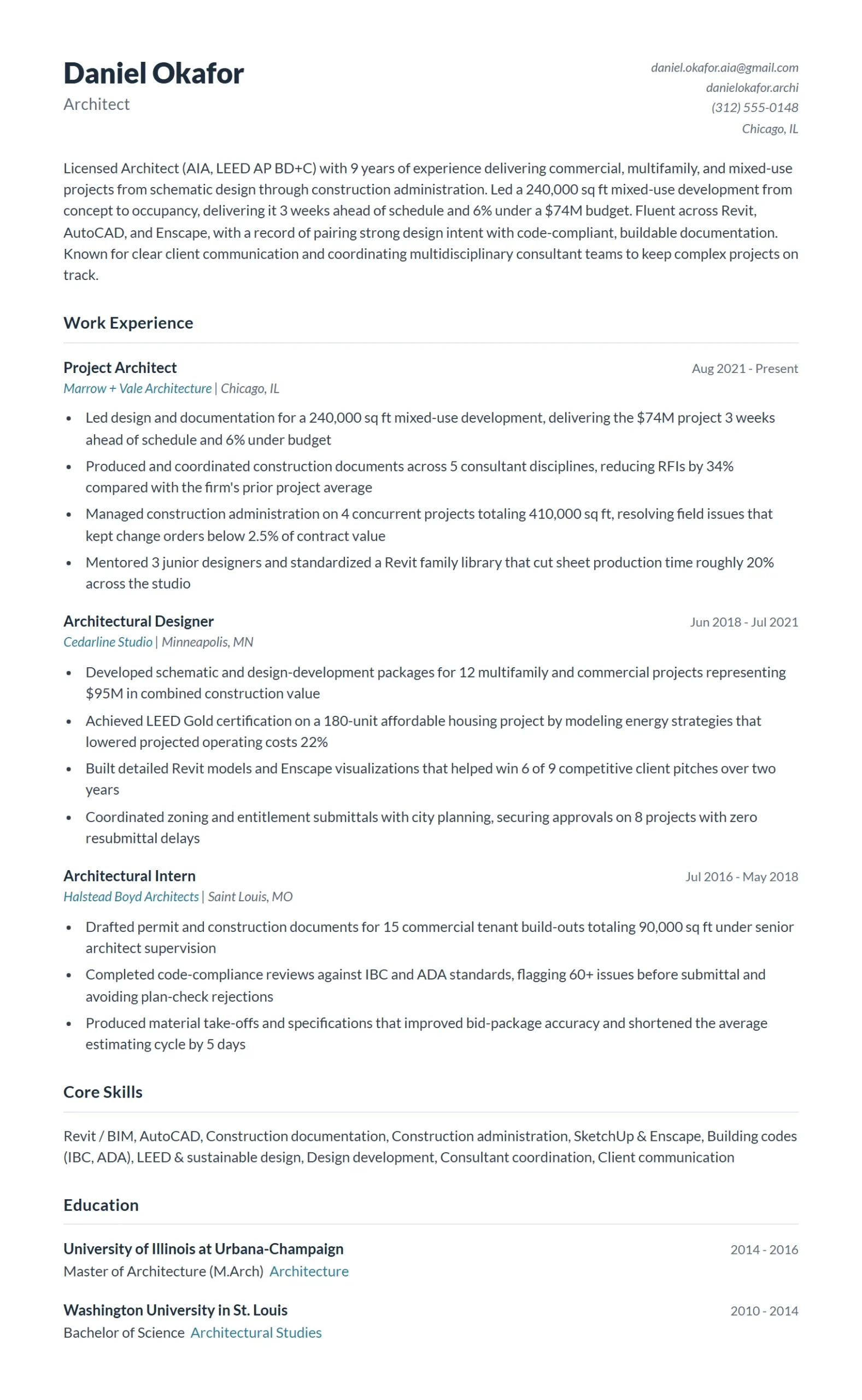
A broad template for any architecture professional, adaptable across roles from design to project leadership. Use it as the starting point, then tailor to the specific title you are targeting.
It leads with a focused summary that names your licensure status and core software, so recruiters and ATS catch your strongest signals in the first few lines. Project entries pair design contributions with hard numbers on scope, budget, and timeline, which turns a portfolio narrative into measurable proof of delivery.
Architect resume example
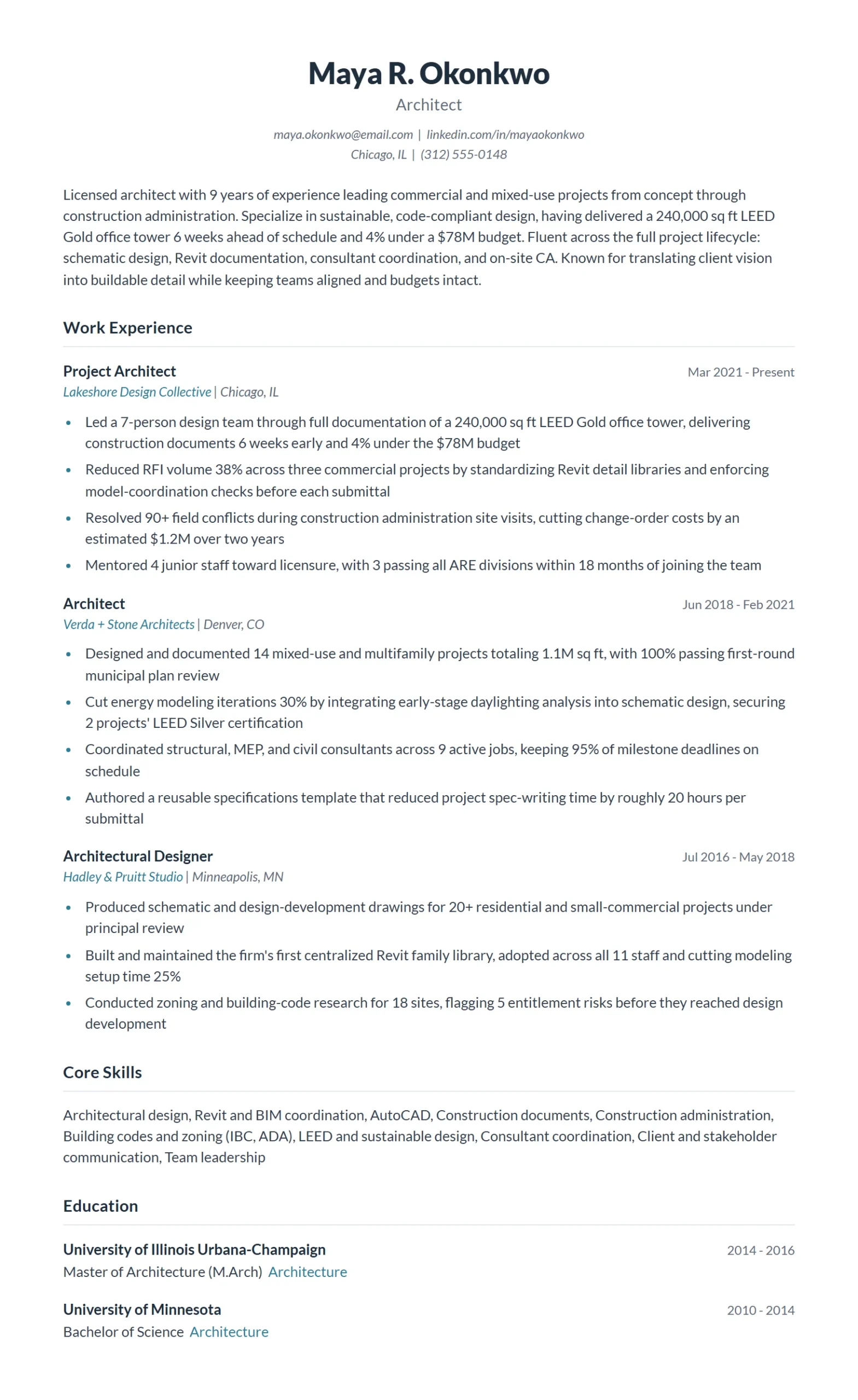
Built for licensed architects who own design and project delivery end to end. It centers your stamp, your firm experience, and the buildings you have brought to completion.
This version foregrounds licensure (state registration, NCARB) right under your name, the first thing a firm verifies. Each project bullet ties a design decision to an outcome (delivered under budget, passed plan review on first submission) so you read as someone who closes work, not just concepts.
Architectural Designer resume example
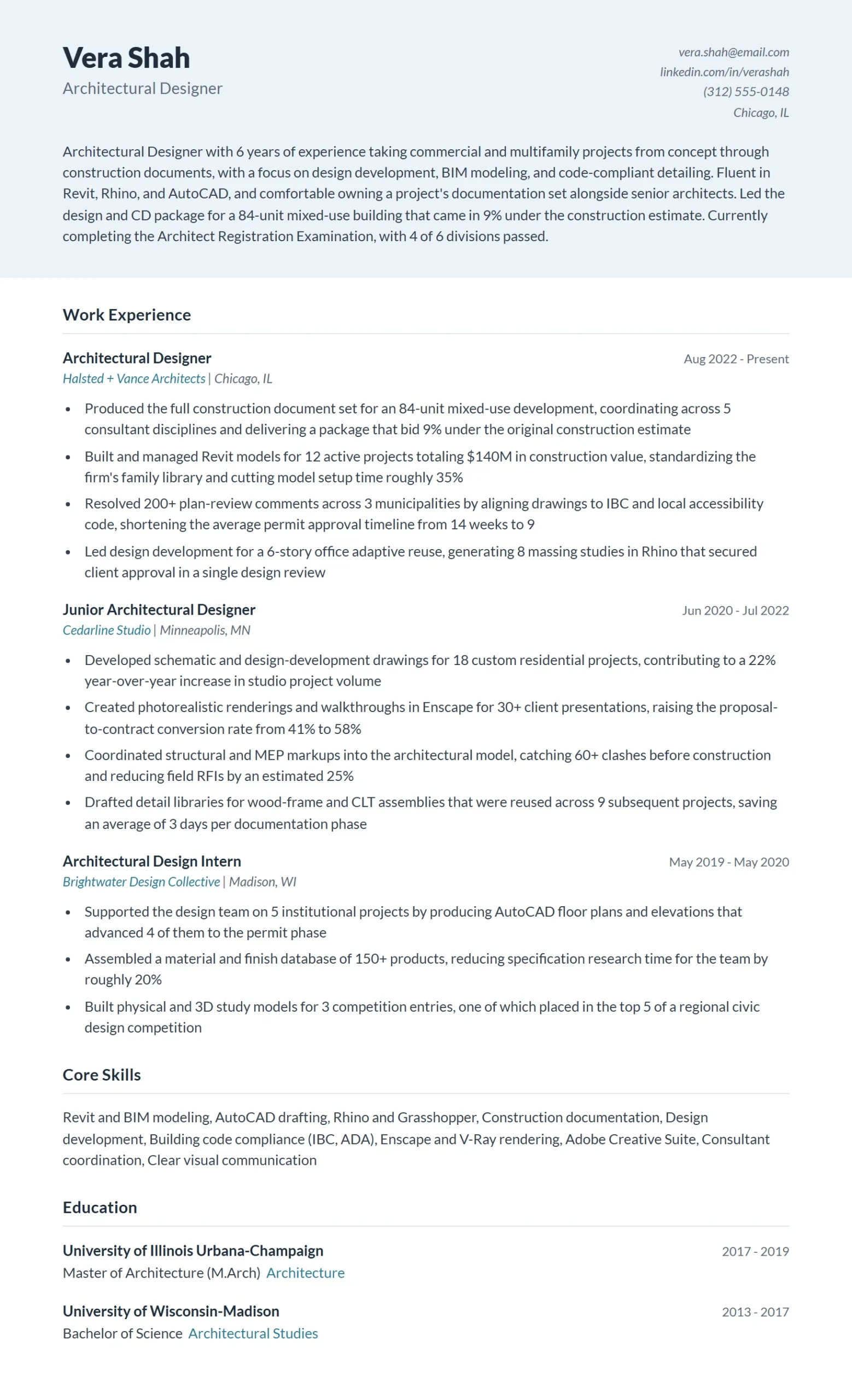
For design-focused professionals, often pre-license, who drive concepts, drawings, and models. It emphasizes design contribution and software depth over the stamp.
It puts software fluency (Revit, Rhino, Adobe Creative Suite) and design phases worked near the top, since that is what studios screen for at this level. Framing contributions as part of named project teams shows collaboration and real production output without overclaiming responsibility you did not hold.
Project Architect resume example
For the role that owns documentation, coordination, and construction administration on active projects. It proves you can run the technical and logistical core of a build.
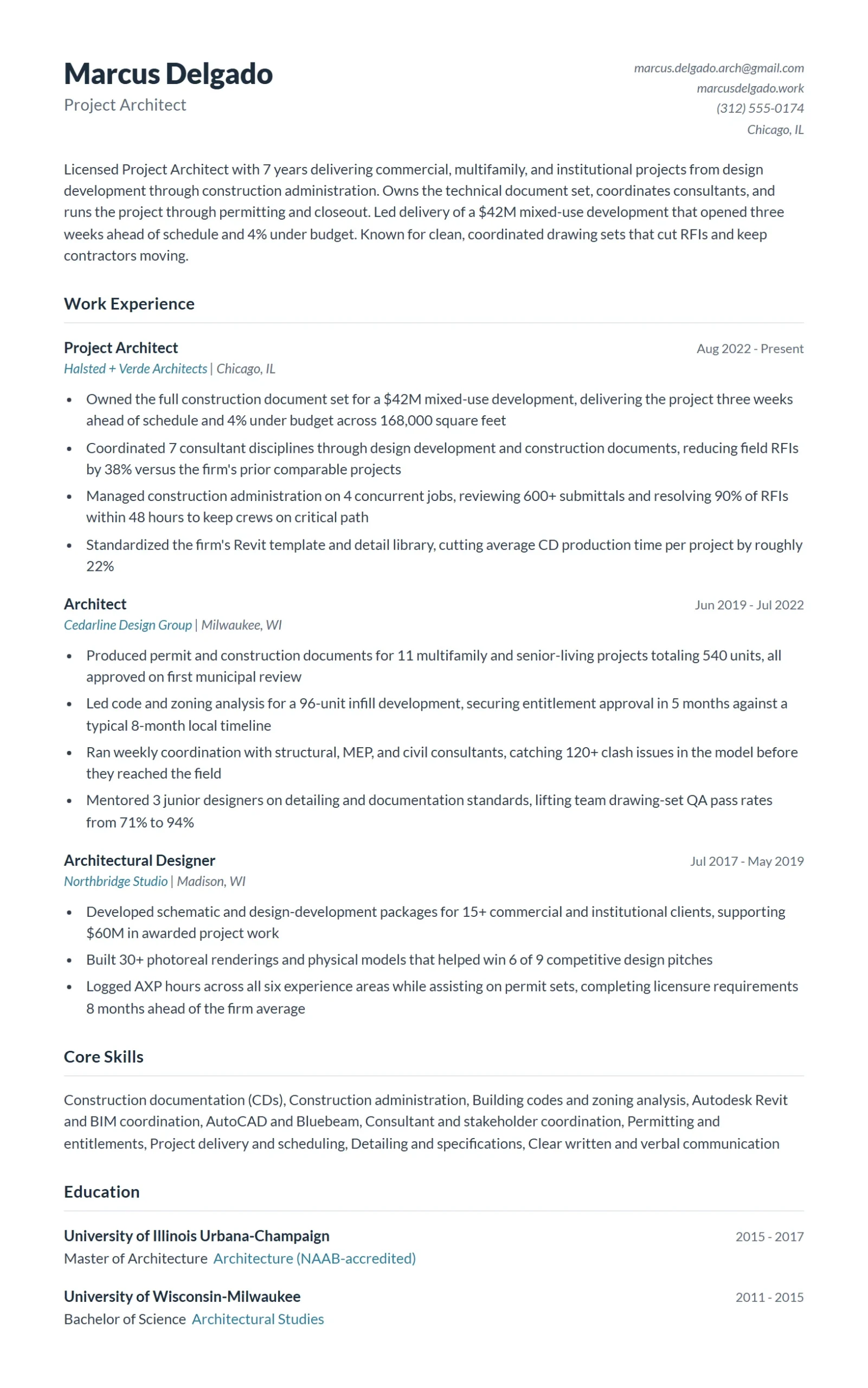
This resume leads with project delivery metrics: square footage managed, consultant teams coordinated, and CA phases completed. Highlighting code compliance and on-time, on-budget delivery signals the operational reliability firms need from the person holding a project together.
Intern Architect resume example
For early-career professionals logging AXP hours on the path to licensure. It makes limited experience read as momentum toward a stamp.
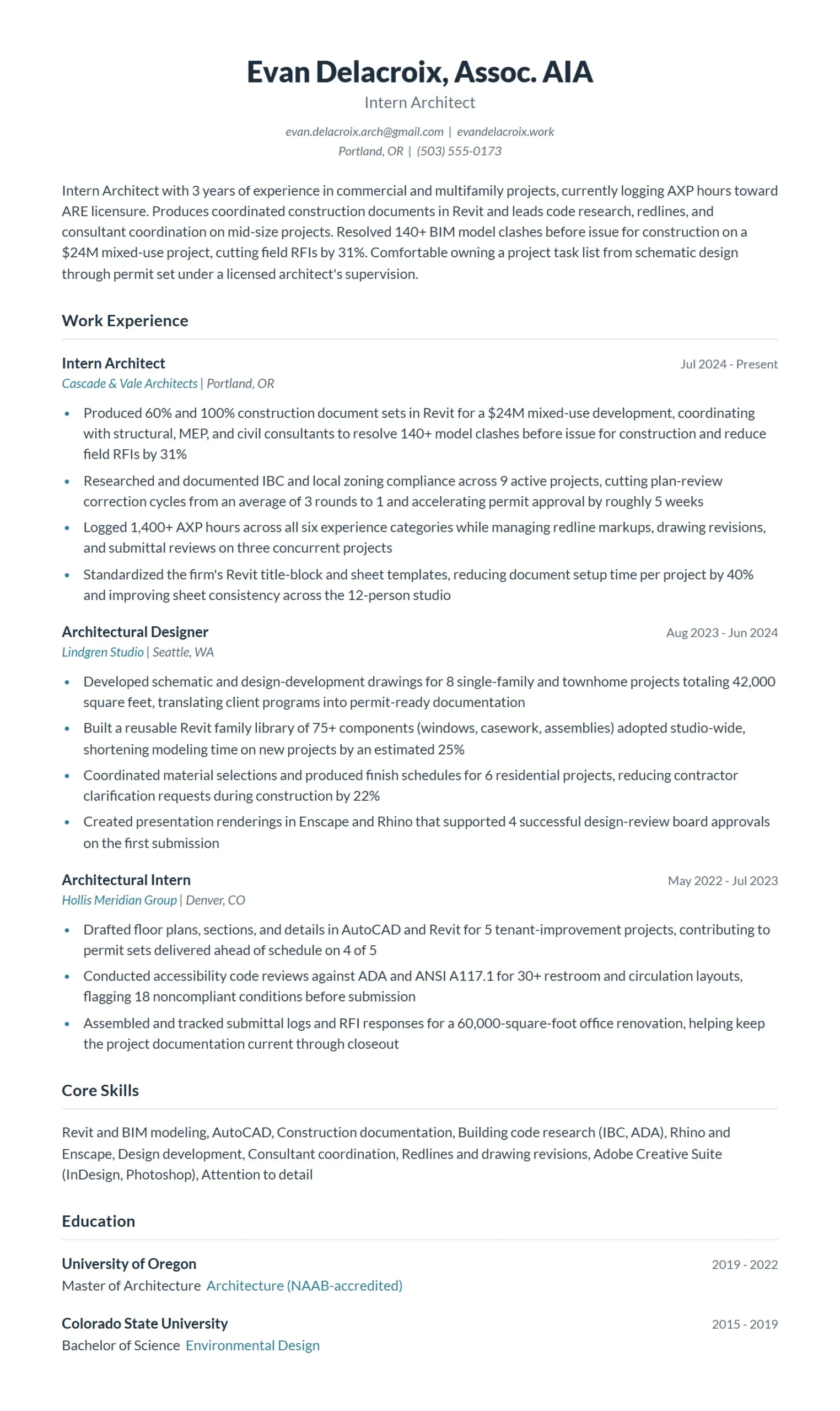
It states your degree, AXP progress, and exams passed up front, the markers firms use to gauge entry-level candidates. Studio projects, internships, and software skills are framed to show range and trajectory, so thin experience reads as a clear runway rather than a gap.
Landscape Architect resume example
For the separately licensed specialty spanning site design, grading, planting, and sustainability. It speaks the distinct language of landscape practice, not building architecture.

It surfaces LARE licensure and tools like Civil 3D, Land F/X, and GIS that hiring teams in this field look for specifically. Project bullets emphasize site planning, stormwater and sustainability outcomes, and acreage, which differentiates you from general architecture candidates and matches the niche keywords ATS screens for.
Senior Architect resume example
For experienced, licensed architects leading teams, clients, and full project portfolios. It shifts the emphasis from individual production to leadership and business impact.

This version leads with scope: teams managed, project values overseen, and clients retained or won. Pairing design leadership with revenue and delivery outcomes positions you for principal-track roles, where firms hire for judgment and accountability over raw drafting speed.
How to write an architecture resume that gets interviews
Hiring principals and design directors skim an architecture resume for proof you can take a project from concept through construction, not just produce pretty renderings. They want to see the project types you have delivered, the phases you have owned, the software you work in, and whether you are licensed or on the path. Most firms also run resumes through an Applicant Tracking System (ATS) first, so your language has to match the job posting before a human ever sees it. The tips below show you how to clear the ATS scan and convince the architect reading next.
- Lead with project types, scale, and your phase ownership: Architecture hiring is project-specific. A firm doing healthcare towers reads differently from one doing single-family residential. Name the sectors you have worked in (healthcare, K-12, multifamily, commercial, hospitality, civic), the scale (square footage, budget, number of units or stories), and which phases you owned: schematic design, design development, construction documents, or construction administration. “Produced full CD sets for a 240,000 SF mixed-use development” tells a hiring manager exactly where you fit on their team.
- State your license status and registration clearly: This is the first thing a principal looks for. If you are a licensed architect, put it up top: “Licensed Architect (RA), CA #C12345, NCARB certified.” If you are not yet licensed, be just as clear about where you are: “AXP complete, 4 of 6 ARE divisions passed.” Add LEED AP, WELL AP, or other credentials. Ambiguity here costs interviews because the firm cannot tell whether you can stamp drawings or need supervision.
- Quantify outcomes, not just deliverables: Anyone can say they worked on construction documents. Show the impact: “Coordinated a 180-sheet CD set across six consultants with zero major RFIs at bid,” “cut redline cycles 30% by standardizing the firm’s Revit detail library,” or “delivered a $42M project 3 weeks ahead of the construction schedule.” Tie your work to budget, schedule, square footage, RFI or change-order reduction, and approvals secured. Numbers separate you from the stack.
- Match software and methods to the job description: ATS scans for specific terms. List the tools you actually use (Revit, AutoCAD, Rhino, Grasshopper, SketchUp, Enscape, Lumion, BIM 360, Adobe Creative Suite) and the methods named in the posting (BIM coordination, construction documentation, code analysis, zoning review, sustainable design, LEED). If the role says “Revit” and you live in it daily, use that exact word, not “BIM software.” Skip tools you have not touched in years and never keyword-stuff.
- Show coordination across consultants and the construction team: Architecture does not happen in isolation. Firms want people who can run a project alongside structural, MEP, and civil engineers, manage contractors during CA, and keep clients aligned. Use bullets that name the coordination and the result: “Led weekly BIM coordination with structural and MEP consultants, resolving 200+ clashes before issuing for construction.” This signals you can carry a real project, not just model in a vacuum.
- Tailor each version and keep the format ATS-clean: A project architect role, a junior designer role, and a sustainability-focused position reward different keywords and project highlights. Reorder your skills and swap your featured projects to mirror each posting. Then keep parsing clean: standard section headings (Experience, Skills, Education, Registration), no text boxes or multi-column layouts that scramble the scan, and selectable text rather than an InDesign image. Run it through Jobscan to check your match rate against the job description before you apply.

Architecture resume summary examples
Your summary is the first thing a recruiter reads. Lead with your specialty, years of experience, and a quantified win.
Good architecture resume summary examples
- Licensed Architect (RA, NY) with 9 years delivering healthcare and higher-education projects from schematic design through construction administration. Led CD production on a $68M, 210,000 SF hospital expansion delivered on budget and 4 weeks ahead of schedule. Expert in Revit and BIM coordination, with a track record of resolving clashes early and keeping multi-consultant teams aligned.
- Project Architect specializing in multifamily and mixed-use development, with 7 years owning projects across all phases for 300+ unit communities. Cut construction-administration RFIs 35% by tightening detail standards and consultant coordination. LEED AP BD+C, fluent in Revit, AutoCAD, and Enscape, and experienced presenting to planning boards and securing entitlements.
- Architectural Designer with 4 years in commercial and hospitality projects, focused on design development and construction documentation. Produced a 140-sheet CD set for a $30M boutique hotel and built the studio’s reusable Revit family library, cutting documentation time roughly 25%. AXP complete and 5 of 6 ARE divisions passed.
What to avoid
- Creative and detail-oriented architect looking for an exciting opportunity to design beautiful buildings with a passionate, forward-thinking firm. (It is all about what the candidate wants, not what they deliver. There is no project type, no scale, no license status, no software, and zero evidence of impact. A principal learns nothing they can act on, and the ATS finds no keywords to match.)
- Passionate designer with a love for architecture and a strong eye for aesthetics who is a fast learner and hard worker. (Pure adjectives with no proof. It names no phases owned, no project sectors, no tools like Revit, and no measurable result. It does not even say whether the person is licensed, so it reads as filler the recruiter and the ATS both skip.)
Architecture resume skills
Pull the exact software and project types from each job description, then mirror that language here, and list your registration status separately so it is easy to spot. This is a quick resume snapshot, so keep it to your strongest, role-relevant skills rather than an exhaustive list (a dedicated skills page covers the full breakdown).
Hard skills for a architecture resume
- Revit
- AutoCAD
- Construction Documentation
- BIM Coordination
- Design Development
- Construction Administration
- Building Code & Zoning Analysis
- Rhino / Grasshopper
- SketchUp & Enscape
- Sustainable Design (LEED)
Soft skills for a architecture resume
- Cross-Disciplinary Coordination
- Client & Stakeholder Communication
- Attention to Detail
- Problem Solving
- Time & Deadline Management
- Team Collaboration
Architecture resume work experience bullet point examples
Lead each bullet with a strong verb and a measurable result.
Good bullet point examples
- Produced and coordinated a 180-sheet construction document set for a $42M, 220,000 SF mixed-use development, issued for bid with zero major RFIs at award.
- Led BIM coordination in Revit across structural, MEP, and civil consultants, resolving 240+ clashes before the construction issue and avoiding an estimated $300K in field rework.
- Managed construction administration on a $28M K-12 school, reviewing 600+ submittals and 320 RFIs and keeping the project on schedule through substantial completion.
- Ran code and zoning analysis for a 14-story residential tower, securing planning-board approval on the first submission and shortening the entitlement timeline by 2 months.
Bad bullet point examples
- Worked on construction documents and drawings for various projects in Revit. (Lists a task with no outcome. “Various projects” is vague, and there is no scale, no project type, and no result. It tells the reader you touched a tool but not whether your work moved a project forward.)
- Responsible for assisting senior architects with design and coordination tasks. (“Responsible for assisting” describes a job title, not an accomplishment. It shows no specific action, no project, and no measurable impact. Lead with a strong verb (Produced, Coordinated, Led, Managed) and end with a result instead.)
- Helped make the building design look better and function well for the client. (Subjective and unquantified. “Look better” and “function well” are opinions with no proof. Replace them with the concrete outcome, such as square footage delivered, approvals secured, schedule met, or RFIs reduced.)
Architecture resume tips
A sharp architecture resume proves you deliver buildings, not just designs, and these six tips help yours pass the ATS scan and impress the hiring principal.
- Mirror Job Posting Keywords: Copy exact terms from the posting, such as “Construction Administration,” “BIM Coordination,” or “Design Development,” because ATS filters score your resume against those precise strings before any human reviews it.
- Quantify Project Impact: Anchor every major project bullet to a number: square footage, construction cost, number of consultants coordinated, or weeks a schedule was compressed, because metrics give hiring principals instant proof of your project scale and scope.
- List License and Exam Status: State your AXP hours completed, exams passed, or your full licensure and NCARB certification clearly near the top, since many firms filter candidates by licensure path before reading further.
- Name Software Versions Specifically: Write “Revit 2024” and “Rhino 7 with Grasshopper” rather than just listing software, because project managers want to know you can open their active files without a retraining delay.
- Separate Project Types Clearly: Group or label experience by sector (healthcare, civic, multifamily) somewhere in each bullet, because firms that specialize in one typology use sector keywords as a fast filter inside ATS and during manual review.
- Keep Length to Two Pages Maximum: Architecture resumes grow long because projects deserve context, but hiring principals at busy firms expect one page for under five years of experience and a strict two pages beyond that, so cut rendering descriptions and keep phase ownership front and center.
Pair your architecture resume with a cover letter
A strong resume goes further with a tailored cover letter. Browse our architecture cover letter examples to round out your application.
Architecture resume frequently asked questions
You need both, and they do different jobs. The resume gets you past the ATS and a recruiter’s first scan by summarizing your experience, software skills, and project outcomes, while the portfolio proves your design ability through actual drawings and built work. Add your portfolio URL in the header next to your email and license info so it is easy to find, and keep the resume focused on impact rather than trying to show the work itself.
Lead with the software and standards firms actually screen for: Revit, AutoCAD, SketchUp, Rhino, and Adobe Creative Suite, plus BIM coordination if you have it. Add domain knowledge like building codes, zoning, construction documents, ZBA submittals, and sustainability credentials such as LEED. Match the exact tools and terms named in the job posting, because an ATS often scans for those specific words before a human ever reads your resume.
Use the title that fits where you are, such as Architectural Designer, Designer, or Job Captain, and state your licensure progress directly. List how many ARE divisions you have passed and your expected completion date so employers can plan around it. Then let your project bullets carry the weight by describing the phases you owned, the drawing sets you produced, and the buildings that got permitted or built.
Yes, naming concrete projects is one of the strongest moves you can make, since architecture hiring is driven by the type and scale of work you have done. For each role, reference a few signature projects with details that signal scope: building type, square footage, budget, and the phase you handled from schematic design through construction administration. This tells a healthcare or multifamily firm at a glance whether your background matches their pipeline.
Translate your work into numbers a hiring manager cares about: project budgets, square footage, number of units, schedule or cost savings, and how many projects you ran at once. For example, “Led construction documents for a $24M, 180-unit mixed-use development, coordinating six consultants and cutting RFI turnaround by 30 percent.” If you do not have hard metrics, use scale and outcomes instead, like permits secured, projects delivered on schedule, or design competitions won.
One page is standard for most architects with under 10 years of experience, and a focused page often beats a padded two-pager. Senior architects, principals, and academics with a long record of significant projects can justify two pages. Use the extra room for the projects most relevant to the role you want, and cut older or repetitive entries rather than listing every building you ever touched.