Best Process Engineer Resume Examples for 2026
Process engineer resume examples for 2026 across manufacturing and chemical roles, showing how to quantify yield, throughput, and the lean and Six Sigma keywords ATS scans for.



A process engineer keeps production running better, faster, and cheaper. You design and refine the steps that turn raw inputs into finished product, hunt down waste and defects, and prove out improvements with data. The role spans industries, from discrete manufacturing and automotive to chemicals, pharma, and food, but the core is the same: make the process more efficient, more reliable, and more repeatable.
Hiring managers read a process engineer resume looking for measurable impact, not job duties. They want to see yield gains, cycle-time cuts, scrap reduction, and dollars saved, backed by the methods you used to get there: lean, Six Sigma, DOE, root-cause analysis, SPC, and CAPA. Before a human reads it, an applicant tracking system scans for those exact terms plus tools like Minitab, AutoCAD, and PLC or SCADA systems. Skip the keywords and your resume can be filtered out before anyone sees your wins.
The examples below show how to do both at once: lead with quantified results and weave in the technical keywords that get you past the filter. Whether you are writing your first resume out of school or stepping up to lead a team, you can borrow the structure, sharpen the numbers, and tailor it to the role you want.
Ready to build yours? Try our ATS-friendly resume builder or scan your draft against the job description.
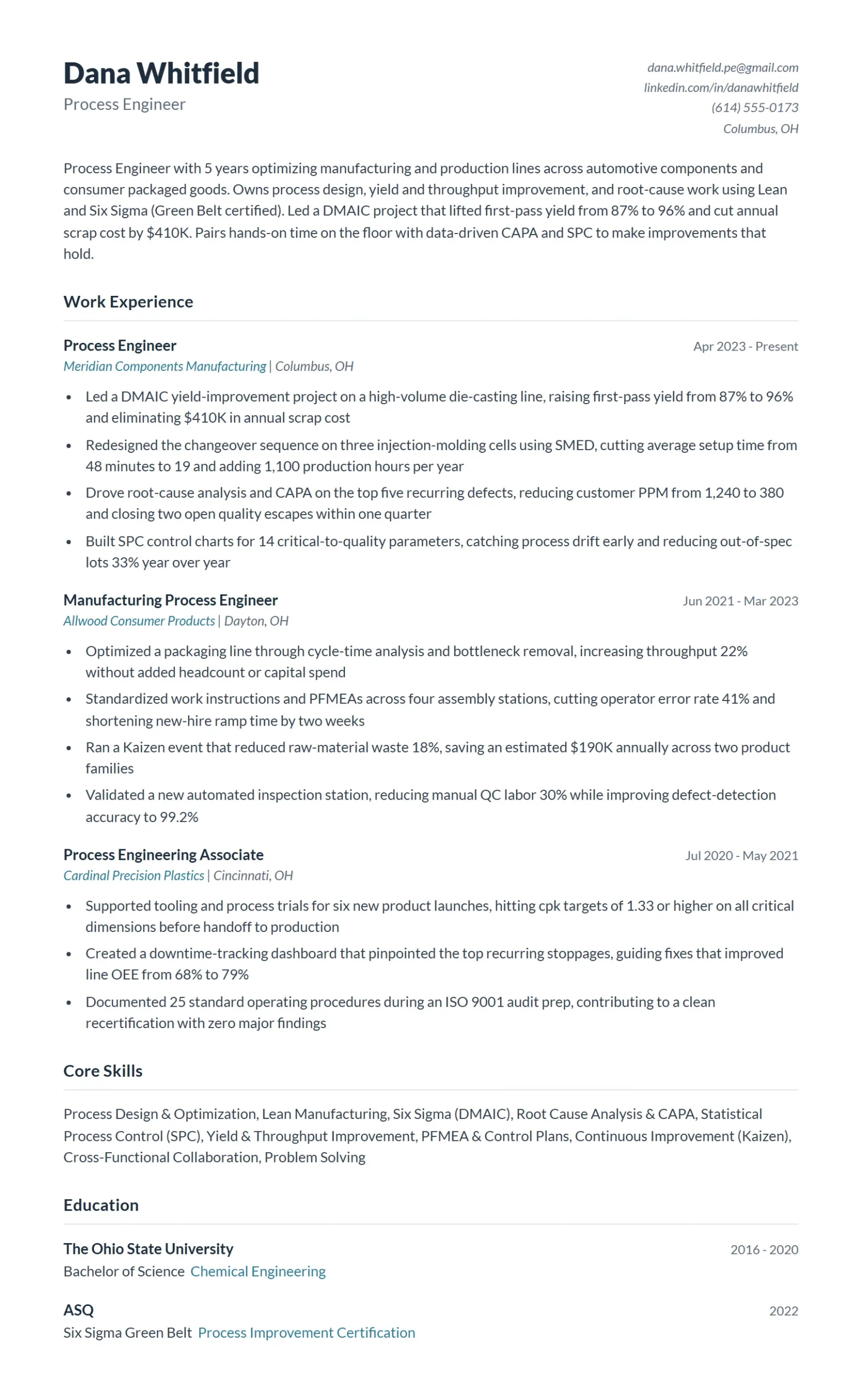
Process Engineer resume example
A mid-level process engineer in a manufacturing plant who owns process design, optimization, and continuous-improvement projects on the production floor.
This resume works because every bullet pairs a method with a measured result, like a DOE that lifted first-pass yield from 88% to 96% or a lean project that cut changeover time 40%. It names the tools recruiters and ATS search for (Minitab, SPC, CAPA, AutoCAD) without burying them in a wall of jargon. The summary frames the candidate as someone who improves processes and proves it, which is exactly the signal a hiring manager scans for first.
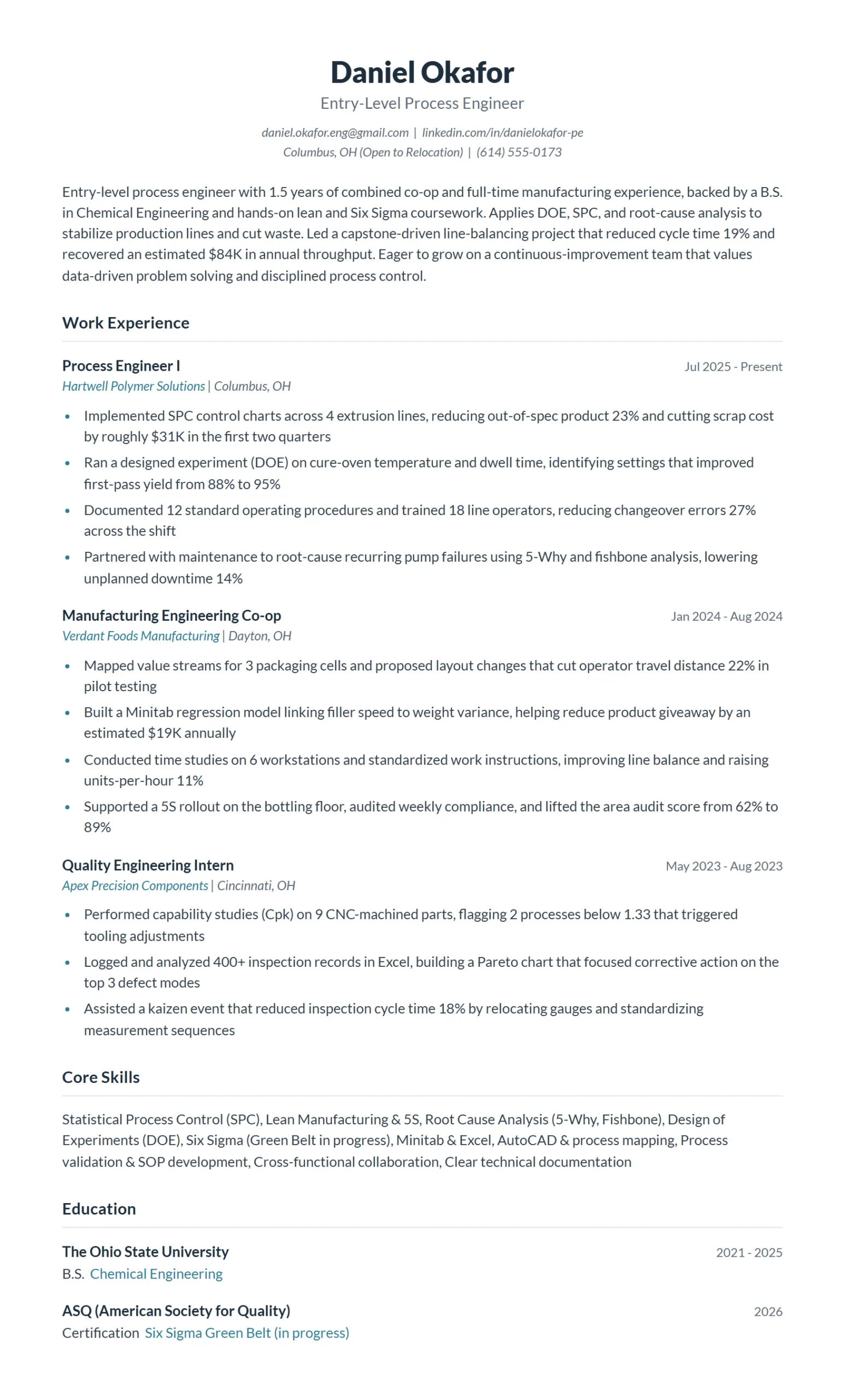
Entry-Level Process Engineer resume example
A recent engineering graduate with internship or co-op experience applying for a first full-time process engineering role.
With limited work history, this resume leans on a capstone project, a manufacturing internship, and relevant coursework to show applied skill rather than just a degree. It quantifies even early wins, such as an internship project that reduced material waste 12%, so the candidate reads as results-minded from day one. Foundational keywords like lean manufacturing, root-cause analysis, and SolidWorks signal readiness without overstating experience.
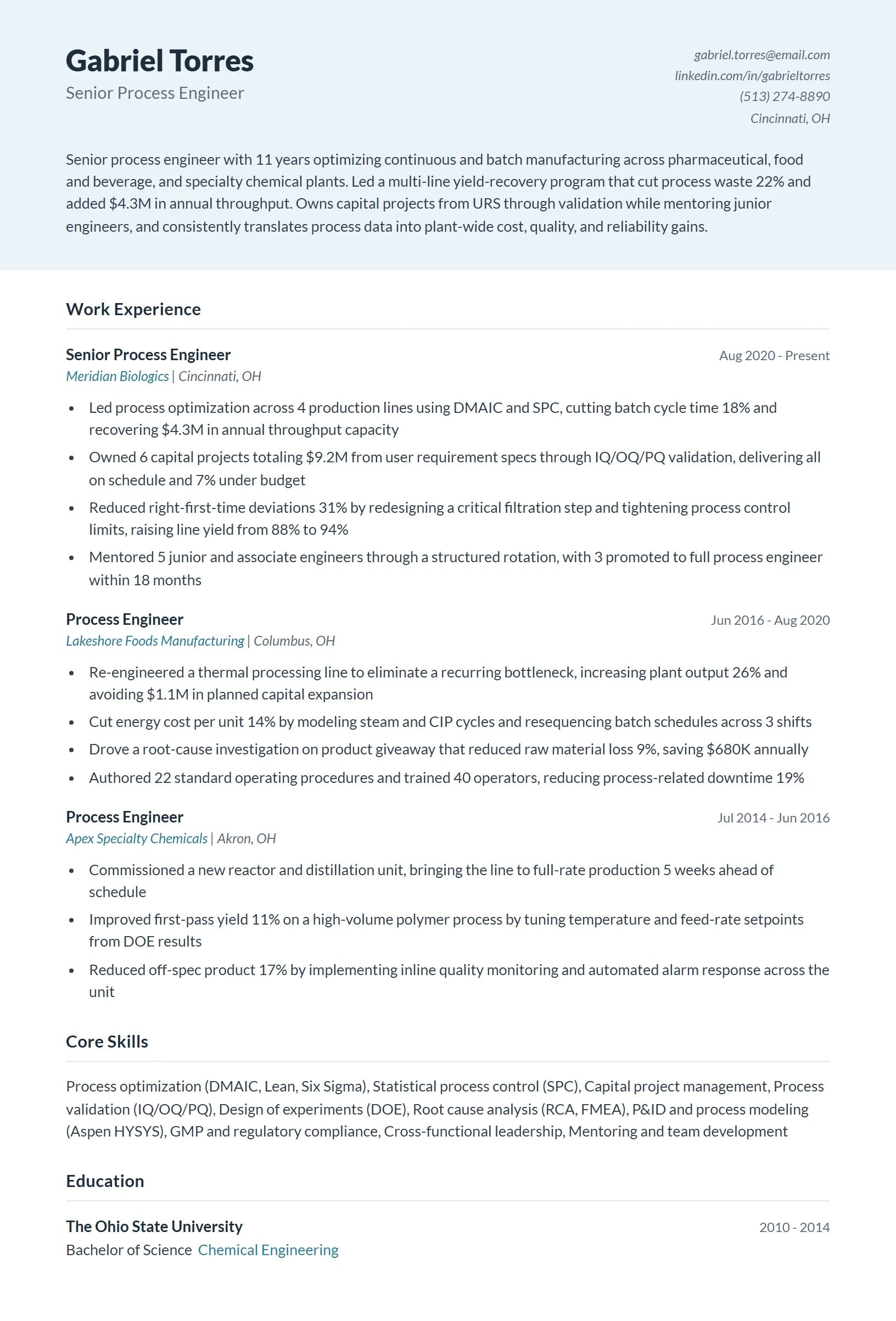
Senior Process Engineer resume example
A senior individual contributor who leads cross-line improvement programs, owns capital and validation projects, and mentors junior engineers.
The bullets here scale from single-line fixes to plant-wide impact, like leading a $2.1M line upgrade that raised OEE 18 points across three production lines. It shows leadership without a manager title by highlighting mentoring, validation ownership, and cross-functional influence. Advanced keywords like Six Sigma Black Belt, process validation, and CAPEX justify the seniority and clear ATS filters tuned for higher-level roles.
Manufacturing Process Engineer resume example
A specialist focused on discrete and assembly manufacturing: line balancing, tooling, OEE, and production ramp.
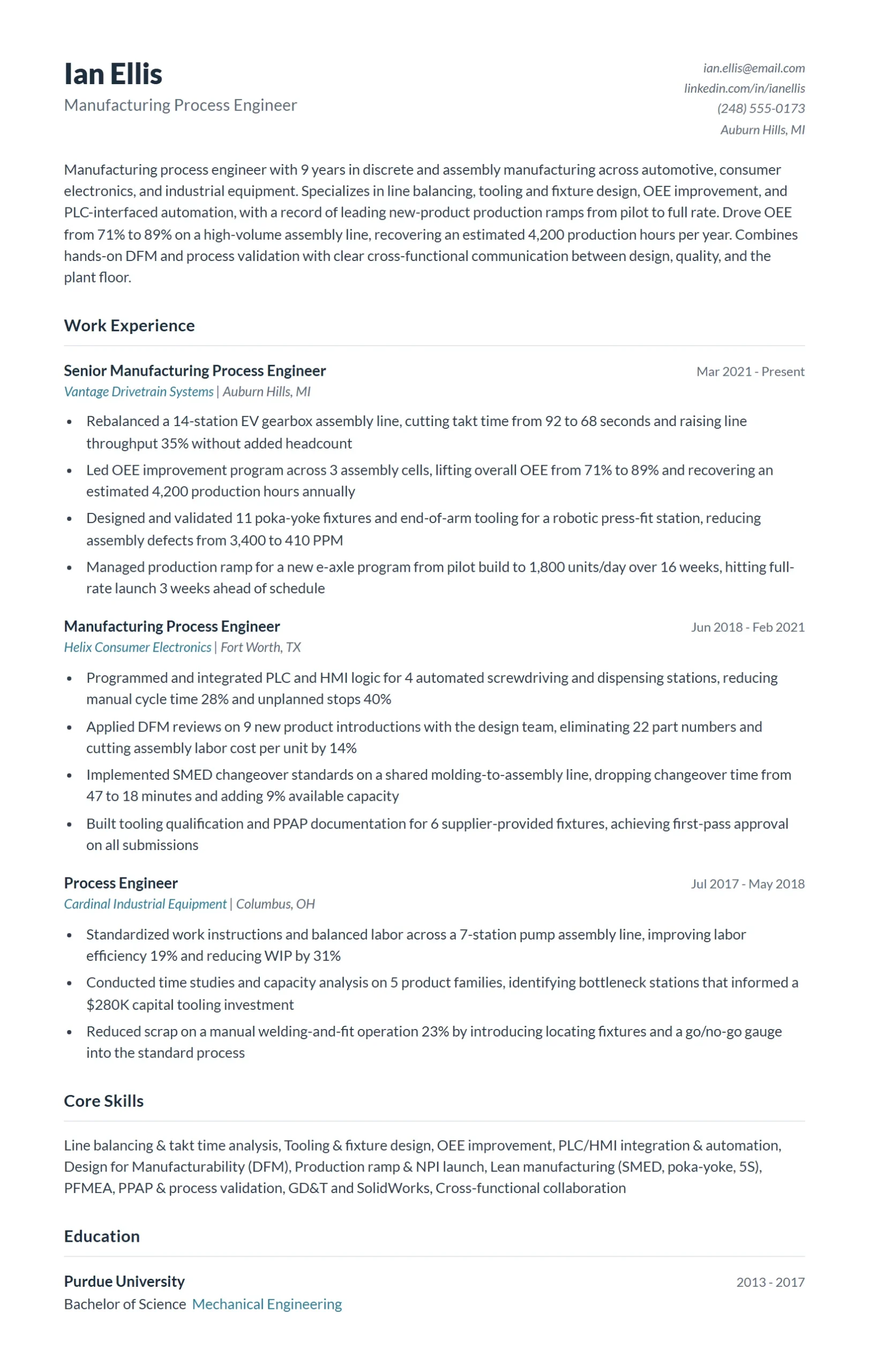
This version sharpens the generalist resume toward the shop floor, foregrounding line balancing, fixture and tooling design, and OEE gains that operations leaders care about most. A standout bullet might tie a DFM redesign to a 25% drop in assembly defects, connecting engineering choices to throughput. Keywords like OEE, automation, PLC, and design for manufacturability target the exact filters a manufacturing employer uses.
Chemical Process Engineer resume example
A process-industry specialist in chemicals, refining, pharma, or food and beverage who works with unit operations, P&IDs, and process safety.

This resume speaks the language of continuous process: mass and energy balances, unit-operation optimization, and P&ID development, each tied to a result like a 9% reduction in energy cost per unit. It puts process safety front and center with PSM and HAZOP experience, which is non-negotiable in this field and a key ATS term. The technical specificity signals genuine domain depth rather than a generic engineering background.
Process Engineering Manager resume example
A people-leader who manages a process engineering team, owns the improvement roadmap and budget, and reports results to operations leadership.

The focus shifts from personal task completion to team and business outcomes, such as leading a 6-engineer team that delivered $4.3M in annualized savings across a fiscal year. It balances leadership signals (hiring, roadmap ownership, budget) with retained technical credibility so the candidate reads as an engineer who can lead, not just a manager. Keywords like continuous improvement program, team leadership, and KPI ownership match what executives and ATS look for in management roles.
How to write a Process Engineer resume that gets interviews
Process engineering is a results discipline, so your resume should read like a record of measurable improvements, not a list of duties. Hiring managers scan for the metrics that define the job: yield, throughput, scrap and defect rates, OEE, cycle time, cost per unit, and the methodologies you used to move them. Make those numbers easy to find, tie every project to a business outcome, and mirror the exact tools and standards named in the job posting so you clear the ATS and impress the engineer who reads you next.
- Quantify every process improvement: Lead with the result, not the task. “Reduced line scrap from 6.2% to 1.8%” or “increased OEE from 71% to 89%” tells a manager more than “responsible for process optimization.” Pull real numbers from your yield reports, OEE dashboards, and cost-savings tracking. If you cannot find an exact figure, use a defensible estimate and label it as such.
- Name your methodologies and certifications by name: ATS filters and reviewers look for specific terms. Spell out Six Sigma (and your belt: Green Belt, Black Belt), Lean Manufacturing, DMAIC, Kaizen, 5S, SPC, FMEA, DOE, and root cause analysis. List your PE license or EIT/FE status if you have it. Match the phrasing in the posting: if they write “continuous improvement,” use that exact phrase rather than a synonym.
- Show the full project arc, not just the fix: Strong process engineers diagnose, test, implement, and validate. Structure key bullets to show that loop: identified the bottleneck, ran the analysis (DOE, capability study, time study), implemented the change, and sustained the gain. This signals you can own a problem end to end, which is what separates a senior candidate from a junior one.
- Specify your industry, equipment, and software: A process engineer in semiconductor fab is not interchangeable with one in food and beverage or pharma. Name your sector, your equipment (CNC, injection molding, distillation columns, PLCs), your standards (GMP, ISO 9001, IATF 16949, cGMP), and your tools (Minitab, AutoCAD, SolidWorks, Aspen HYSYS, MES, SCADA). Specificity here is what makes you findable and credible.
- Include a technical skills section the ATS can parse: Group skills into clear buckets: methodologies, software, equipment, and standards. Use plain text, not graphics or skill bars, because applicant tracking systems cannot read images. Pull the exact keywords from the job description and place them where they read naturally, in both your skills section and your bullets.
- Tailor the resume to each posting before you apply: Two process engineering roles can use entirely different vocabulary for the same work. Scan each job description, identify its priority keywords (the methodology, the metric, the standard it leads with), and weave those into your summary and experience. A resume tuned to the posting clears the ATS match threshold and shows the hiring manager you understand their specific process.

Process Engineer resume summary examples
Your summary is the first thing a recruiter reads. Lead with your specialty, years of experience, and a quantified win.
Good process Engineer resume summary examples
- Six Sigma Black Belt process engineer with 8 years in high-volume automotive manufacturing. Led DMAIC projects that cut line scrap from 6.4% to 1.9% and improved OEE from 73% to 91%, delivering $2.3M in annualized savings. Expert in SPC, FMEA, and IATF 16949 compliance.
- Chemical process engineer with 6 years optimizing continuous and batch operations in cGMP pharmaceutical plants. Scaled a new API process from pilot to commercial production, raising yield 22% while maintaining 100% FDA audit compliance. Skilled in Aspen HYSYS, DOE, and PHA/HAZOP.
- Lean-focused process engineer with 5 years in food and beverage manufacturing. Redesigned packaging line flow to lift throughput 31% and reduce changeover time from 45 to 18 minutes across 4 SKUs. Green Belt certified, fluent in Kaizen, 5S, and root cause analysis.
What to avoid
- Hardworking process engineer seeking a challenging role where I can apply my skills and grow with a dynamic company. (All filler and no evidence. It states ambition instead of results, names zero metrics, methodologies, or industry, and gives a hiring manager nothing to act on.)
- Process engineer with experience in manufacturing, process improvement, and problem solving in a fast-paced environment. (Generic and unquantified. “Process improvement” and “problem solving” describe the job category, not what this person actually achieved. No numbers, no tools, no specialty, so it reads like every other resume in the stack.)
Process Engineer resume skills
Show the methodologies, software, and standards a hiring manager scans for, then prove them in your bullets. For a deeper breakdown of process engineering skills and how to phrase them, see our dedicated skills guide.
Hard skills for a process Engineer resume
- Six Sigma (DMAIC, Green/Black Belt)
- Lean Manufacturing and Kaizen
- Statistical Process Control (SPC)
- Root Cause Analysis (5 Whys, fishbone)
- FMEA and process risk assessment
- Design of Experiments (DOE)
- Minitab and statistical analysis software
- CAD (AutoCAD, SolidWorks)
- Process simulation (Aspen HYSYS, MES, SCADA)
- Quality standards (ISO 9001, IATF 16949, cGMP, GMP)
Soft skills for a process Engineer resume
- Cross-functional collaboration
- Data-driven problem solving
- Clear technical communication
- Project ownership and follow-through
- Training and influencing floor teams
Process Engineer resume work experience bullet point examples
Lead each bullet with a strong verb and a measurable result.
Good bullet point examples
- Led a DMAIC project that reduced injection molding defect rate from 4.8% to 0.9%, eliminating $480K in annual scrap and rework
- Conducted design of experiments (DOE) in Minitab to optimize cure cycle, cutting cycle time 28% and increasing daily throughput by 1,400 units
- Implemented SPC monitoring across 12 CNC machining cells, raising first-pass yield from 88% to 97% and reducing customer PPM from 320 to 45
- Standardized work and rebalanced an assembly line using Lean and 5S, lifting OEE from 72% to 90% and recovering 6.5 hours of capacity per shift
Bad bullet point examples
- Responsible for improving manufacturing processes and reducing waste on the production floor (Describes a job duty, not an accomplishment. No metric, no method, no scale. “Responsible for” signals presence rather than impact and never tells the reader what changed.)
- Worked with the team on various process improvement projects and helped increase efficiency (Vague on every dimension. “Various projects” and “helped” hide your actual contribution, and “increase efficiency” without a number is unverifiable. A reviewer cannot tell what you did or how much it mattered.)
- Used Six Sigma to make the line run better and save the company money (Names the right methodology but wastes it. “Run better” and “save money” are placeholders for the exact figures (defect rate, yield, dollars) that would make the claim credible.)
Process Engineer resume tips
A strong Process Engineer resume turns your improvement projects into a compelling case for hire by putting the right numbers and keywords exactly where ATS scanners and hiring managers expect them.
- Mirror Job Posting Keywords: Copy the exact terminology from each job description, if the posting says ‘OEE’ and ‘DMAIC,’ use those precise strings rather than synonyms so your resume passes ATS keyword matching without manual review flagging.
- Lead With Process Metrics: Anchor every bullet to the numbers hiring managers in this field scan for first: yield percentage gains, scrap rate reductions, cycle time cuts, cost per unit savings, or throughput increases expressed as a specific value.
- Name Your Certifications Explicitly: Spell out Six Sigma Green Belt or Black Belt, Lean certifications, and any industry-specific credentials (IATF 16949, ISO 9001 auditor) in full because ATS systems parse certification names as exact-match strings.
- List Statistical Tools Precisely: Call out Minitab, JMP, or whichever SPC and DOE software you actually used by product name, since recruiters and ATS filters search for these tools specifically rather than the generic phrase ‘statistical software’.
- Separate Hard and Soft Skills: Place technical competencies (FMEA, 5 Whys, fishbone, SPC, CAD platforms) in a dedicated skills section so ATS parsers index them cleanly, and weave soft skills like cross-functional collaboration into bullet context rather than listing them as standalone terms.
- Quantify Kaizen Scope: For Lean and Kaizen projects, include both the scale (number of events led, team size, plant area affected) and the outcome, because process engineers who show they can drive change across a floor are ranked higher than those who list methodology names alone.
Pair your process Engineer resume with a cover letter
A strong resume goes further with a tailored cover letter. Browse our process engineer cover letter examples to round out your application.
Process Engineer resume frequently asked questions
List the process simulation and design tools you actually use (Aspen HYSYS, Aspen Plus, AutoCAD, SolidWorks, MATLAB) alongside core methods like P&ID development, mass and energy balances, HAZOP, and Six Sigma or Lean. Include the standards and systems relevant to your industry, such as GMP, OSHA PSM, ISO 9001, SPC, or DCS and PLC experience. Match the exact tools and methods named in the job posting, since those are often the precise terms an ATS scans for before a human ever reads the page.
Tie each bullet to a number that matters to operations: yield, throughput, cycle time, downtime, scrap rate, or cost. For example, “Redesigned a distillation control loop that increased throughput 14% and cut energy use $220K per year,” or “Led a Six Sigma project that reduced batch reject rate from 8% to 2%.” If you cannot share exact figures because of confidentiality, use percentages or ranges. Hiring managers want proof you improved a process, not just that you maintained one.
Yes, list it prominently if you have it. Put “PE” after your name in the header and add a Licenses and Certifications section noting the state and license number. If you have passed the FE exam, list yourself as an Engineer in Training (EIT) to show you are on the licensure track. Many process engineering roles do not require a PE, but it is a clear differentiator for senior, consulting, and client-facing positions, so make it easy to spot.
Reframe your floor experience as process knowledge, which is exactly what hiring managers value in a new engineer. Highlight where you improved a procedure, reduced waste, troubleshot equipment, or supported a project, and pair each with a result. Lead with your engineering degree and any simulation or data tools you have learned, then show how your hands-on time gives you practical insight most new grads lack. Mirror the target job’s language so the resume reads as an engineer who knows the plant, not an operator hoping to switch.
Pull keywords straight from the job description, then weave them naturally into your summary, skills, and bullets. Common ones include process optimization, P&ID, HAZOP, root cause analysis, continuous improvement, Lean Six Sigma, mass balance, scale-up, and the specific software and standards for your sector (Aspen, GMP, PSM, FDA, SPC). Use the exact phrasing the posting uses, for instance “process validation” rather than “validating processes.” Avoid keyword stuffing, then run your resume through Jobscan to confirm your match rate before you apply.
Use a reverse-chronological, single-column layout with standard headings (Summary, Skills, Experience, Education, Certifications), since it parses cleanly through an ATS and lets recruiters scan your career path fast. Keep it to one page early in your career and no more than two pages for senior roles. Skip text boxes, tables, and graphics that can scramble during parsing, and save the file as a text-based PDF or .docx. Put your strongest technical skills and a quantified summary near the top so your value is clear in the first few seconds.