Best Quality Engineer Resume Examples for 2026
Quality engineer resume examples for 2026, from entry-level to senior, showing how to prove root-cause, CAPA, and audit wins and the keywords ATS scans for.



A quality engineer keeps products and processes within spec: building inspection plans, running root-cause analysis, driving corrective actions, and holding the quality management system to standards like ISO 9001. Whether you sit on the manufacturing floor, in supplier quality, or over the systems side, the job is the same at its core. Find the defect, fix the cause, and prove it stays fixed.
Hiring managers read a quality engineer resume for evidence, not adjectives. They want defect rates you lowered, scrap and rework dollars you saved, audits you passed, and the methods you used to get there: SPC, Six Sigma, CAPA, FMEA, PPAP. The applicant tracking system reads it first, so the tools and standards from the job description (ISO 9001, GD&T, Minitab, 8D) need to appear in plain text, not buried in a graphic.
Use the examples below to see how strong quality engineers turn day-to-day inspection and improvement work into quantified results. Pick the version closest to your level and specialty, then make the numbers and standards your own.
Ready to build yours? Try our ATS-friendly resume builder or scan your draft against the job description.
Quality Engineer resume example
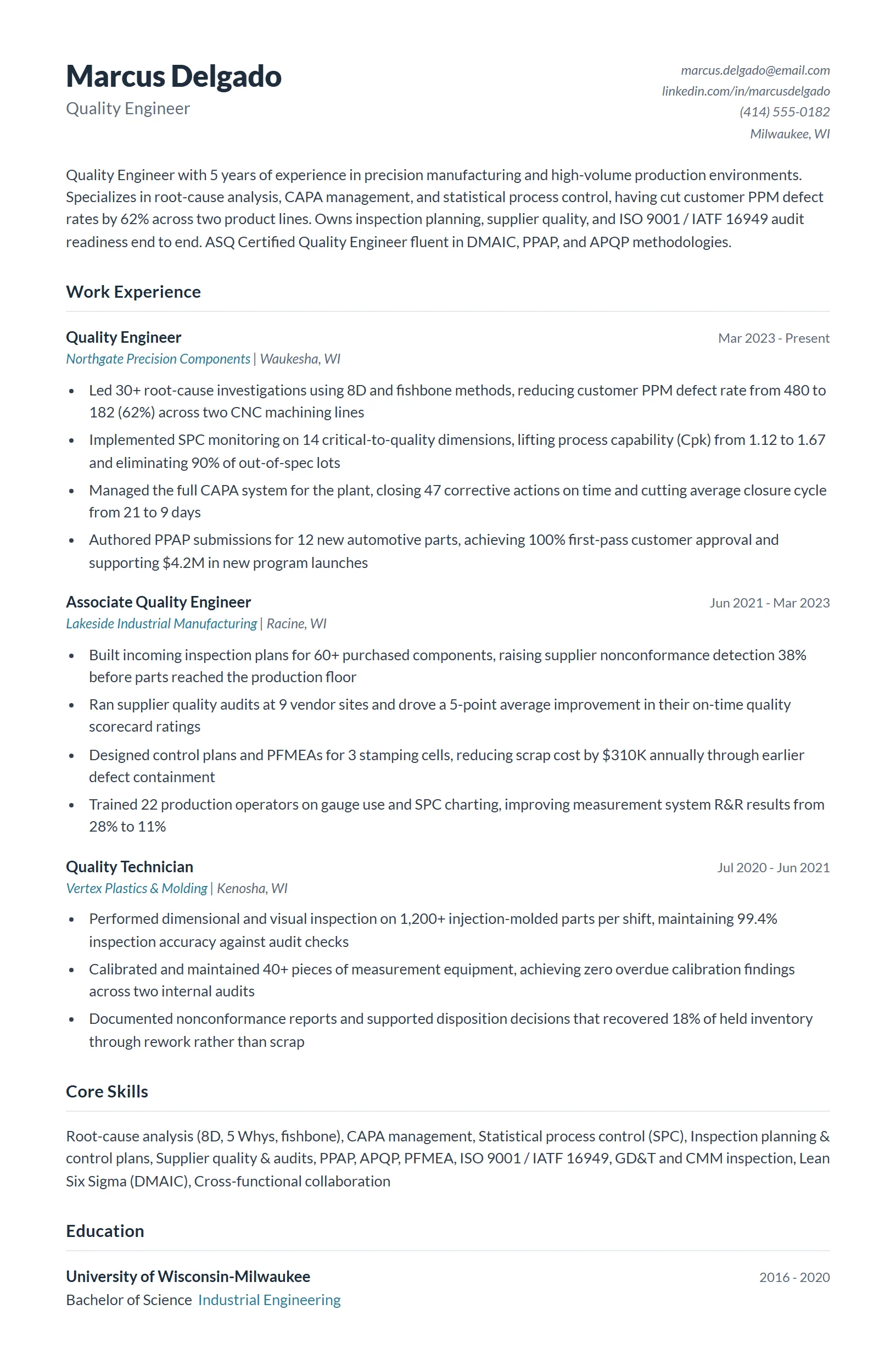
A mid-level manufacturing quality engineer with about five years of experience owning inspection plans, root-cause analysis, and supplier corrective actions in a production environment.
This resume works because every bullet pairs a quality method with a business outcome: an 8D investigation that cut a defect rate, an SPC rollout that reduced scrap dollars, a supplier corrective action that lifted first-pass yield. It leads with the standards and tools an ATS screens for (ISO 9001, FMEA, CAPA, GD&T) without keyword stuffing. The result reads like an engineer who finds causes, not just catches defects.
Senior Quality Engineer resume example
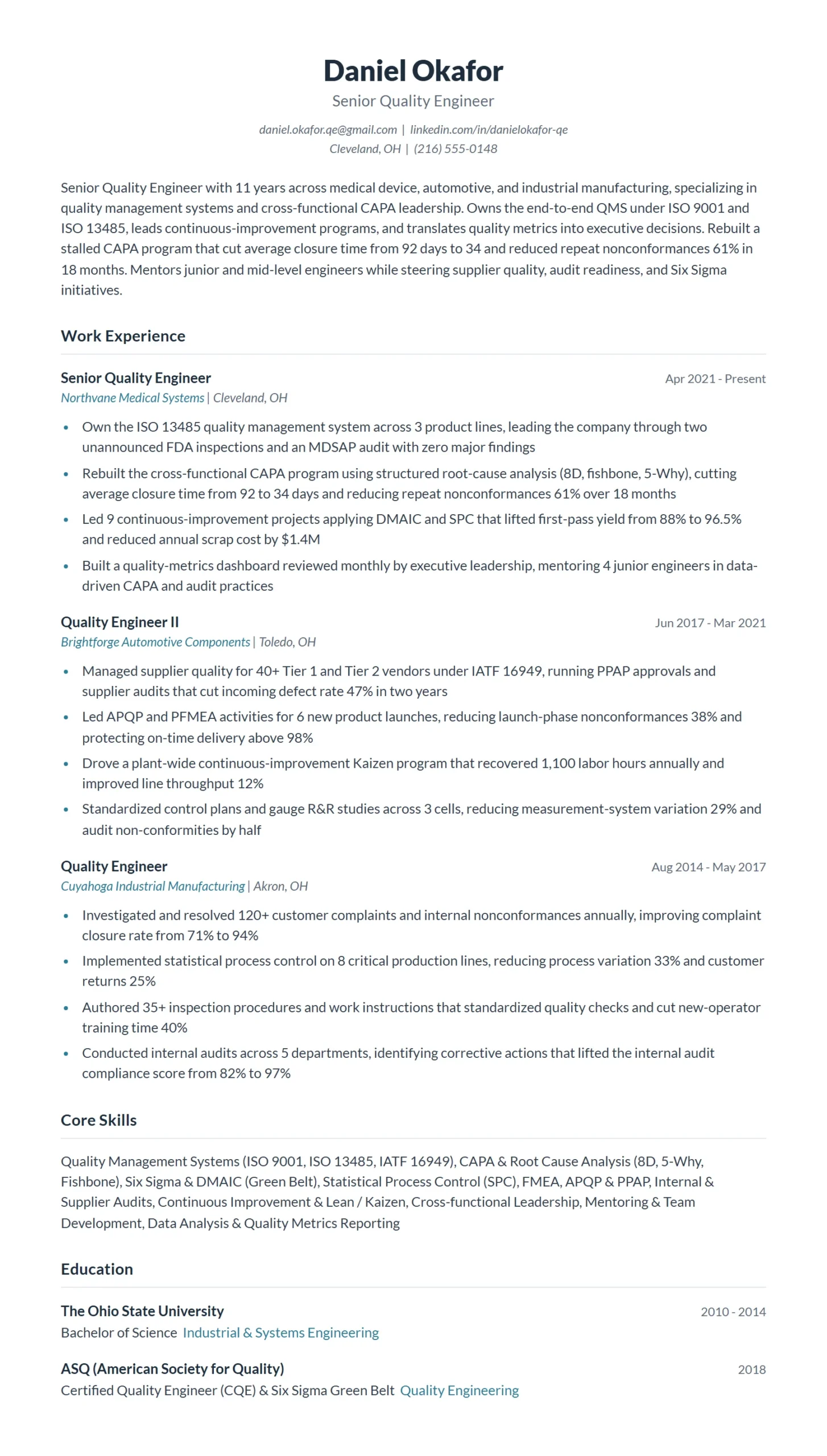
A senior quality engineer with roughly a decade of experience who owns the quality management system, leads cross-functional CAPA programs, and runs internal and customer audits.
The summary frames scope and ownership immediately: site-level QMS, audit readiness, and continuous-improvement programs rather than individual inspections. Bullets quantify leadership leverage (audit pass rates, cost-of-quality reduction, mentoring outcomes) so the seniority is proven, not just claimed. It signals someone ready to own quality strategy for a plant or product line.
Entry-Level Quality Engineer resume example
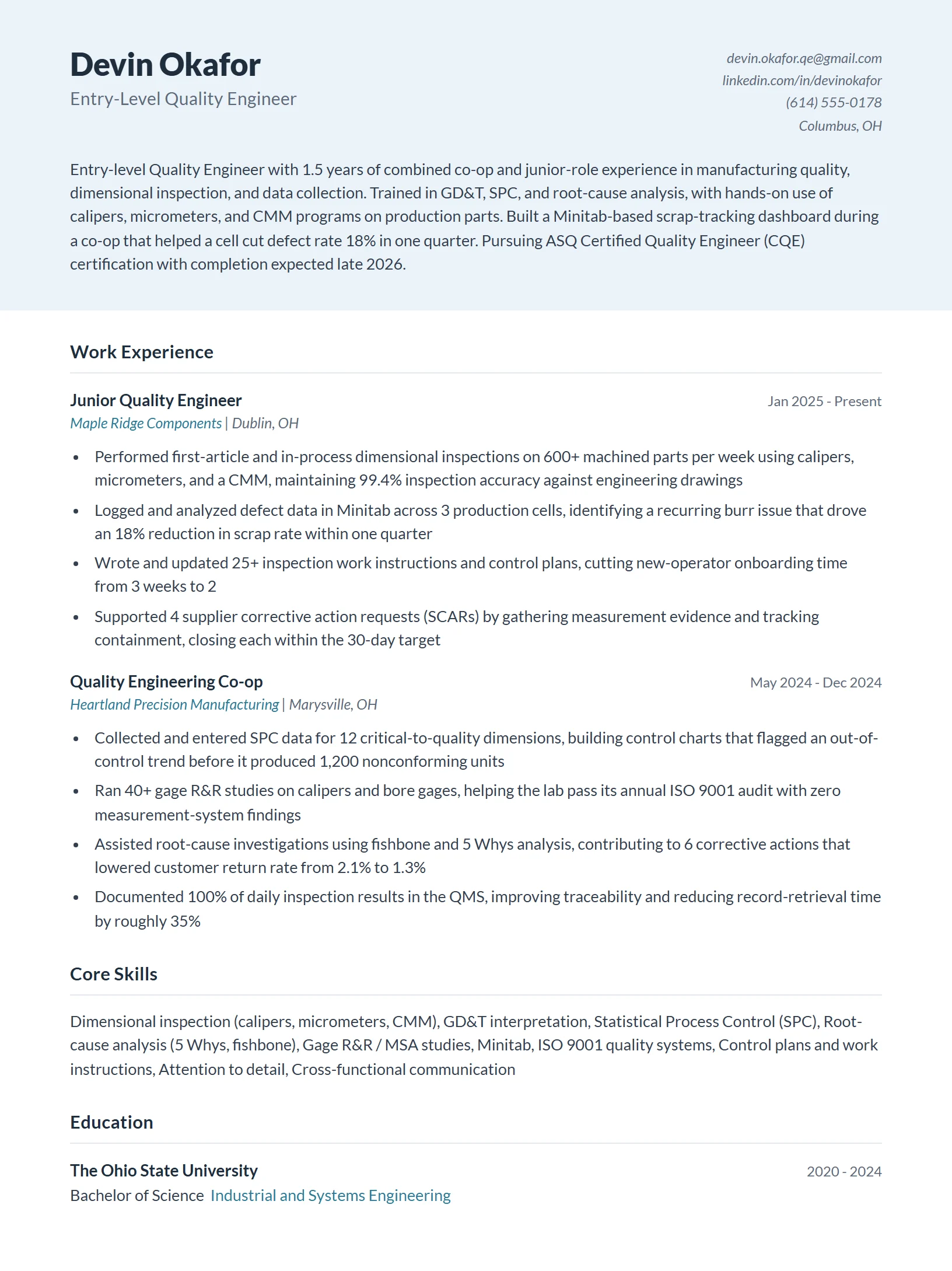
An early-career candidate with an engineering degree plus an internship or co-op, applying for a first full-time quality engineering role.
With limited experience, this resume leans on a quantified internship project, relevant coursework, and certifications in progress (Six Sigma Green Belt, ASQ CQE) to show readiness. It highlights hands-on work that hiring managers value early: data collection, inspection support, and a measurable improvement from a capstone or co-op. The format keeps education and projects high so thin work history never reads as a gap.
Quality Assurance Engineer resume example
A quality engineer on the systems and process side, focused on QMS maintenance, ISO 9001 compliance, process validation, and audit readiness.

This version foregrounds the documentation and process discipline that QA roles hire for: validation protocols, nonconformance tracking, and audit findings closed on time. It separates itself from inspection-heavy QC work by emphasizing systems ownership and standards (ISO 9001, document control, internal audits). The bullets show an engineer who keeps the whole process compliant, not just one part in spec.
Quality Control Engineer resume example
A quality engineer focused on inspection and measurement: incoming and in-process checks, metrology, SPC, and nonconformance dispositioning.

The strength here is precision and throughput. Bullets quantify inspection volume, gauge R&R improvements, and defect-escape reductions that protected the customer. It surfaces the hands-on toolkit a QC hiring manager scans for (CMM, calipers and micrometers, control charts, MRB) so the resume reads as someone who catches problems at the source and keeps the line moving.
Supplier Quality Engineer resume example
A quality engineer specializing in the supply base: supplier audits, PPAP and APQP submissions, scorecards, and vendor corrective actions.

This resume speaks the SQE language directly, with PPAP approvals, APQP launches, and supplier corrective actions tied to measurable quality and delivery gains. It quantifies supplier-driven defect reduction and on-time PPAP rates, which are exactly the metrics manufacturers track. The travel-and-audit cadence and cross-functional sourcing work signal a candidate who can own quality outside the four walls of the plant.
Quality Systems Engineer resume example
A quality engineer who architects and maintains the quality management system, with deep regulatory and compliance focus (ISO 9001, ISO 13485, FDA and GMP, document control).

The differentiator is systems and compliance breadth: building and improving the QMS, leading registrar and regulatory audits, and managing document and change control end to end. Bullets quantify audit outcomes and compliance gaps closed, which proves real ownership of the system rather than activity within it. It targets regulated industries where a clean, traceable QMS is the whole job.
How to write a Quality Engineer resume that gets interviews
Hiring managers scan a Quality Engineer resume for proof you can hold a process to spec and cut defects, scrap, and rework with numbers to back it up. They want to see the standards you work to (ISO 9001, IATF 16949, AS9100, FDA, ISO 13485), the methods you run (root cause analysis, SPC, FMEA, CAPA, Six Sigma), and the measurable results those efforts delivered. Most companies also run your resume through an Applicant Tracking System (ATS) first, so the language has to mirror the job description before a person ever reads it. The tips below show you how to clear the ATS scan and convince the quality manager reading next.
- Lead with defect, scrap, and yield numbers: Quality is a metrics job, so your bullets should read like a scorecard. Quantify what you moved: “cut PPM defects from 1,800 to 420,” “reduced scrap 31% on a high-volume line,” “improved first-pass yield from 87% to 96%,” or “closed 40+ CAPAs with zero recurrence.” Tie work to cost of quality, on-time delivery, customer returns (RMAs), audit findings, or warranty claims. A Quality Engineer resume without numbers reads like a job description, not a track record.
- Name the standards and the industry you work to: An aerospace QE and a medical-device QE clear very different requirements. Spell out the quality systems you operate under (ISO 9001, IATF 16949 for automotive, AS9100 for aerospace, ISO 13485 and FDA 21 CFR Part 820 for medical devices) and the industry, because both the ATS and the hiring manager screen for them. If the posting calls for IATF 16949 and PPAP experience and you have it, use those exact terms. This is often the fastest way to separate a relevant candidate from a generic one.
- Show the full problem-solving arc, not just the tool: Listing “Six Sigma” or “root cause analysis” means little on its own. Show the method working end to end: the problem you found, the analysis you ran (8D, 5 Whys, fishbone, DOE, FMEA), the corrective action you implemented, and the result it locked in. For example: “Led an 8D investigation on a recurring weld failure, identified a fixture tolerance issue, and implemented a poka-yoke that eliminated the defect across 12,000 units.” That structure proves you drive problems to closure instead of just naming techniques.
- Surface your tools, certifications, and software: ATS scans for specifics. List your certifications (Six Sigma Green Belt or Black Belt, ASQ CQE, Certified Quality Auditor) near the top, and name the tools you actually use: SPC software (Minitab, JMP), measurement equipment (CMM, calipers, gauges), GD&T, MSA, gauge R&R, and any quality management system (QMS) software like ETQ, MasterControl, or Windchill. Match the exact tools and acronyms in the posting. Skip outdated systems and never keyword-stuff, because reviewers can tell.
- Prove cross-functional influence on the floor and with suppliers: Quality Engineers rarely fix anything alone. Hiring managers want someone who can drive corrective action with production, design, and suppliers and make it stick. Use bullets that name the partnership and the result: “Partnered with manufacturing and a supplier to redesign an incoming inspection plan, cutting supplier-related defects 44% and recovering $210K in annual scrap.” This signals you can lead a CAPA or a supplier audit through to a verified close, not just write up findings.
- Tailor to each role and keep the format ATS-clean: A supplier quality role, a manufacturing quality role, and a quality systems or compliance role reward different keywords and stories. Reorder your skills and swap your headline accomplishments to mirror each posting (PPAP and APQP for automotive, validation and DHF for medical devices, audits for systems roles). Then keep the format parseable: standard section headings, a single clean column, no text boxes or graphics that scramble parsing. Run it through Jobscan to check your match rate against the job description before you apply.

Quality Engineer resume summary examples
Your summary is the first thing a recruiter reads. Lead with your specialty, years of experience, and a quantified win.
Good quality Engineer resume summary examples
- Quality Engineer with 7 years in automotive manufacturing and a Six Sigma Green Belt, specializing in defect reduction and supplier quality under IATF 16949. Led root cause investigations and CAPAs that cut line PPM from 1,600 to 380 and reduced annual scrap by $340K. Fluent in SPC, FMEA, PPAP, and gauge R&R, with a record of passing customer and third-party audits with zero major findings.
- ASQ-certified Quality Engineer (CQE) with 6 years in medical device manufacturing under ISO 13485 and FDA 21 CFR Part 820. Owns CAPA, complaint investigation, and process validation (IQ/OQ/PQ), recently driving a validation effort that lifted first-pass yield from 89% to 97%. Known for translating audit findings into corrective actions that hold up on re-inspection.
- Process-focused Quality Engineer with a Six Sigma Black Belt and 9 years across aerospace and electronics. Built SPC monitoring on 14 production lines, reducing variation and improving Cpk above 1.67 on critical characteristics. Partners closely with design and production to push quality upstream, cutting customer returns 38% over two years.
What to avoid
- Detail-oriented Quality Engineer seeking a challenging role at a growing company where I can apply my skills and grow my career. (It is all about what the candidate wants, not what they deliver. There is no industry, no standards, no methods, and zero evidence of impact. A quality manager learns nothing they can act on, and the ATS finds no keywords to match.)
- Hardworking and passionate quality professional with a strong attention to detail and a commitment to excellence and continuous improvement. (Pure adjectives with no proof. “Attention to detail” and “commitment to excellence” are claims anyone can make. It names no standard (ISO, IATF), no method (CAPA, SPC, root cause analysis), and no measurable result, so both the ATS and the reviewer skip past it.)
Quality Engineer resume skills
Pull the exact standards, tools, and certifications from each job description and mirror that language here. This is a quick resume snapshot, so keep it to your strongest, role-relevant skills rather than an exhaustive list, and see the dedicated skills page for the full breakdown.
Hard skills for a quality Engineer resume
- Root Cause Analysis (8D, 5 Whys)
- Statistical Process Control (SPC)
- FMEA (DFMEA/PFMEA)
- CAPA Management
- ISO 9001 / IATF 16949 / AS9100
- Six Sigma (Green/Black Belt)
- GD&T and Inspection (CMM, gauge R&R)
- PPAP and APQP
- Minitab / JMP
- Quality Auditing
Soft skills for a quality Engineer resume
- Cross-Functional Collaboration
- Problem Solving
- Communication
- Attention to Detail
- Data-Driven Decision Making
Quality Engineer resume work experience bullet point examples
Lead each bullet with a strong verb and a measurable result.
Good bullet point examples
- Led an 8D root cause investigation on a recurring solder defect, implemented a poka-yoke fixture, and reduced the failure mode from 1,400 PPM to under 200 PPM across 90,000 annual units.
- Owned the CAPA program for two production lines, closing 45+ corrective actions with a 96% verified-effectiveness rate and cutting repeat nonconformances 52% year over year.
- Implemented SPC monitoring with Minitab on 8 critical-to-quality characteristics, raising process capability (Cpk) from 1.12 to 1.67 and reducing scrap by $280K annually.
- Ran supplier audits and tightened the incoming inspection plan for 12 key suppliers, cutting supplier-related defects 44% and improving on-time, in-full delivery from 91% to 99%.
Bad bullet point examples
- Responsible for ensuring product quality and compliance across the manufacturing facility. (“Responsible for” describes a job title, not an accomplishment. It shows no specific action, no method, and no measurable result. Lead with a strong verb (Led, Implemented, Reduced) and end with a number instead.)
- Performed inspections and various quality tasks using company tools and procedures. (Lists tasks with no outcome. “Various quality tasks” is vague, and there is no defect rate, yield, or cost figure to prove the work mattered. It tells the reader you showed up but not whether quality improved.)
- Helped reduce defects and improve processes on the production line. (Unquantified and passive. “Helped reduce defects” gives no scale and no proof. Name the defect rate, the method (8D, SPC, FMEA), and the before-and-after numbers so the claim is verifiable rather than vague.)
Quality Engineer resume tips
A strong Quality Engineer resume proves you catch defects before they ship and drive measurable process improvements across the full product lifecycle.
- Mirror the Job Description: Paste the job posting into a tool like Jobscan and replace vague phrases with the exact terminology the employer uses, swapping a generic ‘quality audits’ for ‘ISO 9001 internal audits’ or ‘IATF 16949 surveillance audits’ to clear ATS filters.
- Quantify Defect Reductions: Lead results with the metrics quality managers care about most: defect PPM reduced, scrap and rework costs eliminated, first-pass yield improved, and COPQ (cost of poor quality) dollars saved, for example ‘Reduced supplier defect PPM from 1,840 to 210 over 12 months.’
- Name Your Standards Explicitly: Spell out every standard you have worked to, including ISO 9001, IATF 16949, AS9100, ISO 13485, or FDA 21 CFR Part 820, because ATS systems scan for these exact alphanumeric strings and will not match abbreviations or paraphrases.
- List Belt and Certification Level: Write ‘Six Sigma Green Belt (ASQ, 2022)’ rather than just ‘Six Sigma experience,’ and do the same for APQP, PPAP, and gauge R&R proficiency, since recruiters filter on certification level and issuing body.
- Highlight Cross-Functional Wins: Because quality engineers sit at the intersection of engineering, manufacturing, and supply chain, note when your FMEA, CAPA, or 8D work involved leading a cross-functional team, since this signals the collaboration and communication skills hiring managers explicitly screen for.
- Keep It to Two Pages: One page is too tight to fit standards, methods, tools, and quantified results for a mid-level or senior quality role, but three pages signals poor editing, so cap your resume at two pages and cut early career duties that do not include measurable outcomes.
Pair your quality Engineer resume with a cover letter
A strong resume goes further with a tailored cover letter. Browse our quality engineer cover letter examples to round out your application.
Quality Engineer resume frequently asked questions
Lead with the testing skills the job description names, then back them with tools. Cover test planning and case design, manual and automated testing, defect tracking, and the methods you use (functional, regression, integration, API, and performance testing). For tools, list what you actually work in: Selenium, Cypress, Playwright, Postman, JIRA, TestRail, and your CI/CD stack like Jenkins or GitLab. Match the exact terms in the posting, since those are usually what the ATS scans for first.
List the one the role weights most heavily, which you can tell from the job title and the required skills. For an SDET or automation-focused QE role, lead with your automation frameworks, programming languages, and CI/CD experience, then support them with manual testing depth. For a hybrid or manual-leaning role, foreground test design and exploratory testing while still naming any automation you have touched. Showing both signals range, but the top of your skills section should mirror the posting.
Tie your testing work to outcomes a hiring manager cares about: defects caught before release, regression cycle time, test coverage, and escaped-defect rate. Use bullets like “Built an automated regression suite that cut release testing from 3 days to 4 hours” or “Increased test coverage from 60% to 92% and reduced production defects 35%.” If you lack business metrics, use testing metrics such as test cases automated, bugs logged and triaged, or pass rate improvements. Numbers prove your testing actually protected quality, not just that you ran tests.
A certification helps but rarely makes or breaks the resume on its own. ISTQB Foundation Level is the most recognized and can strengthen an entry-level or career-change application where hands-on experience is thin. For mid and senior roles, demonstrated results and tool fluency matter more than the credential. If you hold one, list it in a dedicated Certifications section, but spend most of your resume real estate on the testing work you have shipped.
Bridge the two by framing your manual experience as the foundation and your automation work as the direction you are heading. Feature any scripting you have done, even small projects, in a language like Python, Java, or JavaScript, plus tools like Selenium or Playwright. Add a focused skills section that lists your automation stack near the top, and describe manual testing bullets in terms of what you automated or could automate. Personal projects, a GitHub repo with test scripts, or a converted regression suite all give recruiters proof you can do the automation work.
The roles overlap heavily, and many companies use the titles interchangeably for software testing work, so the resumes look similar. The main thing to watch is that “Quality Engineer” sometimes refers to manufacturing or hardware quality (Six Sigma, ISO standards, process control) rather than software QA. Read the job description carefully and mirror its exact title and keywords so the ATS reads a match. If you are targeting software roles, make your testing tools, automation, and defect-tracking experience unmistakable up top.