Best Entry-Level Mechanical Engineer Resume Examples for 2026
Light on experience? An entry-level mechanical engineer resume can still shine. See 2026 examples featuring CAD, coursework, and projects that pass ATS.

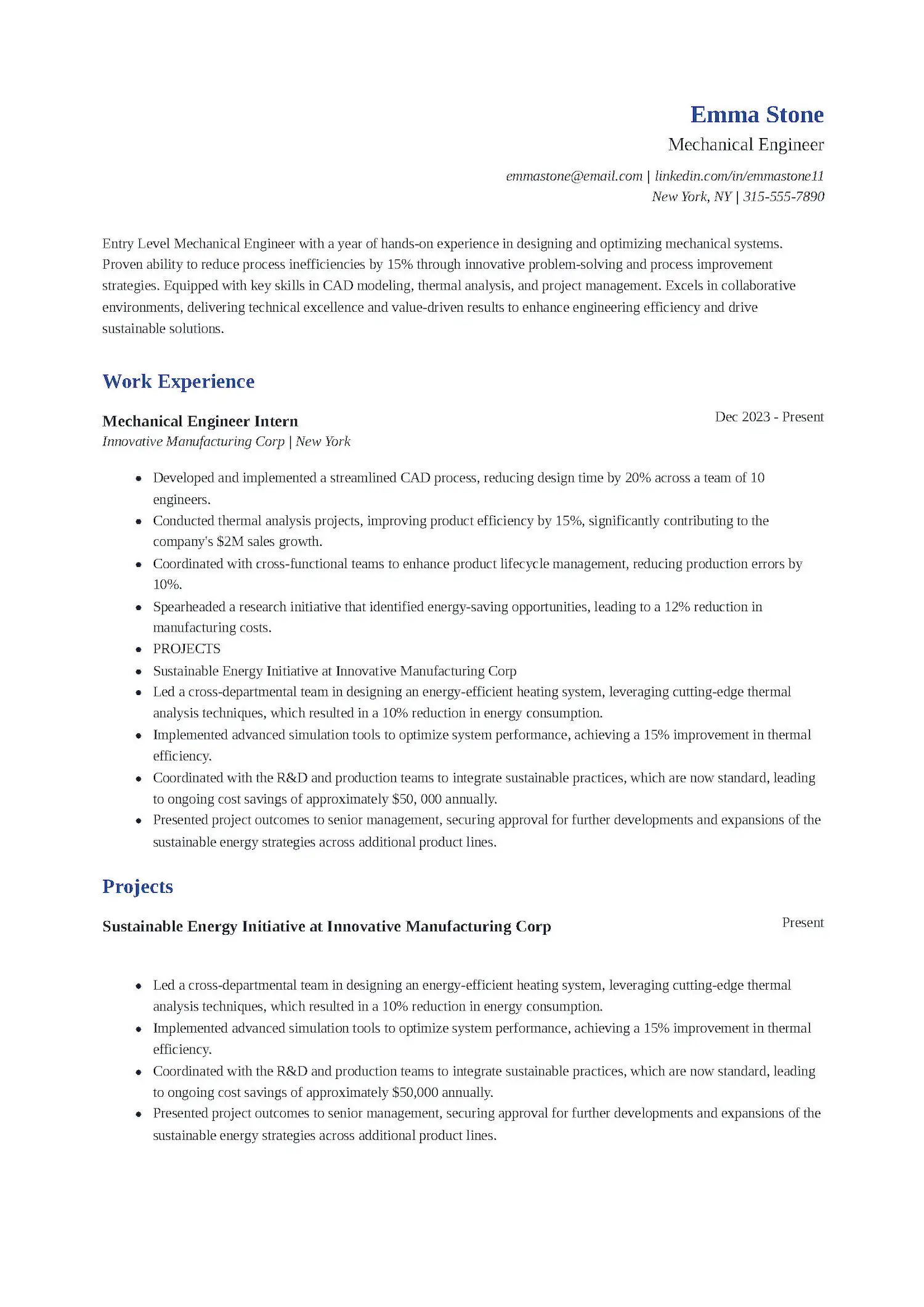
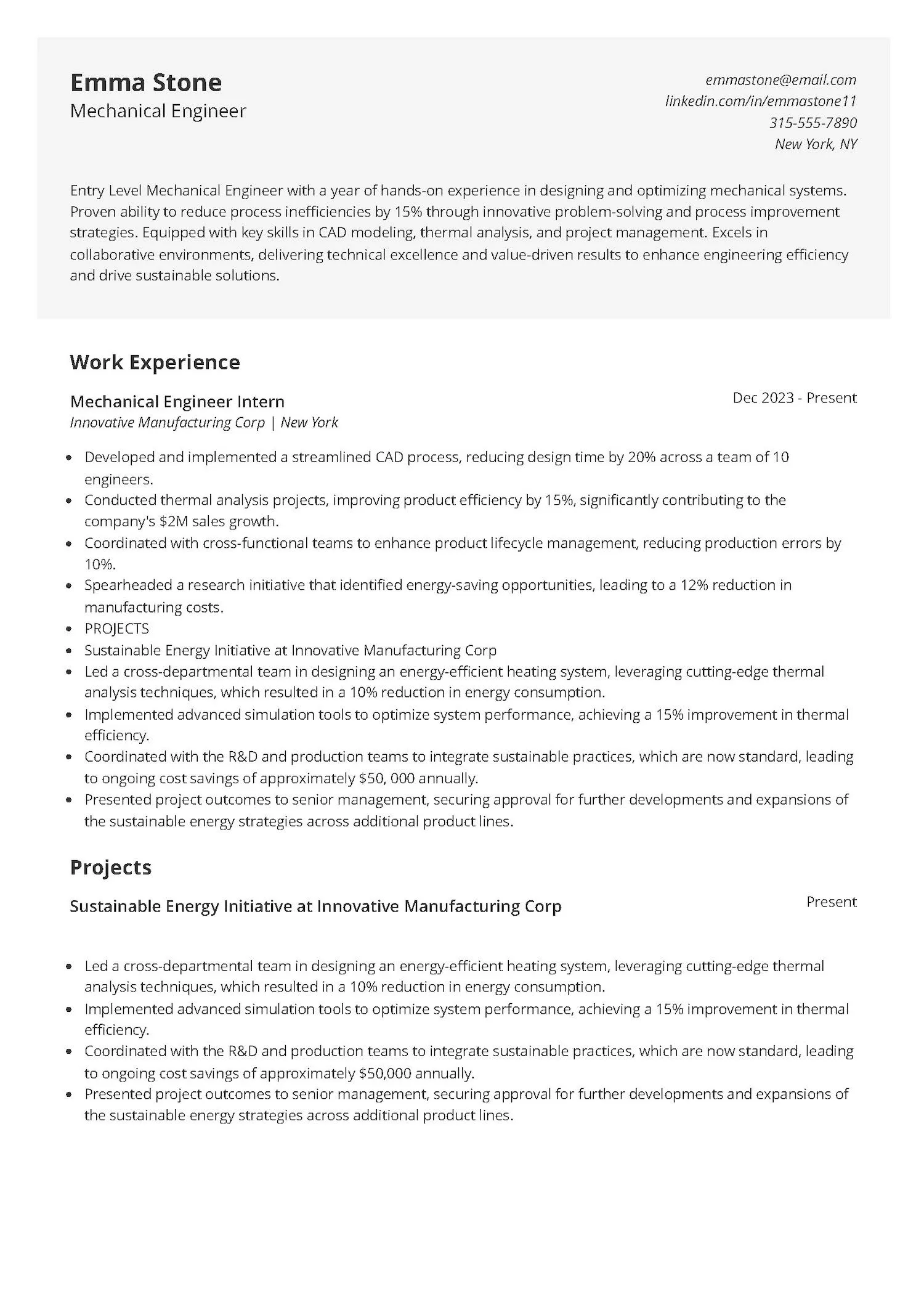
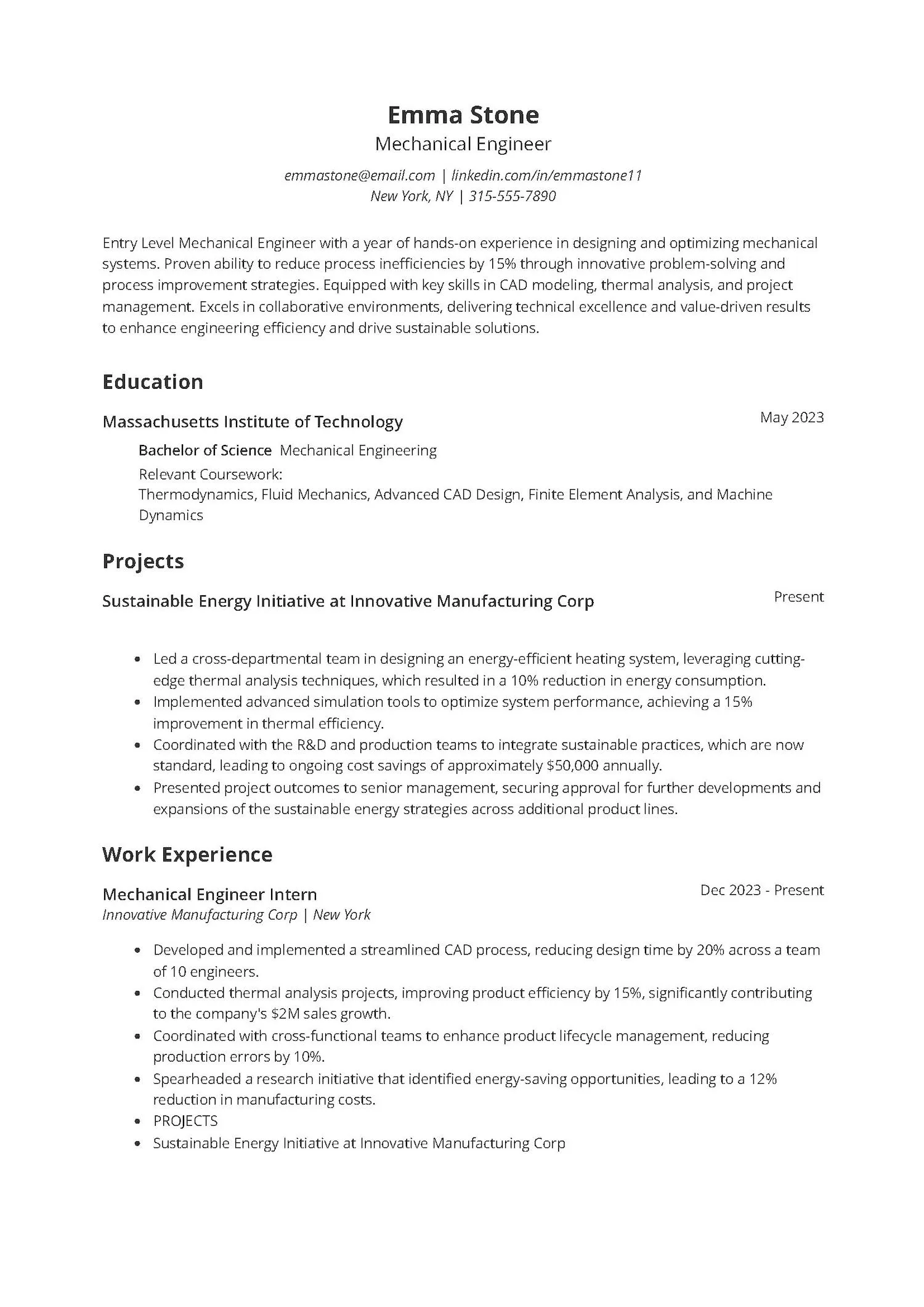


Starting your career as an entry-level mechanical engineer can be exciting, but landing your first job requires more than just technical knowledge—it’s all about writing a standout resume. As an aspiring mechanical engineer, showcasing your skills effectively is crucial for catching the attention of hiring managers and passing Applicant Tracking Systems (ATS).
In this blog, we’ll understand how to build an impressive entry-level mechanical engineer resume that highlights your qualifications, aligns with industry expectations, and gives you a competitive edge. Whether you’re an applicant fresh out of college or transitioning into the field, we’ll guide you step-by-step to ensure your resume stands out in a crowded job market. Let’s dive in!
Entry-level mechanical engineer resume example
Feeling stuck trying to write your entry-level mechanical engineer resume? Not sure what skills to highlight or how to structure your achievements? You’re not alone—and that’s why we’ve put together a resume example that gets it right. Check out the sample below to get inspired and use it as a guide to write your own interview-winning resume.
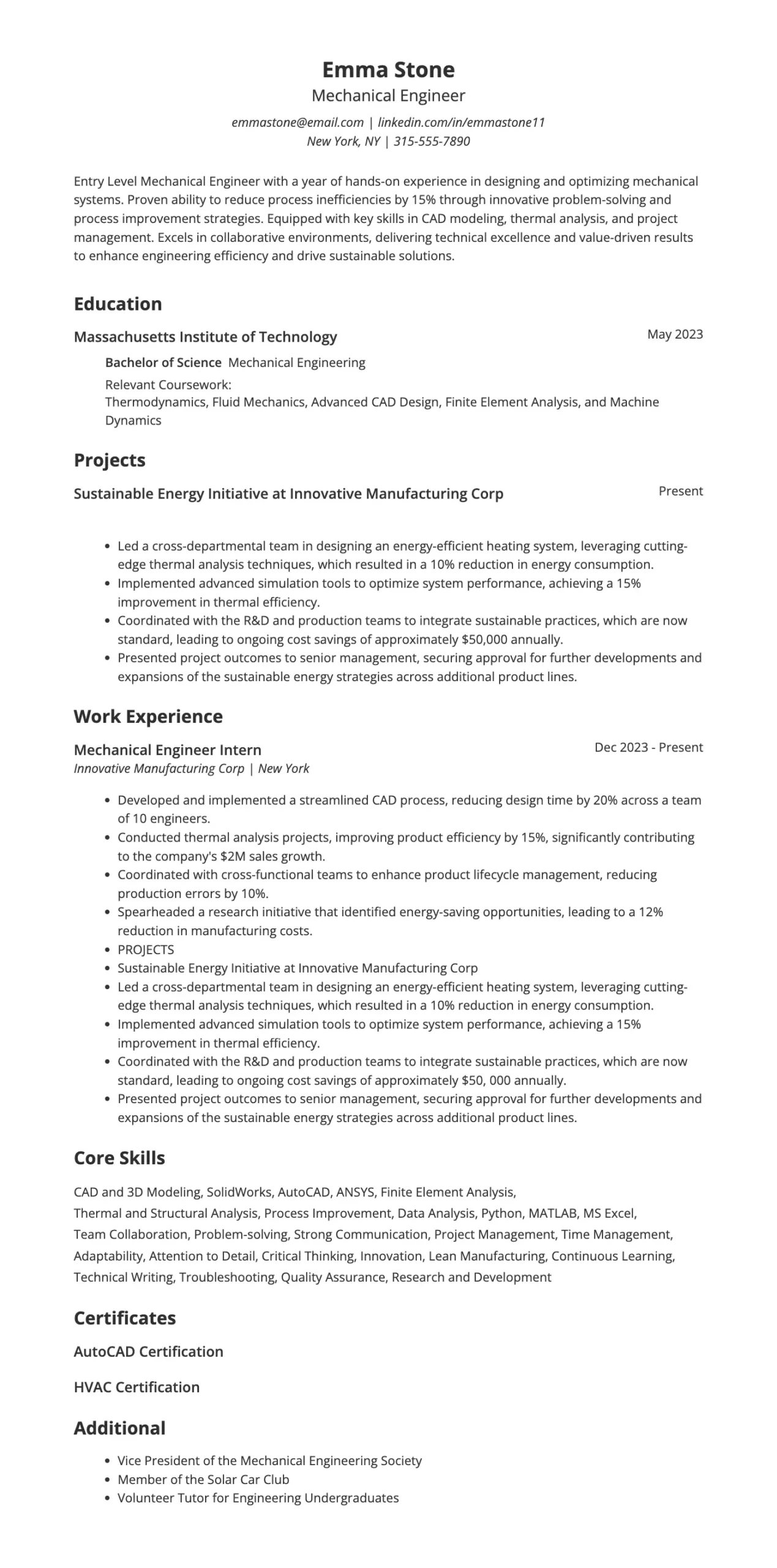
Mechanical engineering roles call for more than just technical knowledge. Employers want candidates who can solve problems, work in teams, and contribute to real results. Your resume should highlight hands-on experience, key software skills like AutoCAD or SolidWorks, and your ability to think critically. Let your projects and achievements do the talking.
With a strong mix of technical skills, measurable achievements, and hands-on project experience, this resume clearly shows the candidate’s readiness for an entry-level mechanical engineering role. It highlights impact-driven contributions like reducing design time by 20% and improving product efficiency.
The inclusion of certifications, a solid GPA, and leadership roles reflects both capability and initiative—qualities employers value in a competitive, engineering-driven environment.
How to write an entry-level mechanical engineer resume that will get you an interview
As an entry-level mechanical engineer, writing a resume that passes through Applicant Tracking Systems (ATS) is crucial. ATS is commonly used by employers to screen resumes based on specific keywords, making it essential to understand how it works and optimize your resume accordingly.
Here’s how ATS works:
- Job posting setup: The hiring team inputs key details such as the job title, required skills, and qualifications into the ATS.
- Resume scanning: The ATS scans submitted resumes to extract key information like skills, experience, and certifications.
- Searchable database: All resumes are stored in a searchable database, allowing recruiters to find candidates based on keywords like “mechanical engineering,” or specific qualifications like “PE.”
To make the process easier, consider usingJobscan’s ATS resume builder. This tool is designed to help you create ATS-friendly resumes, making sure you include the essential keywords that match the job description.

1. Key elements of an entry-level mechanical engineer resume
Including the right elements in your resume is essential to showcase your potential and catch the attention of hiring managers. Here are the key components every entry-level mechanical engineer should include:
- Contact information: Your name, phone number, email, and LinkedIn profile should be clearly listed so recruiters can easily reach out to you.
- Professional summary: A brief overview of who you are, your mechanical engineering background, and what you aim to bring to the role.
- Core skills: Highlight technical and soft skills like CAD, automation systems, or team collaboration. These keywords improve your chances of passing ATS filters.
- Work experience: Even if it’s internships or part-time roles, list relevant experience to show your familiarity with engineering environments and tools.
- Projects: Detail academic or personal engineering projects—especially those involving mechanical systems, refrigeration, or automation—to demonstrate hands-on experience.
- Education: Include your degree(s), university name, and graduation year. Hiring managers want to see your foundational knowledge in mechanical engineering.
- Certifications: List any relevant certifications like EIT or PE (if applicable), which add credibility and show your commitment to professional development.
- Honors and awards: Mention academic or project-based recognitions to highlight your achievements and distinguish yourself from other applicants.
2. Write a strong professional summary
Your professional summary is your resume’s elevator pitch—it should quickly convey who you are, your key strengths, and what you bring to the role. A well-written summary can hook recruiters and help your resume stand out, especially when optimized for ATS.
Good examples of a resume summary
- “Recent mechanical engineering graduate with hands-on experience in automation and CAD software through academic projects and internships. Proven ability to apply engineering principles to real-world challenges, with strong teamwork and problem-solving skills.”
- “Detail-oriented entry-level mechanical engineer with a solid foundation in thermodynamics, HVAC, and mechanical design. Seeking to contribute technical skills and innovative thinking to a forward-thinking engineering team.”
Bad examples of a resume summary
- “I am looking for a job in mechanical engineering where I can learn and grow.”
- “Hardworking individual who likes engineering and wants to work in a company.“
To make writing your summary easier and more effective, try Jobscan’s resume summary generator. It analyzes your target job description and helps you create a tailored, ATS-optimized summary that highlights your strengths and makes a lasting impression on hiring managers.
3. Demonstrate key entry-level mechanical engineer skills
Including relevant skills on your resume is essential—not just to impress hiring managers, but also to pass through ATS filters. By clearly showcasing both hard and soft skills, you highlight your technical proficiency and your ability to thrive in team-oriented engineering environments.
Hard skills for entry-level mechanical engineer
- Computer-Aided Design (CAD)
- Finite Element Analysis (FEA)
- Thermodynamics
- Automation Systems
- HVAC and Refrigeration Systems
- MATLAB or Python
- 3D Printing and Prototyping
- SolidWorks and AutoCAD
Soft skills for entry-level mechanical engineer
- Problem-Solving
- Team Collaboration
- Time Management
- Attention to Detail
- Communication Skills
- Adaptability
- Critical Thinking
- Project Coordination
Integrating these skills into your bullet points can help you show off your accomplishments and highlight your proficiencies. But there’s a right and wrong way to highlight your entry-level engineer skills in your bullet points.
4. Write impactful resume bullet points for entry-level engineer
Highlighting a balanced mix of these skills in bullet points ensures your resume aligns with job descriptions and shows you’re ready to take on real-world engineering challenges. Below are some examples of good and bad resume bullet points:
Good examples of resume bullet points
- “Designed and tested a low-cost HVAC system prototype using SolidWorks and MATLAB, improving energy efficiency by 15%.”
- “Collaborated with a team of 4 to develop an automated conveyor system for a class project, completing it 2 weeks ahead of schedule.”
- “Conducted stress analysis on 3D-printed mechanical components using FEA tools, identifying structural weaknesses before fabrication.”
Bad examples of resume bullet points
- “Worked on a school project about machines.”
- “Helped team with some tasks.”
- “Did engineering stuff using software.”
Try Jobscan’s bullet point generator. This smart feature helps you turn vague responsibilities into powerful, keyword-optimized statements tailored to your experience and target job.
5. Highlight your achievements as an entry-level mechanical engineer
Even if you’re just starting your career, you likely have valuable achievements from internships, academic projects, or part-time roles that can strengthen your resume. Instead of just listing duties, focus on accomplishments that show your impact, technical skills, and problem-solving abilities. Quantifying your contributions—no matter how small—adds credibility and makes your resume more compelling.
Here are some examples:
- “Led a senior design project to develop a solar-powered water pump, increasing efficiency by 20% compared to previous models.”
- “Improved CAD modeling accuracy by 30% during a summer internship by creating a standardized part library for the engineering team.”
- “Received the ‘Best Capstone Project’ award for designing an automated sorting system using sensors and Arduino.”
- “Reduced prototype development time by 15% through rapid iteration techniques and 3D printing.”
6. Tailor your resume to the job description
Customizing your resume for each job you apply to isn’t just a nice-to-have—it’s a game changer. Recruiters and ATS are looking for exact matches, so a generic resume won’t cut it. Tailoring your resume shows you’re not just qualified, but the right fit for the role.
Here’s how to tailor your resume to the job description:
- Study the job description like a blueprint. Highlight the skills, qualifications, and tools mentioned.
- Use the same keywords and phrases the employer uses. This helps your resume pass ATS scans and speaks directly to hiring managers.
- Update your professional summary to reflect the role and show how you align with the company’s goals.
- Reorder your skills list to put the most relevant abilities up top. Make your strengths impossible to miss.
- Revise bullet points in your experience section to highlight tasks and achievements that match the job.
- Adopt the tone and language of the job post. It builds instant alignment and keeps your resume out of the “maybe” pile.
7. Include relevant education and certifications
Your education and certifications show hiring managers you have the foundational knowledge and technical qualifications for a mechanical engineering role.
Here’s how to include them effectively:
- List your degree(s) clearly with the full title, school name, and graduation year (e.g., B.S. in Mechanical Engineering, XYZ University, 2024).
- Place your education near the top since you’re a recent graduate with limited work experience.
- Include relevant coursework or academic honors if they align with the job (e.g., Thermodynamics, Automation Systems, Dean’s List).
- Add certifications in a separate section with full names and dates earned (e.g., Engineer in Training (EIT), 2024).
- Only include relevant certifications that strengthen your application (e.g., PE exam eligibility, SolidWorks Certification, HVAC/R Training).
- Mention in-progress certifications if they’re valuable to the role, and include the expected completion date.
Top entry-level mechanical engineer certifications
Here are some top entry-level mechanical engineer certifications that can enhance your resume:
- Engineer in Training (EIT) / Fundamentals of Engineering (FE)
- Certified SolidWorks Associate (CSWA)
- Certified Manufacturing Technologist (CMfgT)
- AutoCAD Certification
- HVAC Certification
- Six Sigma White/Yellow Belt
- MATLAB Certification
Entry-level mechanical engineer resume tips
Here are some essential tips to help you get noticed:
- Tailor your resume to the job: Customize your resume for each application. Use keywords from the job description to increase your chances of passing ATS scans and grabbing the attention of hiring managers.
- Keep it concise and focused: As an entry-level candidate, aim for a 1-page resume. Focus on the most relevant experience and avoid overwhelming recruiters with unnecessary details.
- Use action verbs: Start each bullet point with action verbs like “designed,” “implemented,” or “collaborated” to convey a sense of accomplishment and proactivity.
- Showcase internships or part-time roles: Even if you haven’t held a full-time engineering role, internships, co-op programs, or part-time positions that involve engineering tasks are valuable experience. Highlight specific engineering tasks or projects you worked on.
- Use a clean, easy-to-read format: Avoid clutter and keep your resume format clean and professional. Use bullet points, a clear hierarchy of information, and standard fonts to ensure readability.
- Proofread for errors: Attention to detail is critical in engineering, and small mistakes can hurt your chances. Carefully proofread your resume for spelling, grammar, or formatting errors.
- Use links to your portfolio or projects: If you have a portfolio of projects, GitHub repository, or any relevant work to show, include links to these. It can be especially useful if you’ve worked on CAD designs, coding projects, or research work that potential employers can explore.
Include a cover letter with your entry-level mechanical engineer resume
A well-written cover letter is your chance to introduce yourself, highlight your qualifications, and explain why you’re passionate about the position and the company. While your resume showcases your skills and experiences, your cover letter gives you the opportunity to tell your story and demonstrate why you’re the ideal fit for the job.
Here are some tips for writing an effective cover letter:
- Personalize it: Address the hiring manager by name and tailor your letter to the job and company.
- Highlight relevant skills: Emphasize experiences, projects, or certifications that align with the job description.
- Show enthusiasm: Explain why you’re excited about the role and the company.
- Keep it brief: Limit your cover letter to one page and avoid repeating your resume details.
- Show personality: Let your passion for mechanical engineering and your goals shine through.
A cover letter can be the key differentiator between you and other candidates. To make writing it easier, consider using Jobscan’s cover letter maker. With Jobscan’s assistance, you can create a tailored cover letter that increases your chances of getting noticed and landing the interview.
Final words
In a competitive field like mechanical engineering, standing out from the crowd requires more than just a solid resume—it’s about presenting your skills, experience, and passion in a way that captures attention. By tailoring your resume, highlighting your achievements, and including a powerful cover letter, you increase your chances of landing the job you want.
Don’t let the nuances of ATS, formatting, or writing the perfect resume hold you back. Leverage Jobscan’s top-notch tools to ensure your application is optimized, personalized, and ready to impress. Take control of your job search today, and make your next engineering opportunity a reality!

Entry-level mechanical engineer common interview questions
Answer:
“In one of my capstone projects, I worked on designing a low-energy HVAC system. I used SolidWorks to model the system and ran simulations to optimize airflow and energy consumption. As a result, the system’s efficiency improved by 12% compared to the original design, which we presented to the faculty as a potential commercial product.”
Answer:
“When faced with a difficult problem, I start by fully understanding the requirements and constraints. I gather as much data as I can, whether it’s from simulation results or feedback from team members. I then brainstorm potential solutions, evaluate them based on feasibility, and perform simulations or tests to verify my assumptions. If the first solution doesn’t work, I reframe the problem and test different approaches.”
Answer:
“I’m highly skilled in using CAD software like SolidWorks and AutoCAD for 3D modeling and drafting. I’m also familiar with MATLAB for data analysis and simulation. Additionally, I have hands-on experience with Finite Element Analysis (FEA) for stress testing components in mechanical systems.”
Answer:
“I believe in breaking down large tasks into manageable steps and setting milestones to stay on track. During my internship, I had to juggle multiple tasks, including project designs and technical reports. I used project management tools to prioritize and allocate time to each task, which allowed me to consistently meet deadlines without compromising quality.”
Answer:
“In 5 years, I hope to have gained enough experience to take on more responsibility in designing and optimizing mechanical systems, particularly in the automation or refrigeration sectors. I’m also interested in pursuing my Professional Engineer (PE) certification, which I know will open up more opportunities for leadership roles in the future.”
Answer:
“I stay up-to-date by reading industry journals like Mechanical Engineering Magazine and following developments in automation and robotics. I also attend webinars and online courses to expand my knowledge, especially on topics like HVAC systems and the latest tools in 3D printing. Additionally, I frequently check reports from the Bureau of Labor Statistics to understand how the field is evolving and where job opportunities are growing.”
Entry-level mechanical engineer resume frequently asked questions
Focus on both technical and soft skills. Highlight software proficiency (like SolidWorks, AutoCAD, MATLAB), understanding of thermodynamics, mechanics, and manufacturing processes. Also include problem-solving, teamwork, communication, and adaptability—essential traits that make you stand out in collaborative engineering environments.
List your degree, university name, and graduation date under an “Education” section. Mention relevant coursework, GPA (if strong), academic honors, and engineering projects. If you lack work experience, your education section becomes a key area to showcase your technical foundation and capabilities.
Focus on academic projects, internships, volunteer work, and coursework that reflect relevant skills. Highlight technical tools you’ve used, soft skills gained through teamwork, and any leadership roles. Tailor your resume to each job, using keywords from the description to pass ATS filters.