Best Design Engineer Resume Examples for 2026
Design Engineer resume examples for 2026 at every level, showing how to feature your design-systems, front-end, and prototyping skills and the keywords ATS scans for.



A Design Engineer sits between design and engineering, and the best ones do both. You translate design intent into production code, build and maintain component libraries, prototype interactions, and hold the line on visual fidelity, accessibility, and performance. It is one of the fastest-growing titles in product teams, and one of the hardest to write a resume for, because it spans two disciplines that usually live in separate job descriptions.
Hiring managers want proof that you ship, not just mock. They look for the systems you built, the interfaces you implemented, and the measurable outcomes those shipped: faster build times, higher activation, fewer accessibility defects, a design system that other teams actually adopt. The applicant tracking system gets there first, so your resume needs the concrete keywords recruiters search for: React, TypeScript, design systems, Figma, accessibility (WCAG), and prototyping, used in real accomplishments rather than a skills dump.
The examples below show how to do both. Each one pairs design and engineering signals, quantifies impact, and stays ATS-friendly so a real person reads it. Find the level and specialization closest to your target role, then tailor it to the job description in front of you.
Ready to build yours? Try our ATS-friendly resume builder or scan your draft against the job description.
Design Engineer resume example
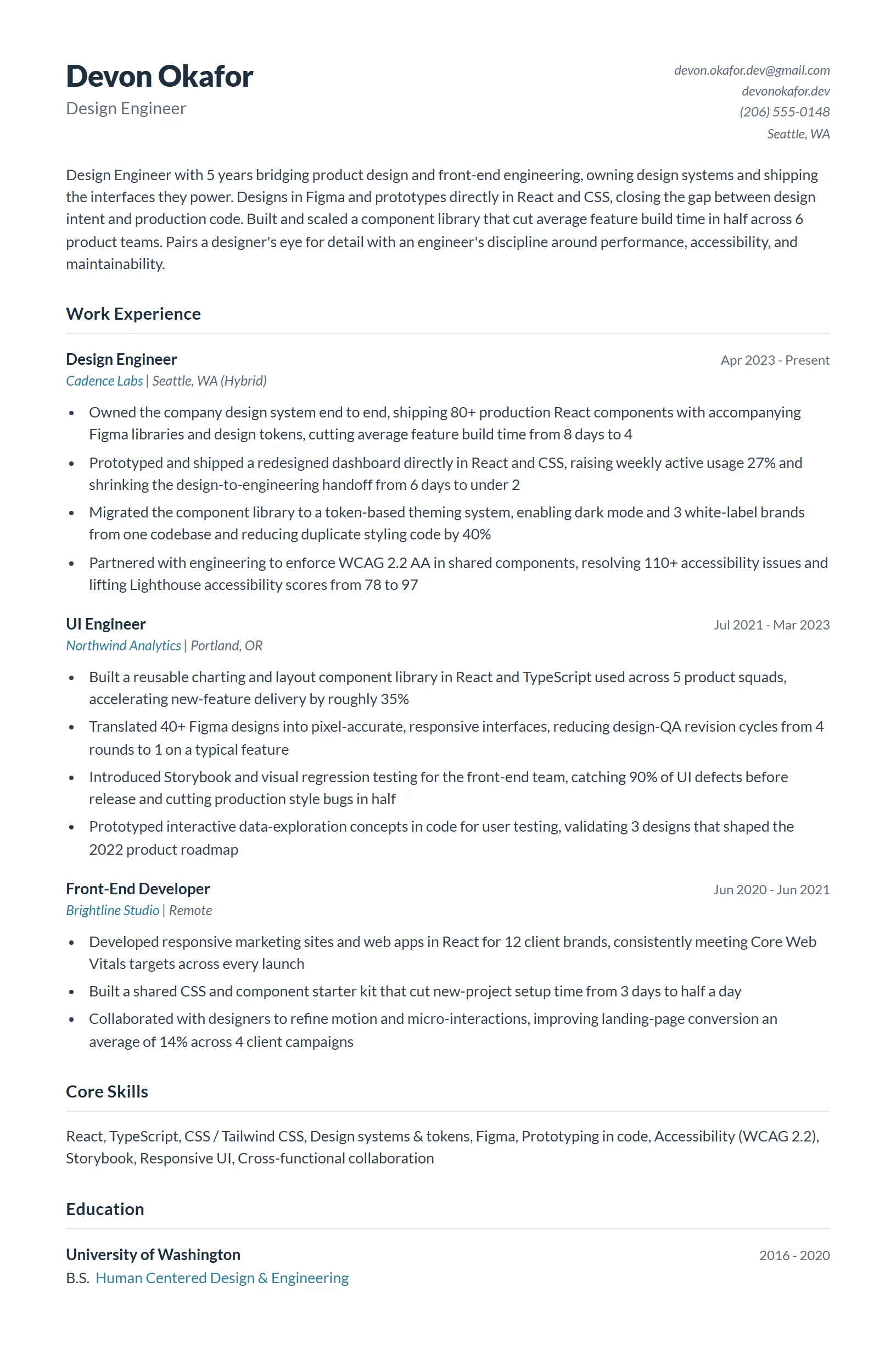
A mid-level Design Engineer (around 4 to 6 years) who designs and ships interfaces end to end, owning components in code and the system they live in.
This resume works because it refuses to pick a side: every bullet pairs a design decision with the engineering that shipped it and the result it drove. It leads with a component-library win that cut feature build time and quantifies adoption across teams, which is exactly the dual-discipline proof hiring managers struggle to find. The skills line front-loads React, TypeScript, design systems, and Figma so the ATS reads it as both a designer and an engineer.
Senior Design Engineer resume example
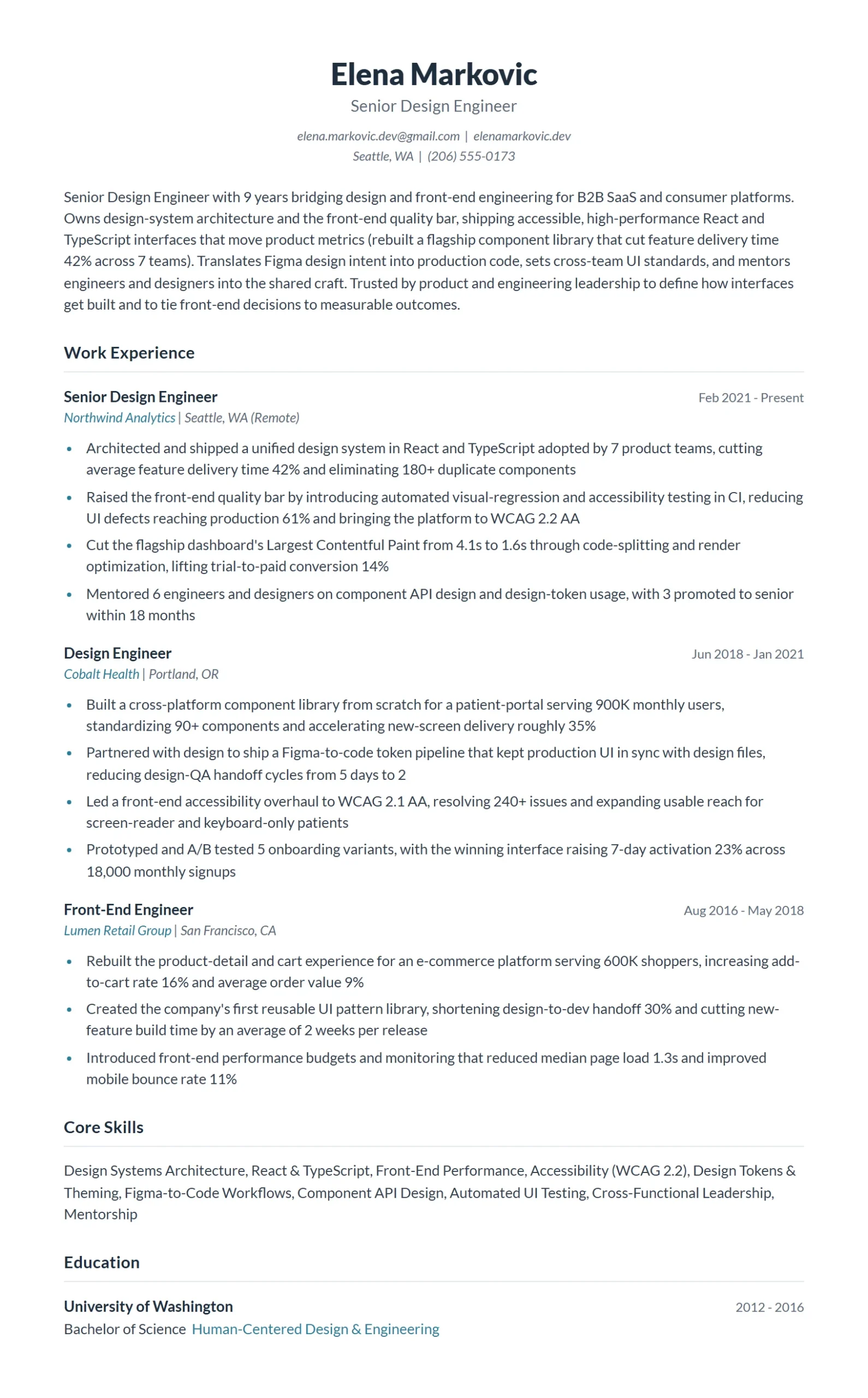
A senior or lead Design Engineer (around 8 or more years) who owns the design-system architecture and the front-end quality bar across multiple teams.
The senior version shifts from tasks to leverage. It centers ownership of a multi-product design system, the standards and tooling that made it adopt, and the engineers and designers mentored along the way. Outcomes are framed at org scale (build-time reduction across teams, fewer UI defects in production), signaling the strategic scope a senior title demands without losing the hands-on credibility that defines the role.
Entry-Level Design Engineer resume example
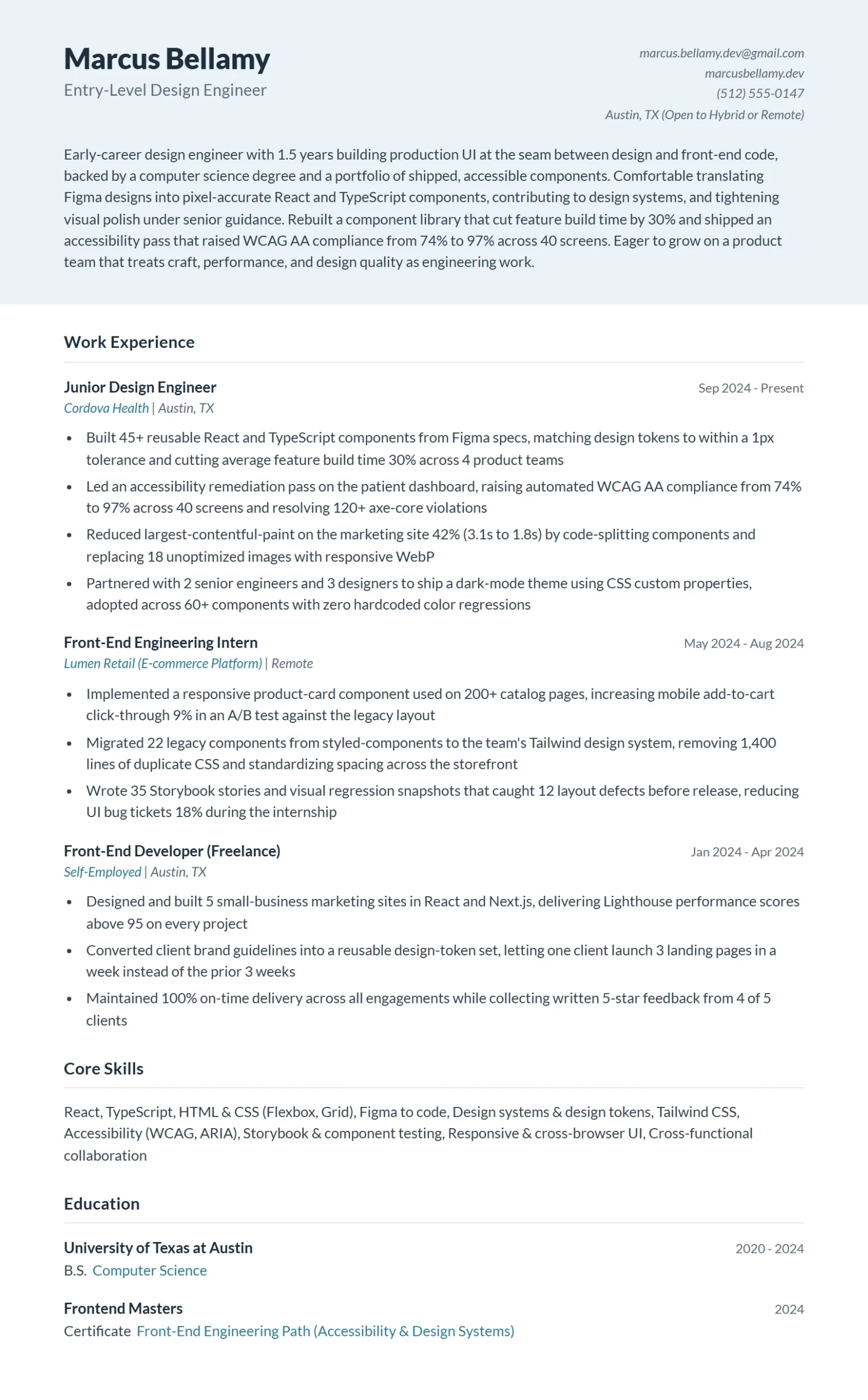
An early-career candidate (around 0 to 2 years) breaking in from a bootcamp, CS degree, or design program, with internships and a strong portfolio.
With limited experience, this resume leans on shipped projects, internship contributions, and a portfolio link, which is what hiring managers expect at this level. It quantifies what it can (components built, pages shipped, Lighthouse or accessibility scores improved) and shows range across both design tools and front-end code. The summary names the hybrid intent directly so neither a design nor an engineering screen filters it out early.
Front-End Design Engineer resume example
An engineering-leaning specialization: heavy on React and TypeScript implementation, with a sharp eye for visual fidelity and interaction detail.

This version weights the engineering side without abandoning craft. Bullets emphasize component implementation, performance, animation and interaction work, and front-end architecture, while still tying each to the design quality it preserved. It is the right framing when the target job description reads more like a front-end engineer role that happens to value design sensibility, and the keywords skew toward the technical stack ATS will scan for.
Product Design Engineer resume example
A product-leaning specialization that works close to product and research, prototyping in code and shipping end-to-end features.
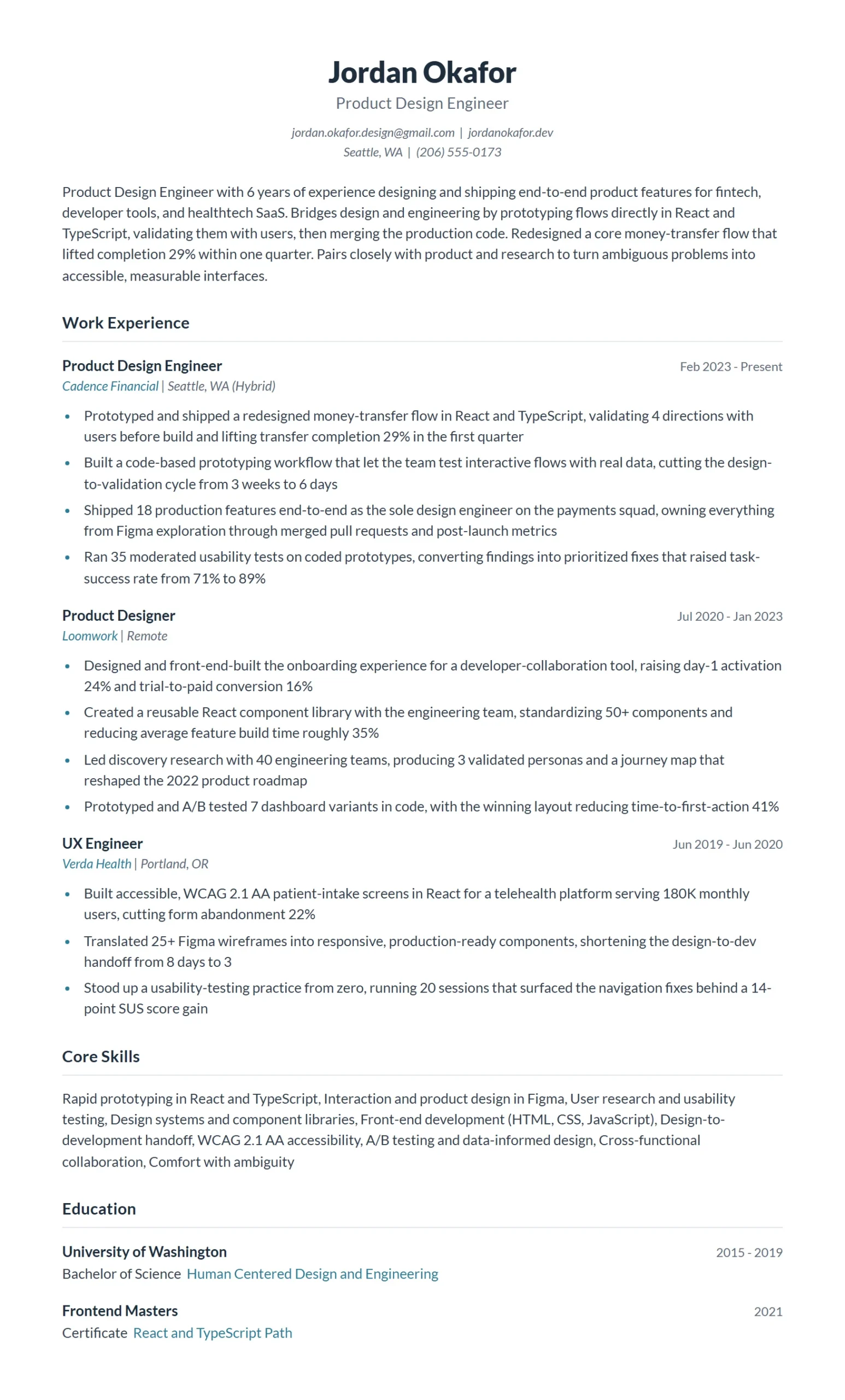
Here the impact is framed in product outcomes, not just delivery: activation, conversion, and retention moved by features this person both designed and built. It highlights rapid prototyping in code to validate ideas before full builds, plus collaboration with product and research. That makes the case for someone trusted to own a problem from concept to ship, which is what product-focused teams hiring this title actually want.
UX Engineer resume example
A closely-related sibling title for the same hybrid role, focused on turning design intent into production-grade, accessible UI and the system that keeps it consistent.
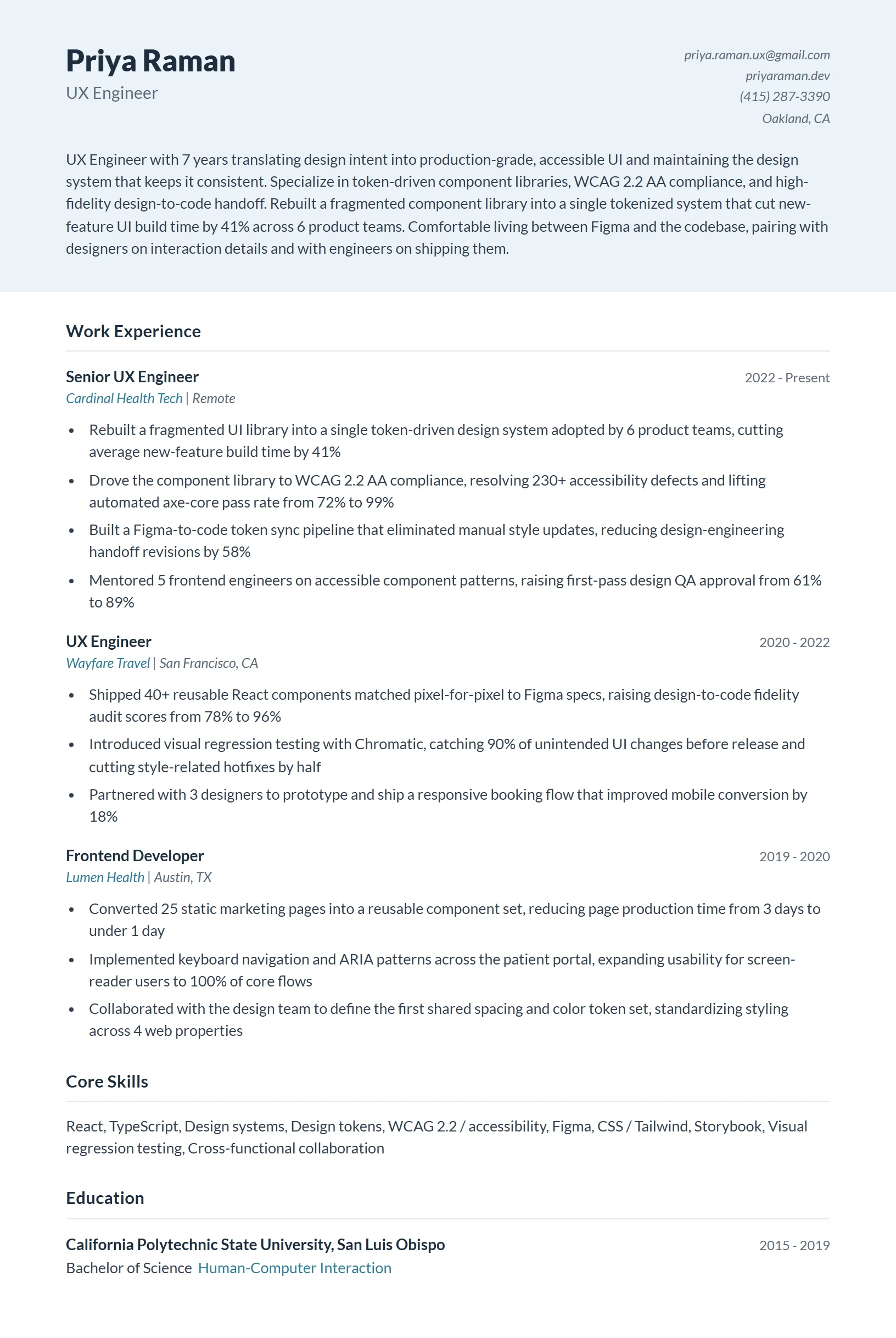
The UX Engineer framing foregrounds accessibility and design-to-code fidelity, the two things this title is most often hired to guarantee. It quantifies WCAG remediation, component reuse, and design-system contributions, and shows tight partnership with UX designers. Because many companies post this exact title for the design-engineer skill set, the resume mirrors that language so it matches both the ATS and the recruiter screening for it.
How to write a Design Engineer resume that gets interviews
A Design Engineer sits between design and engineering: you do not just hand off mockups, you ship the interface. Hiring managers scan your resume for proof you can do both, design quality you can show and front-end code that made it to production. Most teams also run your resume through an Applicant Tracking System (ATS) first, so the language has to match the job description before a human reads it. The tips below show you how to clear the ATS scan and convince the engineering lead and design lead who read next.
- Lead with both: design craft and shipped code: The whole reason this role exists is that it bridges two skill sets, so your resume has to prove both in the same breath. Pair a design signal with an engineering signal in your summary and bullets: “prototyped in Figma, then shipped the production React component.” If you read as a designer who cannot code, or an engineer with no eye for design, you fall into one of the buckets a dedicated Design Engineer role is meant to avoid. Make the dual fluency obvious in the first six lines.
- Link a portfolio and a code sample, not just one: A Design Engineer is judged on output you can see and output you can read. Put a clickable portfolio URL in your header next to your email, and add a GitHub, CodePen, or live-demo link too. The portfolio should lead with 2-3 cases that show interface decisions and the code or design system behind them, not a gallery of static screens. The resume earns the screen; the portfolio and the code earn the offer.
- Quantify outcomes, not just deliverables: Anyone can say they built a component library. Show what it did: “cut design-to-dev handoff time 40%,” “reduced bundle size 28% and lifted Lighthouse performance from 64 to 92,” or “shipped a redesign that raised activation 19%.” Tie work to performance scores, accessibility compliance, conversion, build time saved, or component adoption across teams. When a number is fuzzy, say “estimated” rather than inventing precision.
- Name your stack and your design tools side by side: ATS scans for specific terms, and this role expects an unusually wide vocabulary. List the front-end stack you actually use (React, TypeScript, Tailwind, CSS, Storybook, Vite) right alongside the design tools (Figma, design tokens, Framer, prototyping). If the posting says “design systems” and you have built tokenized components in Figma and code, use that exact phrase. Skip tools you have not touched in years and never keyword-stuff.
- Make design systems and accessibility concrete: Design systems and accessibility are the heart of most Design Engineer roles, so do not leave them as buzzwords. Show the scope: how many components, how many teams adopted them, what consistency or velocity gain followed. For accessibility, name the standard and the result: “brought 30 core components to WCAG 2.2 AA and raised the Lighthouse accessibility score from 71 to 98.” Specifics here separate a real practitioner from someone listing the term.
- Show how you partner across design and engineering: This role lives at a seam, so collaboration is part of the job description, not a soft extra. Use bullets that name the partnership and the outcome: “Worked with 3 designers and 5 engineers to define a shared token system that ended a year of UI drift across web and mobile.” It signals you can translate between two functions that often talk past each other, which is exactly the value a Design Engineer adds. Then keep the format ATS-friendly (single column, standard headings) and run it through Jobscan against the posting before you apply.

Design Engineer resume summary examples
Your summary is the first thing a recruiter reads. Lead with your specialty, years of experience, and a quantified win.
Good design Engineer resume summary examples
- Design Engineer with 6 years bridging product design and front-end engineering for B2B SaaS. Ships production React and TypeScript interfaces and owns the design system end to end, from Figma tokens to published components. Built a 120-component library adopted by 5 teams that cut design-to-dev handoff time 40%, and led a perf overhaul that lifted Lighthouse from 64 to 92.
- Front-end-focused Design Engineer who turns high-fidelity Figma prototypes into accessible, shipped UI. Specializes in design systems, component architecture, and motion, with a track record of WCAG 2.2 AA compliance across core flows. Recent redesign raised onboarding completion 19% and reduced reported UI bugs 45% through a tokenized component rebuild.
- Design Engineer with a design background and 5 years writing production front-end code in React, TypeScript, and Tailwind. Pairs closely with PMs, designers, and engineers to ship interfaces that test well and load fast. Drove a Storybook-backed design system that standardized 90+ components and shortened new-feature build time by an average of two weeks per release.
What to avoid
- Creative Design Engineer passionate about beautiful interfaces and clean code, looking for an exciting role with a great team. (It is all adjectives and wants, with no proof. There is no stack, no design tools, no portfolio or code signal, and zero measurable impact. For a hybrid role that lives on evidence of both skill sets, this tells the reader nothing they can act on.)
- Hardworking developer with an eye for design who is a fast learner and works well with others. (Generic and unprovable. It does not name a single technology or design tool, shows no shipped work, and gives no metric. “Eye for design” is a claim anyone can make, so both the ATS and the hiring lead skip past it.)
Design Engineer resume skills
A Design Engineer resume has to show both sides, so pair your front-end stack with your design tools and pull the exact terms from each job description. This is a quick snapshot, not a full inventory: see the skills page for the complete breakdown and keep this list to your strongest, role-relevant skills.
Hard skills for a design Engineer resume
- React & TypeScript
- HTML & modern CSS
- Design Systems & Component Libraries
- Figma & Design Tokens
- Tailwind CSS
- Prototyping (Figma, Framer)
- Storybook
- Accessibility (WCAG 2.2 AA)
- Front-End Performance Optimization
- Responsive & Cross-Browser UI
Soft skills for a design Engineer resume
- Design-Engineering Collaboration
- Communication
- Attention to Detail
- Problem Solving
- Cross-Functional Partnership
Design Engineer resume work experience bullet point examples
Lead each bullet with a strong verb and a measurable result.
Good bullet point examples
- Built and shipped a 120-component design system in Figma and React (TypeScript, Storybook) adopted by 5 product teams, cutting design-to-dev handoff time 40% and reducing UI inconsistencies flagged in QA 62%.
- Led a front-end performance overhaul on the core dashboard, reducing bundle size 28% and lifting the Lighthouse performance score from 64 to 92 across the 10 most-trafficked pages.
- Prototyped a new onboarding flow in Figma, then implemented the production React UI end to end, raising day-7 activation 19% and cutting setup support tickets 24% within two quarters.
- Partnered with 3 designers and 5 engineers to define a shared design-token system across web and mobile, ending recurring UI drift and bringing 30 core components to WCAG 2.2 AA compliance.
Bad bullet point examples
- Built UI components for the web application using React. (Names a task with no outcome. There is no scale, no design-system or quality angle, and no metric, so it reads as a job duty rather than an accomplishment. It also misses the design half of the role entirely.)
- Responsible for the look and feel of the product front end. (“Responsible for” describes a title, not an achievement. It shows no specific action, no tools, and no measurable result. Lead with a strong verb (Built, Shipped, Led) and end with an outcome instead.)
- Made the app faster and the design more consistent. (Subjective and unquantified. “Faster” and “more consistent” are exactly the claims this role is measured on, so leaving them as opinions wastes the bullet. Back them with the perf score, load time, or component-adoption number that proves it.)
Design Engineer resume tips
A strong Design Engineer resume proves you close the gap between pixels and production, and these six tips help yours do exactly that.
- Mirror the JD: Copy exact tool and skill names from each job posting (React, TypeScript, WCAG 2.2 AA, Storybook) into your resume, because ATS systems match on literal strings and will miss synonyms or abbreviations you use instead.
- Quantify UI Impact: Replace vague verbs with metrics that hiring managers in this role recognize: component reuse rate, Lighthouse accessibility score improvements, reduction in design-to-dev handoff cycles, or percentage drop in UI bug reports after you shipped a design system.
- Name Your Design System Work: Explicitly list design system and component library contributions by tool and scope, for example: built 40-component Storybook library in React and TypeScript, adopted by 3 product teams, because this signals the cross-functional scale that senior roles require.
- Show the Token Pipeline: Mention Figma design tokens and how you connected them to code (CSS custom properties, Tailwind config, or a Style Dictionary pipeline), since this specific workflow appears in job descriptions for mid-to-senior Design Engineer roles and few candidates name it.
- One Page or Two: Keep your resume to one page with under eight years of experience, and move to two pages only when you have distinct design system, accessibility audit, or prototyping projects that each need a bullet or two to show scope and outcome.
- List Accessibility Concretely: Do not write just accessibility as a skill: write WCAG 2.2 AA audits, axe-core automated testing, or keyboard and screen-reader remediation, because a design lead screening for accessibility ownership needs evidence of method, not just awareness.
Pair your design Engineer resume with a cover letter
A strong resume goes further with a tailored cover letter. Browse our cover letter examples to round out your application.
Design Engineer resume frequently asked questions
A Design Engineer resume has to prove you live in both worlds, so it leads with shipped product work rather than pure visual portfolios or pure code volume. Show that you design interfaces and build them in production code (React, CSS, design systems), and quantify the bridge you create between design and engineering teams. UX-only and dev-only resumes tend to lean hard one direction, which is exactly the gap a Design Engineer is hired to close.
Pair design tools with front-end engineering so the hybrid is obvious at a glance: Figma, design tokens, and prototyping on one side, and HTML, CSS, JavaScript or TypeScript, React, and component libraries on the other. Add accessibility (WCAG), responsive layout, animation, and design system maintenance, since those sit squarely between the two disciplines. List the specific frameworks and tools from the job posting so your resume matches what the ATS and the hiring manager are scanning for.
Treat the design system as a product you contributed to, not a tool you used. Describe what you built or maintained (component libraries, tokens, documentation), how many teams or products adopted it, and the impact (faster shipping, fewer design inconsistencies, less engineering rework). A line like “Built and documented 40+ reusable React components adopted by 6 product teams” reads far stronger than “familiar with design systems.”
Yes. Put the portfolio and GitHub links in your header next to your email and LinkedIn, because reviewers expect to see proof of both craft and code. Link to a portfolio that shows live, interactive work rather than static screenshots, and make sure the projects you reference on the resume are easy to find there. The resume gets you the look, the portfolio closes the interest.
Start each bullet with a strong verb, then tie the work to a result a business cares about: conversion, performance, adoption, or speed. For example, “Redesigned and rebuilt the checkout flow in React, improving mobile conversion by 18%” connects design decisions to engineering execution to outcomes. Avoid vague phrasing like “responsible for UI,” and use real numbers from analytics, load times, or team adoption wherever you have them.
Match the exact skills and tools named in the job description, since ATS and recruiters search for terms like “React,” “Figma,” “design systems,” and “accessibility” specifically. Use a clean single-column layout with standard section headings, and skip graphics, tables, or columns that scanners can misread. Run your resume against the target job description with a tool like Jobscan to confirm your match rate before you apply.