Best Industrial Engineer Resume Examples for 2026
Build an industrial engineer resume for 2026 that proves your impact with real examples, lean and Six Sigma keywords, and the metrics ATS and hiring managers scan for.

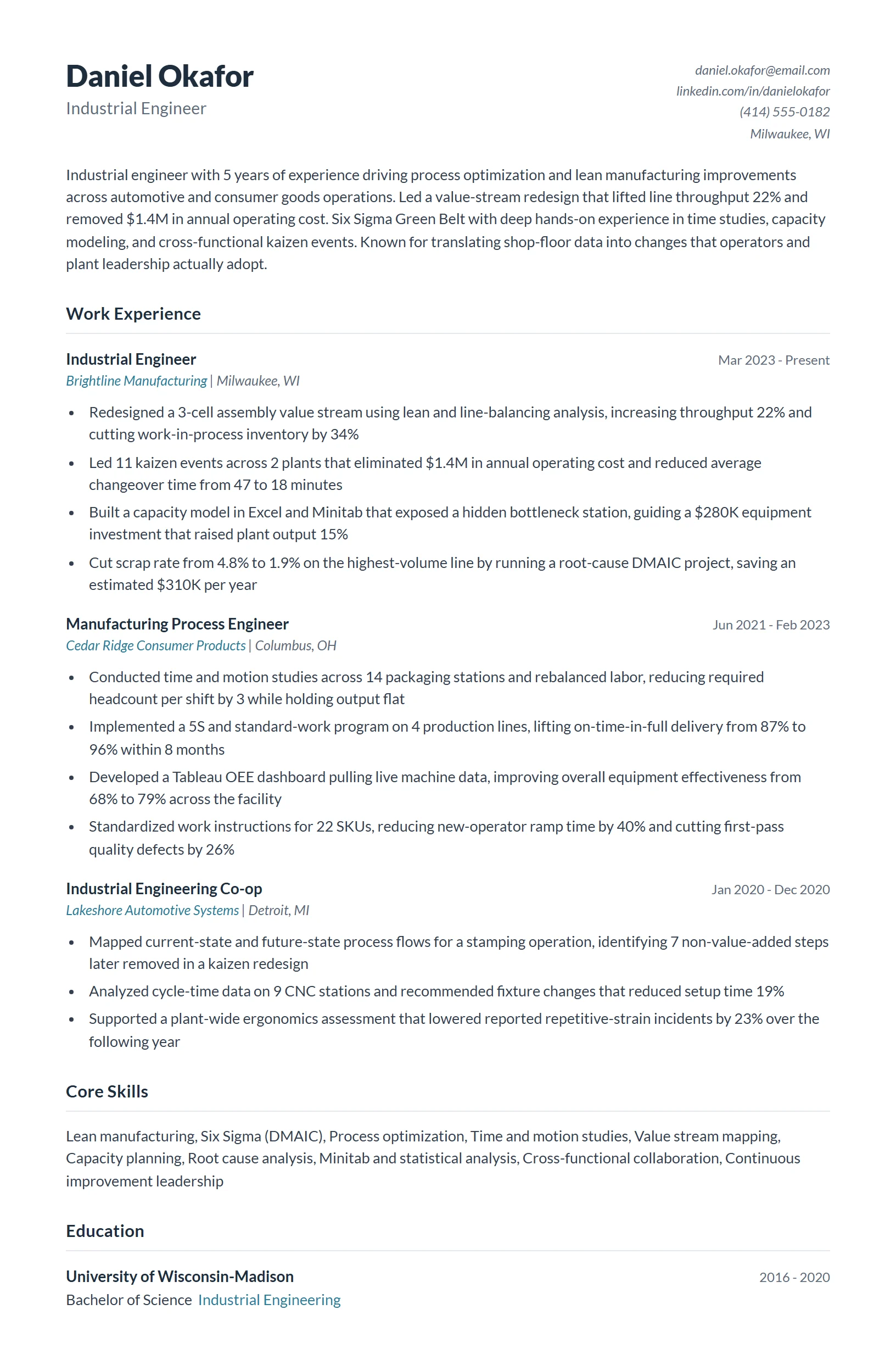
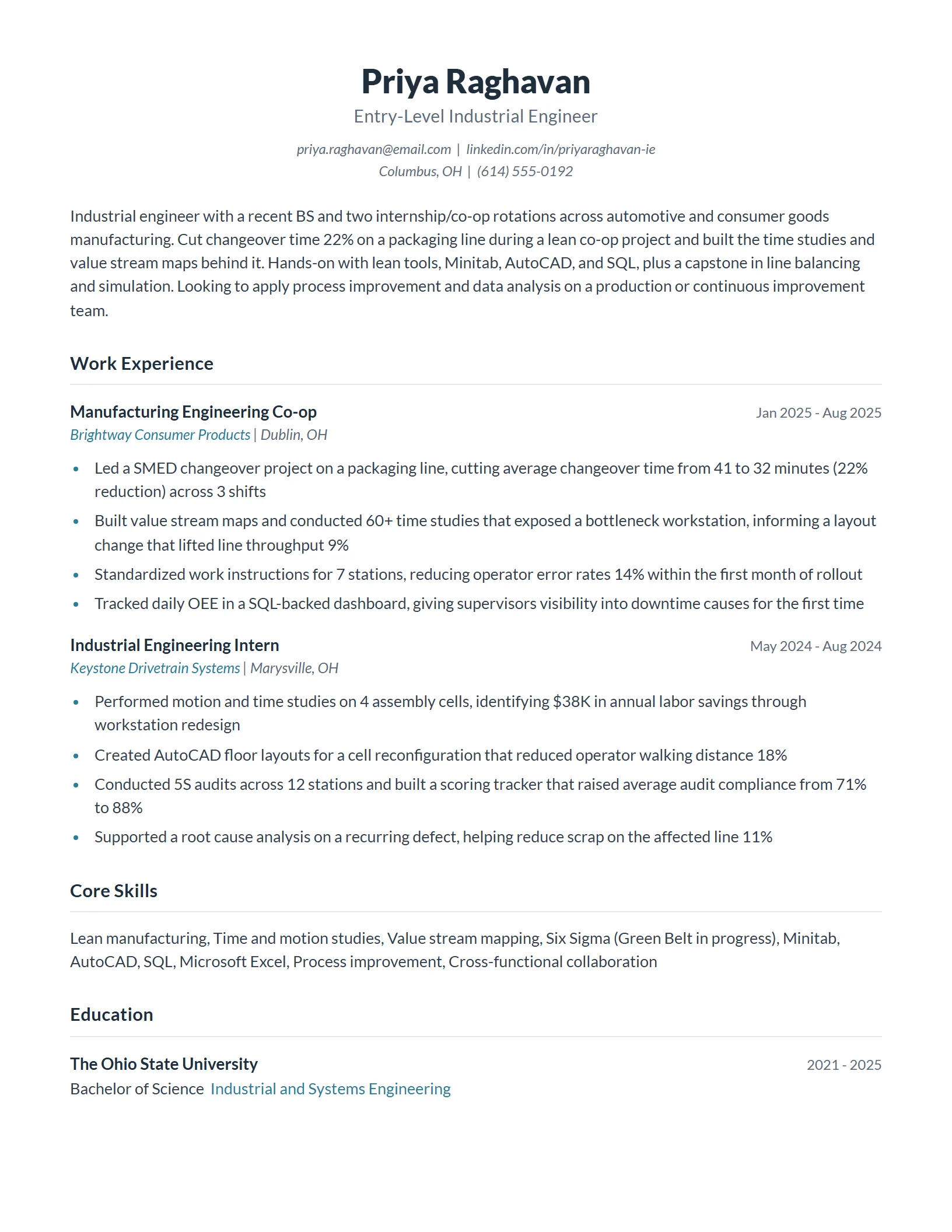
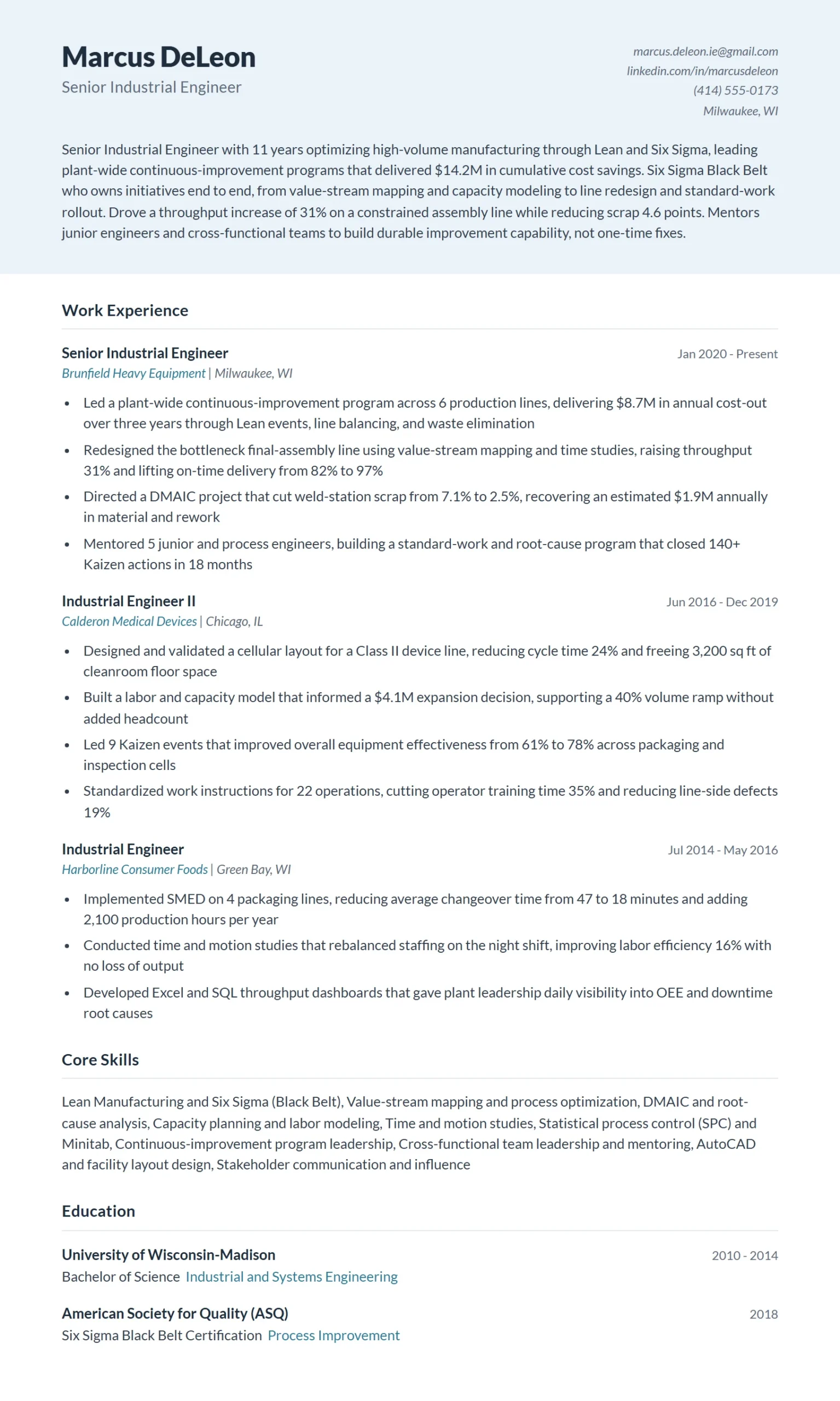


Industrial engineers make systems work better. You map how people, machines, materials, and information move through a process, then redesign it to cut waste, raise throughput, and lower cost. The role spans manufacturing plants, warehouses, hospitals, and supply chains, so your resume has to translate that range into a clear story of measurable improvement.
Hiring managers want proof, not job descriptions. They look for quantified results (percent waste reduced, throughput gained, dollars saved) tied to recognizable methods like lean, Six Sigma, time studies, simulation, and statistical process control. Applicant tracking systems screen for those same terms before a person ever reads your resume, so the right keywords and clean formatting decide whether you make the shortlist.
The examples below show how to do both. Use them to frame your experience around outcomes, surface the tools and certifications recruiters search for, and pass the ATS scan so your work reaches a human.
Ready to build yours? Try our ATS-friendly resume builder or scan your draft against the job description.
Industrial Engineer resume example
A mid-career industrial engineer in a manufacturing setting who leads process-improvement projects and reports results in throughput, cost, and quality terms.
It leads every bullet with a quantified outcome (cycle time cut, scrap reduced, dollars saved) and ties each one to a recognized method like lean or Six Sigma, so the impact reads instantly. The skills section pairs analytical tools (time studies, simulation, SPC) with the lean and continuous-improvement keywords ATS screens for, giving the resume both human credibility and machine readability.
Entry-Level Industrial Engineer resume example
An early-career candidate with an industrial engineering degree, internships or co-ops, and academic projects, applying for a first full-time role.
With less work history to lean on, it puts a relevant degree, lean and Six Sigma coursework, and a quantified capstone or co-op project up front to prove capability fast. Internships are written as real engineering contributions with numbers attached, which reassures hiring managers that the candidate can apply the methods, not just name them.
Senior Industrial Engineer resume example
A seasoned industrial engineer who owns plant-wide or multi-site continuous-improvement programs, mentors junior engineers, and drives large cost and throughput gains.
It opens with a summary that frames scope (sites, teams, and budget influenced) and headlines the biggest financial and operational wins, signaling leadership rather than task execution. A Six Sigma Black Belt and program-level results show the candidate sets direction and delivers at scale, which is what hiring managers expect at the senior level.
Manufacturing Engineer resume example
A close sibling role for industrial engineers focused on production-line and process design, tooling, and cycle-time reduction on the shop floor.

It emphasizes hands-on production wins (cycle-time cuts, scrap and rework reduction, line layout and tooling improvements) and design-for-manufacturing work that separates this role from a pure analytics IE. The keywords skew toward DFM, fixturing, work instructions, and equipment, matching what manufacturing-engineer postings and their ATS filters expect.
Process Engineer resume example
A specialization industrial engineers often move into, centered on process design and control, yield improvement, and standardization across lines or sites.

It foregrounds statistical process control, root-cause analysis, and yield or first-pass-quality gains, showing the candidate stabilizes and improves processes with data. Standardizing procedures across multiple lines or facilities demonstrates the cross-site scope that distinguishes process engineering from single-line work.
Quality Engineer resume example
A related quality-focused role that overlaps heavily with industrial engineering, built around quality systems, audits, and defect reduction.

It leads with quality-system fluency (ISO 9001, CAPA, PPAP, inspection and audit) and defect-reduction results expressed in PPM or cost-of-quality terms, which is exactly what quality-engineer roles screen for. Tying corrective actions to measurable defect drops proves the candidate closes the loop, not just documents problems.
How to write an industrial engineer resume that gets interviews
Hiring managers for industrial engineering roles want proof you can find waste, redesign a process, and move a number: cost, cycle time, throughput, defect rate, or on-time delivery. They are scanning for lean and Six Sigma fluency, the systems you have run, and the dollars and hours you have saved. Most manufacturers and operations teams also run resumes through an Applicant Tracking System (ATS) first, so your language has to match the job description before a person ever reads it. The tips below help you clear the ATS scan and convince the engineering manager reading next.
- Lead every bullet with a quantified efficiency gain: Industrial engineering is the discipline of measurable improvement, so your resume should read that way. Tie each accomplishment to a number: “cut cycle time 18%,” “reduced scrap from 4.2% to 1.1%,” “saved $340K annually by re-balancing the assembly line,” or “raised throughput 25% without adding headcount.” If you cannot attach a metric, attach a before-and-after. A bullet with no number reads like a job duty, not an outcome.
- Name your lean and Six Sigma credentials and methods: Recruiters filter hard on these terms. State your belt level plainly (Six Sigma Green Belt, Black Belt) and name the methods you actually used: 5S, kaizen, value stream mapping, DMAIC, Kanban, SMED, root cause analysis, poka-yoke, time and motion study. If the posting says “continuous improvement” or “lean manufacturing,” use that exact phrase where it is true. These keywords are often the difference between passing and failing the ATS scan.
- Show the tools and systems you have actually run: List the software and systems an industrial engineer is expected to know: AutoCAD or SolidWorks, Minitab for statistical analysis, an ERP or MES platform (SAP, Oracle), simulation tools (Arena, FlexSim), and Excel or SQL for data work. Match these to the job description. A role that names “Minitab” and “SAP” wants to see those words on your resume, not a generic “proficient in engineering software.”
- Quantify scale: lines, plants, SKUs, and budgets: Context makes your numbers credible. Note the size of what you managed: “across 3 production lines,” “a 200,000 sq ft distribution center,” “a 12-person process improvement team,” or “a $2M capital project.” A 20% efficiency gain on one workstation and a 20% gain across a full plant are very different achievements, so give the reader the scale to judge the impact.
- Speak to safety, quality, and compliance: Operations leaders care about more than speed. Show that your improvements held up against quality and safety standards: ISO 9001, OSHA, Six Sigma quality targets, FMEA, statistical process control (SPC). A bullet like “redesigned the workstation layout, cutting motion-related injuries 40% while raising output 15%” signals you optimize the whole system, not just the throughput number.
- Tailor to the sector and keep the format ATS-clean: Industrial engineering spans manufacturing, logistics and supply chain, healthcare systems, and operations consulting, and each rewards different keywords. Reorder your skills and swap your headline projects to mirror each posting. Then keep the layout parseable: standard section headings, a single clean column, no text boxes or graphics that scramble the ATS, and a clear skills section. Run the resume through Jobscan to check your match rate against the job description before you apply.

Industrial Engineer resume summary examples
Your summary is the first thing a recruiter reads. Lead with your specialty, years of experience, and a quantified win.
Good industrial Engineer resume summary examples
- Results-driven industrial engineer with 7+ years optimizing manufacturing and supply chain operations. Led lean and Six Sigma initiatives that cut production cycle time 22% and saved $1.8M annually across 4 production lines. Six Sigma Black Belt fluent in value stream mapping, Minitab, and SAP, with a track record of pairing throughput gains with measurable quality improvement.
- Process improvement engineer specializing in high-volume assembly and warehouse operations. Owns projects end to end, from time and motion studies and DMAIC analysis to floor rollout and SPC controls. Recent work raised on-time delivery from 87% to 98% and reduced scrap 65%, freeing an estimated 11,000 labor hours per year.
- Industrial engineer with a statistics background and Six Sigma Green Belt, focused on data-driven layout and capacity planning. Built a FlexSim simulation model that justified a $2M line investment and increased plant throughput 28%. Known for partnering with operations, quality, and finance to deliver improvements that survive contact with the production floor.
What to avoid
- Hard-working industrial engineer seeking a challenging position where I can apply my skills and grow with a forward-thinking company. (It is entirely about what the candidate wants, not what they deliver. There is no specialization, no methods, no tools, and zero evidence of impact. An engineering manager learns nothing actionable from it.)
- Detail-oriented engineer with strong problem-solving skills and a passion for improving processes and increasing efficiency. (Pure adjectives with no proof. “Improving processes” and “increasing efficiency” are the entire job, stated as a wish rather than a result. It names no method (lean, Six Sigma, SPC), no tool, and no number, so the ATS and the recruiter both pass over it.)
Industrial Engineer resume skills
Pull the exact methods and tools from each job description, then mirror that language here. This is a quick resume snapshot, so keep it to your strongest, role-relevant skills rather than an exhaustive list.
Hard skills for a industrial Engineer resume
- Lean Manufacturing
- Six Sigma (DMAIC)
- Value Stream Mapping
- Process Optimization
- Statistical Process Control (SPC)
- Root Cause Analysis
- Minitab
- AutoCAD / SolidWorks
- ERP / MES (SAP, Oracle)
- Capacity & Production Planning
Soft skills for a industrial Engineer resume
- Cross-Functional Collaboration
- Problem Solving
- Data-Driven Decision Making
- Communication
- Project Management
- Attention to Detail
Industrial Engineer resume work experience bullet point examples
Lead each bullet with a strong verb and a measurable result.
Good bullet point examples
- Led a value stream mapping and kaizen initiative on the main assembly line, cutting cycle time 22% and eliminating $340K in annual labor cost across 3 shifts.
- Applied DMAIC and statistical process control to a high-defect process, reducing scrap from 4.2% to 1.1% and saving an estimated $610K per year in material waste.
- Redesigned warehouse pick paths and slotting using a FlexSim simulation, raising order throughput 28% and improving on-time shipment from 87% to 98%.
- Reconfigured a 12-station workstation layout following a time and motion study, reducing operator travel 35% and cutting motion-related injuries 40% while increasing output 15%.
Bad bullet point examples
- Responsible for improving efficiency on the production floor. (“Responsible for” describes a job duty, not an accomplishment. It names no method, no scope, and no result. Lead with a strong verb (Led, Redesigned, Reduced) and end with a measured outcome instead.)
- Used lean and Six Sigma tools on various projects to reduce waste. (Vague on every dimension. “Various projects” and “reduce waste” give the reader no scale and no number. Name the specific process, the method, and the percentage or dollars saved so the claim is verifiable.)
- Helped the team meet production targets and improve quality. (“Helped” hides your actual contribution, and “improve quality” is unquantified. Replace it with what you personally did and the metric it moved, such as a lower defect rate or a higher first-pass yield.)
Industrial Engineer resume tips
Beyond the fundamentals, these six targeted tips help industrial engineers stand out in applicant tracking systems and with hiring managers reviewing technical resumes.
- Certifications Placement Strategy: List your PE license, CQE, CSSBB, or CPIM in both a dedicated Certifications section and woven into your summary line so ATS parsers catch them regardless of which section the system scans first.
- ATS Formatting Mechanics: Save your resume as a plain .docx or single-column PDF with no tables, text boxes, or headers and footers, because ATS platforms commonly drop data embedded in those elements and your line balancing or capacity metrics disappear entirely.
- Right Resume Length: Keep your resume to one page through roughly eight years of experience, then move to two pages only when you have distinct projects across multiple facilities or product lines that each need a line of context to make sense to a reviewer.
- Portfolio Artifacts: Add a URL to a PDF case study or a shared dashboard showing a value stream map, a simulation model output, or a before-and-after floor layout so hiring managers can see your analytical work rather than only read about it.
- Common Candidate Mistake: The single most frequent mistake industrial engineers make is listing responsibilities pulled from a job description rather than describing the specific constraint they inherited, the method they applied, and the measurable result, which makes every bullet read as generic as a job posting.
- Evidencing Cross-Functional Influence: Prove collaboration by naming the specific teams you aligned, for example writing that you led weekly kaizen reviews with production, quality, and procurement to cut changeover from 47 minutes to 19 minutes, which shows leadership impact more concretely than phrases like strong communicator or team player.
Pair your industrial Engineer resume with a cover letter
A strong resume goes further with a tailored cover letter. Browse our industrial engineer cover letter examples to round out your application.
Industrial Engineer resume frequently asked questions
List the methodologies and tools that show up in your target job postings, since those are the exact terms an ATS scans for. Name your process expertise (Lean, Six Sigma, Kaizen, time and motion studies, value stream mapping), your certifications (Green Belt, Black Belt), and your software (AutoCAD, Minitab, SAP, MATLAB, simulation tools like Arena or FlexSim). Pair the hard skills with measurable results so a recruiter sees both the capability and the impact.
Industrial engineering is built on metrics, so your bullets should be too. Translate each accomplishment into numbers: cycle time reduced by 22 percent, scrap cut from 8 percent to 3 percent, annual savings of 1.4 million dollars, throughput up 15 percent, or OSHA recordables down 40 percent. If you do not have exact figures, use defensible estimates or percentages rather than vague phrases like “improved efficiency.”
Yes, a Six Sigma certification is a strong differentiator for industrial engineering roles and many job descriptions name it directly. Put the belt level (Green Belt, Black Belt) in your summary or skills section so it gets caught early in an ATS scan, then list the full credential and issuing body in a dedicated Certifications section. If a project earned its results through a DMAIC cycle, reference that in the relevant experience bullet to back up the credential with evidence.
Keep your core process-improvement skills constant, then re-weight the rest to match the posting. For manufacturing, foreground production line optimization, capacity planning, OEE, and lean cell design. For logistics or supply chain, lead with warehouse layout, inventory optimization, demand forecasting, and distribution network analysis. Mirror the specific terminology and software named in each job description so both the recruiter and the ATS register an immediate match.
Lead with projects, internships, and quantified coursework rather than waiting for a job title to carry you. Describe a capstone project, a co-op, or a process study using the same structure as a work bullet: the problem, your method (a time study, a simulation, a layout redesign), and the measurable result. Add relevant tools and any certifications in progress, then write a short summary that frames you as an entry-level industrial engineer ready to apply Lean and data analysis.
One page is the standard for early to mid-career industrial engineers and forces you to feature only your highest-impact projects. Move to two pages once you have roughly 10 or more years of experience or a deep list of senior projects that genuinely add value. Keep it scannable with clear section headings and metric-driven bullets, since a recruiter often spends under a minute on the first pass.