Best Manufacturing Engineer Resume Examples for 2026
A manufacturing engineer resume has to prove results on the floor. See 2026 manufacturing engineer resume examples plus the skills and ATS keywords that get interviews.



Manufacturing engineers keep production running and make it better, turning raw processes, tooling, and equipment into lines that build quality parts on time and on budget. The role blends hands-on problem solving with disciplined method: you study how a product gets made, find the bottlenecks and defects, test fixes on the floor, and refine until cost, quality, and throughput all improve. Whether you focus on process, tooling, automation, or continuous improvement, your resume has to prove you move real production metrics, not just keep the line going.
Hiring managers skim a manufacturing engineer resume for evidence. They want the impact of your work (lower scrap, faster cycle times, higher yield, fewer downtime hours) backed by the methods that got you there, like Lean, Six Sigma, and root cause analysis. Before a person ever reads it, though, an applicant tracking system scans for the right signals: tools such as SolidWorks, AutoCAD, and SPC software, methods like GD&T, FMEA, and DOE, and role keywords pulled straight from the job description. A resume that clears the ATS and frames your results in numbers is what earns the interview.
The examples below show how engineers at every level present their experience, from a first co-op project to senior capital work to dedicated process and management roles. Use them as a starting point, then run your own resume through Jobscan to match it against the job description and surface the keywords you are missing before you apply.
Ready to build yours? Try our ATS-friendly resume builder or scan your draft against the job description.
Manufacturing Engineer resume example
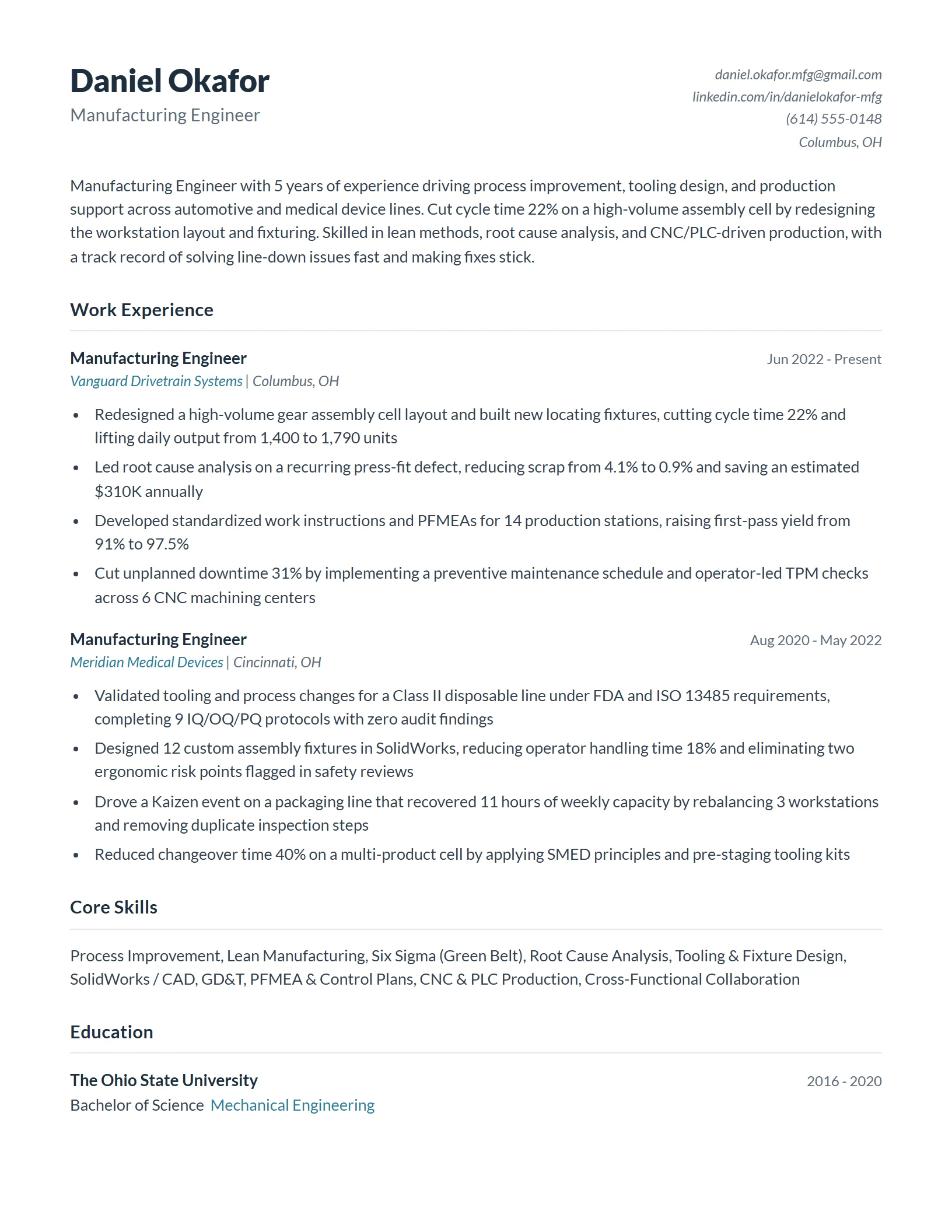
Not sure how to show process work, equipment fixes, and cost savings without it reading like a task list? This manufacturing engineer resume example balances responsibilities with measurable results so hiring managers see your impact fast.
This resume works because it pairs each project with a quantified outcome, like reducing cycle time, lifting first-pass yield, or cutting scrap cost, instead of just listing duties. It leads with a focused skills section that surfaces ATS keywords such as Lean manufacturing, Six Sigma, GD&T, and CAD, then backs them up with experience that shows the full improvement process from problem to result. A clean, single-column layout keeps it easy for both recruiters and the ATS to read.
Senior Manufacturing Engineer resume example
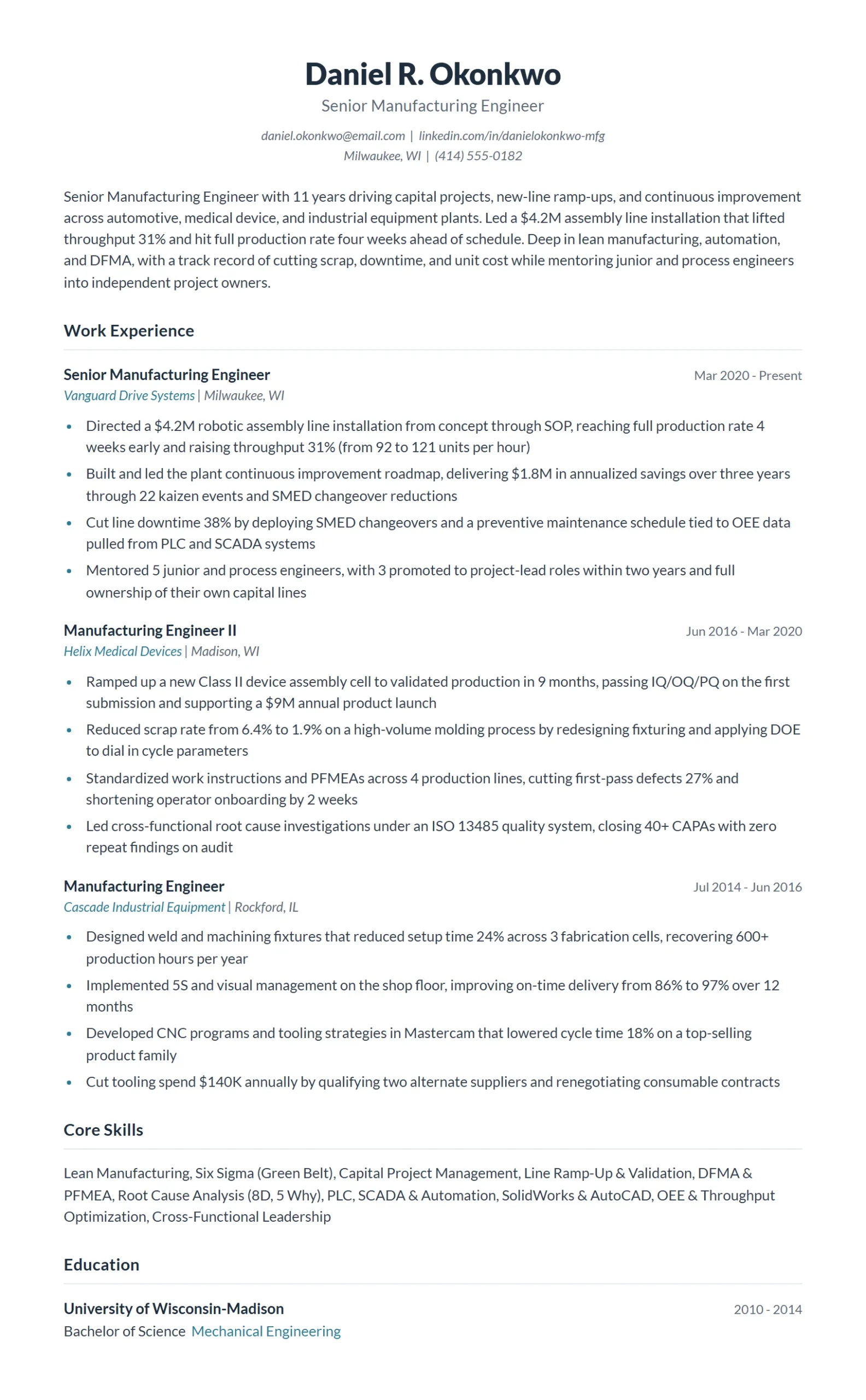
Moving up to a senior role means proving you can lead projects and drive strategy, not just execute. This senior manufacturing engineer resume example shows how to frame capital projects, line ramp-ups, and cross-functional leadership.
This resume works because it shifts the emphasis from individual tasks to ownership and scale: leading new-line installs, managing capital budgets, and setting continuous improvement direction across a plant. Big quantified outcomes (millions in cost avoidance, full-capacity ramps delivered early, defect rates halved) signal seniority a title alone cannot. It still carries the core tool and method keywords an ATS expects, so depth never costs visibility.
Entry-Level Manufacturing Engineer resume example
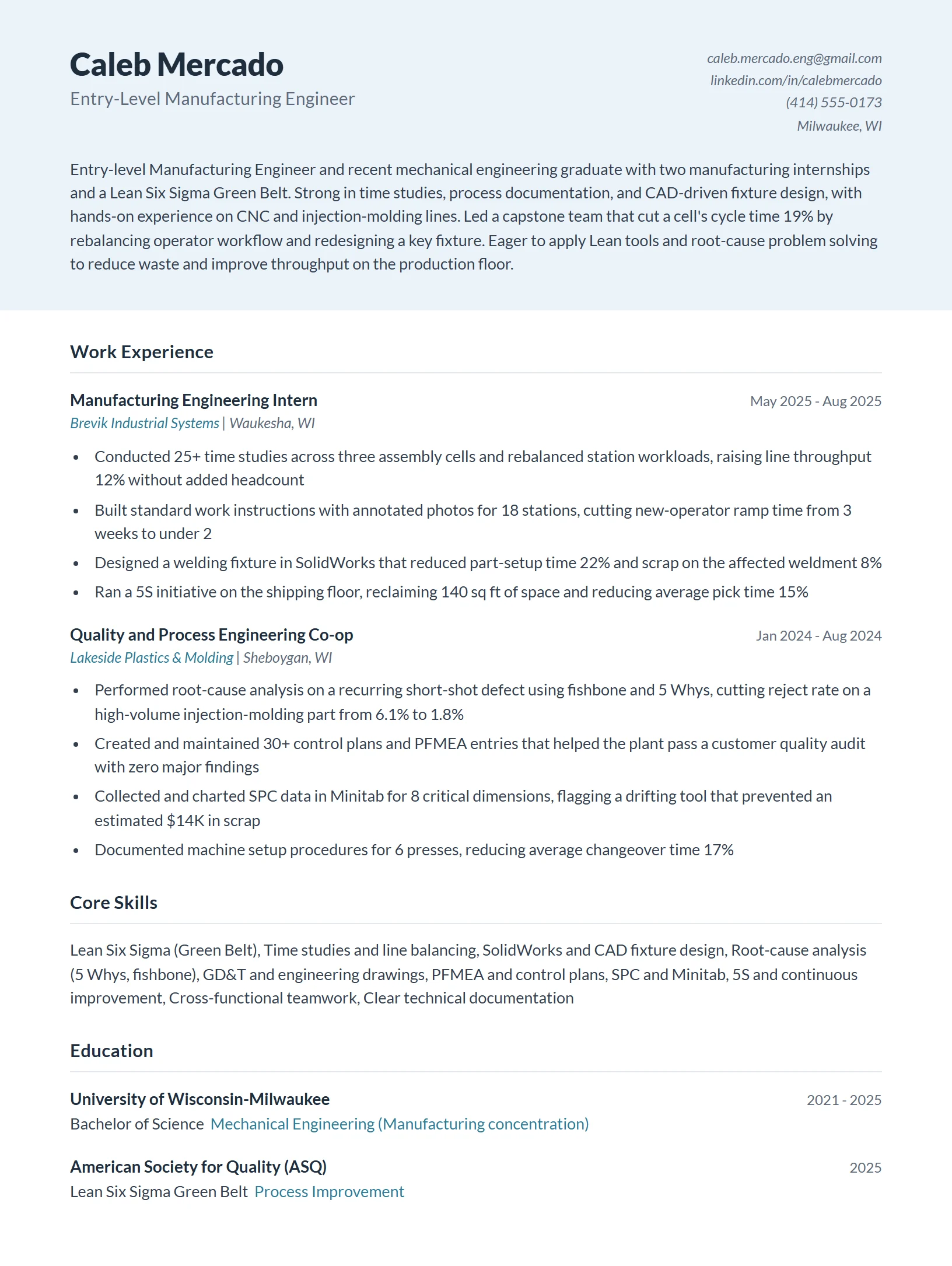
Breaking into manufacturing engineering without years of experience feels tough, but co-ops, internships, and projects can carry real weight. This entry-level manufacturing engineer resume example shows how to make limited experience look strong.
This resume works because it leans on internships, co-ops, capstone projects, and coursework to prove capability when full-time experience is thin. It places a skills and tools section near the top to clear ATS keyword checks for terms like SolidWorks, Lean, and root cause analysis, then describes each project by the problem solved and the method used. Highlighting a Six Sigma certification and hands-on lab or shop work gives hiring managers the proof they need to take a chance on a newer engineer.
Manufacturing Process Engineer resume example
When the role centers on designing and optimizing specific production processes, your resume has to speak in yield, throughput, and stability. This manufacturing process engineer resume example shows how to foreground process expertise and the gains it delivered.

This resume works because it centers process work directly: developing and validating production processes, running DOEs, and improving yield, cycle time, and scrap through controlled experiments. It quantifies each improvement in the metrics a process engineer is measured by, then supports them with method keywords like SPC, FMEA, PFMEA, and process validation that match these job descriptions. Tying every result to a defined process makes it read as a true specialist to both the ATS and the hiring team.
Manufacturing Engineering Manager resume example
A management resume has to prove you can lead a team and own plant-level results, not just solve technical problems. This manufacturing engineering manager resume example shows how to frame leadership, budgets, and production goals.

This resume works because it leads with leadership and business impact: managing a team of engineers, owning capital and operating budgets, and hitting plant-level safety, quality, and output targets. It quantifies outcomes in terms executives care about, like cost per unit, OEE gains, and on-time delivery, while still showing the engineering depth behind the decisions. Pairing people-leadership keywords with core manufacturing methods gives the ATS and the hiring team both signals they screen for.
Process Engineer resume example
Process engineer roles span discrete, chemical, and food production, so your resume has to make your process focus and environment obvious fast. This process engineer resume example shows how to highlight process design, control, and efficiency gains.

This resume works because it foregrounds process design and control: building, monitoring, and optimizing production processes for throughput, quality, and cost. It connects each improvement to a concrete result and supports it with keywords like process optimization, SPC, P&IDs, and continuous improvement that recruiters and the ATS scan for. Naming the production environment and the specific methods used positions you clearly for the right process engineering openings.
How to write a Manufacturing Engineer resume that gets interviews
Hiring managers for manufacturing engineering roles scan a resume for proof you can make a line run faster, cheaper, and with fewer defects. They want process improvements tied to hard numbers, familiarity with lean and Six Sigma, and evidence you can work the floor alongside operators and quality. Most manufacturers also run your resume through an Applicant Tracking System (ATS) first, so your language has to match the job description before a human ever sees it. The tips below show you how to do both: clear the ATS scan and convince the engineering manager reading next.
- Lead every bullet with a quantified process improvement: Manufacturing engineering is a numbers discipline, so your resume should be too. Tie your work to the metrics this field lives by: cycle time, throughput, scrap and rework rates, first-pass yield, OEE, cost per unit, downtime, and on-time delivery. “Reduced cycle time 18%” or “cut scrap from 4.2% to 1.1%, saving $310K annually” tells a hiring manager exactly what you can do for their line. A bullet without a number reads like a job duty, not an achievement.
- Name your lean and Six Sigma methods explicitly: ATS filters and engineering managers both look for the methodology vocabulary: Lean Manufacturing, Six Sigma, Kaizen, 5S, value stream mapping, DMAIC, root cause analysis, PFMEA, SPC, poka-yoke, and Kanban. If you led a Kaizen event or ran a DMAIC project, say so and pair it with the result. If you hold a Green Belt or Black Belt, put it in your header or a certifications line. Use the exact terms from the posting, but only for work you actually did.
- Show the full production lifecycle you own: Strong manufacturing engineers touch the process from design to steady-state production. Reference the arc in your bullets: process design and validation, tooling and fixture design, line layout, PPAP and APQP, work instructions and routings, and the production launch itself. Showing you took a process from prototype through validation to full-rate production signals you can own a line, not just troubleshoot one.
- List the tools, systems, and standards you actually use: Be specific about your technical stack: CAD (SolidWorks, AutoCAD, CATIA), CAM, PLM, an ERP or MES (SAP, Oracle, Epicor), Minitab for statistical analysis, and any GD&T, CNC, PLC, or automation experience. Name the quality and compliance frameworks relevant to the role: ISO 9001, IATF 16949 for automotive, AS9100 for aerospace, or FDA and ISO 13485 for medical devices. Matching the standard named in the posting is often what moves you past the ATS screen.
- Quantify cost, quality, and safety impact together: The best manufacturing engineering bullets connect a technical change to a business result. Pair the action with savings, a quality gain, and a safety or compliance outcome where you have one: “Redesigned a weld fixture that cut rework 30%, saved $145K per year, and eliminated a repetitive-strain ergonomic risk.” Cost reduction, capacity gains, and defect reduction are the three results hiring managers weigh most, so make them easy to find.
- Tailor the resume to the industry and keep the format ATS-clean: An automotive Tier 1 role, an aerospace shop, and a medical-device manufacturer reward different keywords and standards. Reorder your skills and swap your headline projects to mirror each posting’s industry, regulatory framework, and production volume. Then keep the format parse-friendly: standard section headings, a single clean column, no text boxes or graphics that scramble the ATS. Run it through Jobscan to check your match rate against the job description before you apply.

Manufacturing Engineer resume summary examples
Your summary is the first thing a recruiter reads. Lead with your specialty, years of experience, and a quantified win.
Good manufacturing Engineer resume summary examples
- Results-driven Manufacturing Engineer with 7+ years optimizing high-volume production in automotive and consumer goods. Led lean and Six Sigma initiatives that cut cycle time 18%, reduced scrap from 4.2% to 1.1%, and saved $620K annually. Six Sigma Green Belt fluent in SolidWorks, Minitab, and IATF 16949, with a record of launching new lines on time and at full-rate capacity.
- Process-focused Manufacturing Engineer specializing in CNC machining and automation for aerospace components. Owns processes from APQP and PPAP through validation and steady-state production, lifting first-pass yield from 89% to 97% and improving OEE 12 points across three cells. AS9100 and GD&T expertise paired with hands-on PLC and fixture design.
- Manufacturing Engineer with a Six Sigma Black Belt and a track record of cost-down and quality wins in medical-device production. Led Kaizen events and SPC programs that reduced rework 30% and held the line to ISO 13485 and FDA requirements through two successful audits. Strong in SolidWorks, Minitab, and cross-functional launch teams.
What to avoid
- Hardworking manufacturing engineer seeking a challenging role at a growing company where I can use my skills and grow my career. (It is all about what the candidate wants, not what they deliver. There is no industry, no methodology, no tools, and zero evidence of impact. A hiring manager learns nothing they can act on.)
- Detail-oriented engineer passionate about improving processes and solving problems on the production floor. (Pure adjectives with no proof. “Detail-oriented” and “passionate” are claims anyone can make. It names no lean or Six Sigma method, no tools, and no measurable result like cycle time, yield, or cost savings, so the ATS and the recruiter both skip it.)
Manufacturing Engineer resume skills
Pull the exact methods, tools, and quality standards from each job description, then mirror that language here. This is a quick resume snapshot, so keep it to your strongest, role-relevant skills rather than an exhaustive list.
Hard skills for a manufacturing Engineer resume
- Lean Manufacturing
- Six Sigma (DMAIC)
- Root Cause Analysis
- Statistical Process Control (SPC)
- PFMEA
- GD&T
- CAD (SolidWorks, AutoCAD)
- PPAP & APQP
- CNC / PLC Automation
- ISO 9001 / IATF 16949
Soft skills for a manufacturing Engineer resume
- Cross-Functional Collaboration
- Problem Solving
- Communication
- Project Management
- Adaptability
Manufacturing Engineer resume work experience bullet point examples
Lead each bullet with a strong verb and a measurable result.
Good bullet point examples
- Led a DMAIC project on a high-volume assembly line that cut cycle time 18% and increased throughput 2,400 units per shift, adding $480K in annual capacity.
- Redesigned a CNC machining process and weld fixture, reducing scrap from 4.2% to 1.1% and saving $310K per year in material and rework cost.
- Drove a Kaizen and 5S initiative across three production cells that lifted OEE from 68% to 80% and cut unplanned downtime 22%.
- Owned PPAP and APQP for a new automotive component launch, taking the process from prototype to full-rate production on schedule with a 97% first-pass yield.
Bad bullet point examples
- Responsible for improving manufacturing processes and supporting the production team. (“Responsible for” describes a job title, not an accomplishment. It shows no specific action, no method, and no measurable impact. Lead with a strong verb (Led, Redesigned, Implemented) and end with a result instead.)
- Worked on various projects to reduce costs and improve quality on the line. (Vague and unquantified. “Various projects” hides what you actually did, and there is no number behind “reduce costs” or “improve quality.” Name the project and attach a metric like dollars saved, scrap rate, or yield.)
- Used SolidWorks and other tools to design fixtures and help the team. (Lists a tool with no outcome. It tells the reader you opened the software but not whether the fixture cut cycle time, reduced rework, or saved money. Tie the tool to the production result it produced.)
Manufacturing Engineer resume tips
A strong Manufacturing Engineer resume proves you move the needle on throughput, quality, and cost before a hiring manager reaches the second page.
- Mirror Job Description Keywords: Copy exact ATS-targeted terms from each posting, such as PFMEA, APQP, or Statistical Process Control, because systems score your resume on literal keyword matches before a human reviews it.
- Quantify Process Improvements: Anchor every achievement to the metrics manufacturers care about most: cycle time reduction (percentage), scrap or defect rate (PPM or percent), yield improvement, and annual cost savings in dollars.
- Name Your Tools Explicitly: List the specific software and methodologies you used on each project, such as SolidWorks for fixture design or DMAIC for a Six Sigma kaizen, because generic phrases like ‘CAD experience’ will not pass targeted ATS filters.
- Highlight Certifications Prominently: Place credentials like Six Sigma Green Belt, Six Sigma Black Belt, or APQP certification in a dedicated certifications section near the top so both ATS parsers and hiring managers find them immediately.
- Show Floor-Level Collaboration: Call out instances where you partnered directly with operators, quality technicians, or suppliers, because manufacturing managers specifically look for engineers who can drive change on the production floor, not just in an office.
- Keep It One Page (Under 10 Years): Limit your resume to one page if you have fewer than ten years of experience, because plant-floor hiring managers review dozens of candidates quickly and reward concise, scannable documents over dense multi-page narratives.
Pair your manufacturing Engineer resume with a cover letter
A strong resume goes further with a tailored cover letter. Browse our manufacturing engineer cover letter examples to round out your application.
Manufacturing Engineer resume frequently asked questions
List the methodologies and tools recruiters and ATS systems actually scan for: Lean Manufacturing, Six Sigma (with your belt level), root cause analysis, DFM/DFMA, GD&T, SPC, and PFMEA. Pair those with hands-on tools like CAD (SolidWorks, AutoCAD), PLC programming, ERP/MES systems, and CAM software. Match the exact terms to the job description, because a posting that asks for ‘Lean’ will not always credit you for writing ‘continuous improvement.’
Tie every bullet to a number a plant manager cares about: cycle time, scrap rate, yield, throughput, downtime, OEE, or cost per unit. For example, ‘Redesigned the assembly line layout, cutting cycle time 22% and reducing scrap from 4.1% to 1.3%.’ If you do not have exact figures, use defensible estimates and percentages rather than vague claims like ‘improved efficiency.’
Yes, because both ATS keyword filters and hiring managers look for them. Name the CNC machines, robotics (FANUC, ABB), injection molding, CMMs, and PLC platforms you have actually operated or programmed. List certifications like Six Sigma Green or Black Belt, Lean Manufacturing, PMP, or a Certified Manufacturing Engineer (CMfgE) credential in a dedicated section so they are easy to scan.
Pull the exact keywords from the job posting (methodologies, software, and equipment) and work them naturally into your summary, skills section, and bullet points. Use a clean single-column layout with standard headings, save as a .docx or text-based PDF, and avoid tables, text boxes, and graphics that scanners misread. Run your resume through an ATS checker against the specific job description to confirm your match rate before applying.
A Manufacturing Engineer resume should emphasize production systems, plant operations, tooling, automation, and end-to-end line efficiency, while a Process Engineer resume leans harder on optimizing and validating specific processes, often in chemical, semiconductor, or pharmaceutical settings. If you are targeting both, mirror each posting’s language and lead with the accomplishments most relevant to that title. Keep one master version and create tailored copies rather than sending the same document to every role.
One page is right for early-career engineers with under 10 years of experience, and two pages is acceptable once you have a longer record of projects, leadership, and quantified results. Prioritize recent and relevant work; a 15-year-old machine you no longer use does not need a bullet. Cut generic duties and keep the space for measurable outcomes and the skills that match the job.