Best Project Engineer Resume Examples for 2026
Build a Project Engineer resume that proves you can run scope, schedule, and budget, with real examples and the keywords ATS scans for.



A Project Engineer sits where the design meets the build. You translate drawings and specs into a buildable plan, then keep scope, schedule, budget, and quality on track while coordinating engineers, subcontractors, and clients. The role is the proving ground between junior engineer and project manager, so your resume has to show both technical depth and the ability to move a project forward.
Hiring managers want to see outcomes, not duties. They scan for projects you owned, dollar values you managed, schedules you protected, and problems you solved with RFIs, submittals, and change orders. Before a person reads it, an applicant tracking system parses your resume for the exact terms in the job posting: tools like Procore and Bluebeam, processes like cost control and quality assurance, and credentials like your engineering degree, EIT, or PE.
The examples below show how to do both. Use them to frame your experience around measurable results, mirror the language of the role you want, and clear the ATS filter so a hiring manager actually sees your work.
Ready to build yours? Try our ATS-friendly resume builder or scan your draft against the job description.
Project Engineer resume example
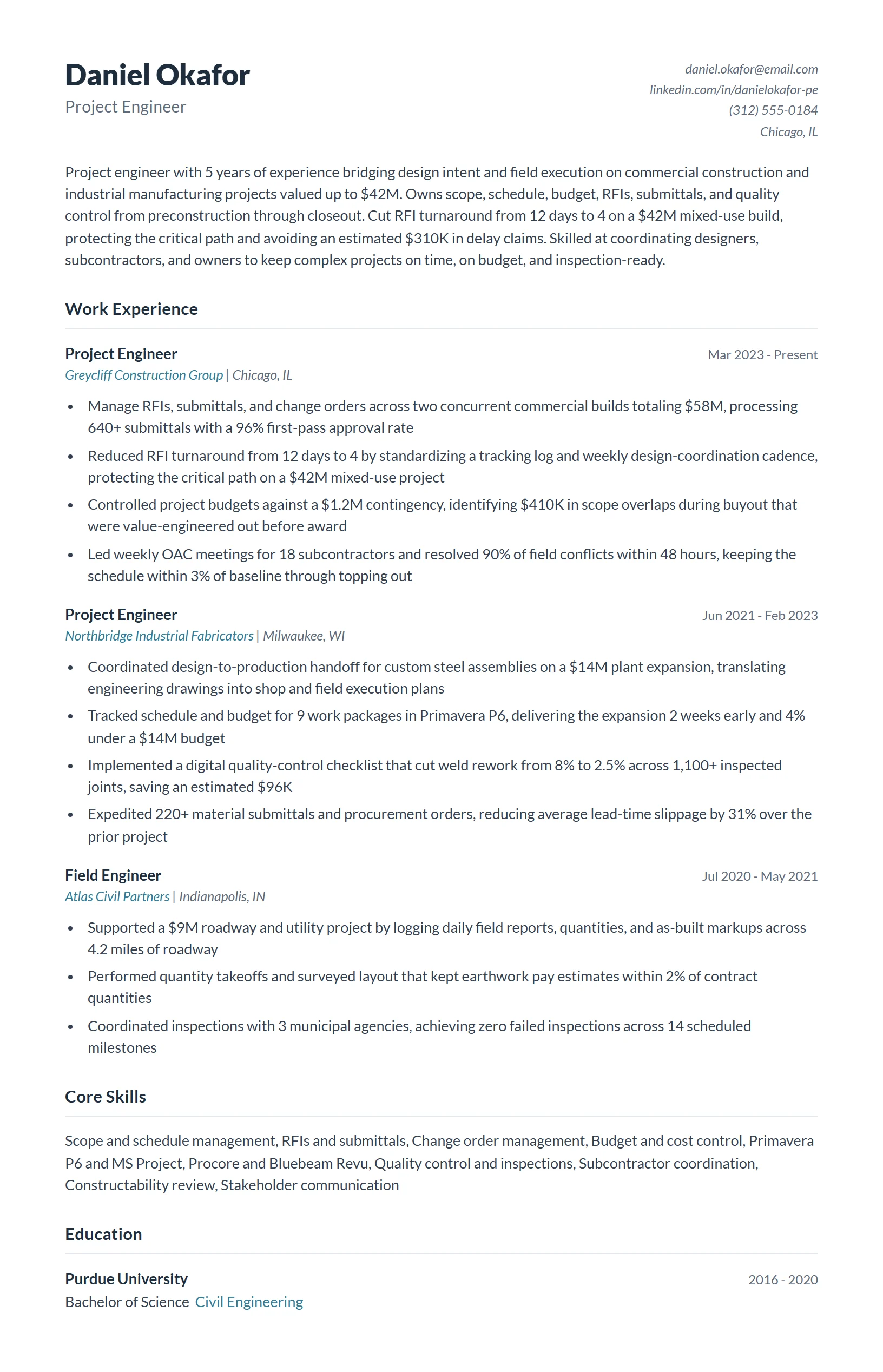
A mid-career Project Engineer who has carried commercial projects from preconstruction through closeout, owning submittals, RFIs, and cost tracking alongside the project manager.
This resume leads with project values and quantified results: total contract dollars managed, schedule variance held to single digits, and cost savings from value engineering. It names the tools recruiters search for, like Procore and Bluebeam, and frames each bullet around an outcome rather than a task, which is exactly what both the ATS and the hiring manager are looking for.
Senior Project Engineer resume example
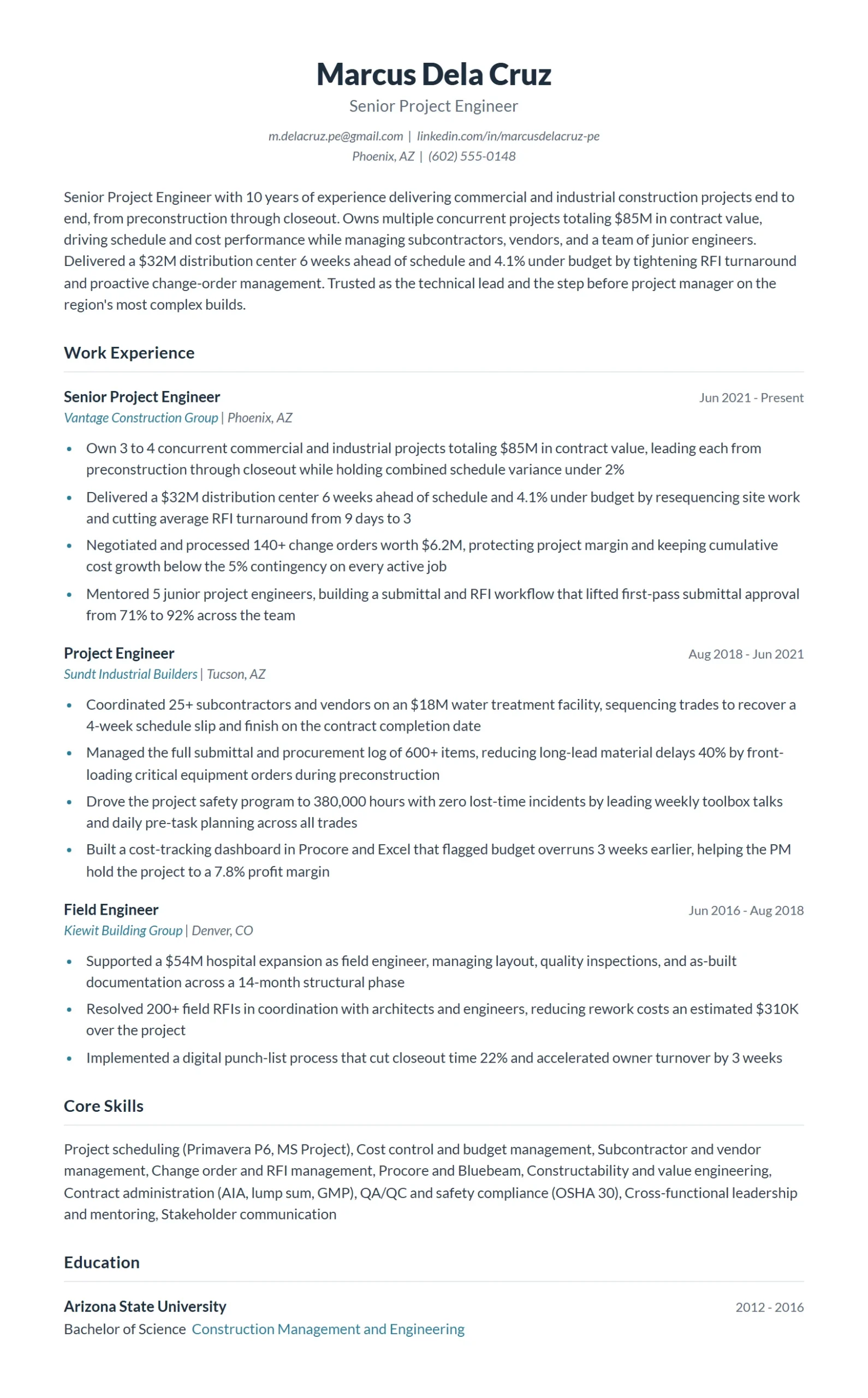
A senior engineer who runs multiple or high-value projects at once, manages subcontractors and vendors, and mentors the junior engineers behind them.
The summary positions this candidate as one step from project manager, leading with portfolio scale (number of concurrent projects and combined budget) instead of individual tasks. Bullets emphasize leadership, vendor negotiation, and schedule recovery on troubled projects, signaling the ownership and judgment that separate a senior engineer from a mid-level one.
Entry-Level Project Engineer resume example
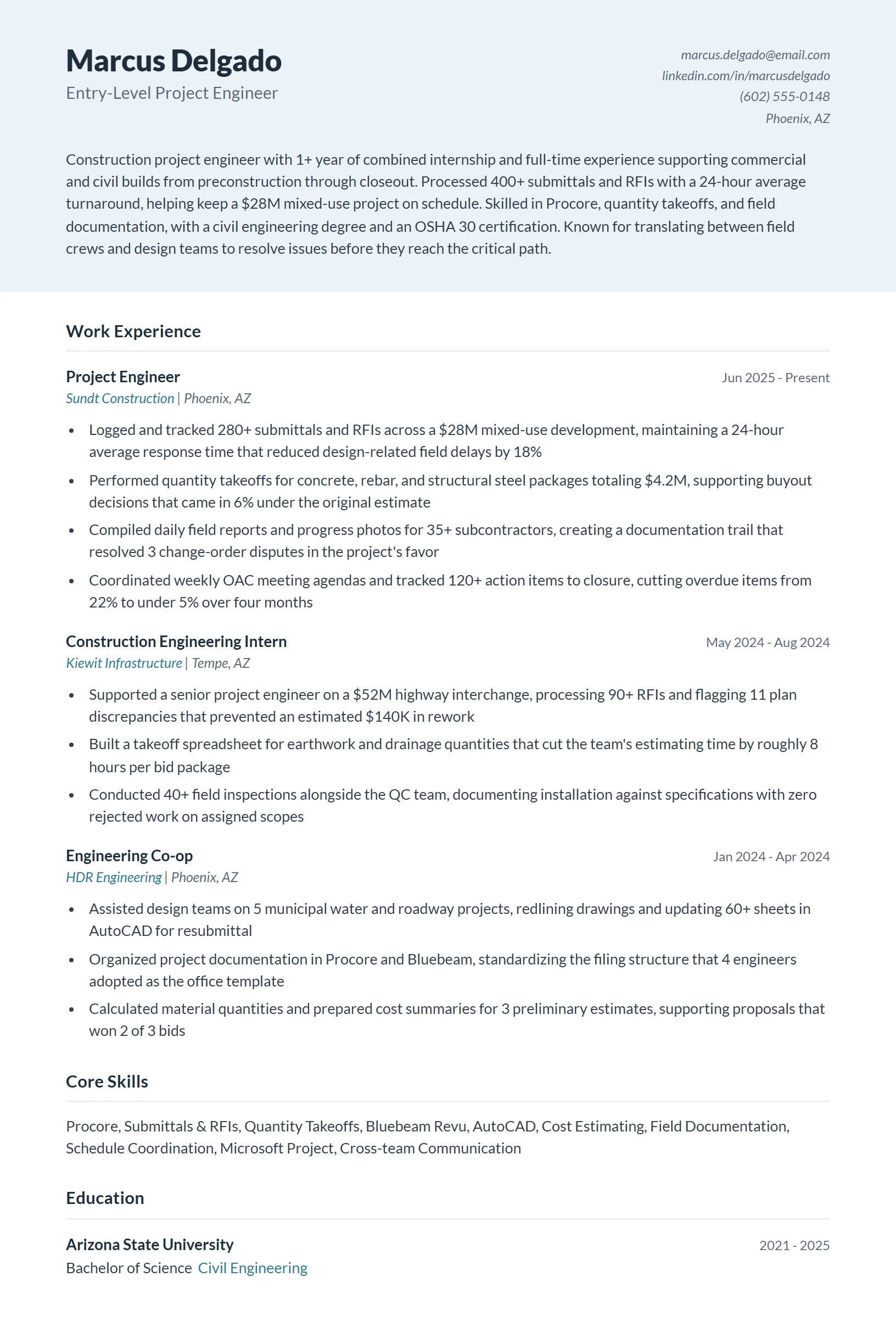
A recent engineering graduate moving from internships and co-ops into a first full-time Project Engineer role.
With limited work history, this resume puts the engineering degree, EIT status, and relevant coursework near the top, then turns internship and capstone work into achievement-driven bullets. It mirrors entry-level posting language (supporting RFIs, submittals, and takeoffs) so the resume still matches keyword filters even without years of experience to point to.
Construction Project Engineer resume example
A construction-focused Project Engineer managing submittals, RFIs, change orders, and subcontractor coordination on commercial and infrastructure builds.
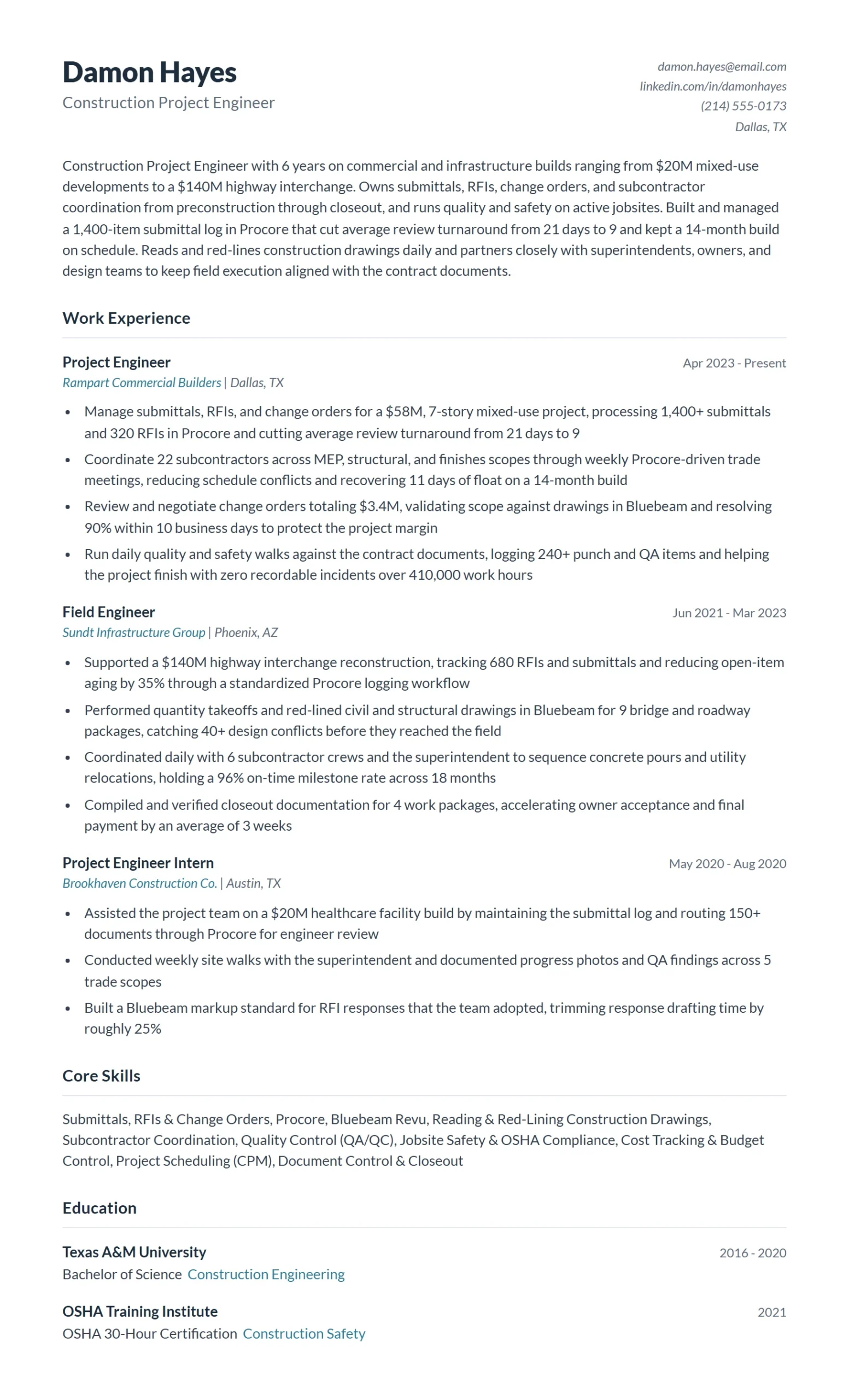
Every bullet is grounded in construction language an ATS expects for this niche: change order management, subcontractor buyout, QA/QC, and safety compliance. It quantifies impact in the terms that matter on a jobsite, like change orders processed, RFI turnaround time, and budget held against a multimillion-dollar contract, proving fluency in how real projects get built.
Field Engineer resume example
An on-site Field Engineer who owns layout, daily reports, inspections, and the coordination between field crews and the project office.
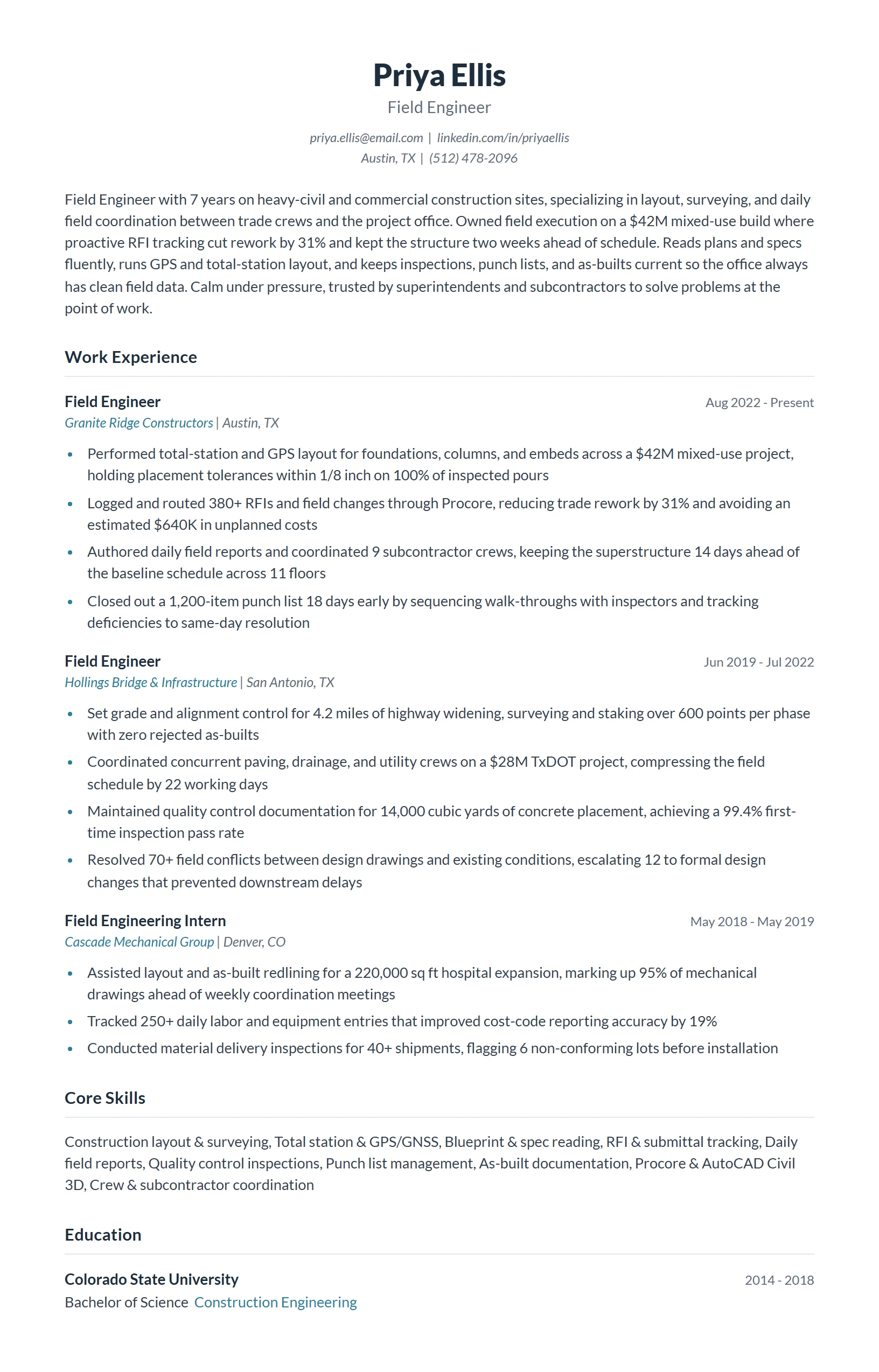
This resume is built around execution: surveying and layout accuracy, inspection pass rates, punch-list closeout, and daily documentation that kept the project record clean. It leans on field-specific tools and certifications (total station, OSHA 30) and shows the candidate as the office’s eyes on the ground, which is the distinct value a field engineer brings versus a desk-based project engineer.
How to write a Project Engineer resume that gets interviews
Hiring managers scan a Project Engineer resume for proof you can keep a project on scope, on schedule, and on budget while coordinating engineers, contractors, and field crews. They want hard numbers: project values, schedule variance, cost savings, and the tools you ran them with. Most employers also screen your resume through an Applicant Tracking System (ATS) first, so the language has to match the job description before a human reads it. The tips below show you how to clear the ATS scan and convince the hiring manager who reads next.
- Lead with project scale, scope, and your three numbers: A Project Engineer’s value lives in scope, schedule, and budget. State the size and type of projects you supported (a $12M commercial build-out, a 200-unit residential phase, a plant retrofit) and the dollar value you were responsible for. A reader who sees “coordinated 15 subcontractors across a $12M project” instantly understands your level. Vague phrases like “assisted on construction projects” force them to guess, and they usually guess low.
- Quantify outcomes, not just duties: Anyone can say they tracked a schedule. Show what it did: “brought the project in 6 weeks ahead of schedule,” “cut material costs 9% through value engineering,” or “reduced RFI turnaround from 10 days to 3.” Tie your work to schedule variance, budget vs. actual, cost savings, change-order value, or safety incident rate. If you do not have dollar figures, use percentages, counts, and timelines. They prove impact just as well.
- Name the project-controls vocabulary the role lives on: ATS scans for specific terms, and Project Engineer postings are dense with them. Use the exact language of the work: RFIs, submittals, change orders, punch lists, scope of work, project schedules, budgets and forecasts, and quality control. List the software you actually run (Procore, Primavera P6, MS Project, AutoCAD, Bluebeam, Revit, SAP). If the posting says “submittal management” and you have done it, use that phrase, not a synonym.
- Show the field-and-office balance: Project Engineers translate between the design office and the job site, so prove you operate in both. Reference site walks and inspections, coordinating with superintendents and subcontractors, and resolving constructability issues in the field, alongside the office work of cost tracking, document control, and reporting to the project manager. A resume that reads as pure paperwork (or pure field labor) misses what the role actually is.
- Make safety and compliance explicit: On capital and construction projects, safety and code compliance are non-negotiable, and hiring managers look for candidates who treat them that way. Reference OSHA standards, job-site safety, quality inspections, and the codes or specs you worked to (IBC, local building codes, ASME, industry standards). A bullet like “maintained zero recordable incidents across an 18-month project” signals you can be trusted with liability, not just tasks.
- Tailor to the industry and keep the format ATS-clean: A construction Project Engineer, a manufacturing Project Engineer, and a civil/infrastructure Project Engineer reward different keywords and projects. Reorder your skills and swap your headline projects to mirror each posting’s industry. Then keep the format parseable: standard section headings, a single clean column, no text boxes or graphics that scramble the ATS. Run it through Jobscan to check your match rate against the job description before you apply.

Project Engineer resume summary examples
Your summary is the first thing a recruiter reads. Lead with your specialty, years of experience, and a quantified win.
Good project Engineer resume summary examples
- Project Engineer with 5+ years supporting commercial and industrial construction projects valued up to $30M. Manages RFIs, submittals, and change orders while coordinating 20+ subcontractors, with a record of bringing projects in on or ahead of schedule. Proficient in Procore, Primavera P6, and Bluebeam, and delivered $1.8M in value-engineering savings across recent builds.
- Detail-driven Project Engineer specializing in manufacturing capital projects from design through commissioning. Owns project scheduling, budget tracking, and quality control, recently delivering a $14M plant retrofit 7% under budget with zero recordable safety incidents. Strong in MS Project, AutoCAD, and cross-functional coordination between engineering, procurement, and field teams.
- Civil-focused Project Engineer with experience on $50M+ infrastructure and site-development projects. Manages submittals, document control, and contractor coordination, and reduced RFI turnaround from 9 days to 3 through tighter document workflows. Skilled in Primavera P6, Civil 3D, and OSHA-compliant field oversight.
What to avoid
- Hardworking project engineer looking for a challenging opportunity to grow my career and apply my engineering skills with a great company. (It is about what the candidate wants, not what they deliver. There is no project scale, no software, no scope/schedule/budget signal, and zero evidence of impact. A hiring manager learns nothing they can act on.)
- Motivated team player with strong communication and problem-solving skills and a passion for engineering and construction. (Pure adjectives with no proof. “Strong communication” and “passion” are claims anyone can make. It names no projects, no project-controls vocabulary, and no measurable result, so the ATS and the recruiter both skip it.)
Project Engineer resume skills
Pull the exact tools, codes, and project-controls terms from each job description, then mirror that language here. This is a quick resume snapshot, so keep it to your strongest, role-relevant skills rather than an exhaustive list.
Hard skills for a project Engineer resume
- Project Scheduling (Primavera P6, MS Project)
- Budget & Cost Control
- RFIs & Submittals
- Change Order Management
- Procore
- AutoCAD / Revit
- Quality Control & Inspections
- Document Control
- OSHA & Safety Compliance
- Subcontractor Coordination
Soft skills for a project Engineer resume
- Communication
- Problem Solving
- Organization
- Cross-Functional Coordination
- Attention to Detail
- Time Management
Project Engineer resume work experience bullet point examples
Lead each bullet with a strong verb and a measurable result.
Good bullet point examples
- Managed RFIs, submittals, and change orders for a $22M commercial construction project, processing 300+ submittals and cutting RFI turnaround from 10 days to 3.
- Tracked project budget and forecasts against a $14M baseline, identifying $1.8M in value-engineering savings and delivering the project 7% under budget.
- Coordinated 18 subcontractors and weekly site walks with the superintendent, resolving constructability issues that kept the project 6 weeks ahead of schedule.
- Maintained quality control and OSHA-compliant safety oversight across an 18-month build, achieving zero recordable incidents and passing all third-party inspections on first review.
Bad bullet point examples
- Responsible for assisting the project manager with various construction tasks. (“Responsible for” and “various tasks” describe a job title, not an accomplishment. There is no project value, no specific action, and no result. Lead with a strong verb (Managed, Coordinated, Tracked) and end with a number.)
- Helped keep projects on track and worked with contractors and the team. (Vague and unquantified. “On track” and “the team” tell the reader nothing about scale or outcome. Name the project value, the count of contractors, and the schedule or budget result instead.)
- Used software to manage documents and schedules for the company. (Lists a tool category with no specifics and no impact. Which software, which project, what changed? Name the platform (Procore, Primavera P6) and the measurable result it produced, such as faster document turnaround or fewer schedule slips.)
Project Engineer resume tips
Beyond the basics, these six tips address the details that separate a good Project Engineer resume from one that clears ATS filters and earns interviews.
- Certifications Placement: List your PMP, EIT, PE, OSHA 30, or relevant LEED credential in a dedicated Certifications section AND in your resume summary so ATS parsers catch it in both locations.
- ATS File Mechanics: Submit a .docx or plain .pdf with a single-column layout, no tables, no text boxes, and no information buried in headers or footers, since ATS tools routinely drop content stored in those areas.
- Resume Length Rule: Keep your resume to one page if you have fewer than eight years of experience, and use two pages only if every line reflects a distinct project, role, or credential that a hiring manager would act on.
- Common Resume Mistake: The single most common mistake Project Engineers make is listing software and tools without connecting them to a project outcome, for example writing ‘used Primavera P6’ instead of ‘rebuilt the project baseline in Primavera P6 after a scope change that shifted 40 activities.’
- Portfolio Artifacts: Add a clean hyperlink in your contact header to a one-page project sheet, a schedule excerpt, or a portfolio PDF that shows an actual deliverable, since a concrete artifact gives a hiring manager evidence your tools produced real results.
- Evidence Collaboration Skill: Rather than claiming you are a strong communicator, write one bullet that names who you coordinated with and what it prevented, such as ‘aligned weekly with the civil, structural, and MEP leads to resolve 23 RFIs before they became schedule impacts.’
Pair your project Engineer resume with a cover letter
A strong resume goes further with a tailored cover letter. Browse our cover letter examples to round out your application.
Project Engineer resume frequently asked questions
A project engineer resume should lead with technical depth: the systems, drawings, specifications, and engineering decisions you owned, alongside the scheduling and coordination work you supported. A project manager resume leans harder on budget ownership, stakeholder management, and full project lifecycle accountability. If you are targeting project engineer roles, keep your engineering credentials and hands-on technical contributions front and center, then show the coordination and planning skills that prove you can grow into management.
Tie each bullet to a number the business cares about: budget managed, schedule days saved, RFIs or submittals processed, change orders reduced, or rework percentage cut. For example, “Coordinated 14 subcontractors across a $6M commercial build and delivered the project 9 days ahead of schedule” beats “Responsible for project coordination.” If you cannot find a hard metric, use scope (square footage, number of systems, team size) so a recruiter can gauge the size of what you handled.
Yes, always. Put a Professional Engineer (PE) license or Engineer in Training (EIT) designation near the top, in your header or a dedicated certifications section, since these are often exactly what an ATS and a hiring manager scan for first. Include the state of licensure and the discipline (civil, mechanical, electrical). If you are still pursuing the PE, listing “EIT, PE candidate (exam scheduled Q3 2026)” signals momentum and is worth the line.
Match the tools to your discipline and to the job posting. Common entries include AutoCAD, Revit, Civil 3D, Procore, Primavera P6, Microsoft Project, Bluebeam, and SAP, plus methods like RFI and submittal management, cost estimating, and QA/QC. Pull the exact software names from the job description, because applicant tracking systems often screen for those literal terms. Group them under a clear “Technical Skills” heading so a reviewer can find them in seconds.
Lead with relevant coursework, your degree, and any hands-on projects, internships, or co-ops where you touched real engineering work. Describe each project the way you would a job: the problem, the tools and methods you used, and the measurable result, even if it was an academic deliverable. Add certifications like EIT, OSHA 30, or LEED to show initiative, and write a short summary that frames you as an entry-level project engineer rather than apologizing for limited experience. A capstone project or a construction internship often carries more weight than you expect.
One page is right for most project engineers with under 10 years of experience, and it forces you to keep only your strongest, most relevant projects. Move to two pages once you have a long record of large or complex projects that genuinely add value, such as senior roles or major capital programs. Keep older or smaller projects brief and let your recent, highest-impact work take the space. Recruiters often spend under a minute on a first pass, so a tight, scannable layout wins.