Best Lawyer Resume Examples for 2026
A lawyer resume has to prove results, not just list cases. See 2026 lawyer resume examples and the skills and ATS keywords that win interviews.



Lawyers advise clients, build arguments, and carry matters from intake to resolution, whether that means a courtroom, a negotiation table, or a closing. The work rewards precision, judgment, and the ability to turn dense facts into a clear position. Whatever your practice area, your resume has to do the same thing: take years of casework and make your value obvious in a single, scannable page.
Hiring partners and legal recruiters read a lawyer resume for evidence. They want outcomes (cases won, settlements reached, deals closed, risk avoided) and the credentials that back them up: your bar admissions, your JD, and your practice-area depth. Before a person ever opens it, though, an applicant tracking system scans for the right signals, including practice areas like litigation or M&A, skills like legal research and contract drafting, and the exact terms pulled from the job posting. A resume that clears the ATS and frames your results clearly is what earns the interview.
The examples below show how attorneys at every level and across practice areas present their experience, from a first associate role to senior counsel to focused litigation and corporate work. Use them as a starting point, then run your own resume through Jobscan to match it against the job description and catch the keywords you are missing before you apply.
Ready to build yours? Try our ATS-friendly resume builder or scan your draft against the job description.
Lawyer resume example
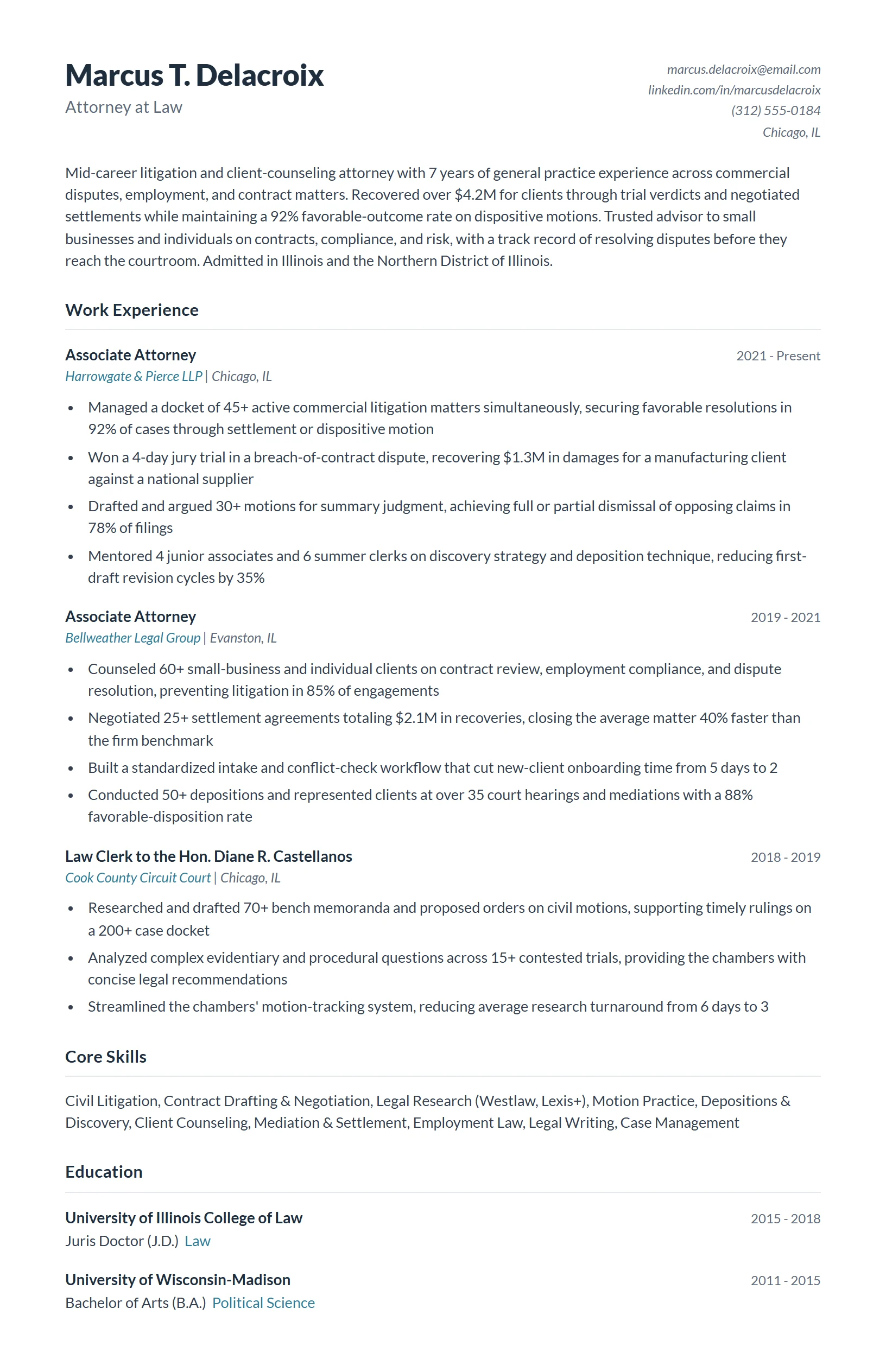
Not sure how to fit years of casework and client wins onto one page without it reading like a docket? This lawyer resume example shows how to balance practice areas, outcomes, and credentials so hiring partners see the full picture.
This resume works because it pairs each role with concrete results, like favorable verdicts, settlement values, and matters resolved, instead of just listing responsibilities. It surfaces a clear practice-area and skills section near the top so ATS keyword checks for legal research, drafting, and litigation are covered early. Bar admissions and the JD sit where a recruiter expects them, and the clean single-column format keeps the whole thing easy to scan.
Entry-Level Lawyer resume example
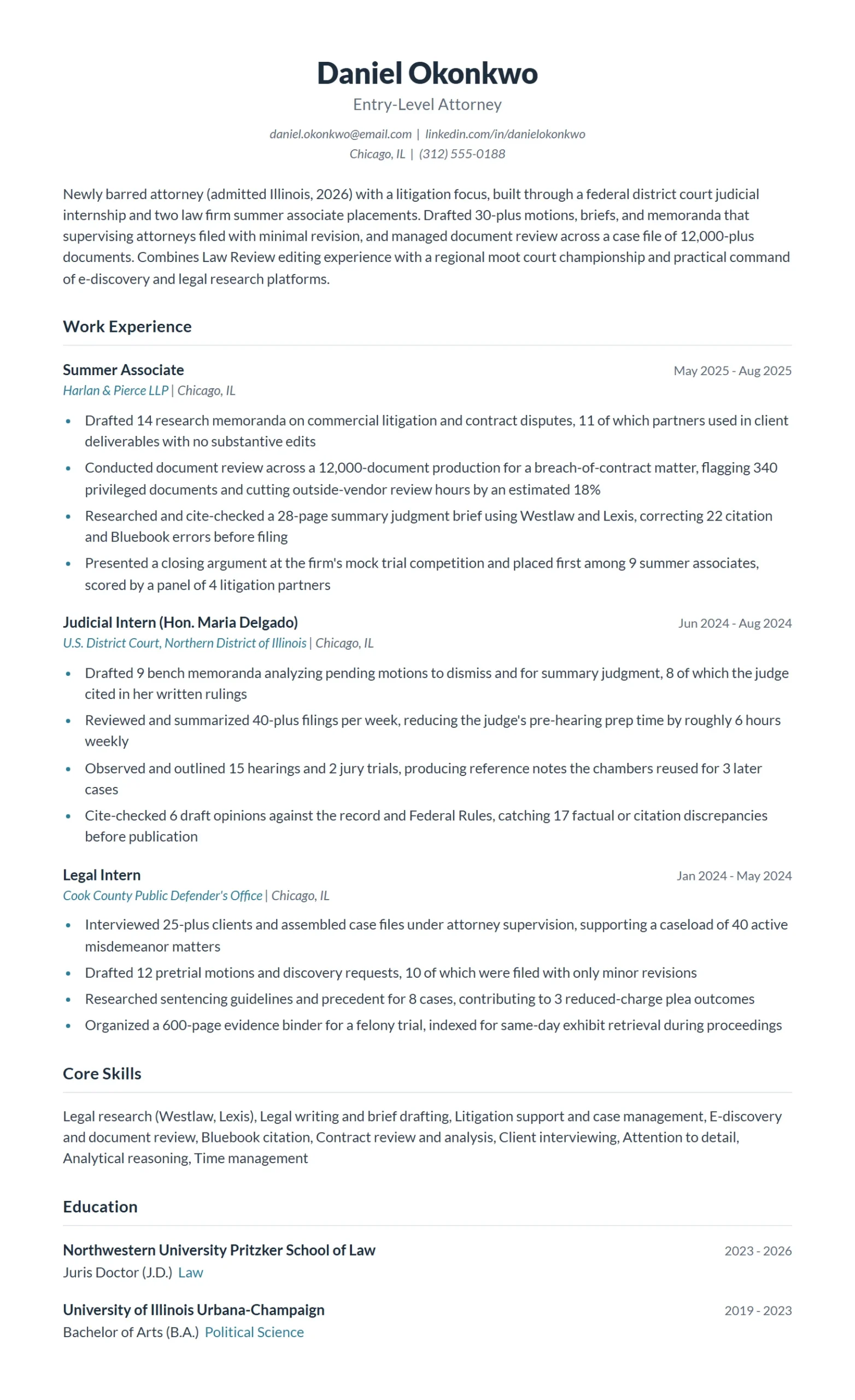
Landing your first associate role without a long case history feels daunting, but your education and clinical work can carry the weight. This entry-level lawyer resume example shows how to make limited experience look strong.
This resume works because it leans on law school, clerkships, internships, and journal or moot court experience to prove capability when billable history is thin. It places bar admission status and the JD up top, then frames each clinic and internship by the legal work performed and the result, showing you already think like a practitioner. Keywords like legal research, brief writing, and case management clear the ATS and signal you are ready to contribute on day one.
Senior Lawyer resume example
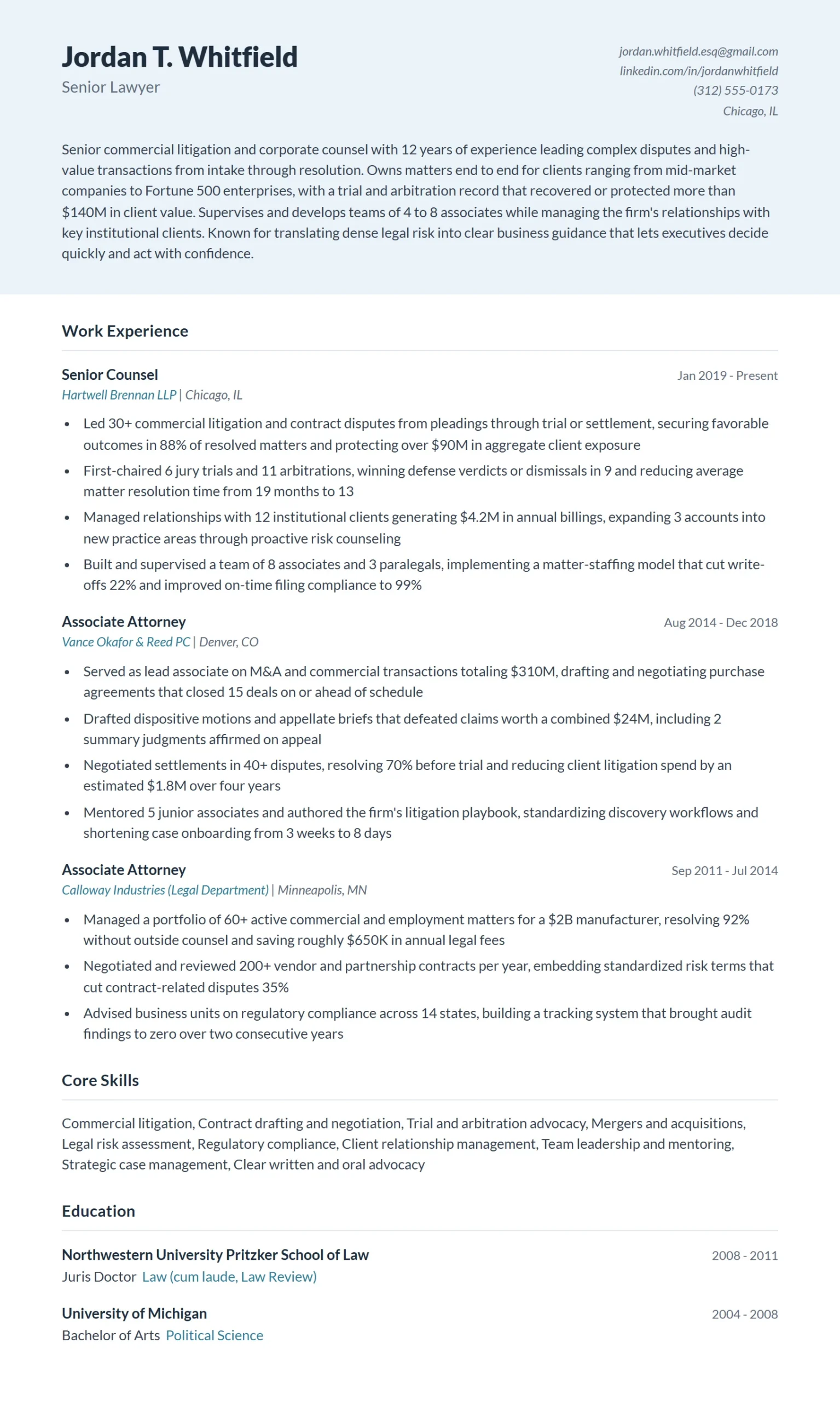
Moving into counsel or partner-track work means proving you can own matters and lead people, not just bill hours. This senior lawyer resume example shows how to frame complex wins, supervision, and client ownership.
This resume works because it shifts the emphasis from tasks to leadership and impact at scale: leading high-stakes matters, supervising associates, and managing the client relationships that drive a book of business. Quantified outcomes (settlement and deal values, win rates, revenue protected) signal a seniority that a title alone cannot. It still carries the core practice-area and skills keywords an ATS expects, so depth never costs you visibility.
Corporate Lawyer resume example
Transactional work is judged on deals closed and risk managed, not courtroom drama. This corporate lawyer resume example shows how to foreground M&A, contracts, and governance experience.
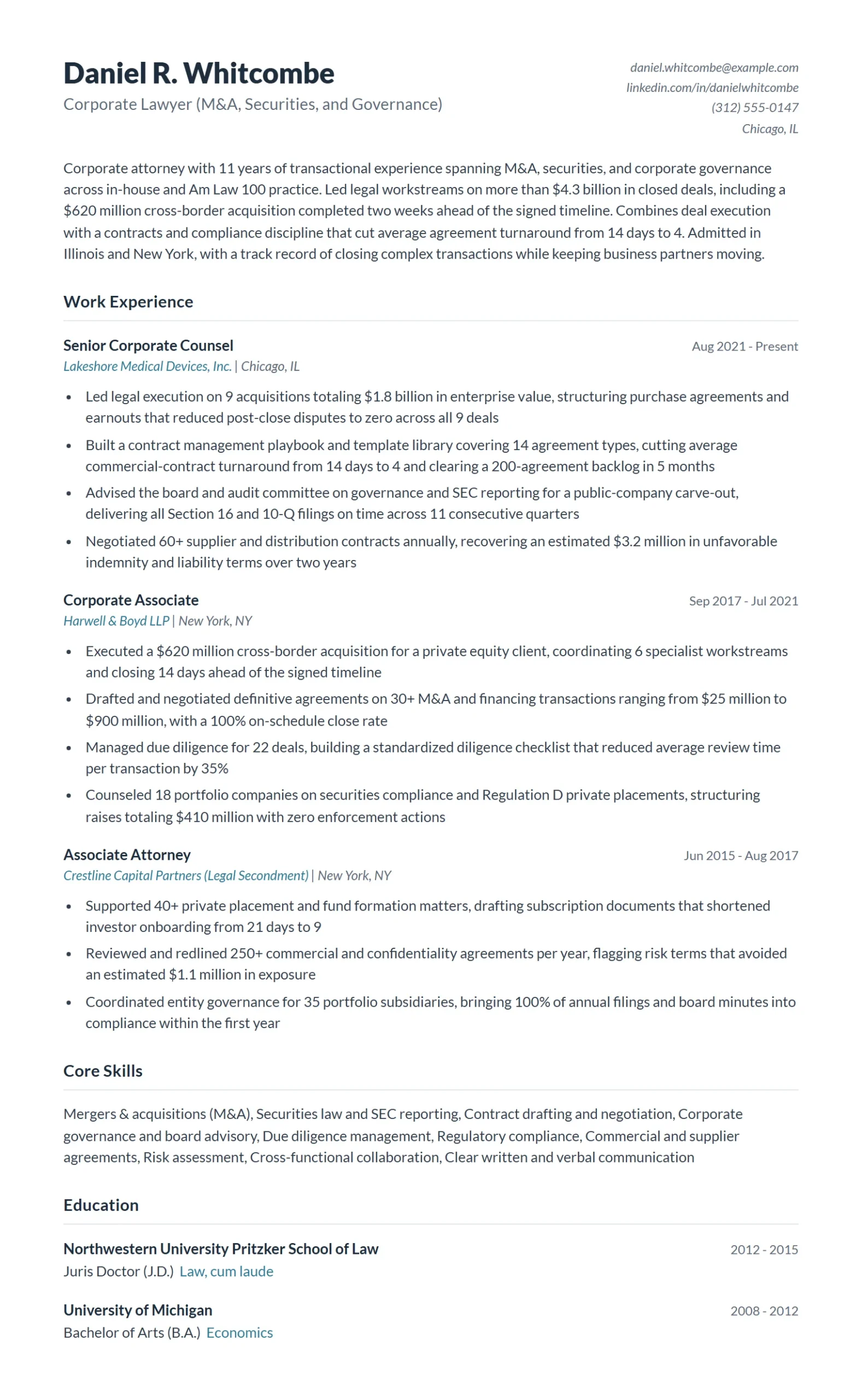
This resume works because it centers transactional outcomes (deals closed, value advised, negotiations led) and connects each to the business result it produced. It loads the skills section with the language corporate roles screen for, like M&A, due diligence, contract drafting, securities, and compliance, widening ATS keyword coverage. Industry and deal-size detail reads as specialist depth to both the system and the hiring partner.
Litigation Attorney resume example
Litigation roles are won on case results and courtroom readiness. This litigation attorney resume example shows how to highlight your trial work, motions, and the verdicts your strategy delivered.

This resume works because it foregrounds the litigation lifecycle (pleadings, discovery, depositions, motions, and trial) and ties each phase to outcomes like favorable rulings, dismissals, and settlement amounts. Method-specific keywords such as e-discovery, motion practice, and trial preparation make it read as a true litigator to the ATS and the hiring team. Quantified wins and caseload give a recruiter the proof of effectiveness they scan for first.
Criminal Defense Lawyer resume example
Defense work lives and dies on results for your clients, from arraignment through trial. This criminal defense lawyer resume example shows how to present case outcomes, trial experience, and negotiation strength.

This resume works because it leads with measurable defense outcomes (charges reduced or dismissed, acquittals, favorable plea agreements) rather than a list of duties. It surfaces the practice-specific keywords a posting screens for, like arraignment, plea negotiation, suppression motions, and trial advocacy, so the ATS reads it as a fit. Caseload volume and trial counts give hiring teams a fast, concrete read on your courtroom experience.
How to write a Lawyer resume that gets interviews
Hiring partners and legal recruiters skim a lawyer resume for proof you can do the work that matters to their practice: research and write, manage matters, and deliver results for clients. They want your bar admissions front and center, your practice areas clear, and your experience tied to outcomes, not just a list of duties. Most firms and corporate legal departments also run resumes through an Applicant Tracking System (ATS) first, so your language has to match the job description before a partner ever reads it. The tips below show you how to do both: clear the ATS scan and convince the person reading next.
- Lead with bar admissions and licensure: A lawyer resume without clear admission details stalls fast. State the jurisdictions where you are licensed and admitted, the year, and your status (active, in good standing). If you are admitted to specific federal courts or are awaiting bar results, say so plainly. Put this near the top, often right under your name or in a short licensure line, so a recruiter confirms eligibility in seconds rather than hunting for it.
- Name your practice area and be specific: “Attorney” tells a reader almost nothing. “Commercial litigation associate” or “M&A and securities counsel” tells them whether to keep reading. Identify your practice area (litigation, corporate, IP, employment, real estate, immigration, criminal defense) and the matters you handle. A firm hiring for healthcare regulatory work will not slow down for a generic profile, so mirror the practice language in the posting.
- Quantify matters, not just responsibilities: Anyone can say they “handled litigation.” Show the scale and the result: “managed a 30-case docket,” “negotiated settlements totaling $4.2M,” “closed 12 M&A deals ranging from $5M to $80M,” or “won summary judgment in 8 of 9 dispositive motions.” Tie your work to case outcomes, deal value, recovery amounts, dockets managed, or matters closed. Numbers turn duties into evidence a hiring partner can trust.
- Show research, writing, and the full matter lifecycle: Legal hiring is about how you think and write. Reference the work itself in your bullets: legal research, drafting briefs and motions, taking depositions, conducting due diligence, negotiating contracts, and arguing before a court or board. Show that you carry matters from intake to resolution. A resume that lists only “litigation experience” with no drafting, discovery, or argument reads as thin to anyone who has done the work.
- Match keywords to the job description: ATS scans for specific terms. List the practice areas, document types, and tools named in the posting: due diligence, discovery, motion practice, contract drafting, Westlaw, LexisNexis, Relativity, and the relevant statutes or regulatory regimes (SEC, HIPAA, GDPR, FLSA). If the role says “complex commercial litigation” and that is your work, use that exact phrase. Skip filler, and never keyword-stuff. Experienced legal recruiters spot it immediately.
- Keep the format clean and ATS-friendly: Use standard section headings (Experience, Education, Bar Admissions, Publications), a single clean column, and no text boxes or graphics that scramble parsing. Reverse-chronological order suits most lawyers; lead each role with a strong verb and a result. Then run it through Jobscan to check your match rate against the job description before you apply, and tailor your practice-area emphasis to each firm or in-house role.

Lawyer resume summary examples
Your summary is the first thing a recruiter reads. Lead with your specialty, years of experience, and a quantified win.
Good lawyer resume summary examples
- Commercial litigation associate with 5+ years representing clients in contract and business disputes across state and federal court. Managed a 35-matter docket, drafted dispositive motions that won summary judgment in 7 of 9 filings, and second-chaired two jury trials. Admitted in New York and Connecticut, with deep experience in discovery, motion practice, and e-discovery review in Relativity.
- Corporate attorney specializing in M&A and securities, with a track record closing deals from $5M to $80M. Led due diligence and drafted purchase agreements on 12 transactions in 18 months, coordinating cross-border teams and outside counsel. Admitted in California and known for clear deal memos that move negotiations forward.
- Employment and labor counsel with 8+ years advising employers on compliance, investigations, and litigation. Reduced outside-counsel spend 24% by bringing wage-and-hour matters in-house and resolved 40+ EEOC charges without litigation. Admitted in Texas, fluent in FLSA, Title VII, and ADA compliance, and trusted by HR and executive teams as a practical risk advisor.
What to avoid
- Hardworking attorney seeking a challenging position at a reputable firm where I can use my legal skills and grow my career. (It is all about what the candidate wants, not what they deliver. There is no practice area, no jurisdiction, no bar admission, and zero evidence of results. A hiring partner learns nothing they can act on.)
- Passionate lawyer with strong research and writing skills and great attention to detail who loves helping clients. (Pure adjectives with no proof. “Strong research” and “great attention to detail” are claims anyone can make. It names no practice area, no admissions, and no measurable outcome, so the ATS and the recruiter both skip past it.)
Lawyer resume skills
Pull the exact practice areas, statutes, and tools from each job description and mirror that language here. Keep this a quick snapshot of your strongest, role-relevant skills rather than an exhaustive list.
Hard skills for a lawyer resume
- Legal Research (Westlaw, LexisNexis)
- Legal Writing & Drafting
- Litigation & Motion Practice
- Contract Drafting & Negotiation
- Due Diligence
- Discovery & E-Discovery (Relativity)
- Regulatory Compliance
- Case Management
- Depositions
- Client Counseling
Soft skills for a lawyer resume
- Analytical Reasoning
- Written & Oral Communication
- Negotiation
- Attention to Detail
- Judgment & Discretion
- Time Management
Lawyer resume work experience bullet point examples
Lead each bullet with a strong verb and a measurable result.
Good bullet point examples
- Managed a 35-matter commercial litigation docket from intake through resolution, drafting dispositive motions that secured summary judgment in 7 of 9 filings.
- Led due diligence and drafted purchase agreements on 12 M&A transactions ranging from $5M to $80M, closing all within target timelines.
- Negotiated and settled 40+ employment disputes pre-litigation, avoiding an estimated $1.8M in litigation costs and reducing outside-counsel spend 24%.
- Second-chaired two jury trials and argued 15 discovery motions, taking and defending 20+ depositions across complex business disputes.
Bad bullet point examples
- Responsible for handling various legal matters and providing legal advice to clients. (“Responsible for” describes a job title, not an accomplishment. “Various legal matters” is vague, and there is no practice area, no scale, and no result. It tells the reader you had a job, not whether you were good at it.)
- Conducted legal research and wrote documents using Westlaw and LexisNexis. (Lists tasks and tools with no outcome. Every lawyer researches and writes, so this proves nothing. Add the matter type, the document (brief, motion, contract), and what the work achieved.)
- Worked on litigation cases and helped win some for the firm. (Subjective and unquantified. “Some” is not a number, and “helped win” hides your actual role. Lead with a strong verb and state the result: motions won, cases resolved, or recovery secured.)
Lawyer resume tips
A few targeted adjustments to your lawyer resume can mean the difference between getting flagged by an ATS and landing an interview with a hiring partner.
- Mirror Job Description Keywords: Pull exact phrases from each posting, such as “contract drafting,” “motion practice,” or “e-discovery,” and use them verbatim in your experience bullets so the ATS scores your resume as a strong match before a human ever reads it.
- Quantify Legal Impact: Replace duty-based language with outcome metrics that partners recognize: matters handled, contract values negotiated, discovery document volumes managed in Relativity, cost savings achieved, or win rates in litigation.
- Front-Load Bar Admissions: List every state and federal bar admission, including year admitted, immediately below your contact information or in a dedicated line so recruiters and ATS filters find your licensure in the first scan.
- Name Your Research Tools: Spell out Westlaw, LexisNexis, and Relativity explicitly in your skills section and in relevant bullets, because many ATS configurations search for these specific platform names rather than the generic term “legal research.”
- Tailor Practice Area Language: If the role specifies “regulatory compliance” or “due diligence,” use those exact terms as section headers or bullet lead-ins rather than broader synonyms, since ATS keyword matching is literal and partners scan for specialty alignment quickly.
- Respect the Two-Page Norm: Lawyers with under ten years of experience should hold to one page, while senior associates and partners may use two, but never exceed two pages because legal hiring culture treats length as a proxy for editing judgment and conciseness, core skills the role demands.
Pair your lawyer resume with a cover letter
A strong resume goes further with a tailored cover letter. Browse our lawyer cover letter examples to round out your application.
Lawyer resume frequently asked questions
Mirror the language in the job posting, including practice areas (litigation, corporate, family law), your bar admissions by state, and the courts you are admitted to practice before. Spell out tools and terms in full and in abbreviation, such as e-discovery, Relativity, Westlaw, and LexisNexis, so the scanner catches both. List your JD, law school, and bar status near the top, since legal recruiters and ATS both expect them early. Avoid graphics, columns, and headshots, which scanners often garble.
Lead with your JD, bar admission, and law school honors, then build out internships, judicial clerkships, law clinic work, and moot court. Treat substantive law school projects like real experience: describe the legal research, drafting, and client interaction involved, not just the course title. Quantify where you can, such as drafting 15 motions or assisting on a clinic caseload of 30 clients. A strong summary that names your target practice area helps focus a thin resume.
No. Confidentiality rules and sheer length make that a mistake. Describe representative matters by type, scope, and outcome instead of naming clients, for example handling a multi-million-dollar commercial dispute through trial or negotiating a settlement that avoided litigation. Focus on the matters that show the skills the target role wants, and keep client identities and privileged details off the page entirely.
One page is standard for law students and lawyers with under about five years of practice. Experienced attorneys, partners, and those with extensive litigation or publication histories can run two pages. Quality matters more than length, so cut older or unrelated roles before they push you onto a third page. If you have significant publications, speaking engagements, or reported cases, list them on a separate addendum rather than padding the resume itself.
For hard skills, name legal research and writing, contract drafting and review, litigation and motion practice, due diligence, and the platforms you use such as Westlaw, LexisNexis, and Relativity. For soft skills, employers value negotiation, oral advocacy, client counseling, analytical reasoning, and the judgment to spot risk. Tie each claimed skill to a matter or result somewhere in the resume so it reads as proven rather than asserted.
Reorder your experience and skills so the most relevant practice area sits first, and use the exact terms from the posting, whether that is M&A, employment defense, or criminal litigation. Rewrite your summary to state your target focus directly and highlight matters, certifications, and bar memberships that fit. Drop or shorten bullets from unrelated practice areas so a hiring partner sees a focused candidate, not a generalist. Running the final version against the job description with a resume scanner confirms the keywords match.