Best Logistics Resume Examples for 2026
Build a Logistics resume that clears the ATS and proves you keep operations moving. Real examples, recruiter-tested formats, ready to copy.



Logistics professionals keep goods, information, and money moving across the supply chain, from coordinating shipments and managing warehouses to optimizing routes and controlling inventory. Whether you are coordinating freight, running a distribution center, or planning end-to-end supply chains, your resume has to show you can move product on time, on budget, and without disruption.
Hiring managers in logistics scan for measurable impact: on-time delivery rates, cost savings, inventory accuracy, fill rates, and the systems you have run (think WMS, TMS, SAP, or Oracle). Before a person ever sees it, an applicant tracking system checks your resume for the exact terms in the job posting, so the right keywords and a clean, parsable format matter as much as the results themselves.
The examples below show you how to do both. Use them to structure your experience, quantify your wins, and match the language recruiters and ATS software are looking for, then tailor your draft to each posting before you apply.
Ready to build yours? Try our ATS-friendly resume builder or scan your draft against the job description.
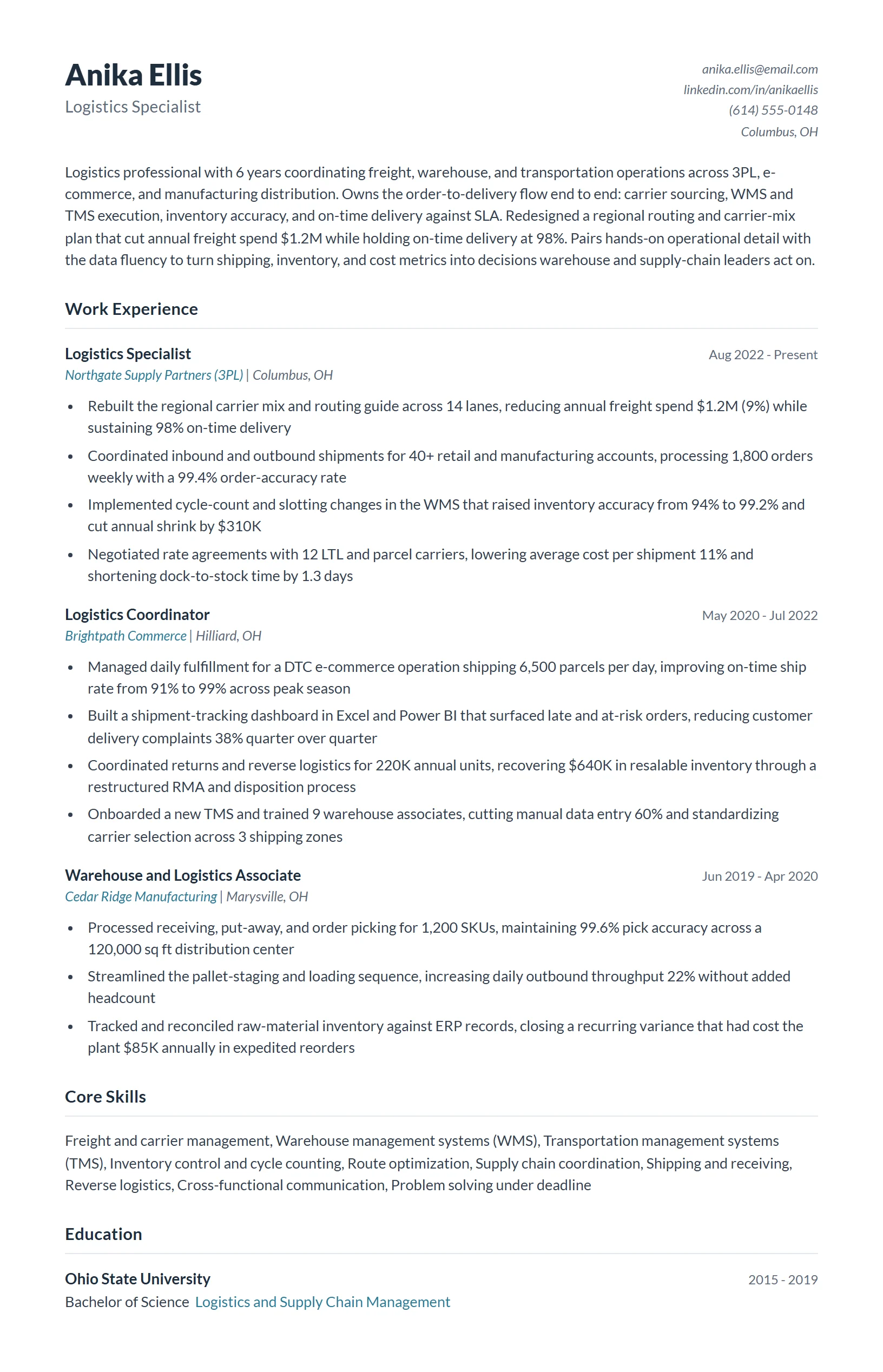
Logistics resume example
A versatile resume for logistics professionals who manage the flow of goods across coordination, warehousing, and distribution. Built to map cleanly to most logistics job postings.
It leads with quantified operational results (on-time delivery, cost-per-shipment, inventory accuracy) instead of generic duties, which is what hiring managers scan for first. It also names the systems and certifications recruiters search for, so the resume surfaces in ATS keyword matching rather than getting filtered out.
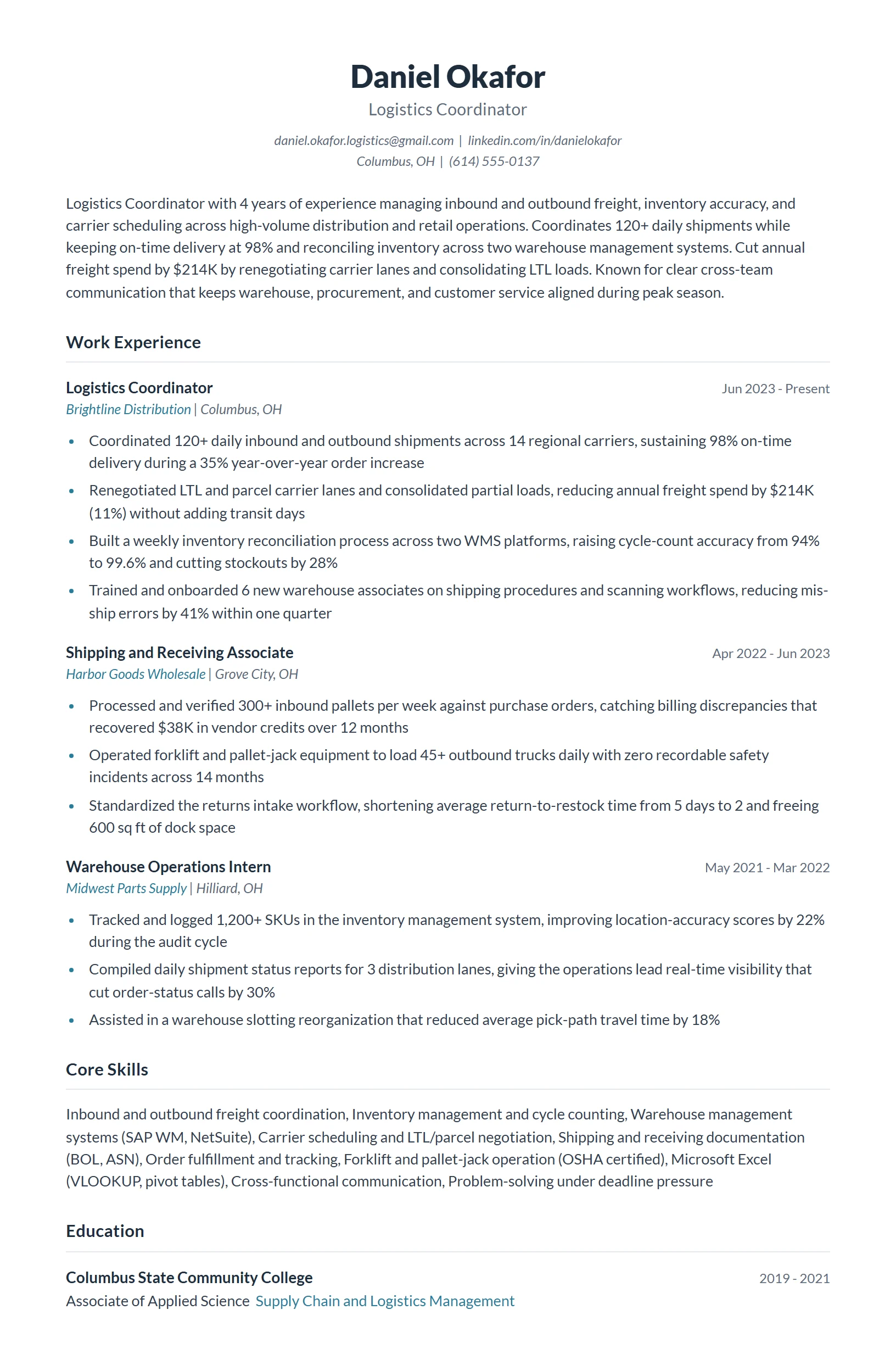
Logistics Coordinator resume example
An entry-to-mid-level resume for coordinators who schedule shipments, track orders, and keep carriers and warehouses in sync. Ideal for your first or second logistics role.
It turns day-to-day coordination tasks into outcomes, like shipments processed per week and reduced delivery exceptions, so limited experience still reads as impact. Strong action verbs and tool keywords (TMS, EDI, Excel) help it pass the ATS screen even without a long track record.
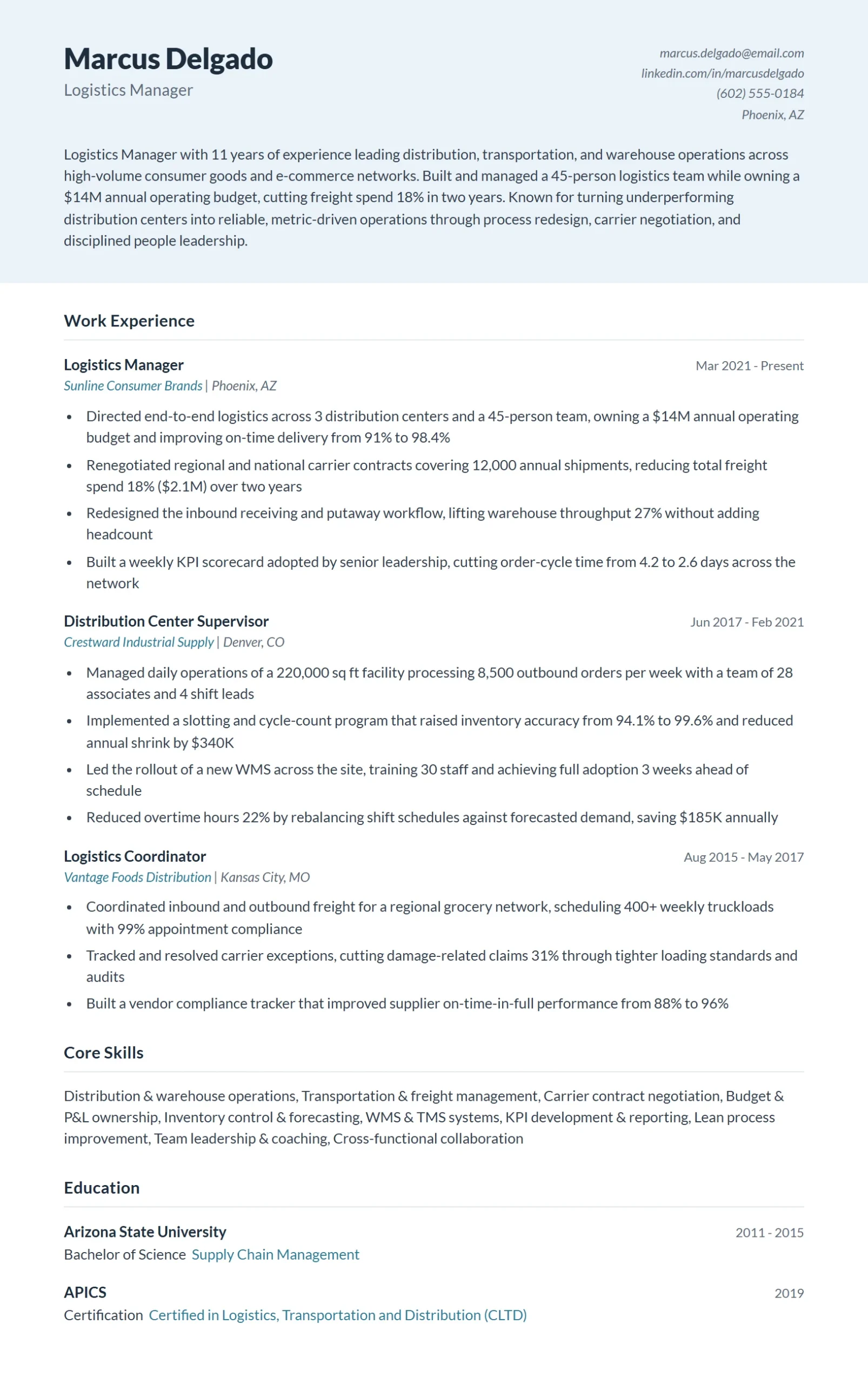
Logistics Manager resume example
A leadership-focused resume for managers who own logistics operations, teams, and budgets. Built to show scope, accountability, and results.
It frames achievements around the metrics executives care about: cost reduction, throughput, and team performance, with dollar figures and percentages that prove scale. By foregrounding leadership scope and P&L impact, it positions you above coordinator-level candidates for the same ATS keyword pool.
Supply Chain Manager resume example
A resume for professionals who plan and optimize the full supply chain, from sourcing and procurement through fulfillment. Broader in scope than a single logistics function.

It demonstrates end-to-end ownership by connecting forecasting, inventory, and supplier results into one cost-and-service story, signaling strategic range. Including ERP and planning systems (SAP, Oracle, demand planning tools) targets the high-value keywords these roles screen for.
Warehouse Manager resume example
An operations-heavy resume for managers who run distribution centers, inventory, and warehouse teams. Built for high-volume, fast-moving environments.

It highlights safety records, pick-and-pack accuracy, and labor productivity, the numbers that prove you can run a floor efficiently. Calling out WMS platforms and lean or Six Sigma methods matches the technical and process keywords warehouse postings filter for.
Transportation Manager resume example
A resume for managers who oversee fleets, freight, carriers, and route planning. Focused on cost control and on-time movement at scale.

It quantifies freight spend reduction, carrier performance, and on-time delivery to show direct control over transportation cost and reliability. Naming DOT compliance, TMS platforms, and carrier negotiation hits the regulatory and systems keywords that set transportation roles apart from general logistics.
How to write a Logistics resume that gets interviews
Logistics hiring managers and operations leads scan a resume for one thing: can you move goods accurately, on time, and at lower cost. Numbers carry this resume. Show throughput, on-time delivery, inventory accuracy, and freight savings, then name the systems (WMS, TMS, ERP) you ran them in. The ATS reads first, so mirror the exact terms in the job posting before a human ever sees the page.
- Lead with throughput, OTIF, and accuracy numbers: Logistics is measured, so measure yourself. Put your strongest operational metrics near the top: on-time-in-full (OTIF) rate, on-time delivery percentage, inventory accuracy, order-picking accuracy, dock-to-stock time, units shipped per shift. A line like “Sustained 99.2% inventory accuracy across 12,000 SKUs” beats “responsible for inventory” every time.
- Name the systems by their real names: ATS keyword matching is literal. List the specific platforms you used: WMS (Manhattan, Blue Yonder, HighJump), TMS (Oracle OTM, MercuryGate), ERP (SAP, Oracle, NetSuite), plus tools like RF scanners, EDI, and Excel. “Warehouse management system” alone will miss a search for “SAP” or “Manhattan WMS.”
- Quantify cost and efficiency, not just activity: Logistics leaders are judged on cost per unit and on-time performance, so show you moved those levers. Tie your work to freight cost reduction, carrier rate negotiation, labor cost per order, reduced detention or demurrage, and fewer expedited shipments. “Cut LTL freight spend 14% by consolidating loads and renegotiating three carrier contracts” reads like a hire.
- Match the resume to the logistics function you want: Logistics is broad. A warehouse supervisor, a transportation coordinator, a supply chain analyst, and an inventory planner are different jobs with different keywords. Read the posting and lean your summary, bullets, and skills toward that function (fleet and routing for transportation, demand and replenishment for planning, picking and safety for warehouse).
- Show people and safety leadership if you have it: Many logistics roles run teams and own a safety record. Quantify both: headcount supervised, shifts managed, peak-season scaling, OSHA recordable rate, days without a lost-time incident, forklift or DOT compliance. “Led a 22-person shift through peak, holding a zero lost-time-incident record for 18 months” signals readiness for the next level.
- Add certifications and compliance keywords the ATS hunts for: List credentials and compliance terms explicitly: forklift / powered industrial truck certification, OSHA 10/30, Six Sigma (Yellow/Green Belt), Lean, APICS CSCP or CPIM, hazmat, DOT, CDL if relevant. These are common required fields, and a missing keyword can drop you below the match threshold before a recruiter ever opens the file.

Logistics resume summary examples
Your summary is the first thing a recruiter reads. Lead with your specialty, years of experience, and a quantified win.
Good logistics resume summary examples
- Logistics coordinator with 6 years in high-volume distribution, managing 400+ daily outbound shipments across LTL and parcel. Raised on-time delivery from 91% to 98.5% and cut freight spend 13% through carrier consolidation in TMS (Oracle OTM).
- Warehouse operations supervisor leading 25-person shifts in a 250,000 sq ft DC. Held 99.3% inventory accuracy on 15,000 SKUs, improved pick rate 18% via slotting optimization in Manhattan WMS, and sustained a zero lost-time-incident record for 20 months.
- Supply chain analyst skilled in demand planning and replenishment across 8 distribution centers. Reduced excess inventory $1.2M and improved forecast accuracy 11 points using SAP and advanced Excel modeling.
What to avoid
- Hardworking logistics professional seeking a challenging role where I can use my skills and grow with a great company. (It is about what the candidate wants, not what they deliver. No function, no systems, no metrics. This could belong to anyone in any industry and gives the ATS nothing to match.)
- Experienced in logistics and warehouse operations with strong attention to detail and a passion for efficiency. (Pure adjectives, zero proof. “Efficiency” is claimed but never measured. No throughput, accuracy, or cost numbers and no named systems, so it reads as filler and ranks poorly in a keyword search.)
Logistics resume skills
A quick snapshot for your resume, not a full list. For deeper, role-specific picks see our logistics resume skills page.
Hard skills for a logistics resume
- Warehouse management systems (WMS: Manhattan, Blue Yonder)
- Transportation management systems (TMS: Oracle OTM, MercuryGate)
- ERP (SAP, Oracle, NetSuite)
- Inventory control and cycle counting
- Freight and carrier management (LTL, FTL, parcel)
- Supply chain and demand planning
- Forklift / powered industrial truck operation
- OSHA and DOT compliance
- Lean and Six Sigma process improvement
- Advanced Excel (pivot tables, logistics reporting)
Soft skills for a logistics resume
- Cross-functional coordination
- Team and shift leadership
- Problem solving under time pressure
- Clear communication with carriers and vendors
- Adaptability during peak and disruptions
Logistics resume work experience bullet point examples
Lead each bullet with a strong verb and a measurable result.
Good bullet point examples
- Increased on-time delivery from 92% to 99.1% across 1,800 monthly shipments by rebuilding the carrier routing guide and load-tendering process in MercuryGate TMS.
- Improved inventory accuracy from 94% to 99.4% on 11,000 SKUs by implementing daily cycle counts and RF-scan verification, eliminating a recurring quarterly write-off of about $180K.
- Reduced freight cost per shipment 16% by consolidating LTL loads into multi-stop truckloads and renegotiating rates with four regional carriers, saving roughly $340K annually.
- Scaled the outbound operation to 2.3x peak-season volume while holding a zero lost-time-incident safety record, cross-training 18 associates and adding a second pick wave.
Bad bullet point examples
- Responsible for managing inventory and shipping orders on time. (Lists a duty, not a result. “On time” is asserted with no rate or volume, and there is no system or scale. It tells the reader nothing about how well you did the job.)
- Helped improve warehouse efficiency and worked with the team to hit goals. (Vague and unquantified. “Improve efficiency” and “hit goals” have no numbers, no metric, and no method, so the hiring manager cannot tell what changed or by how much.)
- Used various software systems to track shipments and orders daily. (“Various software systems” is an ATS dead end. Name the actual platform (TMS, WMS, SAP) so the keyword matches, and attach an outcome rather than just describing routine activity.)
Logistics resume tips
Beyond the basics, these six tips help logistics professionals avoid common pitfalls and stand out at every stage of the ATS and recruiter review process.
- Resume Length Rule: Keep your resume to one page if you have fewer than ten years of experience, and limit it to two pages maximum even for senior supply chain or operations director roles, because hiring managers in logistics move fast and rarely read past page two.
- Avoid ATS Killers: Submit your resume as a plain .docx or single-column PDF and remove all tables, text boxes, and header or footer sections, since warehouse management system data, route tables, and KPI grids placed inside those elements are invisible to most applicant tracking systems.
- Keyword Placement Matters: Place your most critical terms such as HAZMAT, DOT compliance, Cold Chain, or Inbound Freight Management in your Professional Summary and a dedicated Core Competencies section, not buried in bullet points, so ATS parsers score them at the highest weight.
- Biggest Candidate Mistake: The most common mistake logistics candidates make is listing job duties instead of outcomes, for example writing ‘managed a team of drivers’ rather than ‘supervised 18 CDL drivers across three regional routes with a 99.1 percent on-time delivery rate over 24 months’.
- Seniority Positioning: If you are targeting a 3PL coordinator role, lead with operational execution and system proficiency, but if you are pursuing a director or VP level role at a manufacturer or retailer, open with strategic scope such as annual freight spend managed, network redesign projects, or cross-functional team size.
- Evidence Communication Skills: Prove cross-functional coordination ability with a concrete example in one bullet, such as ‘partnered with procurement, warehouse, and carrier teams to reduce inbound receiving discrepancies by 34 percent in one quarter’, which shows collaboration without simply claiming it.
Pair your logistics resume with a cover letter
A strong resume goes further with a tailored cover letter. Browse our logistics cover letter examples to round out your application.
Logistics resume frequently asked questions
Lead with measurable results, not duties: on-time delivery rate, freight cost savings, inventory accuracy, or order fulfillment volume. Show the systems you have run, such as SAP, Oracle SCM, WMS, or a TMS, and the scale you operated at (shipments per day, SKUs managed, square footage). Hiring managers scan for proof you can move product faster and cheaper, so quantify wherever you can.
Name the tools and processes you actually use: warehouse management systems (WMS), transportation management systems (TMS), ERP platforms like SAP or Oracle, inventory control, route planning, and demand forecasting. Add freight and carrier management, customs and import/export documentation, and Lean or Six Sigma if you have applied them. Specific software and process names carry far more weight than generic phrases like supply chain knowledge.
Mirror the exact terms in the job posting. Common ones include supply chain, inventory management, logistics coordination, freight, procurement, distribution, fulfillment, and the specific systems named (SAP, WMS, TMS). Include both the abbreviation and the full phrase, such as KPI and key performance indicator. Spell out certifications like APICS CSCP or Six Sigma so the scanner matches them cleanly.
Tie every accomplishment to a number a business cares about. Examples: reduced freight costs by 14% through carrier renegotiation, improved on-time delivery from 89% to 97%, cut inventory shrinkage by $120K annually, or processed 1,200 orders per day with 99.8% accuracy. If you do not have exact figures, use defensible estimates and percentages rather than vague claims like improved efficiency.
The most recognized are APICS CSCP (Certified Supply Chain Professional), CPIM (Certified in Planning and Inventory Management), and CLTD (Certified in Logistics, Transportation and Distribution). A Lean Six Sigma belt, a forklift or OSHA certification, or a CDL can matter for warehouse and transport roles. List the full name, the issuing body, and the year, and place active certifications near the top if they are central to the job.
Pull relevant skills from any role that involved organizing, tracking, or moving things: retail stocking, military supply duties, warehouse temp work, or coordinating events. Emphasize accuracy, scheduling, problem solving under pressure, and any software exposure like Excel, an ERP, or scanning systems. Add coursework, a logistics or supply chain certificate, and internships, then back each skill with one concrete example rather than relying on adjectives.