Best Data Engineer Resume Examples for 2026
Data engineer resume examples for 2026, from entry-level to senior and Azure-focused. See how to surface pipelines, SQL, cloud tools, and the keywords that pass ATS.



Data Engineers play a crucial role in managing and optimizing data infrastructure, enabling businesses to make data-driven decisions efficiently. This blog provides expertly designed resume examples, along with actionable tips to help you showcase your technical skills, experience, and impact effectively.
With the demand for data engineers projected to grow by 9% from 2023 to 2033, faster than the average for all occupations, companies are actively seeking professionals skilled in SQL, Python, cloud platforms, and big data technologies. A strong resume is essential to stand out in this competitive field and secure interviews at top organizations.
If you’re struggling to craft a resume that highlights your expertise and accomplishments, you’re in the right place. Read on to discover powerful resume examples and proven strategies to help you land your dream Data Engineer role!
Data engineer resume example
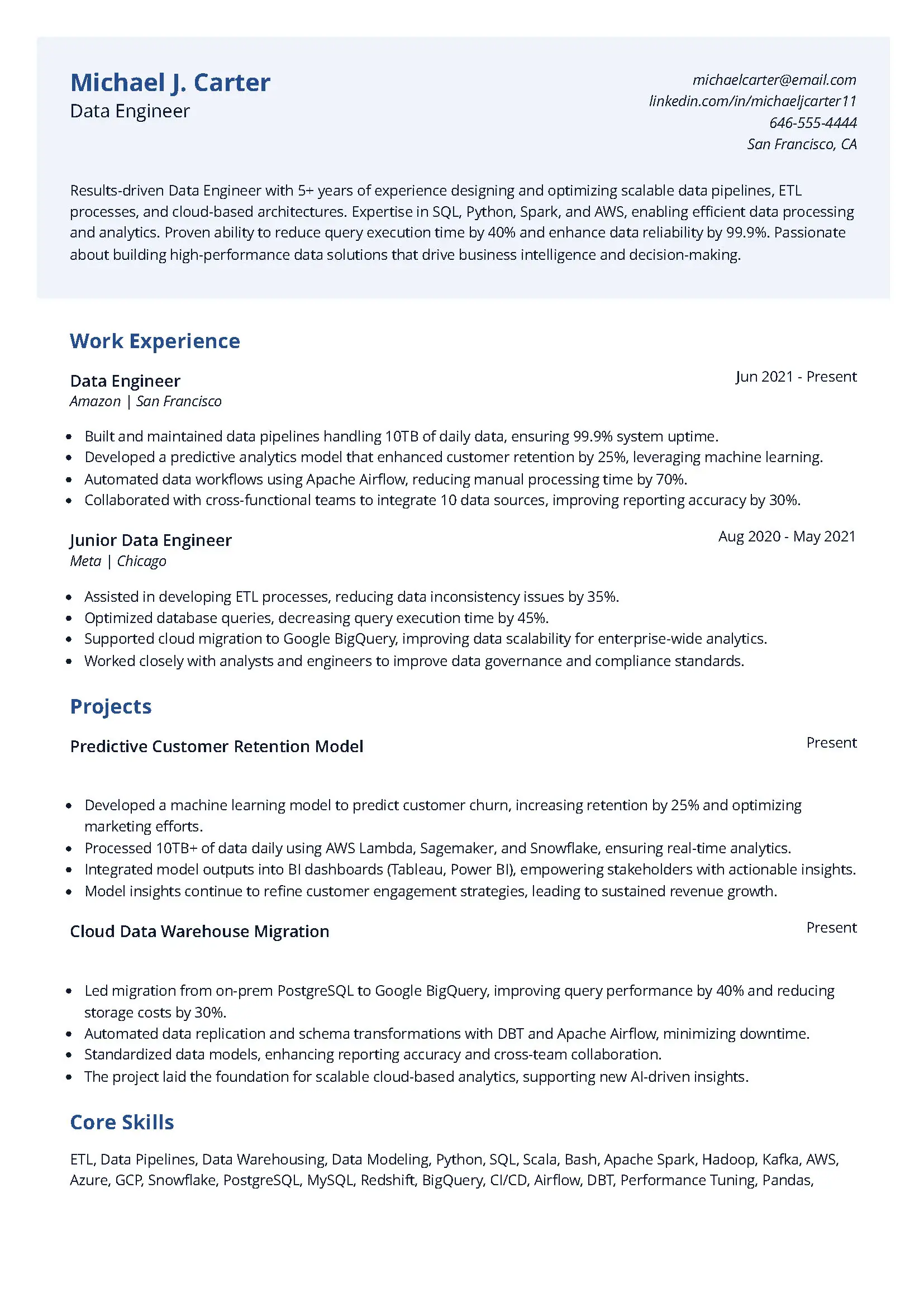
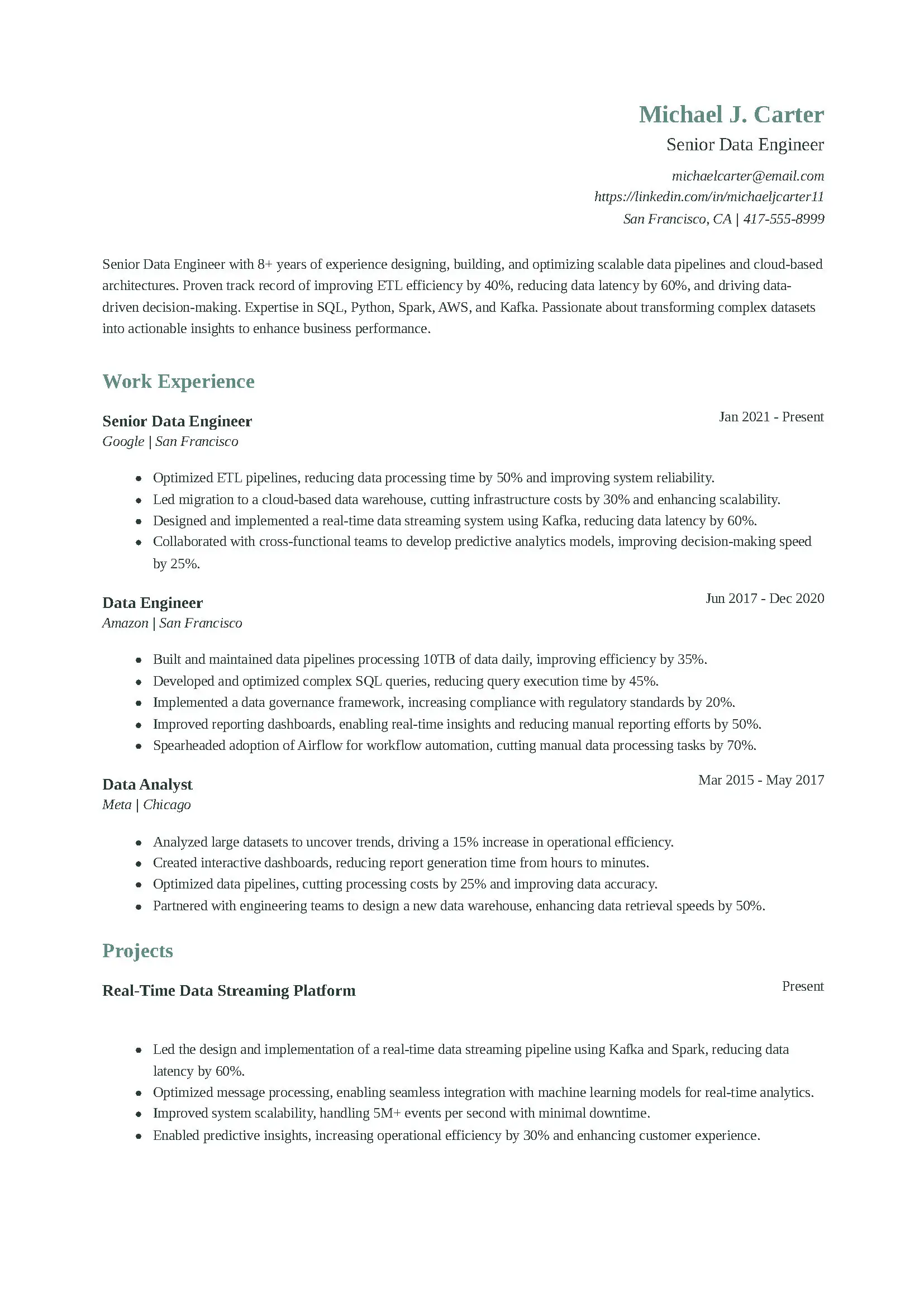
Trying to land a Data Engineer role but unsure how to make your resume stand out? Not sure how to showcase your skills, projects, and achievements in a way that grabs attention? Check out this strong data engineer resume example—it’s structured to highlight key experience, technical expertise, and measurable impact effectively.
Data engineers are expected to build, maintain, and optimize data pipelines, ensuring efficient data processing and storage. Employers look for SQL, Python, Spark, and cloud experience, along with a track record of scaling data systems and improving performance. A well-crafted resume should highlight projects, impact, and problem-solving skills—justlike this one!
This resume format uses strong metrics like improving query execution time by 40%, which shows direct contributions to business goals. It also showcases a mix of technical and cloud-based skills like SQL, Python, AWS etc., that are relevant to the role of a data engineer, proving adaptability. Employers love this because it’s clear, results-driven, and easy to scan. The structured format ensures key skills and achievements stand out immediately.
Entry-level data engineer resume example
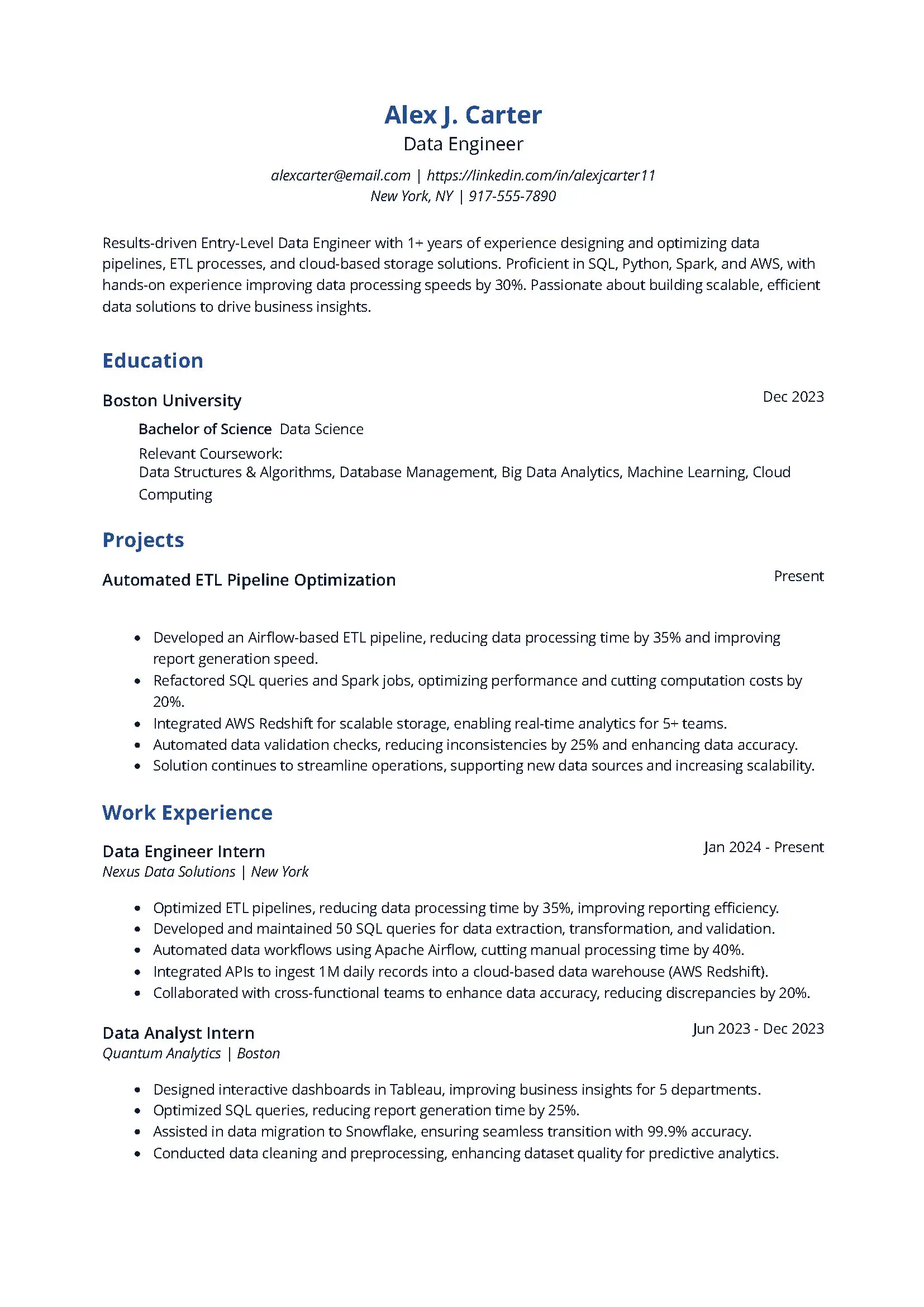
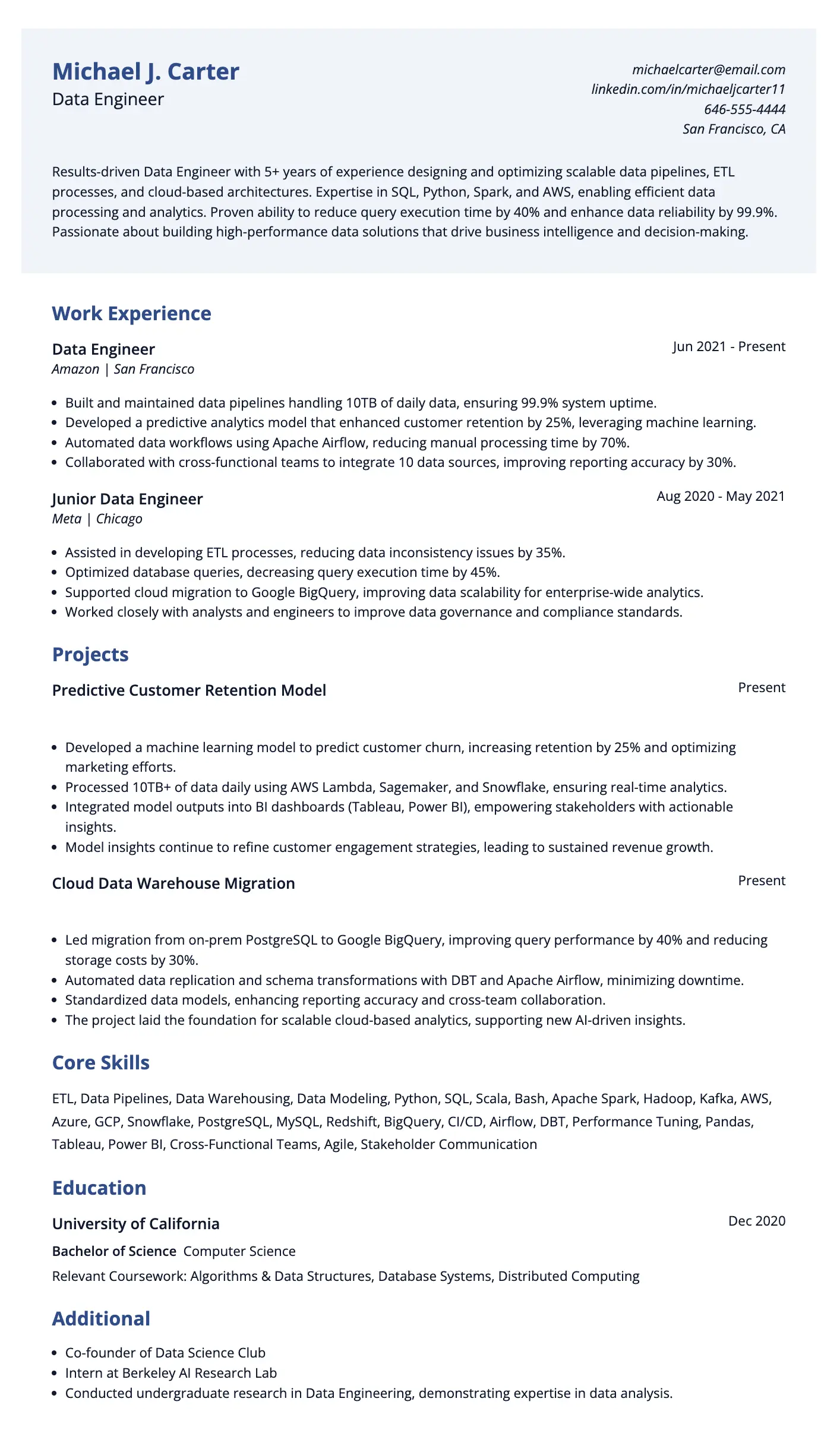
Looking for a strong entry-level data engineer resume to land your first job? Not sure how to showcase your skills and projects in a way that grabs attention? The resume example below highlights the right mix of technical skills, hands-on experience, and measurable achievements to make a great first impression.
This role requires a solid understanding of SQL, Python, ETL processes, and cloud platforms like AWS or GCP. Employers expect candidates to build and maintain data pipelines, optimize workflows, and ensure data accuracy. Strong problem-solving skills and the ability to work with cross-functional teams are key to standing out.
This resume stands out with a strong professional summary that quickly showcases key skills like SQL, Python, and cloud platforms, along with real impact, such as improving data processing speeds. The education section adds value by listing relevant coursework and achievements, proving a solid foundation in data engineering. For an entry-level role, this balance of technical knowledge and demonstrated ability makes it clear the candidate is ready to contribute.
Junior data engineer resume example
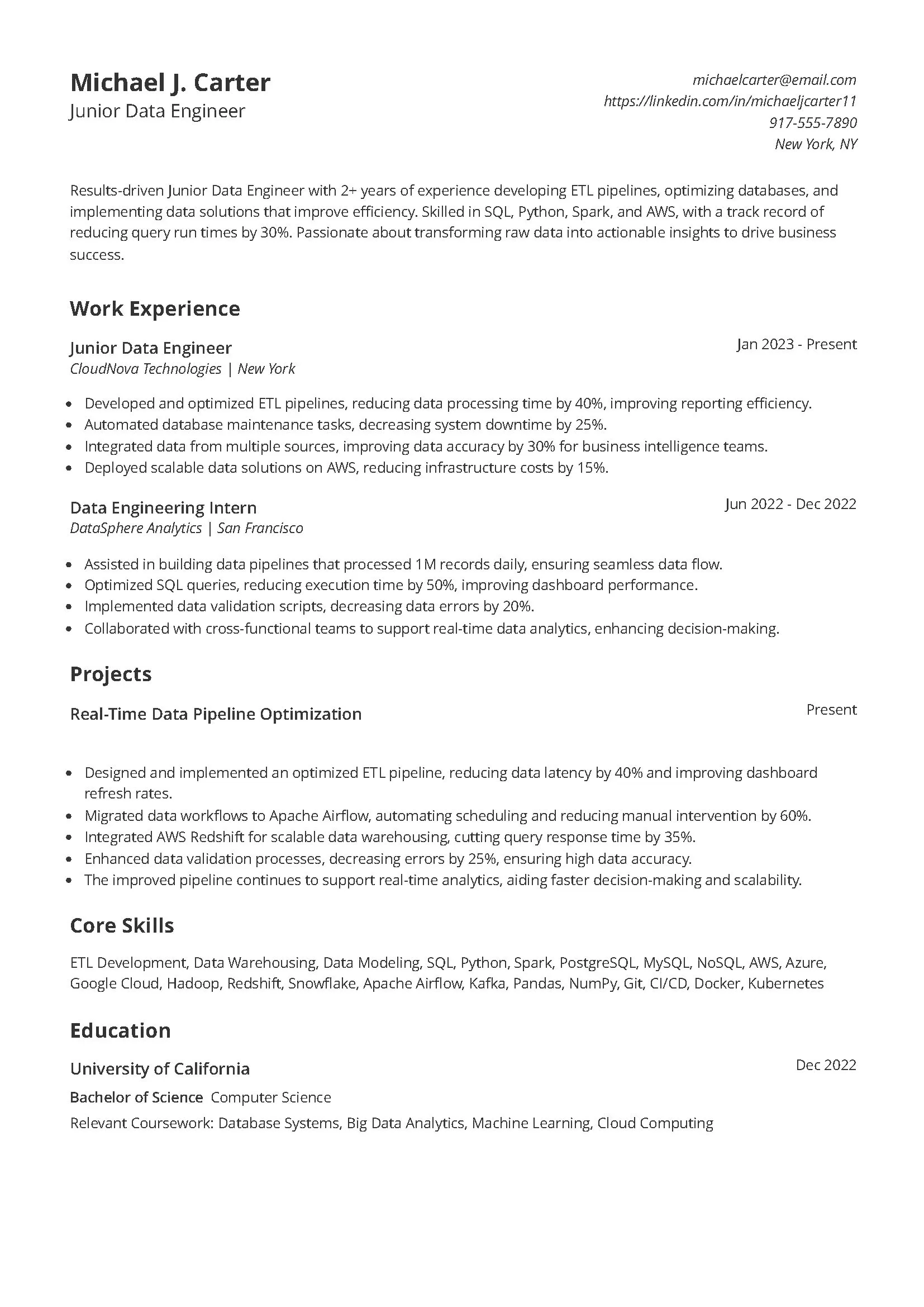
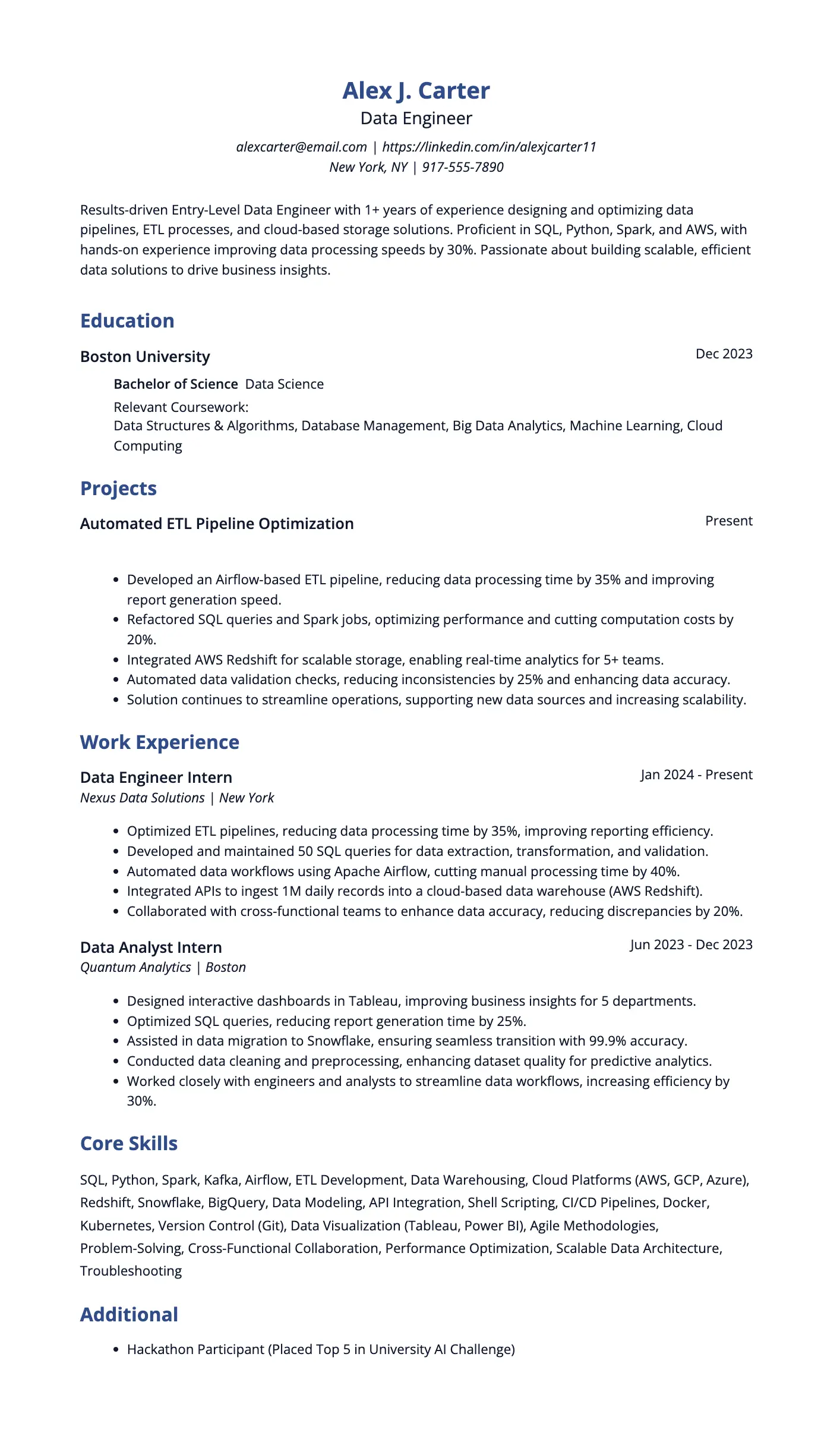
Struggling to create a resume that stands out for a Junior Data Engineer role? Not sure how to showcase your skills and achievements effectively? This resume example shows exactly how to present your experience, projects, and skills in a way that grabs attention.

A junior data engineer role calls for strong technical skills in SQL, Python, and cloud platforms like AWS. Employers expect candidates who can build and optimize data pipelines, ensure data accuracy, and support analytics teams. A well-structured resume showcasing measurable achievements can make all the difference in standing out.
The core skills section is highly relevant, listing essential tools like SQL, Python, Apache Airflow, and AWS—key for a Junior Data Engineer. It also includes cloud platforms and ETL technologies, showing a strong technical foundation. The relevant coursework section adds value by covering Database Systems, Big Data Analytics, and Cloud Computing. Plus, the resume is well-structured, with clear sections that make it easy to scan for key qualifications and achievements.
Senior data engineer resume example
Looking for a senior data engineer job but not sure how to make your resume stand out? How do you showcase your impact, highlight your technical skills, and prove you’re the right fit? Check out this strong resume example that does just that—it’s clear, results-driven, and tailored for the role.
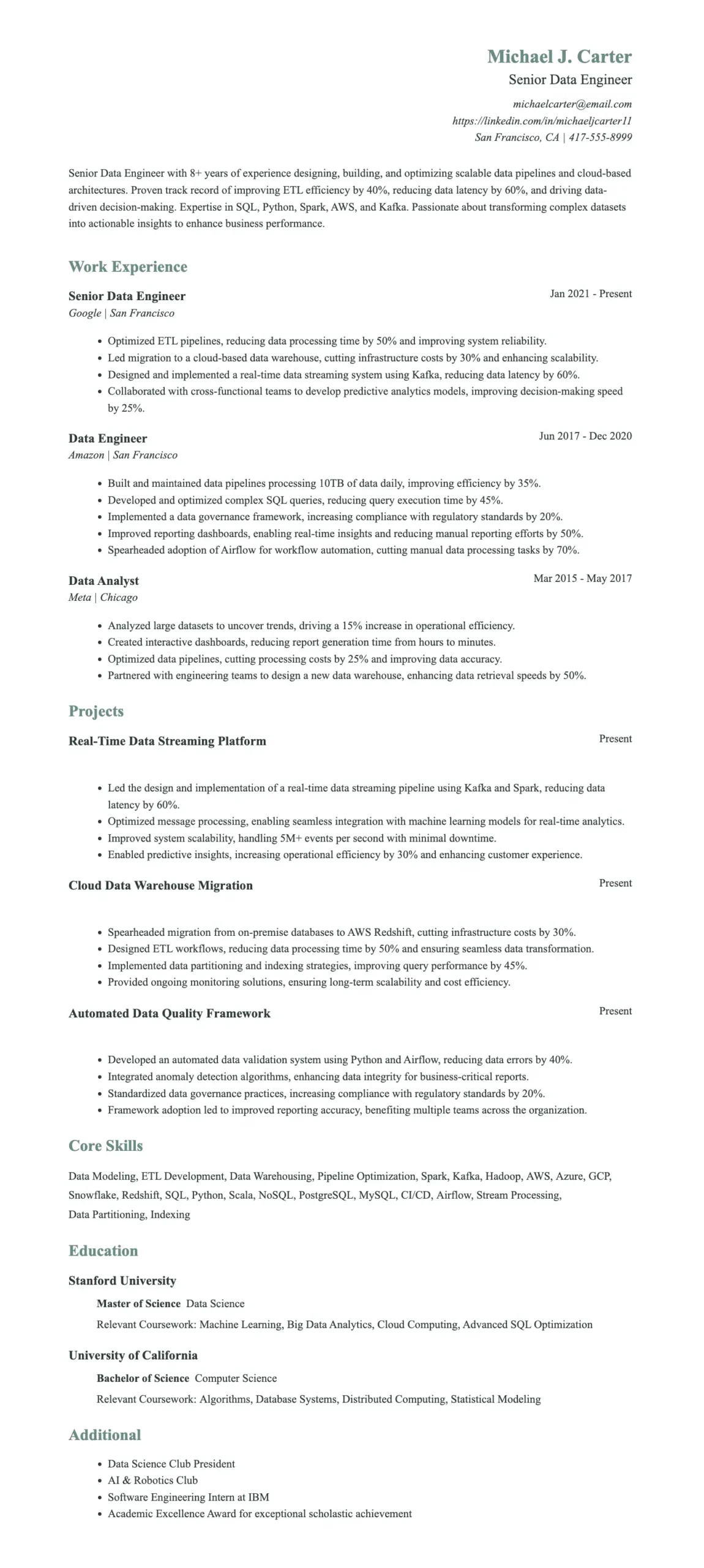
Senior data engineers are expected to design scalable data pipelines, optimize cloud infrastructure, and ensure data quality. Employers look for hands-on experience with ETL, big data tools, cloud platforms, and automation. A strong resume should show measurable results, like improving query performance or reducing processing costs, to prove real impact.
This resume uses strong action verbs like “Optimized,” “Led,” “Designed,” and “Implemented,” making each bullet point impactful. The bullet points are clear, concise, and results-driven, focusing on measurable achievements like improving ETL efficiency by 40% or reducing query execution time by 45%. This approach shows leadership, problem-solving, and technical expertise—exactly what hiring managers look for in a senior data engineer.
Azure data engineer resume example
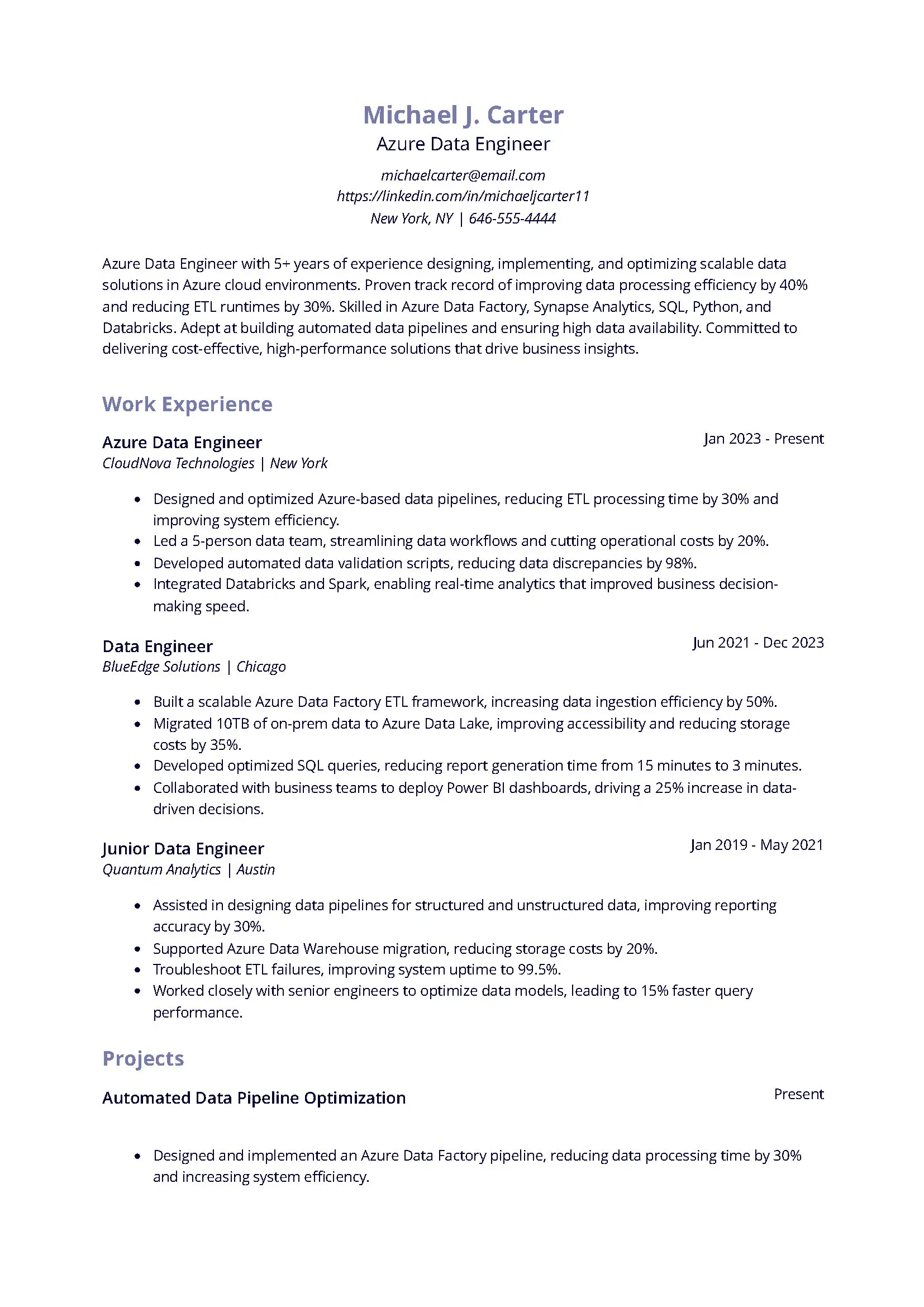
Struggling to craft the perfect Azure Data Engineer resume? Not sure how to showcase your cloud data expertise and technical impact? This resume example is designed to help you stand out. It features a clear layout, quantifiable achievements, and the right mix of technical expertise and impact-driven results.
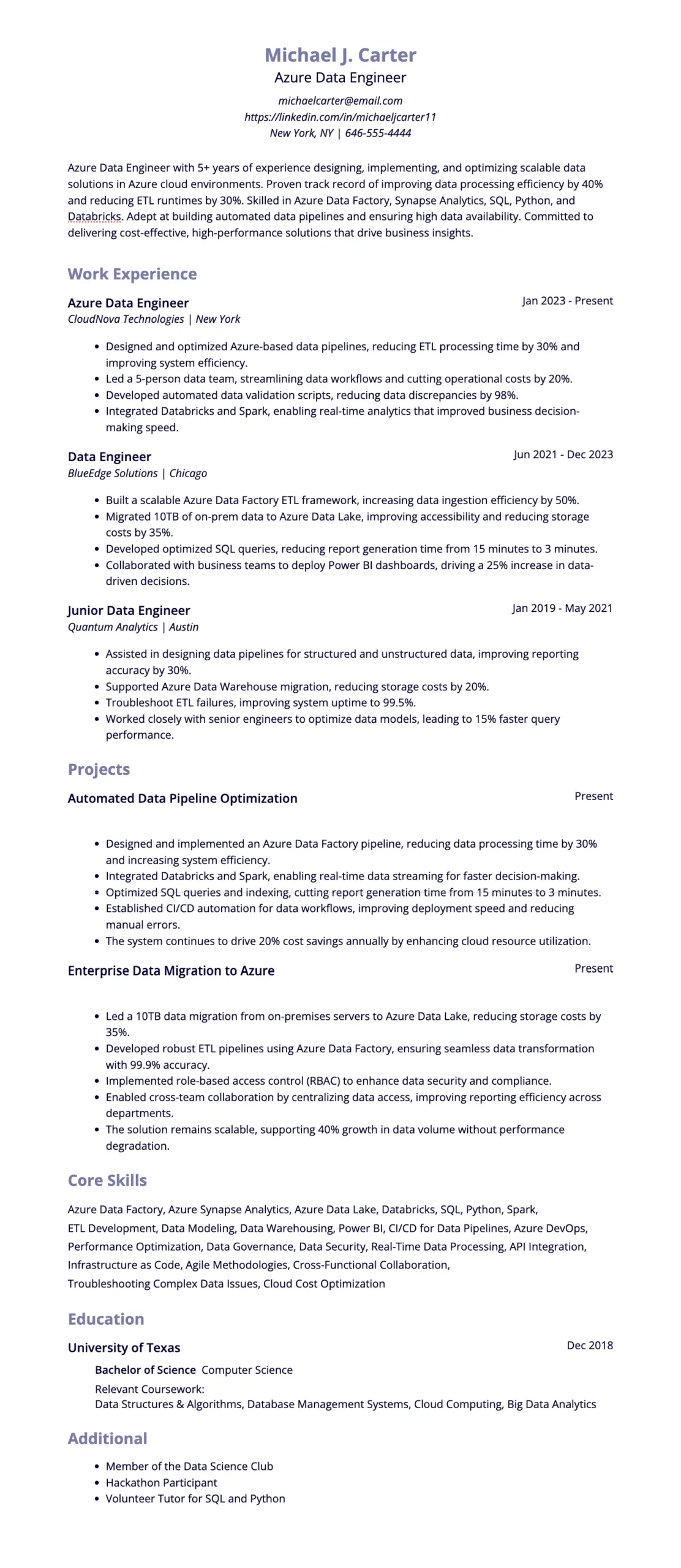
Azure Data Engineers are expected to build and optimize scalable data pipelines, manage cloud-based infrastructure, and ensure data integrity. Employers look for candidates skilled in Azure Data Factory, Synapse Analytics, Databricks, and SQL. Strong problem-solving abilities and experience in automation, security, and performance optimization set top applicants apart.
The projects section highlights hands-on experience with real-world Azure solutions. Each project includes measurable results, like reducing data processing time by 30% or cutting storage costs by 35%. It also covers key Azure skills—Data Factory, Databricks, and security measures—showing expertise beyond daily job tasks. Employers see proof of problem-solving and scalability, making this section highly relevant for an azure data engineer role. Overall, it’s concise, results-driven, and tailored for an azure data engineer role.
Also Read: 10 Best Resume Skills to Put on a Resume
How to write a data engineer resume that will get you an interview
A well-crafted Data Engineer resume can open doors to exciting job opportunities. In a competitive job market, it’s essential to showcase your technical skills, experience, and problem-solving abilities effectively.
Most companies use Applicant Tracking Systems (ATS) to streamline the hiring process. Think of an ATS as a search engine for job applications—recruiters enter specific keywords related to the role, and the system scans resumes to find the best matches. If your resume doesn’t include the right technical terms or doesn’t closely align with the job description, it may never reach a hiring manager.
For example, if a company is hiring a Data Engineer, recruiters might search for terms like “ETL development,” “SQL,” “data pipelines,” “AWS,” “Spark,” or “data warehousing.” Including these keywords increases your chances of getting noticed, while missing them could cause your application to be overlooked.
How ATS works:
- Job posting setup: Employers define job titles, required skills, and qualifications.
- Resume scanning: The system analyzes submitted resumes, identifying key technical skills and experience.
- Searchable database: Hiring managers filter candidates based on relevant keywords or review ranked results.
Not sure where to start? Jobscan’s free ATS resume builder is a free tool that helps job seekers craft ATS-friendly resumes by incorporating the right keywords and effectively showcasing their skills. Try it today!

1. Key elements of a data engineer resume
A compelling Data Engineer resume should include:
- Contact details – Your name, phone number, professional email address, LinkedIn profile, and portfolio (if applicable).
- Professional summary – A concise overview of your expertise and career achievements.
- Technical skills – Proficiency in tools, programming languages, and technologies such as SQL, Python, Hadoop, Spark, and AWS.
- Work experience section– Highlighting relevant projects, responsibilities, and quantifiable achievements.
- Education & certifications – Degrees, relevant coursework, and certifications (e.g., AWS Certified Data Analytics, Google Cloud Professional Data Engineer).
- Projects & contributions – Personal or open-source projects that demonstrate your technical abilities.
Write a strong professional summary
Your professional summary should be a concise, impactful snapshot of your expertise, highlighting key skills and accomplishments relevant to the role. It should align with the job description and clearly demonstrate the value you bring to the company.
Here are some examples of both good and bad resume summaries:
Good examples of a resume summary
- “Results-driven Data Engineer with 5+ years of experience designing and optimizing ETL pipelines, managing large-scale data processing systems, and implementing cloud-based solutions in AWS and Azure. Proven ability to improve data infrastructure efficiency by 30% through automation and optimization. Passionate about building scalable data architectures to drive business insights.”
- “Skilled Data Engineer specializing in data warehousing, real-time data processing, and machine learning pipelines.Experienced in Python, data mining, data integration, data migration, Spark, and Kafka, with a track record of reducing data latency by 40% through efficient streaming solutions. Adept at collaborating with cross-functional teams to translate business needs into data-driven solutions.”
Bad examples of a resume summary
- “I am a data engineer with experience in various tools and data models. I have worked on some data analysis projects and am looking for a new opportunity to grow my skills.”
- “Experienced in data engineering, analytics, and software development. Hardworking and eager to learn new things.”
With Jobscan’s resume summary generator, you can generate a strong professional summary that aligns with job descriptions and includes optimized keywords. It refines your summary to showcase essential skill sets, experience, and achievements, making it more appealing to hiring managers and ATS-friendly. This tool streamlines the process of creating a clear, impactful introduction.
3. Demonstrate key data engineer skills
A strong Data Engineer resume should showcase both technical expertise and problem-solving abilities. Employers look for a mix of hard skills (technical proficiencies) and soft skills (collaborative and analytical abilities) to ensure you can handle complex data challenges while working effectively within a team.
Hard skills
Hard skills are the technical competencies required for the role. Some key hard skills for a Data Engineer include:
- Python, SQL, Java, Scala
- Redshift, Snowflake, BigQuery
- Apache Airflow, Talend, Informatica
- Hadoop, Spark, Kafka
- AWS (S3, Glue, EMR), Azure, Google Cloud Platform
- PostgreSQL, MySQL, MongoDB, Cassandra
- Star Schema, Indexing, Partitioning
- Data Pipeline Development
Soft skills
Soft skills help data engineers collaborate effectively and solve complex problems. Important soft skills include:
- Troubleshooting
- Technical Translation
- Cross-Functional Collaboration
- Data Accuracy
- Project Management
- Data-Driven Decision-Making
Integrating both technical expertise and soft skills into your resume bullet points is key to showcasing your capabilities as a data engineer. Rather than just listing responsibilities, focus on demonstrating your impact, efficiency, and measurable results. Let’s explore some good and bad examples of resume bullet points to see the difference.
4. Craft impactful resume bullet points for data engineer
Resume bullet points are the core of your experience section. They should clearly communicate your skills, the impact you’ve made, and the value you bring to a team. Instead of listing tasks, focus on what you accomplished using specific tools, action verbs, and measurable results. Here’s what that looks like:
Good examples of resume bullet points
- “Designed and implemented an ETL pipeline using Apache Airflow, reducing data processing time by 40%.”
- “Optimized SQL queries and indexing strategies, improving database performance by 30%.”
- “Migrated on-premise data infrastructure to AWS, reducing operational costs by 25%.”
- “Developed real-time data streaming solutions using Kafka, decreasing data latency from 10 minutes to under 1 second.”
Bad examples of resume bullet points
- “Worked on ETL pipelines for data processing.”
- “Used SQL for database queries.”
- “Helped improve data storage efficiency.”
Looking to improve your resume bullet points? Jobscan’s resume bullet point generator helps you craft compelling, ATS-friendly statements that highlight your accomplishments. This tool ensures your bullet points are results-focused, effectively showcasing your skills and making your resume more impactful.
5. Highlight your achievements as a data engineer
Employers value results-driven professionals who can demonstrate their impact through measurable achievements. Instead of listing responsibilities, focus on accomplishments that showcase your contributions to efficiency, scalability, and cost savings.
Here are examples of some strong achievement-based statements:
- “Designed and optimized an ETL pipeline that reduced data processing time by 40%, enhancing reporting efficiency.”
- “Migrated a 5TB on-premise database to AWS Redshift and caused cost reduction by 30% and improved query performance.”
- “Developed real-time data streaming solutions using Apache Kafka, decreasing data latency from 10 minutes to under 1 second.”
- “Automated data quality checks, reducing errors by 50% and improving reporting accuracy for stakeholders.”
By emphasizing accomplishments, you make your resume more compelling and results-driven.
6. Tailor your resume to the job description
A generic resume won’t stand out in a competitive job market. Customizing your resume for each job application ensures that you highlight the most relevant skills and experience that match the employer’s needs.
Here’s how you can tailor your resume to the job description:
- Analyze the job description – Identify key skills, tools, and qualifications the employer is looking for.
- Use keywords strategically – Incorporate relevant terms from the job listing to pass applicant tracking systems (ATS).
- Match your professional experience to the role – Emphasize projects, technologies, and achievements that align with the job requirements.
- Adjust your professional summary – Highlight the most relevant skills and experiences based on the job description.
- Prioritize key skills – List technical and soft skills that are specifically mentioned in the job posting.
- Optimize bullet points – Craft bullet points that emphasize responsibilities and achievements matching the job requirements.
- Ensure ATS Compatibility – Use a clean, professional format free of excessive styling, images, or unconventional fonts for smooth automated screening.
7. Include relevant education and certifications
Your education and certifications demonstrate your foundational knowledge and commitment to professional growth in the data engineering field. While a degree in computer science, data engineering, or a related field is beneficial, certifications can help validate your expertise and make your resume stand out.
Here’s how to effectively highlight your education and certifications as a Data Engineer:
- List your degree, major, and institution concisely (e.g., Bachelor’s Degree in Computer Science, XYZ University).
- If you’re a recent graduate, include your graduation year along with relevant coursework, academic projects, or skills related to data engineering, such as database management, big data technologies, or programming languages.
- Experienced professionals should keep it brief, emphasizing only higher education degrees and certifications relevant to data engineering.
- If you’re transitioning into a data engineering role, highlight coursework or degrees that align with data management, programming, or cloud technologies.
- Certifications in cloud platforms, data processing, and database management—such as AWS Certified Data Analytics, Google Professional Data Engineer, or Microsoft Azure Data Engineer Associate—can strengthen your resume.
- If you have expertise in specific tools or technologies, include certifications in SQL, Apache Spark, Hadoop, or ETL tools to showcase your technical proficiency.
- For those with extensive experience, focus on industry-recognized certifications rather than listing every past training program.
Top data engineer certifications
Earning industry-recognized certifications can showcase your proficiency in data engineering tools and platforms. Some of the most valuable certifications include:
- Google Professional Data Engineer
- AWS Certified Data Analytics
- Microsoft Certified: Azure Data Engineer Associate
- Databricks Certified Data Engineer
- IBM Data Engineering Professional Certificate
- Snowflake SnowPro Core Certification
Data engineer resume tips
Crafting a strong Data Engineer resume goes beyond listing skills and experience. Follow these best practices to ensure your resume stands out and gets noticed by recruiters.
- Keep it concise and well-structured: Limit your resume to one or two pages. Use clear headings, bullet points, and white space for readability. Prioritize relevant information that aligns with the job description.
- Quantify your achievements: Highlight measurable results, such as reducing data processing time by 40% by optimizing ETL pipelines. Showcase impact through performance improvements, cost savings, or efficiency gains.
- Optimize for Applicant Tracking Systems (ATS): Use job-specific keywords found in the job description. Avoid excessive jargon or overly complex formatting. Use standard section titles like “Work Experience,” “Skills,” and“Certifications.”
- Highlight technical and soft skills: List key tools and technologies such as Python, SQL, Hadoop, and AWS. Showcase soft skills like problem-solving, collaboration, and communication.
- Use strong action verbs: Begin bullet points with action verbs like designed, optimized, or automated to make your achievements stand out. Instead of “responsible for maintaining ETL pipelines,” say “developed and optimized ETL pipelines, reducing processing time by 30%.”
- Tailor your resume for each job: Customize your summary and skills based on the job description. Emphasize experience with technologies the employer uses.
- Showcase relevant certifications and projects: Include industry-recognized certifications like AWS, Google Cloud, or Databricks. Feature personal or open-source projects to demonstrate hands-on expertise.
- Proofread and edit thoroughly: Ensure your resume is free of typos, grammatical errors, and inconsistencies. Use professional language and a consistent format.
Also Read: How to Organize Your Resume Sections to Stand Out?
Include a cover letter with your data engineer resume
A well-crafted cover letter can set you apart from other candidates by showcasing your enthusiasm, technical expertise, and how you align with the company’s needs. Even if it’s optional, including one increases your chances of landing an interview.
What to include in your cover letter:
- Start with a compelling introduction: Mention the role you’re applying for and why you’re interested.
- Highlight relevant experience: Focus on your most impactful projects, skills, and achievements.
- Show how you fit the company’s needs: Research the company’s data infrastructure and explain how your expertise can contribute.
- Keep it concise: Limit to one page and use a clear, professional tone.
- End with a strong call to action: Express your interest in an interview and thank the hiring manager for their time.
A tailored cover letter reinforces your qualifications and helps you stand out, making it a valuable addition to your application.
Need help creating a job-winning cover letter? Jobscan’s AI cover letter generator can help you create a professional cover letter in minutes. Try it today!
Craft a compelling data engineer resume with Jobscan
Building a compelling Data Engineer resume requires a well-structured format, targeted content, and a strong emphasis on technical accomplishments. Highlighting your skills in data pipeline development, database management, and cloud technologies—along with relevant certifications—can help you stand out in a competitive job market. Tailoring your resume for each application ensures it aligns with the job description and is optimized for Applicant Tracking Systems (ATS).
Jobscan’s ATS resume maker can simplify this process. This free tool helps you create unlimited ATS-friendly resumes, offering personalized skill suggestions and formatting guidance to boost your chances of landing interviews. Try it today and take the next step in your Data Engineering career!

Data engineer common interview questions
ETL (Extract, Transform, Load) processes data transformation before loading it into the destination, making it ideal for structured data warehouses. ELT (Extract, Load, Transform) loads raw data first and then transforms it within the data warehouse, which is better suited for big data and cloud-based systems. ELT leverages the power of modern data warehouses like Snowflake and BigQuery for faster processing.
To optimize a slow SQL query, I would first analyze the execution plan to identify bottlenecks. I’d optimize indexing strategies, avoid SELECT *, use proper joins, partition large tables, and rewrite queries for efficiency. If needed, I’d leverage caching, denormalization, or materialized views to speed up performance.
I implement validation checks, schema enforcement, and logging mechanisms to detect anomalies. Automated testing and monitoring help catch errors early. I also use deduplication, data cleansing techniques, and tools like Great Expectations to maintain accuracy and consistency.
“I follow a systematic approach: first, I replicate the issue, check error logs, and use debugging tools like Chrome DevTools or PyCharm Debugger. I also break down the problem into smaller parts and use print statements or breakpoints to isolate the issue. If needed, I consult documentation or seek peer insights.”
In my previous role, I migrated a 5TB on-premise database to AWS Redshift while minimizing downtime. I designed an incremental data transfer strategy using AWS DMS and optimized queries post-migration, reducing query execution time by 40%. The project improved scalability and cut infrastructure costs by 25%.
“I use Git daily for source code management, primarily with GitHub and GitLab. I follow best practices like branching strategies (Git Flow), writing meaningful commit messages, and conducting code reviews via pull requests. Version control is essential for team collaboration and maintaining a clean codebase.”
“I stay updated through online platforms like Medium, Dev.to, and Hacker News. I also follow industry leaders on Twitter, attend tech meetups, and take courses on Udemy and Coursera. Contributing to open-source projects helps me apply new skills hands-on.”
Data engineer resume frequently asked questions
Your resume should emphasize both technical and soft skills relevant to a data engineer position. Key technical skills include SQL, Python, data modeling, ETL pipeline development, cloud platforms (AWS, Azure, Google Cloud), big data technologies (Hadoop, Spark, Kafka), and database management (PostgreSQL, MySQL, MongoDB). Soft skills like problem-solving, collaboration, and communication are also essential for working with cross-functional teams.
List your degree, university name, and graduation year in the education section. If you have relevant coursework or projects, include them, especially if you’re early in your career. Certifications like AWS Certified Data Analytics, Google Professional Data Engineer, or Databricks Certified Data Engineer can also strengthen your resume.
Focus on transferable skills, personal projects, and certifications. Highlight coursework, internships, or hands-on projects involving SQL servers, NoSQL databases, data pipelines, cloud computing, or machine learning integration.
Contribute to open-source projects or build a portfolio showcasing your ability to work with real-world datasets. A strong professional summary and tailored skills section can help demonstrate your potential, even without formal experience.