Best Power BI Resume Examples for 2026
Power BI resume examples for 2026 across developer, analyst, and consultant roles, with the DAX, SQL, and modeling keywords ATS filters scan for.



Power BI roles sit at the intersection of data engineering and business storytelling. Whether you build semantic models and DAX measures all day or turn raw tables into dashboards executives actually use, your resume has to prove you ship reports people trust and act on.
Hiring managers scan a Power BI resume for the stack (DAX, Power Query, SQL, data modeling) and for outcomes: faster refreshes, decisions you enabled, hours of manual reporting you eliminated. Applicant tracking systems screen for those exact skill keywords first, so a dashboard you are proud of will not help if the terms never make it onto the page.
The examples below show how to do both. Each one pairs the right Power BI keywords with quantified wins so your resume reads well to a recruiter and clears the ATS on the way in.
Ready to build yours? Try our ATS-friendly resume builder or scan your draft against the job description.
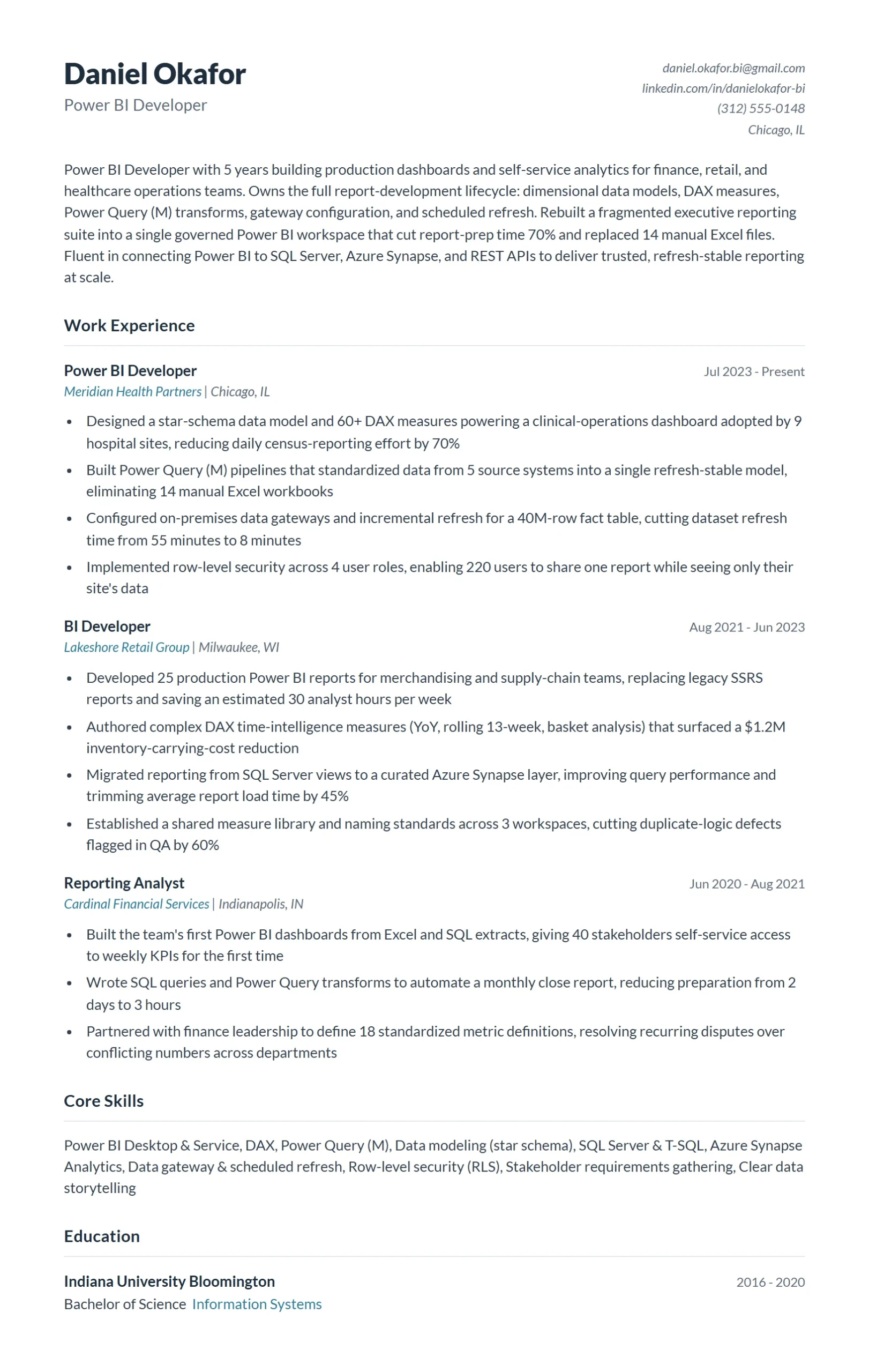
Power BI Developer resume example
A mid-level developer who owns the full report lifecycle, from data model and DAX through published, refreshing dashboards.
This resume leads with the technical stack hiring managers search for (DAX, Power Query, data modeling, gateway refresh) and then ties each one to a result, like cutting report load time or replacing manual spreadsheets. It quantifies dashboards built, datasets modeled, and stakeholders served, which signals both depth and production scale rather than one-off projects.
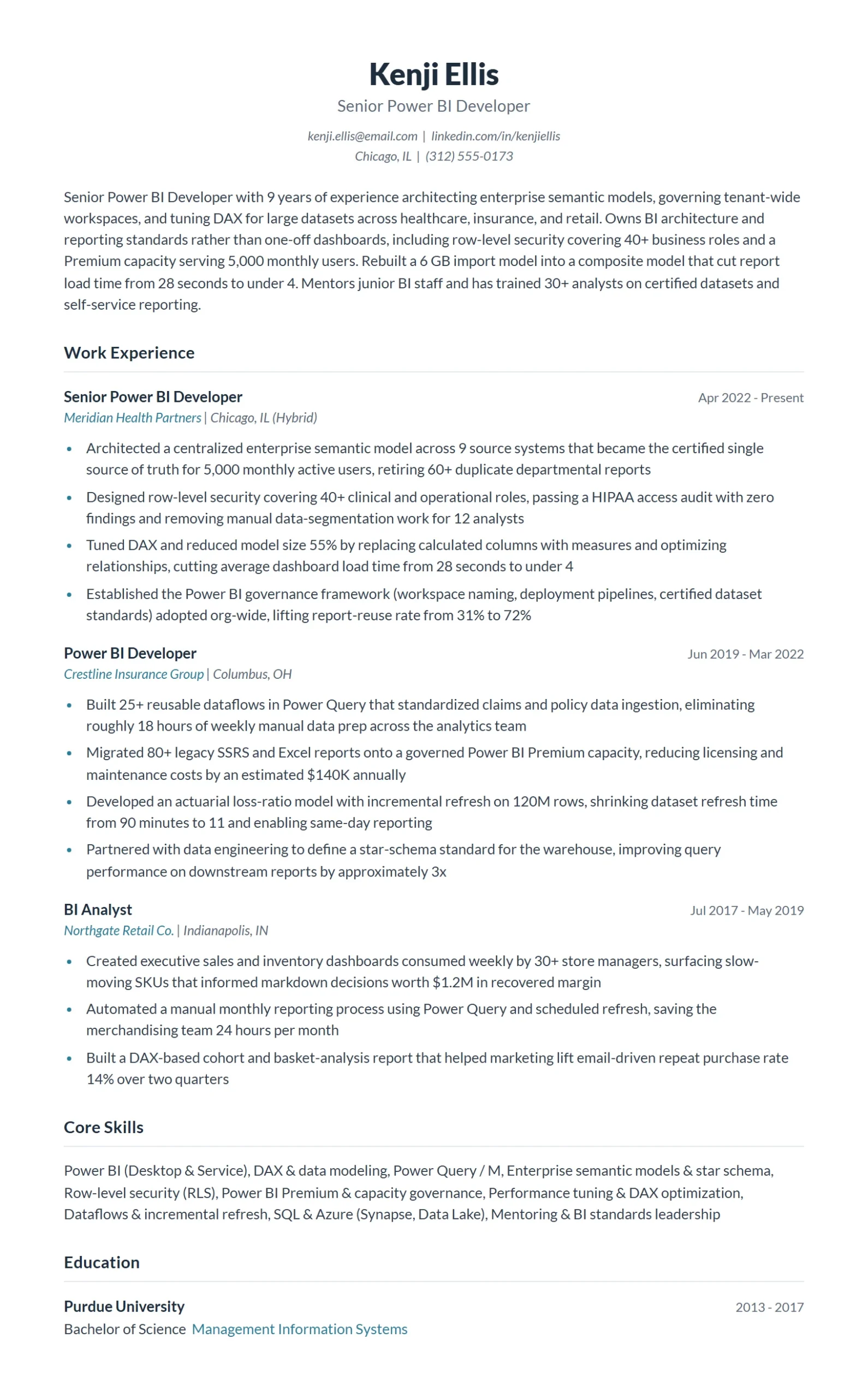
Senior Power BI Developer resume example
A senior developer who sets BI architecture and standards, not just individual reports.
It shifts the emphasis from building reports to owning the platform: enterprise semantic models, row-level security, workspace governance, and performance tuning across hundreds of users. Bullets show mentorship and standardization, plus measurable wins like refresh times slashed and a single source of truth adopted org-wide, which is what separates senior pay bands from mid-level ones.
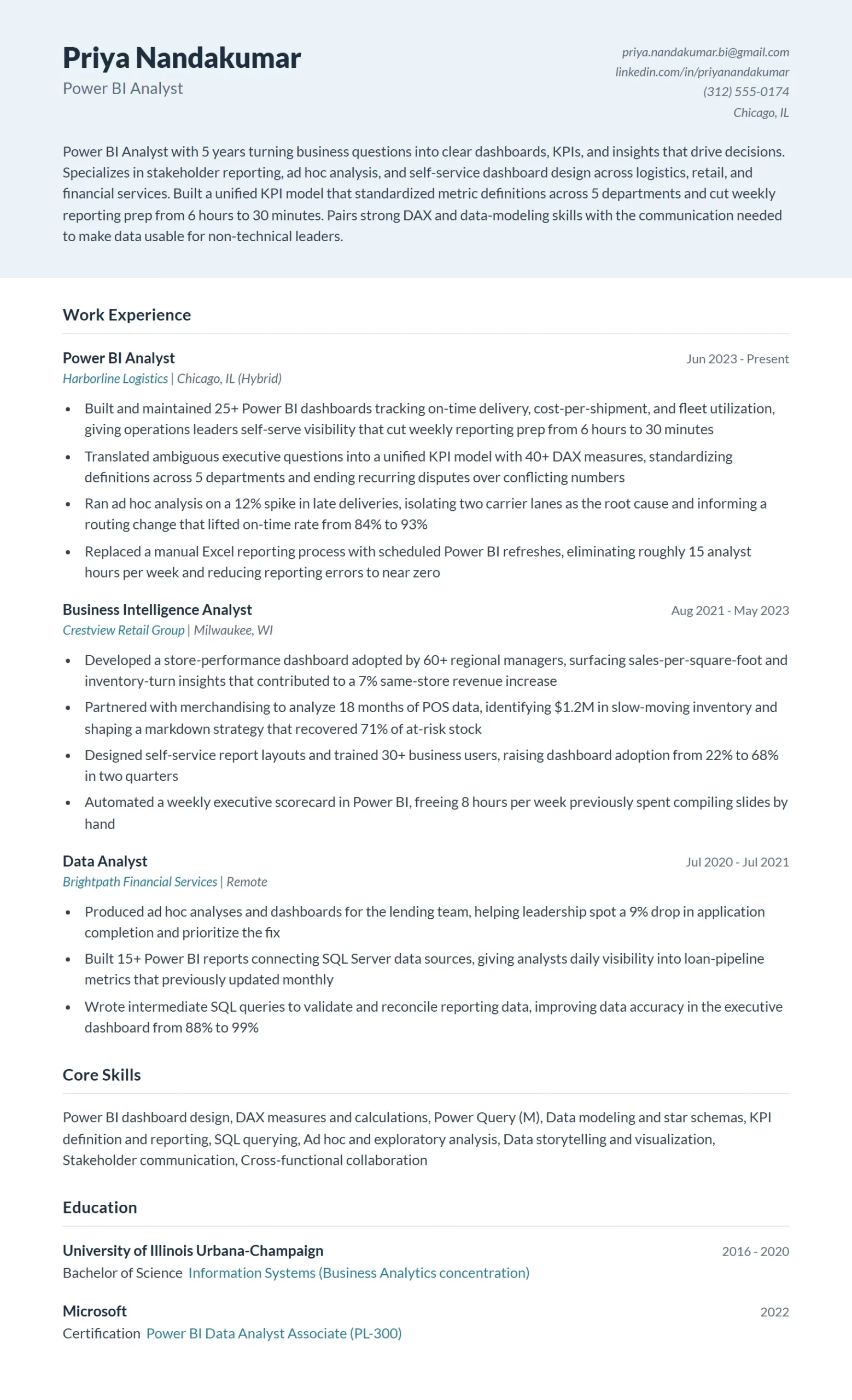
Power BI Analyst resume example
An analyst who translates business questions into dashboards and KPIs that drive decisions.
This version foregrounds business impact and stakeholder communication over heavy data engineering, which fits how analyst roles are actually scoped. It still proves the Power BI and SQL fluency ATS looks for, but the bullets center on insights delivered, decisions influenced, and reporting cycles automated, showing the candidate connects data to outcomes leadership cares about.
BI Developer resume example
A business intelligence developer working across the broader Microsoft stack, with Power BI as one tool among several.
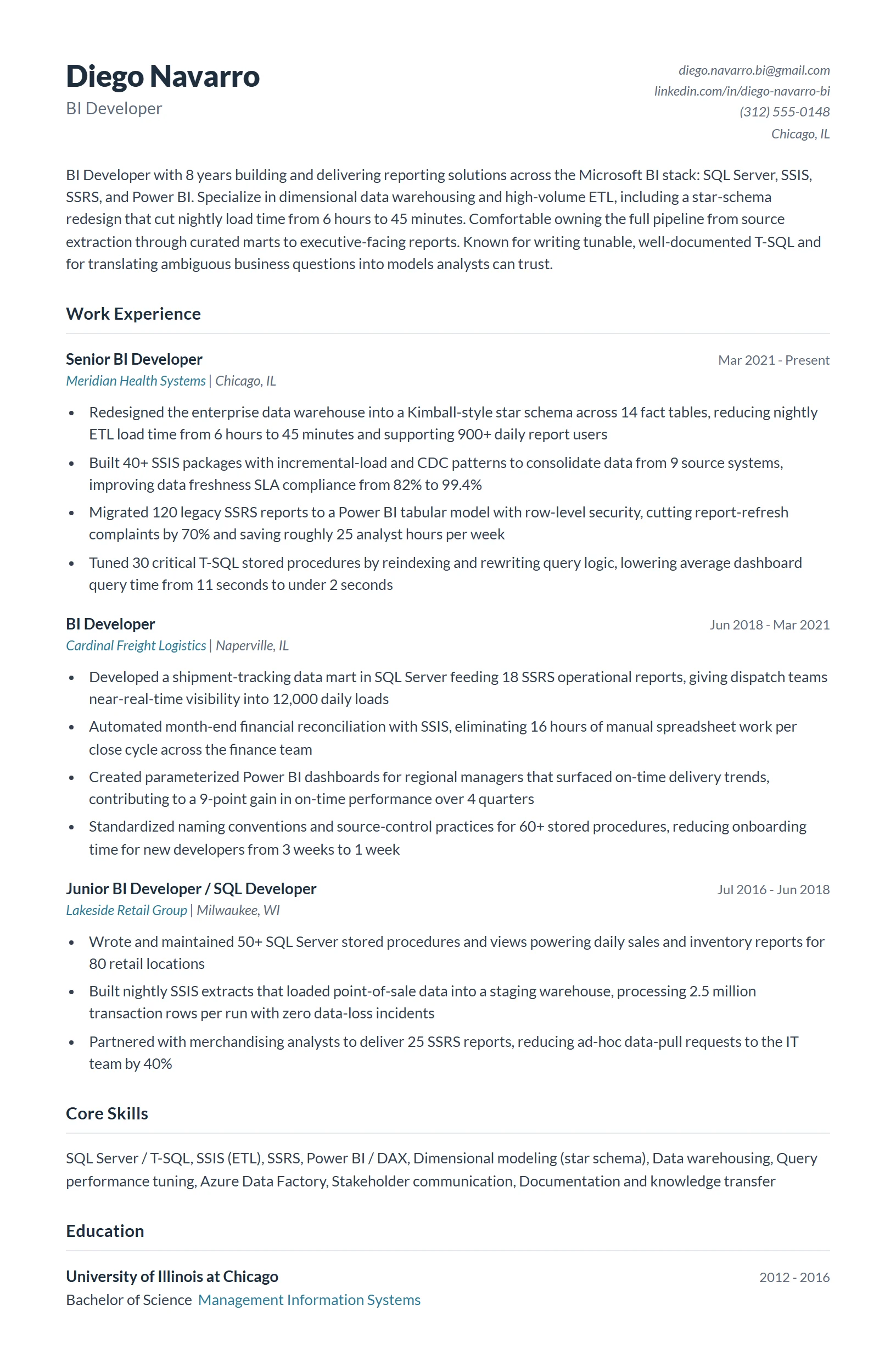
It broadens the keyword footprint to SSIS, SSRS, SQL Server, and data warehousing so the resume matches BI roles that expect full ETL and modeling, not just report building. Quantified bullets on pipelines built, data volumes processed, and star-schema designs prove engineering depth, while Power BI work shows the candidate can also deliver the front-end layer.
Data Analyst (Power BI) resume example
A data analyst who specializes in Power BI, the most common path into dedicated BI work.
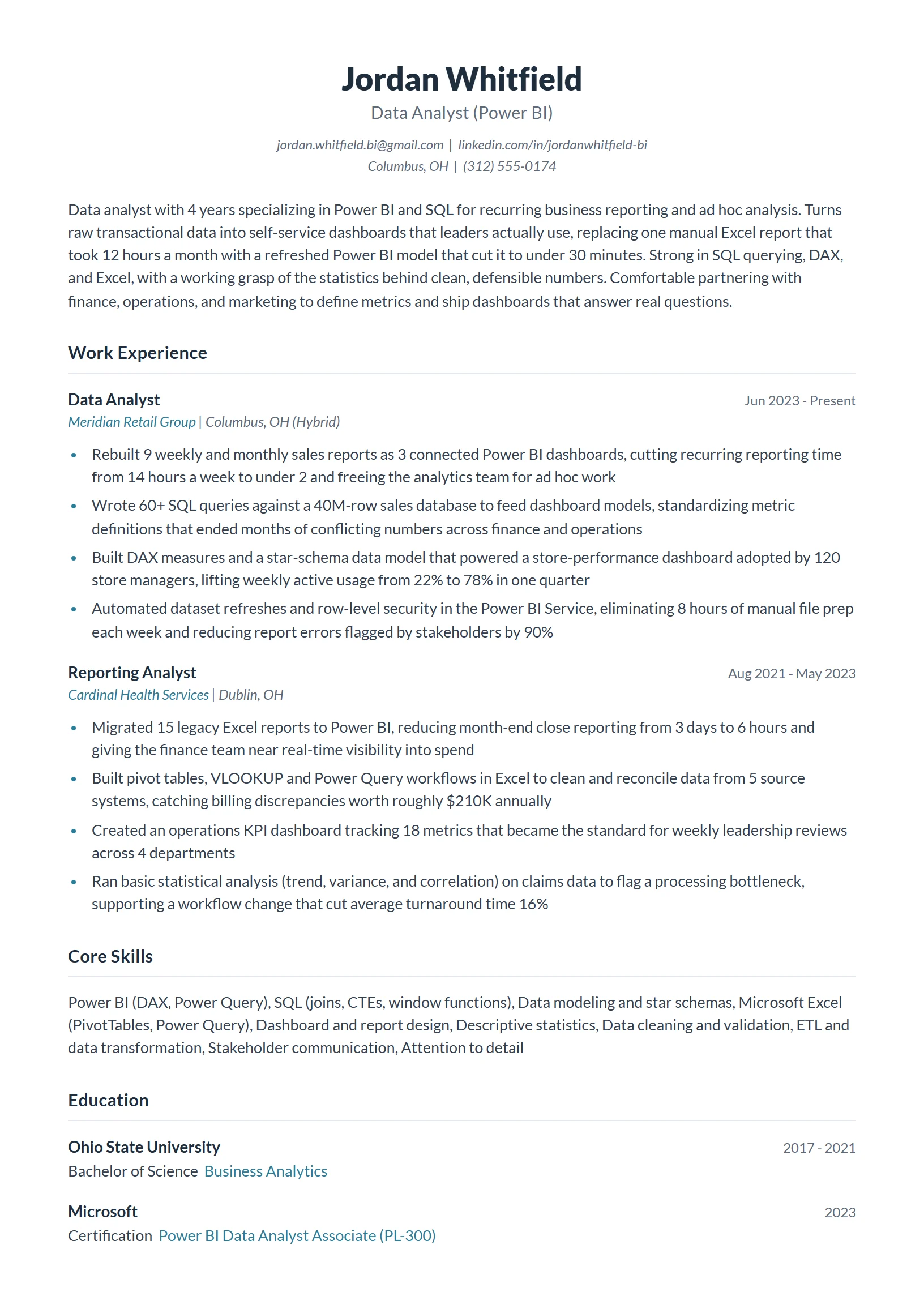
This resume is the friendliest on-ramp: it pairs core Power BI and SQL skills with Excel and analysis fundamentals, so candidates moving up from general analyst roles can show transferable wins. Bullets emphasize recurring reporting automated and questions answered for the business, framing Power BI as a strength rather than the entire job description.
Power BI Consultant resume example
A client-facing consultant who delivers Power BI solutions across multiple engagements and industries.

It leans on breadth and adoption: number of clients served, industries covered, and dashboards delivered under deadline, alongside requirements gathering and training. The bullets prove the candidate ships fast and gets stakeholders to actually use what they build, which is the outcome consulting clients pay for and what hiring firms screen consultant resumes for.
How to write a Power BI resume that gets interviews
Hiring managers for Power BI roles are looking for one thing: proof you can turn messy data into dashboards that people actually use to make decisions. They scan for the technical stack (DAX, Power Query, data modeling) and for business outcomes (faster reporting, hours saved, decisions enabled). Most companies also run your resume through an Applicant Tracking System (ATS) first, so your wording has to match the job description before a recruiter ever reads it. The tips below show you how to clear the ATS scan and convince the analytics lead reading next.
- Name the full Microsoft BI stack, not just “Power BI”: “Power BI” alone is too broad. ATS and hiring managers look for the specific layers: DAX for measures, Power Query (M) for transformation, data modeling and star schemas, Power BI Service for publishing, and how you source data (SQL Server, Azure Synapse, Dataflows, Excel). If the posting mentions Power BI Premium, paginated reports, or the on-premises data gateway and you have used them, name them exactly. Listing the real components signals you build models, not just charts.
- Quantify the business impact, not the number of dashboards: Anyone can say they “built dashboards.” Show what changed: “cut monthly close reporting from 3 days to 4 hours,” “replaced 12 manual Excel reports with one refreshing model,” or “gave 200+ sales reps self-serve KPIs that ended ad-hoc report requests.” Tie your work to time saved, decisions enabled, manual work removed, or revenue and cost the dashboard influenced. Reporting metrics like refresh time and adoption count as impact too.
- Show data modeling and DAX depth, not just visuals: A pretty dashboard on a bad model breaks at scale. Hiring managers want proof you can design a clean star schema, write performant DAX measures, and use Power Query to shape data before it hits the model. Reference real work: “built a 9-table star schema,” “wrote 40+ reusable DAX measures with time-intelligence,” or “optimized a model that cut refresh time 60%.” This is what separates a report builder from a BI developer.
- Prove governance and performance awareness: At any serious scale, Power BI is about trust and speed. Mention row-level security (RLS) for controlling who sees what, workspace and deployment-pipeline management, scheduled refresh and gateway setup, and performance tuning (Performance Analyzer, aggregations, reducing cardinality). One line like “implemented RLS across 5 regional workspaces” tells a hiring manager you can ship to a real organization, not just your own laptop.
- Connect dashboards to the decisions they drove: BI does not happen in a vacuum. Show that you partnered with stakeholders to define KPIs and that the output changed how the business operated. Use bullets that name the partnership and the result: “Partnered with finance and operations to define 15 KPIs, then built an executive dashboard the leadership team now uses in weekly reviews.” This signals you translate business questions into data products, not just take ticket requests.
- Tailor to the role and keep the format ATS-safe: A Power BI Developer role, a BI Analyst role, and a Data Analyst role reward different keywords. Reorder your skills and swap your headline projects to mirror each posting (some want heavy DAX and modeling, others want SQL and stakeholder reporting). Then keep the format ATS-friendly: standard section headings, no text boxes or multi-column layouts that scramble parsing, and one clean column. Run it through Jobscan to check your match rate against the job description before you apply.

Power BI resume summary examples
Your summary is the first thing a recruiter reads. Lead with your specialty, years of experience, and a quantified win.
Good power BI resume summary examples
- Power BI Developer with 6+ years building enterprise reporting on the Microsoft BI stack (DAX, Power Query, SQL Server, Azure). Designed star-schema models and 50+ reusable DAX measures that cut report refresh time 60% and replaced 20 manual Excel reports with one governed model. Implemented row-level security across 8 regional workspaces serving 400+ users.
- Data analyst specializing in Power BI and SQL, turning raw operational data into self-serve dashboards for finance and sales teams. Built executive KPI dashboards now used in weekly leadership reviews, cutting ad-hoc report requests 70% and reducing monthly close reporting from 3 days to 4 hours.
- BI analyst with deep DAX and data-modeling expertise and a track record of stakeholder-driven reporting. Migrated legacy Excel and SSRS reporting to Power BI Service with scheduled refresh and gateway connectivity, giving 250+ users trusted, single-source metrics and freeing 15 analyst hours per week.
What to avoid
- Detail-oriented Power BI professional seeking a challenging role where I can use my skills and grow with a dynamic company. (It is all about what the candidate wants, not what they deliver. There is no stack (DAX, Power Query, modeling), no scale, and zero evidence of impact. A hiring manager learns nothing they can act on.)
- Passionate about data and dashboards, with strong knowledge of Power BI and a great eye for visualizations. (Pure adjectives with no proof. “Strong knowledge” and “great eye” are claims anyone can make. It names no specific tools or methods (DAX, RLS, data modeling) and no measurable result, so the ATS and the recruiter both skip it.)
Power BI resume skills
Pull the exact tools and metrics named in each job description, then mirror that language here. This is a quick resume snapshot, so keep it to your strongest, role-relevant skills rather than an exhaustive list.
Hard skills for a power BI resume
- Power BI Desktop & Service
- DAX (Data Analysis Expressions)
- Power Query (M)
- Data Modeling (Star Schema)
- SQL
- Row-Level Security (RLS)
- Data Visualization & Dashboard Design
- ETL & Data Transformation
- Scheduled Refresh & Data Gateway
- Microsoft Excel (Power Pivot)
Soft skills for a power BI resume
- Stakeholder Communication
- Requirements Gathering
- Problem Solving
- Attention to Detail
- Business Acumen
- Storytelling with Data
Power BI resume work experience bullet point examples
Lead each bullet with a strong verb and a measurable result.
Good bullet point examples
- Built a 10-table star-schema model with 50+ reusable DAX measures, cutting report refresh time from 25 minutes to under 10 and powering self-serve analytics for 400+ users.
- Replaced 18 manually maintained Excel reports with a single Power BI model on scheduled refresh, eliminating roughly 15 analyst hours of report assembly per week.
- Partnered with finance and operations to define 15 KPIs, then delivered an executive dashboard now used in weekly leadership reviews, reducing ad-hoc report requests 70%.
- Implemented row-level security across 6 regional workspaces and optimized model cardinality with Performance Analyzer, improving dashboard load time 55% while keeping data access compliant.
Bad bullet point examples
- Created various dashboards and reports in Power BI for different departments. (Lists a task with no outcome. “Various” and “different departments” are vague, and there is no metric, no business problem solved, and no scale. It says you used the tool but not whether your work mattered.)
- Responsible for company reporting and data visualizations. (“Responsible for” describes a job title, not an accomplishment. It shows no specific action, no part of the stack (DAX, Power Query, modeling), and no measurable impact. Lead with a strong verb (Built, Automated, Migrated) and end with a result.)
- Used Power BI to make data look nice and help people understand it better. (Subjective and unquantified. “Look nice” and “understand it better” are opinions with no proof. Replace them with the metric that backs the claim, such as refresh time cut, manual hours removed, or adoption across a number of users.)
Power BI resume tips
A strong Power BI resume proves you can connect raw data to real decisions, and these six tips help yours clear every ATS filter and land on the right desk.
- Mirror Job Description Keywords: Copy exact terms from the posting (such as DAX, Power Query, Star Schema, or Row-Level Security) into your skills section and bullet points, because ATS systems match strings literally and will miss synonyms.
- Quantify Dashboard Impact: Pair every major project with a metric that analytics managers care about: dashboards delivered to N users, report refresh time cut by X hours per week, or decisions enabled for a specific revenue or cost figure.
- List Your DAX Depth: Specify the complexity of your DAX work (calculated columns, time-intelligence functions, iterators like SUMX) rather than writing DAX alone, since recruiters screen for seniority by scanning for these sub-skills.
- Add Your PL-300 Cert: If you hold the Microsoft Power BI Data Analyst (PL-300) certification, place it in both a dedicated Certifications section and your summary line, because hiring managers and ATS filters actively scan for that credential.
- Name the Data Sources: Call out every upstream system you connected to Power BI (such as SQL Server, Azure Synapse, Salesforce, or SharePoint) because many job descriptions screen for familiarity with the same stack the employer already runs.
- Separate Desktop from Service: List Power BI Desktop and Power BI Service as distinct skills rather than lumping them as Power BI, since roles focused on enterprise deployment specifically screen for Service skills like workspaces, dataflows, and scheduled refresh.
Pair your power BI resume with a cover letter
A strong resume goes further with a tailored cover letter. Browse our cover letter examples to round out your application.
Power BI resume frequently asked questions
List the skills that map to real job duties: DAX, Power Query (M), data modeling, and building dashboards and reports. Add supporting tools like SQL, Excel, Azure, and the Power BI Service for publishing and sharing. Match your wording to the job description, since an ATS scans for terms like “DAX,” “Power Query,” and “data visualization” exactly as they appear in the posting.
Lead with the business outcome, then name the technical work. For example: “Built an executive sales dashboard in Power BI that cut weekly reporting time by 8 hours and surfaced a 12% revenue gap.” Quantify wherever you can (rows of data modeled, hours saved, decisions influenced) so a hiring manager sees impact, not just tool usage.
Yes. They are distinct skills that recruiters and ATS filters search for individually, so spelling out both shows real depth rather than surface-level familiarity. Name them in your skills section and back them up in your experience bullets (for example, a measure you wrote in DAX or a data transformation you built in Power Query).
Build 2 or 3 portfolio dashboards using public datasets (Kaggle, government data, or your own tracked numbers) and describe them on your resume like real projects with a goal and an outcome. Add the Microsoft PL-300 (Power BI Data Analyst) certification if you can, since it signals verified skills to employers. Link your portfolio or a public Power BI Service workspace so reviewers can see the work.
Power BI shows up well beyond “Power BI Developer.” Common matches include Data Analyst, Business Intelligence Analyst, BI Developer, Reporting Analyst, and Financial or Operations Analyst roles. Read each posting closely, because the same skills can be titled very differently across companies, and tailoring your resume to that exact title helps you pass the ATS keyword match.
The Microsoft PL-300 (Power BI Data Analyst Associate) is the one most employers recognize, and it is worth listing if you have it or can earn it. Put it in a dedicated certifications section with the full name and year so an ATS and a recruiter both catch it. A certification helps most when you pair it with demonstrated projects, since proof of work carries more weight than the credential alone.