Best Programmer Resume Examples for 2026
See programmer resume examples for 2026 at every level, from entry to senior, with the languages, frameworks, and measurable results that get you past the ATS.

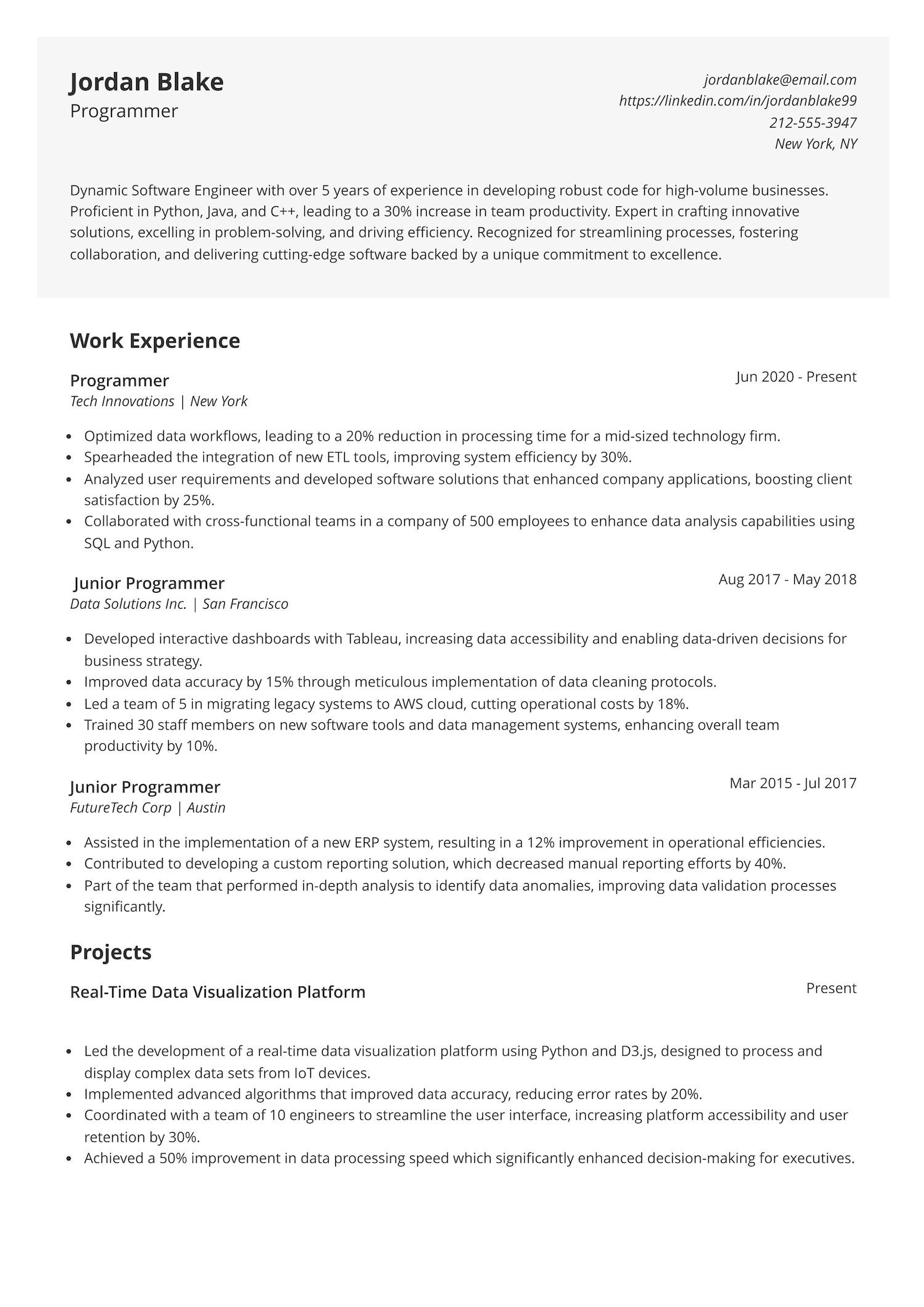


Landing a programming job in today’s competitive tech landscape starts with one crucial document: your programmer resume. However, writing a programmer resume that gets noticed is one of the most common hurdles job seekers in tech face today.
Whether applying for your first junior programmer role or aiming for a senior-level position, many programmers face the same frustrating questions: How do I prove my value beyond just listing programming languages? What projects should I highlight? How do I format my resume to be ATS-friendly without losing the human touch? If these challenges sound familiar, you’re in the right place.
In this guide, you’ll find programmer resume examples tailored for 2025—complete with insights on structure, content, and strategies to help your resume resonate with both recruiters and hiring managers. Whether you’re struggling to condense complex projects into bullet points or unsure which skills to prioritize, this blog is designed to give you the clarity and confidence to present your programming journey in the best light possible.
Programmer resume example
Landing a programmer role in 2025 means showing more than just coding skills—you need a resume that proves you can think critically, work in teams, and drive real results. This resume example is a solid reference if you’re trying to show your impact through measurable outcomes, real projects, and a career story that highlights steady growth and technical depth.
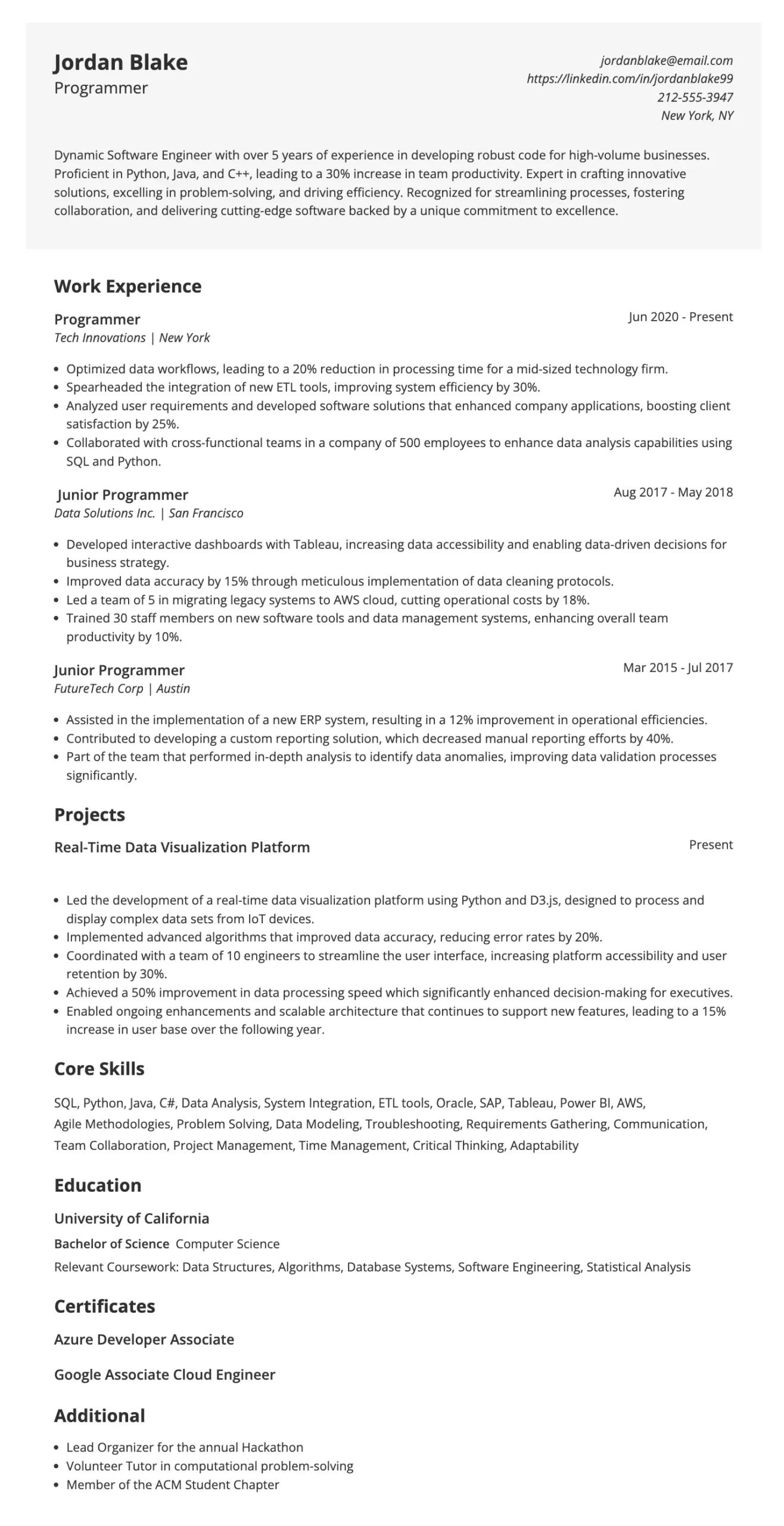
A great programmer resume needs to show hands-on experience with modern tech stacks, cloud platforms, data tools, and collaboration. Employers are looking for candidates who not only write clean code but also understand how to solve problems, streamline processes, and support business goals. This role demands people who can balance technical expertise with adaptability, and resumes like this one help you show just that.
Demonstrating a balance of technical expertise and business impact, this resume highlights over five years of hands-on experience with Python, Java, and ETL tools, backed by measurable achievements like boosting system efficiency by 30% and cutting processing time by 20%.
It effectively showcases leadership in cross-functional teams, success in cloud migration, and a track record of driving innovation—making it an excellent example of what employers seek in a programmer.
Entry-level programmer resume example
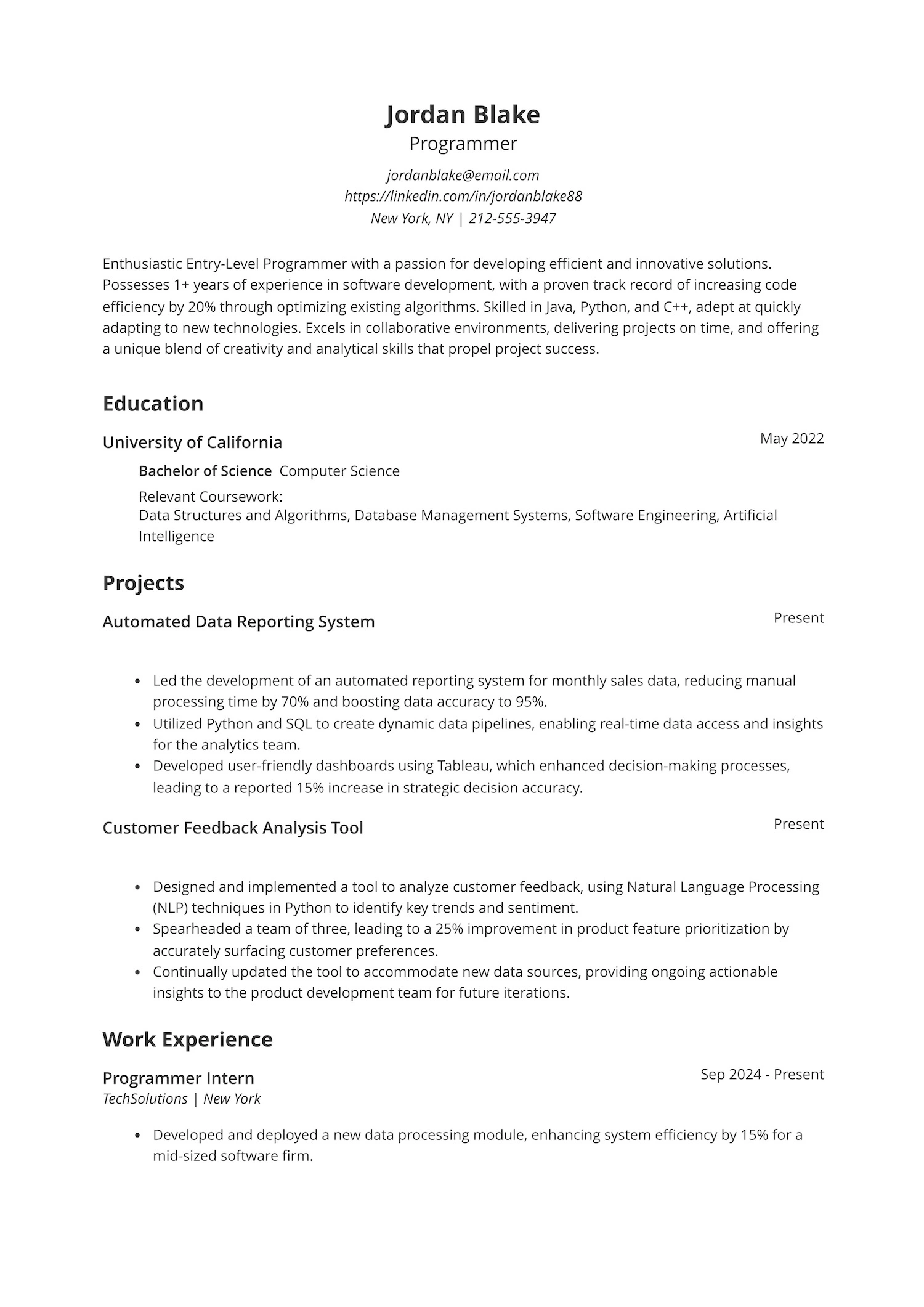
Breaking into tech as a programmer can feel overwhelming without the right resume that truly reflects your skills and potential. Check out this entry-level programmer resume example and learn how to highlight early experience, relevant projects, and technical skills in a way that makes an impact.
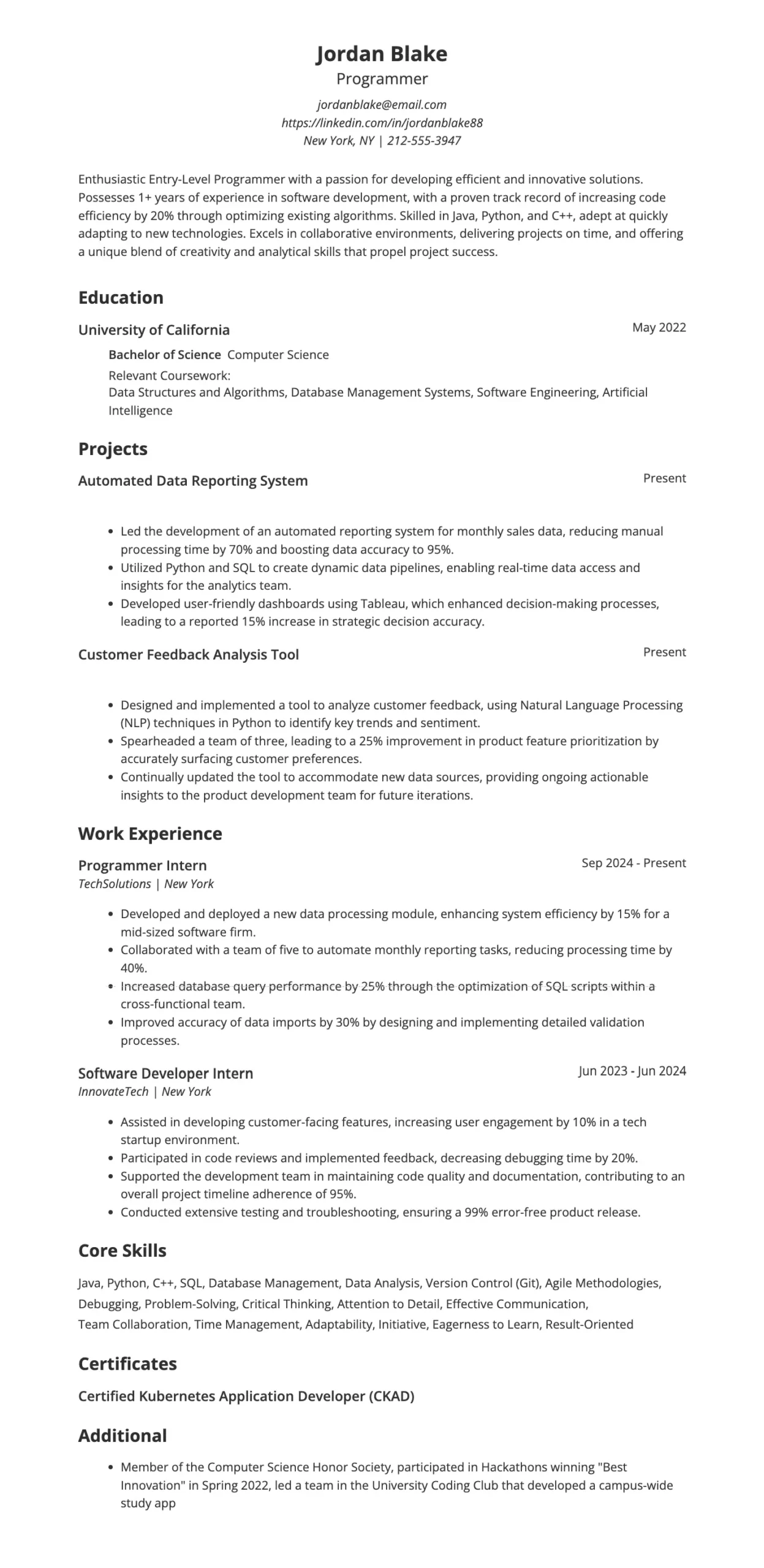
With a professional summary that clearly highlights technical adaptability and a track record of improving code efficiency, this resume positions the candidate as a strong entry-level programmer. The projects section reinforces this by showcasing real-world experience in building automated systems and NLP tools that drove measurable results.
Together, these elements present a candidate who’s proactive, skilled in multiple languages, and capable of contributing value from day one.
With a professional summary that clearly highlights technical adaptability and a track record of improving code efficiency, this resume positions the candidate as a strong entry-level programmer. The projects section reinforces this by showcasing real-world experience in building automated systems and NLP tools that drove measurable results.
Together, these elements present a candidate who’s proactive, skilled in multiple languages, and capable of contributing value from day one.
Senior programmer resume example
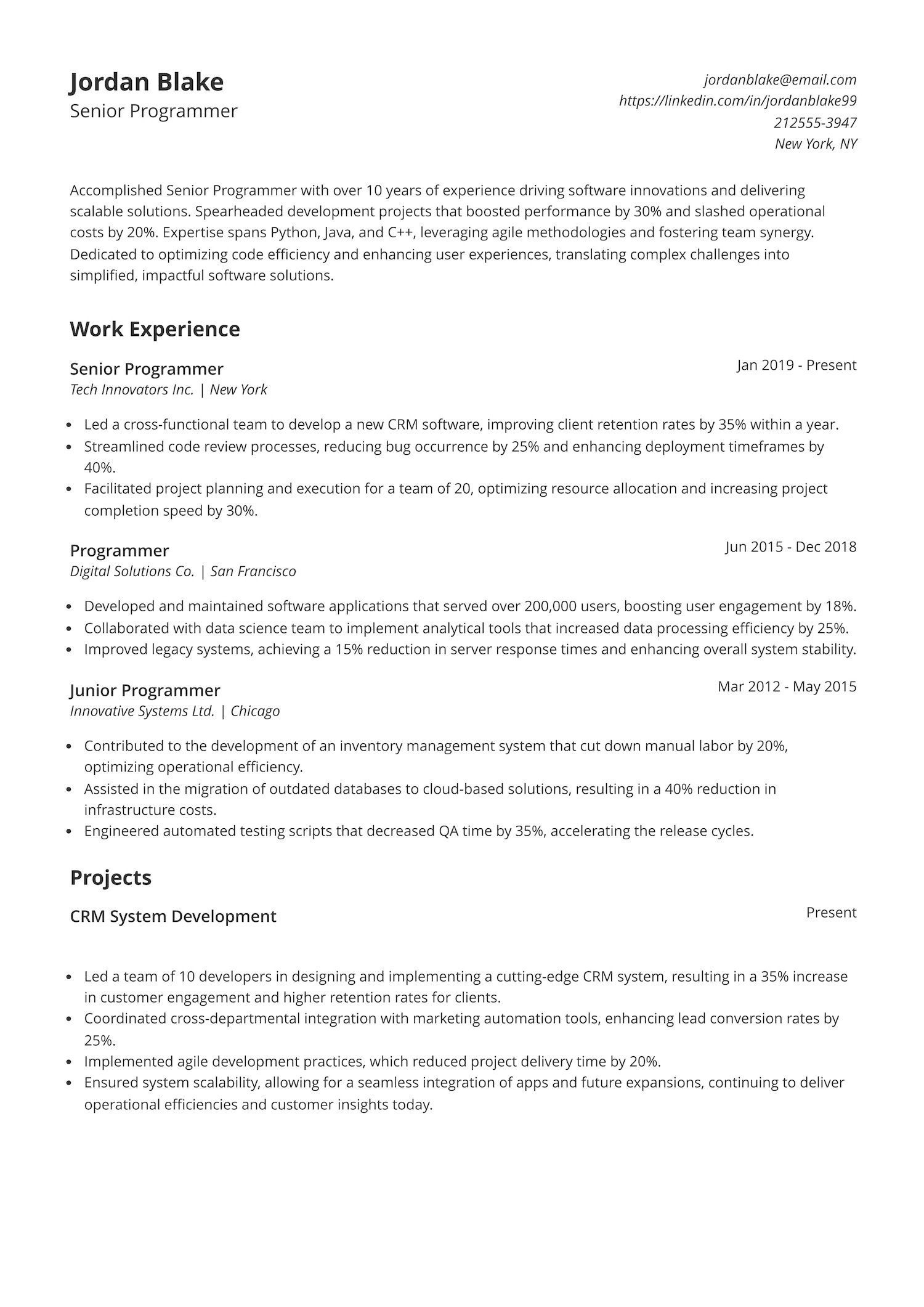
If you’re aiming to level up your career in software development and want to show your leadership and technical depth, this senior programmer resume example hits the mark. Use it as a reference for writing your own standout resume.
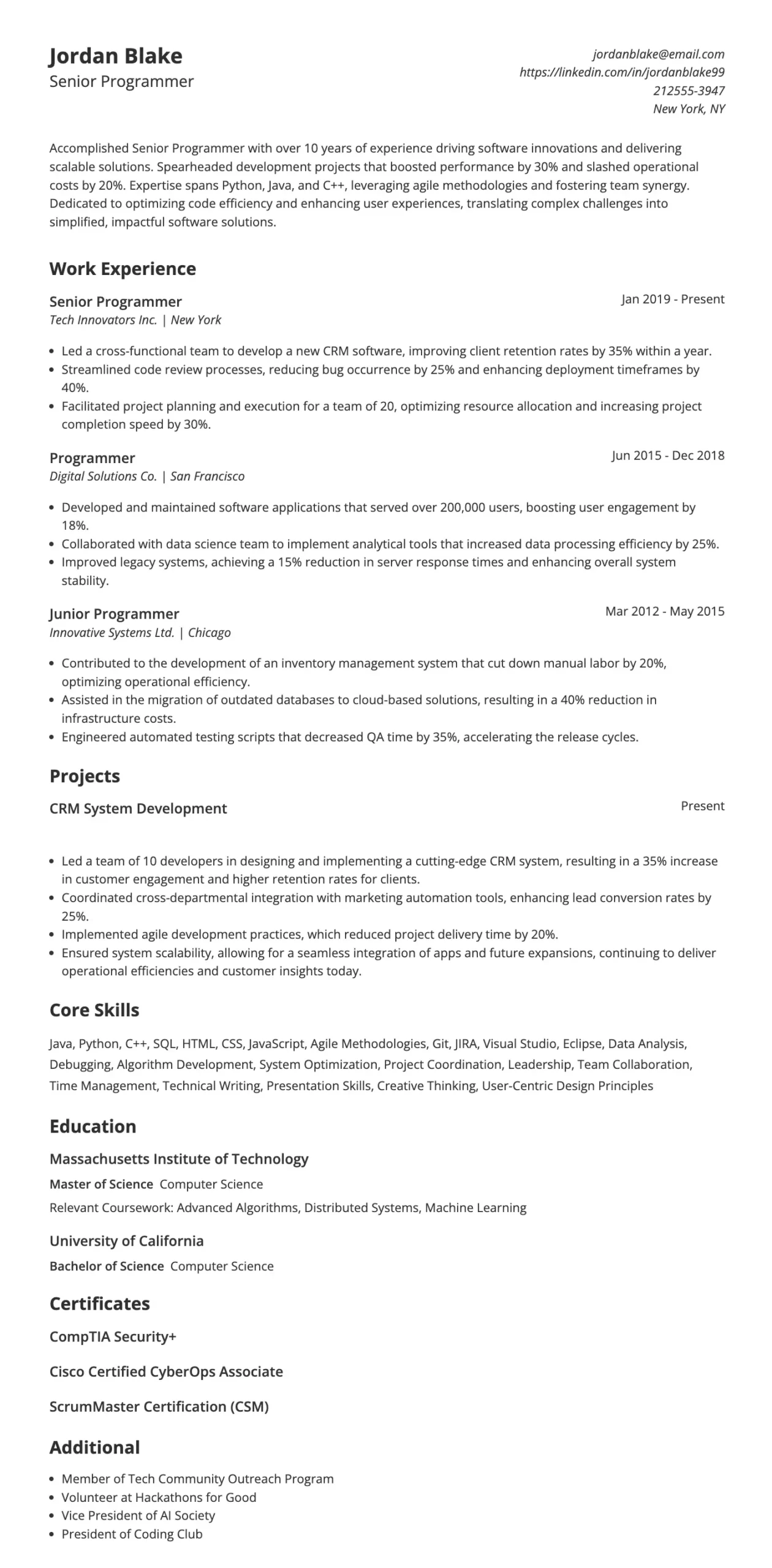
Senior programmer roles demand more than just coding skills. Hiring managers look for professionals who can lead teams, streamline systems, and deliver measurable results. Your resume should reflect not only your technical abilities but also your experience in managing projects, improving processes, and collaborating across departments.
This resume immediately highlights over a decade of impactful experience, evidenced by quantifiable achievements like boosting performance by 30%. The work history showcases a clear progression and leadership in significant projects.
Furthermore, the strategic inclusion of relevant certifications (Security+, CyberOps, CSM) alongside a robust skills section covering key technologies and methodologies positions the candidate as a well-rounded and highly qualified professional.
Junior programmer resume example
Breaking into the tech world or advancing early in your programming career means your resume needs to reflect both your technical know-how and the real-world results you’ve achieved. Below is a junior programmer resume example that does just that, use it to write your own.
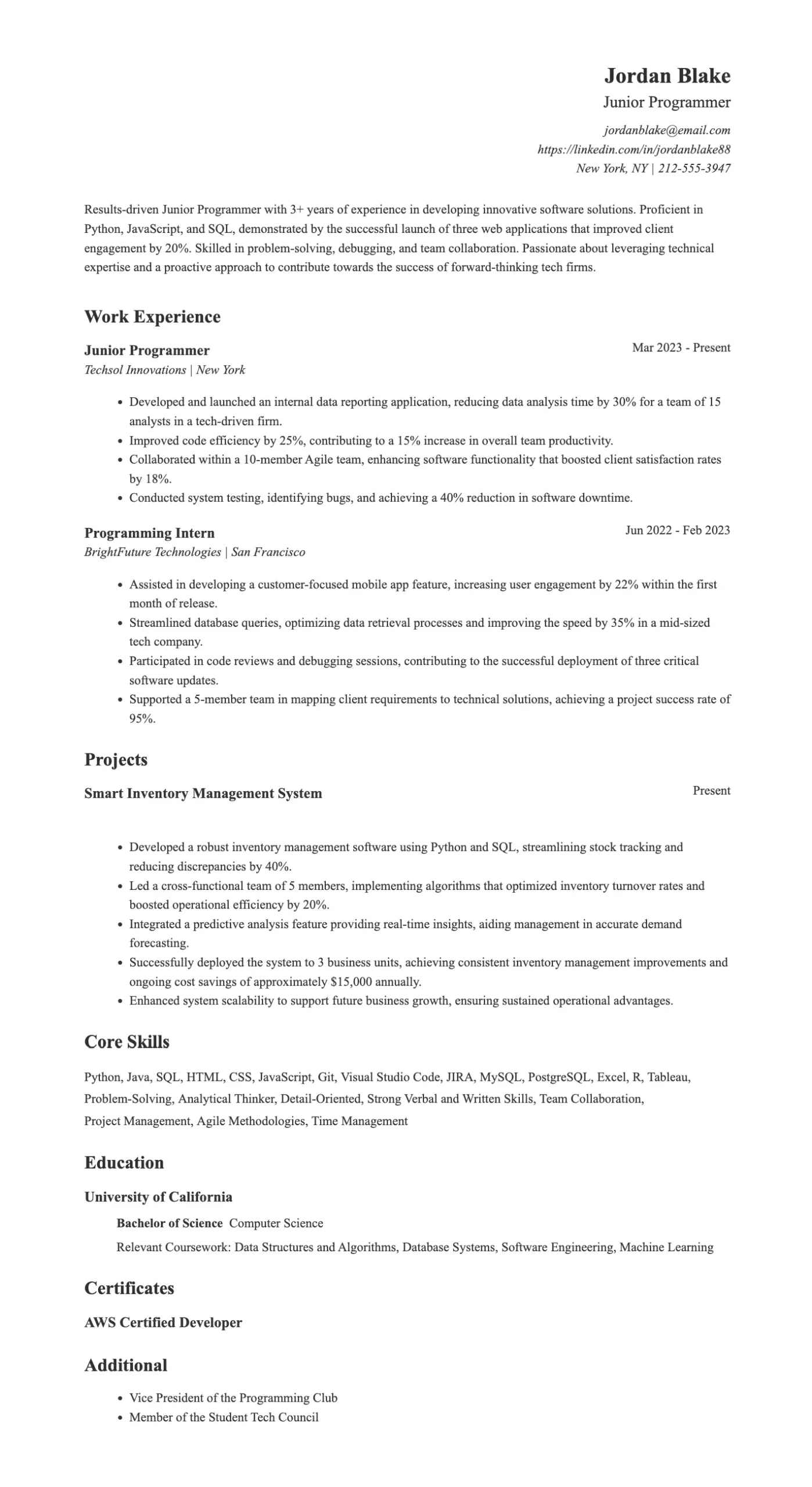
As a junior programmer, your resume should focus on the fundamentals—core programming languages, databases, and tools—but also go beyond just listing skills. Employers want to see how you apply what you know: Have you improved performance? Did you contribute to a successful project? How well do you work in a team? Highlighting achievements like process improvements, app launches, and collaboration shows you’re ready to take on bigger challenges while still being eager to learn and grow.
What makes this resume compelling is its immediate demonstration of tangible impact within a short career span, evidenced by the successful launch of applications that measurably improved client engagement. The work experience section further reinforces this with specific achievements, such as reducing data analysis time by 30% and improving code efficiency.
Moreover, the inclusion of a relevant AWS Certified Developer certification alongside a strong blend of technical and soft skills like problem-solving and team collaboration clearly positions the candidate as both capable and driven for a junior programmer role.
How to write a programmer resume that will get you an interview
If you’re applying for programming jobs in 2025, writing a strong resume isn’t just about showcasing your technical skills—it’s about making sure your resume actually gets seen. With most companies now using Applicant Tracking Systems (ATS) to manage the hiring process, your resume needs to be optimized for both humans and machines. A well-structured, keyword-rich programmer resume can be the difference between landing in the “shortlisted” pile or disappearing into a digital black hole.
Understanding how ATS works is essential to tailoring your resume for success. Think of an ATS as a search engine that hiring managers use to find the most relevant candidates. If your resume doesn’t align with what the system is looking for, it may never reach a real person—even if you’re the perfect fit for the job.
Here’s how an ATS works behind the scenes:
- Job posting setup: The employer enters the job title, key responsibilities, required skills, and qualifications into the ATS.
- Resume scanning: When you submit your application, the ATS scans your resume and parses out essential details like your work experience, education, and skills.
- Searchable database: It is then stored in a searchable database. Recruiters can then search using specific keywords to find candidates
This is why optimizing your programmer resume for ATS is non-negotiable. Missing even one critical keyword could cause your resume to remain buried in the system. Fortunately, you don’t have to navigate this alone—Jobscan’s free resume builder is specifically designed to help job seekers like you overcome the challenges of creating an ATS-optimized resume.

Key elements of a programmer resume
Each section of your resume plays a crucial role in telling your story, highlighting your programming skills, and showing hiring managers why you’re the right fit. Here are the key elements every programmer resume should have:
- Contact information: Include your full name, phone number, email address, LinkedIn profile, and optionally, a link to your GitHub or personal portfolio site.
- Professional summary: A brief 2–3 sentence overview that highlights your experience, key strengths, and what type of role you’re seeking.
- Core skills section: A list of your most relevant technical and soft skills, such as programming languages, frameworks, tools, and methodologies.
- Work experience section: Detail your professional experience in reverse chronological order, emphasizing accomplishments, technologies used, and measurable results.
- Projects: Include notable programming projects, either personal or professional, especially those that showcase problem-solving skills and technical expertise.
- Education section: List your degrees, universities, and graduation dates. Include relevant coursework if you’re an entry-level candidate.
- Certifications: Highlight any programming or tech certifications such as AWS, Microsoft, or Google certifications that add credibility to your skillset.
- Honors and awards: Mention any academic or professional awards that demonstrate excellence or recognition in your field.
Write a strong professional summary
The professional summary should sit at the top of your resume and clearly convey your level of experience, specific skills, and the value you bring to a development team. A strong summary helps establish you as a good fit for the role before anyone even gets to your work history. Below are examples of both good and bad resume summaries to guide you.
Good examples of a resume summary
- “Results-driven software engineer with 5+ years of experience in web development and database management, specializing in building scalable web applications using React, Node.js, and MongoDB. Proven track record of improving user experience and increasing customer satisfaction through high-performance software solutions.”
- “Detail-oriented computer programmer with a Bachelor of Science in Computer Science and strong command of Java, Python, and SQL. Skilled in Agile environments with a focus on collaboration and delivering reliable code. Holds relevant certifications in AWS and DevOps.”
Bad examples of a resume summary
- “I’m a passionate programmer looking for a new job where I can use my skills. I enjoy coding and working on different projects.”
- “I am hardworking and loyal. I always do my best and can work independently or as part of a team.”
Use Jobscan’s resume summary generator to create a tailored, keyword-optimized summary based on your skills, job title, and target role. It’s the best way to make sure your resume includes the key information hiring managers and applicant tracking systems are looking for.
Demonstrate key programmer skills
To make your programmer resume stand out, it’s important to highlight a mix of hard and soft skills that show you’re not just technically capable, but also a great collaborator and problem-solver. Below are some of the key skills that are often sought after in software engineering and web development roles.
Hard skills for programmer
- Proficiency in Various Programming Languages (e.g., Python, Java, JavaScript, C++)
- Web Development (HTML, CSS, React, Node.js)
- Mobile App Development (Android, iOS, Flutter)
- Software Development Life Cycle (SDLC)
- Object-Oriented Programming (OOP)
- API Design and Integration
- Version Control (Git, GitHub, GitLab)
- Database Management (MySQL, MongoDB, PostgreSQL)
- Cloud Computing (AWS, Azure, Google Cloud)
- Unit Testing and Debugging
- DevOps and CI/CD Tools
- Agile and Scrum Methodologies
Soft skills for programmer
- Problem-Solving
- Analytical Thinking
- Communication Skills
- Collaboration and Teamwork
- Time Management
- Adaptability
- Attention to Detail
- Critical Thinking
- Creativity
- Project Management
Including a balanced mix of these skills in your bullet points not only helps you match job postings more effectively but also demonstrates to potential employers that you’re a well-rounded candidate capable of contributing to a development team on multiple levels. Here are some good and bad examples of bullet points for your reference.
Write impactful resume bullet points for a programmer
Resume bullet points are the core of your experience section. They should clearly communicate your skills, the impact you’ve made, and the value you bring to a team. Instead of listing tasks, focus on what you accomplished using specific tools, action verbs, and measurable results. Here’s what that looks like:
Good examples of resume bullet points
- “Developed and deployed a customer-facing web application using React and Node.js, reducing support requests by 25% through improved user experience.”
- “Led a team of 4 developers in an Agile environment to deliver a new software feature ahead of schedule, resulting in a 15% increase in customer satisfaction.”
- “Refactored legacy codebase in Java, improving system performance by 30% and reducing page load times.”
Bad examples of resume bullet points
- “Worked on web development.”
- “Fixed bugs.”
- “Helped team with projects.”
Want better bullet points? Let Jobscan’s resume bullet point generator do the heavy lifting for you. It helps you write strong, tailored, and ATS-optimized bullet points that align with your programmer resume, reflect your relevant experience, showcase your specific skills, and uses action verbs. Whether you’re customizing a resume template or building one from scratch, Jobscan ensures every line adds value.
Highlight your achievements as a programmer
When writing your programmer resume, it’s not enough to simply list your responsibilities—you need to highlight your achievements. Employers want to see the impact you’ve made, how you’ve applied your specific skills, and the value you’ve delivered in past roles. Use metrics, outcomes, and specific technologies to make your accomplishments stand out.
Here are some strong examples to guide you
- “Increased application speed by 40% by optimizing SQL queries and refactoring inefficient code.”
- “Built a custom inventory management system using Django and PostgreSQL, reducing inventory errors by 60%.”
- “Designed and launched a mobile-friendly web application that supported 10,000+ daily active users with 99.9% uptime.”
- “Improved customer satisfaction scores by 20% by implementing intuitive UI/UX features in a React-based frontend.”
Tailor your resume to the job description
A one-size-fits-all resume may seem easier, but it’s far less effective. Customizing your resume shows employers that you’ve read the job description carefully and that you’re a good fit for the role.
Here’s how you can tailor your resume to the job description:
- Use keywords from the job posting: Match important terms like “JavaScript,” “REST API,” “Agile development,” or “database management” directly in your resume under skills, work history, and projects.
- Match your job title when possible: If the job description uses “Software Engineer,” and you held a similar role titled “Programmer,” consider using “Software Engineer (Programmer)” in your work experience section for clarity.
- Align your achievements with company goals: If the job highlights improving performance or enhancing user experience, showcase projects where you achieved similar results.
- Customize your professional summary: Write a professional summary that incorporates the job title, top-required skills, and key contributions you can make to the company.
- Adjust your core skills section: Ensure that your specific skills mirror those mentioned in the job description, from programming languages to tools and frameworks.
Include relevant education & certifications
Whether you’re a recent graduate or an experienced developer, showcasing the right qualifications can set your programmer resume apart, especially when you’re applying for roles that require specific credentials or relevant experience.
Here’s how to include relevant education and certifications in your resume:
- Create separate sections for Education and Certifications to keep your resume organized and easy to scan.
- List your highest degree first, including the degree name, university, location, and graduation date.
- For recent grads, you can include relevant coursework, academic honors, and GPA (if above 3.5).
- Under Certifications, list each certification with the full name, issuing organization, and the date you earned it.
- Only include certifications that are relevant to software development, web applications, or your desired job title.
Top programmer certifications
Here are some industry-recognized certifications that can add real value to your resume:
- AWS Certified Developer – Associate
- Microsoft Certified: Azure Developer Associate
- Google Associate Cloud Engineer
- Certified Kubernetes Application Developer (CKAD)
- Oracle Certified Professional, Java SE Programmer
- CompTIA Security+
- Cisco Certified CyberOps Associate
- ScrumMaster Certification (CSM)
- Certified Python Programmer (PCAP)
- GitHub Foundations Certification
Programmer resume tips
To land a programmer role, your resume must be clear, concise, and results-driven. Follow these expert tips to create a compelling resume that grabs attention:
- Use a clean, professional layout: Keep your resume format simple and easy to read. Avoid clutter and excessive graphics to ensure ATS compatibility.
- Tailor your resume to each job: Customize your resume for every role by aligning your skills and experience with the job description.
- Showcase your projects: Include personal or professional programming projects to demonstrate practical experience, especially if you’re a junior developer.
- Prioritize your most recent experience: In your work history, focus on the most recent roles or projects that align with the job you’re applying for.
- Keep it concise: Limit your resume to one or two pages, focusing on the most relevant and impactful information.
- Proofread for errors: Ensure there are no typos or formatting issues that could harm your credibility.
Include a cover letter with your programmer resume
While your programmer resume highlights your qualifications, experience, and technical skills, your cover letter gives you a unique opportunity to personally connect with the hiring manager. A cover letter allows you to showcase your passion, demonstrate your understanding of the company, and explain why you’re the perfect fit for the role. It’s a chance to go beyond what’s listed on your resume and give context to your achievements and experiences.
Here are some tips to remember:
- Personalize the greeting: Address the hiring manager by name if possible to make your cover letter more personal.
- Tailor your content: Customize the letter for the specific job, showcasing how your skills align with the job description.
- Show enthusiasm: Express your excitement about the company and the opportunity to contribute to their success.
- Keep it concise: Aim for a clear, to-the-point cover letter, ideally one page in length.
- Focus on value: Explain how you can contribute to the company’s goals and make an impact from day one.
- Include a strong closing: Invite the hiring manager to contact you for an interview, expressing your eagerness to discuss further.
Jobscan’s cover letter generator is a great tool to help you create a tailored and ATS-friendly cover letter that perfectly complements your programmer resume. Simply input your job description, and the generator will help you write a personalized letter that highlights your leadership experience, technical skills, and the unique value you bring to the team.
Final words
Writing a standout programmer resume in 2025 means going beyond just listing programming languages or previous job titles—it’s about telling your story in a way that resonates with both ATS systems and real people. Your resume should highlight measurable impact, relevant experience, and specific skills that match the job description. Use action verbs, quantify achievements, and tailor every section to the role you want.
If you’re ready to take your resume to the next level, don’t do it alone—Jobscan’s suite of tools can help you optimize every detail. From tailored resume templates to AI-powered summary and bullet point generators, Jobscan ensures you don’t just write a resume—you create one that works. Try it out today and land more interviews faster.

Programmer common interview questions
Answer:
“In my previous role, I was tasked with optimizing the performance of a legacy web application that was struggling with slow load times. After profiling the code, I identified several inefficient database queries and optimized them by indexing key columns and caching frequently accessed data. As a result, we saw a 40% improvement in load times and a significant reduction in user complaints.”
Answer:
“When debugging, my first step is to reproduce the issue and gather all relevant information, such as error messages and logs. I then narrow down the problem by isolating different sections of the code using breakpoints or logging. After identifying the root cause, I fix the issue and ensure that I write unit tests to prevent future regressions. I also make sure to document the solution for future reference.”
Answer:
“A class is a blueprint for creating objects, providing default values for state and implementations of behavior. An object, on the other hand, is an instance of a class. Think of a class as a template and an object as an actual product made from that template. For example, a Car class might define properties like color, make, and model, while an object would represent a specific car like a red 2020 Toyota Corolla.”
Answer:
“A stack is a data structure that follows the Last In, First Out (LIFO) principle, meaning that the most recently added item is the first to be removed. A queue follows the First In, First Out (FIFO) principle, where the first item added is the first to be removed. Stacks are commonly used in function calls and backtracking algorithms, while queues are often used in scheduling tasks or managing requests in a server.”
Answer:
“I am most comfortable with JavaScript, Python, and Java. I use JavaScript for front-end development with frameworks like React and for back-end development with Node.js. Python is my go-to language for scripting and data analysis, and I use Java in object-oriented programming and Android app development. I enjoy using these languages because of their versatility, large communities, and robust libraries.”
Answer:
“I follow best practices such as writing clean, maintainable code with clear comments and meaningful variable names. I also use version control to track changes and collaborate with others. Additionally, I write unit and integration tests to ensure the functionality works as expected and perform code reviews with teammates to catch potential issues early.”
Programmer resume frequently asked questions
Focus on technical skills like programming languages (e.g., Python, Java), database management, software development, debugging, and version control. Also highlight soft skills like problem-solving, teamwork, communication, and adaptability in fast-paced environments.
List your degree, major (e.g., Computer Science), university name, location, and graduation date. Include relevant coursework, academic honors, or GPA if strong. If you’re a recent graduate, place the education section near the top of your resume.
Focus on personal projects, open-source contributions, coursework, and internships. Highlight technical skills, certifications, and achievements that show initiative. Tailor your resume to the job by aligning your strengths with the role’s requirements.