



Both Jobscan and aiApply will apply to jobs for you. That is where the similarity ends. aiApply is built for volume: set your preferences once and it applies to a high number of matching jobs on its own, hands-off, with a tailored resume and cover letter for each. Jobscan Auto Apply is built for fit and control: it surfaces roles that match your profile, drafts a tailored application for each one, and holds every application for you to review and approve before anything is sent. One tool optimizes for how many applications go out. The other optimizes for whether they should.
That distinction matters more in 2026 than it used to, because volume now has a documented downside. Employers are buried in AI-generated applications, callback rates on mass applying are low, and firing off large batches of similar submissions is a fast way to get filtered out or flagged. So the real question is not which tool applies to more jobs. aiApply wins that easily. The question is which approach actually helps you get hired.
Want to see what reviewing every application actually looks like? See how Jobscan Auto Apply works.
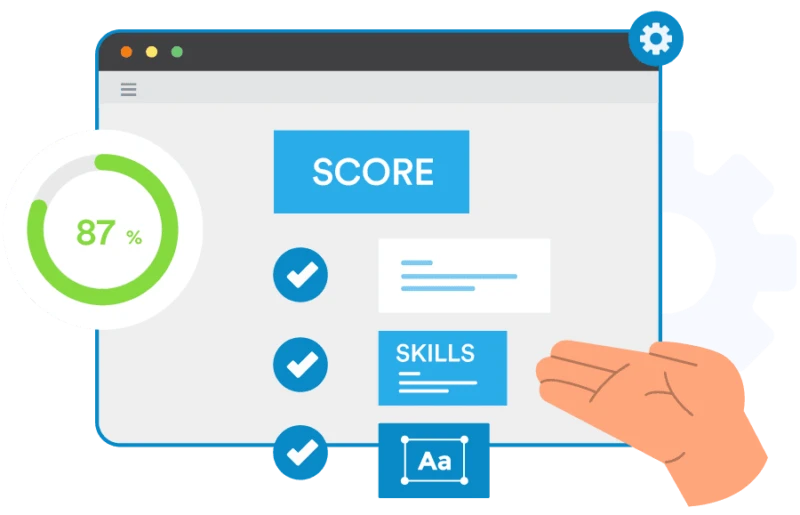
Jobscan vs aiApply at a glance
| aiApply | Jobscan Auto Apply | |
|---|---|---|
| Application model | Hands-off, applies on its own by default | Drafts each application and holds it for your approval |
| Per-application tailoring | Generated for each role, quality varies | Grounded in a resume match engine, tuned to each job |
| Review step | Optional, and not the default path | Review by default, with an opt-in auto-submit setting |
| Source coverage | Very broad, including the major job boards | A focused set of applicant tracking systems at launch |
| Volume orientation | Thousands of applications, that is the point | A smaller queue of matched, reviewed applications |
| Broader toolkit | Resume builder, cover letters, scanner, interview prep, job board | Match score, resume tailoring, builder, cover letters, LinkedIn |
| Pricing model | Base subscription plus separate auto-apply plans or credits | Included for Premium, with free credits to try and add-on packs |
Read honestly, aiApply wins on breadth, raw volume, and the strength of its cover letter and interview tools. Jobscan wins on review by default, match-grounded tailoring, and the quality of what each application actually is. The rest of this piece is about why that trade decides the choice.
What both tools actually do
aiApply is a high-volume, hands-off auto-apply platform bundled with a broad AI job-search toolkit. Its pitch is speed: it finds matching jobs and applies to them for you at scale, tailoring a resume and cover letter for each, so you can set it once and step away. Around that sits a resume builder, a cover letter generator, an ATS scanner, interview prep, and a job board.
Jobscan Auto Apply is a native application assistant built on the resume-optimization engine Jobscan has run for years. It is not a browser form-filler and not a mass-apply bot. You set your preferences, choose the resume you want to use, and browse jobs matched to that resume. When you click Auto Apply on a role, Jobscan reads the application form and drafts answers from your resume, then holds the application so you can check it before it goes out.
The category difference: this is volume automation versus reviewed, tailored quality. One tool sends. The other prepares and waits for you.
For the wider field, our guide to how AI auto-apply tools actually compare covers the category; the rest of this piece gets specific about these two.
How the automation actually works
aiApply’s flow is designed to disappear. You set your preferences and upload a resume, and from there the AI finds matching jobs and submits applications on its own, tailoring documents per role, at high volume. The appeal is that you do not have to do anything. The trade-off is that you do not see most of what goes out under your name before it goes out.
Jobscan’s flow keeps you in the loop. You set preferences, upload the resume you want to use, and browse only jobs matched to your profile. When you click Auto Apply on a role, Jobscan reads that form and drafts answers from your resume, then holds the application in a queue where you can see every answer, edit anything, and decide whether it is worth sending. Applications move through clear statuses, from autofilling to pending review to submitting to applied. There is an auto-submit setting for people who want it, and you choose your mode when you onboard, but review is the default.
The honest concession: aiApply will get far more applications out the door in the same window, and for some people that is the entire appeal. The next sections are about whether it is the right goal.
Control and quality: the part that actually differs
This is the core of the comparison, so it is worth being precise and fair.
aiApply’s model is hands-off, and its own terms are candid about what that means. Its job-search policy states that job titles, skills, and experience level are treated as soft filters, that its Job Fit Score is “an automated relevance estimate and is not a guarantee of suitability,” and that if you want matches meeting most or all of your criteria you “must use Review Mode or Hybrid Mode.” On automatic applying it goes further: if you enable Auto mode, “AutoApply may include lower Job Fit Score jobs,” and the company is “not liable if lower-fit jobs are submitted on your behalf.” A separate clause says application content is sent to employers “exactly as you provide or approve,” with no redaction on your behalf. That is the company describing its own volume model accurately, and it is the clearest evidence in this comparison of what hands-off applying actually risks.

Testing bore this out. During onboarding we selected Review mode, the setting described on screen as full control, nothing sent without your approval. An application still submitted on its own, and it went out using the boilerplate placeholder text sitting in the background section of preferences, generic filler like “tailor your experience to the job description,” instead of any real work history. A resume had already been uploaded and parsed, but it never populated the section that actually feeds applications, nothing in onboarding flagged the gap, and the system submitted anyway. No human would send that to an employer. The automation did.

Jobscan is built the other way around. Every application holds in a review queue until you approve it, and you can see and edit every answer first.


The tailoring is grounded in the same resume match score that has graded resumes against real job descriptions for years, so each application is matched to the role, not just generated for it. You can tailor your resume to each job and optimize each application before you send. An auto-submit option exists for people who deliberately want it, and that is worth being transparent about, but the default is review, and the design assumes you want the final call.

aiApply decides what to send. Jobscan drafts it and lets you decide.
The line that sums it up: aiApply decides what to send. Jobscan drafts it and lets you decide. See how Auto Apply prepares and reviews each application.
Volume, limits, and the spam risk
The case for volume rests on an assumption getting weaker every year: that more applications means more interviews. The data no longer supports it.
Employers are drowning. In 2026 Greenhouse’s CEO described a doom loop: candidates auto-apply, recruiters auto-filter, and both sides make the pile worse. When everyone has volume, volume stops being an edge.
What moves the needle is fit. Analysis from Huntr across more than a million applications in 2025 found tailored resumes converted to interviews at 5.75 percent, versus 2.68 percent for generic ones, roughly a 115 percent improvement. And the ceiling on pure volume is lower than the pitch suggests. One widely reported job seeker used a mass-apply tool to send around 5,000 applications and landed about 20 interviews, roughly the same number he had gotten from a few hundred applications sent by hand, with his best leads coming through personal connections rather than the bot.
Volume also carries a reputational cost a hands-off tool cannot manage for you. Sending many similar applications in a short window can trigger automated blocking, and apply-to-everything tools sometimes route users toward fraudulent postings built to harvest data, which matters more when a tool transmits your information with, in aiApply’s words, no redaction. A smaller, reviewed, well-matched queue avoids the pattern that gets people filtered and keeps your name off applications you never vetted. To be fair, this is a category risk, not proof that any single aiApply application is spam, but the volume model carries the risk and control reduces it.
Job sources and coverage
Here is where aiApply wins cleanly, and it is worth saying so plainly. aiApply applies across far more sources than Jobscan Auto Apply does today, including the major job boards, and at far higher volume. If reach is your only measure, aiApply covers more ground.
Jobscan Auto Apply is narrower at launch. It connects directly to more than 20 applicant tracking systems and applies where it can apply well and reviewably, rather than everywhere blindly. That is a deliberate design choice, not a gap being hidden. The tool goes where each application can be drafted from your real resume, matched to the posting, and held for your approval, which is a different job than firing forms at everything with an opening.
The useful way to hold it: aiApply goes wide, Jobscan goes where it can apply well and asks you first.
Pricing and free tiers
aiApply’s pricing is the single most-cited complaint about it, and mapping it out shows why. The base subscription runs about 29 dollars a month and includes the resume builder, cover letters, scanner, and mock interviews, but it does not include auto-apply, the feature the product is named for. Auto-apply is a separate purchase: a plan at 49 dollars a month for 100 applications, higher tiers such as 99 dollars a month for 250, or pay-as-you-go credits. The live interview assistant, Interview Buddy, is another line item at 19 dollars a month or 99 dollars a year. No single page on the site lays these plans out side by side, so you tend to discover each price only when you hit its paywall.
- Base subscription: 29 dollars a month, and it does not include auto-apply
- Auto-apply: 49 dollars a month for 100 applications, or 99 for 250
- Interview Buddy: 19 dollars a month, or 99 dollars a year
- No single page lists the plans side by side
- One Premium plan covers the whole toolkit, Auto Apply included
- Two free Auto Apply credits each month, then add-on packs: 5 for 8.50 dollars, 10 for 15 dollars, 25 for 35 dollars
- One credit is one application, matched to the role and reviewed by you
- One clear price, published plainly, no separate paywalls
The result is a real cost well above the headline. An active seeker doing 100 or more applications a month, with tailored documents and interview prep, lands somewhere around 68 to 90 dollars a month once the layers add up. We saw the gap first-hand: on the 49-dollar auto-apply plan, tailoring a resume triggered a paywall to a different 29-dollar plan, so the more expensive subscription did not include a core feature the cheaper one did. We are not calling it a scam, but the name of the product and the contents of its base plan do not match.
aiApply is named for auto-apply, but its base plan does not include it. The name of the product and the contents of its base plan do not match.
Jobscan’s Auto Apply pricing is clearer because it is published plainly. Auto Apply is included for Premium users, who get two free Auto Apply credits each month to try it, with add-on credit packs at five credits for 8.50 dollars, ten for 15 dollars, or twenty-five for 35 dollars. One credit is one application. You pay a little more per application than a volume plan charges, and that is the point: you are paying for an application that was matched to the role and reviewed by you, not one of a thousand blind sends. If raw count is the goal, aiApply’s higher tiers buy a lot of applications. If reviewed, matched quality is the goal, Jobscan’s value is in what each application is.
Beyond auto-apply: the broader toolkit
Both tools wrap their auto-apply in a wider set of features, and they point in different directions.
aiApply’s toolkit extends outward across the whole search. Its cover letter generator is consistently its most-praised feature, with clean, human-sounding output and accurate keyword extraction, and it deserves the credit. Its interview prep, a live assistant plus a mock-interview tool, gets genuine praise for building confidence before interviews. Add the resume builder, the scanner, and the job board, and aiApply is a broad all-in-one. The seams show in integration, though: in testing, generating a cover letter or tailored resume meant manually pasting the job description back in, even though aiApply had already pulled that posting into its own job search.
Jobscan’s toolkit extends deeper into the quality of each application. From scratch, a resume builder with an AI Resume Coach guides you an ideal base resume. Then a resume match score grades your resume against the specific job and the employer’s applicant tracking system.
On a broader spectrum is the cover letter generator that keeps letters aligned to the posting, and LinkedIn optimization that scores your profile against real job descriptions. Everything is measured against the job you are applying to. Same idea of an all-in-one, different center of gravity: aiApply spreads across the search, Jobscan drives into the strength of each application.
Looking for an aiApply alternative
If you came here because aiApply’s hands-off model makes you uneasy, or the layered pricing wore you down, the thing you are missing is usually control. A true aiApply alternative does not have to apply to fewer jobs on principle. It has to let you decide what goes out under your name, and make each application good enough to be worth sending.
That is the case for Jobscan Auto Apply. You still get automation that finds matched roles and drafts each application, but you add a review queue by default, tailoring grounded in a real match engine rather than generated generically, and pricing you can actually read.
Who should choose which, plainly. Choose aiApply if you want maximum hands-off volume and will tolerate variable quality, you are applying broadly to entry-level or high-turnover roles where volume can still work, or you specifically want its cover letter generator and interview prep. Choose Jobscan Auto Apply if you are mid to senior and cannot risk a wrong-fit or wrong-language application going out under your name, you want every application reviewed and approved before it sends, and you would rather apply to fewer, better-matched roles. If that is you, try Auto Apply on your next few roles.
For some people, yes. If you want hands-off volume and value aiApply’s cover letter generator and interview prep, it fits. For applications that are reviewed and matched to each role before they send, Jobscan Auto Apply is the stronger tool. They optimize for different things, so the honest answer depends on whether you want more applications or better ones.
High-volume, hands-off applying carries a documented risk. Sending many similar applications quickly can trigger automated filtering, and apply-to-everything tools sometimes surface fraudulent postings that harvest data. Reviewing each application before it sends, which is Jobscan’s default, reduces both risks. It is a real category concern, not a certainty for every application.
Jobscan Auto Apply is the review-first, match-grounded alternative. It drafts each application from your resume, matches it to the role, and holds it in a queue for you to approve before anything sends, rather than submitting on its own. You keep the automation and add the final say.
Some people do. You can use Jobscan to optimize your resume and run reviewed, tailored applications, and a volume tool separately for broad, hands-off reach. It is a reasonable split, as long as you know which applications you have actually vetted and which went out on their own.
aiApply genuinely submits, which makes it a true auto-apply tool rather than one that only fills forms and stops. That is also the exact trade-off: because it submits on its own by default, most of what goes out under your name is not reviewed by you first, unlike Jobscan’s approve-before-send model.
Final verdict
aiApply and Jobscan Auto Apply solve the same chore in opposite ways. aiApply bets that volume does the work, and for a hands-off seeker applying broadly, with a strong cover letter and interview toolkit alongside, it delivers what it promises. Jobscan bets that fit and control do the work, applying to the right roles, tailored against each one and approved by you before anything sends. More applications is the easy metric. Whether the right ones go out, under your name, with your sign-off, is the one that actually moves a job search.
If that is the version of automation you want, start with Jobscan Auto Apply, see the sibling breakdown in Jobscan vs JobCopilot, or browse the wider field of AI job search tools.