Computer Science Cover Letter Examples & Tips for 2026
Three computer science cover letter examples for 2026, plus the tips, metrics, and ATS keywords that turn a strong resume into an interview.
Build your cover letter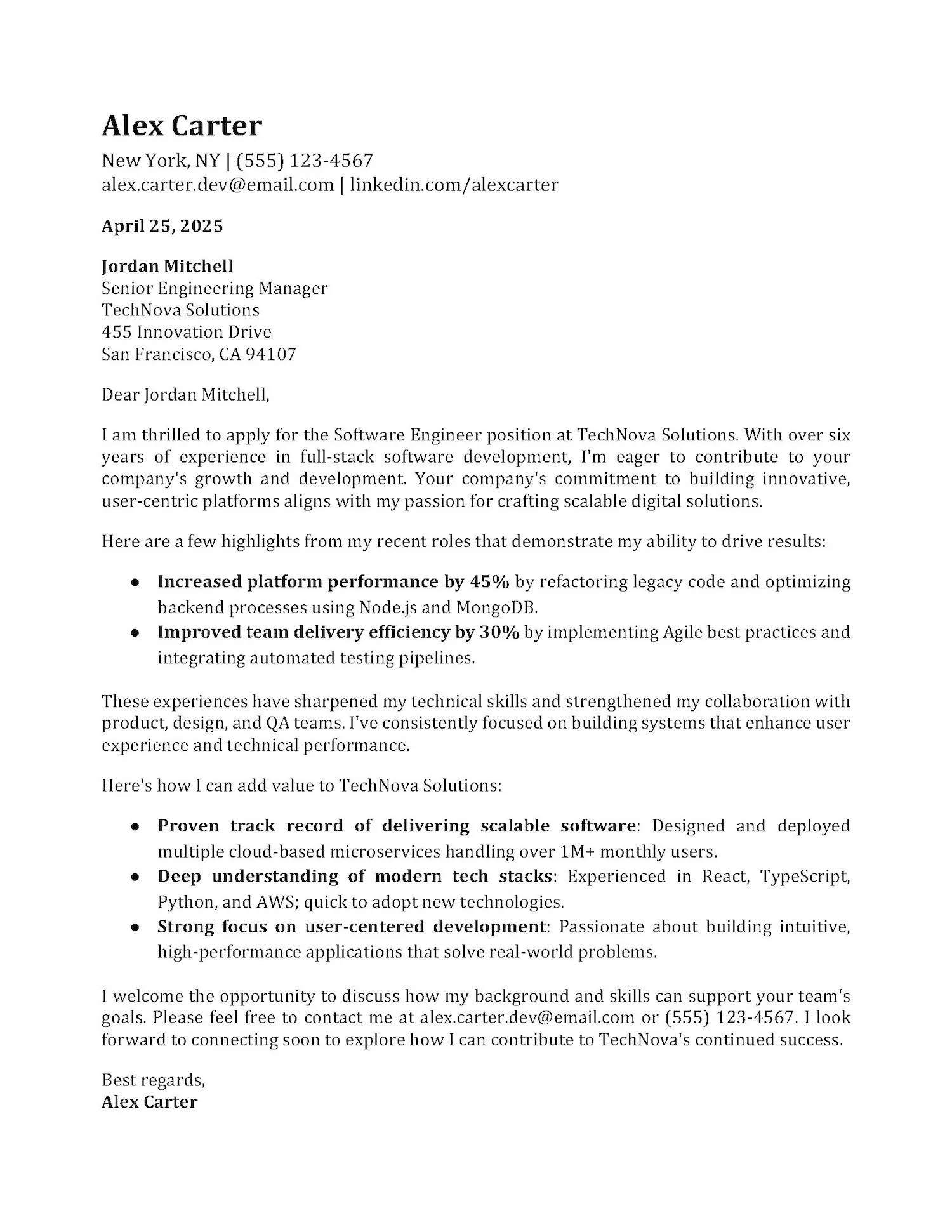



A computer science resume lists the languages you know and the systems you have shipped. A cover letter explains the judgment behind them: why you chose Go over Python for a latency-sensitive service, how you cut a build pipeline from 40 minutes to 9, what you actually own when you say you “led” a project. Hiring managers at engineering teams read dozens of nearly identical applications, and the candidate who connects their work to the company’s actual problems is the one who gets the call.
This page gives you three complete computer science cover letters: one for a mid-level software engineer, one for a new graduate, and one for a senior engineer moving into a staff-level role. Each is annotated so you can see exactly what makes it work, followed by practical writing tips and answers to the questions job seekers ask most.
Computer Science cover letter examples for different experience levels
Computer Science Cover Letter Example
This mid-level example is built for a software engineer with three to five years of experience applying to a product company. It leads with a concrete result, names the tools that matter, and ties the candidate’s strengths to the role’s day-to-day work.
Daniel Okafor
Austin, TX | (512) 555-0147 | daniel.okafor@email.com
March 3, 2026
Rachel Tran
Engineering Manager, Platform
Brightloom Software, 200 Congress Ave, Austin, TX 78701
Dear Ms. Tran,
Last year I rebuilt the payment reconciliation service my team owned, and the daily mismatch rate dropped from 2.1 percent to under 0.2 percent. The Backend Engineer role on Brightloom’s Platform team caught my attention because it sits at the same intersection of data integrity and scale where I do my best work.
I am a software engineer at Cardova with four years building distributed services in Go and Python. The reconciliation rewrite meant moving a fragile cron job onto an event-driven pipeline backed by Kafka and Postgres, then adding idempotency keys so retries stopped creating duplicate records. I wrote the migration plan, paired with two other engineers through the rollout, and we shipped it with zero customer-facing downtime across roughly 1.4 million daily transactions.
Beyond that project, I have spent real time on the unglamorous parts of engineering: cutting our CI runtime from 22 minutes to 8 by parallelizing test suites, and writing the runbooks that let on-call engineers resolve the top five alert types without paging me. Your job posting emphasizes observability and ownership, and those are the habits I have built deliberately rather than the buzzwords I reach for.
I would welcome the chance to talk about how Brightloom is scaling its payments infrastructure and where I could contribute early. Thank you for considering my application.
Sincerely,
Daniel Okafor
- Opens with a measurable win: The first sentence states a specific outcome (a mismatch rate falling from 2.1 percent to under 0.2 percent) instead of a generic introduction, so the reader is hooked before the second paragraph.
- Names the real stack: Go, Python, Kafka, and Postgres appear in context, which both signals competence and helps the application clear ATS keyword scans for backend roles.
- Shows ownership, not just participation: Phrases like “I wrote the migration plan” and “we shipped it with zero downtime” distinguish what the candidate personally drove from what the team did together.
- Includes the unglamorous work: Cutting CI time and writing runbooks signals maturity, since experienced engineers know the job is more than feature work.
- Mirrors the posting: Calling back to “observability and ownership” from the job description proves the letter was tailored to this specific role, not mass-sent.
- Ends with a forward question: The close invites a conversation about Brightloom’s roadmap rather than restating interest, which reads as confident and collaborative.
Entry-Level Computer Science Cover Letter Example
New graduates often worry they have nothing concrete to write about. This example shows how to turn coursework, internships, and personal projects into evidence, with honest scope and real numbers a recruiter can trust.
Priya Venkatesan
San Jose, CA | (408) 555-0192 | priya.venkat@email.com
April 14, 2026
Marcus Bell
Recruiting Lead, University Programs
Northpeak Labs, 1100 Technology Dr, San Jose, CA 95110
Dear Mr. Bell,
I graduated from UC Davis in March with a B.S. in Computer Science and a stubborn habit of finishing the side projects I start. That habit is why I am applying for the New Grad Software Engineer position at Northpeak Labs.
During my summer internship at a logistics startup, I owned a small but real piece of the codebase: a route-caching layer in Redis that cut repeat lookup times by roughly 60 percent for the dispatcher dashboard. It was the first time my code touched production traffic, and learning to write defensively, with tests and graceful fallbacks, taught me more than any lecture had.
My capstone pushed me further. I built a full-stack tool in React and Node that let students compare course schedules, and I deployed it on AWS for about 300 classmates during enrollment week. I handled the load spike badly the first day, the server fell over, and fixing it forced me to actually understand connection pooling and caching rather than copy answers from a forum. I would rather tell you about a failure I learned from than pretend my projects went perfectly.
Northpeak’s work on developer tooling is exactly the kind of problem I want to grow into. I am comfortable in JavaScript and Python, eager to learn Go, and ready to do the careful, repetitive work that turns a junior engineer into a dependable one. Thank you for your time.
Sincerely,
Priya Venkatesan
- Leads with personality and proof: The line about finishing side projects gives the recruiter a memorable hook while previewing a genuine work trait, not an empty adjective.
- Quantifies an internship: A 60 percent improvement in lookup times shows the candidate can measure impact even at the intern level, which most new-grad letters fail to do.
- Treats a project as real engineering: Deploying the capstone for 300 classmates on AWS gives a believable scope and demonstrates production thinking, not just a class assignment.
- Owns a failure honestly: Admitting the server crashed and explaining the fix signals maturity and a learning mindset, which hiring managers value far more than a flawless story.
- Sets realistic skill expectations: Saying she is comfortable in JavaScript and Python and eager to learn Go is honest, and it matches what teams actually expect from a new grad.
- Keeps the tone humble but confident: The letter never overclaims, yet it leaves no doubt the candidate is ready to do real work.
Senior Computer Science Cover Letter Example
For senior and staff-level roles, the bar shifts from “can you code” to “can you raise the level of an entire team.” This example foregrounds architecture decisions, mentorship, and business impact rather than individual feature work.
Elena Marchetti
Seattle, WA | (206) 555-0168 | elena.marchetti@email.com
February 19, 2026
James Whitfield
Director of Engineering
Harbor Systems, 500 Yale Ave N, Seattle, WA 98109
Dear Mr. Whitfield,
When my team’s core API started buckling under growth, I argued for breaking the monolith into services gradually rather than rewriting it. Two years later that migration is done, p99 latency is down 70 percent, and we never froze feature work to do it. I am writing about the Staff Software Engineer role at Harbor Systems because that kind of patient, high-stakes architecture is where I add the most value.
I have spent nine years in backend and infrastructure engineering, the last four as a senior engineer at Vantix. My focus has shifted from shipping features alone to designing systems other engineers build on. I led the design of our service mesh on Kubernetes, set the standards for how we handle backward-compatible API changes, and reduced our cloud spend by about 1.2 million dollars annually by right-sizing instances and killing idle resources.
The part of the job I care most about now is multiplying other people’s output. I run our design review process, mentor three mid-level engineers, and have made a point of writing the kind of clear technical proposals that let a team disagree productively before code gets written. Good architecture is as much about communication as it is about diagrams.
Harbor’s move toward a platform model is precisely the work I want to do next. I would value the opportunity to discuss where your infrastructure is headed and how I could help shape it. Thank you for your consideration.
Sincerely,
Elena Marchetti
- Frames a decision, not a task: Opening with the argument to migrate gradually rather than rewrite shows strategic judgment, the trait that separates senior from mid-level engineers.
- Ties engineering to the business: The 1.2 million dollar annual cloud savings translates technical work into language leadership cares about, which matters at the staff level.
- Demonstrates scope through systems: Designing a service mesh and setting API compatibility standards proves the candidate operates at the level of platforms and standards, not single features.
- Centers mentorship and multiplication: Naming three mentees and a design review process signals the candidate raises the whole team’s output, a core staff-engineer expectation.
- Values communication explicitly: The line about clear technical proposals shows awareness that senior impact depends on writing and influence, not just code.
- Aligns with the company’s direction: Referencing Harbor’s shift to a platform model proves the candidate researched the role and sees a specific fit, not a generic opportunity.
How to write a Computer Science cover letter
A strong computer science cover letter does one job: it gives the hiring manager a reason to open your resume with interest instead of skimming it out of obligation. That means leading with a concrete accomplishment, proving you understand the specific role, and using the technical vocabulary that both a human reviewer and an applicant tracking system are looking for. Keep it to one page, roughly three to four paragraphs, and let the work speak before you do.
Lead with a result, then show your stack in context
Your opening line should state something you built or improved with a real number attached: a latency reduction, a deploy time cut, a bug rate lowered, users served. Then weave your technical skills into the story instead of listing them. “I migrated our reporting service to Go and cut query times by half” tells a hiring manager more than a sentence naming six languages. Pick the two or three accomplishments most relevant to the job and go deep on those rather than cataloging everything you have ever touched.
Mirror the job description for ATS and for humans
Applicant tracking systems rank your application partly on keyword overlap with the posting, so the languages, frameworks, and concepts in the job description should appear naturally in your letter when they genuinely apply to you. For computer science roles, that often includes specific terms the team uses.
- Languages and runtimes the role names: Python, Java, Go, TypeScript, C++, Node.js
- Infrastructure and tooling: AWS, Kubernetes, Docker, CI/CD, Terraform
- Concepts: distributed systems, REST APIs, microservices, observability, data structures
Never stuff keywords you cannot back up. Use them only where they describe work you actually did.
Tailor to the company’s real problems
Spend ten minutes on the company’s engineering blog, GitHub, or product before you write. Reference something specific: a scaling challenge they have written about, an open-source project they maintain, a platform shift they are making. A single sentence that proves you understand what their team is working on does more than a paragraph of praise. It shows you are applying to this job, not five hundred jobs.
Computer Science cover letter tips
A computer science cover letter should connect your technical foundation to the kind of problems the employer actually needs solved.
- Name the stack: State the specific languages, frameworks, and tools from the job posting that you have shipped real work with, rather than listing every technology you have touched.
- Link to your code: Point to a GitHub repository, a deployed project, or an open-source contribution so the hiring team can verify your skills before the interview.
- Describe a build: Walk through one project you designed or shipped, naming the problem, your technical approach, and the measurable outcome it produced.
- Translate theory to practice: If you are early in your career, show how a course project, hackathon, or internship applied data structures or algorithms to something concrete.
- Mirror the role: Tailor your framing to whether the position is frontend, backend, data, or infrastructure so your examples match what the team does daily.
- Cut the jargon: Write so a non-technical recruiter doing the first screen can understand your impact, then save the deep technical detail for the interview.
Write your computer science cover letter faster with Jobscan
If you are staring at a blank page, Jobscan’s Cover Letter Generator builds a tailored first draft from your resume and the job description, pulling in the keywords that matter for the role so you spend your time refining rather than starting cold. Use it to get a solid structure, then add the specific projects and numbers that make the letter yours.
Computer Science cover letter FAQs

Keep it to one page, usually three to four short paragraphs and around 250 to 350 words. Hiring managers and recruiters skim, so a tight letter that opens with a concrete result and ends with a clear ask beats a dense full page every time. If you are filling space, cut it.
Treat internships, capstone projects, hackathons, and serious personal projects as real evidence. Describe what you built, the tools you used, and any measurable outcome, even a modest one like “deployed for 300 users” or “cut load time by half.” Owning a small failure you learned from often lands better than claiming a flawless record.
When the application gives you the option, include one. Many engineering teams weight resumes more heavily, but a sharp, tailored cover letter is a tiebreaker that signals communication skills and genuine interest in the specific role. A generic or templated letter, however, can hurt you more than no letter at all.
Frame your previous field as an asset, then prove the technical shift is real. A former analyst pivoting to engineering might highlight SQL and Python work plus a bootcamp portfolio or shipped projects. Name the languages and tools you are now fluent in, link to your GitHub, and be direct about why you made the switch and what you have built since.
Match the language of the job description. If the posting lists Kubernetes, microservices, or TypeScript and you have used them, use those exact terms in your letter rather than synonyms. Avoid heavy formatting, images, and tables that parsers struggle with. Running your draft through Jobscan shows you which keywords from the posting you are missing.
Pair your cover letter with a resume
A great cover letter pairs with a strong resume. Browse our Computer Science resume examples to build one that gets noticed.