Software Developer Cover Letter Examples & Tips for 2026
Code is the easy part; showing impact is the edge. These software developer cover letter examples for 2026 turn shipped features into interviews.
Build Your Cover Letter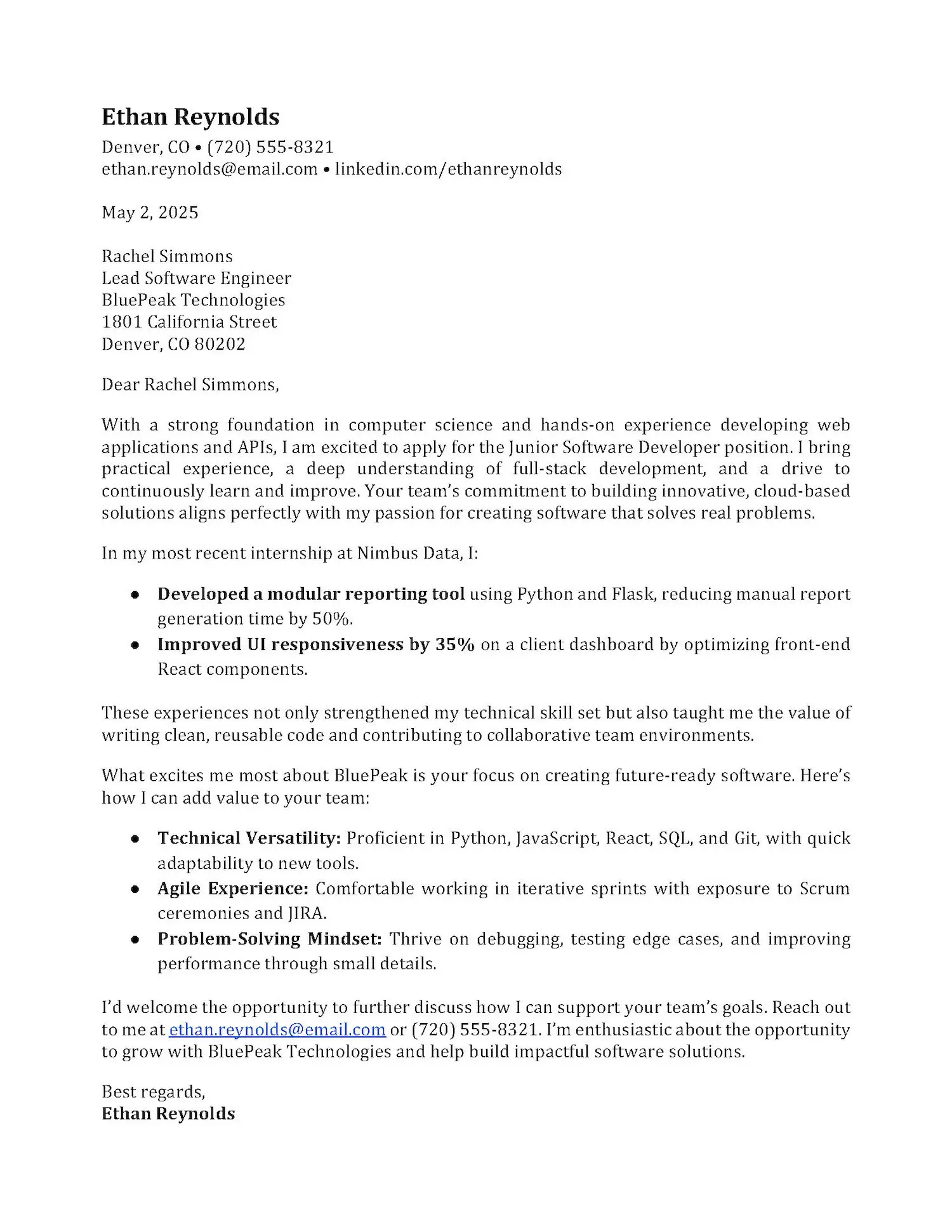


Hiring teams reading software developer applications are rarely short on resumes. What they are short on is a reason to believe a candidate will ship working code, communicate clearly across a team, and grow into the role. A cover letter is where you make that case in plain language, connecting the projects on your resume to the problems the company is trying to solve.
This page walks through three real-world examples, one each for entry-level, junior, and senior software developers. Each letter shows how to translate technical work into business impact, name the right languages and tools without padding, and address the things 2026 hiring managers actually weigh: code you can point to, AI-assisted workflows, and how you operate when something breaks in production.
Software Developer cover letter examples for different experience levels
Entry-level software developer cover letter example
This example is for someone with a degree or bootcamp behind them and limited paid experience. It leans on coursework, a capstone project, and an internship to show real output rather than potential alone.
Maya Okonkwo
Austin, TX | (512) 555-0147 | maya.okonkwo@email.com
March 4, 2026
Daniel Reyes
Engineering Manager
Brightpath Software
Dear Daniel,
I finished my computer science degree at UT Austin in December, and the work I am proudest of is a real one: a class scheduling tool I built for a campus student org that now handles bookings for roughly 200 members each semester. Seeing the entry-level developer opening at Brightpath, where small teams own features end to end, felt like the right place to keep doing that kind of work.
That scheduling tool started as a React front end talking to a Node and PostgreSQL backend. The first version was slow because I was querying the database on every keystroke, so I added debouncing and a caching layer, which cut page load from about four seconds to under one. It was the first time I had to fix something I had built rather than something an assignment handed me, and it taught me more than the original build did.
During a summer internship at a logistics startup, I wrote unit tests for an internal API and closed out 30 or so bug tickets in Jira. Nothing glamorous, but I learned to read someone else’s codebase, ask good questions in code review, and use AI tools to draft tests faster while still checking the logic myself before merging.
I would welcome the chance to talk about how I can contribute to your team. Thank you for considering my application.
Sincerely,
Maya Okonkwo
- Leads with a shipped artifact: She opens on a scheduling tool that real students use, which is far more convincing than listing a degree and waiting for the resume to do the work.
- Shows debugging instinct: The four-seconds-to-under-one detail proves she can diagnose and fix her own code, the exact skill entry-level hires are usually missing.
- Names a realistic stack: React, Node, and PostgreSQL are specific without being padded, and they match what a small product team actually uses.
- Frames the internship honestly: Calling the bug-ticket work “nothing glamorous” reads as self-aware rather than inflated, which builds trust.
- Handles AI tools with judgment: She mentions using AI to draft tests but checking the logic before merging, signaling current workflow awareness plus accountability.
- Connects to the team model: Referencing Brightpath’s small teams owning features end to end shows she read the posting and pictured herself in the actual role.
Junior software developer cover letter example
This example fits a developer with one to three years on the job. It shifts the emphasis from school projects to owned features, measurable outcomes, and the soft skills that come from real team work.
Theo Vasquez
Denver, CO | (720) 555-0192 | theo.vasquez@email.com
June 18, 2026
Priya Nair
Director of Engineering
Cadence Health
Dear Priya,
Two years ago I joined a fintech team as the most junior engineer in the room, and I have spent every sprint since trying to be useful beyond my tickets. Your junior developer role at Cadence Health caught my attention because it sits on a team building patient-facing tools, and shipping software that people lean on during stressful moments is the kind of work I want more of.
At my current company I own a slice of the customer dashboard, built in TypeScript and React with a Python and Django backend. Last quarter I rebuilt the transaction history view, which had been timing out for our highest-volume users. Paginating the API responses and adding indexes to two slow queries brought the load time down to about 600 milliseconds and cut related support tickets by roughly 40 percent. That fix taught me to read database query plans, which I had honestly been avoiding.
I also try to leave the codebase better than I find it. I wrote our team’s first set of integration tests for the payments flow after a small regression slipped to production, and I now review three or four pull requests a week. Mentoring our two interns last summer made me a sharper communicator, since explaining a decision out loud forces you to actually understand it.
I would love to bring that mix of ownership and care to Cadence. Thank you for your time and consideration.
Sincerely,
Theo Vasquez
- Opens with a posture, not a title: “Trying to be useful beyond my tickets” tells the reader who he is on a team before any metric appears.
- Quantifies a real fix: The 600-millisecond load time and 40 percent ticket drop tie his code directly to user experience and support cost.
- Admits a growth edge: Saying he had been avoiding query plans makes the learning credible and signals coachability, which matters at the junior level.
- Demonstrates code stewardship: Writing the team’s first integration tests after a regression shows initiative and accountability, not just feature output.
- Cites mentoring as communication proof: Coaching interns reframes a soft skill as concrete evidence rather than an empty claim.
- Ties motivation to the product: Linking patient-facing tools to high-stakes moments shows he understands why the work matters at Cadence specifically.
Senior software developer cover letter example
This example is for a developer with significant experience leading projects and people. It centers on architectural decisions, mentorship, and outcomes measured in system reliability and team velocity.
Renata Castellanos
Seattle, WA | (206) 555-0173 | renata.castellanos@email.com
February 27, 2026
Marcus Feldman
VP of Engineering
Northwind Systems
Dear Marcus,
The hardest engineering problem I solved last year had almost nothing to do with code: it was convincing three teams that our shared monolith was the thing slowing all of us down. Your senior developer posting at Northwind, with its focus on decomposing a legacy platform, reads like the same problem I just spent a year working through, and I would welcome doing it again with your team.
I currently lead a five-person backend group at a B2B SaaS company. Over the past 18 months I led the extraction of our billing and notifications services out of a Rails monolith into separate Go services, which let those teams deploy independently and cut our deploy-related incidents by more than half. The migration was incremental and reversible at every step, because a big-bang rewrite was never going to survive contact with a real product roadmap.
Beyond architecture, I care a lot about the people writing the code. I rebuilt our on-call rotation to include blameless retros, which brought our mean time to recovery from a few hours to under 45 minutes and made engineers far less anxious about owning production. I have mentored four developers into mid-level roles, and two of them now run their own services.
I write code daily and intend to keep doing so. What I bring on top of that is the judgment to know which problems are worth the disruption and which are not. I would be glad to talk further.
Sincerely,
Renata Castellanos
- Opens on influence, not syntax: Framing the hardest problem as convincing three teams immediately signals the cross-team leadership a senior role demands.
- Quantifies system-level impact: Cutting deploy incidents by more than half and MTTR to under 45 minutes speaks the language of reliability that VPs care about.
- Reveals architectural judgment: Choosing an incremental, reversible migration over a big-bang rewrite shows hard-won pragmatism rather than resume-driven tech choices.
- Centers people and process: The blameless retros and on-call rebuild prove she scales teams, not just systems, which is the senior differentiator.
- Backs mentorship with outcomes: Naming four developers promoted and two now running services turns a vague claim into a track record.
- Reassures on hands-on work: Stating she still writes code daily heads off the common worry that a senior hire has drifted fully into management.
How to write a software developer cover letter that will get you an interview
To make your cover letter stand out, emphasize the software development skills that make you a strong candidate. Here’s how to effectively highlight your capabilities:
- Showcase technical proficiency: Share examples where you’ve applied programming languages, frameworks, or tools to build real-world applications or solve development challenges.
- Demonstrate problem-solving abilities: Highlight situations where you’ve debugged critical issues, optimized performance, or architected solutions that improved functionality or efficiency.
- Emphasize collaboration and Agile experience: Mention how you’ve worked within Agile or Scrum environments, collaborated with cross-functional teams, or participated in code reviews.
- Mention adaptability and continuous learning: Provide examples of how you quickly learned new technologies or adapted to changes in project scope or tech stack.
- Tailor examples to the job: Align your skills (both hard and soft) with the specific requirements in the job posting, especially if the company uses particular technologies or values specific methodologies.
By providing targeted, relevant examples, you’ll show hiring managers how your skills directly contribute to engineering success. Here are a few ways to highlight your software developer skills effectively in a cover letter:
- “While working on a customer analytics dashboard, I used React and Redux to build a scalable interface that improved user experience and reduced load times by 40%.”
- “When our team faced issues with system latency, I analyzed backend services and rewrote core APIs in Node.js, cutting response time by 50% without increasing infrastructure cost.”
Also read: How to Start a Cover Letter to Keep Recruiters Reading
Give examples of your achievements
In addition to highlighting your technical skills, your cover letter should showcase the tangible impact you’ve made in past software development roles. Employers seek results—proof that you’ve improved performance, optimized processes, or driven successful product outcomes. The more specific you are, the stronger your case. Whenever possible, back your achievements with metrics to show the scale and effectiveness of your contributions.
Here are a few examples of how to highlight your achievements in a software developer cover letter:
- “At my previous company, I reduced API response time by 50% by restructuring database queries and introducing Redis caching, which significantly improved user experience.”
- “I led the front-end development of a React-based dashboard that processed real-time analytics for over 20,000 users, contributing to a 35% growth in active engagement.”
- “While working on a legacy system upgrade, I migrated critical backend services to .NET Core, resulting in a 40% reduction in server costs and improved maintainability.”
- “As part of a cross-functional team, I implemented automated testing using Jest and Cypress, cutting regression bugs by 60% and speeding up release cycles.”
- “I introduced code linting and peer review workflows in a fast-growing startup, which enhanced code quality and reduced post-deployment issues by 45% within three months.”
Tailor your cover letter to the target company
This is one of the most overlooked yet powerful parts of any good cover letter. Tailoring shows you’re not just sending out generic job applications—you’ve taken time to understand the company’s goals, values, and needs.
Here’s how to personalize effectively:
- Analyze the job description: Identify key job requirements or responsibilities, tools, and skills mentioned. Mirror the language and highlight how your years of experience align.
- Mention the company’s mission or values: Reference what the company stands for—whether it’s open-source, innovative solutions, or sustainability—and show why it resonates with you.
- Reference their products or tech stack: Mention tools, frameworks, or platforms they use that you’ve worked with or are excited to work on.
- Address a challenge or initiative: Refer to a recent product launch, technical problem, or blog post, and explain how you can contribute.
- Adapt to their culture and tone: Based on their website and communications, use a tone that fits their style—formal, friendly, or innovative.
- Mention shared interests or connections: If you follow their developers on GitHub or saw a talk they gave, reference that to show genuine interest.
Also Read: What Should a Cover Letter Look Like?
Software developer cover letter tips
Once you’ve written the main content, take time to refine and perfect it. For software developers, where attention to detail, clarity, and structure are critical, your cover letter should reflect the same professionalism and precision you bring to your code. Here are some key tips to help you write a compelling cover letter:
- Start strong: Open with enthusiasm and a clear value statement that immediately conveys why you’re a strong fit for the role.
- Keep it concise and focused: Limit your letter to 250–400 words. Stick to one page and use short paragraphs or bullet points for easy readability.
- Use a personalized greeting: Address the hiring manager by name whenever possible, instead of “dear hiring manager” or “To Whom It May Concern.” Avoid generic greetings, which make your letter feel impersonal.
- Include your contact information: Make sure your full name, phone number, email address, and optionally, your LinkedIn or portfolio link are clearly listed as part of the cover letter.
- Avoid buzzwords and generic phrases: Rather than stating vague traits, let your accomplishments and relevant experience demonstrate your strengths.
- Tailor every line: Ensure each sentence supports your candidacy and aligns with the specific job and company you’re targeting.
- Proofread thoroughly: Review for typos, grammar errors, and formatting issues. A polished letter reflects your attention to detail.
- Match your tone to the company: Adjust your language to reflect the company’s culture—whether professional, casual, or innovative.
- Close with confidence and a call to action: Reinforce your interest in the role and express your willingness to continue the conversation.
Supercharge your cover letter with Jobscan
A well-written software developer cover letter can set you apart by showcasing not just your technical expertise but your passion for problem-solving, your adaptability, and your alignment with the company’s goals. Whether you’re applying for an entry-level, junior, or senior role, taking the time to personalize your letter shows initiative and professionalism. Use the examples and tips above to create a compelling, tailored cover letter that complements your resume and positions you as a standout candidate in any development team.
Want to streamline the process? Try Jobscan’s AI cover letter generator! It is designed to help you create personalized, ATS-optimized cover letters in minutes. Enter your details, and it will automatically format and tailor your letter to match the job description. It’s fast, effective, and built to increase your chances of landing that interview.
Software developer cover letter frequently asked questions

Highlight transferable skills like problem-solving, project management, and technical aptitude. Mention certifications, bootcamps, or specific projects, and explain how your experience adds unique value to a development role.
Mention salary expectations only if the job posting asks for it. Otherwise, it’s best to save salary discussions for the interview stage. If required, provide a reasonable range and note that you’re open to negotiation.
Keep it to one page—ideally 250–400 words. Focus on your most relevant skills and achievements, and format them with short paragraphs or bullet points for easy reading.


Pair your cover letter with a resume
A great cover letter pairs with a strong resume. Browse our Software Developer resume examples to build one that gets noticed.