Editor Cover Letter Examples & Tips for 2026
Three editor cover letter examples for 2026, from entry-level to senior, plus practical tips on metrics, voice, and tailoring that get you to the interview.
Build your cover letter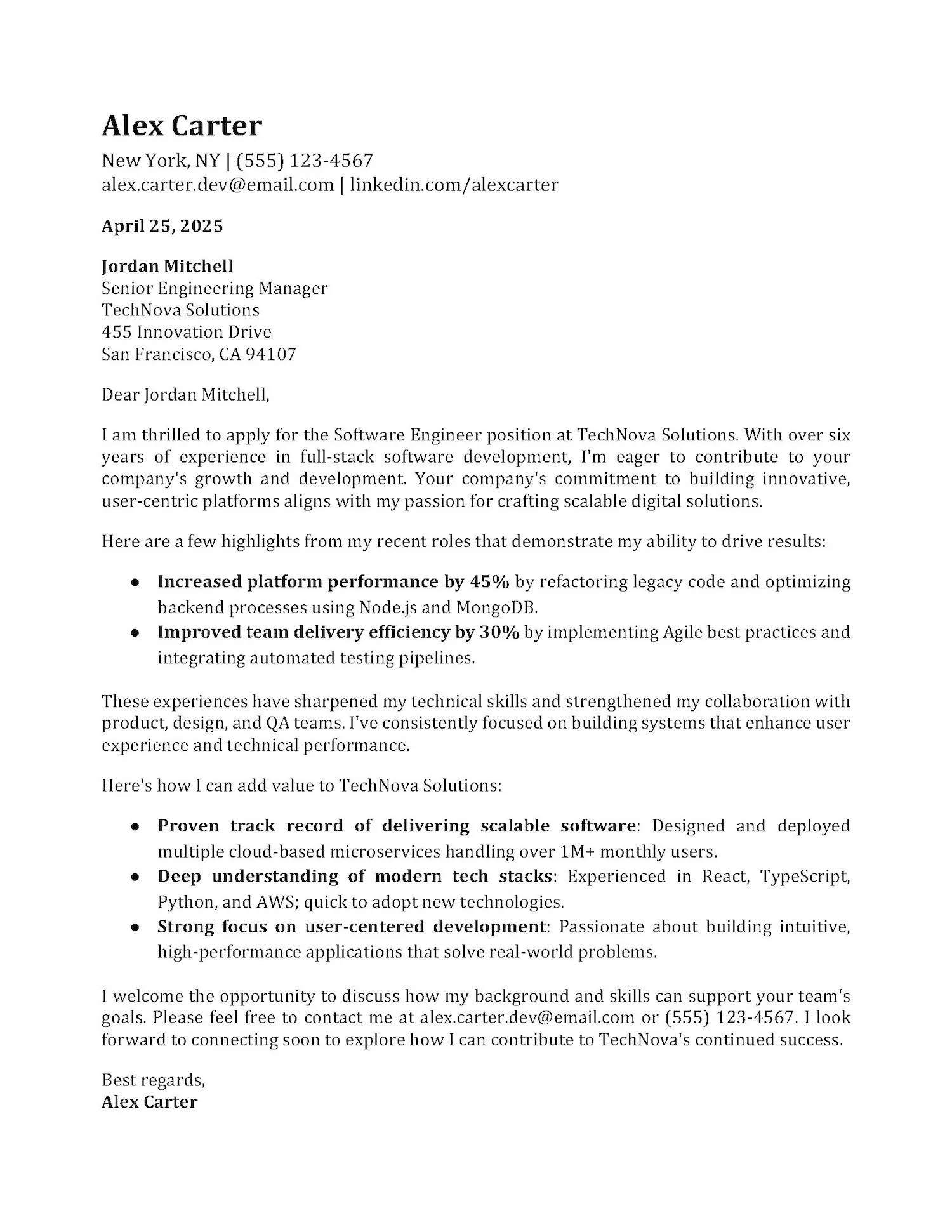


Editing is mostly invisible work. The cleaner the final piece, the less anyone notices what you did to get it there. A cover letter is one of the few places you get to make that work visible, showing a hiring manager how you think about clarity, accuracy, and a writer’s voice before they ever see your resume in full.
This page gives you three complete editor cover letter examples, each written for a different stage of an editing career, along with a breakdown of why each one works. After the samples, you’ll find concrete guidance on the accomplishments worth featuring, the keywords that matter to applicant tracking systems, and the questions editors ask most when they sit down to write.
3 Editor cover letter examples that work
Editor Cover Letter Example
This example fits a mid-level editor with a few years of experience who handles both line editing and production. It shows how to pair a quality story with numbers an editor can actually point to.
Dana Whitfield
Portland, OR | (503) 555-0142 | dana.whitfield@email.com
March 9, 2026
Marcus Ellery
Managing Editor
Northbeam Media, 1200 Burnside Street, Portland, OR 97209
Dear Mr. Ellery,
The last article I edited went live with zero corrections after publication, which is the kind of quiet result I have spent four years building toward. Your opening for a Staff Editor caught my attention because Northbeam runs the same mix of fast turnaround and long-form reporting that taught me how to switch gears without dropping the bar on quality.
At Cascade Quarterly, I edit roughly 25 pieces a month across reported features and service content. I rebuilt our style guide in my first year, which cut repeat copyediting questions by about 40 percent and freed writers to fix issues before drafts ever reached me. I also manage our CMS production in WordPress, schedule the editorial calendar, and run a final fact-check pass that has kept our correction rate under one percent for eight straight quarters.
What I enjoy most is the part of the job that does not show up in metrics: helping a writer find the sentence they were actually trying to write. I edit to preserve voice, not flatten it, and I have mentored two junior writers who now file clean copy on their first draft. I work comfortably in AP style, track changes, and Asana, and I am used to defending an edit when it matters and letting one go when it does not.
I would welcome the chance to talk about how I can help Northbeam keep its standards high while the team grows. Thank you for your time and consideration.
Sincerely,
Dana Whitfield
- Opens with a result, not a greeting: The first line (zero post-publication corrections) signals competence immediately and frames the whole letter around quality, which is the editor’s core value.
- Quantifies invisible work: Numbers like 25 pieces a month, a 40 percent drop in repeat questions, and a correction rate under one percent turn abstract editing into evidence a hiring manager can weigh.
- Names real tools: WordPress, AP style, track changes, and Asana give the letter specificity and double as ATS keywords without sounding like a list.
- Shows range: Mentioning both reported features and service content tells the reader Dana can handle the publication’s actual mix rather than one narrow format.
- Adds a human note: The paragraph about preserving a writer’s voice and mentoring juniors shows editorial judgment and collaboration, qualities that separate good editors from mechanical proofreaders.
- Closes with the company’s goal: Tying the offer to Northbeam keeping standards high as the team grows reframes the candidate as a solution to a problem the employer already has.
Entry-Level Editor Cover Letter Example
This example works for a recent graduate or career starter with internship and freelance experience but no full-time editing title yet. It leans on transferable proof and genuine familiarity with the publication.
Priya Nair
Austin, TX | (512) 555-0188 | priya.nair@email.com
April 2, 2026
Helen Castro
Editorial Director
Field Notes Press, 410 Congress Avenue, Austin, TX 78701
Dear Ms. Castro,
I have read Field Notes for three years, and the thing I keep noticing is how clean your science coverage stays even when the topics get dense. That is the work I want to do, and the Assistant Editor role is exactly where I would like to learn to do it well.
My editing experience is real, even if my title is not full-time yet. As editor-in-chief of my university magazine, I led a team of eight writers, set deadlines for a monthly issue, and edited about 15 articles per cycle for accuracy, structure, and AP style. During a six-month internship at a regional newsletter, I copyedited a weekly send that reached 22,000 subscribers and built a simple error-log that dropped our typo rate noticeably over the spring. I also freelance proofread for two small nonprofits, which has taught me to edit kindly and clearly when there is no second set of eyes behind me.
I know an assistant role means owning the unglamorous parts, including link checks, caption fixes, and CMS formatting, and I am genuinely good at that careful, repetitive work. I pick up new systems quickly, having already worked in WordPress and Google Docs suggestions, and I take feedback as a way to get better rather than something to survive.
I would love to bring that attention and energy to Field Notes. Thank you for considering my application.
Sincerely,
Priya Nair
- Leads with familiarity: Opening with three years of reading the publication and a specific observation about its science coverage proves genuine interest rather than a mass application.
- Reframes the experience gap: The line acknowledging the title is not full-time yet is honest and confident, then immediately pivots to real responsibilities that count as editing.
- Uses transferable proof: A team of eight, a 22,000-subscriber send, and an error-log show leadership and impact even without a formal editor job.
- Embraces the grunt work: Naming link checks, caption fixes, and CMS formatting signals that the candidate understands what an assistant editor actually does day to day.
- Highlights coachability: Treating feedback as a path to improvement is exactly what a hiring manager wants from a junior hire who will be edited heavily at first.
- Stays concise and warm: The tone is eager without overselling, and the letter avoids inflating modest experience into something it is not.
Senior Editor Cover Letter Example
This example suits a seasoned editor stepping into a leadership or department-head role. It foregrounds strategy, team building, and measurable outcomes rather than line-level mechanics.
Theodore Ramos
Chicago, IL | (312) 555-0173 | theo.ramos@email.com
February 18, 2026
Janet Okафор
VP of Content
Meridian Health Digital, 875 North Michigan Avenue, Chicago, IL 60611
Dear Ms. Okafor,
Building an editorial standard is harder than enforcing one, and over twelve years I have done both. When I took over content at HealthLine Regional, organic traffic to our medical library was flat and writers were filing without a shared review process. The Senior Editor role at Meridian reads like the next version of that challenge, which is why I am writing.
At HealthLine I led a team of seven editors and a freelance bench of roughly 30 writers. I introduced a tiered review workflow with a medical accuracy checkpoint, which brought our post-publish correction rate down to near zero and let us scale from 40 to 110 published articles a month without losing reader trust. Editorially sound content compounds, and that discipline helped grow organic sessions 65 percent over two years. I also rebuilt our hiring rubric, reducing editor onboarding time from eight weeks to four.
I care about the craft as much as the dashboard. I still edit complex pieces myself, I coach editors on giving feedback writers can act on, and I have run two newsroom-wide style migrations without derailing the publishing calendar. In a regulated space like health, I am rigorous about sourcing, plain-language standards, and the difference between cautious copy and clear copy.
I would value a conversation about where Meridian wants its editorial bar to be in a year and how I can help you get there. Thank you for your consideration.
Sincerely,
Theodore Ramos
- Frames the role as strategy: The opening contrast between building and enforcing a standard immediately positions Theodore as a leader rather than a senior line editor.
- Pairs a turnaround story with numbers: Scaling from 40 to 110 articles a month and growing organic sessions 65 percent show business impact, which matters at the senior level far more than typo counts.
- Demonstrates people leadership: Managing seven editors, a 30-writer bench, and cutting onboarding from eight weeks to four proves the candidate can build and run a team.
- Keeps the craft visible: Saying he still edits complex pieces himself reassures the reader that the candidate has not drifted too far from the actual work.
- Speaks to the niche: The health-specific points on sourcing and plain language prove domain fluency and show the letter was tailored to a regulated publisher.
- Ends with a forward question: Asking where Meridian wants its editorial bar in a year invites a peer-level conversation, which is the right register for a leadership hire.
How to write an Editor cover letter
An editor’s cover letter is itself a writing sample, so the standard is higher than for most roles. Hiring managers read it the way they would read a submission: scanning for clean structure, no typos, a clear voice, and evidence you can think about content beyond the sentence. The goal is to prove your editorial judgment on the page, not just claim it. Below are the moves that separate a strong editor letter from a generic one.
Feature accomplishments an editor can verify
Editing impact is easy to assert and hard to prove, so reach for numbers that hold up. The most credible editor metrics include volume (pieces edited per week or month), quality (correction or error rate after publishing), efficiency (turnaround time, onboarding time you reduced), and outcomes (traffic, engagement, or subscriber growth tied to content you shaped).
- Quantify volume: “edited 25 pieces a month across features and service content.”
- Show quality: “kept the post-publication correction rate under one percent for eight quarters.”
- Tie to results: “helped grow organic sessions 65 percent over two years” carries more weight than “improved content quality.”
Match the publication’s voice and beat
Editors are hired to protect a specific voice, so show you understand the one you are applying to. Read a few recent pieces and name what you noticed: the clean science coverage, the conversational service tone, the rigor of the reporting. Then connect your experience to that specific need. A candidate who references the actual publication and its editorial mix reads as someone who already thinks like part of the team, while a one-size-fits-all letter reads like a mass send.
Include the keywords ATS and editors both look for
Many editing applications pass through an applicant tracking system before a human reads them, so mirror the language in the job description. Common editor terms worth including when they are true of you: copyediting, line editing, proofreading, AP style (or Chicago, AMA, or the relevant style guide), fact-checking, CMS or WordPress, editorial calendar, SEO, and content strategy. Use the same phrasing the listing uses (“copy editor” versus “copyeditor,” for example) and weave the terms into real sentences rather than dumping them in a list.
Editor cover letter tips
Treat this cover letter as a writing sample and use these tips to make every line prove you can edit.
- Make the letter flawless: Proofread relentlessly, because a single typo in an editor’s cover letter ends the application faster than in almost any other role.
- Name your specialty: Clarify whether you do developmental editing, copyediting, or proofreading, since these are distinct crafts that employers hire for separately.
- Cite the style guides: Reference the guides you work in, such as AP, Chicago, or a custom house style, so they know you can match their standards.
- Show range and volume: Mention the formats and pace you handle, such as long-form features, technical docs, or a weekly content calendar, to signal you can keep up.
- Respect the writer’s voice: Describe how you sharpen a piece while preserving the author’s intent, because the best editors improve work without flattening it.
- Demonstrate, do not claim: Instead of saying you have a great eye for detail, write tight, clean prose that lets the letter itself prove it.
Write your editor cover letter faster with Jobscan
If you want a head start, Jobscan’s AI cover letter generator builds a tailored first draft from your resume and the job description, pulling in the keywords and skills the listing actually asks for. You still bring the voice and the specifics, but you skip the blank page and the guesswork about what to include.
Editor cover letter FAQs

Keep it to one page, ideally three to four short paragraphs and around 250 to 350 words. Editors are judged on concision, so a tight, well-structured letter is itself a credential. If you cannot trim it to a page, treat that as a sign the draft needs another editing pass.
Lead with a specific result or a genuine observation about the publication, then cover your editing volume, the styles and tools you know (AP or Chicago, CMS, fact-checking), and one or two measurable outcomes. Close by connecting your strengths to a need the employer already has. Skip generic claims and let concrete examples carry the weight.
Use the real editing you have done, even without the title. Student publications, internships, freelance proofreading, and managing a club newsletter all count. Quantify what you can (articles edited, subscribers reached, errors reduced) and emphasize coachability and careful, detailed work, which is exactly what hiring managers want from an assistant editor.
Read several recent pieces and name what makes the editorial voice distinctive, then reference it directly. Mirror the job description’s exact terminology, including which style guide and CMS it names, and connect your experience to the specific challenge in the listing. A tailored letter that mentions the publication by name and shows you have actually read it stands far above a template.
Yes, address it briefly and confidently. Explain what drew you to editing and bridge from your prior field, since skills like writing, project management, quality control, or subject-matter expertise transfer well. Show you understand the craft (style guides, fact-checking, voice) and point to any editing you have already done, even informally, so the switch reads as deliberate rather than a fallback.

