Photographer Cover Letter Examples & Tips for 2026
Real photographer cover letter examples and practical tips for 2026, built to show your eye, your range, and the results behind your portfolio.
Build your cover letter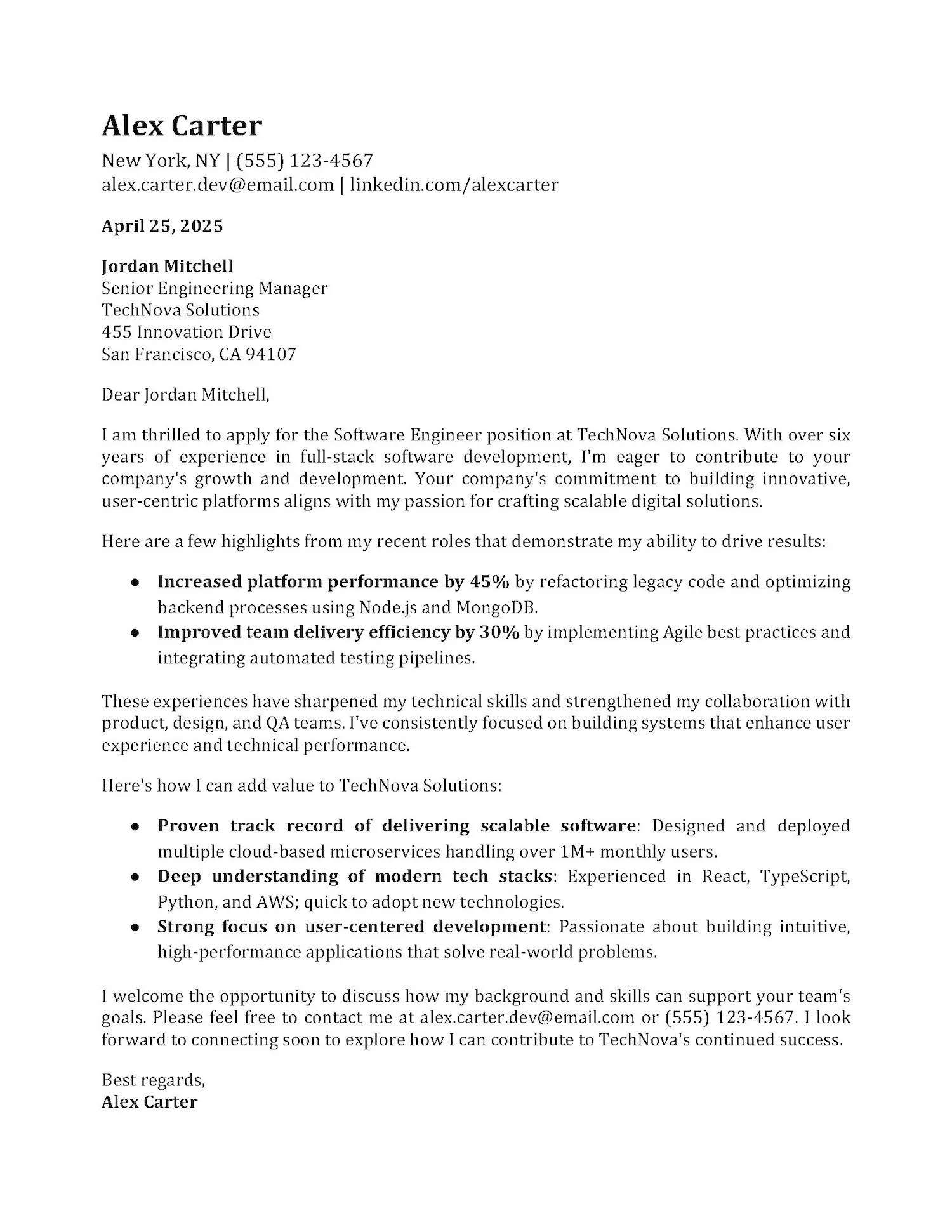



Your portfolio shows what you can shoot. Your cover letter explains why a studio, brand, or publication should trust you with their next assignment. Hiring managers in photography rarely read past the first two lines if a letter feels generic, so the goal is to connect your visual style to the work this specific employer needs done.
Below are three photographer cover letter examples for different stages of a career, from a first studio job to a senior commercial role. Each one is followed by a breakdown of why it works, plus concrete guidance on the achievements, tools, and keywords that help your application clear both the recruiter and the applicant tracking system.
3 Photographer cover letter examples that get interviews
Photographer Cover Letter Example
This example fits a mid-level photographer with a few years of professional shoots applying to an in-house brand or studio role. It pairs a clear specialty with numbers that prove the work paid off.
Maya Reyes
Austin, TX | (512) 555-0184 | maya.reyes@email.com
March 3, 2026
Daniel Cho
Creative Director
Lumen & Co. Studios, Austin, TX
Dear Mr. Cho,
I shoot product and lifestyle imagery that gives e-commerce brands a reason to slow down and look. Your posting for a Brand Photographer caught my attention because Lumen & Co. builds full visual systems for clients rather than one-off galleries, which is exactly the kind of consistent, story-led work I want to keep making.
For the past four years I have been the lead photographer at Maple Lane Goods, a direct-to-consumer home brand. I planned and shot roughly 60 product launches a year, managing everything from lighting setups to final retouching in Lightroom and Photoshop. After I rebuilt the studio lighting workflow and standardized our color profiles, our product pages saw a 22 percent lift in add-to-cart rate, and the art team cut post-production turnaround from five days to two.
Beyond the studio, I handle on-location lifestyle shoots and direct small talent crews. I am comfortable owning a shot list, staying on schedule, and adjusting quickly when a setup is not working. I also keep a tidy digital asset library, which matters when a brand is shipping hundreds of assets a quarter.
I would welcome the chance to show how my catalog and campaign work could support Lumen & Co.’s clients. Thank you for considering my application, and I have attached my portfolio for your review.
Sincerely,
Maya Reyes
- Opens with a point of view: The first line states what she shoots and the effect it has, instead of restating the job title, which signals a real photographer rather than a generic applicant.
- Names a measurable result: The 22 percent add-to-cart lift ties her photography directly to revenue, the kind of outcome a brand hiring manager remembers.
- Shows tool fluency: Mentioning Lightroom, Photoshop, and color profiles plants the software keywords an ATS scans for without sounding like a list.
- Proves operational reliability: Cutting post-production from five days to two tells the employer she improves process, not just images.
- Demonstrates range: The mix of studio product work and on-location lifestyle shoots covers the two skill sets most brand roles need.
- Closes with a clear next step: Pointing to the attached portfolio invites the reader to act and keeps the focus on her work.
Entry-Level Photographer Cover Letter Example
This example suits an early-career photographer with internship, freelance, or academic experience but no full-time role yet. It leans on transferable skills and concrete student work to make up for a shorter resume.
Caleb Nguyen
Portland, OR | (503) 555-0142 | caleb.nguyen@email.com
April 18, 2026
Sarah Brennan
Studio Manager
Northlight Photography, Portland, OR
Dear Ms. Brennan,
Spending two years as the lead photographer for my university’s athletics department taught me how to get a sharp, usable frame when there is no second chance at the moment. That is the instinct I would bring to the Assistant Photographer role at Northlight, and it is why your sports and event work stood out to me.
While finishing my B.F.A. in Photography at Portland State, I covered more than 40 games and campus events, delivering edited galleries within 24 hours so the communications team could post the same day. I shot in fast-changing light with a Canon R6, handled my own culling and editing in Capture One, and learned to keep gear organized under real deadline pressure. My work was published in the student paper and the alumni magazine.
I have also taken on freelance portrait and event sessions, which pushed me to manage client expectations, scout locations, and stay calm when a plan changes. I know an assistant role means carrying equipment, setting up lighting, and supporting the lead shooter, and I am genuinely eager to learn the craft from a working studio.
I would love to talk about how I can be useful on set while I grow. Thank you for your time, and my portfolio link is included with my application.
Sincerely,
Caleb Nguyen
- Leads with a transferable strength: Capturing the decisive moment in live sports reframes limited experience as a real, relevant skill.
- Quantifies student work: Forty-plus events and 24-hour gallery turnaround give hard numbers even without a salaried job history.
- Lists role-specific gear: Naming the Canon R6 and Capture One shows hands-on familiarity with equipment an entry hire is expected to know.
- Sets realistic expectations: Acknowledging that the assistant role means hauling gear and supporting the lead reads as humble and informed.
- Mentions published work: Bylines in the paper and alumni magazine offer third-party proof his images met a publishing standard.
- Frames eagerness as an asset: Wanting to learn from a working studio fits an entry role without sounding unsure of his ability.
Senior Photographer Cover Letter Example
This example fits an experienced photographer moving into a lead or senior commercial role. It emphasizes team leadership, client management, and the scale of the work rather than basic technical skills.
Theo Garrison
Chicago, IL | (312) 555-0167 | theo.garrison@email.com
February 11, 2026
Priya Anand
VP of Creative
Harborline Media Group, Chicago, IL
Dear Ms. Anand,
Twelve years behind the camera have taught me that a strong commercial shoot is run as much as it is shot. I am applying for the Senior Photographer position at Harborline because your campaigns demand both a refined visual eye and the production discipline to deliver them on budget, and that is the work I have built my career around.
As Lead Photographer at Crest Visual Agency, I directed national campaigns for retail and hospitality clients, often managing shoots of 200-plus final assets across multiple locations in a single week. I built and led a four-person production crew, set the creative direction with art directors, and owned the budget on shoots ranging up to $80,000. Two campaigns I led were picked up for the clients’ flagship store displays, and our repeat-booking rate with key accounts held above 85 percent.
My technical foundation is deep, covering studio and location lighting, tethered capture, and color-managed workflows in Capture One and Photoshop. What I bring beyond that is the judgment to keep a client confident when a shoot day goes sideways, and the mentorship to bring junior photographers up to a professional standard.
I would value the opportunity to discuss how my campaign and leadership experience could serve Harborline’s clients. Thank you for your consideration; my full portfolio and case studies are attached.
Sincerely,
Theo Garrison
- Frames seniority as a philosophy: The opening line about running a shoot, not just shooting it, immediately separates him from less experienced applicants.
- Quantifies scale and budget: The 200-plus assets and $80,000 budget figures show he can be trusted with high-stakes production.
- Highlights leadership: Building and directing a four-person crew speaks to the people-management a senior role requires.
- Cites retention data: The 85 percent repeat-booking rate proves clients value the work enough to come back.
- Treats technical skill as a baseline: He covers lighting and Capture One briefly, then pivots to judgment and mentorship, which is the right emphasis at this level.
- Backs claims with case studies: Offering attached case studies, not just a portfolio, matches the documentation a VP expects from a senior hire.
How to write a Photographer cover letter
A photographer cover letter should do what a contact sheet cannot: explain the thinking behind your images and connect your style to the employer’s needs. Keep it to one page, write in your own voice, and treat it as a focused argument for why your eye fits this particular role. The points below cover what to feature, how to tailor it, and which terms help you pass an automated screen.
Feature outcomes, not just shoots
Editors and creative directors see hundreds of portfolios. What they remember is evidence that your photography moved a number. Translate your work into results the business cares about, then attach the visual skill that produced it.
- Tie images to impact: a conversion lift on product pages, social engagement on a campaign, or a faster delivery timeline.
- Quantify volume and scope: assets shot per quarter, events covered, or crew size you have led.
- Name the genre you own (product, editorial, portrait, event, real estate) so the reader can place you instantly.
Tailor it to the employer’s actual work
Before you write, study the company’s existing imagery and the job description side by side. A studio that shoots minimalist e-commerce wants something different from a wedding brand or a newsroom. Reference what you noticed and explain how your approach fits.
- Mention a specific quality of their work you admire, briefly and honestly, without flattery.
- Mirror the priorities in the posting, whether that is fast turnaround, on-location flexibility, or brand consistency.
- Match the deliverables they list, such as retouching, asset management, or directing talent on set.
Use the right keywords for ATS and recruiters
Many photography roles, especially in-house and agency positions, are filtered through an applicant tracking system before a human reads them. Work in the exact terms from the job posting so your application is not screened out on a technicality.
- Include the literal job title, such as Brand Photographer or Senior Photographer, as it appears in the listing.
- Name the tools you genuinely use: Lightroom, Photoshop, Capture One, tethered capture, and your camera systems.
- Reference relevant techniques and tasks like studio lighting, color grading, photo retouching, and digital asset management.
Photographer cover letter tips
A photographer’s cover letter should sell your eye and your reliability, since clients trust you with one-time moments and tight deadlines.
- Link your portfolio: Put a direct link to your portfolio in the first lines, because no amount of description replaces letting the hiring manager see your actual work.
- Match the genre: Speak to the specific style the role needs, whether that is editorial, product, wedding, or real estate, and reference shoots that mirror it.
- Name your gear: Mention the camera bodies, lighting, and editing software you work with, such as a full-frame mirrorless setup and Lightroom and Capture One, so they know you can deliver on their specs.
- Prove your turnaround: State how fast you typically deliver edited galleries, since dependable post-production timelines often matter to clients as much as the images themselves.
- Show you direct people: Describe how you put subjects at ease or run a set, because a calm, organized presence is a real differentiator for portrait and event work.
- Tie images to results: Note when your photos served a goal, like product shots that supported a retail launch or images licensed by a publication, to show commercial value.
Write your photographer cover letter faster with Jobscan
If you are staring at a blank page, Jobscan’s Cover Letter Generator helps you build a tailored draft in minutes, pulling in the keywords from the job description so your letter speaks to both the hiring manager and the ATS. Use it as a starting point, then add the specific shoots and results that only you can tell.
Photographer cover letter FAQs

Keep it to one page, usually three or four short paragraphs and around 250 to 320 words. Hiring managers skim, so lead with your strongest specialty or result, and let your portfolio carry the visual proof rather than describing every image in the letter.
Open with your photographic specialty and a reason you fit this employer, then give one or two specific accomplishments with real numbers (assets shot, conversion lift, events covered). Name the tools you use, such as Lightroom or Capture One, and close by pointing to your portfolio with a clear next step.
Lean on transferable work: student assignments, internships, freelance sessions, or personal projects that show real output. Quantify what you can, such as galleries delivered or events covered, name the gear and software you know, and frame your eagerness to learn the craft as a genuine asset for an assistant or junior role.
Do both when possible. Reference your portfolio in the closing paragraph and include a clean link, since most photography hiring happens online. If you are emailing or submitting a PDF, make sure the link works and points to a focused selection of your best, most relevant work for this specific role.
Read the posting and study the employer’s existing imagery, then match your letter to both. Use the exact job title, mirror the deliverables they emphasize (fast turnaround, retouching, on-location work), and reference the genre and tools that align with their work. A tailored letter beats a polished generic one every time.


