Best Business Intelligence Resume Examples for 2026
Business intelligence resume examples for 2026 across analyst, developer, engineer, and manager roles, with the SQL, dashboard, and ATS keywords that win interviews.



Business intelligence professionals turn raw data into the dashboards, reports, and recommendations that drive decisions. The work spans analysts who answer business questions, developers and engineers who build the pipelines and models behind them, and managers who lead the whole function. Your resume has to prove you can do both: handle the technical work and connect it to outcomes leaders care about.
Hiring managers scan a BI resume for two things: the stack you know (SQL, Power BI, Tableau, Python, data warehousing) and the business impact you delivered. Before a human ever sees it, an applicant tracking system screens for those exact skills and tools by keyword. List the platforms you actually use, then quantify results: faster reporting, dollars saved, decisions changed, hours of manual work automated away.
The examples below show how to do that at every level, from your first analyst role to leading a team. Use them to frame your own experience, match the language of the job description, and build a resume that clears the ATS and earns the interview.
Ready to build yours? Try our ATS-friendly resume builder or scan your draft against the job description.
Business Intelligence resume example
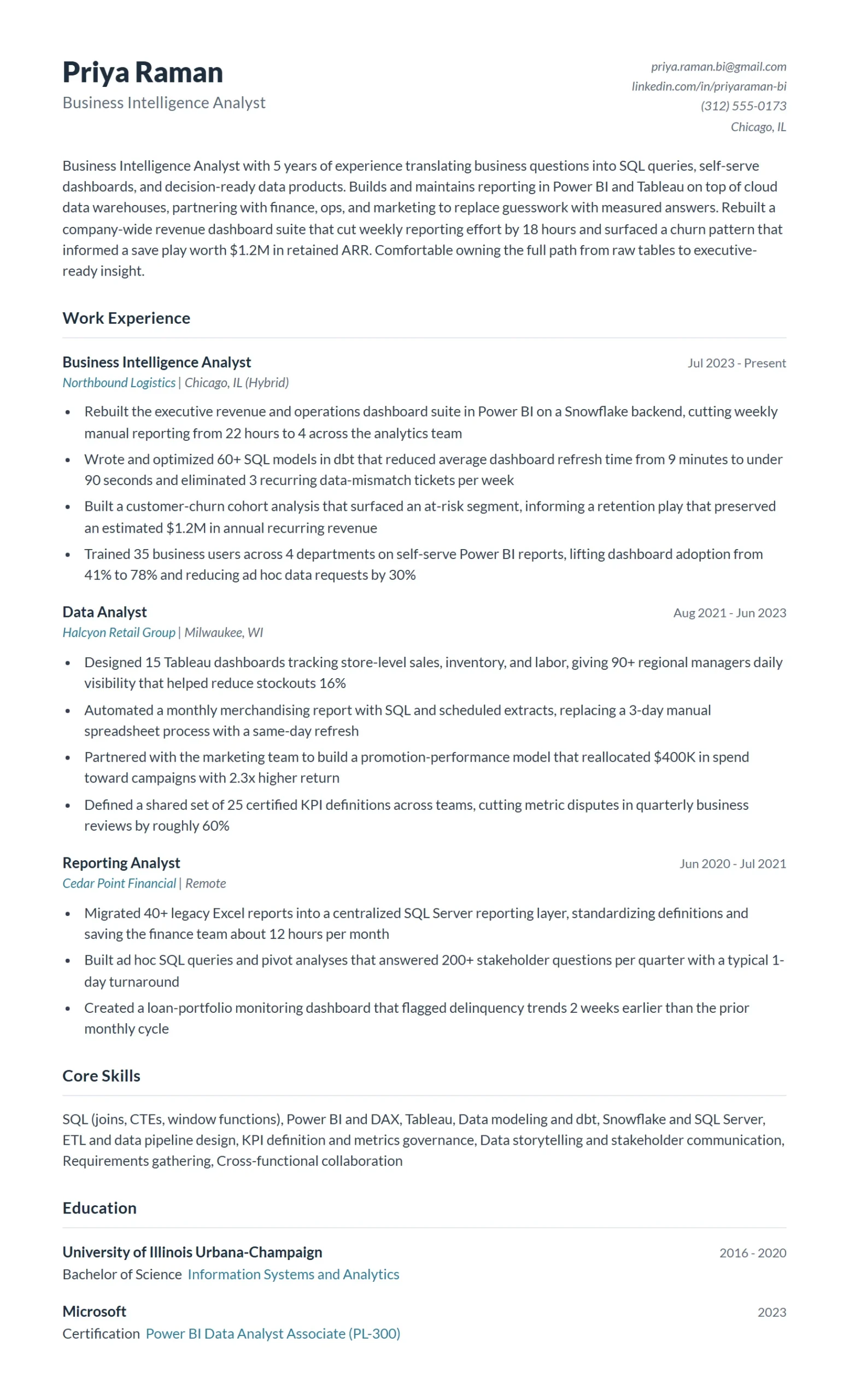
A mid-level BI generalist who blends hands-on analysis with reporting and dashboard development. This is the all-around profile most BI job descriptions describe.
It works because it balances technical depth with business framing: SQL and dashboard tools are named explicitly for the ATS, and every bullet ties the work to a decision or dollar figure. The summary leads with the stack and the impact in one line, so a recruiter sees fit in five seconds. It avoids listing tools in a vacuum by pairing each one with the outcome it produced.
Business Intelligence Analyst resume example
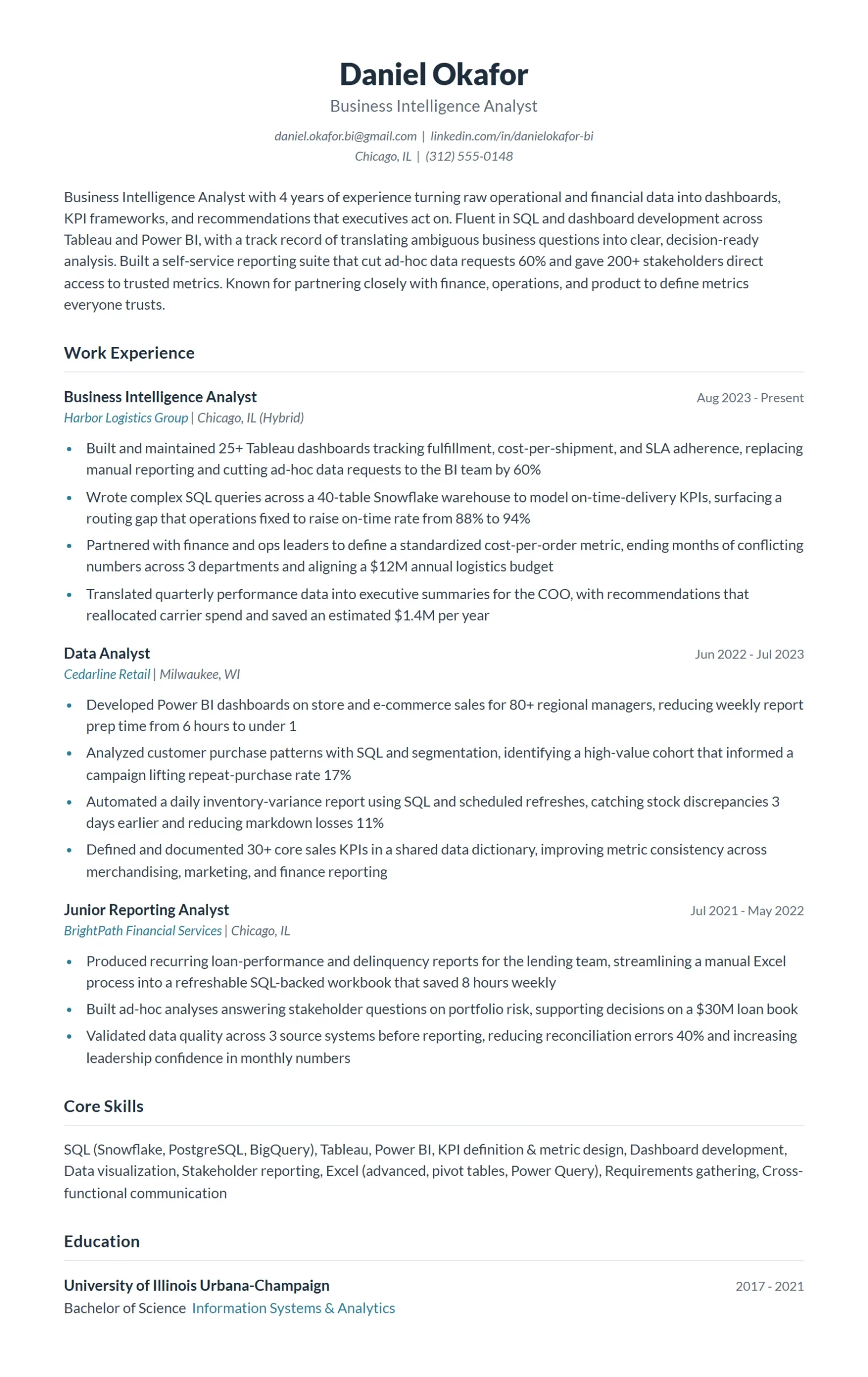
An analysis-leaning role focused on querying data, building dashboards, defining KPIs, and turning findings into recommendations for stakeholders.
This resume wins by showing the analyst as a translator between data and the business, not just a report builder. Bullets quantify the decisions the analysis drove, not the number of reports produced, which is what hiring managers actually value. Stakeholder and KPI keywords are woven in naturally so it reads human while still passing the ATS scan.
Business Intelligence Developer resume example
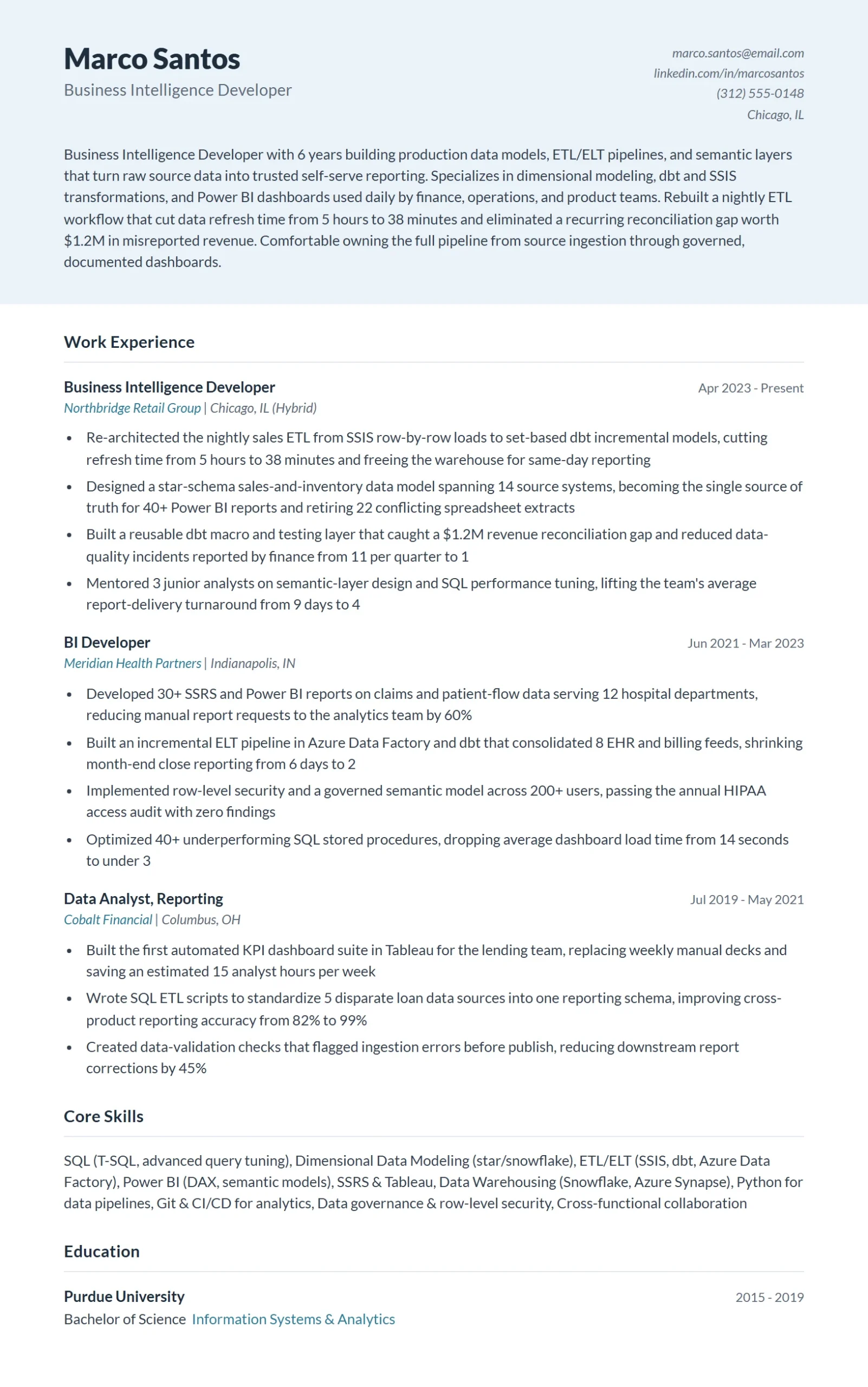
A build-side specialist who designs data models, ETL pipelines, semantic layers, and production reporting in tools like SSIS, SSRS, or dbt.
It works because it foregrounds the engineering: data models, pipeline reliability, and report performance are shown as built systems, not tasks. Each project names the specific tooling an ATS screens for and pairs it with a measurable gain like faster refresh times or reduced manual reporting. That combination signals a developer who ships, not just queries.
Business Intelligence Engineer resume example
The most technical BI profile, owning data pipelines, warehousing, large-scale SQL, and analytics infrastructure, often at big-tech scale.

This example earns its keep by quantifying scale: data volume, query performance, and automation that removed thousands of manual hours. It frames infrastructure work in business terms so non-technical reviewers grasp the value, while keeping the warehousing and pipeline keywords engineers and ATS both look for. The depth here is what separates an engineer resume from an analyst one.
Business Intelligence Manager resume example
A leadership profile that runs a BI or analytics team, sets reporting strategy, owns the data roadmap, and manages stakeholder relationships.

It works because it shifts the proof from personal output to team and business results: revenue influenced, reporting cycles shortened across the org, analysts hired and grown. Leadership and strategy keywords replace the hands-on tool list a junior resume would lean on. The summary signals scope immediately, so it reads as a manager rather than a senior individual contributor.
Data Analyst resume example
The closest sibling role, focused on SQL, Excel, visualization, and ad hoc analysis across the business. A common entry point and frequent cross-search for BI candidates.

This resume succeeds by keeping the stack broad and tool-agnostic while still naming the specific platforms an ATS scans for. Bullets show curiosity and impact, framing analysis as answering real business questions rather than running queries. It is the right model for anyone moving toward BI who wants to show analytical range before specializing.
How to write a Business Intelligence resume that gets interviews
Hiring managers for BI roles skim a resume for one thing: proof that you turn raw data into decisions the business acts on. They want to see the tools (SQL, a warehouse, a BI platform), the pipeline (how data gets clean and modeled), and the outcome (what changed because of your dashboard or analysis). Before a human reads it, an Applicant Tracking System (ATS) scans for the exact tools and methods named in the posting, so the language has to match first. The tips below help you clear the ATS scan and convince the analyst or data lead who reads next.
- Lead every bullet with a business outcome, not a query you ran: BI exists to drive decisions, so quantify the decision your work enabled. “Built an executive churn dashboard that flagged at-risk accounts and helped reduce monthly churn from 4.1% to 2.8%” beats “created dashboards in Tableau.” Tie your work to revenue, cost savings, churn, conversion, forecast accuracy, or hours of manual reporting eliminated. If you cannot attach a dollar figure, use adoption metrics: “adopted by 12 department leads as the single source of truth for weekly planning.”
- Name your SQL and data modeling depth explicitly: SQL is the non-negotiable core of BI, so do not bury it. Show the level: window functions, CTEs, query optimization, and the scale you worked at (“optimized a 40-table reporting query, cutting refresh time from 18 minutes to 90 seconds”). Name your warehouse (Snowflake, BigQuery, Redshift) and your modeling approach (star schema, dbt models, dimensional modeling). Recruiters filtering for senior BI roles search for these exact terms, and they separate a dashboard builder from a true BI engineer.
- Specify your BI platform and the scale of what you shipped: List the platform you actually use (Tableau, Power BI, Looker, Qlik) and back it with scope: number of dashboards, reports, or data sources, and the audience size. “Designed 25+ Power BI reports consumed by 300 sales reps and the C-suite, with row-level security across 4 regions” tells a reader far more than “experienced in Power BI.” If a posting names Looker and you have built LookML models, use that exact phrase rather than a generic “data visualization” claim.
- Show the full data pipeline, not just the final chart: Strong BI candidates own data end to end. Reference the arc in your bullets: sourcing and ETL/ELT (Airflow, Fivetran, dbt), cleaning and validation, modeling, then reporting and self-serve enablement. A resume that jumps straight to “built a dashboard” with no mention of where the data came from or how it was trusted reads as surface-level. Showing you built reliable pipelines and a tested semantic layer signals you can be trusted with the numbers leadership makes decisions on.
- Frame yourself as a partner to the business, not a report factory: BI work lives or dies on stakeholder trust. Hiring managers want analysts who translate vague business questions into the right metric, then defend the definition. Use bullets that name the partnership and the result: “Partnered with Finance and RevOps to define a single ARR metric, ending months of conflicting reports and aligning the board deck.” This signals you can run requirements gathering, manage stakeholders, and turn ambiguity into a trusted KPI, not just fulfill ticket requests.
- Mirror the job description and keep the format ATS-clean: A BI Analyst role, a BI Developer role, and a BI-leaning data analyst role reward different keywords. Reorder your skills and swap your headline projects to match each posting (some weight SQL and warehousing, others weight visualization and stakeholder reporting). Keep the format ATS-friendly: standard section headings, no text boxes or multi-column layouts that scramble parsing, and real selectable text. Run it through Jobscan to check your match rate against the job description before you apply.

Business Intelligence resume summary examples
Your summary is the first thing a recruiter reads. Lead with your specialty, years of experience, and a quantified win.
Good business Intelligence resume summary examples
- Business Intelligence Analyst with 6+ years turning raw data into executive decisions across SaaS and retail. Expert in SQL, Snowflake, and dbt, with a track record of building self-serve Tableau and Power BI dashboards adopted by 200+ users. Built a churn-prediction reporting layer that helped cut monthly churn from 4.1% to 2.8% and automated reporting that eliminated 15 hours of manual work per week.
- BI Developer specializing in dimensional modeling and high-performance reporting on BigQuery and Looker. Owns the full pipeline from ELT (Fivetran, dbt) through governed LookML semantic layers serving 6 departments. Recent work cut a flagship dashboard’s refresh time from 18 minutes to 90 seconds and standardized a single ARR definition across Finance and RevOps.
- Data-driven BI Analyst with a strong SQL and stakeholder-partnership background. Translates ambiguous business questions into trusted KPIs, then ships the dashboards leaders run their weekly reviews on. Built an inventory-forecasting model that improved forecast accuracy 23% and reduced stockouts 17% across 40 stores.
What to avoid
- Detail-oriented data professional seeking a challenging Business Intelligence role where I can use my analytical skills and grow with a forward-thinking company. (It is all about what the candidate wants, not what they deliver. There is no SQL, no BI platform, no warehouse, and zero quantified impact. A hiring manager learns nothing they can act on, and the ATS finds none of the keywords it is scanning for.)
- Hardworking analyst with a passion for data and a great eye for dashboards who is a quick learner and team player. (Pure adjectives with no proof. “Passion for data” and “great eye for dashboards” are claims anyone can make. It names no tools (SQL, Tableau, Power BI), no methods, and no measurable result, so both the ATS and the recruiter skip past it.)
Business Intelligence resume skills
Pull the exact tools and platforms from each job description (the warehouse, the BI tool, the modeling layer) and mirror that language here. This is a quick resume snapshot, so keep it to your strongest, role-relevant skills rather than an exhaustive list.
Hard skills for a business Intelligence resume
- SQL
- Data Warehousing (Snowflake, BigQuery, Redshift)
- Tableau
- Power BI
- Looker / LookML
- ETL / ELT (dbt, Fivetran, Airflow)
- Data Modeling (star schema, dimensional)
- Python
- Excel (advanced, pivot tables)
- KPI & Metrics Definition
Soft skills for a business Intelligence resume
- Stakeholder Communication
- Requirements Gathering
- Storytelling with Data
- Problem Solving
- Cross-Functional Collaboration
- Attention to Detail
Business Intelligence resume work experience bullet point examples
Lead each bullet with a strong verb and a measurable result.
Good bullet point examples
- Built an executive churn dashboard in Tableau backed by a Snowflake data model, surfacing at-risk accounts weekly and helping reduce monthly churn from 4.1% to 2.8% over two quarters.
- Optimized a 40-table revenue reporting query and rebuilt it as dbt models, cutting dashboard refresh time from 18 minutes to 90 seconds and eliminating 15 hours of manual reporting per week.
- Partnered with Finance and RevOps to define a single company-wide ARR metric, ending months of conflicting reports and becoming the source of truth for the board deck.
- Designed 25+ Power BI reports with row-level security for 300 sales reps across 4 regions, driving self-serve adoption that cut ad hoc data requests to the analytics team by 60%.
Bad bullet point examples
- Created various dashboards and reports for different teams using Tableau. (Lists a task with no outcome. “Various” and “different teams” are vague, and there is no result, no audience size, and no metric. It tells the reader you used a tool but not whether your reporting changed any decision.)
- Responsible for pulling data and maintaining the company’s reporting. (“Responsible for” describes a job title, not an accomplishment. It shows no specific action, no scale, and no measurable impact. Lead with a strong verb (Built, Automated, Modeled) and end with the business result instead.)
- Wrote SQL queries to analyze data and help the business make better decisions. (Generic and unquantified. Every BI analyst writes SQL, so this proves nothing. Name the analysis, the data scale, and the specific decision it drove, such as a forecast accuracy gain or a cost reduction the dashboard surfaced.)
Business Intelligence resume tips
A strong Business Intelligence resume proves you speak both the language of data pipelines and the language of business outcomes.
- Mirror the Job Post: Copy the exact tool names from the posting (Snowflake vs. Redshift, Power BI vs. Tableau) because ATS systems match strings literally, and paraphrasing costs you the scan.
- Quantify BI Outcomes: Anchor every bullet to a metric that a BI role actually moves: dashboard adoption rate, query runtime reduction, hours saved on manual reporting, or revenue influenced by an insight you surfaced.
- Name Your Data Stack: List the full pipeline explicitly (for example: Fivetran, dbt, BigQuery, Looker) so ATS and hiring managers can confirm you have end-to-end ELT experience rather than just a single tool.
- Highlight Modeling Choices: Call out the specific data modeling pattern you used (star schema, slowly changing dimensions, OBT) because BI leads screen for candidates who design for performance, not just connect to an existing model.
- Include Certifications: Add role-relevant credentials such as Tableau Desktop Specialist, Microsoft PL-300 (Power BI), dbt Analytics Engineering, or Google Professional Data Engineer directly in a certifications section so ATS indexes them as hard keywords.
- Show Stakeholder Impact: Soft skills like requirements gathering and storytelling with data are increasingly listed in BI postings, so include one bullet per role that names a non-technical stakeholder (finance, marketing, operations) and the decision your analysis enabled.
Pair your business Intelligence resume with a cover letter
A strong resume goes further with a tailored cover letter. Browse our business intelligence cover letter examples to round out your application.
Business Intelligence resume frequently asked questions
They overlap, but BI roles lean harder on building and maintaining reporting infrastructure: dashboards, data models, ETL pipelines, and self-service tools that the whole business runs on. A BI resume should foreground tools like Power BI, Tableau, and SQL alongside data warehousing (Snowflake, BigQuery, Redshift) and how your work scaled decision-making, not just one-off analyses. If the job title says BI, mirror that exact language and emphasize the systems you owned rather than ad hoc reports you ran.
List the core stack recruiters and ATS scan for: SQL (state the dialects, like T-SQL or PostgreSQL), at least one visualization platform (Power BI, Tableau, or Looker), and a data warehouse (Snowflake, BigQuery, or Redshift). Add ETL/ELT tools (dbt, SSIS, Informatica, Fivetran), a scripting language (Python or R), and data modeling concepts like star schemas and DAX. Match the specific tools named in the job description word for word, because an ATS often searches for the exact term, not a synonym.
Tie your work to a business outcome and put a number on it. Strong examples: “Built 12 executive Power BI dashboards that cut monthly reporting time from 3 days to 4 hours,” or “Redesigned a SQL data model that reduced query runtime 60 percent and supported 400 daily users.” When you cannot share exact figures, use scope instead: rows of data, number of stakeholders served, reports automated, or hours saved. The goal is to show impact and adoption, not just that you produced a report.
Yes, when they match the tools the employer uses. The Microsoft Power BI Data Analyst (PL-300), Tableau Desktop Specialist or Certified Data Analyst, and cloud certs like SnowPro or Google Professional Data Engineer carry real weight and double as ATS keywords. Put them in a dedicated certifications section near your skills, and list the issuer and year so a recruiter can verify them at a glance. Skip generic or expired certs that do not reinforce the specific role.
Lead with transferable, evidence-backed work that proves you can turn data into decisions. Feature projects from coursework, a bootcamp, a previous analyst-adjacent role, or self-built dashboards using public datasets, and describe each with the problem, the tools you used, and the measurable result. Make your SQL and visualization skills impossible to miss in a skills section and a sharp summary that frames you as an aspiring or entry-level BI analyst. A portfolio link to a published Tableau Public dashboard or a GitHub repo of SQL projects often does more than another bullet point.
One page is right for most BI analysts; move to two only with roughly 10-plus years or several senior and lead roles. To stay ATS-readable, use a single-column layout with standard section headings, save as a .docx or text-based PDF, and skip text boxes, tables, and graphics that parsers garble. Ironically, the same people who build dashboards often over-design their resumes, so keep yours clean and let the content carry it. Run it through an ATS checker against the job description before you apply to confirm your keywords land.