Best Change Management Resume Examples for 2026
Change management resume examples for 2026 across manager, specialist, consultant, analyst, and director roles, with the keywords ATS filters scan for.



Change management professionals guide organizations through transitions: new systems, restructures, mergers, and process overhauls. The work lives at the intersection of strategy, communication, and people, which makes it hard to capture on a resume. You have to show that you moved an organization, not just that you ran a project.
Hiring managers want proof you can plan a change, build stakeholder buy-in, and measure adoption. They look for recognized frameworks like Prosci ADKAR and Kotter, plus hard outcomes: adoption rates, reduced resistance, on-time rollouts, and dollars saved. Before a person reads any of it, an applicant tracking system scans for the right titles, certifications, and skill keywords, so the language you use matters as much as the results.
The examples below cover the main change management roles, from analyst to director. Use them to frame your own experience, mirror the keywords that match the job description, and build a resume that clears the ATS and earns the interview.
Ready to build yours? Try our ATS-friendly resume builder or scan your draft against the job description.
Change Management resume example
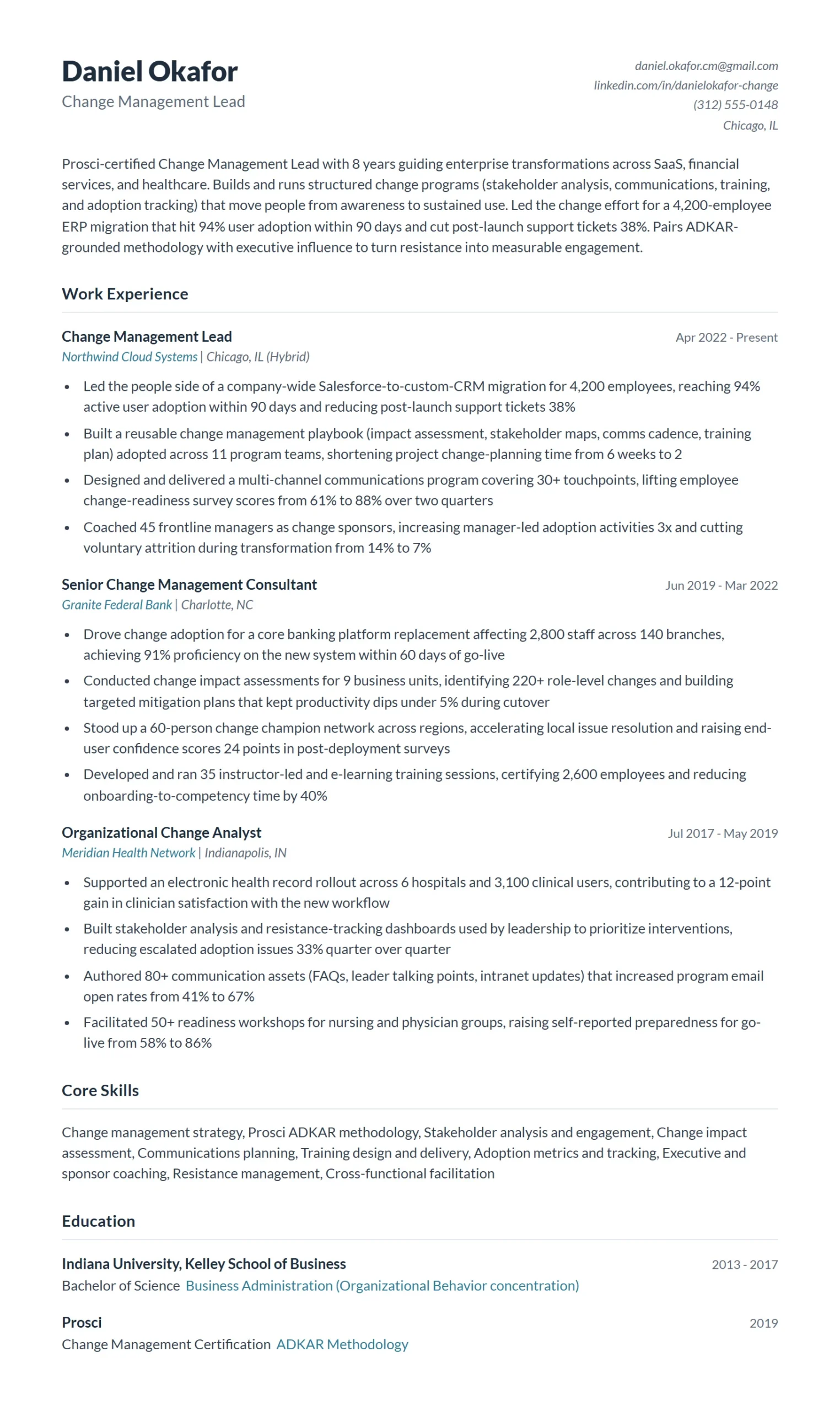
A general-purpose example for change management roles, built to flex across titles and industries. It leads with transformation outcomes rather than task lists.
This resume works because it frames every initiative around adoption and impact: what changed, who was affected, and the measurable result. It names recognized frameworks (ADKAR, Kotter) and surfaces stakeholder management and communication skills that both recruiters and ATS filters look for.
Change Manager resume example
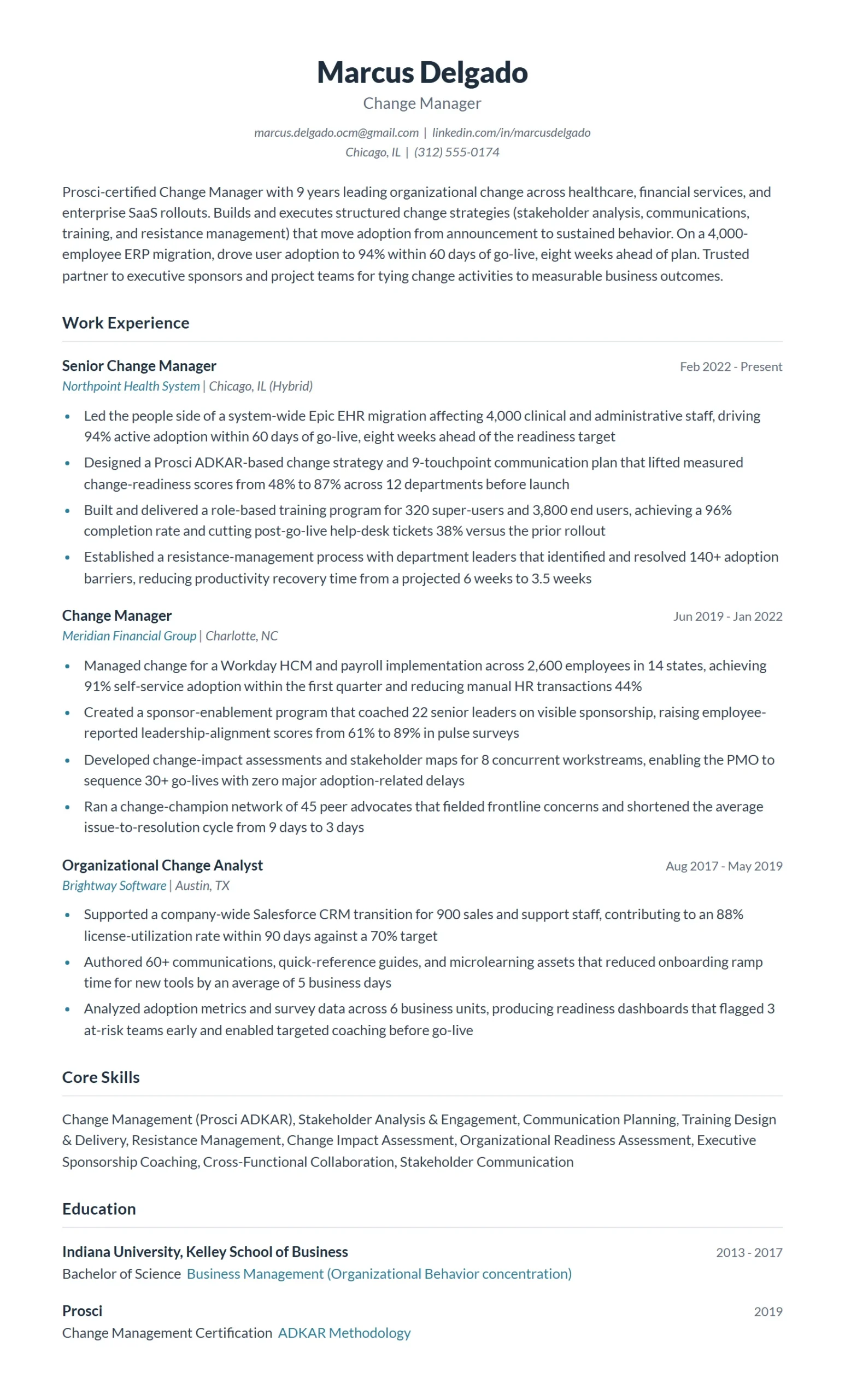
The core change management role, responsible for planning and delivering change across teams and systems. This example centers on ownership of full change lifecycles.
It works because it shows the candidate driving change end to end: assessment, planning, communication, training, and reinforcement. Quantified adoption rates and on-time rollouts prove delivery, while terms like change impact assessment and resistance management mirror the job description language ATS scans for.
Change Management Specialist resume example
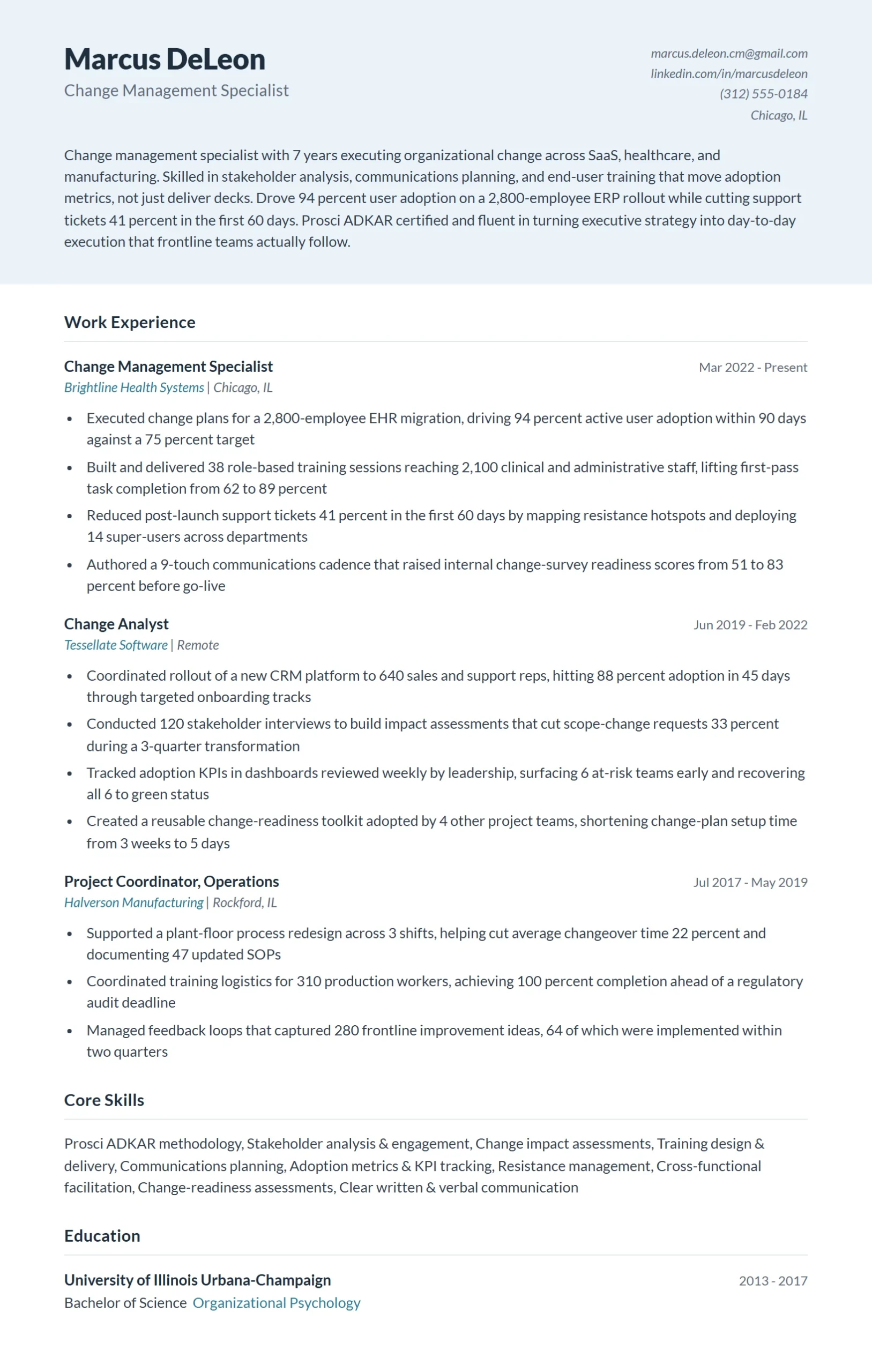
An execution-focused variant for specialists who run the day-to-day mechanics of change programs. This example emphasizes hands-on delivery and tooling.
This one stands out by detailing the practical work: building training materials, running readiness assessments, and tracking adoption metrics. It pairs concrete deliverables with framework keywords, which separates a specialist who executes from a manager who only oversees.
Organizational Change Management Consultant resume example
A consulting-oriented example for advisory and transformation engagements, often across multiple clients. This version highlights breadth and repeatable methodology.

It works because it positions the candidate as a methodology expert who delivers results across diverse clients and industries. Listing certifications like Prosci alongside engagement outcomes and a structured approach signals the credibility consulting and transformation roles require.
Change Management Analyst resume example
A specialization for the analytical, data-driven side of change work. This example leans into measurement, reporting, and readiness tracking.
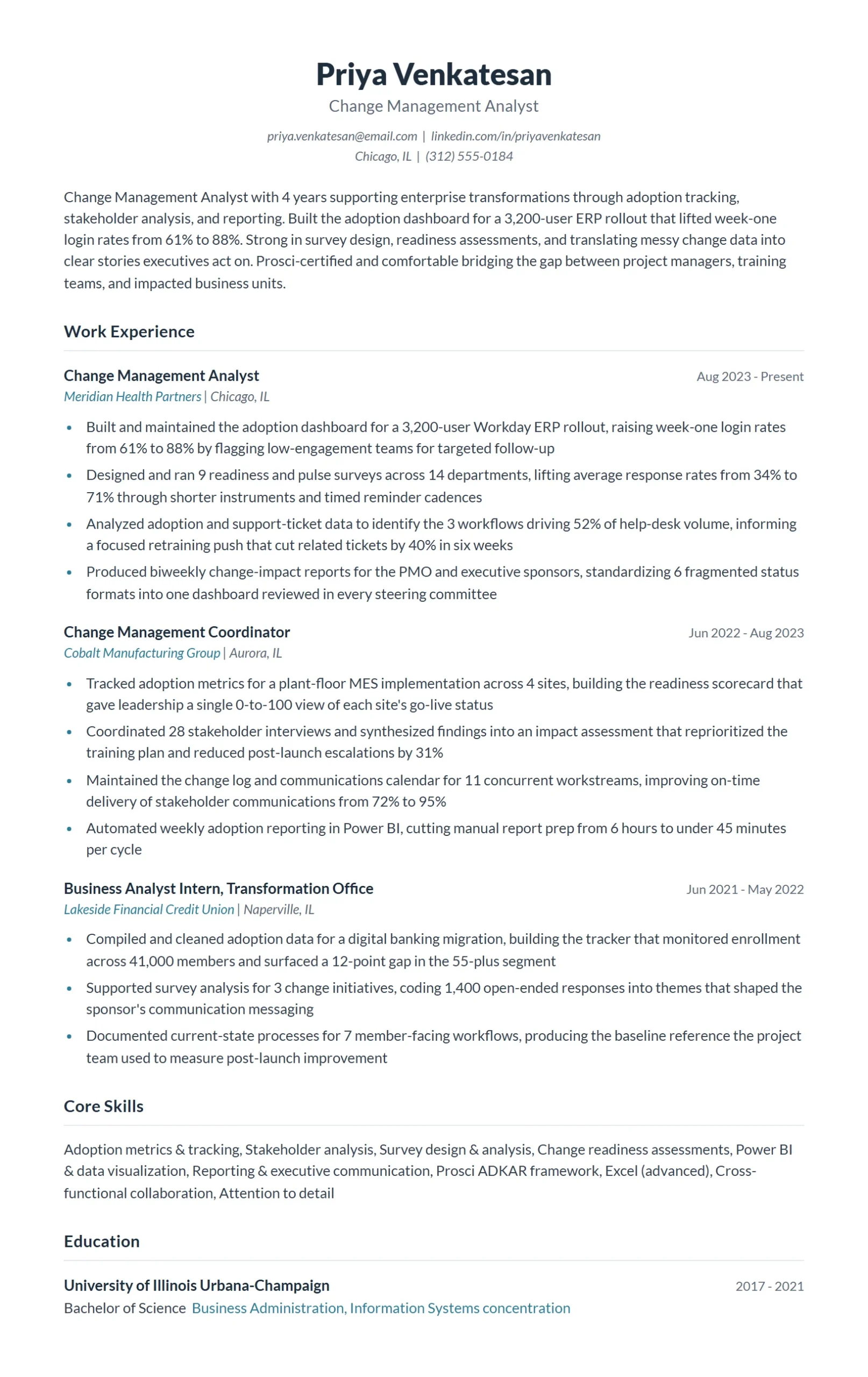
This resume succeeds by quantifying the analysis behind the change: survey results, adoption dashboards, and impact assessments. It balances analytical tools with change management vocabulary, showing a candidate who supports change programs with evidence rather than guesswork.
Director of Change Management resume example
A leadership example for directors owning enterprise transformation and a portfolio of change initiatives. This version foregrounds strategy, scale, and team leadership.

It works because it shifts from executing change to leading it: building a change management function, setting strategy, and reporting to executives. Portfolio-level metrics, team leadership, and governance language signal the scope and seniority a director role demands.
How to write a Change Management resume that gets interviews
Hiring managers and transformation leads read a change management resume for one thing: proof that you can move an organization from a current state to a future state and make the new way stick. They want adoption rates, not activity lists. They want to see you handled resistance, aligned sponsors, and tied your work to a business outcome the project was funded to deliver. Most companies also run your resume through an Applicant Tracking System (ATS) first, so the language has to mirror the job description before a person ever reads it. The tips below help you do both: clear the ATS scan and convince the practitioner reading next.
- Lead with adoption and usage, not training session counts: Change management exists to drive adoption, so make adoption the headline. “Ran 40 training sessions” is activity. “Drove 92% user adoption of the new CRM within 60 days of go-live, against a 70% target” is impact. Tie your bullets to adoption rate, usage/utilization, proficiency, time-to-competency, sustainment at 90 days, or reduced support tickets after rollout. If you owned a piece of a larger transformation, quantify your slice (the population you covered, the regions, the function) rather than claiming the whole program.
- Name your methodology and where you actually applied it: Recruiters scan for frameworks. If you are Prosci certified, say so and show ADKAR in action: “Used ADKAR to diagnose low Awareness and Desire scores, then redesigned sponsor messaging that lifted readiness from 48% to 81%.” If you run Kotter’s 8 steps, Lean change, or an internal model, name it and connect it to a result. Listing “change management methodologies” with no framework named reads as secondhand. Showing the model driving a decision reads as practitioner.
- Show you managed sponsors and resistance, not just communications: The hardest part of the job is people who do not want to change and executives who go quiet. Hiring managers look for that explicitly. Use bullets that name the stakeholder work and the outcome: “Built a sponsor coalition of 6 VPs and coached them on active, visible sponsorship, cutting mid-project resistance escalations by half.” Show change-impact assessments, stakeholder analysis, resistance management plans, and how you turned a blocker into a champion. A resume that is all newsletters and town halls reads as comms, not change management.
- Tie the change to the business case that funded it: Change programs get budget because a system migration, reorg, merger, or process redesign is supposed to deliver savings, revenue, or risk reduction. Connect your work to that number. “Led the people side of an ERP migration across 1,200 employees in 5 countries, supporting an on-time go-live that protected a projected $4M in annual efficiency gains.” Even when you cannot claim the full ROI, anchoring to the business case shows you understand why the change mattered beyond the rollout itself.
- Quantify the scope you operated at: Change roles range from a single team rollout to enterprise transformation, and readers need to place you fast. Put the scale in your bullets and summary: number of employees impacted, sites or geographies, business units, concurrent workstreams, and the size of the change network you built. “Coordinated 35 change champions across 8 sites” tells a reader more about your level than a job title does. Scope is one of the first filters a hiring manager applies.
- Match the keywords to the job description without stuffing: ATS scans for specific terms. Pull the language the posting uses (organizational change management, OCM, stakeholder engagement, change readiness assessment, communication plan, training strategy, adoption, sustainment, Prosci, ADKAR, change impact assessment) and mirror only the ones that are genuinely true of your experience. If the role says “OCM” and you have done organizational change management, use both. Skip buzzwords you cannot back up in an interview, and never pad a skills bar with frameworks you have only read about.

Change Management resume summary examples
Your summary is the first thing a recruiter reads. Lead with your specialty, years of experience, and a quantified win.
Good change Management resume summary examples
- Prosci-certified Change Manager with 8+ years leading the people side of enterprise transformations across finance and healthcare. Delivered ADKAR-based adoption strategies for ERP, CRM, and operating-model changes affecting 5,000+ employees, consistently beating adoption targets (most recent program hit 94% adoption within 90 days). Skilled at coaching executive sponsors, running change-impact assessments, and turning resistance into measurable buy-in.
- Organizational Change Management lead specializing in large-scale system migrations and post-merger integration. Built and ran change networks of 40+ champions across multiple geographies, supporting on-time go-lives that protected over $6M in projected program value. Pairs structured methodology (Prosci, Kotter) with hands-on stakeholder engagement to make new ways of working stick.
- Change Management consultant with a track record of lifting adoption and shortening time-to-proficiency on complex rollouts. Designed communication and training strategies that raised user readiness from 51% to 88% pre-go-live and cut post-launch support tickets 35%. Known for partnering closely with project, HR, and business leaders to align people, process, and technology.
What to avoid
- Experienced change management professional seeking a challenging role where I can use my skills to help organizations navigate change and grow. (It is about what the candidate wants, not what they deliver. No methodology, no scale, no adoption result, and no industry. A hiring manager learns nothing they can act on, and the ATS finds no specific terms to match.)
- Passionate change leader who loves helping people through transitions and is great at communication and building relationships. (Pure adjectives with no proof. “Passionate” and “great at communication” are claims anyone can make. It names no framework (ADKAR, Kotter), no stakeholder or resistance work, and no measurable outcome, so it reads as filler that both the recruiter and the scan skip.)
Change Management resume skills
Mirror the exact frameworks and terms each job description uses (Prosci, ADKAR, OCM, sustainment) and list only what you can defend in an interview. Keep this to your strongest, role-relevant skills; a dedicated skills page covers the full set in depth.
Hard skills for a change Management resume
- Change Management
- Organizational Change Management (OCM)
- Prosci / ADKAR
- Stakeholder Management
- Change Impact Assessment
- Communication Planning
- Training Strategy
- Change Readiness Assessment
- Adoption & Sustainment
- Project Management
Soft skills for a change Management resume
- Stakeholder Engagement
- Executive Communication
- Influence & Persuasion
- Resistance Management
- Coaching
- Adaptability
Change Management resume work experience bullet point examples
Lead each bullet with a strong verb and a measurable result.
Good bullet point examples
- Led the people side of a Workday ERP migration across 1,200 employees in 5 countries, driving 92% adoption within 60 days of go-live against a 75% target and supporting an on-time launch.
- Coached a coalition of 6 executive sponsors on active, visible sponsorship using ADKAR, cutting mid-project resistance escalations 50% and lifting change-readiness scores from 54% to 86%.
- Designed and ran a communication and training strategy for a new CRM rollout, reducing time-to-proficiency from 6 weeks to 3 and cutting post-launch support tickets 35%.
- Built a network of 35 change champions across 8 sites to sustain adoption after go-live, holding usage above 90% at the 90-day mark when the prior rollout had dropped to 62%.
Bad bullet point examples
- Responsible for change management activities on a large transformation project. (“Responsible for” describes a job title, not an accomplishment, and “change management activities” could mean anything. There is no scope, no method, and no result. Lead with a strong verb and end with an adoption or readiness number instead.)
- Conducted training sessions and sent communications to employees about the new system. (Lists tasks with no outcome. Training and comms are inputs; the reader needs the adoption, proficiency, or resistance result they produced. As written, it reads as logistics rather than change leadership.)
- Helped the organization manage change and improve employee buy-in during a difficult transition. (Vague and unquantified. “Helped” hides your actual contribution, and “improve buy-in” has no proof. Replace it with the readiness or adoption metric that backs the claim, and name what you specifically did to move it.)
Change Management resume tips
A strong change management resume proves you move people, not just projects, and these tips help you show exactly that.
- Mirror ATS Keywords: Pull exact phrases from the job posting such as Organizational Change Management, ADKAR, and Change Readiness Assessment and place them in your skills section and bullet points verbatim, because ATS systems match strings, not synonyms.
- Quantify Adoption Rates: Replace vague claims with the metrics hiring managers actually care about: end-user adoption rates, training completion percentages, time-to-proficiency reductions, and sustained behavior change measured at 30, 60, or 90 days post-go-live.
- List Certifications Prominently: Place your Prosci Change Management Certification, CCMP, or equivalent in a dedicated Certifications section near the top of the resume, because these credentials are frequent ATS filters and recruiter checkboxes for senior roles.
- Name the Change Type: Specify the nature of each initiative (ERP implementation, merger integration, workforce restructuring, or digital transformation) so recruiters can instantly match your experience to the scope of change they are hiring for.
- Show Resistance Handled: Include at least one bullet per major role that describes a specific resistance challenge, the intervention you used (executive sponsor alignment, targeted coaching, or stakeholder working sessions), and the measurable outcome that followed.
- Tailor Scope Signals: Call out the scale of each engagement explicitly, including number of impacted employees, number of business units, and geographic footprint, because change management hiring decisions hinge heavily on whether your experience matches the size and complexity of their initiative.
Pair your change Management resume with a cover letter
A strong resume goes further with a tailored cover letter. Browse our change management cover letter examples to round out your application.
Change Management resume frequently asked questions
Lead with the skills hiring managers and ATS scanners look for: change management methodologies (Prosci ADKAR, Kotter’s 8-Step), stakeholder management, communication planning, training and adoption, and resistance management. Pair those with the soft skills that make change work, like executive influence and cross-functional facilitation. Mirror the exact terms in the job description so your resume matches what the ATS is scanning for.
A certification is not always required, but it helps you pass keyword filters and signals credibility to recruiters. Prosci, CCMP (Certified Change Management Professional), and APMG Change Management are the most recognized. List the credential name and year in a dedicated certifications section, and if a posting names a specific framework, make sure it appears in your skills and bullet points too.
Tie your bullets to adoption rates, timelines, and people affected, not just activities. For example, state how many employees a change impacted, the adoption or proficiency rate you reached, the timeline you delivered against, and any cost savings or productivity gains from the transition. If you lack hard numbers, use proxies like number of stakeholders managed, training sessions delivered, or business units rolled out.
This format works for Change Manager, Change Management Consultant, Organizational Change Management (OCM) Lead, Transformation Manager, and Change Analyst roles. It also fits adjacent titles where change is part of the job, such as Program Manager, HR Business Partner, or PMO Lead running large transitions. Match your headline and summary to the exact title in the posting so the ATS and recruiter see an immediate fit.
A project management resume centers on scope, budget, timeline, and deliverables. A change management resume centers on the people side: adoption, stakeholder buy-in, communication, training, and overcoming resistance. If you have done both, keep the focus on the people and behavior outcomes so you are not mistaken for a pure delivery PM, and use change-specific language like ADKAR, readiness assessment, and adoption metrics.
Reframe the change work you have already done under previous roles. Highlight times you led a system rollout, a reorganization, a process overhaul, or a merger transition, and describe how you drove adoption and managed stakeholders. Add a strong summary that positions you as a change practitioner, list any relevant frameworks you applied, and run your resume against the job description to confirm the key change management terms are present.