Best Facilities Manager Resume Examples for 2026
A facilities manager resume has to prove you keep buildings running and budgets tight. See 2026 facilities manager resume examples and the skills and ATS keywords that win interviews.



Facilities managers keep the physical side of a business running so everyone else can do their jobs. You own building operations, maintenance, vendors, safety and compliance, and a budget that has to stretch, all while responding to whatever breaks at 4 p.m. on a Friday. It is a role measured in uptime, cost savings, and tenant or employee satisfaction, so your resume has to show you deliver on all three, not just that you held the title.
Hiring managers skim a facilities resume for proof you can run a site without surprises. They want quantified wins (energy costs cut, downtime reduced, projects delivered on budget) backed by the systems and certifications that make you credible. Before a person ever reads it, an applicant tracking system scans for the right signals first: terms like preventive maintenance, CMMS, HVAC, OSHA, vendor management, and capital projects, often pulled straight from the job description. A resume that clears the ATS and frames your results clearly is what earns the interview.
The five examples below show how facilities professionals at every level present their experience, from a first coordinator role to senior multi-site leadership to maintenance-focused work. Use them as a starting point, then run your own resume through Jobscan to match it against the job description and surface the keywords you are missing before you apply.
Ready to build yours? Try our ATS-friendly resume builder or scan your draft against the job description.
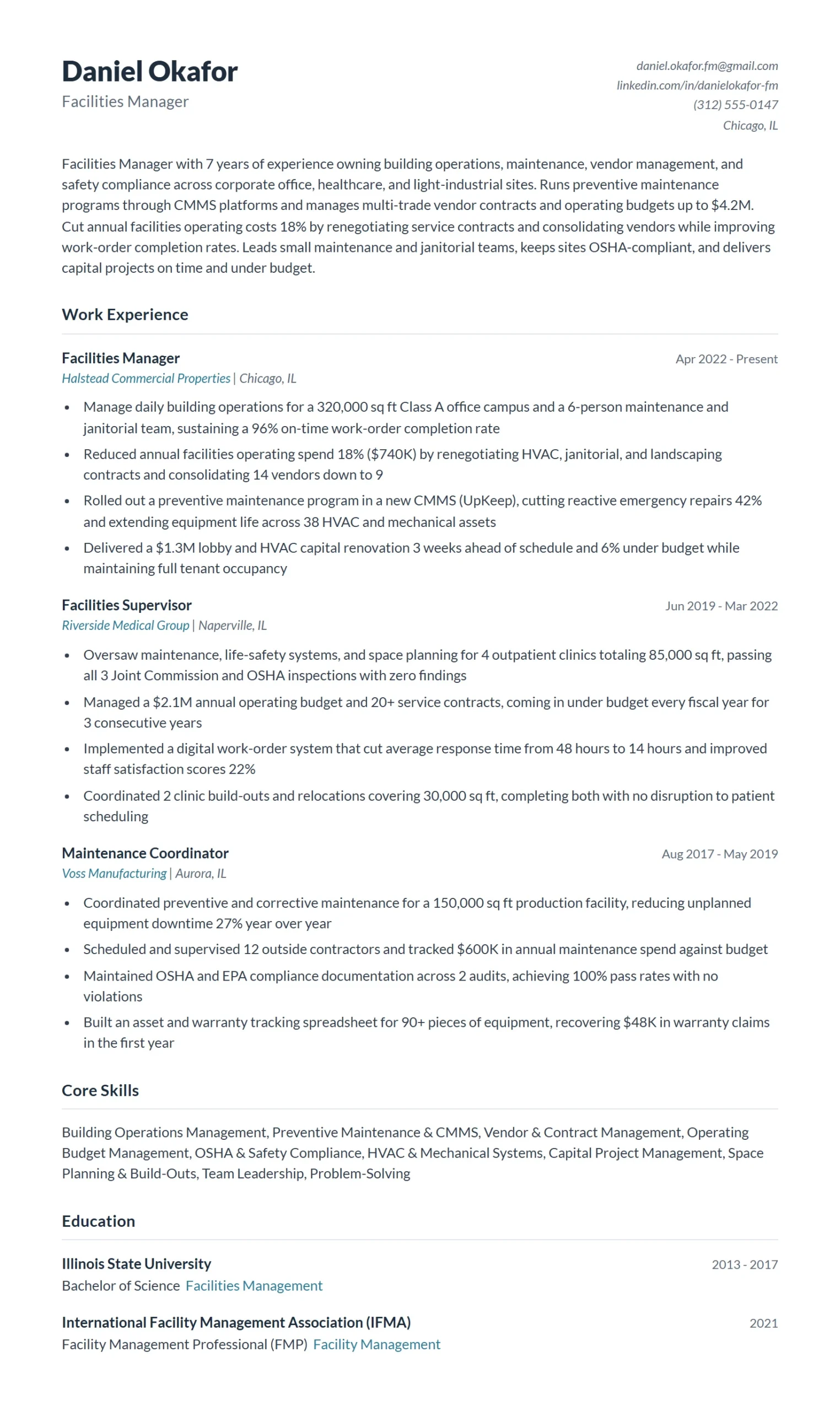
Facilities Manager resume example
Not sure how to fit operations, maintenance, budgets, and safety onto one page without it reading like a duty list? This facilities manager resume example shows how to balance scope and outcomes so hiring managers see the full picture.
This resume works because it pairs each responsibility with a measurable result, like cutting energy spend, reducing equipment downtime, or bringing a renovation in under budget, instead of just naming areas of ownership. It leads with a skills section that surfaces ATS keywords such as preventive maintenance, CMMS, HVAC, and vendor management, then backs them up with experience that shows you run a site end to end. A clean single-column format keeps it easy for both recruiters and the ATS to scan.
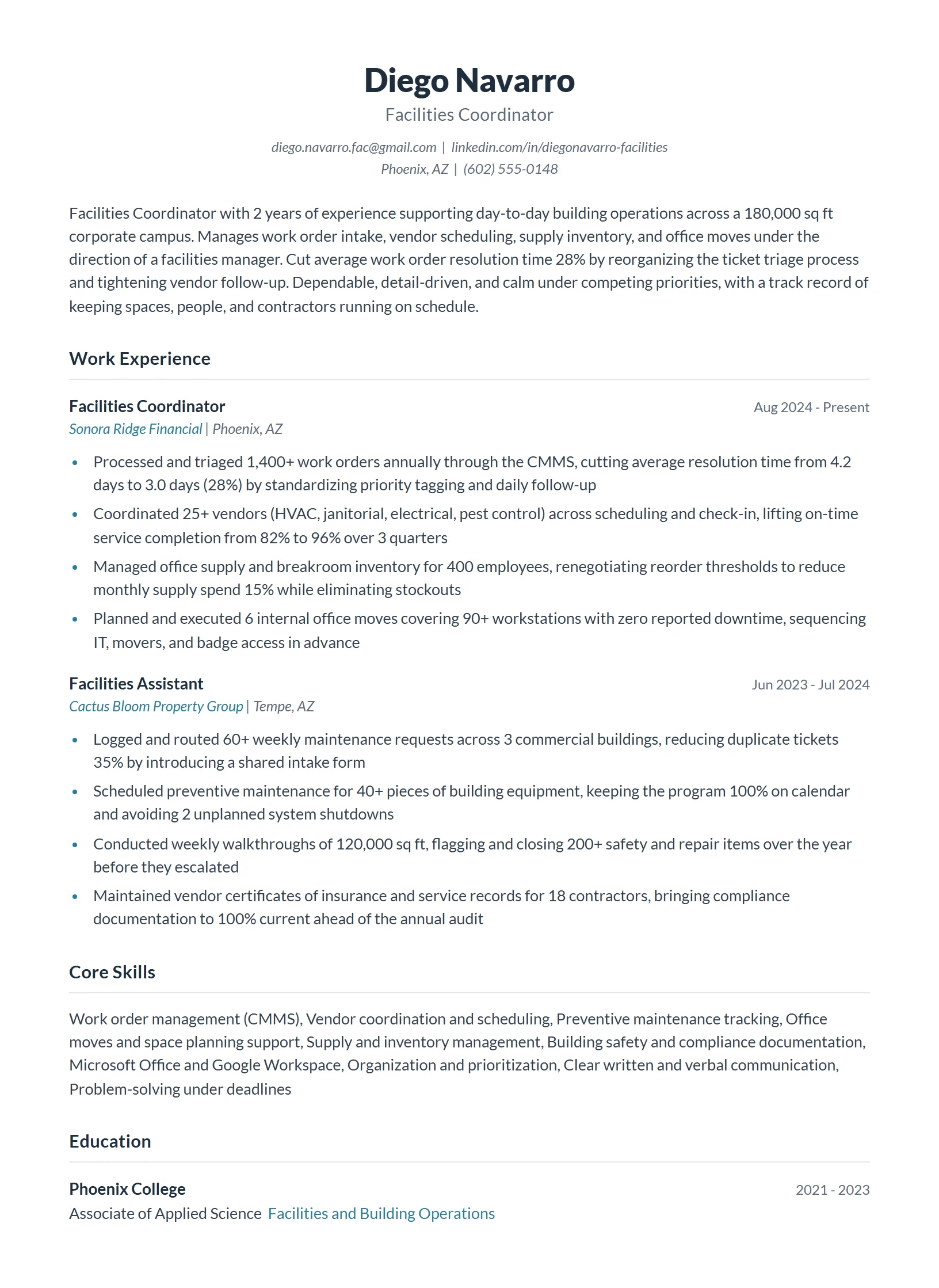
Facilities Coordinator resume example
Coordinator roles are won on reliability and organization, not years of management. This facilities coordinator resume example shows how to make early-career experience look capable and ready for more.
This resume works because it turns day-to-day coordination into evidence: work orders closed on time, vendor schedules kept tight, and office moves run without disruption. It puts a tools and skills section near the top to clear ATS keyword checks (work order systems, scheduling, vendor coordination, safety basics), and it frames each task by the problem solved rather than the chore completed. That signals you already think like a facilities professional, which is exactly what earns the step up to manager.
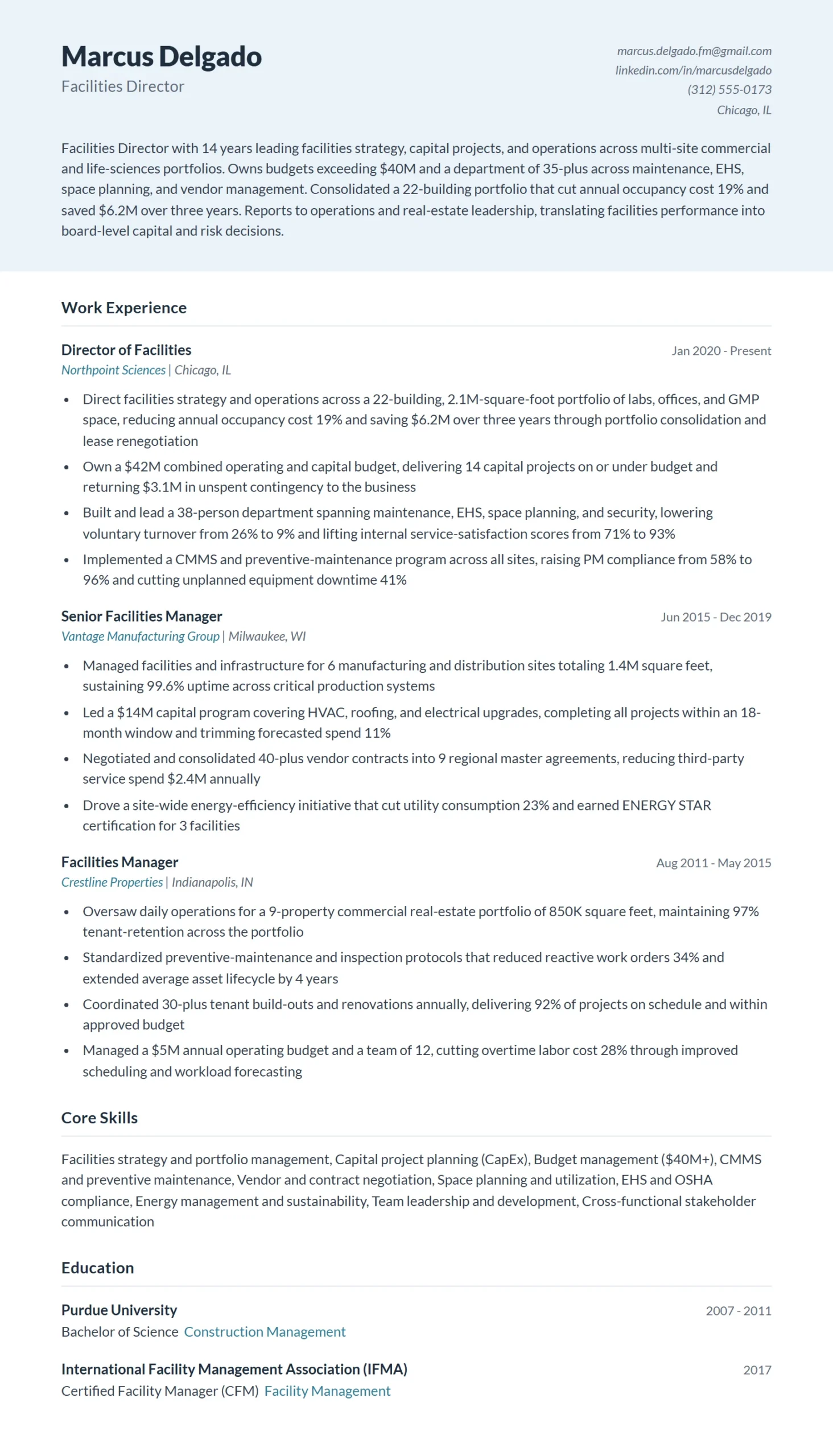
Facilities Director resume example
Leading facilities at the portfolio level means proving strategy and stewardship, not hands-on fixes. This facilities director resume example shows how to frame multi-site scope, capital planning, and team leadership.
This resume works because it shifts the emphasis from running one building to directing facilities across many: owning multimillion-dollar budgets, leading capital projects, and setting maintenance and safety standards a department executes. Quantified outcomes (portfolio cost reductions, large renovations delivered, compliance audits passed) signal seniority that a title alone cannot. It still names the core systems and certifications an ATS expects, so strategic framing never costs keyword visibility.
Maintenance Manager resume example
When the role leans technical, your resume has to prove uptime and trade leadership, not just administration. This maintenance manager resume example shows how to foreground preventive maintenance, reliability, and the team you run.

This resume works because it centers the metrics a maintenance leader is judged on: equipment uptime, mean time to repair, preventive-maintenance compliance, and safety incidents avoided. It highlights hands-on systems (HVAC, electrical, plumbing, building automation) and a CMMS, then connects each to a reliability or cost result. Listing both technical trades and supervisory skills widens the keyword coverage an ATS rewards for these maintenance-heavy roles.
Assistant Facilities Manager resume example
Stepping up from coordinator to assistant manager means showing you can own day-to-day operations under your own judgment. This assistant facilities manager resume example shows how to frame growing responsibility and early wins.

This resume works because it positions you between coordination and full ownership: managing vendors, handling escalations, and running building operations when the facilities manager is out. It quantifies the impact of that trust (response times improved, recurring issues resolved, small projects led) so the promotion looks earned. Keeping the manager-level keywords (vendor management, preventive maintenance, compliance) alongside hands-on coordination terms helps the ATS read you as ready for the next title.
How to write a Facilities Manager resume that gets interviews
Hiring managers scan a Facilities Manager resume for proof you can keep a building running, control costs, and pass an inspection without surprises. They want to see square footage managed, budgets owned, vendors coordinated, and downtime driven down. Most companies also run your resume through an Applicant Tracking System (ATS) before a person ever reads it, so your language has to match the job description first. The tips below show you how to do both: clear the ATS scan and convince the facilities director reading next.
- Lead with scope: square footage, sites, and headcount: A Facilities Manager who oversees one 40,000 sq ft office is a different hire than one running a 12-building, 1.2M sq ft campus. Put your scope up front in your summary and your top bullets: total square footage, number of sites or buildings, occupant or employee count served, and the size of the team and vendor network you direct. This is the fastest way for a reviewer to size your experience, and it frames every other number on the page.
- Quantify uptime, cost savings, and budget: Facilities is a numbers job, so prove it. Show the operating or capital budget you managed ($2.5M annual facilities budget), the savings you found (cut energy spend 18% through an HVAC retrofit), and the reliability you delivered (maintained 99.5% equipment uptime, closed 95% of work orders within SLA). If you renegotiated a janitorial or security contract, name the dollar amount you saved. Reviewers reward managers who treat the building like a P&L.
- Name the systems and the CMMS by name: ATS scans for specific tools. List the maintenance platform you actually use (CMMS, CAFM, work-order software like UpKeep, Fiix, Limble, or IBM Maximo) and the building systems you own (HVAC, electrical, plumbing, fire and life safety, BAS/building automation, access control). If the posting says “preventive maintenance program,” use that exact phrase where it is true. Skip tools you have not touched in years and never keyword-stuff.
- Foreground safety and compliance: A building that fails an inspection is the manager’s problem, so make compliance visible. Reference the standards you work to (OSHA, NFPA, ADA, local fire and building codes, EPA) and the outcomes you hit: passed annual fire-safety inspection with zero citations, ran the emergency preparedness program, maintained 100% on-time elevator and sprinkler certifications. If you hold certifications like FMP, CFM, or OSHA 30, list them clearly. This is a trust signal that sets you apart.
- Show vendor and contract management: Much of the role is directing people you do not employ. Show that you can source, negotiate, and hold vendors accountable: managed 15 service contracts (HVAC, janitorial, landscaping, security), ran competitive bids that cut costs 12%, and enforced SLAs through monthly performance reviews. Naming the contract count and the savings proves you can run the supply side of facilities, not just react to breakdowns.
- Tailor each version and keep the format ATS-clean: A corporate-office FM role, a manufacturing-plant role, and a multi-site retail role reward different keywords and wins. Reorder your skills and swap your headline bullets to mirror each posting (manufacturing wants reliability and OSHA depth; corporate wants tenant experience and space planning). Then keep the layout parse-friendly: standard section headings, one clean column, no text boxes or tables that scramble the ATS. Run it through Jobscan to check your match rate against the job description before you apply.

Facilities Manager resume summary examples
Your summary is the first thing a recruiter reads. Lead with your specialty, years of experience, and a quantified win.
Good facilities Manager resume summary examples
- Results-driven Facilities Manager with 9+ years overseeing multi-site commercial operations spanning 850,000 sq ft and 1,200 occupants. Managed a $3.2M annual facilities budget and cut operating costs 17% through energy retrofits and renegotiated vendor contracts. Maintained 99.4% building uptime and led teams of 14 across maintenance, custodial, and security.
- Certified Facilities Manager (CFM) specializing in preventive maintenance and life-safety compliance for manufacturing environments. Built a CMMS-driven PM program that lifted equipment uptime from 92% to 99% and reduced reactive work orders 40%. Passed three consecutive OSHA and fire-marshal inspections with zero citations while managing 18 service contracts.
- Facilities Manager with deep HVAC, electrical, and building-automation expertise across a 6-building corporate campus. Directed $4M in capital improvement projects on time and under budget, and reduced annual energy spend 22% through a BAS upgrade and LED conversion. Known for tight vendor accountability and SLA enforcement that closed 96% of work orders within target.
What to avoid
- Hardworking facilities manager looking for a new opportunity to use my skills and grow with a great company. (It is all about what the candidate wants, not what they deliver. There is no scope (square footage, sites, budget), no systems named, and zero evidence of cost savings or uptime. A facilities director learns nothing they can act on.)
- Experienced building manager responsible for maintaining facilities and ensuring everything runs smoothly day to day. (Pure duty language with no proof. “Runs smoothly” is a claim anyone can make. It names no budget, no CMMS or building systems, no compliance record, and no metric, so the ATS and the reviewer both skip past it.)
Facilities Manager resume skills
Pull the exact systems, codes, and platforms from each job description, then mirror that language here. This is a quick resume snapshot, so keep it to your strongest, role-relevant skills. A dedicated Facilities Manager skills page covers the full list in depth.
Hard skills for a facilities Manager resume
- Preventive Maintenance
- CMMS / Work Order Management
- HVAC Systems
- Budget Management
- Vendor & Contract Management
- OSHA Compliance
- Building Automation Systems (BAS)
- Fire & Life Safety
- Capital Project Management
- Space Planning
Soft skills for a facilities Manager resume
- Leadership
- Problem Solving
- Communication
- Vendor Negotiation
- Prioritization
- Attention to Detail
Facilities Manager resume work experience bullet point examples
Lead each bullet with a strong verb and a measurable result.
Good bullet point examples
- Managed a $3.2M annual facilities budget across 4 buildings (850,000 sq ft), cutting operating costs 17% through an HVAC retrofit and renegotiated janitorial and security contracts.
- Built and ran a CMMS-driven preventive maintenance program that raised equipment uptime from 92% to 99% and reduced reactive work orders 40% year over year.
- Led 3 consecutive OSHA and fire-marshal inspections to zero citations by overhauling the life-safety, emergency-preparedness, and documentation programs.
- Directed $4M in capital improvement projects (roof replacement, BAS upgrade, LED conversion) on schedule and 6% under budget, lowering annual energy spend 22%.
Bad bullet point examples
- Responsible for the maintenance and upkeep of the building and its systems. (“Responsible for” describes a job title, not an accomplishment. It shows no specific action, no systems named, and no measurable result. Lead with a strong verb (Managed, Built, Directed) and end with a number instead.)
- Handled work orders and made sure repairs were done on time. (Vague and unquantified. There is no work-order volume, no SLA or close rate, and no CMMS named. Replace it with the metric that backs the claim, such as closing 95% of work orders within SLA across 2,000 annual tickets.)
- Worked with vendors and contractors to keep the facility in good shape. (Generic duty with no proof. It names no contract count, no negotiation outcome, and no savings. Show the scope and the dollars: managed 15 service contracts and cut costs 12% through competitive bidding.)
Facilities Manager resume tips
A strong Facilities Manager resume proves you can protect assets, control costs, and keep operations running without missing a beat.
- Mirror Job Description Keywords: Pull exact phrases from each posting, such as CMMS, preventive maintenance, or building automation systems, and use them verbatim so your resume clears ATS filters before a human ever reads it.
- Quantify With FM Metrics: Anchor every achievement to numbers that facilities directors recognize: square footage managed, maintenance budget size, work order volume, vendor contract savings, or percentage reduction in equipment downtime.
- Name Your CMMS Platform: List the specific software you have used, such as Maximo, Archibus, ServiceChannel, or FMX, because ATS systems and hiring managers often filter for exact platform names rather than the generic term CMMS.
- Cite Compliance Wins: Call out OSHA inspections passed, fire and life safety audits completed, or code violations reduced to zero, since compliance outcomes signal risk management ability that facilities directors weight heavily.
- List Relevant Certifications: Include credentials like CFM, FMP, CPMM, EPA 608, or relevant OSHA 30 near your contact header or in a dedicated certifications section so they appear early in both ATS scans and recruiter skimming.
- Keep It Two Pages: Facilities Manager roles span technical depth and leadership breadth, so two pages are acceptable and often necessary, but cut anything older than 15 years unless it directly supports a certification or a landmark project.
Pair your facilities Manager resume with a cover letter
A strong resume goes further with a tailored cover letter. Browse our facilities manager cover letter examples to round out your application.
Facilities Manager resume frequently asked questions
Write 2 or 3 sentences that name the scale you manage (square footage, number of buildings or sites, headcount, and annual budget), your areas of focus (maintenance, HVAC, safety and compliance, vendor management), and one quantified result. For example: “Facilities Manager overseeing 4 commercial sites totaling 600,000 sq ft and a $3.2M operating budget, with a track record of cutting energy costs 18 percent.” Mirror the job title and a few keywords from the posting so the recruiter and the ATS register an immediate match.
Cover building systems, compliance, and the software you run operations on. Name systems experience (HVAC, electrical, plumbing, fire and life safety, BMS and building automation), compliance frameworks (OSHA, ADA, EPA, NFPA, local fire codes), and your CMMS or work-order platform (such as a computerized maintenance management system). Add budgeting, preventive maintenance planning, vendor and contract management, and space planning. Match the exact tools and standards named in the job description, since those are often the precise terms an ATS scans for.
Lead bullet points with the number, then explain how you got there. Quantify reductions in energy spend, maintenance costs, downtime, or work-order backlog, and frame each one as a result of a specific action you took. For example: “Renegotiated 12 vendor contracts and consolidated suppliers, reducing annual service spend by $240K.” If you cannot find an exact figure, use a defensible estimate or a percentage rather than leaving the impact unquantified.
List the credentials that match the role and put them near the top if they are required in the posting. The most recognized are CFM (Certified Facility Manager) from IFMA, FMP (Facility Management Professional), and the SFP sustainability credential, along with safety certifications like OSHA 30. If you hold trade licenses, a building operator certification, or LEED accreditation, include those too. Spell out each acronym once so both a human reader and the ATS can match it.
Two pages is acceptable and often expected once you have more than 10 years of experience or have managed multiple sites, large budgets, or significant capital projects. Early-career facilities professionals should aim for one page. Whatever the length, lead with your most recent and highest-impact roles, and keep older or unrelated positions short so the page stays focused on operations, compliance, and cost results.
Reframe your experience around management scope rather than hands-on tasks. Emphasize the budgets you influenced, the teams and contractors you directed, the preventive maintenance programs you built, and the compliance or safety outcomes you owned. Use a summary that positions you for the manager title you are targeting, and mirror leadership and budgeting keywords from the job posting so the ATS reads you as a fit for the higher-level role.