Best Supply Chain Manager Resume Examples for 2026
A supply chain manager resume has to prove you move product, cut cost, and lead. See 2026 supply chain manager resume examples plus the ATS keywords that land interviews.



Supply chain managers keep product moving from supplier to customer while controlling cost, inventory, and risk at every step. The role spans demand planning, procurement, logistics, and supplier performance, and it lives or dies on numbers: fill rate, on-time delivery, days of inventory, and landed cost. Whether you lean toward planning, sourcing, or distribution, your resume has to prove you can run a complex operation and make it more efficient, not just keep it running.
Hiring managers scan a supply chain resume for outcomes they can measure: cost reduced, lead times shortened, service levels lifted, suppliers consolidated. Before a person ever reads it, an applicant tracking system checks for the right signals first: systems like SAP and Oracle, methods like S&OP and lean, and role keywords pulled straight from the job description. Naming the tools is not enough. The resume that clears the ATS and frames each result in hard numbers is the one that earns the interview.
The examples below show how supply chain professionals present their experience at different levels and specialties, from a coordinator handling purchase orders to a director owning a global network. Use them as a starting point, then run your own resume through Jobscan to match it against the job description and surface the keywords you are missing before you apply.
Ready to build yours? Try our ATS-friendly resume builder or scan your draft against the job description.
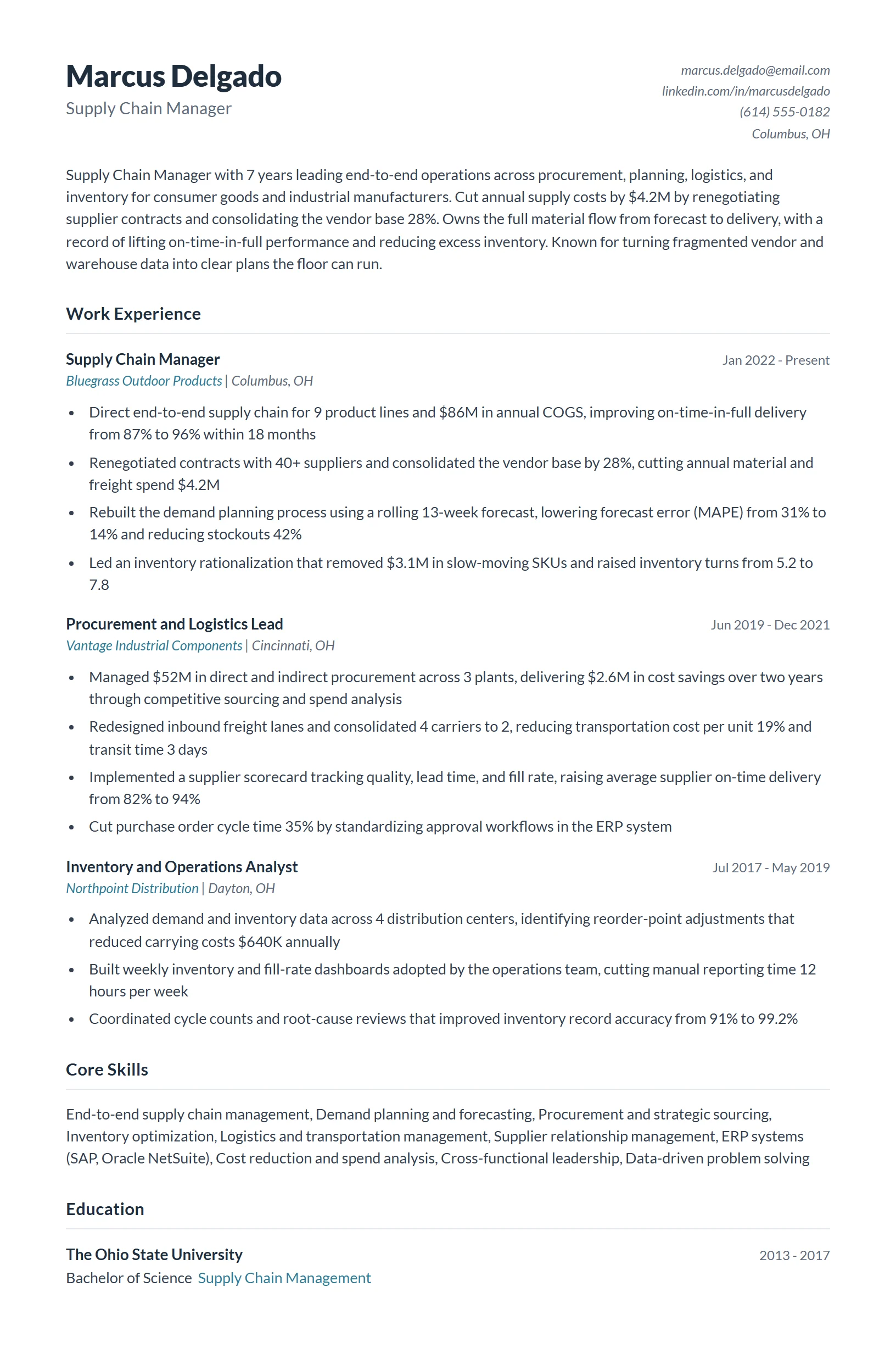
Supply Chain Manager resume example
Not sure how to show ownership of planning, procurement, and logistics on one page without it reading like a duty list? This supply chain manager resume example shows how to lead with results across the whole operation.
This resume works because it pairs each responsibility with a measured outcome, like cutting inventory carrying cost or improving on-time delivery, instead of just listing functions managed. It surfaces ATS keywords such as demand planning, procurement, S&OP, and ERP early, then backs them with experience that proves end-to-end ownership. A clean, single-column layout keeps it easy for both recruiters and the ATS to scan.
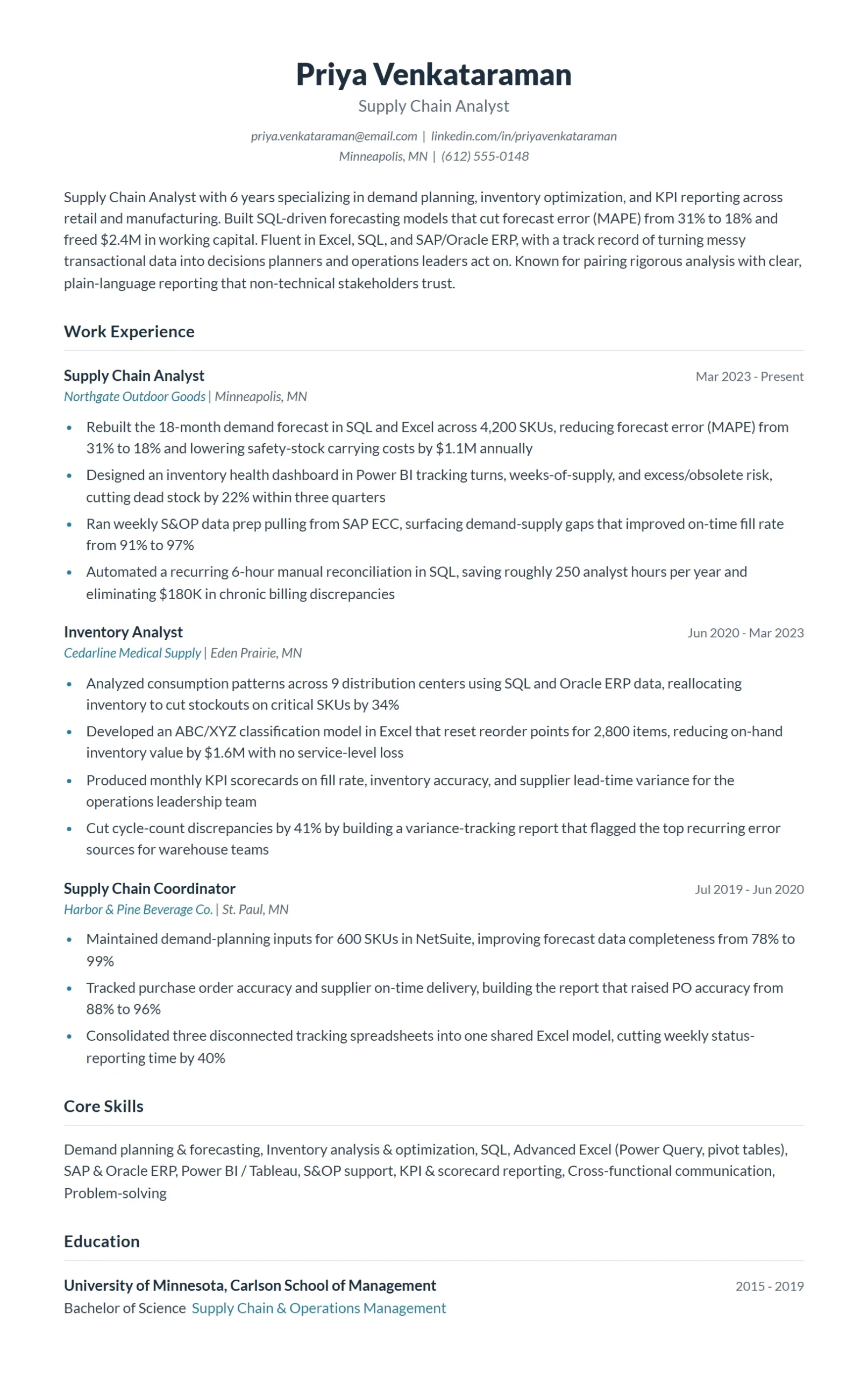
Supply Chain Analyst resume example
Analyst roles are won on data and the decisions it drove, not on how much you managed. This supply chain analyst resume example shows how to foreground your forecasting, reporting, and process-improvement work.
This resume works because it centers analytical skill: demand forecasting, inventory optimization, and KPI reporting tied to dollars saved or accuracy gained. It calls out tools an ATS expects for the role, like Excel, SQL, Power BI, and the ERP modules you worked in, then shows how your analysis changed a buying, stocking, or routing decision. Quantified accuracy and savings figures signal an analyst who improves the operation, not just reports on it.
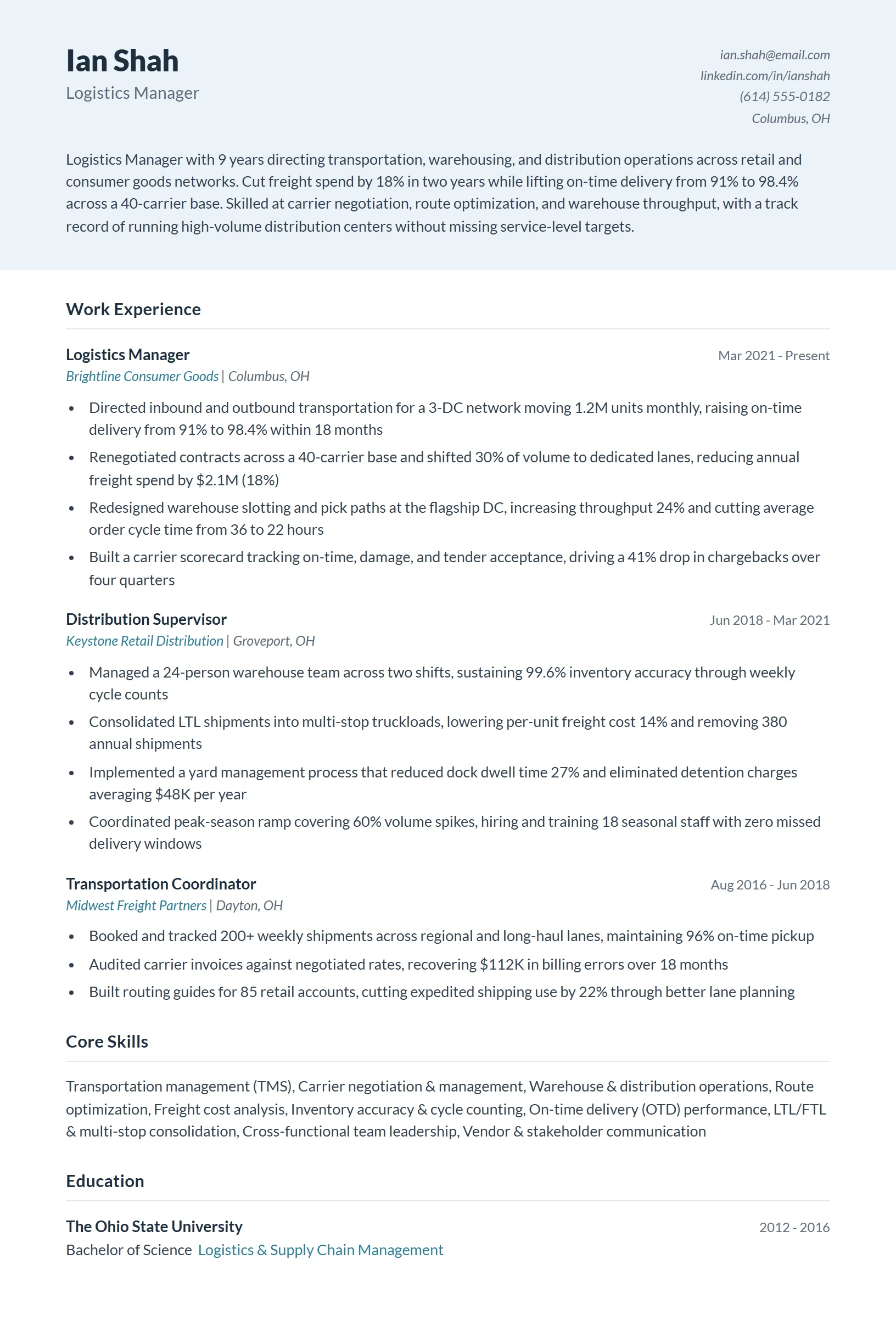
Logistics Manager resume example
When the job is moving freight on time and on budget, your resume has to speak in service levels and cost per unit. This logistics manager resume example shows how to frame transportation, warehousing, and distribution results.
This resume works because it leads with the metrics logistics is judged on: on-time delivery rate, freight cost, and warehouse throughput, each tied to an action you took. It surfaces keywords like carrier management, distribution, fleet, and WMS that ATS filters scan for in logistics roles. Examples of consolidating carriers or redesigning routes prove you can lower cost without breaking service, the balance hiring managers are buying.
Procurement Manager resume example
Sourcing roles come down to savings, supplier quality, and risk you removed. This procurement manager resume example shows how to make your negotiation and vendor-management wins concrete.

This resume works because it quantifies the procurement story: cost savings delivered, contracts negotiated, and suppliers consolidated or qualified. It puts strategic sourcing, supplier negotiation, contract management, and spend analysis up front where the ATS reads them, matching the language of procurement job descriptions. Tying each win to a percentage or dollar figure shows you protect margin and supply continuity, not just process purchase orders.
Supply Chain Director resume example
Stepping into a director role means proving you set strategy and lead teams, not just run the day to day. This supply chain director resume example shows how to frame network-level decisions and bottom-line impact.

This resume works because it shifts the focus from tasks to leadership at scale: owning a multi-site or global network, leading S&OP, and managing budgets and teams toward measurable margin and service gains. Outcomes stated in revenue influenced, cost taken out, and headcount led signal a seniority a title alone cannot. It still includes the core systems and methods keywords, so strategic framing never costs ATS visibility.
Supply Chain Coordinator resume example
Starting out in supply chain means your reliability and systems skills carry the resume. This supply chain coordinator resume example shows how to make hands-on coordination work look strong.

This resume works because it leans on the day-to-day execution that coordinators own: managing purchase orders, tracking shipments, scheduling, and keeping data clean in the ERP. It places a skills and systems section near the top to clear ATS keyword checks for tools like SAP, Excel, and inventory software. Small but quantified wins, like reducing order errors or speeding supplier follow-up, show you are ready to take on more responsibility.
How to write a Supply Chain Manager resume that gets interviews
Hiring managers skim a supply chain resume for one thing: proof you move product faster, cheaper, and more reliably than the person before you. They want hard numbers on cost, service level, and inventory, plus the systems and methods to back them up. Most companies run your resume through an Applicant Tracking System (ATS) first, so the language has to match the job description before a human ever reads it. The tips below show you how to do both: clear the ATS scan and convince the operations leader reading next.
- Lead every bullet with a number, in dollars or percentages: Supply chain is a numbers job, so your resume has to read like one. Quantify the savings, the service level, and the speed: “cut freight spend $1.2M (14%),” “raised on-time-in-full from 91% to 98%,” “reduced excess inventory $3.4M while holding a 99% fill rate.” If you cannot attach a dollar figure, use a percentage, a unit count, or a time savings. A resume full of “managed” and “oversaw” with no metrics reads as a job description, not a track record.
- Name the scale you operated at: A manager who runs three regional DCs and a $40M procurement budget is a different hire than one who manages a single warehouse. Quantify your span: annual spend managed, SKU count, number of suppliers, warehouse square footage, headcount, shipment volume, and the regions or plants in scope. “Managed a $60M procurement budget across 120 suppliers and 4 distribution centers” tells the reader in one line whether you fit the role’s scope.
- Show the full flow: plan, source, make, deliver, return: Strong supply chain managers connect the whole chain, not one silo. Reference the disciplines the posting cares about: demand planning and S&OP, procurement and supplier negotiation, inventory optimization, logistics and transportation, warehouse operations, and returns or reverse logistics. Show you can balance cost against service and cash (inventory) against availability. A resume that only covers warehousing reads as a coordinator; one that ties planning to fulfillment reads as a manager.
- Match the systems and methodologies to the job description: ATS scans for specific terms. List the ERP and planning systems you actually use (SAP, Oracle, NetSuite, Kinaxis, Blue Yonder, Manhattan WMS) and the methods named in the posting (Lean, Six Sigma, Kaizen, S&OP, MRP, demand forecasting, supplier scorecards). If the role says “S&OP” and you have run that cycle, use that exact phrase. Add certifications like APICS CPIM, CSCP, or a Six Sigma belt. Skip dead tools and never keyword-stuff.
- Prove you manage risk and continuous improvement, not just steady state: Operations leaders hire for the bad weeks, not the calm ones. Show how you handled disruption and drove improvement: dual-sourced a single-source component, cut supplier lead time, recovered service after a port delay, or led a Kaizen that removed a process step. “Built a dual-source plan that protected production through a 6-week supplier outage with zero line-down hours” signals you can keep product moving when the plan breaks.
- Tailor each version and keep the format ATS-clean: A procurement-heavy role, a logistics role, and a demand-planning role reward different keywords. Reorder your skills and swap your headline accomplishments to mirror each posting. Then keep the format ATS-friendly: standard section headings, no text boxes or multi-column layouts that scramble parsing, and a single clean column. Run it through Jobscan to check your match rate against the job description before you apply.

Supply Chain Manager resume summary examples
Your summary is the first thing a recruiter reads. Lead with your specialty, years of experience, and a quantified win.
Good supply Chain Manager resume summary examples
- Results-driven Supply Chain Manager with 9 years leading procurement, logistics, and inventory across multi-site operations. Cut freight and logistics spend $2.1M (16%) and raised on-time-in-full from 90% to 98% across 3 distribution centers. APICS CSCP certified, fluent in SAP and Kinaxis, with deep S&OP and supplier-negotiation experience.
- Supply Chain Manager specializing in inventory optimization and demand planning for high-SKU consumer goods. Reduced excess and obsolete inventory $4.3M while holding a 99% fill rate, and rebuilt the forecasting model to cut forecast error 22%. Lean Six Sigma Black Belt who pairs S&OP discipline with hands-on WMS and ERP execution.
- Operations-focused Supply Chain Manager with a track record of building resilient, lower-cost networks. Managed a $55M annual procurement budget across 140 suppliers, negotiated contracts that saved $1.8M, and dual-sourced critical components to eliminate single points of failure. Known for partnering tightly with planning, production, and finance to balance cost, cash, and service.
What to avoid
- Hardworking supply chain professional seeking a challenging Supply Chain Manager role with a growing company where I can use my skills and grow my career. (It is all about what the candidate wants, not what they deliver. There is no scale, no systems, no metrics, and no specialization. An operations leader learns nothing they can act on and moves to the next resume.)
- Experienced manager responsible for overseeing the supply chain, logistics, and inventory for a large company. (“Responsible for” and “overseeing” describe a job title, not results. “Large company” is vague where a dollar budget, SKU count, or service level would be concrete. It names no ERP, no method, and no measurable impact, so the ATS and the recruiter both skip past it.)
Supply Chain Manager resume skills
Pull the exact systems and methods from each job description, then mirror that language here. This is a quick resume snapshot, so keep it to your strongest, role-relevant skills rather than an exhaustive list.
Hard skills for a supply Chain Manager resume
- Procurement & Sourcing
- Inventory Management
- Demand Planning & Forecasting
- Logistics & Transportation
- S&OP (Sales & Operations Planning)
- ERP Systems (SAP, Oracle, NetSuite)
- Warehouse Management Systems (WMS)
- Supplier Negotiation & Contract Management
- Lean / Six Sigma
- Cost Reduction & Budgeting
Soft skills for a supply Chain Manager resume
- Cross-Functional Leadership
- Problem Solving
- Negotiation
- Communication
- Analytical Thinking
- Adaptability
Supply Chain Manager resume work experience bullet point examples
Lead each bullet with a strong verb and a measurable result.
Good bullet point examples
- Renegotiated contracts with 40 key suppliers and consolidated the freight carrier base, cutting annual logistics spend $2.1M (16%) without missing a single delivery commitment.
- Redesigned the inventory and replenishment model across 3 distribution centers, reducing excess and obsolete inventory $4.3M while raising fill rate from 94% to 99%.
- Led the monthly S&OP cycle across sales, planning, and production, cutting forecast error 22% and reducing expedited freight charges $480K per year.
- Built a dual-sourcing and safety-stock plan for critical components that protected production through a 6-week supplier outage with zero line-down hours.
Bad bullet point examples
- Responsible for managing the company’s inventory and working with suppliers. (“Responsible for” describes a duty, not an accomplishment. There is no scale (how much inventory, how many suppliers), no method, and no result. Lead with a strong verb and end with a number instead.)
- Helped reduce costs and improve efficiency in the supply chain. (Vague and unquantified. “Reduce costs” and “improve efficiency” are claims with no proof. Replace them with the dollar savings, the percentage, or the service-level gain that backs the claim, such as freight spend cut or fill rate raised.)
- Oversaw daily warehouse operations and made sure orders shipped on time. (“Oversaw” and “made sure” read as steady-state babysitting, not impact. Name the volume (orders or units shipped), the service metric (on-time rate), and what you changed to move it, so the reader sees a result rather than a routine.)
Supply Chain Manager resume tips
A strong Supply Chain Manager resume proves you can cut costs, protect service levels, and keep inventory lean, and these six tips will help yours do exactly that.
- Mirror Job Description Keywords: Pull exact phrases from the posting, such as S&OP, demand planning, or supplier negotiation, and use them verbatim in your resume so ATS parsers score you as a match before a recruiter ever reads your name.
- Quantify With Supply Chain Metrics: Lead bullets with the numbers operations leaders care about most: inventory turns, fill rate, on-time delivery percentage, freight cost per unit, and cash-to-cash cycle time, because vague claims like improved logistics carry zero weight.
- Name Your ERP and WMS Systems: Spell out every platform you have touched, SAP, Oracle, NetSuite, Manhattan WMS, and so on, because many ATS configurations screen for exact system names and hiring managers disqualify candidates who omit them.
- List Relevant Certifications: Credentials such as APICS CSCP, CPIM, or ISM CPSM signal supply chain fluency instantly, so place them after your name in the header or in a dedicated certifications line near the top rather than burying them at the bottom.
- Tailor for Industry Context: A supply chain role in discrete manufacturing demands different language than one in retail or pharma, so swap in industry-specific terms like MRP, cold chain, or SKU rationalization to match the employer’s operational world.
- Show Cross-Functional Scope: Supply chain managers are judged on influence across finance, sales, and operations, so each bullet that involves an S&OP cycle, a supplier contract, or a logistics redesign should name the functions or stakeholders you aligned to prove leadership reach.
Pair your supply Chain Manager resume with a cover letter
A strong resume goes further with a tailored cover letter. Browse our supply chain manager cover letter examples to round out your application.
Supply Chain Manager resume frequently asked questions
Lead with the numbers that prove you moved cost, service, and inventory. Quantify things like landed-cost reduction, on-time-in-full (OTIF) or fill-rate improvement, inventory turns, days of supply or carrying-cost cuts, freight savings, and forecast accuracy. Frame each bullet as the action plus the result, for example “renegotiated carrier contracts to cut freight spend 14 percent on a $22M logistics budget.” Hiring managers scan for scale and impact, so always attach a dollar figure, percentage, or volume to your wins.
APICS CPIM and CSCP (now under ASCM) are the most recognized, and CSCP signals end-to-end supply chain command rather than a single function. Six Sigma (Green or Black Belt) and Lean credentials carry weight for process and cost-reduction roles, while CPSM is the standard for procurement-heavy positions. List the exact acronym and the full name so both the recruiter and the ATS catch it, and put certifications near the top if the job posting names them as required or preferred.
Name the specific systems you have actually used, since these are some of the most common ATS keywords for the role. Cover your ERP (SAP, Oracle, NetSuite, Microsoft Dynamics), any planning or APS tools (Kinaxis, Blue Yonder, o9, SAP IBP), and WMS or TMS platforms if relevant. Add the analytics layer too, such as Excel at an advanced level, Power BI, Tableau, or SQL. Mirror the exact tool names from the job description rather than listing every system you have ever touched.
Use percentages, ratios, and relative ranges instead of exact dollar figures when the raw numbers are sensitive. “Reduced procurement spend 11 percent across a category portfolio” or “improved inventory turns from 5.2 to 7.8” tells the story without exposing private financials. You can also describe the scale you managed in general terms, like “a multi-site network of three distribution centers.” The goal is credible, specific impact, not a leak of your employer’s books.
Lead with the analytical and process work that proves you can run a function, even if your title was coordinator, planner, or analyst. Quantify wins from internships, rotational programs, or coursework, such as a demand-forecasting project or an inventory-reduction initiative. Feature your ERP and Excel skills, any APICS coursework or in-progress certification, and a summary that frames you as ready to step up. A capstone or co-op that touched real procurement, logistics, or planning data often reads stronger than a generic objective.
Read the posting for whether it leans toward procurement, logistics, planning, or operations, then reorder your bullets and skills to match that emphasis. A logistics-heavy role rewards freight, carrier, and OTIF language, while a planning role rewards forecast accuracy, S&OP, and inventory metrics. Pull the exact tools, methods, and certifications the posting names and use that same wording in your skills section. Run the resume through Jobscan against the job description to confirm your match rate and surface the keywords you are missing before you apply.