Best Business Development Resume Examples for 2026
See real Business Development resume examples that beat the ATS and win interviews, plus the skills, metrics, and formatting hiring managers look for in 2026.

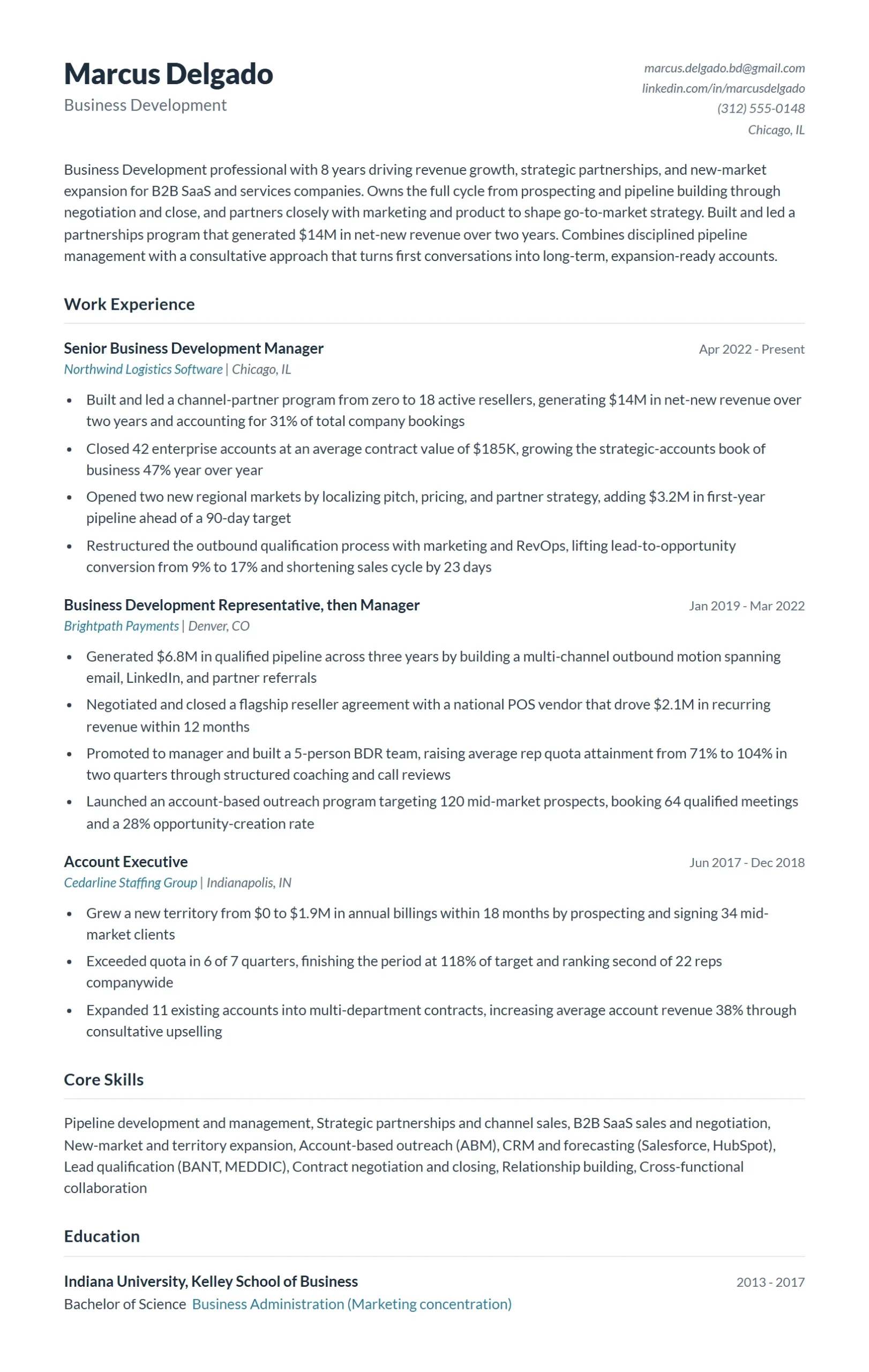
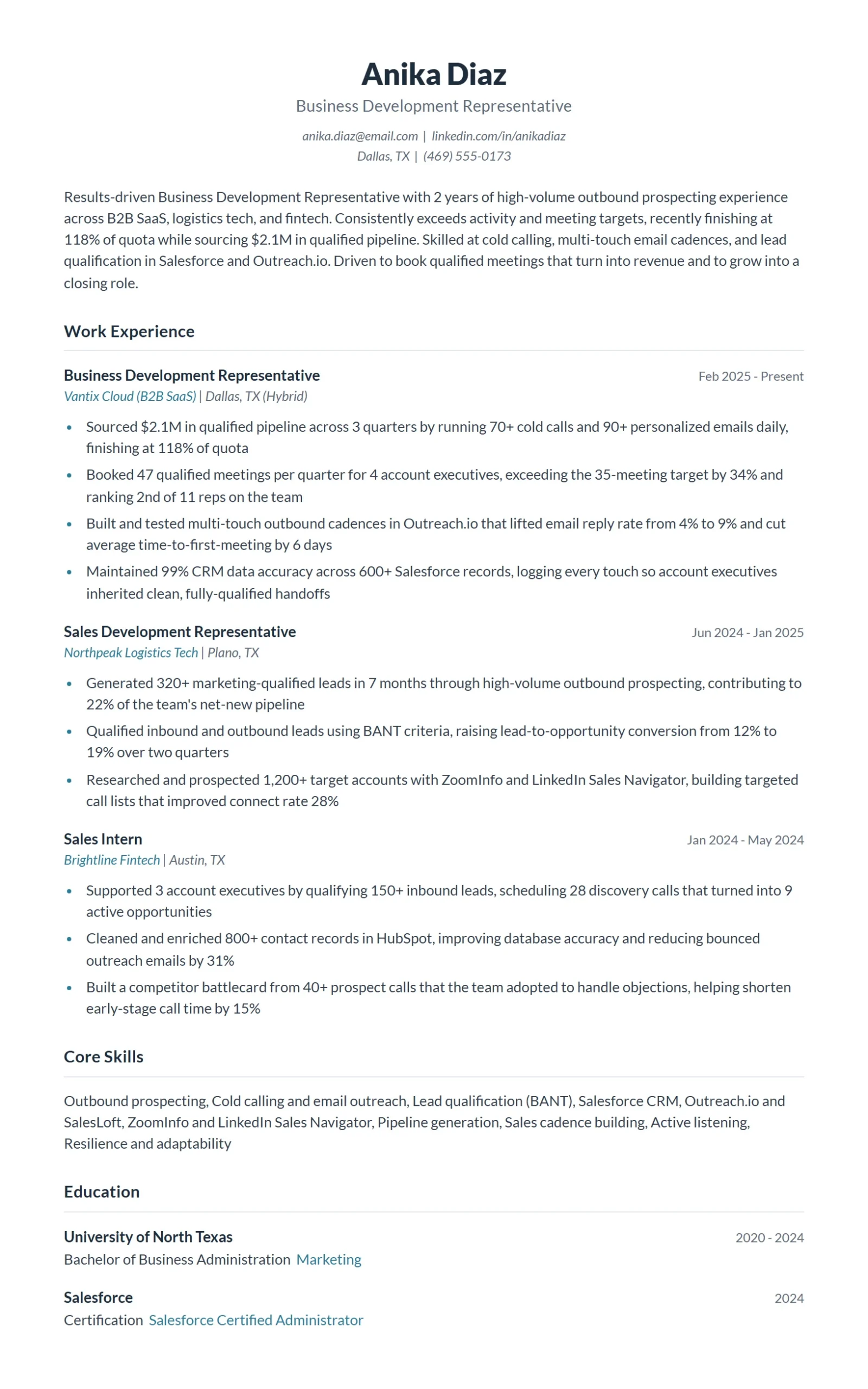
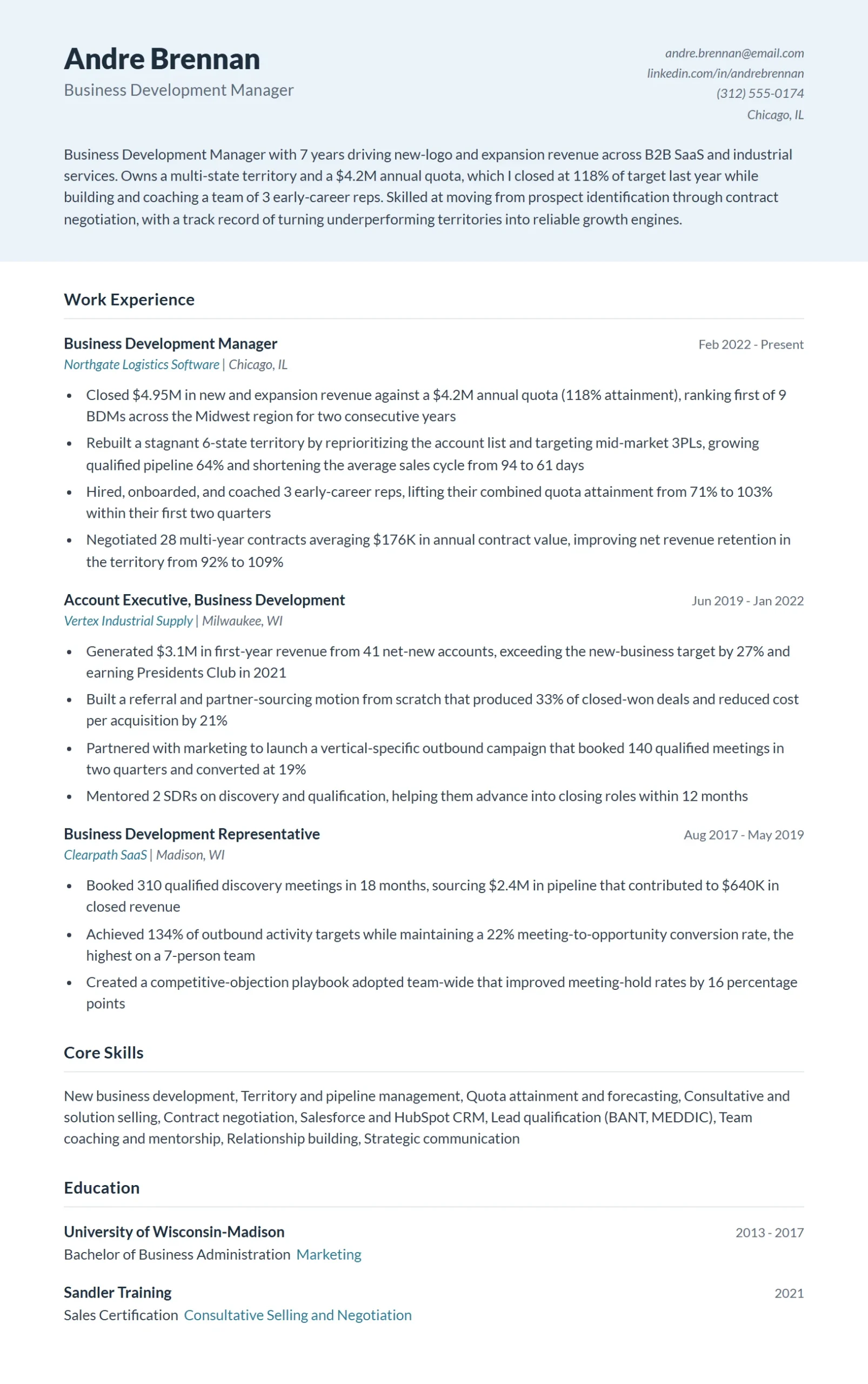


Business development is about finding revenue before it exists: opening new markets, building partnerships, and turning early conversations into signed deals. Whether you are prospecting as a BDR or setting strategy as a director, your resume has to prove you can spot opportunity and close it.
Hiring managers scan for proof you move the number. They want quota attainment, pipeline generated, deal sizes, partnership wins, and growth percentages, not vague claims about being a strong relationship builder. Before a person ever reads your resume, an applicant tracking system parses it for the exact terms in the job description, so titles, tools, and skills have to match the posting in plain text.
The examples below show how to do both at once. Use them to frame your wins with hard numbers, mirror the language of the roles you want, and build a resume that clears the ATS and earns the interview.
Ready to build yours? Try our ATS-friendly resume builder or scan your draft against the job description.
Business Development resume example
A versatile resume for professionals who source, qualify, and close new business across sales and partnership roles. It balances prospecting activity with closed revenue.
This resume works because every bullet ties an action to an outcome a hiring manager cares about: pipeline created, deals closed, and revenue added. It leads with a metrics-rich summary so the value lands in the first six seconds, then uses keywords like pipeline development, lead generation, and account growth that match what the ATS scans for.
Business Development Representative resume example
Built for early-career reps focused on outbound prospecting and qualifying inbound leads to fill the sales pipeline. It highlights activity volume and conversion.
It works because it quantifies the daily grind that defines the BDR role: calls and emails sent, meetings booked, and SQLs passed to account executives. Naming tools like Salesforce, Outreach, and LinkedIn Sales Navigator signals you can plug in fast, and those exact terms double as the keywords recruiters filter for.
Business Development Manager resume example
For mid-level professionals who own a territory or quota and may coach junior reps. It shifts the emphasis from activity to closed revenue and team results.
This resume succeeds by showing ownership: quota attainment percentages, total revenue closed, and new accounts landed. It frames leadership through measurable team outcomes, such as ramping new reps or lifting close rates, which separates a manager from an individual contributor in both the recruiter’s eyes and the ATS.
Senior Business Development Manager resume example
For seasoned BD professionals running strategic accounts and complex, multi-stakeholder deals. It emphasizes deal size, sales cycles, and cross-functional influence.

It works because it elevates the story from hitting quota to driving strategy: six and seven-figure deals, multi-year contracts, and partnerships that opened new revenue streams. Bullets show influence across product, marketing, and legal, signaling the seniority and scope that justify the title.
Business Development Director resume example
For leaders who set BD strategy, build and run the function, and report to the executive team. It centers on revenue ownership, team building, and market expansion.

This resume lands because it speaks in business outcomes, not tasks: total revenue under ownership, growth across fiscal years, new markets entered, and the size of the team built and led. It pairs strategic framing with hard financial results, the proof points executives and the ATS both look for in a director-level hire.
Entry-Level Business Development resume example
For new graduates and career changers breaking into BD with limited direct experience. It leans on transferable skills, internships, and early wins.

It works by reframing non-sales experience as BD-relevant proof: customer-facing roles, fundraising, campus ambassador work, or any results you can quantify. Leading with a focused skills section and keywords like prospecting, CRM, and lead qualification helps an entry-level resume clear the ATS even without a formal sales title.
How to write a Business Development resume that gets interviews
Hiring managers read a business development resume looking for one thing: proof you can grow revenue. They want pipeline you built, deals you closed, partnerships you opened, and quota you beat, all backed by numbers. Most companies also run your resume through an Applicant Tracking System (ATS) first, so the language has to match the job description before a recruiter ever sees it. The tips below show you how to do both: clear the ATS scan and convince the sales leader reading next.
- Lead with revenue, pipeline, and quota numbers: Business development is a numbers job, so your resume should read like one. Open your summary and your strongest bullets with hard figures: “generated $4.2M in new pipeline,” “closed $1.8M in net-new ARR,” “hit 127% of a $2M annual quota.” If you cannot share exact dollar amounts because of confidentiality, use percentages and multiples instead (“grew territory revenue 40% year over year,” “3x’d qualified pipeline in two quarters”). A BD resume with no revenue numbers reads like a job description, not a track record.
- Show the full deal cycle, not just the close: Strong BD candidates own the motion end to end: prospecting and outbound, qualifying, discovery, demos, negotiation, and close. Reference the stages you ran, not just the wins. Bullets like “built outbound sequences that booked 25 qualified meetings per month” or “shortened the average sales cycle from 90 to 62 days” prove you understand how revenue actually gets made. This also separates true business development (opening markets and sourcing deals) from account management or inbound-only sales.
- Distinguish business development from sales: BD is about creating new opportunities: breaking into new markets, building channel and strategic partnerships, and generating demand where none existed. If that is your strength, say so explicitly. Use bullets that name the partnership or the market: “launched a reseller program that contributed 28% of new revenue in year one” or “opened the healthcare vertical from zero to $3M in 18 months.” If the role leans transactional and quota-driven, lead with closing metrics instead. Read the posting and mirror its emphasis.
- Name your tools and match the job description keywords: ATS scans for specific terms. List the CRM and sales-tech stack you actually use (Salesforce, HubSpot, Outreach, Salesloft, ZoomInfo, LinkedIn Sales Navigator, Gong) and the methods named in the posting (lead generation, account-based marketing, pipeline management, contract negotiation, channel partnerships, consultative selling). If the role says “Salesforce” and you live in it daily, use that exact word. Skip tools you barely touched and never keyword-stuff. A sales leader can spot padding in the first interview.
- Prove consistency over one lucky quarter: Anyone can have a great month. Hiring managers want a pattern. Show quota attainment across multiple periods (“exceeded quota 7 of 8 quarters”), President’s Club or ranking awards (“ranked #2 of 34 reps company-wide”), and growth that compounds. Promotions tell the same story, so make them visible in your job titles. Consistency is what convinces a hiring manager you will repeat the result on their team.
- Tailor each resume and keep the format ATS-clean: An SDR role, a partnerships manager role, and a senior BD director role reward different keywords and different proof points. Reorder your skills and swap your headline metrics to mirror each posting. Then keep the format parseable: standard section headings, a single clean column, no text boxes or graphics that scramble the ATS. Run it through Jobscan to check your match rate against the job description before you apply, and close any keyword gaps it flags.

Business Development resume summary examples
Your summary is the first thing a recruiter reads. Lead with your specialty, years of experience, and a quantified win.
Good business Development resume summary examples
- Results-driven business development manager with 7+ years opening new markets and closing enterprise deals in SaaS. Generated $6.4M in net-new pipeline and closed $2.1M in ARR last year while hitting 118% of quota. Skilled in outbound prospecting, consultative selling, and Salesforce-driven pipeline management across a full sales cycle.
- Strategic business development professional focused on channel and partnership growth. Built a reseller program from the ground up that drove 30% of new revenue in its first year and expanded the partner network from 4 to 22 accounts. Combines disciplined CRM hygiene in HubSpot with a consultative approach to long, multi-stakeholder deals.
- High-performing BD representative with a track record of exceeding quota 7 of 8 quarters and ranking #2 of 34 reps company-wide. Booked 25+ qualified meetings per month through cold outreach and ABM, and shortened the average sales cycle from 90 to 62 days. Fluent in Outreach, ZoomInfo, and LinkedIn Sales Navigator.
What to avoid
- Motivated business development professional seeking a challenging role where I can use my sales skills and grow with a dynamic company. (It is all about what the candidate wants, not what they deliver. There is no revenue, no quota, no market or partnership, and no tools. A sales leader learns nothing they can act on and moves to the next resume.)
- Hardworking, results-oriented self-starter with excellent communication skills and a passion for building relationships and closing deals. (Pure adjectives with no proof. “Results-oriented” with zero results is a contradiction. It names no numbers, no deal size, no CRM, and no track record, so the ATS finds no keywords and the recruiter sees filler.)
Business Development resume skills
Pull the exact tools and methods from each job description, then mirror that language here. Keep this to your strongest, role-relevant skills; a deeper skills breakdown lives on the dedicated business development skills page.
Hard skills for a business Development resume
- Lead Generation
- Pipeline Management
- Salesforce (CRM)
- Prospecting & Outbound
- Contract Negotiation
- Account-Based Marketing (ABM)
- Channel & Partnership Development
- Sales Forecasting
- Market Research
- HubSpot, Outreach & ZoomInfo
Soft skills for a business Development resume
- Relationship Building
- Communication
- Negotiation
- Persistence
- Strategic Thinking
- Active Listening
Business Development resume work experience bullet point examples
Lead each bullet with a strong verb and a measurable result.
Good bullet point examples
- Generated $6.4M in new pipeline and closed $2.1M in net-new ARR in 12 months, finishing the year at 118% of a $1.8M quota.
- Opened the healthcare vertical from zero to $3M in revenue within 18 months by building an outbound playbook and a 5-partner referral network.
- Built and ran cold-outreach sequences in Outreach and ZoomInfo that booked 25+ qualified meetings per month and grew SQLs 45% quarter over quarter.
- Launched a channel reseller program that contributed 28% of new revenue in year one and expanded the active partner network from 4 to 22 accounts.
Bad bullet point examples
- Responsible for generating leads and managing the sales pipeline for the territory. (“Responsible for” describes a job duty, not an accomplishment. There is no number of leads, no pipeline value, and no result. Lead with a strong verb (Generated, Built, Closed) and end with a metric instead.)
- Made cold calls and sent emails to prospects to try to set up meetings. (Lists an activity with no outcome. How many calls, how many meetings booked, what conversion? Without the result, it tells the reader what you did but not whether it worked.)
- Helped grow the business and built strong relationships with clients. (Vague and unquantified. “Helped grow” and “strong relationships” are claims anyone can make. Replace them with the revenue, retention, or partnership number that proves the impact, such as accounts opened or revenue added.)
Business Development resume tips
A strong business development resume proves you can open doors and close deals, and these tips help you do exactly that.
- Mirror the Job Description: Pull exact phrases from each posting, such as “pipeline management,” “account-based marketing,” or “channel partnerships,” and use them verbatim so ATS parsers score your resume as a strong match before a recruiter reads a word.
- Quantify Pipeline Impact: Go beyond deal count and include the metrics sales leaders care about most: total pipeline generated, average contract value, quota attainment percentage, and sales cycle length reduced, because those numbers tell the full revenue story.
- Name Your CRM Tools: List Salesforce and any other platforms you have used (HubSpot, Outreach, LinkedIn Sales Navigator) in a dedicated tools line, because many ATS filters screen for these keywords before flagging a candidate as qualified.
- Separate Hunting from Farming: Clearly distinguish outbound prospecting wins from existing account expansion on your resume, since hiring managers want to know whether you can build pipeline from scratch or only grow what someone else started.
- Include Certifications Strategically: Add recognized credentials such as Salesforce certifications, HubSpot Sales Software, or SPIN Selling training in a certifications section near the top, as these signal structured sales methodology knowledge that ATS systems and managers both reward.
- Keep It to One Page: Unless you have more than ten years of progressive business development experience, hold your resume to one page, because sales leaders reviewing dozens of candidates respond better to a tight, scannable summary of impact than a dense career history.
Pair your business Development resume with a cover letter
A strong resume goes further with a tailored cover letter. Browse our business development cover letter examples to round out your application.
Business Development resume frequently asked questions
A sales resume centers on closing transactions, quota attainment, and individual deal velocity, while a business development resume emphasizes pipeline creation, partnerships, market expansion, and long-term revenue strategy. Lead with metrics that show you built opportunities rather than just converted existing ones: new accounts opened, partnerships signed, market segments entered, and revenue influenced over time. If the job description leans toward one side, mirror its exact language so both the recruiter and the ATS see an immediate match.
Quantify pipeline and revenue impact wherever you can: new revenue generated, percentage growth in qualified pipeline, number and value of partnerships closed, deal sizes, sales cycle reduction, and new markets or verticals entered. Frame each bullet as an outcome rather than a duty, for example “Built a partner channel that drove 1.4 million dollars in new annual recurring revenue in 18 months.” If you cannot share exact figures for confidentiality reasons, use percentages, ranges, or relative growth so the impact still reads clearly.
Balance revenue-driving hard skills with the relationship skills the role depends on. Name lead generation, prospecting, CRM platforms (Salesforce, HubSpot), market research, contract negotiation, partnership management, and pipeline forecasting, then add strategic skills like go-to-market planning and account expansion. Match the specific tools and methods listed in the job posting, since those are often the exact terms an ATS scans for. Keep the list role-relevant rather than exhaustive so your strongest qualifications stand out.
Translate adjacent experience into business development language by focusing on outcomes that show you can find and grow opportunities. Sales, account management, partnerships, marketing, and even customer success roles all involve building relationships, identifying needs, and influencing revenue, so reframe those wins around pipeline, growth, and new business. Quantify everything you can, name the CRM and prospecting tools you have used, and write a summary that positions you for the BD role you want. A strong record of expanding existing accounts or sourcing referrals often reads as real BD work.
Write 2 or 3 sentences that name your specialty, your years or level of experience, and one quantified result that proves you drive growth. For example: “Business development manager with 6 years in B2B SaaS, focused on building partner channels and new-market pipeline that added 3 million dollars in annual revenue.” Mirror the exact job title and a few keywords from the posting so the recruiter and the ATS register an instant fit. Skip generic phrases like “results-driven professional” and lead with evidence instead.
Use a clean single-column layout with standard section headings (Experience, Skills, Education), real selectable text instead of graphics, and a .docx or text-based PDF so the parser reads everything correctly. Match the keywords in the job description, especially the role title, target industries, CRM platforms, and skills like lead generation and pipeline management. Spell out acronyms at least once, for example “business development representative (BDR),” so you rank for both versions. Then scan your resume against the posting with a tool like Jobscan to confirm your keywords and formatting pass before you apply.