
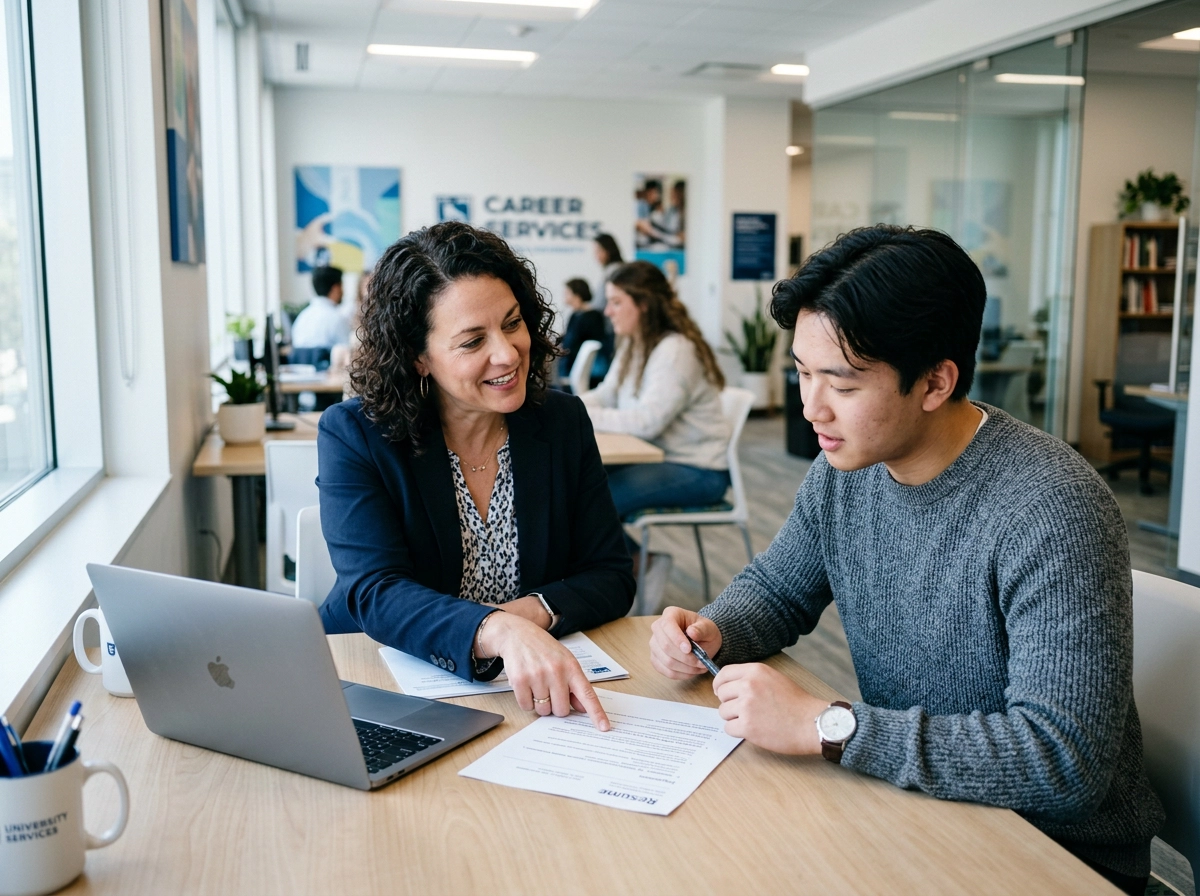



Great news: the job market for new graduates is on the rise. Employers project they’ll increase hiring of the Class of 2026 by 5.6%, according to the 2026 Job Outlook survey by the National Association of Colleges and Employers (NACE).
And yet, 55.5% of employers say graduates’ skills are only partially aligned with their hiring needs.
Students are entering the best hiring market in years—and still getting passed over. The issue isn’t a lack of jobs; it’s a mismatch between how students are presenting their skills and what employers are looking for.
Career readiness skills matter. But if your students have them and employers can’t see them in applications, those skills might as well not exist. Here is where your career services can make a big difference for student outcomes. By helping students align their resumes to employer expectations, you can increase the number of graduates who land roles that truly match their education and potential.
The Market Is Up, But That’s Not the Full Picture
It’s fantastic to see hiring rebound for graduates, as that’s a reversal from the bleak media headlines from the past year. But that growth doesn’t tell the whole story. Beneath it are additional clues that can shape how we help current students acquire career readiness skills. Jobscan CEO James Hu, who joined NACE’s Job Outlook 2026 launch webinar this spring, has pointed to exactly this tension: the market is opening up, but the bar for standing out is rising with it.
First off, only about a third of employers are actually increasing hiring. The majority of others are holding steady, and a notable share are pulling back. That means student employment outcomes will vary widely depending on industry and role; some will benefit from expanding fields, while others face shrinking opportunities. The impacts of these trends may require career professionals to provide more targeted, creative support to students entering tighter segments of the job market.
- 33.7% of employers are increasing hires
- 54.9% of employers are maintaining their level of hiring
- 11.4% of employers are decreasing their hiring
Among employers reducing hiring, the reasons are telling. The most common drivers are reduced business demand (78.9%), budget cuts (57.9%), and economic uncertainty (52.6%). There’s also an emerging signal that could spell more trouble down the road: 15.8% of these companies say AI is replacing entry-level workers. This number will likely grow in future years, but even at current levels, it represents a meaningful loss of opportunity at the very point where graduates are trying to get their foot in the door.
The upshot: while hiring is up overall, the window of opportunity is narrower than it appears. Students are competing in a more constrained and uneven job market, while pressure is mounting on career centers to improve employment metrics. Getting more students placed will require strategic, focused efforts.
The Demonstration Gap: The Finding That Should Change How You Coach
When the data points to a clear opportunity to improve outcomes, it’s worth acting on it. One of the most actionable insights right now: 59% of employers want resumes to show specific skills supported by examples. Most students are still just listing skills. Employers want proof.
Only 16.1% of employers are satisfied with specific skills listed alone, and just 1.9% accept general, unsupported lists of skills. In other words, the typical student resume says, “Here are my skills,” while hiring managers are looking for, “Here’s how I used this skill—and here’s what happened.” It’s not enough to claim to have the skills. Without evidence, even strong candidates can be overlooked.
This is the demonstration gap—and it’s one of the most important areas where career centers can make a measurable impact. Getting students to expand on their skills and cite outcomes often requires coaching.
What Employers Want from College Graduates
Employers aren’t just screening resumes for keywords; they’re looking for evidence. That means bullet points that clearly show how a student applied a skill and what results they achieved. For many students, identifying and articulating those examples is one of the most difficult stumbling blocks, and it’s one of the highest-value interventions career advisors can provide.

Whether in one-on-one sessions, group workshops, or classroom settings, advisors can help students:
- Identify experiences (coursework, internships, jobs, extracurriculars) that demonstrate in-demand career readiness skills
- Translate those experiences into concise, results-oriented statements
- Connect their specific examples directly to the needs outlined in job postings
Tools like Jobscan can support this process by helping students match their resumes to job descriptions and identify the skills that they can then use as proof points of their suitability for the role. Career counselors can help students translate their work experiences into demonstrable evidence that they truly have the desired career readiness skills—and that they know how to put them to good use.
The goal is simple: career success for graduates. This requires moving students from claiming skills to demonstrating them. When resumes show not just what students know, but how they’ve used it, they become far more compelling to potential employers—and far more likely to make it out of the “no” pile.
The Skills Employers Prioritize — And Where Graduates Fall Short
Career readiness skills, especially communication and problem solving, consistently top employers’ lists. The most in-demand capabilities include teamwork (85%), problem-solving (82%), verbal communication skills (78%), technical skills (73%), and written communication (72%). Ideally, college graduates should excel in these skills.
But what employers want and what they see in applicants are not the same.
There’s a clear and consequential gap between the importance hiring managers place on key skills and the proficiency they observe in recent graduates:
- Communication gap: 98.7% important vs. 55.4% proficient — 43-point gap
- Critical thinking: 93.5% important vs. 50% proficient — 43-point gap
- Professionalism: 94.1% important vs. 54.7% proficient — 39-point gap
These career readiness skills gaps point to a dual challenge. Higher education institutions need to strengthen these skills in coursework, extracurricular activities, and co-curricular experiences across the campus. But just as importantly, students need to demonstrate these skills, and it falls to the career center staff to help them showcase these capabilities through examples on their resumes.

Even well-prepared students can fall short if they can’t make their abilities visible to employers. Translating classroom, work, and extracurricular experiences into clear, results-oriented resume statements is what bridges that gap.
Proving Career Readiness Skills
There is one relatively bright spot: teamwork skills. While still important (96.1%), employer-rated proficiency is higher (75%), suggesting college students both develop and more easily recognize examples of this skill. It’s also one of the simplest to demonstrate with concrete experiences, making it a useful entry point for coaching.
The real opportunity lies in helping students mine their own experiences for evidence of impact. When students learn to connect their actions to outcomes, they shift from describing participation to demonstrating value.
And that distinction matters. If most students are graduating “somewhat prepared” (71.2% fall into this category), the question isn’t just whether they have the career readiness skills—it’s whether they can prove it.
Why is Career Readiness Important?
The National Association of Colleges and Employers (NACE) outlines eight core areas of career readiness skills that help guide how institutions prepare students for the workforce. These NACE competencies provide a clear framework, and can make the difference between a student sending out dozens of unanswered applications and landing interviews.
But having these NACE competencies isn’t enough. Students also need to demonstrate them. The qualities employers value most—communication, teamwork, critical thinking, professionalism—are often categorized as “soft skills,” yet they significantly impact hiring decisions.
The real advantage comes when students can translate those skills into specific, results-driven examples. When soft skills become visible through concrete achievements, resumes become more compelling, and students become far more competitive in the job market.
The AI Picture: It’s More Nuanced Than the Headlines Suggest
As universities strive to prepare students for an AI-driven future, employer data tells a more measured story. Demand for AI-related skills in entry-level job postings has more than doubled over the past six months. Still, overall employer expectations remain mixed, despite all the media coverage about AI readiness.
According to the survey, 42.5% of employers are not yet seeking AI skills, 28.1% are, and 29.4% are unsure. Only 18.4% rate AI skills as important, while 25.3% of applicants already report proficiency. This is the only skill category where perceived proficiency exceeds employer demand, suggesting that AI, while growing, is not yet a primary differentiator for most entry-level roles.
That said, when employers do value AI skills, they’re looking for practical application. The most sought-after AI capabilities include:
- Identifying and using appropriate AI tools (75%)
- Writing effective prompts (72.7%)
- Evaluating and refining AI-generated outputs (65.9%)
Career professionals may worry that hiring managers will penalize AI-assisted applications. However, only 44% of employers detected AI-generated applications, and just 20% use formal detection tools. As the sophistication of AI tools increases and students use them to enhance rather than replace their own thinking, AI use in preparing resumes and cover letters can improve the quality of students’ applications.
The message for students isn’t to use AI more, but to use it better. Career advisors can emphasize that AI use isn’t about speed and quantity of output. Students should use AI strategically to analyze job descriptions, identify skill gaps, refine messaging, and tailor materials. Thoughtful use of AI can produce more polished and competitive applications, better targeted to the jobs most suitable for a student’s qualifications.
What This Means for How You Run Your Career Center
Employers are looking for results—and your career center is, too. Improving graduate outcomes depends on tweaking methods to align with what the data analysis tells us. Insights from the NACE report point to a clear opportunity: refine how you coach students so their applications demonstrate value, not just potential. Here are three actionable shifts to put into practice:
1. Shift from listing skills to proving them.
The 43-point gap on critical thinking, professionalism, and communication skills won’t close in a single resume workshop. These are essential skills that need reinforcement across the student experience.
Career centers are well-positioned to connect academic work with employer expectations, helping students refine how they express ideas, present themselves, and adapt their communication for different audiences. Incorporating this into coaching in multiple ways (appointments, workshops, and classroom partnerships) provides the support students need to make progress towards more successful job applications.
2. Prioritize communication coaching as part of the core curriculum.
The 43-point gap on critical thinking, professionalism, and communication skills won’t close a single resume workshop. These are essential skills that need reinforcement across the student experience.
Career centers are well-positioned to connect academic work with employer expectations, helping students refine how they express ideas, present themselves, and adapt their communication for different audiences. Incorporating this into coaching in multiple ways (appointments, workshops, and classroom partnerships) provides the support students need to make progress towards more successful job applications.
3. Get specific about AI guidance.
Students already think they’re prepared for the AI future. They feel confident using AI, but confidence doesn’t always translate to effective use. The risk isn’t underuse, but misaligned use: relying on AI to generate generic or inaccurate applications. Instead, students should apply critical thinking alongside AI insights.
Career advisors can reframe AI as a thinking tool, not a shortcut. Guide students to use it to analyze job descriptions, identify the most relevant skills, and refine language, while ensuring the final product reflects their authentic work and results.
Wise use of AI tools can help coaches scale their work effectively to deal with deal with rising caseloads. Using Jobscan’s advisor dashboard and resume scanning helps staff quickly align student resumes with job postings and point out opportunities to strengthen proof points. Career advisors can extend their impact without increasing advising hours.
The impact can be transformative: when you help students demonstrate their value more clearly, you improve both their outcomes and your own.




