



A student comes into your office with a job posting pulled up and a look on their face you’ve seen a hundred times. “I don’t think I should apply,” they say. “I only hit like 60% of the requirements.”
You’ve had this conversation before. You’ll have it again this week. And here’s what’s frustrating about it: the data says that student had just as good a shot as the “100% qualified” candidate who did apply. Your student never found that out, though, because they talked themselves out of the room before anyone got a chance to say no.
That’s Myth #4 on this list, and it’s not even the most surprising one. We checked six pieces of job search advice that get repeated in career centers, career fairs, and LinkedIn comment sections. Nobody questions them anymore. And yet half of them fall apart the moment you look at what actually happens to real applicants.
Myth #1: “Cover letters are dead.”
You’ve heard the question from a student this semester, as they consider skipping the cover letter field on an application entirely. “Does anyone read these?” And you’ve probably softened your pushback on it over the years, because the question they are repeating isn’t entirely wrong. Recruiters really don’t read most cover letters closely — only about a quarter say they factor into screening at all.
What’s The Verdict? Busted — but only if the letter is actually tailored. A field study tracking 7,287 real applications found tailored cover letters lifted callback rates from 10.7% to 16.4%. That’s a 53% jump. But generic ones? They did almost nothing. So “cover letters don’t matter” was never quite true; it was always “generic cover letters don’t matter,” which is a very different piece of advice to give a student.
Here’s the asterisk, and it’s a big one: that data is from before ChatGPT arrived on the scene. A newer study tracking 5 million cover letters across 100,000 jobs found that once AI writing tools became common, the correlation between a tailored-sounding letter and getting a callback fell 51% — and the correlation with getting an offer dropped 79%. The signal that used to mean “this person cared enough to customize this” has been muddied by tools that can fake customization in ten seconds.
What to actually tell students: the cover letter isn’t dead, but the version that used to work — sounding tailored — no longer proves anything on its own. If a student is going to write one, it needs to reference something a generic AI prompt (or an alien impersonating the student) couldn’t know: a specific detail from the role, the team, or a conversation they had. That’s the thing recruiters still can’t discount.
Myth #2: “LinkedIn’s Open to Work badge hurts you.”
Somewhere in the last two or three years, you gave a student a confident answer about whether to turn that badge on. Maybe you said go for it — recruiters respect the hustle. Maybe you said hold off — it can read as desperate, or worse, make them a target for scammers. Either answer felt right at the time, because it probably was.
What’s The Verdict? Deadlocked — and not because nobody’s checked, but because the ground actually moved. In 2021, badge holders performed measurably worse on technical hiring assessments than everyone else. By 2023, that had flipped — badge holders were performing better than average, by a wide enough margin that researchers called it statistically undeniable. Whatever confident advice you gave in between those two years, the data underneath it was quietly rewriting itself.

Here’s what makes this one different from a normal “it depends”: there’s no expert consensus to defer to, because the honest, current research position is a shrug. Recruiters and hiring managers largely say the badge doesn’t factor into their decisions either way. The one thing that is consistently true? Turning it on publicly does bring messages, from both recruiters and scammers. That’s the trade a student is actually making: more visibility, more noise, unclear net effect on outcomes.
What to actually tell students: stop treating this as a yes/no or black/white rule. It’s a risk-tolerance conversation — how much unsolicited outreach can they filter through, versus how much visibility do they need. That’s a better use of a coaching session than repeating advice that might already be out of date again by the time they graduate.
Myth #3: “ChatGPT is a fine resume tool.”
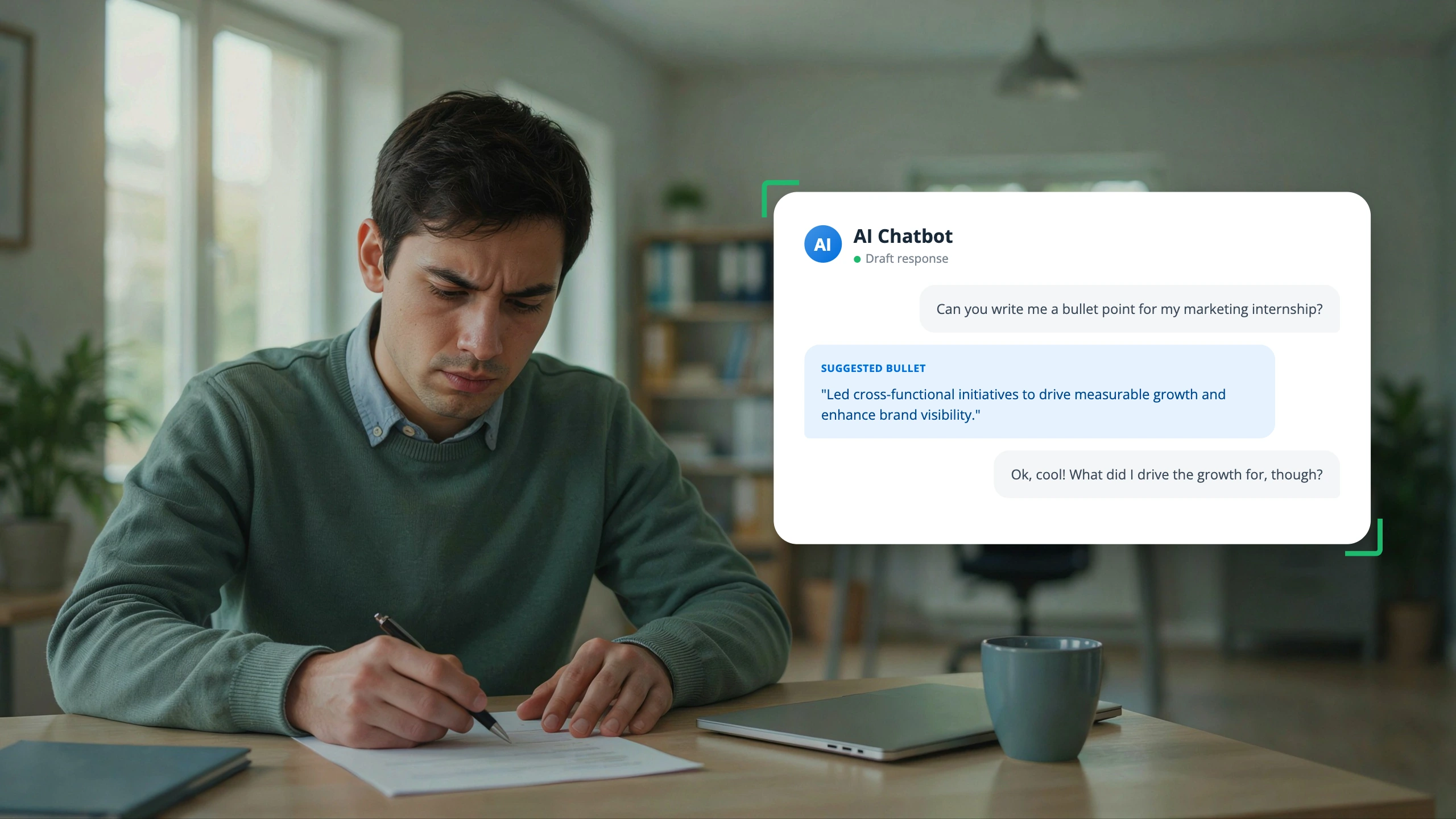
This is the one where you don’t get to have a clean position, and you know it. You tell a student AI can help them get unstuck on a blank page. You tell another student their bullet points read like nobody wrote them — because nobody did, not really. Both things are true, in the same week, about the same tool, and there’s no tidy rule that tells a student which conversation they’re about to be in.
Some career centers have leaned into the free tools across the board — it’s the cheapest option on paper, and staff are stretched too thin to referee every draft. But “cheap” is doing a lot of heavy lifting. The real cost doesn’t go away; it’s just a can kicked down the road: into the hours an advisor spends walking a student back out of generic phrasing, hallucinated bullet points, and a resume that sounds like everyone else’s. This process is dealt with one appointment at a time. The “free” here falls into the phrasing, “When something is free, you (and your students) are the product.” And there’s a cost for that.
What’s The Verdict? Depends on the prompt — and that’s not a hedge, it’s the actual finding. Job seekers given structured AI writing help didn’t just feel more confident — they got hired more, got more offers, and were paid more than a comparable group without it. The tool isn’t the problem. The problem is what happens when “help me with this” becomes the entire instruction, and the output goes out the door unread and undefended. This is exactly the output that recruiters have gotten fast at spotting, and exactly the output that means you have to set aside 30 minutes in an advising appointment instead of a 5-minute block of time.
We go deep on what that failure actually looks like — and what it costs a student at the interview, not just at the ATS — in a separate piece. [Read the full breakdown here.] For now: the line isn’t “AI or no AI.” It’s whether a student can still defend, in their own words, whatever ends up on the page — because the alternative is paying for it later, in advisor time instead of tool cost.
Myth #4: “You must be 100% qualified to apply.”
Go back to that student from the top of this piece — the one who read the requirements, landed at 60%, and closed the tab. Here’s the side-by-side you never got to run for them: a candidate who checked 100% of the boxes, and a candidate who checked somewhere between half and two-thirds, applying for the exact same role. Before AI changed the applicant pool, those two candidates had roughly the same odds of landing an interview. Not close. Comparable.
That’s not because qualifications don’t matter. There’s a real bar here — it’s just not the one your student was picturing. Somewhere around 60–80% is “good enough”: past that line, more boxes checked barely moves the needle. Your student had already cleared it. What cost them the interview wasn’t their experience — it was hesitating at a line they couldn’t see, and never sending in a resume aligned closely enough to the role to prove they’d cleared it.

What’s The Verdict? Busted — and the data gets stranger the further you push it. Jobscan’s own platform data puts the actual optimal match rate at around 80%, not 100% — resumes scoring higher than that usually got there by embellishing, and results decline past that point rather than improve. Push it further still, toward a 98%+ match, and you’re not looking at an unusually strong candidate anymore — you’re looking at a resume that trips the same anti-keyword-stuffing filters ATS platforms use to catch people gaming the system. At the very top of the qualification scale, “impressively qualified” and “algorithmically suspicious” start to look identical to the software doing the first read.
A candidate who checks every single box can easily put forward a resume that doesn’t show that, a match rate in the teens. They could also put forward a resume that is way too optimized, near 100%, and appear suspicious.
A candidate who is below the bar could optimize a resume to get into an optimal match rate, between 60%-80%, or to appear perfect — but could never defend either.
The student who talked themselves out of applying at 40% wasn’t underqualified. They just needed a resume that feel into optimal range and also tells their story the best possible way — that means it is employer aligned, ATS-optimized, and showcases their fit for the role.
What to actually tell students: the percentage on that requirements list was never a pass/fail line. Treat it as a floor worth clearing, not a target worth chasing — chasing it past 80–90% doesn’t just waste their time tailoring bullet points nobody needed, it can actively work against them.
Myth #5: “Resumes must be one page.”
If you caught our Mythbusters webinar, you already heard us call this one busted — recruiters, when surveyed, actually prefer two-page resumes, even for entry-level candidates. We said that on stage, and it’s real data.
Then we checked our own outcome data of Jobscan users instead of stated preferences from recruiters, and entry-level candidates told a different story: the shortest resumes in our platform data landed interviews at a noticeably higher rate than longer ones — not a small gap, either. What recruiters say they prefer and what actually gets someone hired turned out to be two different questions.
What’s The Verdict? Complicated. This is one where the honest answer needs more room than a paragraph, so we gave it its own full breakdown — including where the data holds up cleanly, where it gets messier at mid- and senior-level, and what we’d actually tell a student to do with it.
Myth #6: “You can’t measure career services impact.”
This one’s different from the other five. It’s not outdated advice or advice that’s gone stale — it’s a myth that survives because it’s convenient. Nobody particularly wants to be measured, and “the impact isn’t really quantifiable” is a comfortable place to stop asking. It protects the budget conversation from ever really starting, which is exactly the wrong direction if you’re the one trying to grow that budget.
What’s The Verdict? Busted. Students who used even one career service saw 24% more job offers than students who used none. That’s not a soft, feel-good number — it’s a hard outcome, tied directly to the thing your institution’s leadership actually cares about. The harder truth sitting next to it: only about a fifth to a quarter of students ever touch these services in the first place. The access gap, not the measurement gap, is the real story.
And the mechanism behind that outcome shows up almost immediately once you look for it. In our own platform data, students assigned a career coach engaged with job search tools at 3–4x the rate of students without one — at every school size, and most dramatically at larger institutions, where coached students averaged 14.1 usage events versus 3.59 for uncoached students at the same school. (Worth being precise about what this does and doesn’t prove: it’s a correlation, not a causal claim — schools may be assigning coaches to students already inclined to engage more, and this measures engagement, not job offers or placement directly.) But paired with the NACE outcome data, the shape of the story is hard to miss: coaching drives engagement, and engagement drives outcomes. The “impact” you’d be measuring isn’t hypothetical. It’s already sitting in your usage data.
What to actually do with this: stop treating “impact” as something abstract you’d need a research team to prove. Tie service usage to something the institution already tracks — retention is usually the fastest, cleanest line to draw, and it’s the one number that turns “we help students” into “we help the institution keep students,” which is a very different conversation with the people who control your budget.
Want to stop repeating this — and start checking it yourself?
Every myth in this piece came from the same instinct: stop repeating the advice, go look at what the data actually says. You don’t need our stats table to do that with your own students’ resumes. Create a free Jobscan account, pull up a resume and a real job posting, and run the actual match. Watch the score move as you tighten the language, cut the padding, or add a skill that’s genuinely missing — the same 80% sweet spot from Myth #4, the same length-and-density tradeoff from Myth #5, playing out in front of you instead of sitting in a stats table.
That’s the fastest way to build the habit this whole article has been arguing for: not memorizing six answers, but knowing how to go check the seventh one yourself.
Create a free account and see how Jobscan can optimize a student’s resume



