
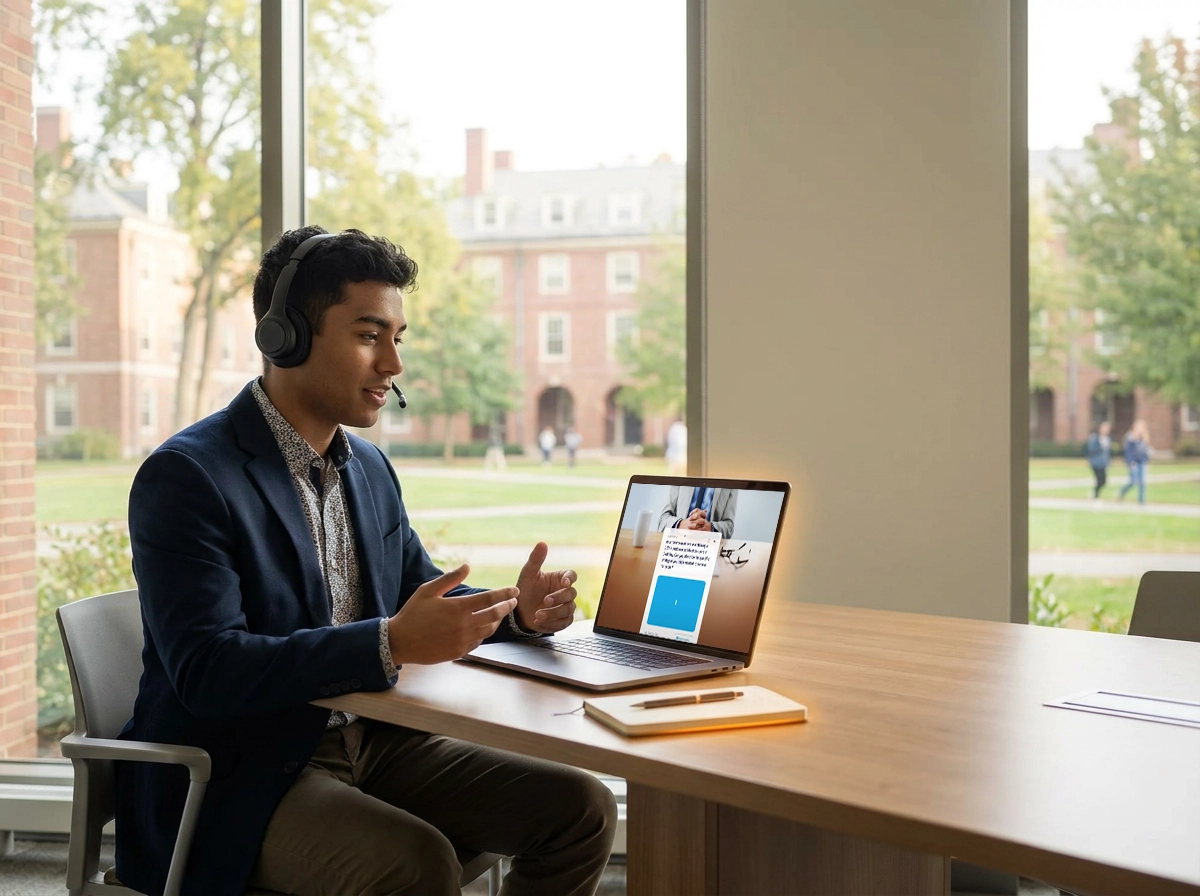



Interviews are that final, crucial step students must ace to get the job. Mock interviews will give them the best chance of impressing an employer, but how can your career center do 1-on-1 practice interviews when your staff-to-student ratio is 1:1,381?
Most students never get any practice before their first real interview. This can impact your employment statistics: students stumble in interviews, placement rates suffer, and your career center can’t point to outcomes that justify your budget.
AI mock interview tools promise to solve this. But the market has exploded, and the tools vary wildly in quality. Some are glorified flashcard decks. Others genuinely simulate what it’s like to sit across from a recruiter who’s read your resume and the job description.
Choosing the right solution to provide job seekers with interview practice at scale can help you meet the needs of the many students you serve. More robust and widely available AI job interview prep will put your career center on a trajectory to achieve improved graduate employment metrics and impress your institution’s administration.
The Interview Prep Crisis in Career Services
Without practice, students are much less likely to succeed in interviews. But if your staff tried to do mock interviews with every student who needs the practice, they would be working more than 24 hours a day, seven days a week. You just can’t get to the volume of interview practice sessions needed. And with all the other work on career counselors’ plates, time-consuming mock interviews are likely the first thing to go—you can’t get the scale you need to reach every student with interview practice.
Students who may need this practice most are not making it to office hours. A career educator at a major university told us, “When students report that they’re not getting any employers, we often realize they just never came in to see us.” If they don’t get to your career center, they’re likely to perform sub-optimally when speaking to a hiring manager. If only you could offer people the convenience of AI interview practice that truly works and runs them through the paces necessary to know what to expect when they speak with an employer.

The interview is where everything breaks down — a resume gets students in the door, but unprepared students fumble the close. Career centers own the placement rate metric but can’t control this bottleneck at scale.
This isn’t a technology problem — it’s a capacity problem. You know mock interviews work. You just can’t do enough of them.
What Makes an AI Mock Interview Tool Actually Useful?
AI interview practice can work, but not every platform is the same. You can find solutions that do very little to prep students, or AI mock interview interactions that give students practice that hones their skills, challenges their thinking, and builds their confidence to walk in feeling prepared.
Let’s look at the basic categories of AI mock interview software out there:
Tier 1 — Generic Question Banks
These tools will have pre-recorded or static question sets, such as “Tell me about yourself,” or “What’s your greatest weakness”. There’s no personalization, and therefore, little engagement. Students practice the same questions regardless of role. These options might be better than nothing, but barely.
Tier 2 — Role-Based Question Generators
With questions tailored to the job title or industry, role-based question generators are better than generic ones, but they still miss the individual. At least the questions will be more relevant to the industry and level, but rote questions may elicit rote, therefore not specific, answers from users.
For instance, two students applying for the “Marketing Coordinator” role at different companies receive the same questions, even though the job descriptions emphasize entirely different skills.

Tier 3 — Employer-Aligned Practice
An employer-aligned AI mock interview tool reads the student’s actual resume AND the specific job description, then generates questions a recruiter would actually ask. The questions will be based on gaps, claims, and role requirements, prompting applicants to think through their answers and practice responding to detailed questions they are likely to face. Students will be engaged and challenged to authentically frame their qualifications in ways that apply to the job.
This is the tier that simulates a real interview — because it’s aligned to what this employer is actually looking for, not a generic competency model. In the same way that an employer-aligned resume outperforms a best-practices resume, employer-aligned interview prep outperforms generic practice.
If you’re evaluating AI interview tools for your career center, the tier matters more than the brand name. The question is: does this tool prepare my students for an interview, or for the specific interview they will face?
Features That Actually Move the Needle
The best AI mock interview solutions have features that go beyond basic. They offer both the specificity of alignment with the employer’s job description and deeper engagement that responds to students’ answers, providing real feedback. The best tools also offer ways to share practice results with career coaches, giving the valuable human touch that drives students to the next level when they are a finalist for a position.
Employer-Aligned Questions from Resume + Job Description
This feature is the single biggest differentiator — and it makes a tool employer-aligned rather than generically helpful. Questions generated from the student’s actual application materials mirror what a recruiter who’s read the job description and resume would ask. An artificial intelligence interview tool without the job description is just a question bank. The details and specifics matter.
When career professionals see interview tools generate questions from the actual job description, the reaction is usually a single word: wow. That’s the moment the tier distinction clicks.
AI Feedback on Delivery AND Content
Generic feedback like ‘you said um 12 times’ isn’t useful. The best tools evaluate substance: did the answer address the question, was it structured (STAR method), did it use power words? A proposed model answer gives students a benchmark to compare against — not a script to memorize.
Practice vs. Real Mode
A superior tool offers a practice mode that lets students pause, restart, and redo their answers to build confidence. Once ready, students can move to a “real mode” to simulate more realistic interview pressure. Students self-select when they’re ready to “go live.”
Shareable Results for Coach Review
AI feedback is valuable. But the best tools let students share their recorded interview and the AI feedback with a human coach. The AI identifies patterns; the coach adds judgment. Technology augments career advisors’ expertise, saves them time, and provides tools that help students reach the next level for more personal feedback.
This is the ‘AI with training wheels’ model — the technology augments the advisor, it doesn’t replace them.
Administrator Visibility into Usage
Key questions for career center directors: are students actually using the tool? Which cohorts are engaged? Who hasn’t practiced before their career fair interview? All answerable with usage data. Justify the budget for the tools that make career coaches’ lives easier—and help the center reach more students with services.
Is AI Making Interview Prep “Too Easy”?
From hundreds of conversations with career professionals, one concern comes up more than any other: does AI interview prep encourage cognitive offloading — replacing student effort with rehearsed answers?
This concern is real, as we have heard it from hundreds of conversations with career professionals. If AI feeds students perfect STAR-method answers, do they actually learn to interview? Can they speak to what’s on their resume?
Certain types of AI interview practice tools do students a disservice, especially when they generate full scripts. The best tools propose answers as starting points for students to internalize, not memorize. Employer-aligned tools have a built-in safeguard, as the questions are drawn from this specific job description and resume combination. The student can’t just memorize a generic script — they must understand their own experience in relation to what the employer is looking for.
With AI solutions, the guardrails matter. Effective practice solutions use AI to make suggestions based on the student’s real experience, but the student still has to own the story. Purpose-built tools outperform chatbots because the employer context is baked into the system, not left to the student to prompt-engineer. If a student can’t elaborate in a live interview, that’s a coaching conversation — and the coach now has data to address a student’s weakness.
The alternative isn’t AI-free interview prep. Students are already using ChatGPT with zero structure — and generic AI gives generic answers. Employer-aligned AI gives answers grounded in what this role at this company actually requires.
Suggested: Callout Box
AI Interview Practice from the Student’s Perspective
Let’s walk through a student’s experience from start to finish, including how AI mock interviews boost their readiness:
Scenario: A senior applying for a Marketing Coordinator role at a mid-size company.
- Student finds the job on Handshake, saves it to Job Tracker
- Student uploads their resume and pastes the job description into the tool
- AI generates 8 tailored interview questions
- Student practices in Practice mode, reviewing AI feedback after each question
- Student switches to Real mode for a full simulation
- Student shares the recording and AI feedback with their career advisor
- Advisor reviews, adds human coaching notes on 2-3 answers
- Student interviews with confidence because they’ve already answered versions of these questions
No 1-on-1 appointment needed. No scheduling bottleneck. The advisor’s time was spent on coaching, not on answering basic questions.
End Callout Box
How to Evaluate AI Interview Tools for Your Career Center
Use this checklist when you’re evaluating AI interview prep tools. Here is an actionable checklist to assist you in your evaluation process:
- Does it personalize questions based on the resume and job description, not just the job title?
- Does it provide AI feedback on content AND delivery?
- Can students share results with a coach for human review?
- Does the admin dashboard show usage, engagement, and cohort-level data?
- Does it integrate with your existing career services tech stack (SSO, Handshake)?
- Is pricing based on anticipated usage rather than total enrollment?
- Does it address accessibility and compliance requirements (HECVAT, VPAT, FERPA)?
- Does it have practice and simulation modes?
If a tool checks all eight boxes, you’ve found a partner, not just a platform.
Getting Started with AI Job Interview Prep
We’ve made this argument before about employer-aligned resumes — scale alignment rather than scaling generality. The same rule applies to interview prep.
The interview is the moment of truth for your students — and the metric your leadership watches. AI mock interview tools let you scale that preparation without sacrificing quality or burning out your team.
But the tool you choose matters. Generic question banks scale generality. Employer-aligned interview practice scales what actually gets students hired.




