Best Event Coordinator Resume Examples for 2026
An event coordinator resume needs to show flawless execution, not just a task list. See 2026 event coordinator resume examples and the ATS keywords that win interviews.



Event coordinators turn an idea into a day that runs without a hitch. The role blends logistics with people skills: you build timelines, manage budgets, line up vendors, and stay calm when something goes sideways an hour before doors open. Whether you focus on corporate conferences, weddings, fundraisers, or all of the above, your resume has to prove you can deliver an event on time, on budget, and without the chaos showing.
Hiring managers skim an event coordinator resume for proof you can execute under pressure. They want to see real numbers (guest counts, budgets managed, events delivered) and the calm, organized process behind them. Before a person ever reads it, though, an applicant tracking system scans for the right signals: tools like Cvent and Eventbrite, skills like vendor management, budgeting, and logistics, and role keywords pulled straight from the job description. A resume that clears the ATS and frames your results clearly is what earns the interview.
The examples below show how coordinators and planners at every level present their experience, from a first event role to senior program ownership to corporate and planning specialties. Use them as a starting point, then run your own resume through Jobscan to match it against the job description and surface the keywords you are missing before you apply.
Ready to build yours? Try our ATS-friendly resume builder or scan your draft against the job description.
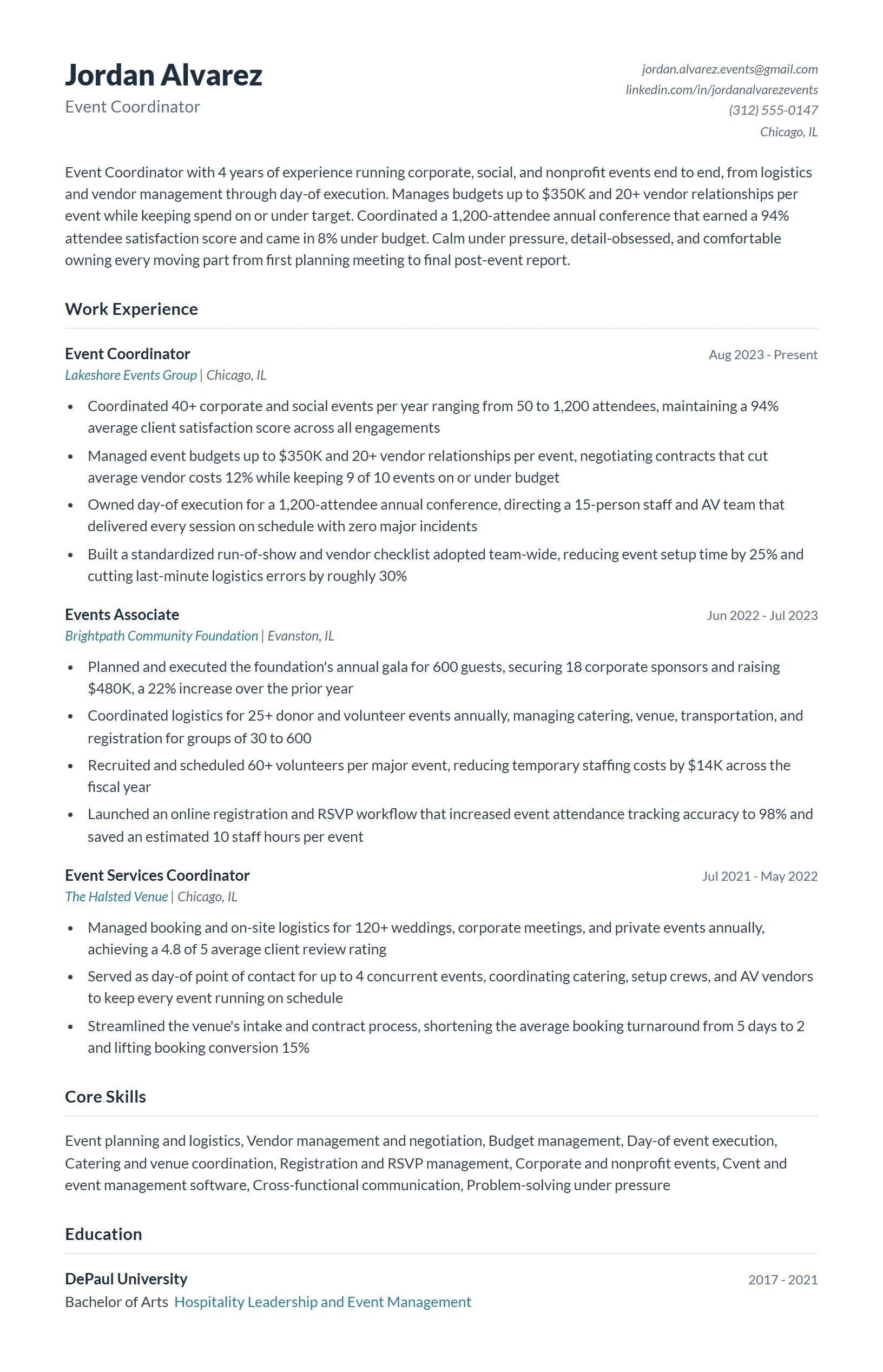
Event Coordinator resume example
Not sure how to show vendors, budgets, and day-of execution without it reading like a chore list? This event coordinator resume example shows how to frame logistics as measurable results.
This resume works because it pairs each event with concrete numbers, like guest count, budget managed, and vendor count, instead of just listing duties. It leads with a skills section that surfaces ATS keywords such as vendor management, budget tracking, and event logistics, then backs them up with experience that shows events delivered on time and under budget. The clean, single-column format keeps it easy for both recruiters and the ATS to scan.
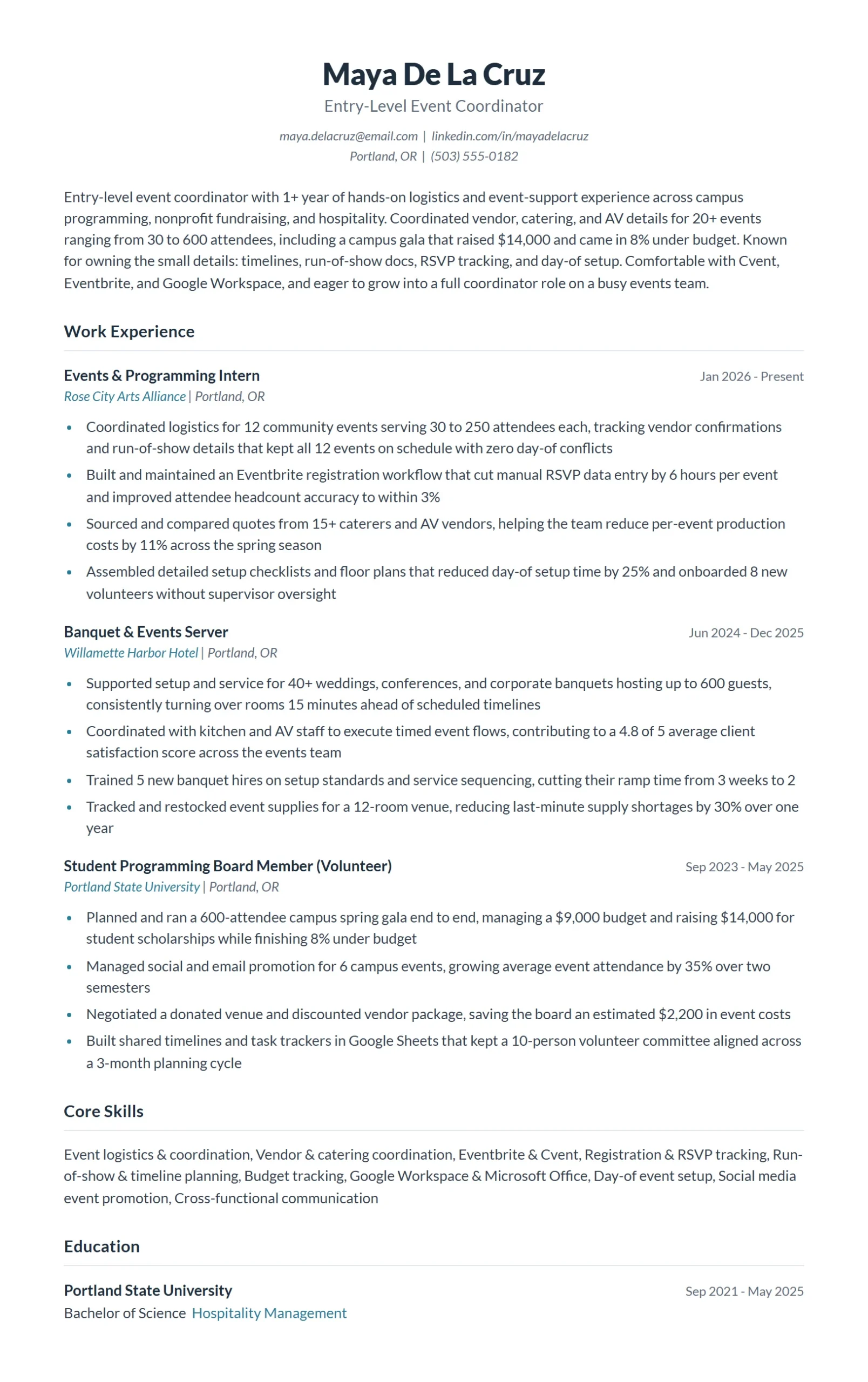
Entry-Level Event Coordinator resume example
Breaking into events without a long track record feels daunting, but internships, campus events, and hospitality work can carry real weight. This entry-level event coordinator resume example shows how to make limited experience look strong.
This resume works because it turns internships, volunteer events, and part-time hospitality roles into proof you can handle logistics and pressure. It puts a skills and tools section near the top to clear ATS keyword checks, and it describes each event by what was organized and the outcome, like attendance hit or setup completed on schedule. Transferable strengths such as scheduling, organization, and customer service give a newer candidate a credible foundation.
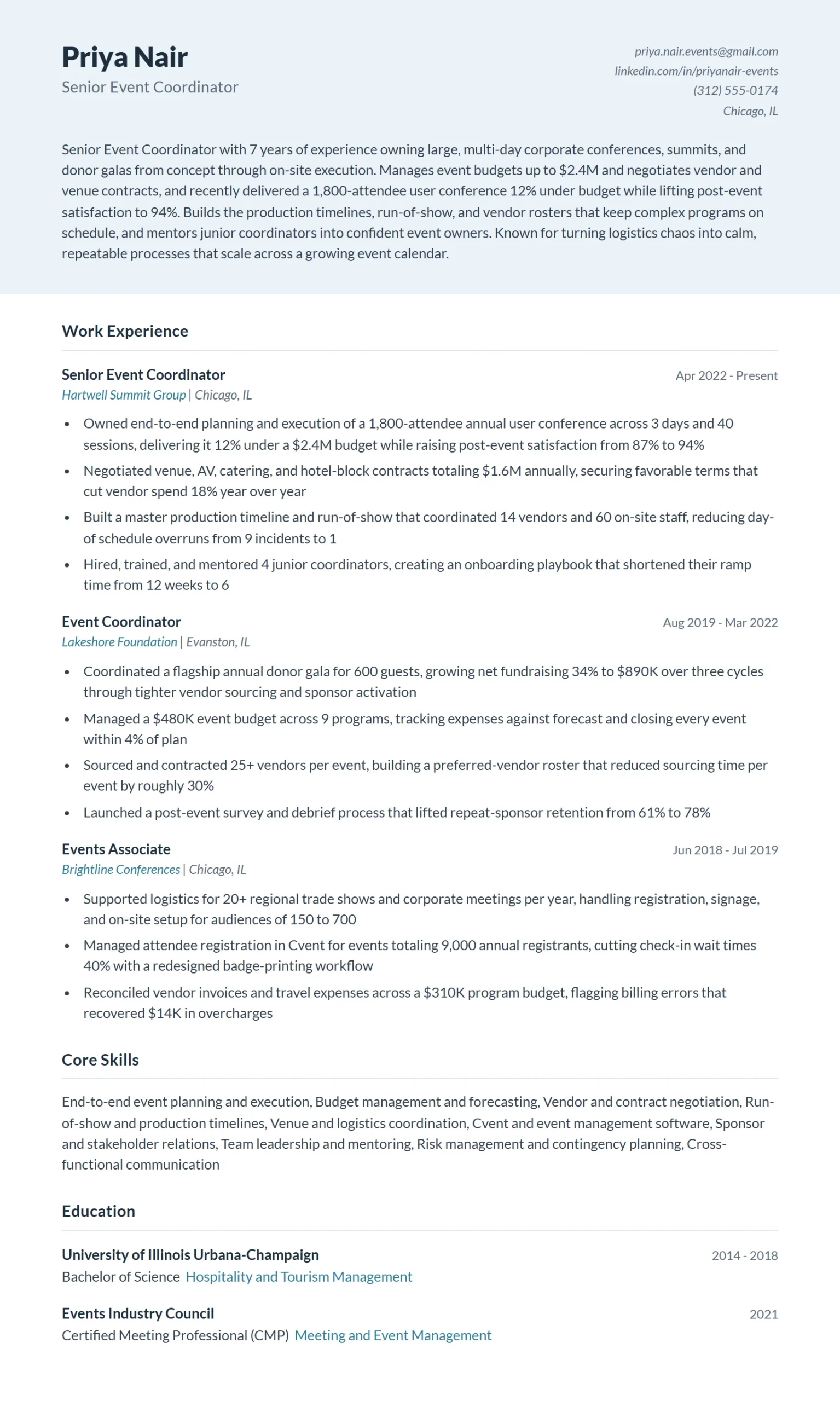
Senior Event Coordinator resume example
Moving up means proving you can own complexity, not just support it. This senior event coordinator resume example shows how to frame large-scale events, budget ownership, and the coordinators you lead.
This resume works because it shifts the emphasis from individual tasks to scale and accountability: owning multi-day events, managing five- and six-figure budgets, negotiating vendor contracts, and directing onsite teams. Quantified outcomes (cost savings, attendance growth, sponsor revenue) signal a seniority that a title alone cannot. It still includes the core logistics and software keywords an ATS expects, so the added scope never costs visibility.
Event Planner resume example
Planning roles are won on vision and guest experience, not just logistics. This event planner resume example shows how to highlight concept, design, and the relationships that bring an event to life.

This resume works because it foregrounds the creative and client-facing side of the job: developing themes, curating vendors, and designing guest experiences that clients rave about. It still quantifies the practical wins, like budgets honored and repeat or referral business earned, so the artistry reads as results. Keywords spanning vendor sourcing, client management, and event design widen the ATS coverage planning roles reward.
Event Manager resume example
When a role owns the whole event program, your resume has to speak strategy and numbers. This event manager resume example shows how to frame portfolio ownership, budgets, and business impact.

This resume works because it elevates events from logistics to a business function: owning the event calendar, managing a team and a P&L, and tying programs to outcomes like leads generated and pipeline influenced. It leads with leadership and results, then supports them with the operational depth (vendor negotiation, registration platforms, post-event reporting) that proves you still know the mechanics. Strategic and tool keywords together signal a manager to both the ATS and the hiring team.
Corporate Event Coordinator resume example
Corporate events run on process, platforms, and stakeholders. This corporate event coordinator resume example shows how to highlight conferences, trade shows, and the systems that keep them on track.
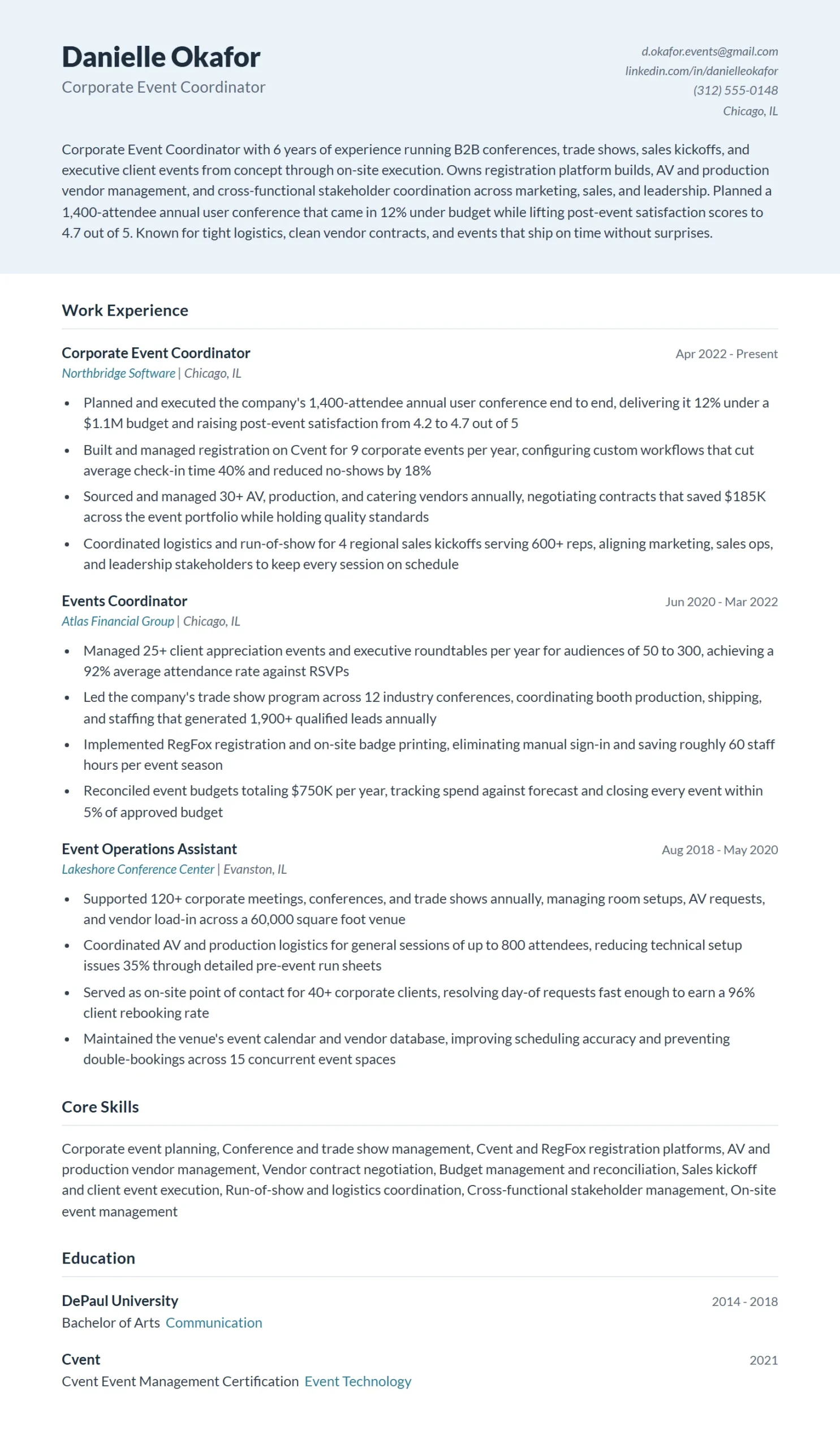
This resume works because it speaks the language of corporate event work: coordinating conferences, sales kickoffs, and trade shows while managing registration platforms, AV and production vendors, and internal stakeholders. It quantifies scale and efficiency, like attendees registered, sessions run, and costs kept in line, and it surfaces tool keywords such as Cvent, Eventbrite, and Asana that corporate postings screen for. Showing both stakeholder management and platform fluency makes it read as a fit for in-house teams.
How to write an event coordinator resume that gets interviews
Hiring managers skim an event coordinator resume for proof you can run an event end to end without things falling apart: a budget that holds, vendors that show up, and a room full of attendees who leave happy. They want scale (how big, how many, how often) and outcomes tied to numbers. Most employers also run your resume through an Applicant Tracking System (ATS) first, so the language has to match the job description before a human ever reads it. The tips below show you how to do both: clear the ATS scan and convince the person who reads next.
- Lead every bullet with scale and a number: Event coordination is a numbers job, so quantify everything. Show how many events you ran per year, headcounts (“managed logistics for a 500-attendee annual conference”), budgets you owned (“administered a $250K event budget”), and vendors you coordinated (“sourced and managed 20+ vendors”). A resume that says you “helped plan events” tells the reader nothing. One that says you “coordinated 40+ corporate events annually for up to 800 guests” proves you can handle their scale.
- Show you can own a budget, not just spend one: Budget control separates a coordinator from an assistant. State the budget size you managed and the result: “managed a $180K conference budget and came in 12% under” or “negotiated vendor contracts that cut catering costs 15% without changing the menu.” Hiring managers want proof you protect the bottom line, not just book the venue. Tie your work to cost savings, on-budget delivery, or revenue from ticket sales and sponsorships.
- Prove you handle vendor and venue logistics: Name the moving parts you coordinated: venue sourcing and contracts, catering, AV and production, transportation, lodging room blocks, signage, and staffing. Use bullets that show you ran the operation: “coordinated 15 vendors and a 10-person event-day team across a 3-day trade show with zero scheduling conflicts.” This signals you can keep dozens of dependencies on track under a hard deadline that cannot move.
- Match keywords and tools to the job description: ATS scans for specific terms. List the event-management tools you actually use (Cvent, Eventbrite, Asana, Monday.com, Bizzabo, Hopin, Social Tables) and the methods named in the posting (event planning, vendor management, budget management, logistics coordination, on-site management, registration). If the role says “corporate events” or “trade shows” and that is your background, use that exact phrase. Skip outdated tools and never keyword-stuff. Recruiters can tell.
- Specify the event types you have run: A corporate conference, a wedding, a fundraising gala, and a product launch reward different experience. Name the formats you have delivered: corporate meetings, conferences, trade shows, galas, weddings, virtual and hybrid events, product launches. If the posting is for a nonprofit gala coordinator, lead with your fundraising-event experience and the dollars raised. Mirroring the employer’s event mix shows you can step in without a learning curve.
- Tailor the resume to each role and keep it ATS-clean: Reorder your skills and swap your headline examples to mirror each posting, since a venue coordinator role and a corporate-events manager role reward different keywords. Then keep the format ATS-friendly: standard section headings, no text boxes or multi-column layouts that scramble parsing, and a single clean column. Run it through Jobscan to check your match rate against the job description before you apply.

Event Coordinator resume summary examples
Your summary is the first thing a recruiter reads. Lead with your specialty, years of experience, and a quantified win.
Good event Coordinator resume summary examples
- Detail-driven event coordinator with 5+ years planning corporate conferences, trade shows, and client galas for up to 800 attendees. Managed event budgets up to $250K, consistently delivering 10-15% under budget through vendor negotiation. Skilled in Cvent, vendor and venue management, and on-site execution, with a record of 50+ events delivered on time with zero major incidents.
- Results-focused event coordinator specializing in large-scale corporate and nonprofit events. Owns the full cycle from venue sourcing and contracts to day-of logistics and post-event reporting. Recent work raised $320K at an annual fundraising gala and grew attendance 28% year over year while holding the budget flat.
- Organized event coordinator with a background in hospitality and a track record of running 30+ events per year, from product launches to 3-day trade shows. Coordinates 20+ vendors per event and a 12-person event-day team, earning a 96% attendee satisfaction score across post-event surveys.
What to avoid
- Hardworking event coordinator looking for an exciting opportunity to use my organizational skills and grow with a great company. (It is all about what the candidate wants, not what they deliver. There is no event scale, no budget figure, no tools, and zero evidence of results. A hiring manager learns nothing they can act on.)
- Passionate planner who loves creating memorable events and is great at multitasking under pressure. (Pure adjectives with no proof. “Passionate” and “memorable” are claims anyone can make. It names no event types, no headcounts, no budgets, and no measurable outcome, so the ATS and the recruiter both skip it.)
Event Coordinator resume skills
Pull the exact tools and event types from each job description, then mirror that language here. This is a quick resume snapshot, so keep it to your strongest, role-relevant skills rather than an exhaustive list (a dedicated skills page can cover the full set).
Hard skills for a event Coordinator resume
- Event Planning
- Vendor Management
- Budget Management
- Venue Sourcing & Contracts
- Logistics Coordination
- On-Site Event Management
- Cvent
- Registration & Attendee Management
- Catering & AV Coordination
- Post-Event Reporting
Soft skills for a event Coordinator resume
- Organization
- Communication
- Problem Solving
- Time Management
- Attention to Detail
- Grace Under Pressure
Event Coordinator resume work experience bullet point examples
Lead each bullet with a strong verb and a measurable result.
Good bullet point examples
- Planned and executed 40+ corporate events annually for up to 800 attendees, managing a combined $600K budget and delivering every event on time and under budget.
- Negotiated venue and catering contracts for a 500-person annual conference, cutting vendor costs 15% and saving $38K while upgrading the AV package.
- Coordinated 20+ vendors and a 12-person event-day team across a 3-day trade show, running registration for 1,200 attendees with zero scheduling conflicts.
- Led logistics for an annual fundraising gala that raised $320K, a 28% increase over the prior year, while growing attendance from 240 to 310 guests.
Bad bullet point examples
- Helped plan and organize various company events throughout the year. (Lists a task with no scale or outcome. “Various events” is vague, and there is no headcount, budget, or result. It tells the reader you were present but not whether your work mattered.)
- Responsible for coordinating vendors and booking venues for events. (“Responsible for” describes a job duty, not an accomplishment. It shows no number of vendors, no event size, and no result. Lead with a strong verb (Coordinated, Negotiated, Managed) and end with a measurable outcome instead.)
- Worked hard to make sure every event ran smoothly and guests were happy. (Subjective and unquantified. “Ran smoothly” and “guests were happy” are opinions with no proof. Replace them with the metric that backs the claim, such as an attendee satisfaction score, on-time delivery rate, or repeat-booking figure.)
Event Coordinator resume tips
A strong event coordinator resume proves you can handle the chaos before, during, and after an event, and these tips will help yours do exactly that.
- Mirror Job Description Keywords: Pull exact phrases like ‘vendor management,’ ‘budget management,’ and ‘attendee registration’ directly from each job posting and weave them into your resume so the ATS scores your application as a strong match before a recruiter ever sees it.
- Quantify Event Scale: For every event you list, include the attendee count, budget size, and number of vendors managed, because hiring managers need those numbers to judge whether your experience matches the scope of their events.
- Name Your Tools: List platforms like Cvent, Eventbrite, or your venue sourcing and contract management software by name in your skills section, since ATS filters frequently screen for specific technology before passing resumes to a hiring manager.
- Show Vendor Outcomes: Go beyond listing vendor management as a duty by noting a result, such as renegotiating a catering contract that cut costs by 12 percent, to prove you protect budgets and build productive supplier relationships.
- Add Certifications Prominently: If you hold a CMP (Certified Meeting Professional) or similar credential, place it near the top of your resume next to your name or in a dedicated certifications line, because many employers filter for it as a baseline qualifier.
- Address the Day-Of Reality: Include at least one bullet that speaks to on-site event management and real-time problem solving, such as coordinating a last-minute venue change for 400 attendees, since employers specifically want proof you stay composed when logistics go sideways.
Pair your event Coordinator resume with a cover letter
A strong resume goes further with a tailored cover letter. Browse our event coordinator cover letter examples to round out your application.
Event Coordinator resume frequently asked questions
Write 2 or 3 sentences that name your event types, your years of experience, and one quantified result that proves your value. For example: “Detail-driven event coordinator with 5 years planning corporate conferences and galas, managing budgets up to $250K and consistently delivering events under budget while raising attendee satisfaction to 95 percent.” Mirror the exact job title and a few keywords from the posting so both the recruiter and the ATS see an immediate match. Lead with logistics and outcomes you owned, not generic phrases like “passionate about events.”
Balance the logistics tools, planning methods, and people skills that run a successful event. For hard skills, name the software you use (Cvent, Eventbrite, Asana, Social Tables, Microsoft Office) plus budget management, vendor negotiation, contract management, and venue sourcing. For soft skills, highlight stakeholder communication, problem solving under pressure, and the ability to juggle multiple events at once. Match the specific platforms and methods named in the job description, since those are often the exact terms an ATS scans for.
Attach numbers to the things you owned: budget size, attendee or guest count, number of events per year, vendor count, and any cost savings or satisfaction scores. For example, “Coordinated 40+ corporate events annually for up to 1,200 attendees” or “Negotiated vendor contracts that cut catering costs 18 percent.” If you do not have formal metrics, estimate conservatively from real details like headcount, budget, or repeat-client rates. Numbers turn vague duties into proof that you can run events at scale.
Coordinators focus on execution and logistics (timelines, vendor management, day-of operations, on-site problem solving), while planners often own higher-level strategy, concept, and client relationships. On a coordinator resume, emphasize the operational details you managed and the events you helped deliver flawlessly. If you are targeting planner roles, shift the language toward budget ownership, client strategy, and end-to-end event design. Tailor your titles and bullet points to the specific role you want, and mirror the wording from the job posting.
Lead with transferable experience and any hands-on event work, even if it was not a formal job. Feature volunteer events, fundraisers, school or campus activities, weddings you helped run, or projects where you managed logistics, vendors, or a budget, and describe each with the problem, your role, and the result. Add relevant tools (Eventbrite, Asana, spreadsheets) and a short summary that frames you as an entry-level event coordinator. A campus event you organized for 200 people often reads stronger than a generic objective statement.
One page is the standard for most event coordinators, and it forces you to feature only your strongest, most relevant events. Move to two pages only if you have roughly 10 or more years of experience or a long list of senior and lead roles that genuinely add value. Keep it tight, scannable, and outcome-focused, since recruiters often spend under a minute on a first pass. Before you submit, scan your resume against the job description with a tool like Jobscan to confirm your keywords and formatting pass the ATS.