Best Operations Manager Resume Examples for 2026
An operations manager resume should prove you make teams and processes run leaner. See 2026 examples and the efficiency-focused keywords ATS look for.

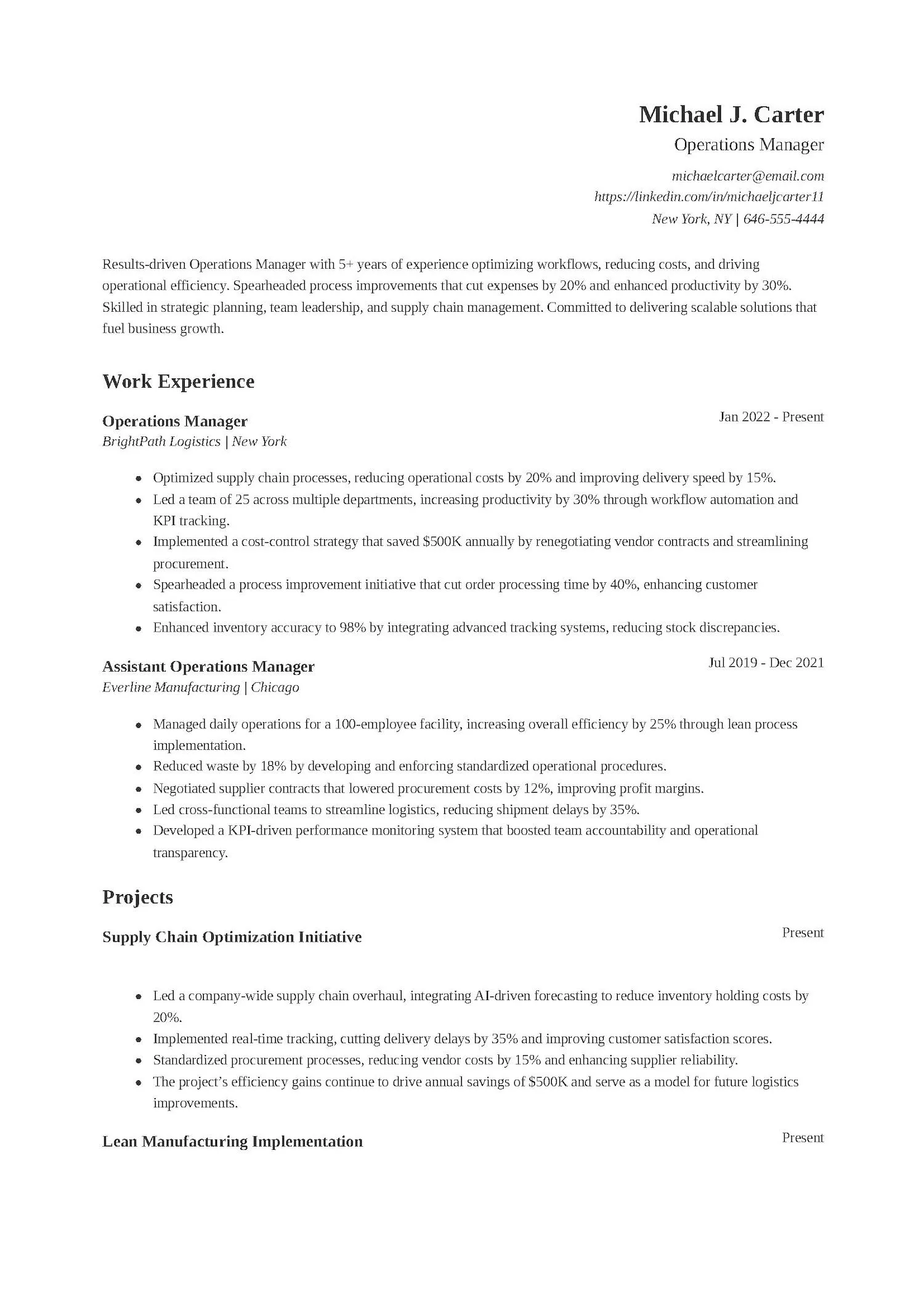
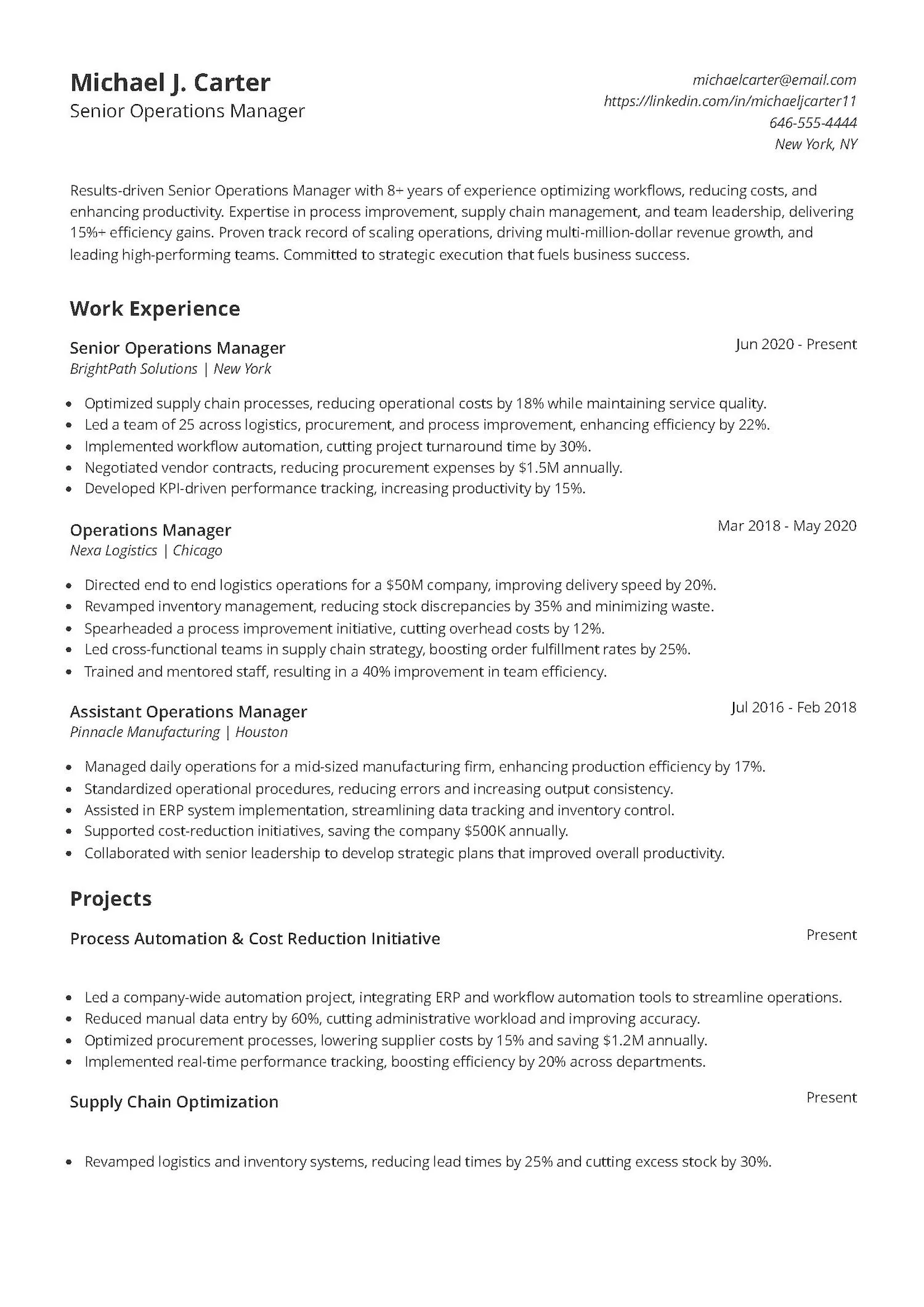


Operations managers are the driving force behind business efficiency, ensuring smooth workflows, cost optimization, and overall productivity. Writing a standout resume is crucial to showcasing your leadership, strategic planning, and problem-solving skills. In this blog, you’ll find expertly designed resume examples along with essential tips to help you create a compelling application.
According to the U.S. Bureau of Labor Statistics, operations management roles are projected to grow 6% from 2023 to 2033, outpacing the average for all occupations. Employers seek candidates with strong leadership, data-driven decision-making, and process improvement expertise. A well-written resume can set you apart from the competition and increase your chances of landing an interview.
If you’re looking to build a resume that truly reflects your skills and achievements, you’re in the right place! Keep reading for practical tips, real-world examples, and insider strategies to make your resume stand out in a crowded job market.
Operations manager resume example
Struggling to create an operations manager resume that stands out? How do you highlight your leadership skills, cost-saving initiatives, and ability to streamline processes? This resume example lays it all out—clear, results-driven, and tailored for impact.
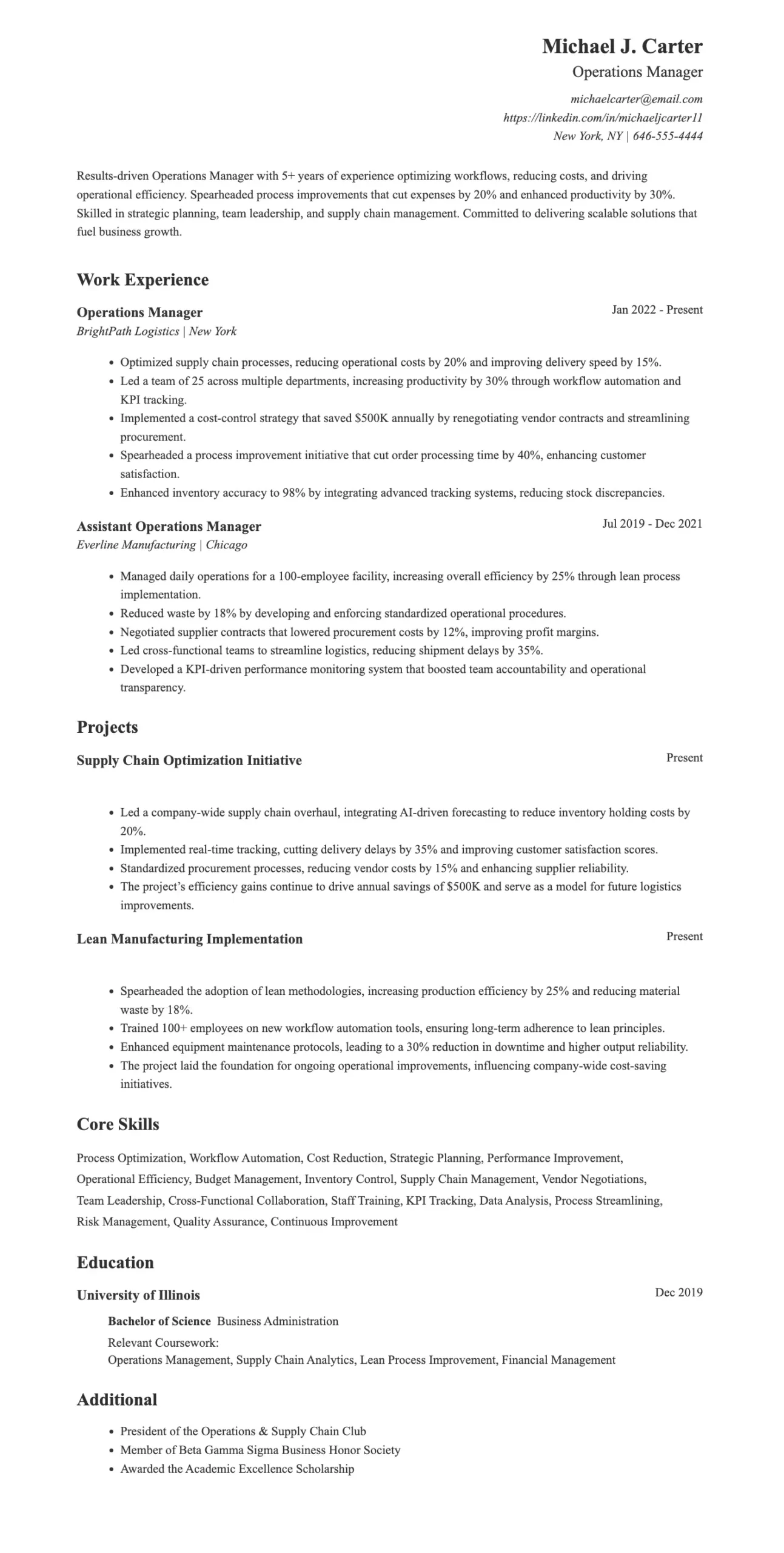
Operations managers are the backbone of any business, ensuring everything runs smoothly. Employers want candidates who can optimize workflows, cut costs, and boost efficiency for an operations manager job. Strong leadership, data-driven decision-making, and the ability to improve processes are key. A well-structured resume that highlights measurable results can make all the difference in landing the job.
This resume template effectively showcases operations management expertise by highlighting process optimization, cost reduction, and efficiency improvements. The work experience section is packed with measurable results, proving real impact. Every bullet point is clear and action-driven. Plus, the well-structured format—with concise sections and strong action verbs—makes it easy to read, ensuring hiring managers quickly see the candidate’s value.
Assistant operations manager resume example
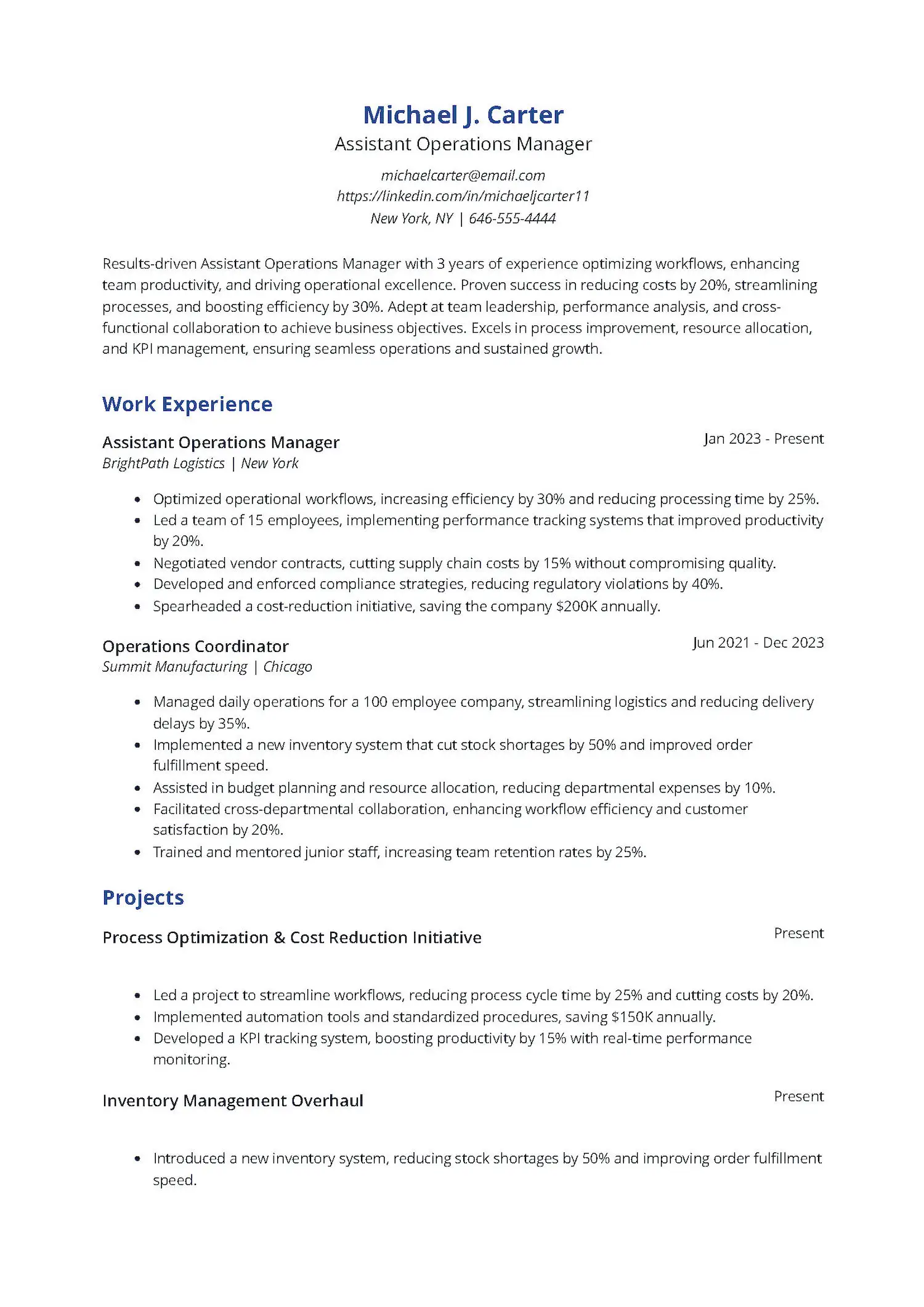
Looking to land an assistant operations manager role but not sure how to write the perfect resume? How do you showcase leadership, efficiency, and problem-solving skills in a way that grabs attention? The resume example below is designed to highlight the right mix of experience, achievements, and skills that hiring managers look for.
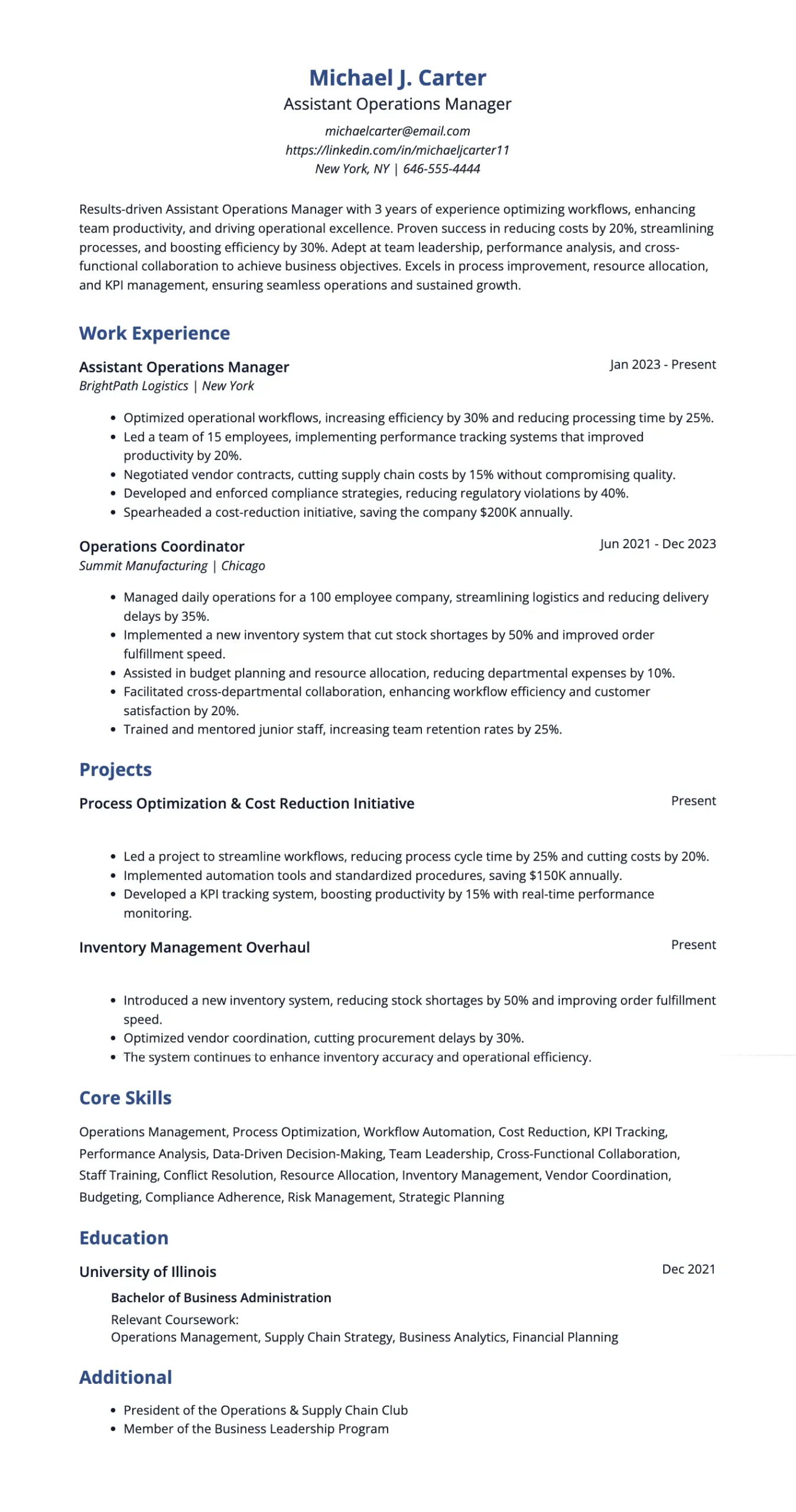
This role calls for someone who can streamline processes, manage teams, and drive operational efficiency. Employers expect candidates to analyze workflows, cut costs, and improve productivity while ensuring smooth daily operations. A strong resume should demonstrate measurable results, leadership experience, and the ability to make data-driven decisions.
This resume stands out with strong action verbs like optimized, spearheaded, and implemented, making each bullet point results-driven and impactful. It clearly shows value by quantifying achievements like cost savings and efficiency improvements. The clean layout ensures easy readability, helping employers quickly grasp key strengths. With a mix of clear structure and measurable success, this resume effectively showcases leadership and operational expertise.
Senior operations manager resume example
Looking to land a senior operations manager role but unsure how to showcase your experience? How do you highlight leadership, efficiency, and cost-saving strategies in a way that grabs an employer’s attention? This resume example does just that—structured, results-driven, and tailored to what hiring managers want to see.

This role demands strong leadership, strategic planning, and the ability to optimize processes for maximum efficiency. Companies expect candidates to drive cost reductions, improve workflows, and lead teams toward operational excellence. If you’re aiming for this position, your resume should clearly demonstrate measurable impact and proven success in managing operations at scale.
The projects section adds depth, showcasing leadership in automation and cost reduction, like streamlining procurement to save $1.2M annually. A clear structure highlights problem-solving, efficiency gains, and strategic execution. Strong leadership experience, cross-functional collaboration, and data-driven decision-making make it appealing to employers looking for someone to scale operations and drive growth.
DevOps resume example
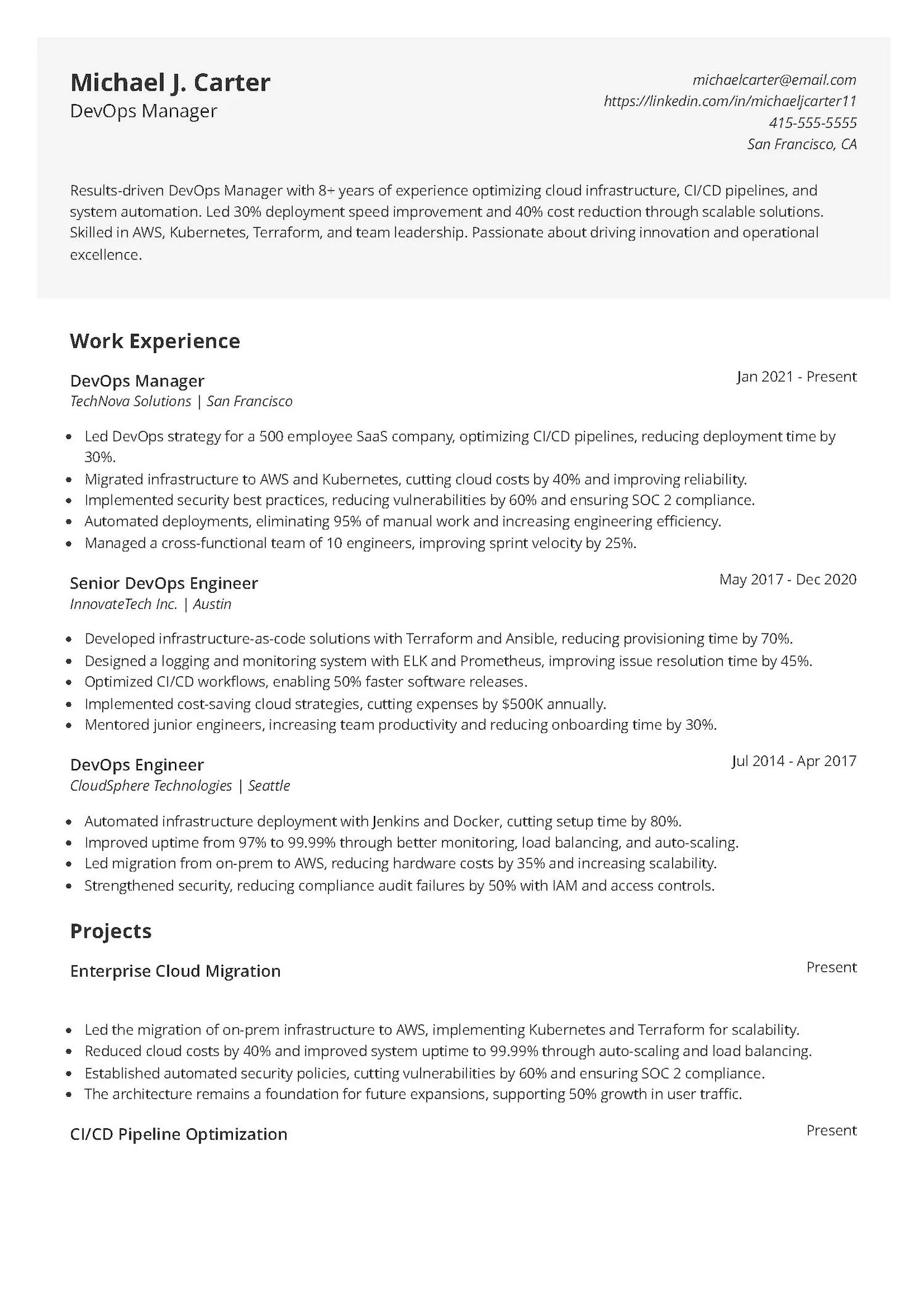
Struggling to write a resume that gets noticed? Wondering how to highlight your DevOps skills in a way that impresses recruiters? This DevOps Manager resume example shows exactly how to showcase your experience, achievements, and technical expertise to land interviews.

A DevOps Manager role demands a mix of technical know-how and leadership. Employers look for expertise in cloud infrastructure, automation, CI/CD, and security, along with the ability to lead teams and optimize workflows. Your resume should highlight measurable results—like faster deployments, cost savings, or improved system reliability—to prove your impact.
Strong action verbs like led, optimized, implemented, and automated make each achievement clear and impactful. The bullet points are concise, results-driven, and easy to skim—perfect for busy recruiters. Plus, the well-structured layout, with clear sections for skills, experience, and projects, ensures key information stands out. This makes it effortless for employers to see the candidate’s expertise in DevOps management and system automation.
IT operations manager resume example
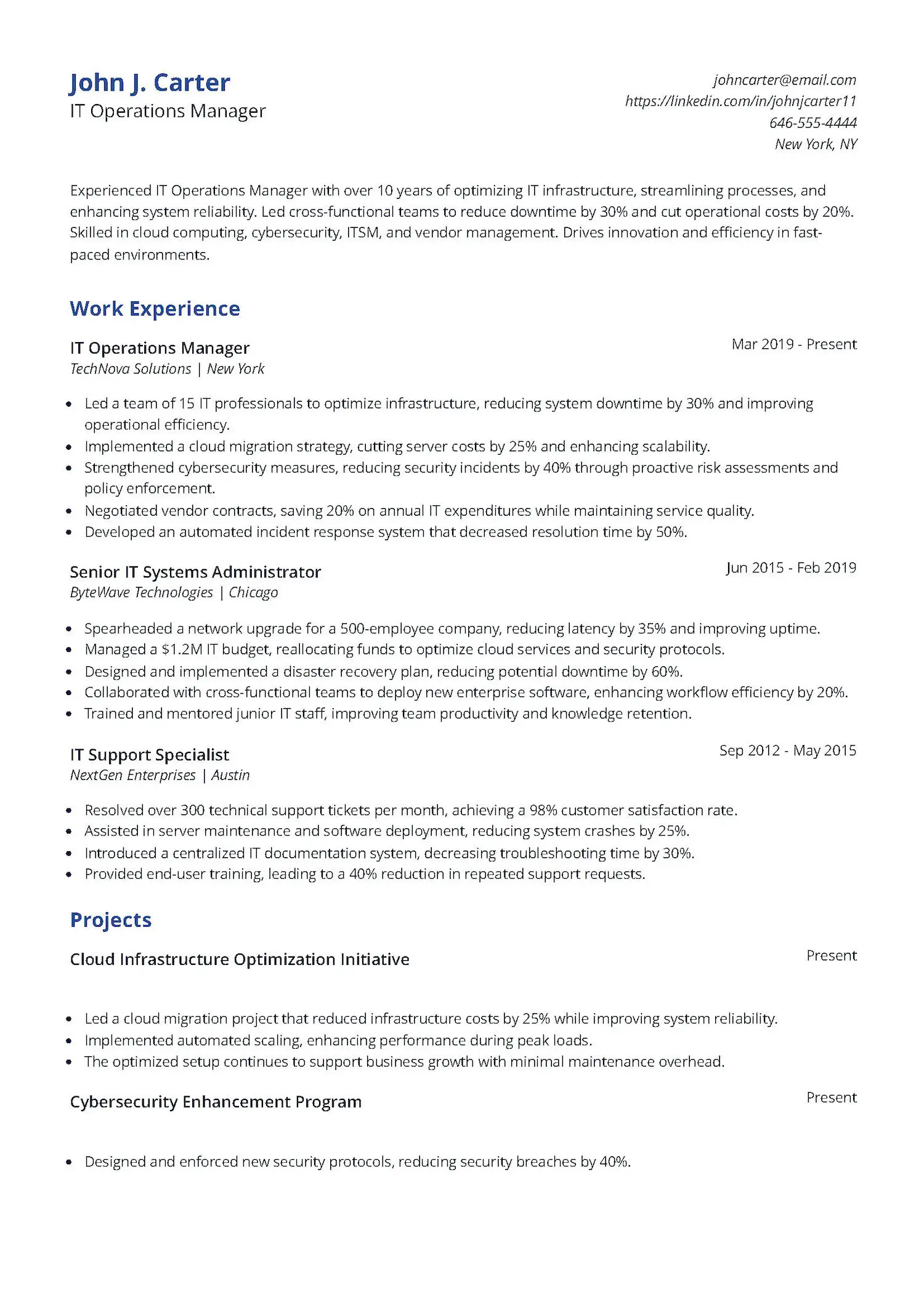
Want to create a strong IT operations manager resume that sets you apart? Wondering how to highlight your leadership skills, technical expertise, and measurable impact? This resume example showcases a proven track record in optimizing IT infrastructure, enhancing cybersecurity, and leading high-performing teams—all key to landing your next role.
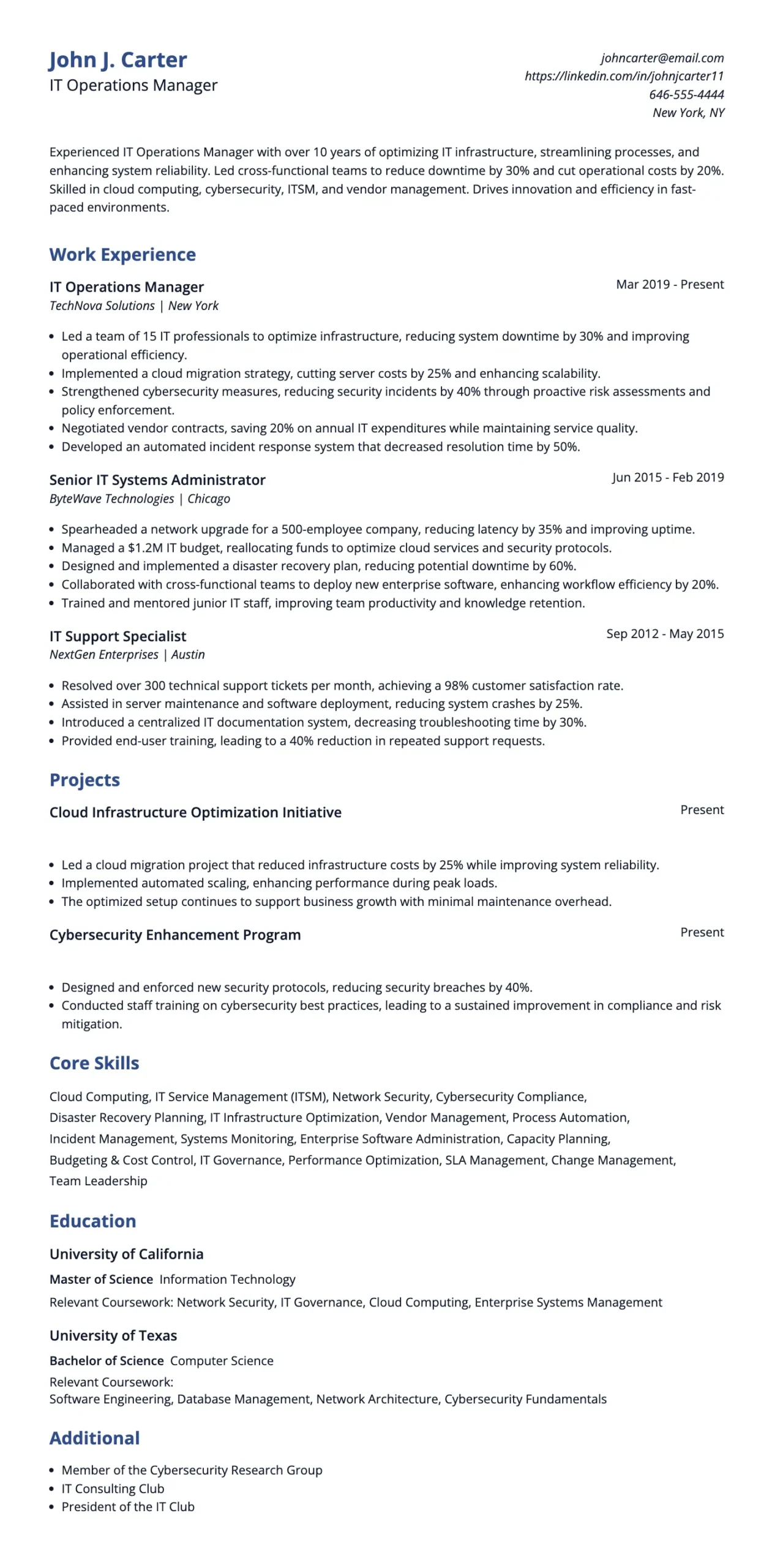
IT operations managers are expected to ensure smooth IT operations, reduce downtime, and improve system efficiency. Employers look for candidates who can lead teams, manage budgets, implement new technologies, and drive cost-saving initiatives. Your resume should highlight achievements, technical skills, and leadership qualities that prove you can handle the demands of this role.
The education section strengthens the resume by showcasing a solid foundation in IT and business administration. Honors and extracurriculars further highlight dedication and leadership. The work experience section demonstrates clear career progression, moving from IT Support Specialist to IT operations manager. Employers value this steady growth, as it reflects adaptability, expertise, and a track record of success.
Director of operations resume example
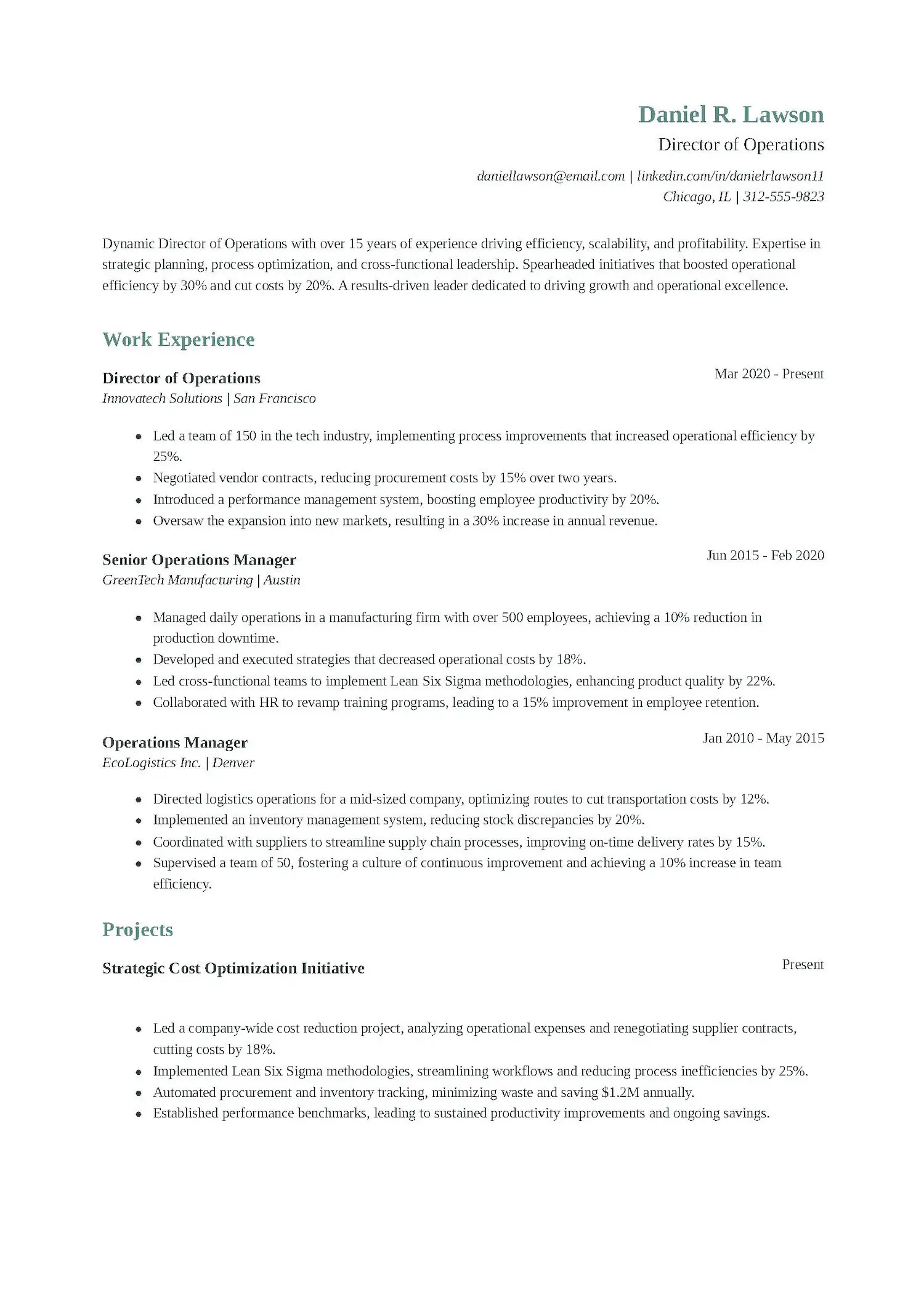
Trying to land a director of operations role but unsure how to showcase your impact? Struggling to highlight achievements in efficiency, cost savings, and leadership? This director of operations resume example shows exactly how to present measurable results, key skills, and career achievements to stand out.
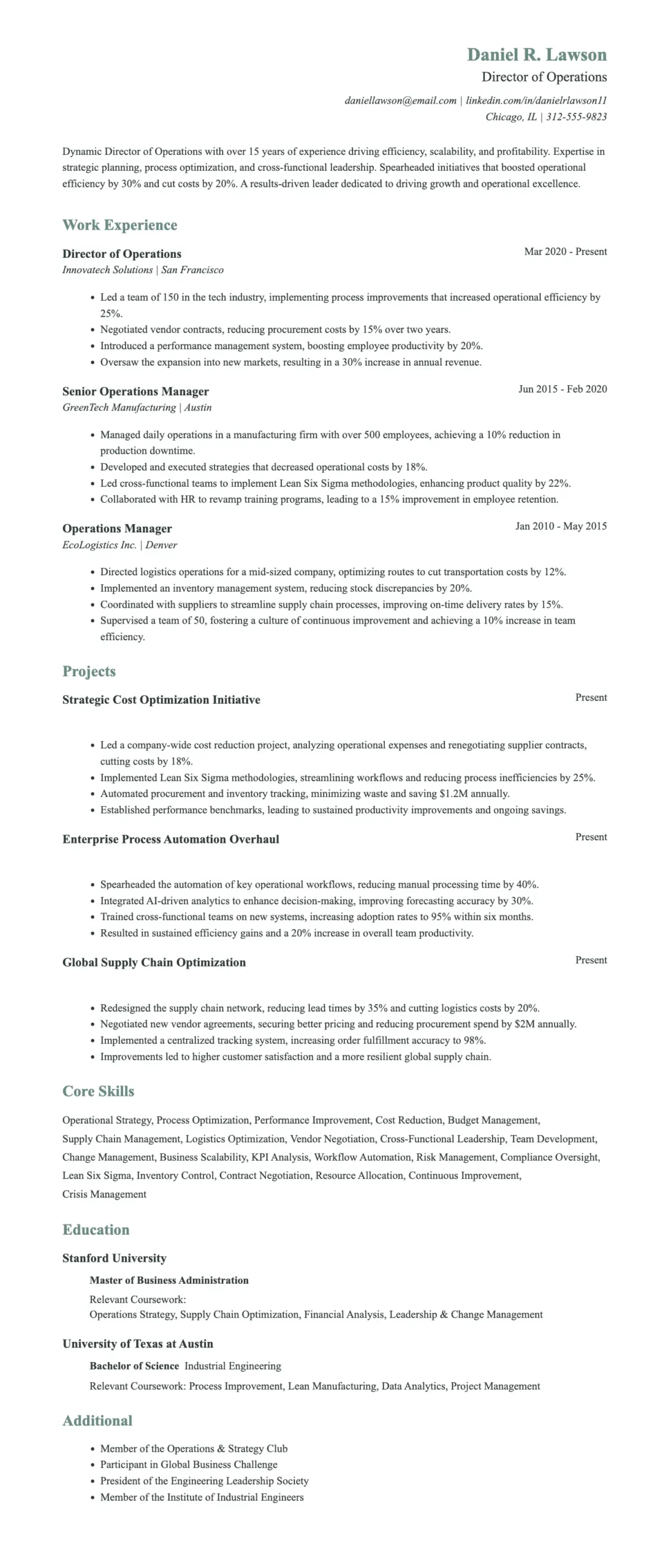
This role requires a leader who can streamline processes, optimize supply chains, and drive profitability. Employers expect candidates to demonstrate strong strategic planning, team leadership, and problem-solving abilities. A well-structured resume with clear accomplishments is key to making a strong impression.
This resume opens with a strong professional summary that immediately highlights years of experience, key skills, and measurable achievements. It sets the tone by emphasizing expertise in efficiency, cost reduction, and team leadership. Each role includes quantifiable results, like reducing costs by 18% and increasing revenue by 30%, making the candidate’s impact clear. The well-structured core skills section groups related abilities for easy reading. Strategic projects showcase leadership in solving business challenges, and the clean, professional format ensures hiring managers can quickly spot key qualifications.
How to write an operations manager resume that will get you an interview
An operations manager plays a crucial role in ensuring business efficiency, overseeing processes, and optimizing productivity. To land an interview, your resume needs to highlight your leadership skills, problem-solving abilities, and experience in streamlining operations.
Most companies use Applicant Tracking Systems (ATS) to streamline their hiring process. Think of ATS as a search engine for job applications—recruiters enter specific keywords to find the best candidates. The system scans resumes for relevant terms, formatting, and overall alignment with the job description. If your resume doesn’t include the right keywords or closely match the job requirements, it may not reach a hiring manager.
For example, if a company is hiring an operations manager, recruiters might look for terms like “process optimization,” “supply chain management,” “budgeting,” “team leadership,” or “workflow improvement.” Including these keywords increases your chances of getting noticed, while omitting them could cause your application to be overlooked.
How ATS works:
- Job posting setup: Employers define job titles, required skills, and qualifications.
- Resume scanning: The system analyzes resumes to identify relevant details.
- Searchable database: Hiring managers search for candidates using keywords or review ranked results.
Not sure how to optimize your resume? Jobscan’s free ATS resume builder is a free tool that helps job seekers create ATS-friendly resumes by incorporating the right keywords and effectively showcasing their skills. Try it today!

Key elements of an operations manager resume
A strong resume should include:
- Contact details – Your name, phone number, professional email address, and LinkedIn profile.
- Professional summary – A brief yet compelling overview of your experience and skills.
- Core competencies – A list of key skills relevant to the role, such as process improvement, budget management, resource allocation and team leadership.
- Work experience – Instead of simply listing job duties, give detailed job descriptions (including company names and years of experience) showcasing your achievements and impact in previous roles.
- Education & certifications – Relevant degrees or certifications that support your qualifications.
- Metrics & achievements – Quantifiable results that demonstrate your effectiveness as an operations manager.
Write a strong professional summary
Your professional summary is the first thing recruiters see, so it must be impactful. This section should highlight your most relevant experience, key skills, and achievements in 3-5 concise sentences.
Here are some examples of both good and bad resume summaries:
Good examples of a resume summary
- “Results-driven operations manager with 8+ years of experience optimizing business processes, reducing costs, and leading cross-functional teams. Proven ability to enhance efficiency, implement innovative solutions, and drive operational success. Adept at managing budgets, improving workflows, and fostering a culture of continuous improvement.”
- “Strategic and analytical Business operations manager with a track record of reducing operational costs by 20% and increasing productivity through process automation. Skilled in supply chain management, team leadership, and performance optimization. Passionate about developing scalable solutions to improve business performance.”
Bad examples of a resume summary
- “I am an experienced operations manager looking for a new job where I can use my skills. I have worked in different industries and know a lot about business operations.”
- “Hardworking and dedicated professional with strong organizational skills. Looking for a challenging role in a good company.”
Jobscan’s resume summary generator creates powerful professional summaries by examining job descriptions and recommending tailored, keyword-rich content. It customizes your summary to emphasize key skills, experience, and accomplishments, helping you stand out to hiring managers and pass ATS scans. This tool simplifies writing a compelling and concise introduction.
Demonstrate key operations manager skills
To stand out, your resume should highlight a balance of hard and soft skills that demonstrate your ability to optimize operations, lead teams, and drive business success.
Hard skills for an operations manager
Hard skills are technical abilities that can be measured and learned. Essential hard skills for an operations manager include:
- Process Improvement
- Project Management (Agile, Lean, Six Sigma)
- Budget Management
- Supply Chain & Logistics Management
- Inventory & Resource Planning
- Data Analysis
- Reporting
- Compliance
- Risk Management
Soft skills for an operations manger
Soft skills reflect how you interact with teams, solve problems, and lead initiatives. Important soft skills for an operations manager include:
- Communication Skills
- Conflict Resolution
- De-Escalation
- Problem-Solving
- Analytical Thinking
- Time Management
- Task Prioritization
- Team Collaboration
- Cross-Functional Coordination
- Customer Engagement
- Relationship-Building
To write a compelling operations manager resume, emphasize both your strategic leadership and process optimization skills in your bullet points. Instead of just listing job responsibilities, focus on showcasing your impact, efficiency improvements, and measurable business outcomes. Below are examples of strong and weak resume bullet points.
4. Write impactful resume bullet points for operation manager
Good examples of resume bullet points
- “Implemented a new inventory management system, reducing stock shortages by 30% and improving supply chain efficiency.”
- “Led a cross-functional team of 15, increasing productivity by 25% through process automation and streamlined workflows.”
- “Developed cost-reduction strategies that saved the company $500K annually without compromising operational efficiency.”
Bad examples of resume bullet points
- “Managed operations and ensured customer satisfaction.”
- “Led a team and handled various tasks.”
- “Responsible for improving processes in the company.”
Need strong resume bullet points? Jobscan’s resume bullet point generator can help you create impactful, ATS-friendly statements that emphasize your achievements. This tool ensures your bullet points are results-driven, effectively showcasing your skills and making your resume stand out.
Highlight your achievements as an operations manager
Recruiters look for measurable impact when reviewing resumes. Instead of just listing responsibilities, focus on how you improved processes, optimized efficiency, or contributed to business growth.
Here are examples of some strong achievement-based statements:
- “Increased operational efficiency by 30% through process automation and workflow improvements.”
- “Reduced costs by $500K annually by renegotiating vendor contracts and optimizing supply chain logistics.”
- “Led a team of 20+ employees, improving performance and reducing turnover by 15%.”
- “Streamlined inventory management, cutting stock shortages by 40% and reducing excess inventory costs.”
- “Implemented data-driven decision-making strategies, leading to a 25% increase in productivity.”
By emphasizing measurable achievements, you make your resume more impactful and appealing to hiring managers.
Tailor your resume to the job description
Customizing your resume for each job application increases your chances of landing an interview. Align your experience, skills, and achievements with the employer’s specific requirements.
Here’s how you can tailor your resume to the job description:
- Analyze the job posting – Identify key skills, qualifications, and responsibilities mentioned in the job description.
- Use relevant keywords – Incorporate industry-specific terms and phrases from the job listing to pass applicant tracking systems (ATS).
- Highlight matching skills – Emphasize hard and soft skills that align with the employer’s needs.
- Showcase relevant achievements – Use quantifiable results that directly relate to the job’s requirements.
- Adjust your professional summary – Make it clear how your expertise fits the role by mirroring key points from the job ad in your resume objective.
- Tailor Your Bullet Points – Highlight key responsibilities and achievements that align with the job posting.
- Optimize for ATS – Use a clean, professional format without excessive styling, images, or unconventional fonts to ensure your resume passes automated screenings.
Include relevant education and certifications
The right education and certifications strengthen your resume and showcase your expertise. List your highest degree with the university name and graduation year (if recent). Highlight relevant, industry-recognized certifications that reflect specialized knowledge and professional growth in operations management.
Here’s how to effectively highlight your education and certifications as an operations manager:
- Clearly list your degree, major, and institution in a concise format (e.g., Bachelor’s Degree in Business Management, XYZ University).
- If you’re a recent graduate, include your graduation year along with coursework, honors, or projects related to operations, logistics, or business strategy.
- Experienced professionals should prioritize higher education degrees and certifications directly relevant to operations, process improvement, and leadership.
- If you’re transitioning into an operations management role, highlight coursework or degrees related to business operations, supply chain management, or organizational leadership.
- Certifications that enhance efficiency, project management, and leadership can strengthen your resume. Consider industry-recognized credentials like Lean Six Sigma, PMP (Project Management Professional), or CPIM (Certified in Production and Inventory Management).
- If you have expertise in ERP systems, supply chain analytics, or team management, include certifications such as Certified Supply Chain Professional (CSCP), Scrum Master, or APICS certifications to reinforce your qualifications.
- For professionals with extensive experience, focus on high-impact certifications that demonstrate expertise in operational efficiency and strategic management rather than listing every training program.
Top office assistant certifications
Earning certifications can enhance your skills and boost your credibility. Here are some of the most valuable ones:
- Certified Supply Chain Professional (CSCP)
- Project Management Professional (PMP)
- Lean Six Sigma (Green Belt/Black Belt)
- Certified Operations Manager (COM)
- Certified in Production and Inventory Management (CPIM)
- Certified Manager (CM) Certification
Operations manager resume tips
Writing a strong operations manager resume is essential for securing an operations manager position. Highlight your leadership, strategic planning, and process optimization skills to showcase your ability to drive efficiency and operational success. Here are some key tips to help you create a compelling resume:
- Keep it concise: Aim for a one- to two-page resume that focuses on relevant experience and achievements. Avoid unnecessary details that don’t add value.
- Use action verbs: Start bullet points with strong action verbs like “Implemented,” “Optimized,” or “Led” to clearly convey your impact and leadership.
- Quantify your achievements: Whenever possible, include numbers to highlight your success. Metrics like cost savings, efficiency improvements, or productivity increases make your accomplishments more compelling.
- Tailor your resume: Customize your resume for each job application by aligning your skills and experience with the job description. Using relevant keywords helps pass applicant tracking systems (ATS).
- Format for readability: Use clear headings, bullet points, and a professional font to ensure recruiters can quickly scan your resume and find key information.
- Optimize for ATS: Many companies use ATS to filter resumes. Incorporate industry-specific keywords and phrases from the job posting to improve your chances of getting through.
- Proofread carefully: Spelling and grammar errors can make a bad impression. Review your resume multiple times and consider using a tool like Grammarly to catch mistakes.
Also Read: How to Organize Your Resume Sections to Stand Out?
Include a cover letter with your operations manager resume
A well-written cover letter can strengthen your job application by providing context for your resume and showcasing your enthusiasm for the role.
What to include in your cover letter:
- Introduction – Briefly state the position you’re applying for and express enthusiasm.
- Key qualifications – Highlight your most relevant skills and achievements related to operations management.
- Company alignment – Show how your experience aligns with the company’s goals and values.
- Call to action – End with a strong closing statement, expressing interest in an interview.
Writing a personalized, ATS-friendly cover letter can be simple. With Jobscan’s cover letter generator, you can quickly create a compelling cover letter tailored to the job description. Try it today!
Build a powerful operations manager resume with Jobscan
A well-structured operations manager resume should effectively highlight your leadership abilities, process improvement expertise, and measurable achievements. You can make a strong impression in a competitive job market by tailoring your content to emphasize key skills and industry-specific experience. Customizing your resume for each application ensures it aligns with the job description and meets applicant tracking system (ATS) requirements, increasing your chances of getting noticed.
Jobscan’s ATS resume makerresume builder simplifies this process. This free tool helps you write unlimited ATS-friendly resumes, offering personalized skill suggestions and formatting guidance to enhance your chances of securing interviews. Try it today and take the next step in your Operations Manager career!

Operations manager common interview questions
Answer:
“In my previous role, I identified bottlenecks in the supply chain and implemented a process automation system that reduced delays by 30%. By analyzing workflow data and training staff on efficiency best practices, we improved overall productivity and reduced operational costs by $500K annually.”
Answer:
“I believe in proactive communication and addressing conflicts early. In one instance, two department leads had differing priorities that were causing delays. I facilitated a meeting to align their goals and implemented a workflow adjustment that improved collaboration. As a result, project turnaround times improved by 20%.”
Answer:
“I analyze financial reports to identify inefficiencies, negotiate better vendor contracts, and implement lean processes. In my last role, I introduced data-driven decision-making, which led to a 15% reduction in overhead costs without compromising quality or service levels.”
Answer:
“I focus on clear goal-setting, regular feedback, and professional development opportunities. At my last company, I introduced an incentive program that recognized top-performing employees, which increased overall team productivity by 25% and reduced turnover by 10%.”
Operations manager resume frequently asked questions
The most crucial skills to highlight include process optimization, budget management, supply chain coordination, warehouse operations, quality control, sales operations, data analysis, project management (Lean, Six Sigma, or Agile), and leadership. Additionally, emphasize soft skills like strategic decision-making, communication, workforce management and problem-solving to showcase your ability to lead teams and drive efficiency.
List your highest degree, including the degree name, university, and graduation year (if recent). If you have relevant certifications such as PMP, Lean Six Sigma, or CSCP, include them in a separate certifications section to further strengthen your qualifications. If you’re a recent graduate, you can also mention coursework or projects relevant to operations management.
If you’re transitioning into operations management, focus on transferable skills from previous roles, such as leadership, process improvement, or project coordination. Use a strong professional summary to highlight relevant professional experience, even if it’s from a different industry. Showcase achievements that demonstrate your ability to manage teams, optimize workflows, or reduce costs. If applicable, include certifications, relevant coursework, or internships to support your qualifications.
Pair your resume with a cover letter
A strong job application includes both. Browse our Operations Manager cover letter examples to write a cover letter that complements your resume.