Best Retail Resume Examples for 2026
A strong retail resume turns shifts into results: sales, service, and store impact. See 2026 retail resume examples plus the skills and ATS keywords that get interviews.



Retail roles run the store: you sell, serve customers, handle the register, restock the floor, and keep things moving during the busiest hours. Whether you are working the floor, leading a team, or shaping how the store looks, the job rewards people who can balance customer experience with hitting numbers. Your resume has to prove you do both, not just that you showed up for your shifts.
Hiring managers skim a retail resume for evidence you can sell and keep customers happy under pressure. They look for results: sales you drove, conversion or units-per-transaction you lifted, shrink you reduced, or teams you trained. Before a person ever reads it, though, many retailers run resumes through an applicant tracking system that scans for the right terms, like POS systems, loss prevention, visual merchandising, inventory management, and the exact role title from the posting. A resume that clears the ATS and leads with concrete outcomes is what earns the call.
The examples below show how retail professionals present their experience at every level, from the sales floor to store leadership to merchandising. Use them as a starting point, then run your own resume through Jobscan to match it against the job description and catch the keywords you are missing before you apply.
Ready to build yours? Try our ATS-friendly resume builder or scan your draft against the job description.
Retail resume example
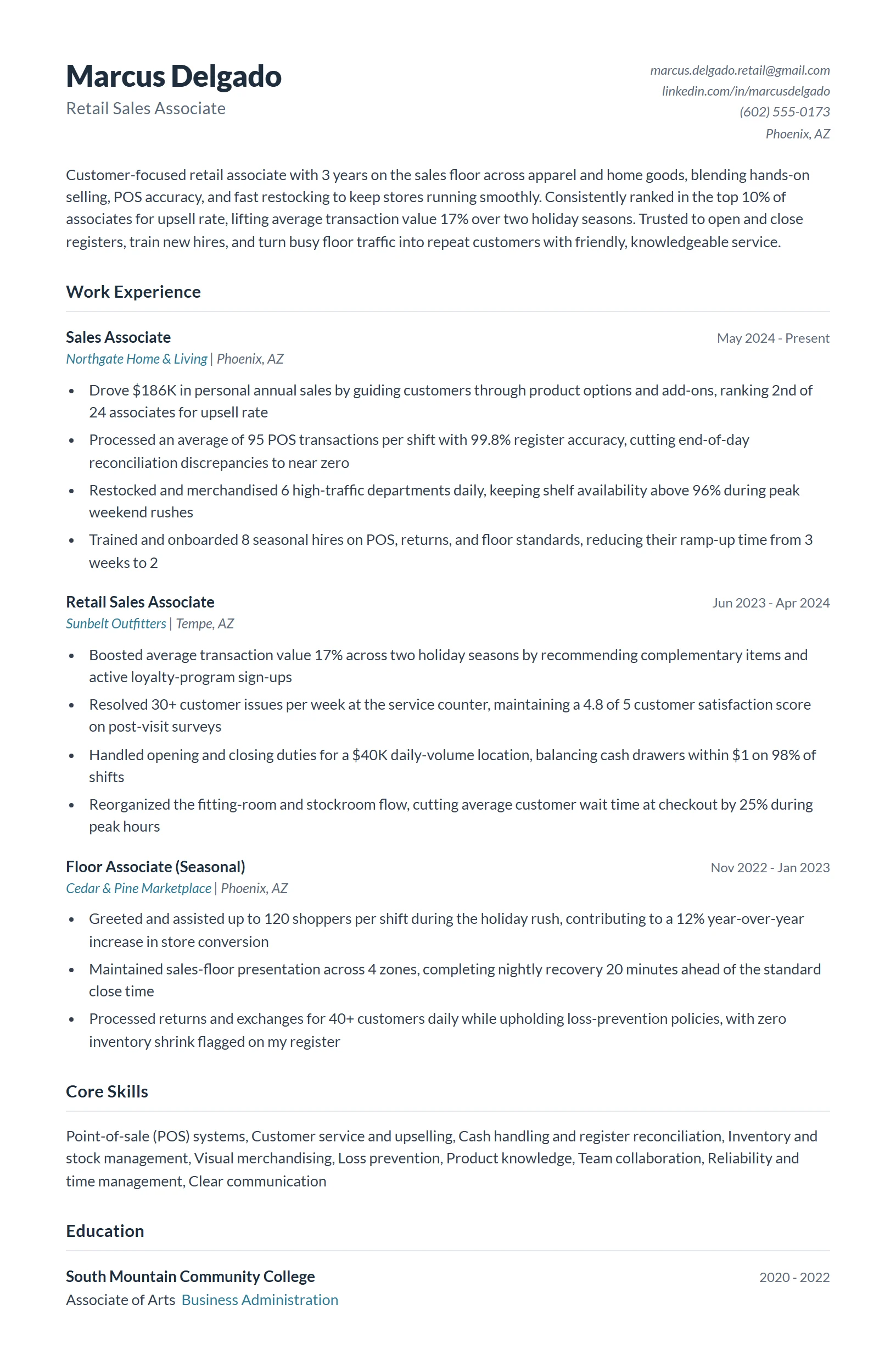
Not sure how to make a string of retail shifts read like real accomplishments? This retail resume example shows how to turn everyday floor work into proof you can sell and serve.
This resume works because it reframes routine duties as outcomes: hitting sales goals, lifting units per transaction, and keeping customer satisfaction high during peak hours. It leads with a skills section that surfaces the ATS keywords retailers scan for, like POS systems, cash handling, customer service, and inventory, then backs them with experience that quantifies the impact. A clean, single-column layout keeps it easy for both a busy hiring manager and the ATS to read.
Retail Manager resume example
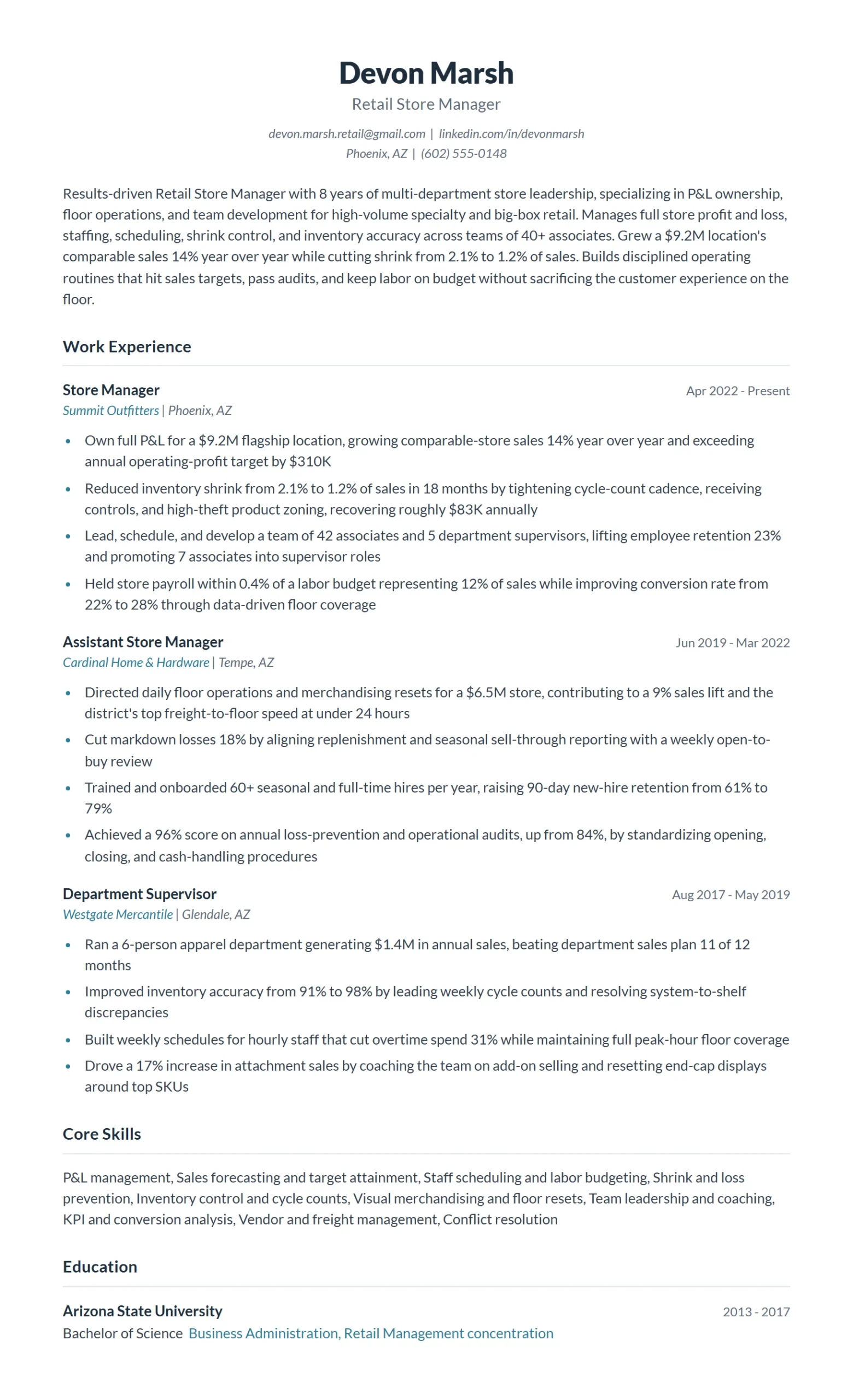
Moving into retail management means proving you can run the floor and the numbers, not just work a shift. This retail manager resume example shows how to frame sales results, team leadership, and store operations.
This resume works because it centers store performance: revenue growth, shrink reduction, and labor managed against targets. It shows leadership through teams hired, trained, and scheduled, and it pairs each responsibility with a measurable result so seniority is obvious. Operations keywords like inventory management, loss prevention, and KPI reporting keep it visible to the ATS while signaling you can own a store.
Store Manager resume example
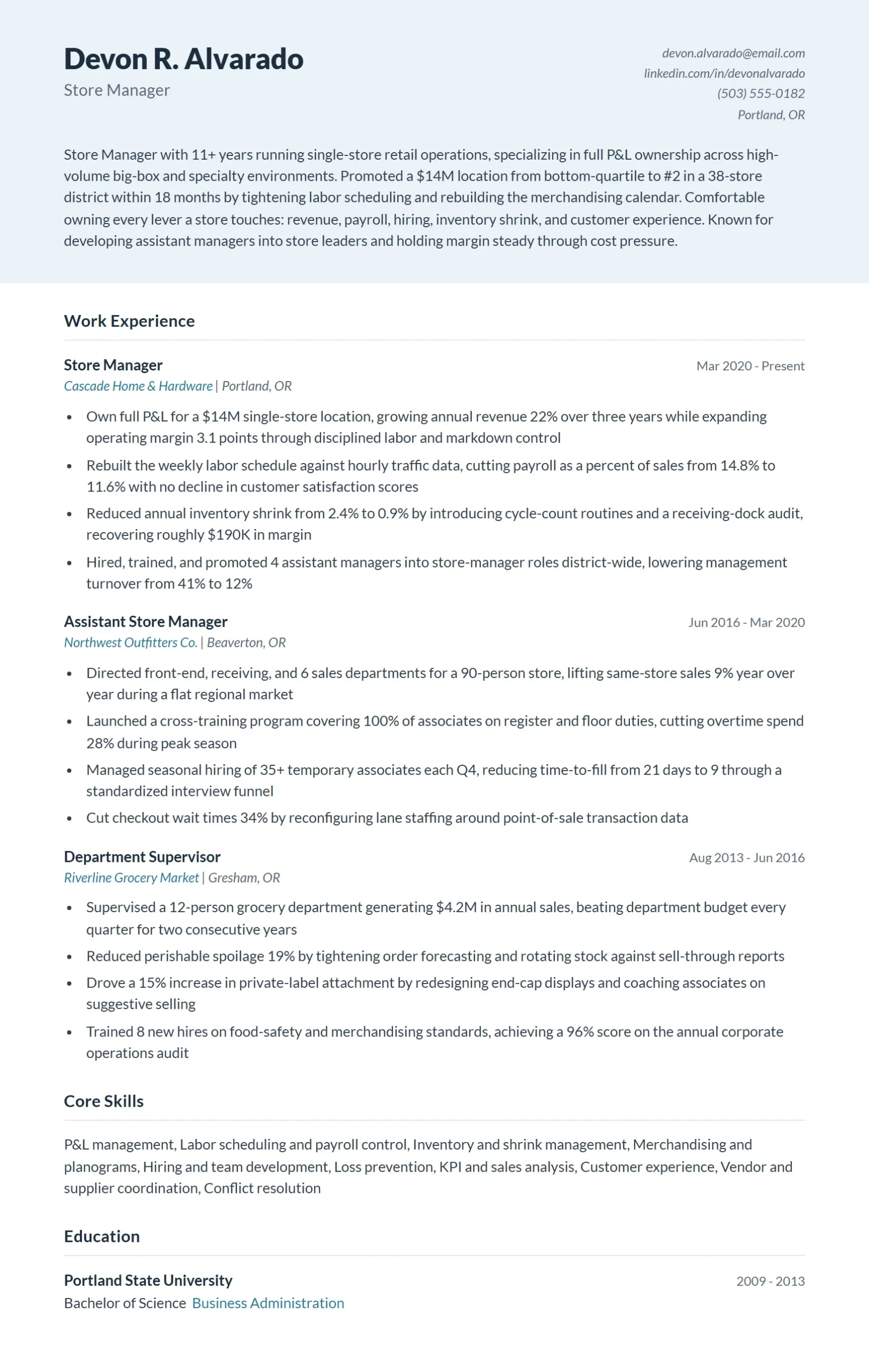
A store manager owns the whole building, from the P&L to the people. This store manager resume example shows how to present full-store responsibility and the results that come with it.
This resume works because it leads with scope and impact: annual revenue managed, payroll and staffing decisions, and year-over-year growth across departments. It frames you as an operator who balances customer experience, profitability, and team development rather than someone who simply supervises shifts. Quantified outcomes plus leadership and P&L keywords prove the seniority a store manager title demands, to both the ATS and the regional team reading it.
Assistant Store Manager resume example
Stuck between sales associate and store manager and ready to show you can lead? This assistant store manager resume example shows how to highlight supervisory work and readiness for the next step.
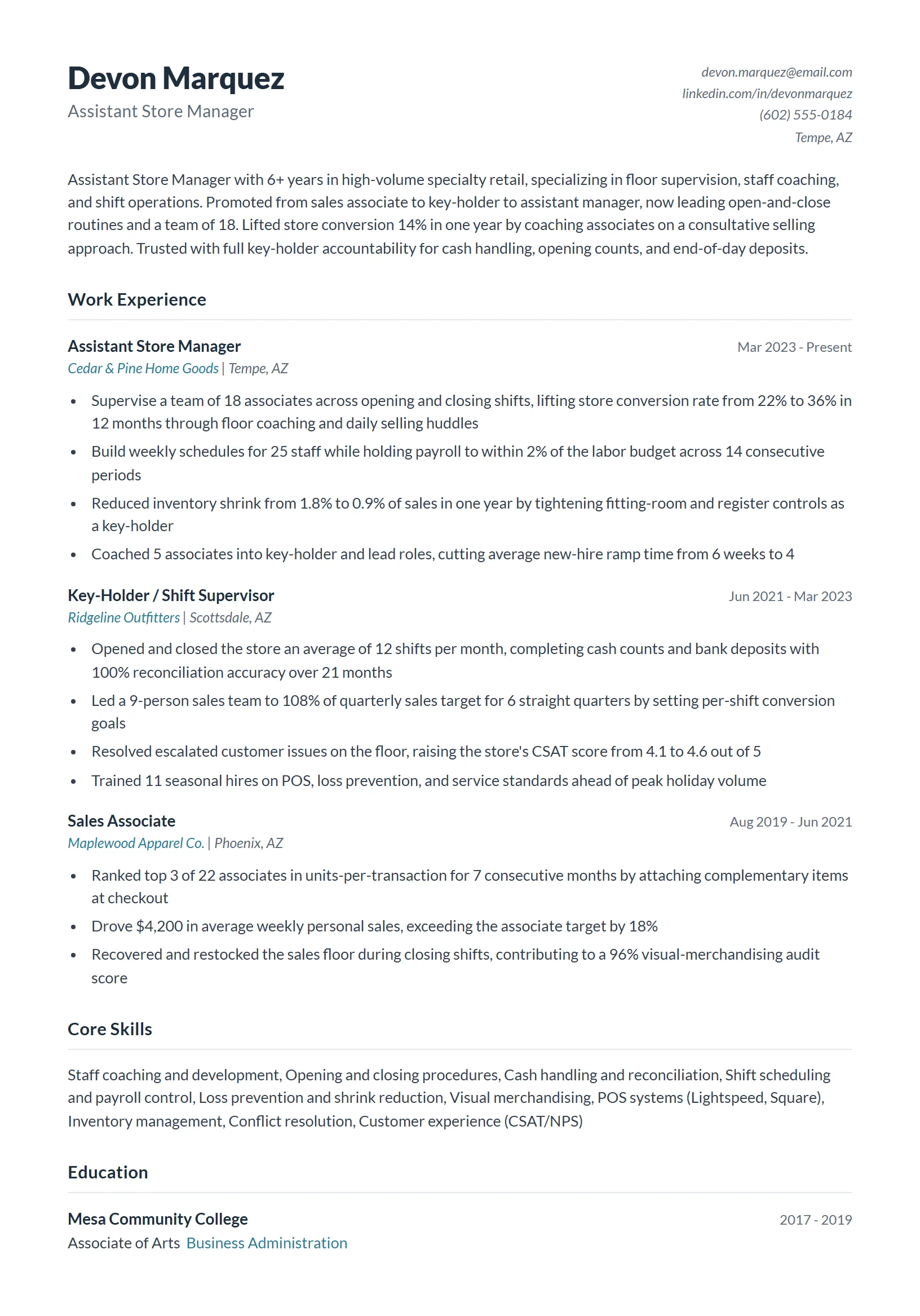
This resume works because it spotlights the in-between responsibilities that signal promotion readiness: opening and closing, key-holder duties, coaching new hires, and covering for the manager. It quantifies the floor results you helped drive and frames each task as a leadership skill, not just a chore. Supervisory keywords like scheduling, team training, and cash reconciliation keep it ATS-friendly while making the case that you are ready to run a store.
Retail Sales Associate resume example
When the job is all about the sale, your resume has to prove you can close. This retail sales associate resume example shows how to highlight selling skills and customer results for retail-specific roles.

This resume works because it foregrounds selling: meeting or beating sales targets, building add-on and upsell habits, and earning repeat customers through product knowledge. It mirrors the language of retail job descriptions, pairing customer service and POS with consultative selling and loyalty sign-ups. Leading with quantified sales numbers and the right keywords makes it read as a closer to both the ATS and the hiring manager.
Visual Merchandiser resume example
Visual merchandising roles are won on presentation and sales lift, not just an eye for display. This visual merchandiser resume example shows how to connect your creative work to store results.

This resume works because it ties design decisions to outcomes: window and floor displays that lifted sales, planograms executed across locations, and brand standards maintained at scale. It blends creative skills with commercial proof, showing you understand that good displays exist to sell. Merchandising-specific keywords like planograms, visual standards, and seasonal resets make it read as a specialist to the ATS while the quantified results win over the hiring team.
How to write a Retail resume that gets interviews
Retail hiring moves fast and managers screen for two things: can you sell, and can you keep the floor running. A wall of duties (“helped customers,” “operated register”) tells them neither. They want proof you hit sales targets, kept shrink down, and showed up when the schedule needed you. Most mid-size and corporate retailers also run resumes through an Applicant Tracking System (ATS) first, so your language has to mirror the job posting before a hiring manager ever reads it. The tips below help you do both: clear the ATS scan and convince the store or district manager reading next.
- Lead with sales numbers, not duties: Retail is a numbers business, so put yours up front. Replace “responsible for sales” with what you actually moved: “exceeded monthly sales goal by 18% for 6 straight months,” “ranked top 3 of 24 associates in units per transaction,” or “drove $420K in annual personal sales.” If you do not know your exact figures, estimate honestly from what you do know (daily averages, target percentages, store rank). A quantified associate beats a vague one every time.
- Use the metrics retailers actually track: Speak the language of the floor: conversion rate, average transaction value (ATV), units per transaction (UPT), sales per hour, attachment or add-on rate, shrink and inventory accuracy, and customer satisfaction or mystery-shop scores. A bullet like “raised UPT from 1.8 to 2.4 by coaching add-on selling” signals you understand how a store makes money, which is exactly what separates a future keyholder or manager from a cashier.
- Show customer service with outcomes, not adjectives: Everyone claims “excellent customer service.” Prove it instead: “maintained a 96% customer satisfaction score across 400+ monthly transactions,” “resolved escalated complaints with a 90% first-contact resolution rate,” or “earned 15 positive customer callouts in a quarter.” Tie service to a number a manager cares about (repeat business, loyalty sign-ups, review scores) so it reads as results, not personality.
- Match keywords and systems to the job posting: The ATS scans for specific terms. List the POS systems you have used (Square, Shopify POS, Lightspeed, Clover, NCR) and the responsibilities named in the posting: loss prevention, visual merchandising, planograms, inventory management, cash handling, opening and closing, scheduling. If the role says “loss prevention” and you reduced shrink, use that exact phrase. List real systems and skills only; recruiters spot keyword stuffing.
- Quantify the scale you have operated at: Context makes your experience credible. Note store volume, team size, and traffic: “high-volume location averaging $2M annually,” “supported a team of 12 associates,” or “handled 200+ transactions per shift during peak holiday season.” An associate from a $50K-day flagship and one from a quiet boutique are evaluated very differently, so give the manager the scale to judge you fairly.
- Tailor to the role and keep the format ATS-clean: A cashier role, a sales associate role, and a keyholder or assistant manager role reward different keywords. Reorder your skills and swap your headline wins to mirror each posting (cash accuracy for cashier, sales and upselling for associate, scheduling and shrink for keyholder). Then keep parsing clean: standard section headings, a single column, no text boxes or graphics that scramble the ATS. Run it through Jobscan to check your match rate against the job description before you apply.

Retail resume summary examples
Your summary is the first thing a recruiter reads. Lead with your specialty, years of experience, and a quantified win.
Good retail resume summary examples
- Results-driven retail sales associate with 5+ years in high-volume apparel and electronics. Exceeded monthly sales goals by an average of 17% and ranked top 3 of 28 associates in units per transaction. Skilled in POS operations, upselling, and loss prevention, with a consistent 95%+ customer satisfaction score.
- Customer-focused retail keyholder with 4 years progressing from associate to shift lead at a $2.5M-volume store. Cut shrink 1.2 points through tighter inventory controls and trained 10+ new hires on POS and service standards. Known for opening and closing a clean, compliant floor and hitting daily sales targets.
- Sales associate specializing in attachment selling and customer loyalty in big-box retail. Drove a UPT increase from 1.9 to 2.5 and signed up 40+ loyalty members per month, the highest on the team. Reliable in fast-paced, high-traffic environments and cross-trained across register, stockroom, and floor.
What to avoid
- Hardworking team player looking for a retail position where I can use my skills and grow with a great company. (It is about what the candidate wants, not what they deliver. There is no sales record, no metrics, no systems, and no specialty. A store manager learns nothing they can act on or compare against other applicants.)
- Friendly and reliable associate with great customer service and a passion for helping people. (Pure adjectives with no proof. “Friendly” and “great customer service” are claims anyone can make. It names no metric (sales goal, satisfaction score, UPT), no POS system, and no result, so the ATS and the manager both skim past it.)
Retail resume skills
Pull the exact systems and responsibilities from each job posting (the POS named, loss prevention, merchandising) and mirror that wording here. Keep this to your strongest, role-relevant skills; it is a quick resume snapshot, not a full skills inventory.
Hard skills for a retail resume
- POS Systems (Square, Shopify POS, Clover)
- Cash Handling & Reconciliation
- Visual Merchandising
- Inventory Management
- Loss Prevention
- Upselling & Cross-Selling
- Product Knowledge
- Stock Replenishment
- Customer Loyalty Programs
- Opening & Closing Procedures
Soft skills for a retail resume
- Customer Service
- Communication
- Teamwork
- Reliability
- Problem Solving
- Time Management
Retail resume work experience bullet point examples
Lead each bullet with a strong verb and a measurable result.
Good bullet point examples
- Exceeded monthly sales targets by an average of 18% over 12 months, finishing the year as the #2 associate of 26 in total personal sales.
- Increased units per transaction from 1.8 to 2.4 by coaching add-on and accessory selling, contributing an estimated $90K in incremental annual revenue.
- Reduced store shrink by 1.5 percentage points in one year through tighter cash-handling, fitting-room, and inventory-audit procedures.
- Trained and onboarded 12 new associates on POS, merchandising standards, and loss prevention, cutting average ramp time from 3 weeks to 2.
Bad bullet point examples
- Responsible for helping customers and operating the cash register. (“Responsible for” describes a duty, not an achievement. It lists routine tasks with no scale, no accuracy figure, and no result. Lead with a strong verb and a number, such as transaction volume or cash-drawer accuracy, instead.)
- Worked on the sales floor and met sales goals. (Vague and unquantified. “Met sales goals” raises the obvious question: by how much, against what target, and ranked where? Replace it with the actual percentage over goal and your standing among peers.)
- Provided excellent customer service to all customers every day. (Subjective filler with no proof. “Excellent” is an opinion, not evidence. Back it with a customer satisfaction score, a mystery-shop result, or repeat-business and loyalty-signup numbers a manager can verify.)
Retail resume tips
A strong retail resume proves you can drive sales and keep operations running smoothly, and these six tips will help yours get past the ATS and impress the hiring manager.
- Mirror Job Posting Keywords: Copy exact phrases from the job description (such as ‘loss prevention,’ ‘visual merchandising,’ or ‘stock replenishment’) into your skills section and bullets, because ATS systems score your resume against those specific terms.
- Quantify Sales Impact: Attach numbers to every sales result you can, for example ‘exceeded monthly upselling target by 22%’ or ‘maintained a $1,200 average transaction value,’ so hiring managers see proof of performance, not just participation.
- Name Your POS Systems: List the specific POS platforms you have used (Square, Shopify POS, Clover) by name rather than writing ‘POS systems,’ because recruiters and ATS filters frequently search for those exact product names.
- Include Shrink and Accuracy Metrics: If you contributed to loss prevention or cash handling, state a measurable outcome such as ‘99.8% cash drawer accuracy over 12 months’ or ‘helped reduce shrink by 15%,’ since these figures signal operational reliability to store managers.
- Tailor for Store Format: Adjust your language to match the retailer’s format (big-box, specialty, luxury, or grocery) by emphasizing the skills each context values most, for instance product knowledge and upselling for specialty retail versus throughput and inventory management for high-volume stores.
- Keep It One Page: Unless you have more than ten years of retail management experience, limit your resume to one page, because retail hiring moves fast and managers reviewing dozens of applications favor concise, scannable documents over lengthy ones.
Pair your retail resume with a cover letter
A strong resume goes further with a tailored cover letter. Browse our cover letter examples to round out your application.
Retail resume frequently asked questions
Focus on transferable skills that retail managers actually hire for: customer service, cash handling, teamwork, reliability, and the ability to stay calm during busy periods. Pull examples from school, volunteering, sports teams, or babysitting and frame them around helping people, hitting goals, or handling money and schedules. Add a short summary that names the role you want (sales associate, cashier) and lead with availability and a strong work ethic, since retail employers weigh dependability heavily for entry-level hires.
Balance customer-facing skills with the operational ones stores rely on every shift. List customer service, point-of-sale (POS) systems, cash handling and register reconciliation, upselling and cross-selling, inventory and stock management, visual merchandising, and loss prevention. Add soft skills like communication, problem-solving, and working under pressure during peak hours. Match the exact terms in the job posting, because an applicant tracking system often scans for things like POS, planogram, or shrinkage word for word.
Retail runs on numbers, so use them to prove your impact. Mention sales figures or percentages (exceeded monthly sales targets by 18 percent), transaction volume (processed 150+ transactions per shift), customer metrics (maintained a 95 percent satisfaction score), or team size and basket size. If you do not have exact figures, give honest estimates of foot traffic, units sold, or shifts covered. Concrete numbers separate you from candidates who only list duties like greeting customers and stocking shelves.
No. A sales associate resume should emphasize customer service, sales results, and reliability, while a retail manager resume needs to show leadership, scheduling, inventory control, P&L or budget responsibility, and team development. Reorder your bullets and rewrite your summary so the most relevant experience sits at the top for each role. Mirror the job title and core responsibilities from each posting so both the hiring manager and the ATS see an immediate fit.
Name the environment directly and back it with specifics. Reference peak periods you worked (Black Friday, holiday season, back-to-school) and the volume you managed, such as long checkout lines, large daily transaction counts, or a high-traffic flagship location. Pair that with results like keeping wait times low, maintaining accuracy under pressure, or covering multiple departments in one shift. Employers want proof you stay composed and productive when the store gets busy.
Many mid-size and large retailers screen applications through an ATS before a human sees them, so formatting matters. Use a clean single-column layout, standard headings (Experience, Skills, Education), and real text instead of icons, columns, or graphics that can get scrambled during parsing. Save it as a .docx or text-based PDF, and include the exact keywords from the job posting like POS, cash handling, or visual merchandising. Scanning your resume against the description with a tool like Jobscan helps confirm the match before you apply.